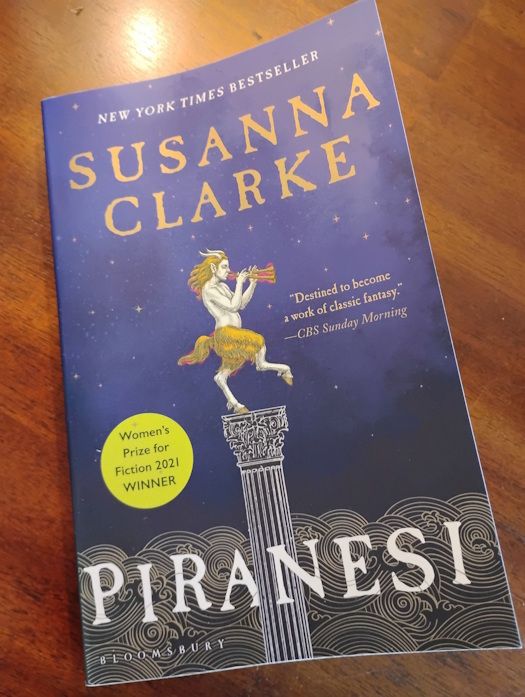
Despite having a copy of Susanna Clarke's Jonathan Strange & Mr. Norrell on my shelf**, I haven't yet read it. Instead it's been sitting there for many years awaiting the day when I pick it up crack it open. However, I did recently finish her latest novel, Piranesi. If memory serves, it was published during lockdown and I heard good things about it at the time. It went onto my to-read list and it took me only a comparatively brief 6 years get it under my belt. Much shorter than Jonathan Strange & Mr. Norrell, it went by quickly as it was filled with allusions and intriguing possibilities.
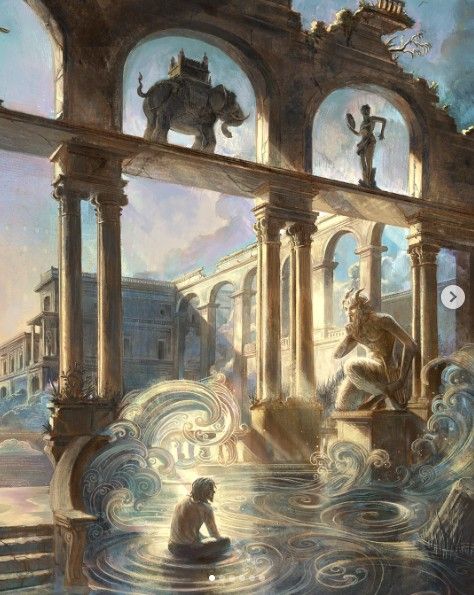
It concerns Piranesi, a man who lives in a place he calls the House which brought House of Leaves to mind as its stretches on into infinity. One hall simply leads to another which, in turn, leads to another and so on. The House has 3 levels: an ocean on the lower floor, clouds in the upper, and Piranesi's home of unending hallways in the middle adorned with an equally infinite array of statues. I don't recall the House's architecture being described but in my mind's eye I saw classical architecture featuring stone columns and cornices with vast spaces open to the skies.
Piranesi spends his days journaling when he's not trying to fashion seaweed into rope or shoes or whatever it is he lacks. He tells us about 13 sets of skellingtons that are scattered about the House and theorizes about who they were in life. Once or twice a week he meets with a fashionably dressed gentlemen he calls the Other (this brought the Doctor Who Virgin New Adventures to mind) who gives him supplies in exchange for help uncovering a "Great and Secret Knowledge" that exists within the House but whose location is obscure. I felt some Gnostic vibes here. The Other also warns him of a 16th person who roams the House and to avoid them at all costs lest he get hurt or go mad. If only the Other's dialogue had been written in a Lovecraftian style. Ha!
Our protagonist's routines are disrupted one day when he meets an elderly gentleman whom he christens the Prophet. This stranger reveals that the Other's name is Ketterley and that he was his student at one time. According to the Prophet, Ketterley stole his ideas about the arcane knowledge he seeks in the House. Instead of being teacher and student, they are now rivals.
As the story goes on, Piranesi plunders his older journals and undergoes a series of anamnestic experiences as he comes across references to things and people he does not recall. In turn, it is revealed that the Prophet is Laurence Arne-Sayles, an occultist whose bizarre theory is that knowledge leaves our world and goes to others such as the House. In addition we learn that Piranesi is, in fact, one Matthew Rose Sorensen, a journalist who was researching Arne-Styles for an article. He was interviewing Ketterley for the piece when the dastardly villain inveigled the unsuspecting member of the Fourth Estate into performing the rite which transports people to the House. And we also learn that being in the world of the House for too long causes one to lose their memories, to lose their identity.
While the plot itself is not particularly twisty or hard to follow, the story is filled with things that give rise to all sorts of questions and I have yet to truly puzzle things out. For starters, I've read that the book is rife with allusions to the Chronicle of Narnia and they all went over my head. The only Narnia book I've read is The Lion, the Witch and the Wardrobe and that was back in 7th grade.
At one point Piranesi witnesses the arrival of an albatross and he describes it as a vision of a blazing white light in the air in the form of a cross. As the bird approaches he wonders if he and it will merge into "another order of being entirely: an Angel!" We have Christian imagery here and an albatross which to Western readers will surely invoke The Rime of the Ancient Mariner and its representation of the bird as the beauty inherent in Nature/Creation. But our narrator gives the bird the potential of being a path to apotheosis.
Towards the end of the book there is a flood and I'm sure there are more Biblical references to be had that I missed. Still, the story doesn't come across to me as being overtly Christian in nature.
Here's what I am wrestling with.
The Prophet tells Piranesi that, while the wisdom of the ancients was replaced with our modern conception of progress, their wisdom cannot and did not vanish. It merely flowed out of our world to another as if it were a form of energy, like electricity flowing from one pole to another. And so he set out to discover the places where our collective wisdom went. This theorizing and his discovery of the House were passed on to Ketterley.
Ketterley, as we learn, trapped Piranesi/Sorensen in the House and has him do his bidding. Not a nice fellow, this Ketterley. A deceiver - Satan? The Prophet/Arne-Sayles admits "I've never been very interested in what you might call morality". I don't recall him being portrayed as evil, per se, but more like the Rani in Doctor Who - out pursuing knowledge amorally.
That leaves Piranesi/Sorenesen. He's innocent here, a goody two-shoes there. As Piranesi he seems content to study the House, to maps its infinite halls, note which statues reside where, chart the tides, and so on. He is emamored of the House. After he regains knowledge of the Other and what he's done - what Ketterley did to Sorensen - Piranesi commits himself to caring for Ketterley's body after he dies in the flood. Piranesi is just a good person. He turns his cheek, I guess you could say.
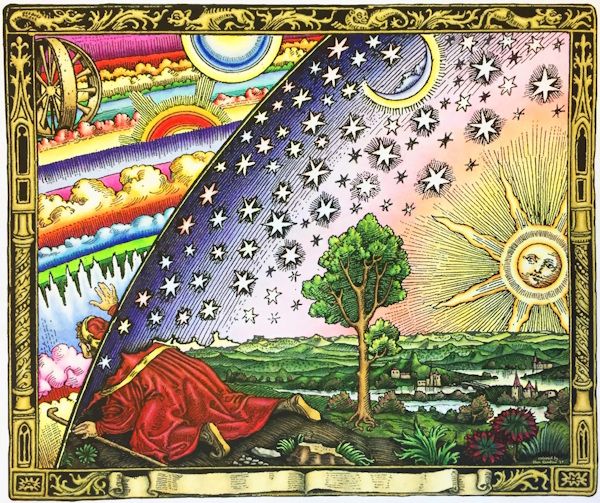
So what is the House? If Arne-Sayles is to be believed, it is a kind of repository of wisdom that our ancestors gleaned from communing with rivers and mountains then perhaps it is some kind of distilled essence of Nature, if you will. It seems to me that Sorenesen didn't so much become forgetful as he absorbed the wisdom around him. It wasn't that the waters of the lower floor were like those of Lethe, but rather the air was rife with atavism. He was, basically, transmogrified from a modern into an ancient.
I am unwilling to commit to simple syllogisms such as saying that because Piranesi is good and like the ancients, thusly the ancients are good. And that since the Prophet and the Other are of our world and are "bad", our world is bad. Unwilling at this point, anyway.
Piranesi is a wonderful tale rich with thematic food for thought and one that eludes easy answers. I am not sure what possessing extensive Narnia knowledge would do for interpreting the story. It didn't seem to me that the book is anywhere near as dense with allusions as The Waste Land and so a reader can easily comprehend things while not catching every reference and find meaning as well. Perhaps the Narnia references are largely tips of the hat to Lewis. Or maybe I am completely missing their points. Regardless, the characters and the world of the House are enough for an engaging and compelling read.
**Not true. It remains in a box as I have not yet bought a bookshelf to display its unbroken spine.
No comments:
Post a Comment