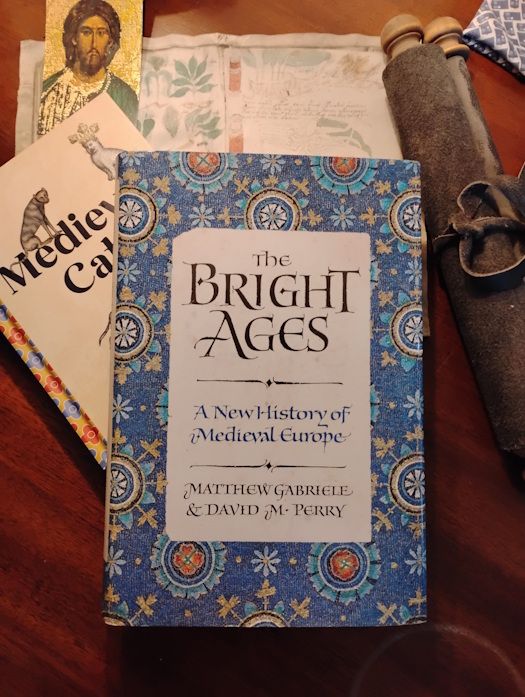
I'd heard of The Bright Ages a few years back in 2021 when the authors appeared on a podcast that I listen to. Then earlier this year I found a copy at a used bookstore and snatched it up.
While it is aimed at the lay reader and I am one, I think I've read enough books on medieval history and listened to enough podcasts to say that I have moved just beyond being a typical lay reader. And so nothing here surprised me. I may have not read a particular fabliaux or about the life of a particular empress but I've learned enough about these and other subjects that they're not new to me nor are they greatly revelatory, by and large.
Authors Matthew Gabriele and David M. Perry have, I think, a couple goals here. One is to dispel myths about the so-called Dark Ages, a concept given to us by Petrarch, and to show that they were, in fact, bright. The second follows from the first and is to counter the evildoers of our time who justify their views and actions by placing themselves in a line that extends back to the Middle Ages, to cast their words and deed as a continuation of those medieval figures that they deem righteous.
The book is a series of tableaux that counter one or more widely held misconceptions about the Middle Ages and present a truth more complicated. The first chapter looks at the role of women in medieval Europe. They were not simply these meek creatures ruled over by and beholden to the men in their lives. And so we learn about Galla Placida who ruled the Western Roman Empire on behalf of her minor son from 425 to 437 until he turned 18. Women may not have been 100% equal to men but they did wield power.
In one chapter we learn about Vikings and the myriad of trading routes and partners they had. In the popular imagination they cruised around northern Europe in their longboats and, upon landing, immediately began raping and pillaging. And so it was really neat to learn about Viking in the Caspian Sea region where they traded their ships for camels to haul goods. Since Islamic states charged higher taxes to pagan northerners, these Viking pretended to be Christian.
Of course, in my head I envisioned these blond warriors with horned helmets trucking through the desert on camels. But Viking helmets didn't have horns. D'oh! This section of the book is emblematic of many others which illustrate that Europe wasn't an all white place in the Middle Ages and that people moved around and intermingled all the time. Vikings went to the Caspian Sea and to North America; Muslims made their way into Spain where they preserved many an ancient text; the Mongols went west and extended their empire into Europe, knocking on the gates of Vienna; monks from France went to the steppes with bare feet to convert the Mongols to Christianity. Humanity mingled throughout the Middle Ages.
I really enjoyed the final chapter on medieval cities. We non-historians have this notion that people lived out in rural areas under the feudal system. But many medieval Europeans lived in cities. City air was free and urbanites were sometimes granted freedoms and privileges that their country cousins were not. The book states "Voting was a prominent part of medieval urban life" yet most common conceptions of that time exclude voting and view it as a habit of ancient Greeks that we moderns picked up after a long period of kings issuing orders to their vassals and popes pronouncing ex cathedra.
One of the disturbing things in the book that I felt had relevance to today was the all-too often terrible plight of the Jews. The Christians of the First Crusade killed Jews on their way to Jerusalem and in the city once it was taken; Jews were run out of France in the early 14th century; piles of manuscripts of the Talmud were burned in Paris in 1241; they were forced to convert at the tip of sword or else. And on and on.
I think the book's discussion of horrible treatment of the Jews (the book discussed Jews in more terms than their persecution, it should be noted) resonated with me as I heard last month that, Francesca Hong, a candidate for governor of my fair state, was gleefully looking forward to chatting with Hasan Piker, an internet celebrity or commentator or something internet, who has said some terrible things such as:
"...any 'Zionist entity' should be 'treated in the same way as a rabid neo-Nazi, and you shouldn’t even let someone be the local dog catcher if they’ve ever exhibited any positive feelings about the State of Israel.'"
Last year Kanye West was seen in public wearing a Swastika shirt. And I recall the numerous reports of Jewish students being harassed on American college campuses in the wake of the events of 7 October. And on and on. When I was young virulent anti-Semitism was largely practiced by assholes who lived out in the boonies and accumulated large caches of guns or marched in Skokie and now it has a certain, albeit limited, mainstream acceptance.
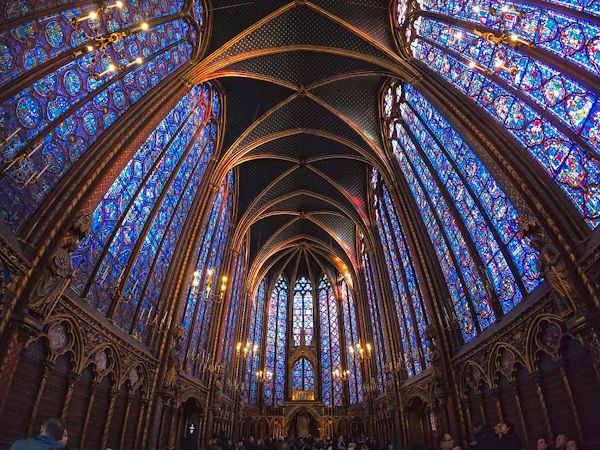
Lastly I want to mention that the book delves into how the Middle Ages were, well, bright. Just look at the 13th century stained glass of Sainte-Chapelle!
And here's a reconstruction of a standing stone from the tenth century with carvings. The stones were painted back in the day.
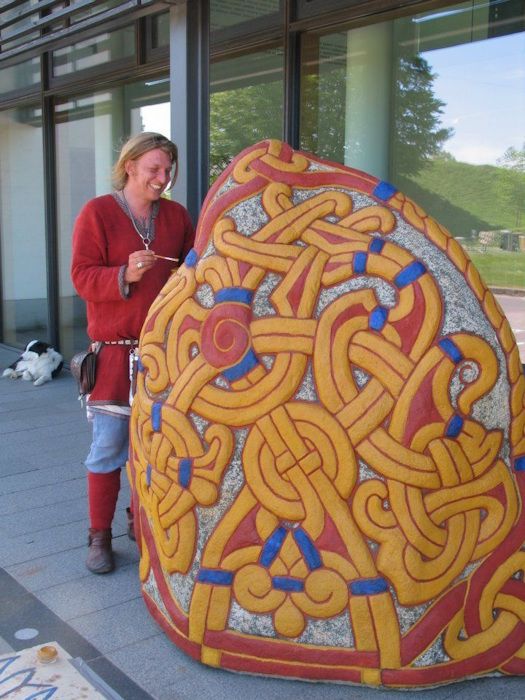
We see surviving medieval objects in cold brown and grey but they were bright and colorful back in the so-called Dark Ages. Medieval churches were often colorfully painted and brilliant mosaics were not uncommon.
The Bright Ages dispels common myths and implores readers to take the Middle Ages on its own terms and see commonalities with our own time, to view the people of that time as being much like us despite their foibles and failings. They may have had weird beliefs and held to superstitions we have discarded but they loved their children, enjoyed a good meal, and their leaders were just as conniving and corrupt as our own. This is not an exhaustive retelling of history but a sampler that will hopefully impel readers to investigate this fascinating period further.


No comments:
Post a Comment