Showing posts with label Virgin Missing Adventures. Show all posts

11 August, 2023

We have no need for ancient ways


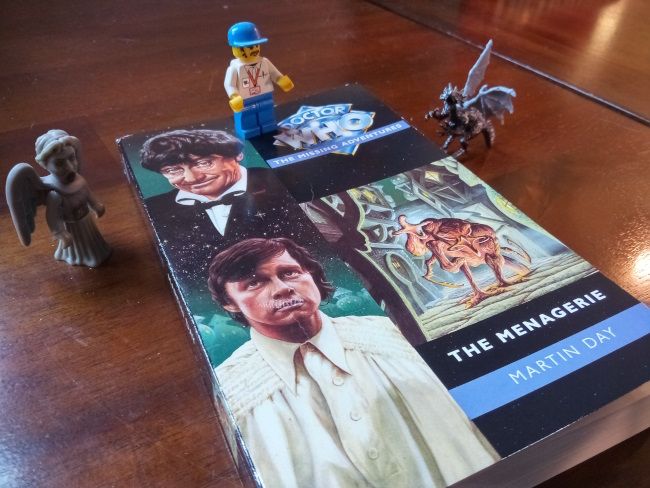
The Final Virgin Missing Adventure for the Second Doctor sees the TARDIS land on a planet that I don't believe is ever named in a city that also remains anonymous. It's a dark and rainy place and there are these ape-like creatures emerging from the sewers and raining mayhem and destruction down on the locals. Where is Auguste Dupin when you need him?

A group called the Knights of Kuabris make sure that no one gets too crazy and starts using science. Except, that is, for a power plant that allows the well-heeled to bask in the refulgence of electric lights. One day, Grand Knight Himesor calls the local alchemist/tinkerer, Defrabax, over for a chat. Himesor has reason to believe that Defrabax has created a homunculus. Homunculi don't breathe and so one can be helpful in doing a little reconnoitering in the sewers which are miasma-filled and keep any Knights from going to explore themselves.

There's a secret cult called the Brotherhood of Rexulon which is devoutly anti-science, even more so that the Knights of Kuabris, and they claim the apemen are part of the Menagerie of Ukkazaal, with various creatures living beneath the city. 

As Defrabax is having his confab with Himesor, the wizard's acolyte, Cosmae, is back at the lab gaining some carnal knowledge from a young lady of the night named Kaquaan. She is forced to leave when the homunculus returns. But before she goes, she snags a weird, but enchanting, glass cube thingy.

The Doctor, Jamie, and Zoe emerge from the TARDIS into this tech-light, vaguely medieval flavored world. As in your standard Dungeons & Dragons adventure, our heroes head to a local tavern. Unfortunately for them, the establishment lacks the proper license and the joint is raided by the Knights. So everyone is rounded up and thrown in this world's version of the paddy wagon and hauled back to the nearest cop shop. Everyone, that is, except for Jamie who manages to escape.

From here the TARDIS crew are split into different storylines. Zoe is unable to pay the fine and so is sold into slavery where she is bought by a gentleman named Diseada who just so happens to run a freak show. There she befriends conjoined twins Raitak and Reisak who tell her that Diseada isn't too bad of a boss/owner. Their master also collects bric-a-brac which includes a suspended animation bed which inconveniently runs out of power and so now there's a vicious killing machine, a Mecrim, on the loose.

The Doctor, having introduced himself as a man of science to the bar-raiding Knights, is taken to Himesor to account for his heretical views. But instead of being subject to the equivalent of the Spanish Inquisition, the Doctor ingratiates himself with the Grand Poobah and is given permission to check out the Knights' walk-in reliquary and discovers suits with their own air supplies. Just the things to allow them to penetrate the sewers.

They don the suits and head below the city where the party is waylaid by a bunch of moth-like creatures whom we learn are the Taculbain. Only the Doctor survives their deadly venom.

Jamie meets up with Cosmae who has been sent by Defrabax to the Knights' stronghold. The wizard has deduced that Kaquaan had taken his cube dealio which was no mere tchotchke. Instead it was an integral part of his plan to have the plebs overthrow the Knights and usher in a new age of science and prosperity. Those apemen, Rocarbies, are in league with Defrabax, and are another race in the subterranean menagerie.

With Himesor having died at the stingers of the Taculbain on that ill-fated mission to the sewers, his devious second in command, Zaitabor, takes over. 

Attention all Knights of Kuabris

Zaitabor has assumed control
 
Jamie and Cosmae discover that Zaitabor is a member of the Brotherhood of Rexulon and would impose an even more Luddite tyrrany on this city.
 
The Brotherhood's plan involves reactivating a reactor in the subterranean world which we discover is the remains of a previous city that was home to many a scientist. We learn from a series of transcripts of transmissions that Dr. Jenn Alforge and others did bio research in the city and ended up creating the Mecrim. Oh, and a deadly microbe came onto the scene too. Zaitabor is a cyborg who was involved with that research but a shuttle crash wiped his memory long ago.
 
The world here had some urban fantasy vibes from China MiƩville's Perdido Street Station mixed with the Fourth Doctor adventure, The Stones of Blood, with its medieval present obscuring a technological past. The Mecrim are nasty buggers - just vicious killers - and reminded me a bit of xenomorphs or, in a more Doctor Who vein, the Krill. There's some good thrills and chills to be had when the one awakens from the cryo unit that Diseada had bought and goes on a rampage.

Aside from the Mecrim being genuinely terrifying, I thought the idea of the Menagerie was just really neat. Day does a fine job of introducing the idea and giving us snatches of the underworld inhabitants before we get the big reveal of just who is down there and what they're intentions are. 

The regulars are done alright, but I don't mean this as a criticism, really. Zoe does a modicum of computing and keeps a stiff upper lip as the Mecrim threaten. Jamie is all action here, kicking butt and being all sneaky. The Doctor's more whimsical side is seen briefly but he's more Holmesian here than anything else. I am unsure if I simply got wrapped up in the story and the world Day has built and I simply neglected our heroes or who. Maybe they were done well but adjusted for something of a bleak story.
 
They show no playfulness and are basically all business. And they're separated to one degree or another for most of the story and this disallows the natural TARDIS traveler bonhomie to emerge. They feel like the TV characters but slightly obscured in the shadows of this world lit by fire.
 
Day does a good job of world building. The city feels like a city. Not a metropolis, but a conurbation. We go through various parts of it and there are nearby towns, such as where Diseada's band of merry performers have set up shop. We aren't told it's a big city and then get to see all of 2 rooms in it.

I also liked how Day gave us those messages from Alforge back to HQ. Oh, and a brief prelude involving her too. Honestly, I got really wrapped up in the world laid out here and forgot about the prelude until late in the book. It hints at the situation but doesn't give it all away. There are also bits of commentary from Himesor and his predecessors excerpted from various texts that illustrate the changing attitudes towards technology on the part of the Knights.

Overall, I very much enjoyed The Menagerie. There's a nice variety of characters. The Mecrim are brutish, nasty, unthinking killers. On the other hand, Defrabax comes across early on as scheming and conniving but we find out that he truly means well, he truly wants what's best for his people but he goes about achieving his goals in a misguided way. Similarly, Diseada goes from a man who buys slaves and runs a freak show into someone with a heart of gold who makes the ultimate sacrifice.

I enjoyed the city with its primitiveness yet having electricity, even if it's only for the rich. It was fun to be kept guessing at all the motivations of all the creatures and factions and personalities. Day juggles the various characters very well.

Next up are more of those Doctor Who Annual short stories. Ugh.
31 May, 2023

Koschei + Power + Betrayal = Master

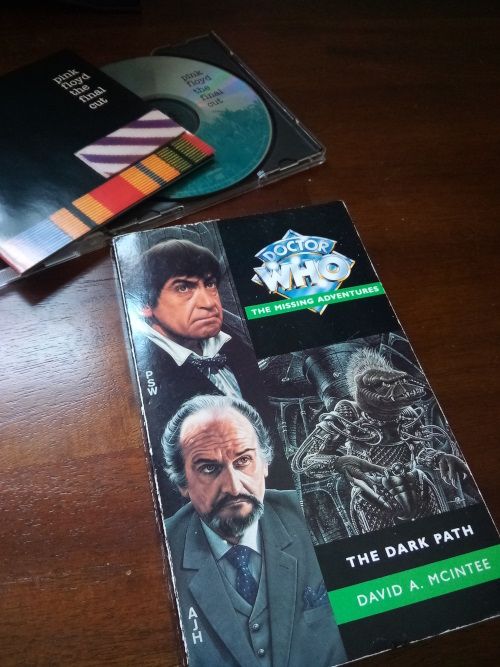
The first David A. McIntee story I read was Mission: Impractical which I thought was just a boatload of fun. Next came White Darkness which, again, was pure fun to read and had a touch of Cthulhu Mythos thrown in for good measure which added to my enjoyment. McIntee's name became synonymous with well-crafted tales that were a joy to read. And so I was looking forward to tackling his Second Doctor Missing Adventure, The Dark Path.

The Earth Empire collapsed. From its ashes has arisen the Federation which sees the remnants of the Empire join with its former enemies and subjects as equals, including the Terileptils and the Veltrochni. (Very Star Treky.) The story opens with a squadron of Veltrochni ships that meets its end at the hands of an old Imperial battlecruiser somewhere off in the ass end of the galaxy.

Not too long after this, we are introduced to a Federation ship that is headed to an old Imperial colony in order to establish contact and attempt to inveigle the colony's leadership to join the party. This way out of the way Imperial remnant is something of an enigma as it's on a planet that no one knows quite how it still exists considering its proximity to a past supernova. At the same time, the TARDIS is being followed.

In response to a question from Victoria, the Doctor replies, "Yes, another TA–" which immediately brought to mine that scene from The Omen when Father Brennan says, "His mother was a ja-".

The Doctor and company land at the colony - in a biodome that houses vineyards, as it turns out. The time travelers are mistaken for an advance delegation from the Federation and are treated as official types. I spent some time wondering why the local gendarme, known as Adjudicators, didn't look for a hole in their dome and could only conclude that they never saw the TARDIS and assumed that they had transmatted down.

Concurrently, another TARDIS materializes aboard the Federation ship on its way there, the Piri Reis. That time ship is owned by one Koschei who is, as we see on the cover, the Roger Delgado incarnation of the Master. I was wondering what language "Koschei" was from and figured it surely meant Master in it. Turns out the name refers to a figure from Slavic folklore who is known as "the Immortal" or "the Deathless", according to Wikipedia. Pretty apt considering the Master's future attempts to stay alive after having used up his regenerations.

The colonists are, unsurprisingly, distrustful of the Federation representatives, and still have an Imperial mindset. They also have a secret, a secret which can change all of time and space! A giant energy teat!

Our heroes notice that there are no children in the colony and theorize that the inhabitants are the original ones from 350 years ago. It turns out they discovered this big device, called the Darkheart, which, as we find out, was built by the ancestors of the Chronovores to send energy anywhere and anywhen one of their young or injured needed a boost. The Darkheart is preventing the colonists from aging and explains why the planet survived a nearby supernova.

McIntee deftly handles the various groups of characters, all with various motivations and committing various sins of commission and omission. You've got the colonists and their secrets, the Federation ship hoping to welcome them into the fold, the Doctor and his companions, Koschei and his companion, Ailla, a squadron of Veltrochni ships come to find out what happened to their brethren's ships that we see destroyed at the story's opening, and, finally, a mysterious creature roaming the colony and killing various Adjudicators.

I really liked how McIntee kept identities hidden, secrets secret, and motivations obscured for so long. And little did I know that this was a Master origin story. I kept waiting for him to take pleasure in an act of pure evil once his characters was introduced but he kept being nice. Well, by and large. He does murder someone and dispose of their body in a less than ceremonial way but I think he justified the action as being for the greater good instead of callously claiming the person got in the way of his evil, self-serving machinations. Then Ailla dies only to come back to life after having regenerated and revealing that she was sent by the Time Lords to keep an eye on him. Koschei comes to understand the enormous power given to anyone who could wield the Darkheart and temptation is just too much.

As he tells the Doctor, "That name no longer has any meaning for me, Doctor. In time you too will call me Master."

McIntee captures our heroes well or, at least in a TV-like manner, with the Doctor being very Second Doctor-like. Plenty of those moments of feigned innocence - "Who me?" - and the occasional bit of recorder when locked up. Victoria screams and lapses into despair. You can tell she is becoming disillusioned with life aboard the TARDIS. Jamie is, well, Jamie.

The story ends with the Scotsman observing, "...we’re landing in the sea!" Clearly a reference to our next television story. But first, a quick side step awaits...

Another winner from McIntee.

28 May, 2023

Return to Vortis

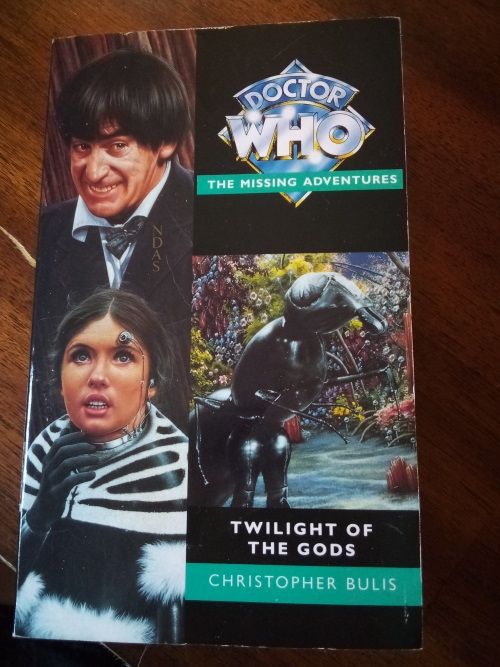
The Web Planet is almost universally mocked for its insectoid costumes which would be marvelous for any third grader's school play. And its 6 episodes were slow going, at times. Certainly not all killer, no filler. So I give Christopher Bulis a lot of credit for writing a story that is a sequel to this much maligned television tale.

The TARDIS lands once again on Vortis. But the crew finds that there are more than just Menoptera and Zarbi here. Two groups, the Imperial and the Republican, from the Rhumon system have laid claim to it with representatives from each stranded on the planet. Our time travelers are captured by Republicans but Victoria manages to escape with an assist from some grey creatures. The Doctor and Jamie escape Republican clutches too but only because they fall into Imperial ones.

Amongst the representatives of the Empire is one Father Modeenus, whose religious fervor gives Jonathan Edwards a run for his money. I seem to recall that various authors from the Wilderness Years had an anti-religious bent but I cannot remember if Bulis is one of them. I don't think that Vanderdeken's Children had anything character or story line that was critical of religion. There was "magic" in The Sorcerer's Apprentice but I don't recall there being anything sacrilegious about it. And it's been a long time since I've read Palace of the Red Sun - too long, perhaps.

There's a lot of running & hiding, being captured & recaptured here as our heroes get passed around by the various factions. The Doctor seems a bit generic, for the most part, and I felt that he got lost in shuffle for much of the book - at least until the end. Victoria and Jamie were fine with our Victorian young lady really stepping up. She even does her best Ethan Hunt imitation and goes undercover disguised as a Monoptera. (?!) Perhaps the biggest winners, however, are the Menoptera who lose the high cheese factor of their costumes and fly ships and kill baddies and rescue people and just generally come across heroically, if not as mild-mannered bad asses.

Twilight of the Gods has this vaguely Twilight Zone-like twist to it involving some naughty students and their less than pleased teacher.

Overall, I enjoyed this tale. There's enough action to keep the story's pace going at a nice clip and just enough menace directed at our heroes to keep things interesting. Despite not being overly Troughton-like, I appreciated that the Doctor was not perfect here, attempts to defeat the bad guys didn't always work immediately and there were setbacks. There's also a fun little scene here that reminded me of the introduction of midichlorians in that Star Wars movie I cannot recall the name of where the Doctor figures out and then explains how it is that the Menoptera can fly when their physiology would seem to render that impossible. I also enjoyed how Modeenus chewed the scenery.

But the see saw nature of the action got repetitive and the Imperial and Republicans factions generally came across as 2D mindless military drones. Perhaps this latter bit was meant as a commentary. Fair enough, I suppose.

Despite these things, this was an enjoyable story.