Yesterday David Blaska wrote:
...any charge of racism must be filed at the nearest court or civil rights adjudicator, such as the state Equal Rights Bureau. Prove it in court or shut up.
About a week ago he wrote:
Crime causes poverty, not the other way around.
Any statement alleging causality must have evidence to back it up. Find some proof or shut up. And by "proof" I mean actual scientific data, not press statements from the Cato Institute.
20 November, 2007


15 November, 2007
Eleva-Strum 41, Southwestern 6
The Cards' victory is decisive. Now, I wonder how the Quiz Bowl team is doing this year...
Go Cards!
My high school alma mater, Eleva-Strum Central, is playing today for the Division 7 championship. It's 19-6 with E-S in front at half. They were killed last year something like 42-0 in the finals but things are looking good today.
The Knee Bone's Connected to the Leg Bone
The Hollywood writers' strike hasn't had much of an effect on me and my viewing habits. At least not yet. The Dulcinea is all bummed out because The Office is now in re-runs due to it. I'm a LOST fan and the new 16-episode season isn't supposed to start until February. But, depending on how long the strike lasts, this season could be scrapped altogether. Half of the season was scripted and shot and, in case of a prolonged dispute, there's a possibility that the 8 episodes will be tagged onto next season making it a full 24-episode deal. The prospect of having to wait almost another year to get some more material to speculate on and be introduced to another character named after an Enlightenment philosopher is almost too much to bear. I've really been looking forward to the start of the season and am excited that Fisher Stevens and Jeremy Davies have been tapped to play a couple of the freighter people. Plus it looks like we've got a new hatch and some dinosaur bones.
A brief trailer for next season/the mobisodes has been released:
Of greatest interest to me is that it appears that Hurley stumbles upon Jacob's shack which is lit up.

And there's what appears to be bones hanging on the walls. Couple this with the dinosaur bones and the polar bear skull also seen here and you must wonder what that Jacob guy is up to in his charnel house.
A brief trailer for next season/the mobisodes has been released:
Of greatest interest to me is that it appears that Hurley stumbles upon Jacob's shack which is lit up.
And there's what appears to be bones hanging on the walls. Couple this with the dinosaur bones and the polar bear skull also seen here and you must wonder what that Jacob guy is up to in his charnel house.
13 November, 2007
A Crafty Night at the Majestic
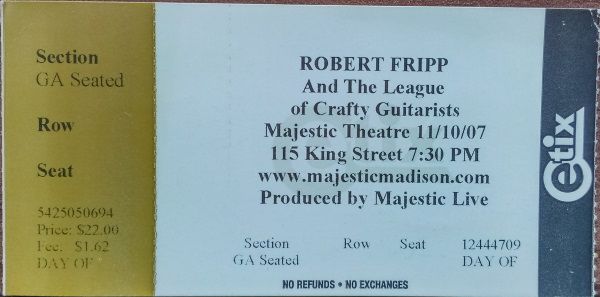
The Dulcinea and I lost our Majestic Theatre virginity on Saturday night when we took in a performance by Robert Fripp & The League of Crafty Guitarists. (For more info on them, check out my posting of an old show of theirs.) The line was most of the way down the block when we approached the theatre much to my surprise as well as my delight. I must admit that I didn't think the show would be particularly well attended. Wandering inside, we found that the new owners had done a wonderful job of restoring the place. Spackling compound and paint really made the place new again. The floor was crowded so we went up to the balcony and found a seat on one of the benches. We discovered that Mr. Fripp himself was just off to our right about 3 feet away doing his pre-show meditation/observation. As the balcony filled up and Fripp found himself seated next to a trio of teenage boys, he made his way backstage.
Being a seated show, I would estimate the capacity at around 300 and nearly every seat was taken. A gentleman was sitting next to us with his daughter who was all of 8 or 9 years old. There was the aforementioned group of teenagers plus a smattering of folks in their 20s. No longer am I guaranteed to be the youngest person at a prog show. Some of Fripp's soundscapes were coming over the PA and, shortly before show time, a group of Crafties came onstage and did intros/announcements in a half a dozen languages. There couldn't have been anyone in the audience that didn't know cameras and recording of any kind were forbidden. Shortly thereafter Fripp came out and seated himself behind his stacks and gave us a few minutes of live soundscapes. I personally am not that enamored of them but there is the odd bit of Frippertronics that I find particularly engaging. Earlier The D has mentioned that she had found his performance opening for Porcupine Tree a couple years ago to have been wonderful and the soundscapes sensual. She said all this within earshot of Mr. Fripp who, I hope, was heartened that even we cheeseheads appreciate his unique craft.
When the spectral sounds died down, the Crafties, 10 in all and clad in black, came on the stage and took their seats which were arranged in a semi-circle. They then proceeded to do what it is they do. Aside from a couple Crimson tunes, I didn't recognize any of the songs they performed but it was really amazing. For the first song, it sounded like two or three folks played a rhythm line while another three or four played the melody. The remaining players colored the melody and, in general, added little bits here and there which accentuated the other elements of the song. The Crafties are, quite truly, a small guitar orchestra.
Fripp would occasionally add flourishes of his own to the songs and then sculpt more soundscapes every two or three songs, giving the Crafties a breather. The ensemble played Crimson's "THRAK" which certainly sounded different but, as I discovered, 10 acoustic guitars can still sound incredibly menacing. For this piece, Fripp added some trademark electric guitar. In the middle of the show they played a very beautiful piece, the name of which is unknown to me. Listening to it, I thought that it was one of those moments where more is more. I could hear the song in my head being done by two people but felt that 10 of them just amplified the beauty of the piece. The Crafties don't get in each other's way so a relatively simple piece doesn't sound cluttered which had the effect of simply heightening the feeling of the song. I realize this doesn't make much sense but it's all I've got at the moment.
The main set ended with another Crimson piece, "Vroom Vroom" followed by two or three encores, the final of which saw Fripp man his acoustic guitar for the first time that night and join his students in the semi-circle. For the occasion, everyone unplugged their instruments and the performance finished with a truly acoustic moment. The lights went up and, as people were filing out, the Crafties (sans Fripp) filed in and positioned themselves right in front of the bar. They serenaded the exiting concertgoers with a song or two before finally taking their leave. It was a really nice gesture to bring the music out to the people and those few minutes were a much looser affair with smiles all around instead of looks of intense concentration on their faces as they had while onstage. The remaining folks were quite appreciative of this chance to stand face to face with the group. Indeed, the audience was that way all night. Rapt attention was given during songs and loud applause and cheers after them.
Lastly, thanks must go out to the Majestic for bringing to Madison something that wouldn't be at home on an AC/MOR station and isn't indie rock as well as for beautifully restoring the theatre.
12 November, 2007
So Sad About Us
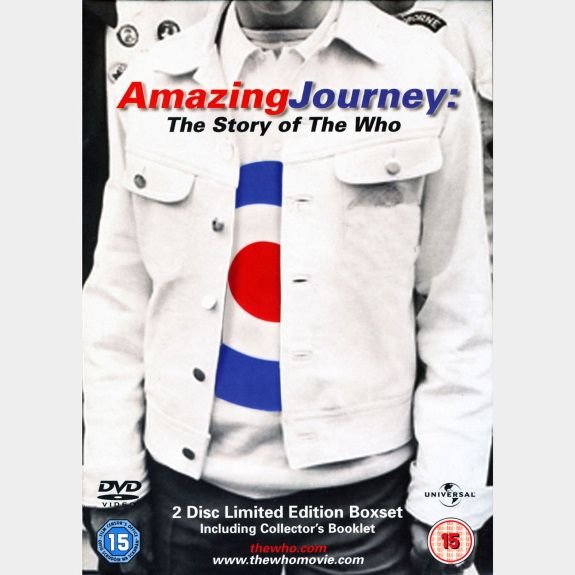
Yesterday I had the chance to watch Amazing Journey: The Story of The Who as I'd Tivo'd it when VH1 put it on. The film is, to the best of my knowledge, the first feature length look at the band since The Kids Are Alright from 1979. It came as a welcome relief since I had recorded the episode of A&E's Biography about Pete Townshend a few months ago which I erased after watching about 10 minutes of it because it featured no interview footage with the man himself. And so I was looking forward to a decent documentary about one of my favorite bands.
Amazing Journey is a straight-forward affair, unlike The Kids Are Alright. For the latter, director Jeff Stein created an impressionistic montage instead of a chronological story. Stein assembled his film almost purely from archival footage with some live performances in the fall of 1977 and spring of '78 put on for the express purpose of filming to capture some songs which were not represented in the archives. The result was a wonderful movie which captured the band's explosive live performances and their often hilarious off-stage antics. It did as good as possible of translating the manic energy of the band to film but it lacked a bio, a look behind the scenes, or much of any commentary on the music. Viewers saw that they rocked onstage and liked to have fun off but were left wondering how it all happened.
Amazing Journey takes a different tack altogether. The surviving members (Daltrey & Townshend) were interviewed especially for the project (at least the former was) which starts at the beginning and works its way up to 2007. There's a ton of archive interviews, live footage, et al to be found here. We begin with the band members' childhoods and work our way to the formation of the group with which everyone is familiar. The filmmakers are to be highly commended for their portrayal of the band's formative years. There is a fair amount of depth here which details how Daltrey recruited first Entwhistle and then the rest into The Detours which became The Who followed by The High Numbers and then The Who again. This well-crafted section is topped off by live footage from 1964 at the Railway Hotel which is a real treasure.
As the 1960s progress, however, the film gets worse as we hear a bit about the dynamics of the band and learn about their recording forays. It becomes obvious fairly quickly that we are in for a Behind the Music kind of expose with a heavy reliance on talk about the relationships of the band's members and a paucity of The Who plying their trade. The parts which document the period through the Tommy – up to 1971 – did a half-decent job of talking about the music considering how little was shown. One of the biggest problems with the movie is that, starting with the Lifehouse debacle, The Who's music gets glossed over in favor of even more attention on the personal lives of the members. Much more detail went into the music during the sections chronicling the 60s. Their blues and R&B; influences were well-noted and we learn about their early singles such as "I Can't Explain" and "My Generation" as well as the mini-opera, "A Quick One While He's Away". On the album front, we get a vintage interview with Townshend explaining his ambitions for The Who Sell Out and there's a hefty good dose of Tommy. But, starting with 1971, music takes a back seat with Lifehouse being explained away in two sentences. We then learn that Who's Next came out instead and it's off to Quadrophrenia which is similarly given short shrift. This is a real shame as Who's Next was a seminal album with Townshend's use of keyboards being a watershed moment in rock's history. Plus the whole concept is something that he continued to revisit and still does to this day. Albums subsequent to Quadrophrenia are all but ignored, unfortunately.
It's not that there aren't live concert clips but they are generally no longer than 10-15 seconds meaning that no song is represented in its entirety or anything close to it. The footage of Keith Moon being carried offstage at the Cow Palace lasts longer than do most of the songs. The only tune to get some real screentime was "My Generation" and this was mostly of Pete and Keith destroying their instruments as opposed to the band playing it. I understand that the film is trying to tell a story about people and isn't a concert video but to shortchange the live footage is ridiculous considering The Who's live reputation and that Lifehouse (i.e. – Townshend's ambitions) heavily explored the audience-musician relationship. What makes this situation unforgivable is that the filmmakers dug up some incredible footage including the holy grail for Who fans: a bit of the show at Leeds University on 14 February 1970. Live at Leeds is certainly the best document of the band in concert and arguably the best live album by any rock band ever. We get to watch a bit of "Christmas" as a teaser and then suddenly – poof! – it's over. Plus the Who's Next tour wasn't, to my recollection, represented at all. I'm no live Who archivist but the filmmakers had 200+ hours of footage to cull from yet the whole reason for The Who's existence – the music – is remarkably lacking.
Aside from the fact that there's too much talking heads and not enough concert footage, another problem is the talking heads. I appreciated the interviews with former & current managers to embellish the story but Daltrey and Townshend get the overwhelming majority of interview time from band members. Kenny Jones got as much time as Entwhistle and more than Moon which makes no sense. The Ox died in 2002 and I am incredulous of the notion that they couldn't have found enough footage to give him a more prominent and perhaps almost equal role in telling the story. Were his feelings about Moon's death never filmed? Ever? As for Moon himself, there was one interview clip that I can recall. Was every interview with him just total goofing around devoid of information? Had he never recalled how he joined the band for a camera regardless of any antics he did? We get to know Entwhistle and Moon mostly through the recollections of others as opposed to seeing for ourselves.
In a similar vein, the vast majority of interviews were vintage the past few years. There's hardly a word from anytime between 1964-2000 so we cannot know how events were perceived at the times they occurred nor how the band members expressed their feelings back in the day. We're left with the views of two old geezers reflecting upon their lives and careers. While I find them sincere, they are talking about events that, in some cases, transpired more than 40 years ago. Drug-addled memories go hazy so why not give interview footage from the times various events transpired instead of almost always having people look back decades later? For instance, how did Townshend feel about Tommy in 1968-69? Viewers are left to ponder this because all we hear about it comes from interviews done after the album's success, after the film, after the musical – after it had already achieved notoriety and become a cultural fixture.
How you will perceive Amazing Journey depends on what kind of fan you are. The dedicated will no doubt feel let down by the whole thing. They're already familiar with the stories and many have most of the concert footage in their collections so they must be disappointed that the rare stuff is so incredibly sparse. On the other hand, there's always new people just getting into the band for whom the well-worn tales of trashed hotel rooms and expensive cars being driven into pools are fresh territory. But that the live clips are so short and no song is represented in its entirety will disappoint everyone. Whether you're a new fan or an old one, the reason you like The Who is because of the music and there's just too little here. With 200+ hours of footage to wade through including stuff donated by bootleggers to the cause, it's inexcusable that there is so little music. This also leads to yet another problem which is that the events which we hear about aren't related to much – they don't get related to the times from which they sprung nor do we find out how they reflect Townshend's life. To me this signals that noting that event A was followed by event B is important but providing context and meaning isn't. For instance, a bit of "However Much I Booze" is shown with Townshend singing, "It's clear to all my friends that I habitually lie; I just bring them down" yet I don't remember the film even attempting to explain why he would be singing those lines. That his life was coming apart due to tremendous pressures relating to The Who as well as drugs & alcohol is omitted. By not showing very much music performance and by not having many interviews which actually talk about the music, viewers learn very little about how the music was a reflection of the band or its times or why it has any significance at all.
The Who demand an extended tribute as an extra two hours would have done wonders. Apparently the original cut was 3.5 hours but honed down to 2 by the studio. This "director's cut" would probably relieve us of the problem of the lack of concert footage, but I must wonder if would alleviate the problem of trying to portray the music as having some meaning to both the musicians and the audiences alike. It's important to note that Tommy was tremendously popular but it's infinitely more interesting to try to explain why it was. That the Lifehouse project yielded Who's Next is history and must be included. But to avoid explaining what Lifehouse was supposed to be, to exclude Townshend's ambitions regarding it is to fail. What was it really about and what did this say about Townshend? How did the rest of the band feel about his metaphysical aspirations? He certainly had some grandiose plans which were in line with his views on the transformative nature of music, specifically rock music.
The Who's music is important to people but this is taken for granted in Amazing Journey and so you never find out what relationship the music has to those who wrote and performed it nor to those millions of people for whom it is a part of the soundtrack of their lives. Except once. It comes at the end when the band are playing on 20 October 2001 at the tribute show for the victims of 9/11. They are doing "Won't Get Fooled Again" and is one of the few times more than 10 seconds of a performance is shown. Watching those firemen and police officers screaming out the words, I realized that it's the only moment of the film in which you get the impression that The Who's music is actually important, that it's actually meaningful to the band and audience alike. And this is exactly why Amazing Journey fails. It's a journey alright, just not that amazing.
01 November, 2007
Review: Lifeguard Nights - The Church of Song
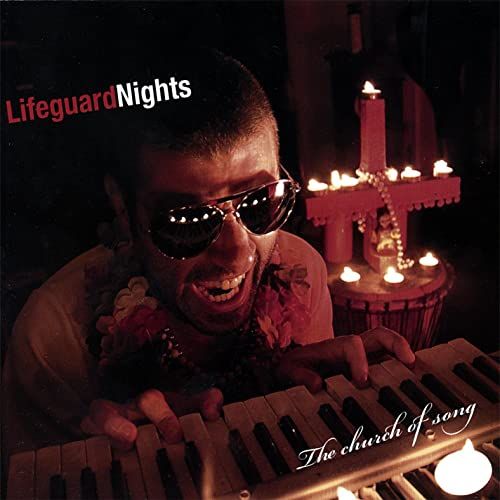
Upon the demise of South Jersey Seashore Lifeguard Convention Band, Vincent Brue went straight back to work. In a strictly solo context, he buckled down and wrote dozens of songs, releasing them under the moniker of Lifeguard Nights. Earlier this year he recruited seven others and Lifeguard Nights was transformed into a full-fledged band. In addition to the usual rock instrumentation, melodica, jaw harp, and harmonium are part of the group's sound and so things have gone from rather minimal lo-fi to a more well-rounded version.
The burst of gospel that is the title track leads things off. It notes that "there is so much wrong in the world today" and offers music as a palliative. "Amen" follows and takes on organized religion much as Jethro Tull did with "My God". However, Brue does it with a late-60s pop pastiche featuring organ and jam band-like guitar noodling instead of the slashing 6-string chords and a C of E chorus hanging overhead. The beat skips along underneath a catchy chorus of "Well Jesus thinks you're an asshole" which makes the tune instantly memorable. The mocking and anger quickly go into hiding and are replaced by more doleful lyrics. "Downtown" is cut from the same musical template as "Amen" but it mourns an inability to get off the bottle. "Spare Tire" is reminiscent of early REM but replaces obscure lyrics with a lament about the narrator's extra girth. The ghost of Johnny Cash rears its head in the bleak "Nothing Left to Live For". What lies under that Motown tambourine is Brue coming down on a Sunday morning.
Listeners not at the bottom will appreciate the relief of "I'd Prefer It If You Weren't in Pornos" which has Brue's gritty voice showering his lover with praise. "Bastille Day" shows the first real signs of the musical eclecticism promised by an 8-piece band wielding a dozen or more instruments with the jaw harp and banjo contributing. The song opens with acoustic guitar strumming, a simple yet effective banjo melody, and the jaw harp bouncing in the background. This makes for a nice departure from the straight ahead pop of the previous 10 songs. Unfortunately, this was just a tease because, as soon as the drums enter, it's back to formula. "In the Navy Now" is faux Pogues while the epic closer "Over It" is notable only for closing the circle with a bit of the gospel that opened the album.
The Church of Song gets off to a good start but the formula grows stale. This is my first exposure to Vincent Brue and it's obvious that he can write a good pop song. He has a limited singing ability but the raggedness of his voice is what makes it great. But I was disappointed that eight musicians with an arsenal of instruments managed not to deviate all that much from the script. Thusly most of the album comes across as boilerplate. Individually the songs are good with a couple being great, but 43 minutes of them gets bogged down. There's a great EP lurking in here somewhere.
Review: The Dynamics - First Landing
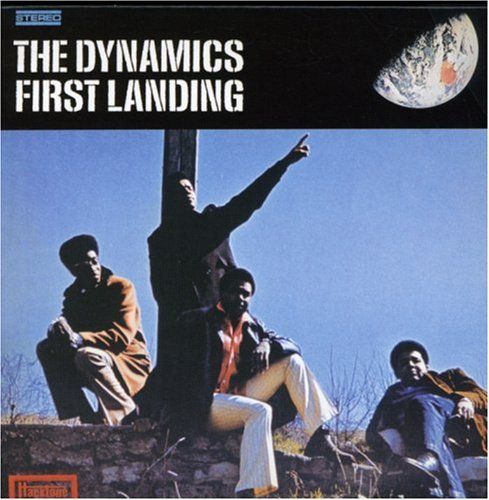
I want to admit that I don't know very much about the state of R&B; these days. But, if the occasional song I hear on the radio courtesy of my roommate is any indication, then I must say that it's for shite. There is the odd exception such as "Crazy" by Gnarls Barkley but, for the most part, R&B; these days hurts my ears. Thusly I was happy to receive First Landing by The Dynamics.
The Dynamics were 4-piece vocal group from Detroit populated by George White, Fred Baker, Zeke Harris, and Samuel Stevenson. They hooked up with Aretha Franklin's husband Ted White who got them onto the Atlantic subsidiary Cotillion and took them to Memphis to record this, their debut effort. "Ice Cream Song" proved to be a minor hit but, after this album, the band disappeared into the miasma that was late-60s. The album was first released in 1969 but has been given new life thanks to the folks at Hacktone Records. They recreated the original release's artwork even to the point of putting the CD in a paper inner sleeve.
"I Don't Want Nobody to Lead Me On" is a strong opener with Zeke Harris' confident vocals holding court. Harris handles the lead on the first five tracks and 8 of the 12 songs in total, though White and Baker get a chance to step up. He does another impassioned take on "Ain't No Love At All" but the song is marred by the melodrama of the strings. I've always been of the mind that strings are anethema to R&B; songs and there's nothing here to change my mind. With a beat oozing funk and punchy horns, why drain the dynamic with syrupy sweet strings? "Ain't No Sun" is a cover of a song by the band's Detroit brethren The Temptations and shows why an army of violins aren't needed to imbue a sense of drama into a song. These guys certainly had the pipes and they use them to great effect halfway in as the song slows down. What was side 1 closes with George White's falsetto on "What Would I Do" which emphasizes the blues in R&B.; White's pleading is just so smooth that it's a great shame that all the soul is drained from the performance by the strings.
Side 2 opens again with White handling the lead vocal chores on "The Love That I Need". There's a great melody here and I can imagine The Rolling Stones having covered this. What they would have done was to give it some more muscle which is lacking here. "Since I Lost You" is Fred Baker's lone contribution at the helm but he makes the most of it. In fact, the music struggles to keep up with his frenetic singing. And that's the general problem with the second half – it's too mellow. Somewhere along the way most of the energy got drained and there is a distinct lack of funk. "Murder in the First Degree" recharges the battery a bit but it's too late as it closes the album.
First Landing is a breath of fresh air in these days when R&B; generally means drums machines and synthesizers. It's not a perfect album but more traditional-minded R&B; fans will be glad this was pulled from the vaults and dusted off.
Review: Sterling Harrison - South of the Snooty Fox
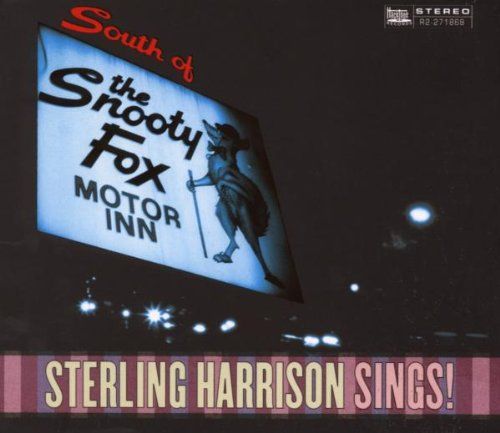
Hacktone Records is getting a reputation for releasing comeback albums by R&B; artists who had faded into relative obscurity. (See Arthur Alexander.) This time around it's Sterling Harrison's South of the Snooty Fox.
Harrison passed away in 2005 and this album was to be his chance to step up from the second tier of soul singers and show off his not inconsiderable talents. In his 40 year career, he had played with the likes of Otis Redding, Wilson Pickett, and Etta James but he was never able to strike out on his own and find more mainstream (i.e. – white) success. Snooty Fox was mostly recorded in 2001 and then polished over the succeeding few years until Harrison's death. It was not until this year that it saw the light of day.
Steve Berlin of Los Lobos was co-producer and he managed to get a nice sound that recalled the R&B; heydays of the 1960s while being planted in the 21st century. Harrison's fantastic baritone is up front leading the music as it should be. All of this means that the album has a nice raw sound that lets the singer ply his trade instead of being bogged down by the production which killed Alexander's comeback effort.
If a guy can take a Tom Waits song and make it his own as is the case here with "The House Where Nobody Lives", then there's something special going on. And indeed there is. "Ain't Nobody Home" may be most closely associated with B.B. King, but the version here is the perfect opener with the classic R&B; beat and Harrison's soaring vocals. O.V. Wright's "A Nickel and a Nail" changes the pace a bit before the booty-shaking of "Seven Days" with its scratchy guitar riff and some sax work from Berlin. "You Left the Water Running" leans towards funk and has some tasty organ work. Perhaps the highlight is the slow-burning "I'll Take Care of You" which showcases guitarist Larry Johnson at his finest. It's a Bobby Bland song which Harrison stretches out to nearly eight minutes of tense seductive flirtation with the listener.
It is a crying shame that Harrison was taken away by cancer because South of the Snooty Fox shows just what an immense talent he was – certainly the equal of the legendary peers he opened for over the years.
Review: OST for Naming Number Two
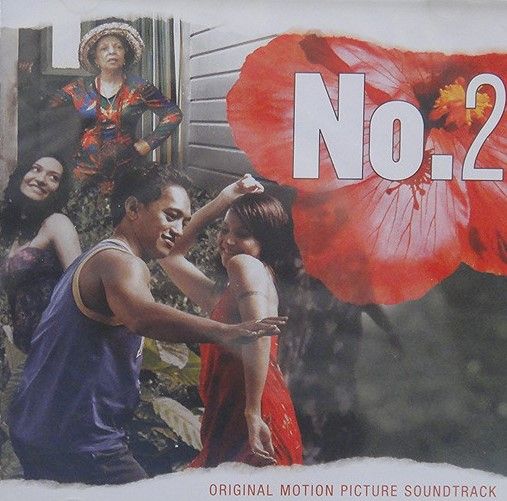
Naming Number Two is the directorial debut of Toa Fraser who hails from New Zealand. I haven't seen the film but I do have the soundtrack from Hacktone Records. It's a rather daunting task to write about the music of that part of the world since I am totally unfamiliar with it. But try I must.
The album features tracks new & old by various artists interspersed with incidental music from the film by composer Don McGlashan. With the movie dealing with intergenerational conflicts, the soundtrack runs the gamut from rap to the classical repertoire with several tunes being flavored by the Pacific Rim. It makes for quite an eclectic mix.
Rap music has spread across the Pacific as evidenced by the lead track here, "The Medicine" by Tha Feelstyle who hails from Somoa by way of NZ. There isn't anything here to betray the homeland of the singer as the song sounds as American as anything you're likely to hear on this side of the ocean. The same goes for "Bathe in the River" by Mt. Raskil Preservation Society which also featured the silky smooth voice of soul singer Hollie Smith. Māori-Niuean hip-hop artist Che Fu contributes a couple songs and the mid-tempo "Waka" is the best with its sampled ethnic percussion which ensures that it doesn't sound overly American.
McGlashan's contributions here are short and obviously served their purposes in the film. "Nanna's Entrance" and "Mt. Roskill/Chasing the Pig" are largely orchestral while the aching dobro on "Early Morning" does a wonderful job of capturing the song's title. "Sai Levuka Ga" has some lovely guitar work and shimmering vocals which make a smooth transition to music hall with the addition of horns.
The best songs here, though, are the ones that don't sound like they originate from the States. "Wai Ni Bu Ni Ovalau" by the Fijian Festival Performers is a vocal tour de force for the large chorus. I have no idea what the lyrics mean but the song is absolutely beautiful. "Chulu Chululu" dates back to the mid-1960s and is by Mila with Eddie Lund and his Tahitians. How much it has to do with Tahitian music is unknown since it sounds fairly Anglicized to my ears but it has a tasty pedal steel break and is just blatantly catchy.
As I said above, my favorite tracks are the ones that sound the most exotic, for want of a better word. The songs that have at least some kind of inflection from cultures across the ocean fare the best to my ears. While you'd think that I'd be used to it by now, I still found myself amazed at how far American music has spread. The rap songs here were the most difficult but, after repeated listenings, even I, a bit of a purist and not a big fan of the genre, grew to like them. Still, they proved the most problematic as they sounded assembled instead of performed and, perhaps worst of all, they sounded American instead of Polynesian. And this makes me want to see the movie because I suspect that, not only is the tension between young and old present, but also that of traditional Pacific Rim cultures vs. Western and those tensions interest me greatly.
19 October, 2007
But It's Star Wars
George Lucas has begun work on two new TV series in his Star Wars world. One is live-action and the other animated.
The half-hour cartoon series takes place between the events depicted in the Attack of the Clones and Revenge of the Sith films.
The live-action TV series will take place in the Star Wars universe but will not feature the Skywalker family, as had previously been suggested.
Oddly enough, the programs are a hard sell to U.S. television moguls.
Lucas, who joked the series would analyse "the life of robots", said the US TV networks were "having a hard time" comprehending his vision.
"They're saying, 'This doesn't fit into our little square boxes.' And I say, 'Well, yeah, but it's Star Wars."
The half-hour cartoon series takes place between the events depicted in the Attack of the Clones and Revenge of the Sith films.
The live-action TV series will take place in the Star Wars universe but will not feature the Skywalker family, as had previously been suggested.
Oddly enough, the programs are a hard sell to U.S. television moguls.
Lucas, who joked the series would analyse "the life of robots", said the US TV networks were "having a hard time" comprehending his vision.
"They're saying, 'This doesn't fit into our little square boxes.' And I say, 'Well, yeah, but it's Star Wars."
The Necessity of Impeachment
I was finally able to watch "Cheney's Law", the first episode of this season's Frontline. It didn't really offer much that was new to people who have been following the administration the past few years but it was nice in that it drew together lots of things and put them all into one handy program. The show ended with a quote from Cheney that he gave while being interviewed by Fox News in 2002:
I've been around town for 34 years. Time after time after time, administrations have traded away the authority of the President to do his job. We're not gonna do that in this administration. The President is bound and determined to defend those principles and to pass on this office – his and mine – to future generations in better shape than we found it.
This irked me beyond the signing statements, the surreptitious dealings, the decisions by Yoo & Addington – and is why we need to impeach Bush & Cheney. As John Nichols and Bruce Fein argued this past summer, impeachment is how we ensure that this administration's legacy doesn't get passed on to future executives. Allowing officials who swore an oath to uphold the Constitution to then turn around and ignore it with the impunity granted to them by a compliant lawyer at the Office of Legal Counsel is not a good precedent to set.
I've been around town for 34 years. Time after time after time, administrations have traded away the authority of the President to do his job. We're not gonna do that in this administration. The President is bound and determined to defend those principles and to pass on this office – his and mine – to future generations in better shape than we found it.
This irked me beyond the signing statements, the surreptitious dealings, the decisions by Yoo & Addington – and is why we need to impeach Bush & Cheney. As John Nichols and Bruce Fein argued this past summer, impeachment is how we ensure that this administration's legacy doesn't get passed on to future executives. Allowing officials who swore an oath to uphold the Constitution to then turn around and ignore it with the impunity granted to them by a compliant lawyer at the Office of Legal Counsel is not a good precedent to set.
17 October, 2007
Before the Motor Law
I've been doing a little reading about the draconian measures being taken to get the Chicago Transit Authority and its suburban counterpart PACE on budget. Plans call for two rounds of cuts and fare increases which will result in the elimination of "roughly 20% of all service and 53% of all bus routes, leaving most areas of the city as much as a half a mile away from the nearest bus." The most simplistic explanation is that the state will not adequately fund the CTA and thusly the cuts. Considering that the Chicago metro area which is served by the public transportation services looking at steep budget cuts account for about three quarters of the state's population, I am forced to wonder how it all came down to this. Here in our state, our biggest city, Milwaukee, is wrestling with a budget and Milwaukee Transit is looking at fare increases and the elimination of routes as well. Considering our efforts here in Madison/Dane County to introduce light rail, I have to ask: where is the money to pay for, expand, and maintain it going to come from?.
I'm sure that the budgets of the two states have some mitigating differences and so the situation in Illinois is not an exact replica of the situation here in Wisconsin. Still, the Chicago metro area has about three quarters of the population of Illinois, while our two biggest metro areas, Milwaukee and Madison, combined don't account for even half of Wisconsin's population which is in itself less than half of Illinois'. I feel compelled to ask how is it that, if Chicago and its environs are unable to get adequate funding, why do we here in Madison think a light rail system would not just be a complete drain on our budget? My understanding is that the Feds will help get it built but that operating costs aren't their problem. Is it right to make outlying communities who don't want to fund light rail here underwrite it? We don't even fund our bus system here in Madison well enough so how can we expect light rail to be a financially viable option?
Being in a transportation frame of mind, I have found some interesting bits.
I think it would be nice if we had Amtrak service here in Madison. I am pleased to see that the Hiawatha line which runs between Milwaukee and Chicago set a record (PDF) this past August for the highest monthly total of passengers in the line's history and looks to set an annual record this year as well. The Hiawatha "currently boasts the best on-time performance of any Amtrak route in the nation" which goes to show that, if done right, people will travel by rail. In fact, I'd love to take a train up to the Twin Cities or down to Chicago. It would even be great for day trips to Milwaukee which is giving its Marquette Interchange a $800+ million overhaul.
With this area's increasing population we'll surely need more ways to move more people more quickly. At the moment, this is going to happen via automobile. If all goes according to schedule, the summer of 2009 will see I94 expanded to six lanes between the Badger Interchange (that's where I39/90/94 and Highway 30 all meet) and County N at the cost of $35-$40 million dollars. Try driving north from Cottage Grove on N as I did this past weekend and see all of the subdivisions. Ugly as they may be, they are there as is a business park at the I94-N intersection. Also I believe there are still plans to make I39/90 six lanes from the Illinois border to Madison. Not only are more folks from the Chicago area going north to vacation, but more people from as far south as Rockford are working here in Madison and making their daily commute on the interstate.
How long before Highway 51 is widened?
However green the Dane County Airport may be, the cars that will fill the new 1,240 stall parking ramp certainly won't be environmentally friendly. Perhaps new stalls are needed because there's only 1 bus route that goes to the airport and it doesn't operate on weekends or holidays. Plus it only goes between the north transfer point and the airport. Wanna get there from downtown or campus easily? Take a cab. At least we have some hybrid buses now.
I read somewhere that trains leave Berlin for Brussels, a trip of about 300 miles, every hour. By contrast, we have trains going from Milwaukee to Minneapolis - what? - a couple times a day? We - the Big Collective We - have opted for the automobile and I don't see that changing here in Madison anytime soon.
I'm sure that the budgets of the two states have some mitigating differences and so the situation in Illinois is not an exact replica of the situation here in Wisconsin. Still, the Chicago metro area has about three quarters of the population of Illinois, while our two biggest metro areas, Milwaukee and Madison, combined don't account for even half of Wisconsin's population which is in itself less than half of Illinois'. I feel compelled to ask how is it that, if Chicago and its environs are unable to get adequate funding, why do we here in Madison think a light rail system would not just be a complete drain on our budget? My understanding is that the Feds will help get it built but that operating costs aren't their problem. Is it right to make outlying communities who don't want to fund light rail here underwrite it? We don't even fund our bus system here in Madison well enough so how can we expect light rail to be a financially viable option?
Being in a transportation frame of mind, I have found some interesting bits.
I think it would be nice if we had Amtrak service here in Madison. I am pleased to see that the Hiawatha line which runs between Milwaukee and Chicago set a record (PDF) this past August for the highest monthly total of passengers in the line's history and looks to set an annual record this year as well. The Hiawatha "currently boasts the best on-time performance of any Amtrak route in the nation" which goes to show that, if done right, people will travel by rail. In fact, I'd love to take a train up to the Twin Cities or down to Chicago. It would even be great for day trips to Milwaukee which is giving its Marquette Interchange a $800+ million overhaul.
With this area's increasing population we'll surely need more ways to move more people more quickly. At the moment, this is going to happen via automobile. If all goes according to schedule, the summer of 2009 will see I94 expanded to six lanes between the Badger Interchange (that's where I39/90/94 and Highway 30 all meet) and County N at the cost of $35-$40 million dollars. Try driving north from Cottage Grove on N as I did this past weekend and see all of the subdivisions. Ugly as they may be, they are there as is a business park at the I94-N intersection. Also I believe there are still plans to make I39/90 six lanes from the Illinois border to Madison. Not only are more folks from the Chicago area going north to vacation, but more people from as far south as Rockford are working here in Madison and making their daily commute on the interstate.
How long before Highway 51 is widened?
However green the Dane County Airport may be, the cars that will fill the new 1,240 stall parking ramp certainly won't be environmentally friendly. Perhaps new stalls are needed because there's only 1 bus route that goes to the airport and it doesn't operate on weekends or holidays. Plus it only goes between the north transfer point and the airport. Wanna get there from downtown or campus easily? Take a cab. At least we have some hybrid buses now.
I read somewhere that trains leave Berlin for Brussels, a trip of about 300 miles, every hour. By contrast, we have trains going from Milwaukee to Minneapolis - what? - a couple times a day? We - the Big Collective We - have opted for the automobile and I don't see that changing here in Madison anytime soon.
15 October, 2007
Some Video of Hitchens From FFRF on Saturday
Here's a medley of three clips of Christopher Hitchens' speech on Saturday at the Freedom From Religion Foundation convention. He discusses religion & morality, fields a question about Iraq, and then discusses Iran.
A different person videotaped at least the first bit of his speech and has posted it in four parts. I haven't watched them but I am told these segments are of when he discussed religion and not the war:
A different person videotaped at least the first bit of his speech and has posted it in four parts. I haven't watched them but I am told these segments are of when he discussed religion and not the war:
14 October, 2007
He Never Pushed a Noun Against a Verb Without Trying to Blow Up Something
Returning from lunch I found a spot fairly close to the stage for the afternoon's event wherein Christopher Hitchens would receive the coveted Emperor Has No Clothes Award. Hitchens was the most popular figure to speak this weekend and also the most divisive. Not only does he draw the ire of the faithful with his excoriation of religion, but he also angers many with his pro-war stance. And so it was yesterday.

While I've heard and seen many of Hitchens' interviews and debates, I'd never actually been present at one. He is a remarkable speaker with great charisma that inspires extreme feelings. Sitting there listening, I thought that he is perhaps the Robert Ingersoll of this day and age. Hitchens is eloquent, funny, and passionate; passionate not only about giving his opinions and defending them, but also of reaching out to his audience and engaging them. At one point when speaking about how he favored pugilism in dealing with Iran, he offered to argue with all comers and to not leave until he had taken everyone on no matter how long it took. I've read a lot of his words, heard recordings of him speak, and watched many videos of him, but having him there and in-person added so much more. That's how we human beings are. Pictures and recordings are very meaningful but face-to-face contact adds other dimensions that representations cannot ever hope to capture.
The change of tone that his speech engendered was great. Ellery Schempp, Matthew LaClair, and Stephanie Salter all talked about the need to keep church and state separate and gave the case for hope that the religious right can be defeated. Then Hitch comes on and, about a minute in, he called Mother Theresa an "old bag". A definite shift of pace in the proceedings. But there was also some good humor to be had such as when he was talking about childbirth and remarked on how wonderful the preconditions for it were. Most of his talk mirrored what he's been saying for the past several months on his tour in support of his book God Is Not Great. I don't want to reiterate much of what he said here so, if you're unfamiliar with how he's been airing his views on religion lately, head over to Buildupthatwall.com and watch some videos.
When Hitchens remarked that, if Jerry Falwell had been given an enema, they could have buried him in a matchbox, he got a great reception. But the decidedly left-leaning crowd was less gracious when he offered his most important contribution to the conversation – fighting theocracy in the Middle East with our military.
I consider Hitchens to be a lefty despite his pro-war views, although I suspect he might say because of them. His ultimate ends are very much in line with other lefties – it is the proximate means that cause for dispute. For instance, he talked about how, in Iran I think it was, women who were virgins could not be killed for having committed crimes which were punishable by death according to law. So what happens is that the women are put into circumstances (I cannot for the life of me recall them exactly) where they are likely to be raped. Once the hymen is punctured, they can then be suitably dispatched with according to the law which gets its muscle from religion. The anger was palpable in his voice when he related the sad tale. But it wasn't an attempt at shock and awe; it wasn't just an atrocity happening somewhere far away that could merely be co-opted to illustrate a point. It provoked a visceral reaction within him – fury. Another highly impassioned moment came at the end of his talk when he said something akin to, "You people can sit around and watch as crazed theocracies pound at Western civilization, but you will NOT do it in my name!"
I see that P.Z. Myers has written recap of the convention which includes a philippic on Hitchens. I guess we'll have to wait for his speech to be available on Wisconsin Eye or online for the truth to emerge but this bit of Myers' recollection of what Hitchens said is at odds with mine:
We cannot afford to allow the Iranian theocracy to arm itself with nuclear weapons (something I entirely sympathize with), and that the only solution is to go in there with bombs and marines and blow it all up. The way to win the war is to kill so many Moslems that they begin to question whether they can bear the mounting casualties.
I think that Myers has either errantly mixed two separate answers that Hitchens gave to two separate questions or switched subjects without being very clear that he was doing so. Hitchens did address how to deal with the Iranian theocracy but the part about questioning whether they can bear the mounting casualties was in reference to Iraq. Someone had asked how to gauge victory in Iraq and Hitchens' reply was when the terrorists began to question themselves and have doubts about their methods and their presence. That's my recollection, at any rate.
And I do not remember Hitchens saying that the solution to Iran was to anything akin to "blow it all up". As I recall in answer to a questioner, he said that to deal with Iran, it was necessary to blow up their nuclear weapons and related facilities. After this it would be optimal to remove the theocracy. Admittedly, he did not offer how this was to be done but he did not say that we ought to just destroy the country.
Myers' summary of Hitchens' foreign policy proposals:
Basically, what Hitchens was proposing is genocide. Basically, what Hitchens was proposing is genocide. Or, at least, wholesale execution of the population of the Moslem world until they are sufficiently cowed and frightened and depleted that they are unable to resist us in any way, ever again.
I must wonder if he and I were listening to a different speaker because I thought he was clear about what he thought we should set our military against – theocratic fascists with nuclear weapons who threaten the West. This is in stark contrast to the notion of obliterating all Muslims. Hitchens has conceded many times with yesterday included that religion is part of our nature and that it is not going to disappear off the face of the earth. Instead its effects can be mediated by secularism. To say that Hitchens called for something akin to the genocide of Muslims is ridiculous. Indeed, he argued against withdrawal from Iraq so that we would not abandon a group of people who are mostly Muslims and mostly secular.
While we'll find out when Hitchens' speech is broadcast by Wisconsin Eye, I find myself at the moment deeply disturbed that Myers' either A) grossly misunderstood what was said yesterday or B) is so at odds with Hitchens that he saw fit to accuse him of advocating genocide. I don't exactly see eye to eye with Hitchens on foreign policy do think Myers' comments go beyond uncharitable.
I was unaware that an FFRF member had handed out open letters to the freethought community protesting Hitchens' inclusion at the convention and opposing any speakers of his sort, as Myers relates. Not having read the letter, I can't really say a whole lot. However, my gut reaction is: wow, how freethinking of you. Instead of welcoming discussion, debate, and argument, let's ensure that we have only speakers who preach to the choir and merely make everyone feel good.
One area in which I do agree with Prof. Myers is in the structure of the meeting. He says:
Seriously. What is our goal at these kinds of meetings? It is to organize. To interact with fellow freethinkers. To get ideas that we can carry home to help advance our goals. To meet new people and to network. To be entertained. Strings of long talks do this very poorly.
Another problem: attendance at this kind of meeting is largely on the gray side of middle age, with very little in the way of young people. Why? Because it's boring! We should be engaging and recruiting more college-aged people, and this format just won't do it.
I've already remarked on the age issue and I presume that this was Myers' first time at an FFRF convention. There were more young faces this year than at the last one I attended. And hearing Chris Hallquist and the fellow from Minnesota talk about strategies for promoting freethought organizations at their respective universities was heartening. It inspired me to think about resurrecting the Madison Atheists Meetup. I don't know if I will or not. It dissolved in late 2005 when the website started charging and meetups had 3 folks tops in attendance. (One of those folks – Kelly – was at the Brocach on Saturday afternoon, ironically enough.) Many people had expressed interest in the group but it was difficult to get everyone together when it seemed like most folks had a 2-hour window on different days of the week. When someone suggested that we meet on Wednesdays, a host of voices rose in opposition. One person could only do Tuesdays and another only Thursdays. If the time was set at 7-9, then people would bow out because they weren't available until the meetup was over. It was exasperating. Madison is friendly towards atheists because it is fairly areligious – people let others do their own thing so it's not like heathens feel the need to band together to oppose a common oppressor. For my part, the majority of my friends are atheists and they're all secularists so it's not like I am desperate to find like-minded individuals. Still, it would be fun to have the meetup because I'm a pretty gregarious. But if it degenerates into paying money to herd cats, I'll take a pass.
Getting back to what Myers said, I agree that it would be nice if there were more, shorter talks where people could do more than listen to a figure behind a podium. The problem is two-fold: 1) The Foundation is stuck having to one degree or another cater to those folks who are on the gray side of middle age. Perhaps I am a horrible person for suggesting this but I don't expect many of these folks to have much of an interest in engaging with popular culture, which is something Myers suggested as a subject for a discussion. I am involved with another organization whose membership is mostly gray-haired and I can tell you that it has no interest in catering to younger people.
2) I don't think the FFRF is interested in being a facilitator of social networking. At least not to any great degree. I cannot find it now but I'd swear I read something (on their old webpage?) where someone asked if the Foundation would sponsor a monthly social gathering of area members or something like that. The answer was no and, if memory serves, the reason was that the Foundation was not a networking organization. In other words, we'll file lawsuits and you folks figure out how to socialize. Perhaps knowing this is why I didn't let the pedantic nature of the convention bother me.
At any rate, I had a good time lunching with some fellow heathens, chatting with some random folks, and hearing the speakers. While the Hitchens dust-up may garner the most attention, I found listening to and afterwards talking with Matthew LaClair to be the real highlight of the weekend. It was great to see a high school kid stand up for what's right instead of being content to just follow along with everyone else. Having met him, I think that he's got a great future ahead of himself.
While I've heard and seen many of Hitchens' interviews and debates, I'd never actually been present at one. He is a remarkable speaker with great charisma that inspires extreme feelings. Sitting there listening, I thought that he is perhaps the Robert Ingersoll of this day and age. Hitchens is eloquent, funny, and passionate; passionate not only about giving his opinions and defending them, but also of reaching out to his audience and engaging them. At one point when speaking about how he favored pugilism in dealing with Iran, he offered to argue with all comers and to not leave until he had taken everyone on no matter how long it took. I've read a lot of his words, heard recordings of him speak, and watched many videos of him, but having him there and in-person added so much more. That's how we human beings are. Pictures and recordings are very meaningful but face-to-face contact adds other dimensions that representations cannot ever hope to capture.
The change of tone that his speech engendered was great. Ellery Schempp, Matthew LaClair, and Stephanie Salter all talked about the need to keep church and state separate and gave the case for hope that the religious right can be defeated. Then Hitch comes on and, about a minute in, he called Mother Theresa an "old bag". A definite shift of pace in the proceedings. But there was also some good humor to be had such as when he was talking about childbirth and remarked on how wonderful the preconditions for it were. Most of his talk mirrored what he's been saying for the past several months on his tour in support of his book God Is Not Great. I don't want to reiterate much of what he said here so, if you're unfamiliar with how he's been airing his views on religion lately, head over to Buildupthatwall.com and watch some videos.
When Hitchens remarked that, if Jerry Falwell had been given an enema, they could have buried him in a matchbox, he got a great reception. But the decidedly left-leaning crowd was less gracious when he offered his most important contribution to the conversation – fighting theocracy in the Middle East with our military.
I consider Hitchens to be a lefty despite his pro-war views, although I suspect he might say because of them. His ultimate ends are very much in line with other lefties – it is the proximate means that cause for dispute. For instance, he talked about how, in Iran I think it was, women who were virgins could not be killed for having committed crimes which were punishable by death according to law. So what happens is that the women are put into circumstances (I cannot for the life of me recall them exactly) where they are likely to be raped. Once the hymen is punctured, they can then be suitably dispatched with according to the law which gets its muscle from religion. The anger was palpable in his voice when he related the sad tale. But it wasn't an attempt at shock and awe; it wasn't just an atrocity happening somewhere far away that could merely be co-opted to illustrate a point. It provoked a visceral reaction within him – fury. Another highly impassioned moment came at the end of his talk when he said something akin to, "You people can sit around and watch as crazed theocracies pound at Western civilization, but you will NOT do it in my name!"
I see that P.Z. Myers has written recap of the convention which includes a philippic on Hitchens. I guess we'll have to wait for his speech to be available on Wisconsin Eye or online for the truth to emerge but this bit of Myers' recollection of what Hitchens said is at odds with mine:
We cannot afford to allow the Iranian theocracy to arm itself with nuclear weapons (something I entirely sympathize with), and that the only solution is to go in there with bombs and marines and blow it all up. The way to win the war is to kill so many Moslems that they begin to question whether they can bear the mounting casualties.
I think that Myers has either errantly mixed two separate answers that Hitchens gave to two separate questions or switched subjects without being very clear that he was doing so. Hitchens did address how to deal with the Iranian theocracy but the part about questioning whether they can bear the mounting casualties was in reference to Iraq. Someone had asked how to gauge victory in Iraq and Hitchens' reply was when the terrorists began to question themselves and have doubts about their methods and their presence. That's my recollection, at any rate.
And I do not remember Hitchens saying that the solution to Iran was to anything akin to "blow it all up". As I recall in answer to a questioner, he said that to deal with Iran, it was necessary to blow up their nuclear weapons and related facilities. After this it would be optimal to remove the theocracy. Admittedly, he did not offer how this was to be done but he did not say that we ought to just destroy the country.
Myers' summary of Hitchens' foreign policy proposals:
Basically, what Hitchens was proposing is genocide. Basically, what Hitchens was proposing is genocide. Or, at least, wholesale execution of the population of the Moslem world until they are sufficiently cowed and frightened and depleted that they are unable to resist us in any way, ever again.
I must wonder if he and I were listening to a different speaker because I thought he was clear about what he thought we should set our military against – theocratic fascists with nuclear weapons who threaten the West. This is in stark contrast to the notion of obliterating all Muslims. Hitchens has conceded many times with yesterday included that religion is part of our nature and that it is not going to disappear off the face of the earth. Instead its effects can be mediated by secularism. To say that Hitchens called for something akin to the genocide of Muslims is ridiculous. Indeed, he argued against withdrawal from Iraq so that we would not abandon a group of people who are mostly Muslims and mostly secular.
While we'll find out when Hitchens' speech is broadcast by Wisconsin Eye, I find myself at the moment deeply disturbed that Myers' either A) grossly misunderstood what was said yesterday or B) is so at odds with Hitchens that he saw fit to accuse him of advocating genocide. I don't exactly see eye to eye with Hitchens on foreign policy do think Myers' comments go beyond uncharitable.
I was unaware that an FFRF member had handed out open letters to the freethought community protesting Hitchens' inclusion at the convention and opposing any speakers of his sort, as Myers relates. Not having read the letter, I can't really say a whole lot. However, my gut reaction is: wow, how freethinking of you. Instead of welcoming discussion, debate, and argument, let's ensure that we have only speakers who preach to the choir and merely make everyone feel good.
One area in which I do agree with Prof. Myers is in the structure of the meeting. He says:
Seriously. What is our goal at these kinds of meetings? It is to organize. To interact with fellow freethinkers. To get ideas that we can carry home to help advance our goals. To meet new people and to network. To be entertained. Strings of long talks do this very poorly.
Another problem: attendance at this kind of meeting is largely on the gray side of middle age, with very little in the way of young people. Why? Because it's boring! We should be engaging and recruiting more college-aged people, and this format just won't do it.
I've already remarked on the age issue and I presume that this was Myers' first time at an FFRF convention. There were more young faces this year than at the last one I attended. And hearing Chris Hallquist and the fellow from Minnesota talk about strategies for promoting freethought organizations at their respective universities was heartening. It inspired me to think about resurrecting the Madison Atheists Meetup. I don't know if I will or not. It dissolved in late 2005 when the website started charging and meetups had 3 folks tops in attendance. (One of those folks – Kelly – was at the Brocach on Saturday afternoon, ironically enough.) Many people had expressed interest in the group but it was difficult to get everyone together when it seemed like most folks had a 2-hour window on different days of the week. When someone suggested that we meet on Wednesdays, a host of voices rose in opposition. One person could only do Tuesdays and another only Thursdays. If the time was set at 7-9, then people would bow out because they weren't available until the meetup was over. It was exasperating. Madison is friendly towards atheists because it is fairly areligious – people let others do their own thing so it's not like heathens feel the need to band together to oppose a common oppressor. For my part, the majority of my friends are atheists and they're all secularists so it's not like I am desperate to find like-minded individuals. Still, it would be fun to have the meetup because I'm a pretty gregarious. But if it degenerates into paying money to herd cats, I'll take a pass.
Getting back to what Myers said, I agree that it would be nice if there were more, shorter talks where people could do more than listen to a figure behind a podium. The problem is two-fold: 1) The Foundation is stuck having to one degree or another cater to those folks who are on the gray side of middle age. Perhaps I am a horrible person for suggesting this but I don't expect many of these folks to have much of an interest in engaging with popular culture, which is something Myers suggested as a subject for a discussion. I am involved with another organization whose membership is mostly gray-haired and I can tell you that it has no interest in catering to younger people.
2) I don't think the FFRF is interested in being a facilitator of social networking. At least not to any great degree. I cannot find it now but I'd swear I read something (on their old webpage?) where someone asked if the Foundation would sponsor a monthly social gathering of area members or something like that. The answer was no and, if memory serves, the reason was that the Foundation was not a networking organization. In other words, we'll file lawsuits and you folks figure out how to socialize. Perhaps knowing this is why I didn't let the pedantic nature of the convention bother me.
At any rate, I had a good time lunching with some fellow heathens, chatting with some random folks, and hearing the speakers. While the Hitchens dust-up may garner the most attention, I found listening to and afterwards talking with Matthew LaClair to be the real highlight of the weekend. It was great to see a high school kid stand up for what's right instead of being content to just follow along with everyone else. Having met him, I think that he's got a great future ahead of himself.
The Last Lunch
Tables for 20 were reserved at Brocach and I arrived just ahead of Lane, PZ Myers, his Trophy Wife™, and another woman named Sue. One group of tables was already occupied by several Internet Infidels and the Pharynguloid sect sat an adjacent one. And people kept on coming. Since this meetup was coordinated via the Net, the crowd was much younger than the average convention attendee who tends to be gray-haired. There were lots of college kids who are involved in freethought organizations on their campus. Brought together by the common bond of godlessness, Minnesotans and Cheeseheads reveled in perfect harmony.

That's a group of folks who were relegated to a satellite table because of the great turnout. Here's my table:

In the front row you have Lane on the left and a couple from Minnesota whose names I cannot recall. The gentleman was very nice and gave me a Get Out of Hell Free card. In the back row from left to right there is another couple folks from our neighbor to the west; turned away from the camera is Chris Hallquist, a UW student here in Madison whose blog is called The Uncredible Hallq; in green is Amy, an aspiring school teacher and fellow Madisonian. Although she was not able to attend the convention, she did join us for lunch. We sat next to one another for most of the meal and I discovered that, like me, she is a big Doctor Who fan and she loves the 8th Doctor, Paul McGann. Finally, there's Prof. Myers on the end. I am able to write this owing to the fact that P.Z. didn't hear my sarcastic quip about Richard Dawkins not framing a recent comment correctly. (This is humorous to readers of Pharyngula.) I found out that Richard Dawkins will be here in Madison come the spring to speak and I hope to see him. Another highlight was meeting a fellow cheesy heathen who hailed from Eau Claire. Having lived up the way, it was fun to catch up on what was happening in an old stomping ground.
On Friday The Dulcinea (who is bi-racial for those not in the know) asked me to take note of the racial diversity at the convention over the weekend so let me say a few words about the demographics. Had I been more diligent in my photography, you would be seeing a group that is much more diverse than the "average" FFRF convention goer. Most of these folks are white and middle aged or older. As far as age goes, this is perhaps not unsurprising. Young folk probably don't have the money to travel to the convention while people closer to my age often have small children to attend to. Older folks established in their careers have the resources to make the trip and don't have to worry about children being taken care of. As for gender, I'd say attendees are mostly men but there was a significant percentage of women. It wasn't like a progressive rock concert where there is usually just a smattering of the fairer sex usually just tagging along with a boyfriend or husband. The FFRF has a female co-president, women sang at the opening ceremonies, and there were three women who were given awards and/or spoke at the convention. Men may write the books which get the most attention from the press but women really are co-equals in the whole secularism pursuit.
When it comes to race, however, things at the convention were very white. But, while chatting with Matthew LaClair, I was joined by a woman who had emigrated from China and had earlier been given directions to an ATM by a black woman. At lunch as college kids poured in to join us, I recall seeing one woman of color as well. The crowd wasn't purely white geeky heathens like me, it's just that there's weren't very many people of color.
One thing that makes gauging the demographics of the godless was the fact that Christopher Hitchens was there. How many people were attending to see and hear the big name on the bill? If there was no best selling author, what would the make-up of the crowd have been? The crowd this year was much larger than the last convention I attended two or three years ago and I am unsure if the percentage of people of color was greater or whether there were more of them purely because attendance had shot up. But I do feel that there were more younger folk this year as a percentage and not just actual numbers. This is a very positive development because the Foundation's 80 year-old members aren't going to be around much longer and probably aren't using the Internet as a tool to organize and to find out what is happening in the world. I don't mean this as an insult but there were multiple times when Katha Pollitt brought up some incident and audible groans of surprise came from the audience. I highly suspect they were from the older members because us younger folk frequent sites that publicize the things that Pollitt referenced. We're generally more attuned to the media and so we're more aware of incidents that don't make the New York Times or the FFRF newsletter.
In the end, I was heartened that there were many more attendees in their early to mid 20s and that I just saw more faces of color. Hopefully future conventions will feature more speakers of color. In decades past, the face of atheism & freethought looked a lot like Bertrand Russell's. And while Dawkins, Hitchens, Harris, and Dennett are the most visible today figures, especially for the population at large, those of us on the inside see that the face of atheism & freethought today is changing with the likes of Ayaan Hirsi Ali, V.S. Ramachandran, and Neil deGrasse Tyson becoming more and more prominent.
That's a group of folks who were relegated to a satellite table because of the great turnout. Here's my table:
In the front row you have Lane on the left and a couple from Minnesota whose names I cannot recall. The gentleman was very nice and gave me a Get Out of Hell Free card. In the back row from left to right there is another couple folks from our neighbor to the west; turned away from the camera is Chris Hallquist, a UW student here in Madison whose blog is called The Uncredible Hallq; in green is Amy, an aspiring school teacher and fellow Madisonian. Although she was not able to attend the convention, she did join us for lunch. We sat next to one another for most of the meal and I discovered that, like me, she is a big Doctor Who fan and she loves the 8th Doctor, Paul McGann. Finally, there's Prof. Myers on the end. I am able to write this owing to the fact that P.Z. didn't hear my sarcastic quip about Richard Dawkins not framing a recent comment correctly. (This is humorous to readers of Pharyngula.) I found out that Richard Dawkins will be here in Madison come the spring to speak and I hope to see him. Another highlight was meeting a fellow cheesy heathen who hailed from Eau Claire. Having lived up the way, it was fun to catch up on what was happening in an old stomping ground.
On Friday The Dulcinea (who is bi-racial for those not in the know) asked me to take note of the racial diversity at the convention over the weekend so let me say a few words about the demographics. Had I been more diligent in my photography, you would be seeing a group that is much more diverse than the "average" FFRF convention goer. Most of these folks are white and middle aged or older. As far as age goes, this is perhaps not unsurprising. Young folk probably don't have the money to travel to the convention while people closer to my age often have small children to attend to. Older folks established in their careers have the resources to make the trip and don't have to worry about children being taken care of. As for gender, I'd say attendees are mostly men but there was a significant percentage of women. It wasn't like a progressive rock concert where there is usually just a smattering of the fairer sex usually just tagging along with a boyfriend or husband. The FFRF has a female co-president, women sang at the opening ceremonies, and there were three women who were given awards and/or spoke at the convention. Men may write the books which get the most attention from the press but women really are co-equals in the whole secularism pursuit.
When it comes to race, however, things at the convention were very white. But, while chatting with Matthew LaClair, I was joined by a woman who had emigrated from China and had earlier been given directions to an ATM by a black woman. At lunch as college kids poured in to join us, I recall seeing one woman of color as well. The crowd wasn't purely white geeky heathens like me, it's just that there's weren't very many people of color.
One thing that makes gauging the demographics of the godless was the fact that Christopher Hitchens was there. How many people were attending to see and hear the big name on the bill? If there was no best selling author, what would the make-up of the crowd have been? The crowd this year was much larger than the last convention I attended two or three years ago and I am unsure if the percentage of people of color was greater or whether there were more of them purely because attendance had shot up. But I do feel that there were more younger folk this year as a percentage and not just actual numbers. This is a very positive development because the Foundation's 80 year-old members aren't going to be around much longer and probably aren't using the Internet as a tool to organize and to find out what is happening in the world. I don't mean this as an insult but there were multiple times when Katha Pollitt brought up some incident and audible groans of surprise came from the audience. I highly suspect they were from the older members because us younger folk frequent sites that publicize the things that Pollitt referenced. We're generally more attuned to the media and so we're more aware of incidents that don't make the New York Times or the FFRF newsletter.
In the end, I was heartened that there were many more attendees in their early to mid 20s and that I just saw more faces of color. Hopefully future conventions will feature more speakers of color. In decades past, the face of atheism & freethought looked a lot like Bertrand Russell's. And while Dawkins, Hitchens, Harris, and Dennett are the most visible today figures, especially for the population at large, those of us on the inside see that the face of atheism & freethought today is changing with the likes of Ayaan Hirsi Ali, V.S. Ramachandran, and Neil deGrasse Tyson becoming more and more prominent.
Inheritors of the Wind
Yesterday was day two of the Freedom From Religion Foundation's 2007 convention. Like a total maroon, I had neglected to pack my notebook in the morning after having emptied it out to make room for books that I'd purchase later in the day. Hence I have no quips nor much in the way of specifics regarding the speeches given. Arriving at the convention center, I overheard a gentleman asking the concierge for directions to the FFRF activities and I told him to follow me. We chatted as we waited for the doors to open. He was a local as well and the owner of a small company that writes software for the medical industry. A bit after 9 we were allowed into the hall and found a seat near a guy named Lane who had organized a lunch meetup for folks at Internet Infidels. Professor P.Z. Myers of Pharyngula fame had committed to attend. Lane got a lot of grief yesterday for living in Kansas, let me tell ya.

The morning began with Prof. Robert Kimbrough welcoming everyone. He was a professor of English here at the UW after having been a genuine atheist in a foxhole. At one point he mentioned his red tie and told the audience in no uncertain terms that it was not in support of the Badgers but rather for socialism and this drew loud applause. Although his remarks were brief, Prof. Kimbrough did mention that he had seen men wounded and his comrades die in war. That comment gave me a brief pause as I contemplated the things he must have seen and experienced. I knew that Hitchens was likely to bring up his support for the war in Iraq and that this wouldn't go over very well with this crowd. I don't recall Kimbrough expressing too many anti-war sentiments in his short time onstage, however.

Kimbrough was followed by Ellery Schempp, a physicist who is also know for having begun the hubub that begat the Abington School District v. Schempp Supreme Court case which found Bible readings in public schools to be unconstitutional. He was awarded Hero of the First Amendment. Schempp was a warm and funny man. He had a wonderful avuncular quality which made his speech an absolute pleasure to listen to. His description of his time in Abington High School seems so remote to me now here in 2007 but it was only 24 years ago that his case was decided. Schempp had to suffer through Bible readings which began each day and eventually decided he wouldn't stand for them any longer. Students were required to read the Bible silently and one day Schempp brought in a copy of the Quran instead. This immediately angered his teacher and the school's principal. I was truly appalled to hear him say that the principal wrote letters of disrecommendation to every college to which he applied. Isn't wrath a cardinal sin?

Matthew LaClair could reasonably be described at Schempp's successor for taking on a proselytizing history teacher at his public school in New Jersey last fall. His theatre training has served him well as he was a remarkably able and eloquent speaker despite being a mere 17 years old. He described his former teacher who condemned non-believers to hell, told students that dinosaur's were on Noah's ark, and that the Big Bang Theory is ridiculous. LaClair noted how the the principal didn't believe him until given recordings of the teacher in action. The school board did not punish the proselytizer and he remains at the school to this day. That some Christian teachers will seek to foist their beliefs on school kids is a given. It's sad but not unexpected. But even sadder was that none of Matthew's fellow students and friends at school found it in themselves to express support for him even privately. Only a geometry teacher at the school stood up for him. Before TV cameras, students asked about LaClair's charges all denied them until the recordings surfaced.
I had the pleasure of talking to Matthew after the day's events had finished. He was smart and well-spoken and he reiterated what he had said in his speech about perseverance in the face of adversity and standing up for what you believe. Unlike most speakers, he didn't poke fun at religion but spoke instead about the courage of one's convictions in the face of religious bullying. He is off to college next year and I asked him what he wanted to do. His reply was to take over The Daily Show when Jon Stewart gets too old.

Stephanie Salter was the last speaker before lunch. She currently works for the Terra Haute Tribune-Star in Indiana although she has done stints in New York for Sports Illustrated and for papers in San Francisco. Ms. Salter was one of the few, if not the only, Christian in attendance. Despite her beliefs, she was being recognized for her staunch advocacy of separation of church and state. In her speech, she related having to deal with what she called "baseball bat Christians" in Indiana. By this she meant those Christians who felt compelled to beat others over the head with their beliefs. She read a couple of her columns, one of which described how a local church had erected a 50' cross with a nice red light perched atop it. The application to put this monstrosity up sailed through the zoning boards and city bureaucracy which prompted Ms. Salter to write a column about the favoritism involved with the situation which generated lots of nasty e-mails and letters to her courtesy of folks who supposedly invoke the notion of love thy neighbor.
With the arrival of the noon hour I was off to the Brocach Irish Pub.
The morning began with Prof. Robert Kimbrough welcoming everyone. He was a professor of English here at the UW after having been a genuine atheist in a foxhole. At one point he mentioned his red tie and told the audience in no uncertain terms that it was not in support of the Badgers but rather for socialism and this drew loud applause. Although his remarks were brief, Prof. Kimbrough did mention that he had seen men wounded and his comrades die in war. That comment gave me a brief pause as I contemplated the things he must have seen and experienced. I knew that Hitchens was likely to bring up his support for the war in Iraq and that this wouldn't go over very well with this crowd. I don't recall Kimbrough expressing too many anti-war sentiments in his short time onstage, however.
Kimbrough was followed by Ellery Schempp, a physicist who is also know for having begun the hubub that begat the Abington School District v. Schempp Supreme Court case which found Bible readings in public schools to be unconstitutional. He was awarded Hero of the First Amendment. Schempp was a warm and funny man. He had a wonderful avuncular quality which made his speech an absolute pleasure to listen to. His description of his time in Abington High School seems so remote to me now here in 2007 but it was only 24 years ago that his case was decided. Schempp had to suffer through Bible readings which began each day and eventually decided he wouldn't stand for them any longer. Students were required to read the Bible silently and one day Schempp brought in a copy of the Quran instead. This immediately angered his teacher and the school's principal. I was truly appalled to hear him say that the principal wrote letters of disrecommendation to every college to which he applied. Isn't wrath a cardinal sin?
Matthew LaClair could reasonably be described at Schempp's successor for taking on a proselytizing history teacher at his public school in New Jersey last fall. His theatre training has served him well as he was a remarkably able and eloquent speaker despite being a mere 17 years old. He described his former teacher who condemned non-believers to hell, told students that dinosaur's were on Noah's ark, and that the Big Bang Theory is ridiculous. LaClair noted how the the principal didn't believe him until given recordings of the teacher in action. The school board did not punish the proselytizer and he remains at the school to this day. That some Christian teachers will seek to foist their beliefs on school kids is a given. It's sad but not unexpected. But even sadder was that none of Matthew's fellow students and friends at school found it in themselves to express support for him even privately. Only a geometry teacher at the school stood up for him. Before TV cameras, students asked about LaClair's charges all denied them until the recordings surfaced.
I had the pleasure of talking to Matthew after the day's events had finished. He was smart and well-spoken and he reiterated what he had said in his speech about perseverance in the face of adversity and standing up for what you believe. Unlike most speakers, he didn't poke fun at religion but spoke instead about the courage of one's convictions in the face of religious bullying. He is off to college next year and I asked him what he wanted to do. His reply was to take over The Daily Show when Jon Stewart gets too old.
Stephanie Salter was the last speaker before lunch. She currently works for the Terra Haute Tribune-Star in Indiana although she has done stints in New York for Sports Illustrated and for papers in San Francisco. Ms. Salter was one of the few, if not the only, Christian in attendance. Despite her beliefs, she was being recognized for her staunch advocacy of separation of church and state. In her speech, she related having to deal with what she called "baseball bat Christians" in Indiana. By this she meant those Christians who felt compelled to beat others over the head with their beliefs. She read a couple of her columns, one of which described how a local church had erected a 50' cross with a nice red light perched atop it. The application to put this monstrosity up sailed through the zoning boards and city bureaucracy which prompted Ms. Salter to write a column about the favoritism involved with the situation which generated lots of nasty e-mails and letters to her courtesy of folks who supposedly invoke the notion of love thy neighbor.
With the arrival of the noon hour I was off to the Brocach Irish Pub.
12 October, 2007
Laughter Is a Devilish Wind
The Freedom From Religion Foundation's 2007 Convention started this evening. I prefaced the event by taking in dinner at Maharani with The Dulciena and M. It was our first time there and it was quite tasty. My Chicken Madras has a goodly amount of heat to it which only encouraged me to stuff myself. The Chili Chicken was good as well with plenty of ginger and bits of meat that were not breaded or battered. M got shrimp biryani and, being a mere 8 years old, he didn't know how good it was. Afterwards I walked them to the bus stop and proceed to the Convention Center.
The room was down a couple floors which meant descending on escalators with many of my fellow heathens. They seemed the usual bunch of older white folks. Approaching the registration table, I proceeded to the section for the part of the alphabet containing my name only to find it manned by a lovely young woman who was bending over as she fiddled with some papers. Her low cut shirt and the angle conspired to give me a nice view of her breasts and I took this as a favorable start to the night. Grabbing my badge, I wandered into the hall
There I found a seat relatively close to the stage next to the video camera of Wisconsin Eye and a few seats down from a young gentleman named Jeramaya who commented kindly on my King Crimson t-shirt. He too was at the show here in Madison back in 2001. It was nice to find another Crimso fan. I offered him a copy of the concert and he gratefully accepted.
Jeramaya and I chatted a bit before Foundation co-presidents Annie Laurie Gaylor and Dan Barker began the proceedings.

The opening remarks noted how the Foundation's membership had grown by 50% over the last year with a total in excess of 11,000. In addition, this year's convention was the most well-attended in the organization's history with an expected headcount of 700+. Barker regaled us with song, in this case, the convention's traditional opener "Die Gedanken Sind Frei (Thoughts Are Free)", a freethinker's anthem if there ever was one. He was joined by the lovely Susan Hofer, a local jazz singer who was unknown to me. But she did have a fantastic set of pipes as she demonstrated with her renditions of the Gershwin's "It Ain't Necessarily So" and a song she wrote with Barker called "It's Only Natural". The song appeared on the Hearts and Minds benefit album.

The Hofer-Barker duetting was followed by The Raging Grannies who gave a performance filled with laughter.
The speakers this night were Katha Pollitt of The Nation magazine and actress Julia Sweeney who has as of late let go of God. I intend to write more about their speeches later but let me offer this: just Christopher Hitchens will be saying tomorrow, Ms. Pollitt and Ms. Sweeney both poked fun at religion and noted some of the horrible things people do in its name. By contrast, however, they both talked about something Hitchens will perhaps touch on, but only briefly, and that is the benefits of religion or, more specifically, the solace that individuals find in it and the sense of community it offers. While Hitchens, Richard Dawkins, and Sam Harris most definitely concede this, they certainly focus on religion as poison or delusion and not so much as an element that brings naturally social animals together. Both Pollitt and Sweeney were very funny and a pleasure to listen to. Plus I appreciated their views in this day and age when talk of religion tends to center around killing in the name of Yahweh and restraining scientific progress for fear of the fate of a soul.
Tomorrow is the big day with Christopher Hitchens but I am really looking forward to seeing and meeting Matthew LeClaire, the high school student who blew the whistle on a proselytizing teacher. I am wondering how Hitch will be received by a crowd which seems to have an anti-war majority. Love him or hate him, I give him full credit for coming to town today and taking in a bit of local culture by going to The Old Fashioned. Tomorrow also brings lunch with a group of Internet heathens including P.Z. Myers of Pharyngula. Should be fun.
The room was down a couple floors which meant descending on escalators with many of my fellow heathens. They seemed the usual bunch of older white folks. Approaching the registration table, I proceeded to the section for the part of the alphabet containing my name only to find it manned by a lovely young woman who was bending over as she fiddled with some papers. Her low cut shirt and the angle conspired to give me a nice view of her breasts and I took this as a favorable start to the night. Grabbing my badge, I wandered into the hall
There I found a seat relatively close to the stage next to the video camera of Wisconsin Eye and a few seats down from a young gentleman named Jeramaya who commented kindly on my King Crimson t-shirt. He too was at the show here in Madison back in 2001. It was nice to find another Crimso fan. I offered him a copy of the concert and he gratefully accepted.
Jeramaya and I chatted a bit before Foundation co-presidents Annie Laurie Gaylor and Dan Barker began the proceedings.
The opening remarks noted how the Foundation's membership had grown by 50% over the last year with a total in excess of 11,000. In addition, this year's convention was the most well-attended in the organization's history with an expected headcount of 700+. Barker regaled us with song, in this case, the convention's traditional opener "Die Gedanken Sind Frei (Thoughts Are Free)", a freethinker's anthem if there ever was one. He was joined by the lovely Susan Hofer, a local jazz singer who was unknown to me. But she did have a fantastic set of pipes as she demonstrated with her renditions of the Gershwin's "It Ain't Necessarily So" and a song she wrote with Barker called "It's Only Natural". The song appeared on the Hearts and Minds benefit album.
The Hofer-Barker duetting was followed by The Raging Grannies who gave a performance filled with laughter.
The speakers this night were Katha Pollitt of The Nation magazine and actress Julia Sweeney who has as of late let go of God. I intend to write more about their speeches later but let me offer this: just Christopher Hitchens will be saying tomorrow, Ms. Pollitt and Ms. Sweeney both poked fun at religion and noted some of the horrible things people do in its name. By contrast, however, they both talked about something Hitchens will perhaps touch on, but only briefly, and that is the benefits of religion or, more specifically, the solace that individuals find in it and the sense of community it offers. While Hitchens, Richard Dawkins, and Sam Harris most definitely concede this, they certainly focus on religion as poison or delusion and not so much as an element that brings naturally social animals together. Both Pollitt and Sweeney were very funny and a pleasure to listen to. Plus I appreciated their views in this day and age when talk of religion tends to center around killing in the name of Yahweh and restraining scientific progress for fear of the fate of a soul.
Tomorrow is the big day with Christopher Hitchens but I am really looking forward to seeing and meeting Matthew LeClaire, the high school student who blew the whistle on a proselytizing teacher. I am wondering how Hitch will be received by a crowd which seems to have an anti-war majority. Love him or hate him, I give him full credit for coming to town today and taking in a bit of local culture by going to The Old Fashioned. Tomorrow also brings lunch with a group of Internet heathens including P.Z. Myers of Pharyngula. Should be fun.
11 October, 2007
The Wisconsin Book Festival: Would You Sign My Dictionary?
Brats on the terrace.
Did you think I was referring to badly behaved children? Or a party featuring bratwurst? Thus was the topic of the Wisconsin Book Festival session The Dulcinea and I attended last night called "The Dictionary of American Regional English Toasts Fred Cassidy: On to Z!". Long-time readers may recall the DARE folks giving a presentation on the Wisconsin dialect last year that I also attended. Last night's event was a celebration of the centennial of the birth of Frederic G. Cassidy, the founding editor of the DARE. While waiting in the lobby for The D to arrive, I looked at some photos and ran into a few folks who knew Cassidy including the gentleman who now occupies his office. It wasn't long before my love walked in and we made our way to the auditorium.
The panel included Joan Houston Hall, the chief editor of DARE; August Rubrecht, one of the fieldworkers who collected countless regional terms from 1967-68 for DARE; finally there was Simon Winchester who I know as the author of The Professor and the Madman, about the creation of the Oxford English Dictionary. I didn't even notice he was on the bill so I didn't bring my copy of the book to be autographed. Robert Easton, an actor and master of dialects, was supposed to be there as well but was unable to make it, unfortunately.
The evening began with Ms. Hall giving an overview of DARE and paying tribute to Fred Cassidy. Cassidy was born in Jamaica to a Canadian father and a Jamaican mother so he was brought up in a multi-lingual household. I believe that he moved to the U.S. at the age of 11. According to this tribute, he was a man of many interests: "His scholarly work embraced many subjects, including Anglo-Saxon, English composition, Jamaican English, the place names of Dane County, fieldwork for the Linguistic Atlas, and of course preeminently the Dictionary of American Regional English."

Cassidy began the research on the dictionary in 1965 when he sent the first wave of grad students out to collect words. I recommend following the link above as Hall's presentation was similar as to that she gave last spring. She gave examples of how the DARE is used and included the tale of how a kidnapper was caught with the help of the dictionary. The note used a term, which I cannot recall, was used only in the area around Cleveland, Akron, and Youngstown. Ms. Hall also related how she was contacted by a psychiatrist from Chicago who asked her to define certain words. A patient had apparently failed a standard test used to diagnose a particular illness which asks people to identify items that are pictured. Well, the only acceptable answers were words commonly used in Boston, where the test originated. And so, when the patient identified what we'd call a mask as a "false-face", he or she got a big red mark. Ms. Hall was in contact with the test masters and trying to expand the answer key to include regional terms.

Mr. Rubrecht spoke next and regaled us with stories of his time collecting words as a grad student in the late 1960s. Cassidy has identified 1,000 towns and cities for collectors to go and people like Rubrecht jumped in "Word Wagons" and hit the road. Word Wagons were old Dodge vans with the UW logo painted on the sides. Rubrecht would swing into a town and set up in a nearby campground. He'd inform the local police of his presence and his mission before heading out to look for folks to interview and fill out the 1,600 item questionnaire. Cassidy had the collectors seek out mostly older individuals who were originally from the area and, preferably, whose parents were also natives. Middle aged and younger folks were also approached but the older folks were able to recall terms dating back further, perhaps to times before the world wars, before mass communication, and the like. Much of his mission involved social engineering. Many people were suspicious of him, thinking he was there to rouse the rabble with notion of civil rights or of ending the Vietnam War. Rubrecht recalled many humorous tales including having to convince the police department of a small town in New York that he wasn't a predator.

Simon Winchester was last. An Englishman, he was a journalist for The Guardian of London for 20 years before turning to book writing for a living. Mr. Winchester had many stories about his acclimation to American English which were quite funny. Apparently "knock up" in British English means to pay someone a visit and so, when he told a woman that he'd knock her up later that evening, it caused more than a bit of confusion. There was also the tale of how he was in the South and speaking to an older gentleman. The man asked how long Winchester had been in America. After replying that he'd been here for two years, the old duff said, "You picked up our language pretty quick." He also talked about how he got the idea for The Professor and the Madman as well as having to get to New York for an interview while he was sledding across the Arctic.
A Q&A period followed. I can recall only a couple of the questions. One was about how the DARE folks keep the dictionary current. Researchers aren't sent into the field any longer but databases and archives of periodicals are constantly perused and they also follow-up on suggestions that people send to them. It was also revealed that an electronic copy is forthcoming. Someone else asked about their ability to trace the movement of words from one region to another. Ms. Hall gave an example involving a word (I think it was "scrid") used almost exclusively in the Northeast. She described an Internet search which revealed its use by someone in California. Contacting the gentleman, she found that he'd gotten it from a girlfriend originally from Maine. I personally am hoping that "hoolie" catches on. I spell it with the –ie to differentiate it from "hooley", meaning a party. We'll see.
Sitting there, I was wondering if there were any documentaries about linguistics. There was a show about the history of English hosted by Robert McNeil which aired on PBS in the 1980s and a more recent one from the UK. Unfortunately, that's all I could think of. When I got frustrated, I started thinking about "..ish", a Doctor Who audio drama which finds the 6th Doctor at a linguistics convention. Anyone know of instances of linguistics in popular culture?
The event was videotaped so perhaps it will appear on Wisconsin Eye. And, for a finale, here's me with Mr. Winchester, an extraordinarily nice gentleman.

Does that Hieronymus Bosch t-shirt make me look fat?
Did you think I was referring to badly behaved children? Or a party featuring bratwurst? Thus was the topic of the Wisconsin Book Festival session The Dulcinea and I attended last night called "The Dictionary of American Regional English Toasts Fred Cassidy: On to Z!". Long-time readers may recall the DARE folks giving a presentation on the Wisconsin dialect last year that I also attended. Last night's event was a celebration of the centennial of the birth of Frederic G. Cassidy, the founding editor of the DARE. While waiting in the lobby for The D to arrive, I looked at some photos and ran into a few folks who knew Cassidy including the gentleman who now occupies his office. It wasn't long before my love walked in and we made our way to the auditorium.
The panel included Joan Houston Hall, the chief editor of DARE; August Rubrecht, one of the fieldworkers who collected countless regional terms from 1967-68 for DARE; finally there was Simon Winchester who I know as the author of The Professor and the Madman, about the creation of the Oxford English Dictionary. I didn't even notice he was on the bill so I didn't bring my copy of the book to be autographed. Robert Easton, an actor and master of dialects, was supposed to be there as well but was unable to make it, unfortunately.
The evening began with Ms. Hall giving an overview of DARE and paying tribute to Fred Cassidy. Cassidy was born in Jamaica to a Canadian father and a Jamaican mother so he was brought up in a multi-lingual household. I believe that he moved to the U.S. at the age of 11. According to this tribute, he was a man of many interests: "His scholarly work embraced many subjects, including Anglo-Saxon, English composition, Jamaican English, the place names of Dane County, fieldwork for the Linguistic Atlas, and of course preeminently the Dictionary of American Regional English."
Cassidy began the research on the dictionary in 1965 when he sent the first wave of grad students out to collect words. I recommend following the link above as Hall's presentation was similar as to that she gave last spring. She gave examples of how the DARE is used and included the tale of how a kidnapper was caught with the help of the dictionary. The note used a term, which I cannot recall, was used only in the area around Cleveland, Akron, and Youngstown. Ms. Hall also related how she was contacted by a psychiatrist from Chicago who asked her to define certain words. A patient had apparently failed a standard test used to diagnose a particular illness which asks people to identify items that are pictured. Well, the only acceptable answers were words commonly used in Boston, where the test originated. And so, when the patient identified what we'd call a mask as a "false-face", he or she got a big red mark. Ms. Hall was in contact with the test masters and trying to expand the answer key to include regional terms.
Mr. Rubrecht spoke next and regaled us with stories of his time collecting words as a grad student in the late 1960s. Cassidy has identified 1,000 towns and cities for collectors to go and people like Rubrecht jumped in "Word Wagons" and hit the road. Word Wagons were old Dodge vans with the UW logo painted on the sides. Rubrecht would swing into a town and set up in a nearby campground. He'd inform the local police of his presence and his mission before heading out to look for folks to interview and fill out the 1,600 item questionnaire. Cassidy had the collectors seek out mostly older individuals who were originally from the area and, preferably, whose parents were also natives. Middle aged and younger folks were also approached but the older folks were able to recall terms dating back further, perhaps to times before the world wars, before mass communication, and the like. Much of his mission involved social engineering. Many people were suspicious of him, thinking he was there to rouse the rabble with notion of civil rights or of ending the Vietnam War. Rubrecht recalled many humorous tales including having to convince the police department of a small town in New York that he wasn't a predator.
Simon Winchester was last. An Englishman, he was a journalist for The Guardian of London for 20 years before turning to book writing for a living. Mr. Winchester had many stories about his acclimation to American English which were quite funny. Apparently "knock up" in British English means to pay someone a visit and so, when he told a woman that he'd knock her up later that evening, it caused more than a bit of confusion. There was also the tale of how he was in the South and speaking to an older gentleman. The man asked how long Winchester had been in America. After replying that he'd been here for two years, the old duff said, "You picked up our language pretty quick." He also talked about how he got the idea for The Professor and the Madman as well as having to get to New York for an interview while he was sledding across the Arctic.
A Q&A period followed. I can recall only a couple of the questions. One was about how the DARE folks keep the dictionary current. Researchers aren't sent into the field any longer but databases and archives of periodicals are constantly perused and they also follow-up on suggestions that people send to them. It was also revealed that an electronic copy is forthcoming. Someone else asked about their ability to trace the movement of words from one region to another. Ms. Hall gave an example involving a word (I think it was "scrid") used almost exclusively in the Northeast. She described an Internet search which revealed its use by someone in California. Contacting the gentleman, she found that he'd gotten it from a girlfriend originally from Maine. I personally am hoping that "hoolie" catches on. I spell it with the –ie to differentiate it from "hooley", meaning a party. We'll see.
Sitting there, I was wondering if there were any documentaries about linguistics. There was a show about the history of English hosted by Robert McNeil which aired on PBS in the 1980s and a more recent one from the UK. Unfortunately, that's all I could think of. When I got frustrated, I started thinking about "..ish", a Doctor Who audio drama which finds the 6th Doctor at a linguistics convention. Anyone know of instances of linguistics in popular culture?
The event was videotaped so perhaps it will appear on Wisconsin Eye. And, for a finale, here's me with Mr. Winchester, an extraordinarily nice gentleman.
Does that Hieronymus Bosch t-shirt make me look fat?
10 October, 2007
You Can't Be Neutral About New Glarus
On Sunday night I was futzing at home with the idiot box on in the background when I heard the following:
"Well, I don't care how they say it in New Glarus,
Wisconsin where you live on a lake and have nothing in common with me."
It was from an episode of American Dad which was written by Dan Vebber who, I discovered, used to write for The Onion. It was a bit ironic since The Dulcinea and I had spent the day in that very town.
We'd been sitting around Sunday morning feeling lethargic. Our conversation never got much past
"What do you wanna do today?"
"I dunno, Marty. What do you wanna do?"
until we hit on the idea of Oktoberfest in New Glarus.
And so we hit the road again with the handy and informative Dane County Place-Names by Frederic G. Cassidy with us. Curiously enough, The D pointed out to me yesterday that there's an event at the Wisconsin Book Festival today of relevance:
The Dictionary of American Regional English Toasts Fred Cassidy: On to Z!
Wednesday, October 10 | 5:00 - 6:45 PM
Venue: Wisconsin Historical Society-Library Mall
Presenter(s): Simon Winchester, Joan Houston Hall, Robert Easton, August Rubrecht
Are American English dialects becoming "homogenized" by the media and our population's mobility? Hear the contrary evidence from award-winning dialect coach Robert Easton ("the Henry Higgins of Hollywood"). Get the British perspective from celebrated author Simon Winchester. And catch up on the progress of the Dictionary of American Regional English with editor Joan Houston Hall. You'll go away confident that, despite the media, there is still plenty of fascinating variety in the ways Americans speak, and there's no reason to expect that the situation will change. This event celebrates DARE and its founding editor, Frederic G. Cassidy, on the centennial of his birth.
She didn't even notice that Cassidy was the same guy that wrote the book she read while co-piloting our expeditions over the weekend. In addition, she didn't notice that he was dead and instead thought we should bring the book along to be autographed. She's had a difficult week so I let such faux pas slide.
On our drive, we learned that Verona was named after Verona, NY, the hometown of George and William Vroman, who helped build the Badger Mill in 1844 in that area. Perusing an appendix, The D came across some interesting bits on how lakes are named. "Lake" comes first if the name is of Native American origin and second if otherwise. Ergo we have Lake Monona on one hand and Mud Lake (a.k.a. – Silver Lake) on the other. This comes from some linguistic bit of French.

We swung into New Glarus and found a block of First Street, well, blocked off, and eventually found parking on Second. Again our age showed through in how delighted we were by the old homes in the area. The town was first settled in 1845 by Swiss immigrants and it celebrates its heritage. It is probably the only place in a large radius where yodeling and alphorns are a regular and celebrated occurrence. Our first stop was the Maple Leaf Cheese and Chocolate House. How could we not go in? They were advertising malted milk fudge!


We sampled some cheeses and fudge as well. It was all quite tasty. I was fond of a horseradish cheddar while The D ogled a cheddar-bleu cheese combo. Both were from Monroe, a bit to the south and probably Wisconsin's archetypal cheesemaking town. There was also a ton of Swiss chocolates and other sweets as well as jams & jellies from Slack's up in Lodi. Not wanting to lug stuff around, we vowed to return later.

Leaving the Maple Leaf, we walked by the beer/music tent which was doing pretty brisk business. The New Glarus Brewing Company was a sponsor so there were Spotted Cow signs everywhere as polka music emanated from the other end of the tent. Unlike Watertown, I'd been to New Glarus a few times previously and had even ventured beyond the brewery. I love the town where every building is old or Swiss or both. We traipsed along the block where every building was some variation of a Swiss chalet and stopped in at Ruef's Meat Market. The wonderful aroma of smoked meats immediately wafted into my nose which caused me to start salivating. The display cases were on the bare side but we still saw a plethora of sausages including mettwurst (the smoked, firm variety) und cervelas, a Swiss sausage. I discovered that they're not normally open on Sundays but were that day to catch the Oktoberfest crowd. The guy behind the counter looked like he was counting down the seconds until he got to go home. They closed at 3 so, again, I decided that we'd head back there later so we weren't lugging fresh sausage around in near 90 degree weather. Next was a stop at a bakery next door.

There were loaves of bread on the back shelves and display cases full of cookies and pastries. Since neither of us had eaten before we left Madison, we were famished. I grabbed an almond cone while The D got a cream filled one. Needless to say, they were both excellent.
At the end of the block and across the street was a church which had a statue and small flower garden by it that commemorated the town's founders.

Walking a block over I found myself in familiar territory. The New Glarus Primrose Winery was just ahead.

It is a really nice little place with bottles of wine lining one stretch of a wall that ran the length of one side of the room. Antiques and bric-a-brac were everywhere and for sale. Shelf space not taken up by bottles and such held old books which gives the place the feel of an old fashioned study. There was a fair crowed bellied up to the counter where a busy gentleman was giving a wine tasting. For better or worse, I'm not a big wine drinker and consequently don't know very much about the stuff. There was still bottles of their summer vino made with cranberries to be had as well as lots of the fall variety made with apples. The D was entranced by the rhubarb wine so we gave it a taste. It was sweet yet still very tasty, though I could probably only handle one glass at a session. She went with a bottle of that while I grabbed one of their Fridolin something or other. Being a semi-sweet white wine, it seemed closest to my favorite, the Riesling. Plus it was made with Wisconsin grown Elvira grapes.

On our way back to the car to drop off our bottles, we again passed by the Chalet of the Golden Fleece Museum. However, approaching it from a different angle, we saw that there were logs on the roof weighted down by rocks.
I have to admit that I have no idea what that's all about. Making our way back to the festivities and admiring the houses, we saw one which was obviously occupied by kegelers. There were sundials around the yard and they were surrounded by bowling balls.

To the best of my knowledge, bowling doesn't have roots in Switzerland so I'm going to chalk this one up to eccentricity.
We grabbed brats at the food cart before venturing into the beer tent. I was disappointed to find that all of the Oktoberfest had been sold. However, some could be found at a local tavern down the street but I couldn't make out the name. A Yokel for me and a Fat Squirrel, I believe, for The D and we took a seat at a table to listen to the music of the New Glarus Polka Kings.

The crowd was mostly seniors but there were a few young couples with small children enjoying themselves as well. Regardless of age, everyone was hot because not a single breeze blew through the tent. After a few songs we departed for a cooler clime, namely a tavern. But first was a quick stop at the porta-potty beneath this bit of bovine statuary:

We weren't quite sure which bar the woman had pointed us towards when telling us that there was still some Oktoberfest to be had. So we followed our guts and wandered into the Glarner Stube. Lo and behold this was the right choice as the place was gorgeous. It was nice and cozy being a bit smaller than the Caribou here in Madison. And there was wood, wood everywhere – on the walls, the ceiling, and the floor; there was a deer head mounted on one wall next to a clock which was next to a sword; the bar top was made of copper; above the bar were bottles of New Glarus of every flavor including the Norski Honey Bock which is long gone; and there was this:

Talk about no crap on tap! All New Glarus beers, not even a token Miller or Bud product. In fact, I saw no beer in bottles being served at all. Luckily one of the taps was for Staghorn just as the woman had said and so we bellied up to the bar and ordered a couple pints. To top things off, I could smoke inside as well. Absolutely perfect. My frau by my side, great beer, indoor smoking like civilized people, and some of the best tavern atmosphere anywhere. There was even a little rack off to the side which, when not empty as it was Sunday, held Landjaeger from Ruef's Meat Market down the street. So your beer travels about a quarter mile from across the highway while your snacks travel a mere 60' or so from down the block. With all the wood and old Swiss accoutrement, the joint resembled a hunting lodge or, if hunting isn't your thing, then the place just had a fantastic old-timey atmosphere – excepting the televisions, of course. But they weren't too loud. The windows afforded us a view of one of the more disturbing things about the fest. It was one of those inflatable moonwalk hoolies for kids. This particular one was of a cow lying on its back. There was a tail and a head plus four feet on top. The disturbing part was that there was a teat inside for the kids to bounce off of...
Lastly, I must mention our bartender. She was great. Our second round was 2-for-1 and, when they changed the barrel, she gave us the first glass of foam to come out of it for free. I definitely intend to return to the Glarner Stube the first chance I get.
The place is also a restaurant and we were nearly drawn in by the prime rib special. Well, I was anyway. Instead, since I had to drive, we wandered out and stopped in at the bakery and cheese shop to purchase some of the goodies we had ogled earlier. (A bit before 3 I had slipped out of the bar and down to the butcher to grab a few things before it closed.) But we were both hungry and, walking by the New Glarus Hotel, we decided to take them up on their Swiss buffet. Going past the bar, I thought of my friend Roy who used to live in the town. The hotel bar was his hangout of choice as it had a great selection of single malt scotches. Within a couple minutes we found ourselves at the buffet and, shortly after that, eating sauerbraten stew, bratwurst with kraut, red cabbage, Swiss green beans, and cheese hacked off one of the bricks that lay on a cutting board next to the salad bar.
Uff da! Of course we had stuffed ourselves and a severe meat buzz was settling upon us. The D had the chance to take a wee nap on the drive home but I was afforded no such luxury.
So now the question is: where to next?
"Well, I don't care how they say it in New Glarus,
Wisconsin where you live on a lake and have nothing in common with me."
It was from an episode of American Dad which was written by Dan Vebber who, I discovered, used to write for The Onion. It was a bit ironic since The Dulcinea and I had spent the day in that very town.
We'd been sitting around Sunday morning feeling lethargic. Our conversation never got much past
"What do you wanna do today?"
"I dunno, Marty. What do you wanna do?"
until we hit on the idea of Oktoberfest in New Glarus.
And so we hit the road again with the handy and informative Dane County Place-Names by Frederic G. Cassidy with us. Curiously enough, The D pointed out to me yesterday that there's an event at the Wisconsin Book Festival today of relevance:
The Dictionary of American Regional English Toasts Fred Cassidy: On to Z!
Wednesday, October 10 | 5:00 - 6:45 PM
Venue: Wisconsin Historical Society-Library Mall
Presenter(s): Simon Winchester, Joan Houston Hall, Robert Easton, August Rubrecht
Are American English dialects becoming "homogenized" by the media and our population's mobility? Hear the contrary evidence from award-winning dialect coach Robert Easton ("the Henry Higgins of Hollywood"). Get the British perspective from celebrated author Simon Winchester. And catch up on the progress of the Dictionary of American Regional English with editor Joan Houston Hall. You'll go away confident that, despite the media, there is still plenty of fascinating variety in the ways Americans speak, and there's no reason to expect that the situation will change. This event celebrates DARE and its founding editor, Frederic G. Cassidy, on the centennial of his birth.
She didn't even notice that Cassidy was the same guy that wrote the book she read while co-piloting our expeditions over the weekend. In addition, she didn't notice that he was dead and instead thought we should bring the book along to be autographed. She's had a difficult week so I let such faux pas slide.
On our drive, we learned that Verona was named after Verona, NY, the hometown of George and William Vroman, who helped build the Badger Mill in 1844 in that area. Perusing an appendix, The D came across some interesting bits on how lakes are named. "Lake" comes first if the name is of Native American origin and second if otherwise. Ergo we have Lake Monona on one hand and Mud Lake (a.k.a. – Silver Lake) on the other. This comes from some linguistic bit of French.
We swung into New Glarus and found a block of First Street, well, blocked off, and eventually found parking on Second. Again our age showed through in how delighted we were by the old homes in the area. The town was first settled in 1845 by Swiss immigrants and it celebrates its heritage. It is probably the only place in a large radius where yodeling and alphorns are a regular and celebrated occurrence. Our first stop was the Maple Leaf Cheese and Chocolate House. How could we not go in? They were advertising malted milk fudge!
We sampled some cheeses and fudge as well. It was all quite tasty. I was fond of a horseradish cheddar while The D ogled a cheddar-bleu cheese combo. Both were from Monroe, a bit to the south and probably Wisconsin's archetypal cheesemaking town. There was also a ton of Swiss chocolates and other sweets as well as jams & jellies from Slack's up in Lodi. Not wanting to lug stuff around, we vowed to return later.
Leaving the Maple Leaf, we walked by the beer/music tent which was doing pretty brisk business. The New Glarus Brewing Company was a sponsor so there were Spotted Cow signs everywhere as polka music emanated from the other end of the tent. Unlike Watertown, I'd been to New Glarus a few times previously and had even ventured beyond the brewery. I love the town where every building is old or Swiss or both. We traipsed along the block where every building was some variation of a Swiss chalet and stopped in at Ruef's Meat Market. The wonderful aroma of smoked meats immediately wafted into my nose which caused me to start salivating. The display cases were on the bare side but we still saw a plethora of sausages including mettwurst (the smoked, firm variety) und cervelas, a Swiss sausage. I discovered that they're not normally open on Sundays but were that day to catch the Oktoberfest crowd. The guy behind the counter looked like he was counting down the seconds until he got to go home. They closed at 3 so, again, I decided that we'd head back there later so we weren't lugging fresh sausage around in near 90 degree weather. Next was a stop at a bakery next door.
There were loaves of bread on the back shelves and display cases full of cookies and pastries. Since neither of us had eaten before we left Madison, we were famished. I grabbed an almond cone while The D got a cream filled one. Needless to say, they were both excellent.
At the end of the block and across the street was a church which had a statue and small flower garden by it that commemorated the town's founders.
Walking a block over I found myself in familiar territory. The New Glarus Primrose Winery was just ahead.
It is a really nice little place with bottles of wine lining one stretch of a wall that ran the length of one side of the room. Antiques and bric-a-brac were everywhere and for sale. Shelf space not taken up by bottles and such held old books which gives the place the feel of an old fashioned study. There was a fair crowed bellied up to the counter where a busy gentleman was giving a wine tasting. For better or worse, I'm not a big wine drinker and consequently don't know very much about the stuff. There was still bottles of their summer vino made with cranberries to be had as well as lots of the fall variety made with apples. The D was entranced by the rhubarb wine so we gave it a taste. It was sweet yet still very tasty, though I could probably only handle one glass at a session. She went with a bottle of that while I grabbed one of their Fridolin something or other. Being a semi-sweet white wine, it seemed closest to my favorite, the Riesling. Plus it was made with Wisconsin grown Elvira grapes.
On our way back to the car to drop off our bottles, we again passed by the Chalet of the Golden Fleece Museum. However, approaching it from a different angle, we saw that there were logs on the roof weighted down by rocks.
I have to admit that I have no idea what that's all about. Making our way back to the festivities and admiring the houses, we saw one which was obviously occupied by kegelers. There were sundials around the yard and they were surrounded by bowling balls.
To the best of my knowledge, bowling doesn't have roots in Switzerland so I'm going to chalk this one up to eccentricity.
We grabbed brats at the food cart before venturing into the beer tent. I was disappointed to find that all of the Oktoberfest had been sold. However, some could be found at a local tavern down the street but I couldn't make out the name. A Yokel for me and a Fat Squirrel, I believe, for The D and we took a seat at a table to listen to the music of the New Glarus Polka Kings.
The crowd was mostly seniors but there were a few young couples with small children enjoying themselves as well. Regardless of age, everyone was hot because not a single breeze blew through the tent. After a few songs we departed for a cooler clime, namely a tavern. But first was a quick stop at the porta-potty beneath this bit of bovine statuary:
We weren't quite sure which bar the woman had pointed us towards when telling us that there was still some Oktoberfest to be had. So we followed our guts and wandered into the Glarner Stube. Lo and behold this was the right choice as the place was gorgeous. It was nice and cozy being a bit smaller than the Caribou here in Madison. And there was wood, wood everywhere – on the walls, the ceiling, and the floor; there was a deer head mounted on one wall next to a clock which was next to a sword; the bar top was made of copper; above the bar were bottles of New Glarus of every flavor including the Norski Honey Bock which is long gone; and there was this:
Talk about no crap on tap! All New Glarus beers, not even a token Miller or Bud product. In fact, I saw no beer in bottles being served at all. Luckily one of the taps was for Staghorn just as the woman had said and so we bellied up to the bar and ordered a couple pints. To top things off, I could smoke inside as well. Absolutely perfect. My frau by my side, great beer, indoor smoking like civilized people, and some of the best tavern atmosphere anywhere. There was even a little rack off to the side which, when not empty as it was Sunday, held Landjaeger from Ruef's Meat Market down the street. So your beer travels about a quarter mile from across the highway while your snacks travel a mere 60' or so from down the block. With all the wood and old Swiss accoutrement, the joint resembled a hunting lodge or, if hunting isn't your thing, then the place just had a fantastic old-timey atmosphere – excepting the televisions, of course. But they weren't too loud. The windows afforded us a view of one of the more disturbing things about the fest. It was one of those inflatable moonwalk hoolies for kids. This particular one was of a cow lying on its back. There was a tail and a head plus four feet on top. The disturbing part was that there was a teat inside for the kids to bounce off of...
Lastly, I must mention our bartender. She was great. Our second round was 2-for-1 and, when they changed the barrel, she gave us the first glass of foam to come out of it for free. I definitely intend to return to the Glarner Stube the first chance I get.
The place is also a restaurant and we were nearly drawn in by the prime rib special. Well, I was anyway. Instead, since I had to drive, we wandered out and stopped in at the bakery and cheese shop to purchase some of the goodies we had ogled earlier. (A bit before 3 I had slipped out of the bar and down to the butcher to grab a few things before it closed.) But we were both hungry and, walking by the New Glarus Hotel, we decided to take them up on their Swiss buffet. Going past the bar, I thought of my friend Roy who used to live in the town. The hotel bar was his hangout of choice as it had a great selection of single malt scotches. Within a couple minutes we found ourselves at the buffet and, shortly after that, eating sauerbraten stew, bratwurst with kraut, red cabbage, Swiss green beans, and cheese hacked off one of the bricks that lay on a cutting board next to the salad bar.
Uff da! Of course we had stuffed ourselves and a severe meat buzz was settling upon us. The D had the chance to take a wee nap on the drive home but I was afforded no such luxury.
So now the question is: where to next?
Subscribe to:
Posts (Atom)