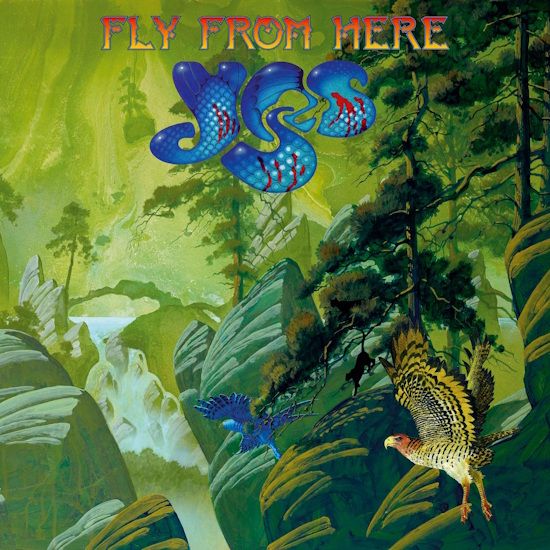
If Wikipedia is to be believed, Yes with Oliver Wakeman had not only brought Trevor Horn back for production duties but they had also decided to resurrect the old Buggles tune "We Can Fly From Here", a song Yes had worked on during the Drama period in 1980. To the best of my knowledge they recorded the song back then or at least demoed it. It became part of the live set on the Drama tour, at any rate.
So Horn returns to the fold as producer and suggests that the band turn "We Can Fly From Here" into a side long epic and do so with Geoff Downes behind the keyboards. And thusly a second member of the Wakeman clan departs Yes.
The resulting 24-minute piece of music was christened "Fly From Here" and it came in 6 parts including an overture which introduces us to the piece's themes as any good and proper overture does. Downes' playing here comes in more staccato bursts than Wakeman's did but he ably orchestrates a lush sonic tapestry including what sounds like a recorder/some kind of woodwind thrown in for good measure even if for only a few seconds. Howe gets some good licks in too. White and Squire give the opening some real oomph and make the first 2 minutes a kinetic burst of proggy energy.
Things slow down as part 1 begins. It's the "We Can Fly From Here" that fans are familiar with from the Drama era. David's singing is confident on the verses and simply lovely on the chorus as he more softly intones "And we can fly from here". This is a great song that really moves on the verses with a pulsing bass line and a steady beat that propels the song ahead. The gadarene rush to the sky is adorned with some wonderful harmony vocals all the while. The band still seem to be brimming with enthusiasm despite having already done an electric, fresh-sounding album and canned it.
"Sad Night at the Airfield" opens on a more gentle note as washes of synth adorn an acoustic guitar at the fore. Downes creates an ethereal backdrop for David as he sings "ghosts are in the empty corridors". Squire gets a solo in as does Howe with his pedal steel. This is a wonderfully moody song that picks up a bit at the end but never loses a melancholy feeling of loss. "Madman at the Screens" continues the moody feel amidst the return of Downes' staccato piano. White suddenly pounds out a hectic rhythm on the toms as if the storm that we were warned about earlier in the song has settled upon us. When it got going, I had vague flashbacks to "The Ancient/Giants Under the Sun" as White continued his thunder and Howe's slashing chords added dissonance underneath David's voice.
Until this point, "Fly From Here" had basically been Horn and Downes' baby. "Madman at the Screens" ends with a piano playing that song's main melody before ceding to a brief piece by Howe, the bouncy, upbeat "Bumpy Ride". The winsome interlude sounds quite out of place coming after the preceding 20 minutes which are much darker and dreamlike. But its playful melody has the saving grace of segueing quite effectively into the soaring chorus of the final section which is a reprise of the first.
"Fly From Here" is, I believe, the longest song Yes ever made. With an abundance of good melodies and great playing & singing all around, it works. I enjoyed the overall feel of the song which is darker than is customary for the group. Nothing despondent, mind you, but the imagery is of abandoned planes, an oncoming storm, and "formless memories lingering". The songs paints a shadowy world with ghosts seeming to hover at the edges. But the chorus of "And we can fly from here" is quite beautiful and provides hope of escape in the beginning and at its return during the finale.
"The Man You Always Wanted Me to Be", a holdover from the Wakeman sessions, makes for a nice come down from the epic title track with its poppy feel and more direct lyrics. "Life On a Film Set" is another reworking of a Buggles song dating back to the early 1980s. It begins with a darker feel like the album's title track but Howe turns things around with some jaunty strumming on acoustic guitar while Downes adds a jig-like synth line. The song's ending is marvelous with White's drums sounding thunderous while Howe's guitar takes on a menacing quality with some slashing chords.
"Hour of Need" is another tune from the Wakeman sessions that was kept on. "Solitaire" follows and is the first Howe solo acoustic piece to grace a Yes album since "Masquerade" on Union, methinks. It's quite gorgeous as it bounces from one section to the next with something vaguely country flavored a la Chet Atkins yielding to what I think of as being more classical guitar sounding.
"Into the Storm" closes out the album. I've written plenty about it already as it too is a refugee from the brief Oliver Wakeman era of the band. The version here is mostly the same as the one on From a Page and the liner notes credit Wakeman with keyboards here. Gone, however, is his exhilarating organ work with Howe and Squire coming to fore during those parts. Plus it sounds like Downes added some of his own synth licks and I certainly cannot blame him. Its reprise of the title track's "And we can fly from here" at the end makes for a satisfying resolution and now makes sense, if you will.
Considering the band had already made a great album with Oliver Wakeman, that they recorded another half an album plus of great music is testimony to just what a fertile period this was for the band. 40+ years in and Yes were still making vibrant, spirited music and had arguably regained some vitality that had been lost along the way as the band muddled through the late 90s. The Horn/Downes songs here have a different feel than the rest - as I've said already, they have a darker feel to them and Downes' playing includes a lot of manic staccato stabs of piano. Their stuff has a retro New Wave feel to it - some serious Drama vibes.
I've described a lot of the songs here as being energetic and, while I don't want to sound like a broken record, it's true. Alan White's drumming often propels these songs allowing Chris Squire to lay down some groovy melodic bass lines. There's a lot of dynamics here and I think that Benoît David's voice is outstanding. He is able to tread a fine line between sounding like Jon Anderson and Trevor Horn without slavishly imitating either.
While some of the material here dates back to 1980 or so, the album itself sounds fresh and vital. It does not sound like a bunch of prog rock pensioners - Benoît David excluded, of course, as he was only in his mid-40s when he recorded this album. I feel a bit ashamed at not having delved into this album upon its release in 2011. Better late than never.


No comments:
Post a Comment