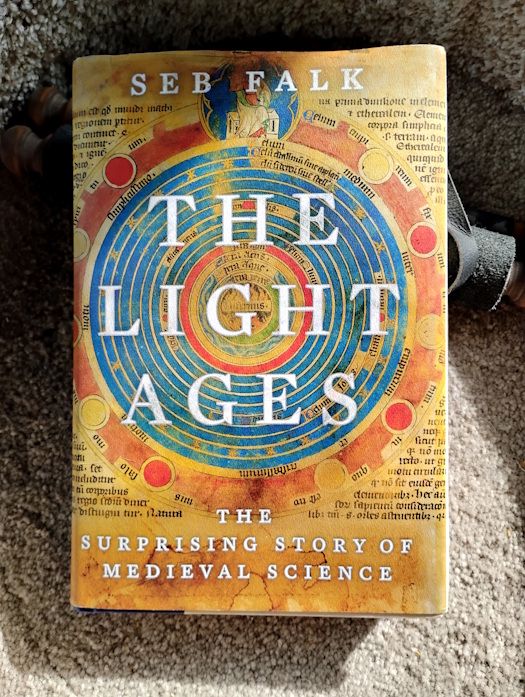
It's been a couple months since I finished The Light Ages so it's not fresh in my mind. We start with the discovery of a manuscript that describes the construction of an astrolabe. Geoffrey Chaucer is attributed authorship but it turns out it was written by a monk, one John of Westwyk.
I thought this was going to be a broad survey of medieval science demonstrating the many innovations during the period derided as the Dark Ages. Instead we let John of Westwyk's life guide us as his wanderings and the people he encounters serve as the launching pads for investigations into medieval learning. The book's emphasis is on the rather amazing mathematics and astronomy of the medieval period. Astrolabes were like the Swiss Army knife/smartphones of their day. Sailors needed to know where to sail, Christians needed to know when Easter was to be celebrated, healers wanted to know where a given planet was at a given time, and so on and so forth.
Mankind has looked to the skies for thousands of years and men created precision instruments like astrolabes and clocks long before the Industrial Revolution. They conceived mathematics that explained what they saw in the heavens long before Newton and Leibnitz.
A fascinating book. While it doesn't cover many areas of medieval knowledge, it does go in-depth into astronomy and mathematics and does good on its subtitle. This was indeed a surprising story and showed that there was much more than superstition capturing the minds of people during the Middle Ages.
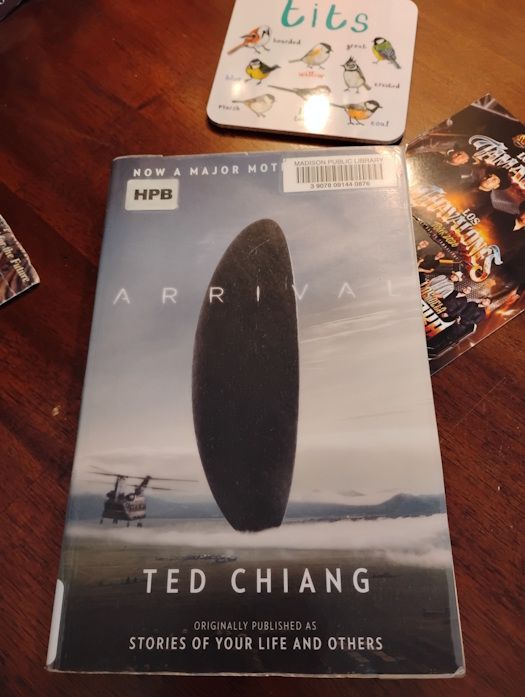
I watched Arrival on my flight back from England back in September and resolved to read the short story that it's based on, "Stories of Your Life" by Ted Chiang.
The tale is only about 50-60 pages, if I recall correctly, and it was easy to see how the film's script was forged from the source material. The stories are mostly the same in the broad sense and in much detail. But it's the differences that really count.
Minor ones include the thingies that actually come to Earth. In the movie they're big spaceships that our heroes must ascend into to meet the aliens behind large windows while in the book, these screens come down to the surface and are activated a bit like televisions. Another difference is that the short story has no scene where disgruntled young men who consume the rantings of the likes of Alex Jones try to kill the aliens.
The biggest difference is that Chiang's tale is littered with flashforwards that strongly hint at the linguist's ability to see into the future whereas that was more of a big revelation in the film. (Right?) Not only does the question of being able to change the future if you know it come into play but also what would it do to a person if they could not only mold stories about their lives from their past but also their future?
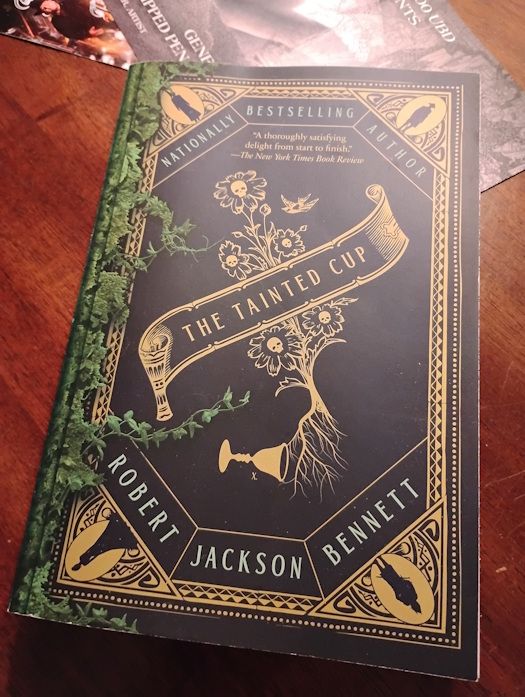
I saw mention of The Tainted Cup months back but I do not recall where. It wasn't until after I had bought it that I learned that it had won a Hugo award. What attracted me was the murder mystery aspect of the plot, that it fit into the fantasy category didn't sway me one way or the other, though I admit that I am not a big fantasy reader.
The setting is the Great and Holy Empire of Khanum. We get a map of it and can see that it is a coastal domain. Every wet season gigantic creatures called leviathans emerge from the seas and attempt to make landfall which is quite bad for the Khanumians. And so they've erected massive walls to keep out the unwanted visitors and fortified them with various range weapons. If the term "fantasy" gives you Silmarillionphobia and you tremor at the thought of epic creation stories and lengthy family trees, fret not. This is the majority of the fantasy world building that the novel gives us. We get a bit more about the various cantons that the empire is divided into and the various social groups that make up hierarchies but that's about it. We get enough to drive the plot and deepen the mysteries that unfold.
Oh, I suppose it bears mention that magic is alive and well in Khanum. Most important is the use of magic to alter people. Dinios Kol, a.k.a. - Din, has been altered so that he has extraordinary memory and recall abilities. A young man, he has been assigned to Ana Dolabra, a detective with a reputation as an eccentric. Ana doesn't like to leave her residence, much preferring to don a blindfold to sharpen her senses and her mental acuity as she speaks with those who come to her home.
And so she dispatches Din to examine the scene of a particularly gruesome botanical death. An imperial officer, Taqtasa Blas, was found dead in a mansion belonging to one of the most powerful aristocratic families in all the land. Din is surprised to find that the cause of death was a tree that grew from inside his body and sundered it apart.
Blas led the engineers whose work protects the empire from the leviathans and soon after his death, there is a breach in the sea walls that allows a giant inland to wreak havoc. Soon Ana and Din learn that several engineers whose duty it was to keep that section of the walls in good stead have died - in the same manner as Blas.
Since Ana doesn't like to leave her home, Din goes out and does the majority of the legwork. He commits the scenes and interviews to his supercharged memory and returns to Ana where he spills the beans. In turn, Ana uses her experience and nimble mind to make all sorts of deductions and postulations.
Bennett does a very nice job of broadening the mystery, of introducing us to new characters, new regions of the empire at a very deliberate pace. We don't just get a heap of stuff dumped on us, we get everything at a speed that allows us to digest what we've been given before moving to something new.
Din is young and attempts to conceal a secret of his from Ana. He is also from a poor background so we come to understand the decadence and corruption of much of Khanumian aristocracy through his eyes. We get to know a group of others that assist with the investigation with Tazi Miljin standing out for me. He's a war hero, a grizzled veteran who proudly sticks out for his incorruptibility. This is your typical working class guy who shakes his head a lot at the behavior of his superiors but ultimately isn't interested all that much in rocking the boat. Ana too has a past that she must contend with.
I thoroughly enjoyed The Tainted Cup. It was a fine mix of procedural, character study, and world building. The initial death had me hooked and then Bennett drops the bomb that many others died the same way and it was buy the ticket, take the ride. No going back. He masterfully introduced and then deepened & widened a mystery, built a new world, and let us get to know a selection of characters at just the right speed for me. The book is a rich stew that simmers most of the way through until it reaches the boiling point at the end.
The opening scene when Blas' death revealed has some serious Annihilation vibes for me and so remains quite memorable. But the scene that hit me on a gut, emotional level came towards the end of the novel. Our gang of investigators is out seeking a soldier named Ditelus whom they suspect is a collaborator with the brains behind all of the deaths. Ditelus is what they call a crackler, someone whose body and strength has been enhanced via magic. They find him hobbling along far from any town mumbling about going home, though his homeland had been destroyed several years ago. In my head he was this Lennie Small type led by the novel's villain and he just had a ton of pathos for me. He knew he was going to die and just wanted to go home. He wasn't this big, bad guy - more of a big child. The scene just had this dark fatalistic feeling to it that really had me in its grip.
The Tainted Cup is the first entry in what is currently a trilogy and I am looking forward to the digging into the second book. It will be interesting to find out if we learn anything more about the leviathans as they are not simply big, threatening creatures. Their corpses literally become part of the landscape in addition to being the source of some magics. They are more than a simple menace and I wonder if the leviathans as a type of ritual sacrifice will be further explored in the series. Plus characters note multiple times that they have increased in size over the years. Why is that?
Ana's past surely has more to it than we know. Perhaps an explanation for her peculiarities? Plus Din is young so he will surely mature as the series progresses.


No comments:
Post a Comment