Showing posts with label Charles W. Anderson. Show all posts

12 November, 2025

Lockean anthimeria

I have started listening to Charles Anderson's ILS 206 lectures from, oh, the late-80s. ILS is Integrated Liberal Studies and the course is called "Western Culture: Political, Economic, and Social Thought". I took one of Anderson's classes back in 1995 or thereabouts - PoliSci 45something - and it was fascinating. That course picked up where ILS 206 leaves off, although there was a little overlap, and examines modern iterations of Liberalism. Liberalism as in prioritizing freedom and giving government a minimal role.

listened to ILS 205 earlier this year and read the required readings listed in the syllabus. Reading Plato's Republic was fascinating, even if not particularly fun. I got to read the bit which, I presume, influenced Wells' The Invisible Man about how, if a man were invisible, he'd act with impunity like a god. Plus the Cave Allegory, the biggie. Aristotle (and Aquinas too) was confusing, though I found the concept of the polis interesting. The whole "man is a political animal" idea was explained which I found fascinating. It is natural for people to form communities for the common good. Furthermore, it is by being a member of such a community that a person becomes good and cultivates virtue. (Or was this Socrates?) Regardless of any confusion, it was a most interesting few months of reading and listening about the origins of Western thought and its early incarnations.

ILS 205 ended with the Scientific Revolution and 206 picks up on it namely in the form of social contract theory. I read some selections from Leviathan by Thomas Hobbes and just finished John Locke's Second Treatise of Government. The Declaration of Independence reads a lot like its early parts and later Locke inveighs against taxation without representation.

Aside from the familiarity of some of his propositions, I have to say that he doesn't justify the use of the State of Nature well nor the idea of the social contract. That people come together and enter into a social contract in order to establish a government essentially comes down to "Well, Rome and Venice were founded by free, equal men coming together and a bunch of folks in the Americas practice something like that too."

He quotes Josephus Acosta, whom I just looked up, a Spanish missionary:

"'There are great and apparent conjectures,' says he, 'that these men [speaking of those of Peru] for a long time had neither kings nor commonwealths, but lived in troops, as they do this day in Florida - the Cheriquanas, those of Brazil, and many other nations, which have no certain kings, but, as occasion is offered in peace or war, they choose their captains as they please'".

I'm not sure the governments of Rome and Venice were constituted by a group of men who were completely free and on equal footing. (Something about 2 brothers suckling at the teat of a wolf comes to mind.) And these American "troops". Are their situations really analogous to anything in Europe? OK, sure. Small towns in Switzerland, perhaps, but we haven't gotten to Rousseau yet. How much can the lessons of tribes in the Americas be applied to the cities of the Enlightenment? Color me skeptical.

Towards the end in a section on the dissolution of government, Locke, who credits legislatures with having the most power, comments on situations in which it is legitimate to disobey a king. He quotes William Barclay, who had a hard-on for monarchies, at length. In Latin. Locke then presents the quotation in English.
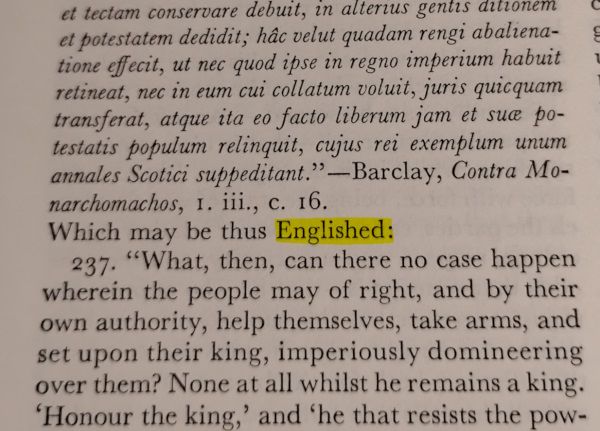
Notice his use of the converse of a gerund, a noun turned into a verb, whatever that's called. So, for all the old duffers who recoil at Facebook users asking to be "friended" or liberals decrying a conservative who was "platformed", know that it's an established practice and even a man of letters such as John Locke did it.

Rousseau is next and I presume I'll hear all about deliberation and social contracts in the cantons of Switzerland.

07 November, 2025

Better Late Than Never

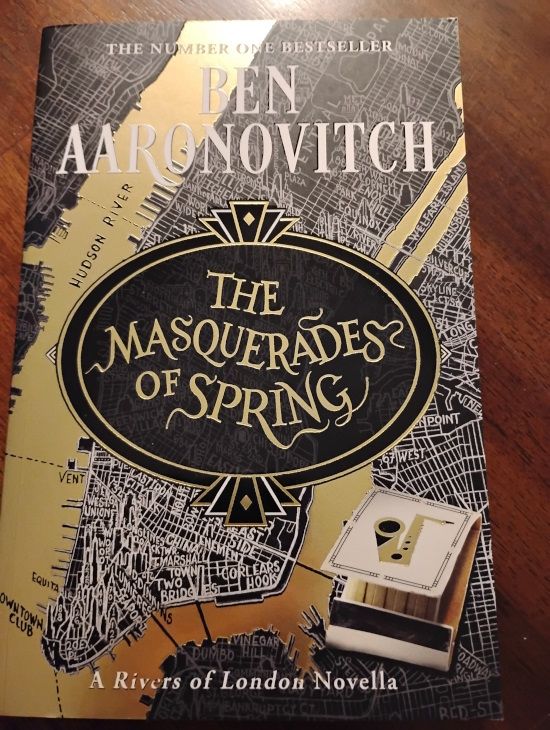
Well, it finally arrived.

I ordered it from Mystery to Me (thanks!) back in August and here we are nearly 3 months later. I wonder what makes it so hard to get a hold of. After 1 month of waiting I found myself in the UK so I sought it out. However, neither the Waterstones on High Street in Birmingham nor the bookstore at the Birmingham airport had it.

At least I have it now. But it'll have to wait to be read. Right now I am plowing through Locke's Second Treatise of Government and this follows on the heels of selections from Leviathan as I am reading and listening along to a recording of a semester of ILS 206 (Western Culture: Political, Economic, and Social Thought II) as taught by one of my old profs, Charles Anderson, back in, oh, the late 1980s.

After reading bits of Hobbes I've decided I need to start using the word "peradventure" more often. Locke is interesting. A couple parts read just like the Declaration of Independence. Or vice versa. And when he goes on about men owning the fruits of their labors I can understand how Marx was influenced by the man.

I expect to get caught up with the Rivers of London series just in time to find out that Aaronovitch has released a new novella.

25 August, 2023

UW-Madison is going through changes

A couple months or so ago, I was spending some quality time with friends. It was gaming day. As is customary before we begin a Twilight: 2000 or Pathfinder or whatever RPG we are playing, we BS about the events of the day, the state of Madison, property taxes, etc. The usual fodder for middle-aged men.

Some time is almost always devoted to all of the new construction going on in Madison, all of those shiny, new apartment buildings. We started talking about the luxury student housing being built near campus. The idea that college students at a state school could afford luxury apartments was foreign to all of us, even my friend who didn't attend a university.

As a UW-Madison graduate, hearing stories of kids (their parents, really) paying 4 figures monthly for rent seems almost absurd. I get that times have changed and there's inflation and whatnot. But still, students in luxury apartments?

I think it seems so alien to me because most of the people I knew when I attended the UW were not from wealthy families. They were from average middle-class homes and hailed from Marinette, Two Rivers, Mosinee, Portage, Green Bay - and several were farm kids. My friends and I pondered if the UW was accepting fewer in-state students in favor of those from out of state or even from another country as folks in these latter groups get charged higher tuition.

While we found an article from 2019 saying that that year's freshman class had the fewest kids from Wisconsin in it in 25 years or more, I don't think we found a whole lot of data and nor did we try. At the end of the day, we concluded that there were fewer Wisconsinites at the UW-Madison and that the student body, overall, came from wealthier families than 30 years ago because why else would developers being falling over themselves to build luxury student apartments?

I was reminded of this conversation recently when I began listening to lectures by this fellow:

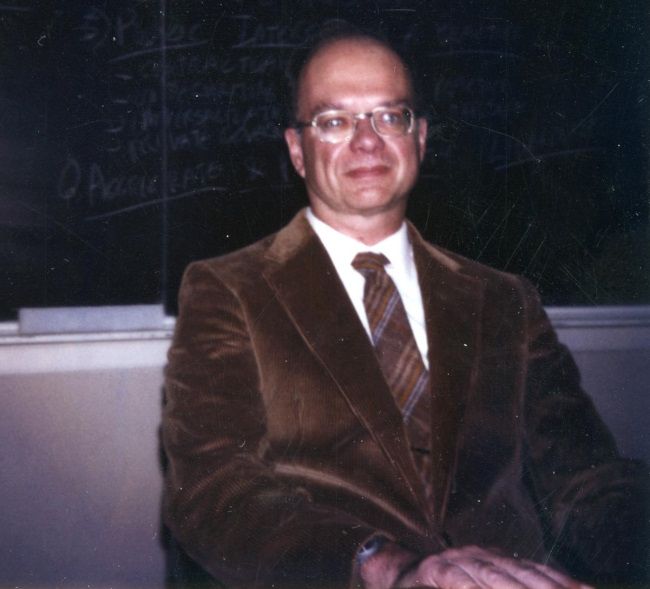
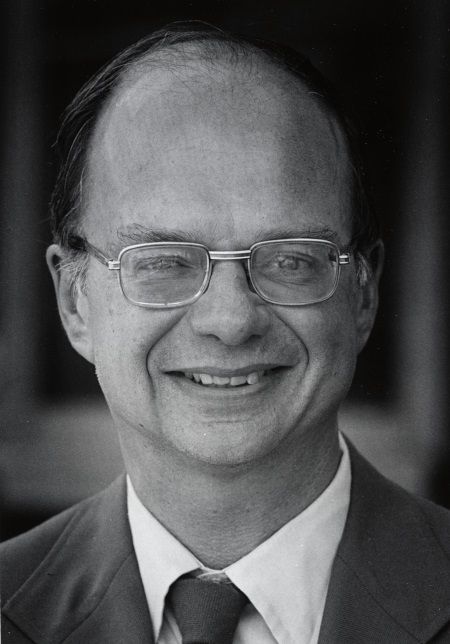
This is Charles W. Anderson, a former political science professor at the UW. I had a class with him my senior year and it was, not only incredibly interesting, but it also had a great impact on my thinking, my outlook on things - how they are and should be.

He also taught courses for the Integrated Liberal Studies program and his lectures for the Western Culture: Political, Economic & Social Thought classes were broadcasted by Wisconsin Public Radio back in the mid-80s on its University of the Air program. There have been a few moments so far that made me think about the UW, those luxury apartments, and how the institution has changed over the years since I attended it. Anderson made references to things that assume that the vast majority of his students, if not all of them, were from Wisconsin.

In the very first lecture, which is an introduction to the course, he says at one point, "In the old Vince Lombardi style of teaching..." Here we have the assumption that his students are from Wisconsin or are Packers fans or football fans or some combination thereof to know who the legendary Packers coach was.

Later, in the third lecture, Anderson is talking about ancient Athens, the cradle of Western democracy. He notes that the city had roughly 250,000 inhabitants with 100,000 of those being slaves. Of the remaining, only 30,000 - all men - could take part in the city-state's democratic process. He likens that number to the population of Manitowoc. I think he is assuming that the great majority of students before him were from Wisconsin and would know of Manitowoc.

In the following lecture, again we're talking ancient Greece, he mentions the Greek goddess Demeter and says, "Some of you who've been with Future Farmers of America or groups like that might have encountered the group the Daughters of Demeter..." Anderson seems to believe that many of his students were from rural, if not farming, backgrounds here.

I'd never heard of Daughters of Demeter but found that the group is still around today and is now known simply as Demeter.

Demeter is a service organization established in 1917 and named for the Greek goddess Demeter – the goddess of agriculture and the harvest. It serves the University of Wisconsin-Madison, primarily the College of Agricultural and Life Sciences (CALS), and the Madison area community. The original organization was called the Daughters of Demeter, and membership was comprised of wives of faculty members in the then-named University of Wisconsin College of Agriculture. Today, while this group is still prominent in the organization, membership is open to both women and men who are faculty, staff, and friends of CALS, along with their spouses, with an interest in agriculture. Demeter currently has about 120 members.

My guess is that a UW-Madison liberal arts professor would not reference a Packers head coach today, nor small towns and cities around the state, and not the FFA/Demeter. Maybe they do and I just don't know about it. I am not a student there, after all. Maybe they do and explain exactly who and what they talking about.

"...about the same number of people who live in Manitowoc, a city in east central Wisconsin on the shores of Lake Michigan."

But Anderson never explains these things. He assumes his students know who Vince Lombardi was, where Manitowoc is and about how many people lived there, and that at least some of them know about youth organizations that promote agricultural training.

But it's also possible that Anderson was just being an old duffer and saying whatever he felt regardless of the composition of the class. Or perhaps he was taking into account that he had a radio audience.

Still, listening to these lectures gives me the impression that the UW circa 1985 had a much higher percentage of students from Wisconsin than it does now and also a student body that had a higher percentage of kids from rural areas than it does today.