Showing posts with label Doctor Who Short Trips. Show all posts

12 September, 2023

Bad Santa (and a Farewell to the Second Doctor)

My Second Doctor marathon comes to a close with a Christmas tale from Mark Michalowski.
If a story told by letters is epistolary, then is there a term for one told by someone within a story?

That's the case here as a teacher named Miss Bennett has, at the recommendation of a Miss Wright (Polly, presumably) brought in the Doctor to tell her class a Christmas tale.

Santa is out in his sleigh doing his thing when the TARDIS suddenly materializes in front of it. In goes the sleigh with Dasher and Vixen and all the other reindeer. The procession comes to rest in an enlarged console room and the Doctor greets St. Nick. He mentions to the South Pole's most famous resident that they had met before when the Doctor was with two friends of his, John and Gillian. These are, in fact, two of the Doctor's grandkids who appeared in the so-called "TV comics" but I am unsure what this means. In some sort of equivalent to TV Guide? I haven't been able to track them down which is, perhaps, just as well given the quality of comics of this time.

Anyway, the Doctor proceeds to tell Santa that he knows of his clones and of the wormholes in space they all use to get presents delivered on a timely basis. Bluntly, he asks Santa to quit delivering presents. Like some Yuletide version of Paul R. Ehrlich, he warns that, as Earth's population grows and humans spread out over the galaxy, things become less cheerful. The Doctor shows Santa a future with thousands of dark satanic mills that are needed to feed the demand for presents for billions and billions of children and he warns that all of those wormholes that'll be required to have Santa simulacrums do their duty will wreak havoc with all of those luminous threads that make up the web of time and space.

The Doctor decides to take over Santa's rounds and deliver presents himself. His first stop at Suzie and Timmy's house doesn't go well. They want a ghetto blaster and computer games but all the Doctor can fish out of his capacious pockets are a bunch of flowers and a nooild, which is a telepathic translator. Unfortunately, it won't work on the kids' cat, Trixie.

The kids' dad shows up and starts manhandling the Doctor but, luckily, Santa appears and puts things right.

Santa and the Doctor agree to work together on robots to take the place of Santa clones and safer, more environmentally friendly wormholes so as to maintain the integrity of the Time-Space Continuum.

A very humorous holiday tale. I could just picture the Doctor fumbling through his pockets while some skeptical, impatient kids waited for some decent presents. This may be a rather insubstantial way to bid farewell to the Second Doctor, but it was a lot of fun.

Watching the Hartnell era, I saw the show's conventions being devised and many of its favorite tropes that we'll see over the coming decades appear for the first time. With Troughton, the show really feels like it should, it feels like it has since his time. The Doctor goes from being an old, grandfatherly figure, to a more avuncular one, albeit like a crazy uncle. He had a warmer rapport, overall, with his companions.

The Second Doctor was written, like all of them, I suppose, inconsistently. I think of him as having a playful side and an occasional charming forgetfulness. Whereas his previous self would charge in lobbing grenades of opprobrium, this incarnation would try to cajole first. For me, there has to be some whimsey to go along with the Second Doctor instead of merely a slavish adherence to duty. Do-gooding is necessary in portraying the Doctor but not sufficient.

You can see Troughton in the nascent Seventh Doctor as well as in the Fifth Doctor with those, "Well, that didn't quite go as planned" moments.

Jamie sticks out as the best companion but I enjoyed Ben and Polly as well. Zoe was a fine companion too but she didn't get nearly the number of good lines as Jamie did and she also didn't get to be a computer whiz as often as Jamie got to be a man of action. At least she fared better than Mel as computer things went. 

We meet the Brigadier in "The Web of Fear" and Troughton gets to play the Doctor and the villain in "The Enemy of the World". I loved the wire work such as in "The Underwater Menace" and Mr. Quill's expression in "Fury From the Deep" is just classic. The Cybermen evolve over the course of the Second Doctor's tenure and those stories never seem far from writers' minds even here decades later. "The Tomb of the Cybermen" is just a blast and deserves all the praise it gets. And "The Mind Robber" was pleasingly surreal.

The writers for the DW Annual stories failed to notice that the Doctor had regenerated into someone who doesn't call those he travels with "children" while the illustrators were similarly in the dark about the new companions.

The novels and short stories continued to bring our beloved hero into new and interesting scenarios that could have never been realized on TV. I really enjoy the Christmas themed short stories and, amongst the novels, enjoyed the The Dark Path, a Master origin story. And, contra my statement above, I also found The Indestrucible Man to be great read despite the absence of whimsey on the Doctor's part. The plot and characterization were enough for a change.

So auf wiedersehen, Second Doctor. We'll see you again in "The Three/Five/Two Doctors" and a future PDA or two.

While I won't start my Third Doctor marathon for a few months yet, I am hoping that the DW Annuals get their shit in gear. And I am done with animated reconstructions, not that I minded them. It should be fun and I am looking forward to it but need a break as I have lots of other non-Doctor Who books to read, movies to rent, and a couple of Call of Cthulhu scenarios to prepare for as I'll be running them at Gamehole Con next month.

The Long and Winding Blue Road


The planet Ost, 1170 by local reckoning. The leader of the Anki, Raysa, is with her Mekash or apprentice, Nayab. Things are looking grim as the Anki are fleeing to the desert from hordes of the evil Asposti. Raysa and Nayab are "sharin", the singers and dancers of the Anki.

We then flashback a couple of hundred years and meet another Mekash of the Anki named Demik. He is a student of the dances and songs of his people and we readers learn that the dances are magical. These sharin types are something like bards, apparently, if I may thrown in a Dungeons & Dragons reference. The magic of the dances can manipulate nature, whether it be replusing a storm or easing the pain of the sick. One day he goes on something akin to a vision quest. Demik heads into the desert in search of the First Singers, the gods of the Anki. He hopes that they will teach him a new dance.

He comes upon a ledge and atop it is the TARDIS. It dematerializes but Demik has the gift of second sight and sees a "blue scar" where it had stood that appears as a knotted line. Thinking it a sign from the First Singers, he makes his way up to the ledge where he tinkers with the knot and dances before it. His terpsichorean cantrip opens a gap in the fabric of reality and before him lies a blue road which leads Demik to the door of the TARDIS where he finds the Doctor standing beside his ship.

The Doctor recognizes that Demik is in danger and offers help but the Mekash stumbles and falls back to the world from whence he came. But he is now a sharin with a new dance - the Blue Road Dance - which opens a portal to another world where a First Singer has help on offer.

Back in the desert, Raysa and Nayab are running out of hope as the Asposti are closing in. But then they stumble upon the site where Demik found the TARDIS and Raysa performs the Blue Road Dance in order to open the portal and let what's left of her people flee.

The pair manage to enter the portal and now walk the Blue Road.

We are then transported to the planet Eshraya where the Doctor has just arrived after leaving Ost and the intriguing Demik. He contemplates the blue stain next to his TARDIS and as well as the weird power that Demik, who just left, demonstrated. The Doctor is apparently a Beatles fan as we heard him play "Hey Jude" previously and here his recorder "tootles" out a bit of "Across the Universe". Suddenly he hears a woman's voice.

At first, the Doctor is unable to touch or do anything with the blue stain. Then he relaxes and just falls into it. Both he and Raysa are taken by surprise when our Time Lord tumbles into her arms seemingly from nowhere as she stands on the Blue Road. He convinces her to reconsider her dancing and to dance as the situation demands, not necessarily in strict imitation of the sharin before her.

The Doctor offers a little recorder music for Raysa who dances and this opens a portal to Eshraya. She and Nayab are able to save the remaining Anki. Several years later, Nayab is contemplating the blue knot left behind when the TARDIS left. He figures that it will lead to everywhere the Doctor has been. Wanderlust is urging him to hit the Blue Road once again and follow the TARDIS. After a little cajoling, Raysa acedes to his request.

The marauding Asposti come across as the Romans with the Anki being the Jews at Masada. Sadly, there's no Jamie here - I guess we've heard the last of him - and the Second Doctor comes across as being very true to form, despite the paucity of words dedicated to him. This leaves us with the Anki. I thought it was really neat that their First Singers are kind of like the Ainur and sang the world into existence. It was also really hoopy that the sharin practice spellcraft by dancing.

Although this story had a rather serious tone - the Asposti appear to not take prisoners, after all, I enjoyed how Milton wove some mysticism into a novel take on travel through the Vortex. From the prose, I could see Troughton's expression when Demik stumbles upon him as well as when he fell into Raysa's arms.

I am not usually a fan of "primitive people" Doctor Who stories but I thoroughly enjoyed this one.

11 September, 2023

In the Earth


Something lies waiting underground, beneath a derelict housing estate. For how many aeons, no one knows. It feels the throbbing energy of the city above. A group of teenage girls are watching what appears to be trashy daytime television, tabloid TV with its endless stream of anger and spite, as the venal parade their tawdry tales before everyone. The girls' glee at witnessing the dingier side of humanity filters down through the earth, animating the waiting golem.

It emerges from the clay and dust onto the surface. Looking down in a puddle, it sees the reflection of a girl. Ready to wreak havoc, it finds that the Doctor is there waiting. He tells the golem that the time is not right for the Earth to have its revenge on humanity. In a fit of rage, the golem disintegrates, the dust returning to the earth.

What a weird, chthonic little tale. Lizzie Hopley, whose name rings a bell, has a somewhat overwrought writing style here but I really enjoyed it. I liked how she alternated the primal descriptions of the golem with the trash on the TV, giving a snapshot of humanity that finds us wanting. I wonder if it's a social commentary that the wicked energy of teenage girls is able to bring a monstrous being to life.

Still no Jamie, alas.

Hands off the threads, creep


In India long ago, the Second Doctor visits a maharaja. The Time Lord obviously enjoyed himself as he stayed for several days. He and his host "spent many nights discussing the universe". But the newcomer arouses the suspicion of the maharaja's magician, Nehra.

Nehra noticed that this other magician left a blue box in the cellar of the palace and decides to investigate. He finds that he cannot open it and that the mysterious case resists all investigation into its workings. Frustrated, Nehra turns to magic, a cantrip which would reveal the blue box's history to him.

He is amazed to have a vision of the Earth viewed from afar, with "luminous threads" wound around it, with many of them seeming to come from the blue box. More threads spring into being and, again, many of them are seen to emanate from other, similar, boxes. Sensing evil at work and that the threads of fire are a threat, he summons a demon named Vishathra to cut the threads.

As Nehra and Vishathra are chatting, the Doctor appears and tries to convince the magician that his plan is not a good one but to no avail. The demon moves to cut a thread and suddenly disappears. As the Doctor explains, the threads he saw were not choking the maharaja's empire, but rather they were the threads of the Web of Time. Vishathra had mistakenly cut his own thread, his own link to existence.

Realizing his mistake, Nehra vows a regimen of self-abnegation and asks how he can atone for his misdeeds. The Doctor urges him to pursue science and give him some time to think on how best to make amends.

The Doctor takes off but the TARDIS rematerializes before Nehra just seconds later. The Doctor steps out but Nehra does not recognize him. 

"Where is the Doctor?" he asks.

"'That,' he said with a smile, 'is a very long story.'"

A neat little tale. Vishathra was funny as he was a bit reluctant to go around cutting the threads. When told of the threads closing tightly around the world, he replies, "And this is...bad?" I appreciated the more light-hearted tone here after the more serious "Dust".

I am beginning to despair that I will never read of Jamie again.

Mark Michalowski's name rang a bell but I couldn't identify him immediately. I then realized he wrote the Seventh Doctor PDA Relative Dementias. This made me think about how I have not really tried to connect the themes/motifs that authors have deployed in their short trips with those used in their novels. I don't recall anything this light-hearted in Relative Dementias but my memory could simply be faulty. Perhaps I'll start this with the Third Doctor.

Dust in the Martian Wind

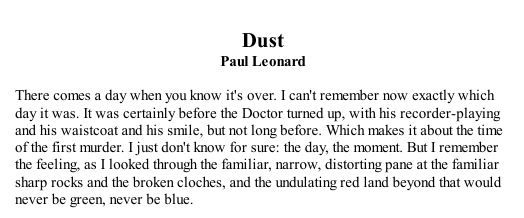
This tale is told by one Jovian Pallis, a man approaching middle age and who is a member of an early Martian colony. He tells of being in love with a woman named Marissa, who was 16 years his junior, but he never actually got around to letting her know of his feelings for her. She died out on the Martian surface as a seal that was part of her suit's air supply apparently had a crack in it. Pallis isn't distraught, though. It meant the end of his anger at not having her in his life the way he wanted.

We learn that Pallis, along with a woman named Isabel, are the ones responsible for the daily check of all the space suits and their air supplies. Hmmm... 

And then a man named Uther dies. He died out in the Ponds, which are the Martian equivalent of those lakes of toxic sludge in China that unscrupulous smartphone manufacturers just dump all of their waste into after those iPhones are shipped off.

And then the Doctor arrives and quickly enters Hercule Poirot mode. He deduces that Pallis killed both Marissa and Uther. Marissa because he couldn't stand the thought of having to live in the same environment as the woman who was the object of his theoretically unrequited love. And so he poisoned the air in her suit. Uther was an accident. Isabel was harboring suspicions about Pallis so he poisoned the air in a suit he thought she'd take but Uther carelessly grabbed it instead.

In order for the colony to continue for another 2 years until the next transport ship arrives, there must be no more killing. So the Doctor takes Pallis and drops him off on a planet by himself where he can live out the rest of his days.

This recent spate of short trips have largely featured a protagonist who wasn't the Doctor or a companion. But none until now had one that was a killer. We learn that there were murders at the colony in the first paragraph when Pallis tries to recall when he felt it was "over". He places that moment "about the time of the first murder". Still, I didn't recall this until much later in the tale when I should have thought about it on the next page.

Pallis comes off as unstable and rather pathetic. He describes himself as being physically clumsy but we learn that he is also socially clumsy as he never even reveals his feelings to Marissa.

"My thoughts are often disconnected, as well," he admits. "I leave behind me a chain of random associations, incomplete tasks: half-empty mugs, dropped clothes, abandoned poems."

I really liked this peek into the mind of a madman and murderer. From Pallis' descriptions, it seems that his state of mind really mirrors that of the colony. There's the Ponds and the fact that funding for the colony is slowly dwindling. It is simply in a pitiful state. And I don't recall there being any explanation for the Doctor's appearance, which I thought was neat. He just comes in with his crime-solving skills blazing.

It is a nice change of pace to have a villain that is a bit banal. Pallis is not some megalomaniac bent on ruling the universe, but rather an average Joe who has watched the Martian dust creep into everything, despoiling the colony, and has lost touch with reality, perhaps, amidst the isolation. The colony was a failure, if he is to be believed, and they're all stuck there.

Still no Jamie.

"Hey Jude" on recorder? Yes!


A very average and very drunk solicitor, Dan, is hitting on a lovely young woman who is, against all improbability, receptive to his beer-sodden overtures. I had visions of the woman looking like Scarlett Johansson and of Dan drowning in a pit of black slime. Instead, he is lured to an empty Underground platform by the temptress.  He boards a train with her where he finds a bunch of passengers with blank faces just staring off into the distance. Oh, there's a slimness challenged guy named Dobtcheff there too. The Doctor interrupts his rendition of "Hey Jude" on the recorder to help out our poor solicitor. Our hero is held at bay by the pretty lady, Martha, or, more accurately, her gun. The passengers then start some weird occultist chant that left me waiting for Nyarlathotep to pop up and the Doctor manages to rescue Dan.

The Doctor probes Dan's mind and discovers that there is an alien at work here. When they return to the train, Dobtcheff is losing his human form. He has drained some alien essence from the other passengers allowing him to transform. In the process, it killed the innocent humans. You see, Dobtcheff is the last surviving members of a mission to Earth from the future. His race came unannounced to our fair planet seeking humanity's help. But our primitive monkey brains panicked, became fearful, and we proceeded to destroy their ship. The being that is now Dobtcheff fled in an escape pod which was thrown into the past. He put his life essence into a human fetus and he is now reassembling it from the descendants of that person.

The alien realizes that its quest to become whole again is just a quixotic dream. So it decides to take revenge upon humanity by having its escape pod, which is burrowing through the earth in a bid to return to its owner, self-destruct in a rather big boom. Dobtcheff attempts to pull some essence from Dan but the Doctor foils this last ditch vampiric maneuver which causes the alien to die.

Despite starting on a somewhat light-hearted note, "Reunion" ends on a rather serious one. Dobtcheff isn't a malicious invader but he becomes blinded by hate due to circumstances. I mean, who wouldn't have some empathy for a guy who comes in peace only to be shot at?

He summons his escape pod and, as I noted, it burrows through the earth towards the Underground platform. But it is unable to penetrate the tunnel and so it just stops and goes into low power mode. With an alien ship near a tube station, I thought for a moment that this was a prequel to Quatermass and the Pit.

For reasons I can't quite explain, the more humorous elements at the beginning of the story just don't quite mesh with the more serious ones that follow. They just clash in an uncomfortable way for me. Perhaps there wasn't enough of a transition or the light-hearted tone just never returned to bookend the death and woe. But I do appreciate the tragedy here. Dobtcheff is a tragic figure and I found it hard to hate him after learning of how a bunchy of monkey men treated him and his kin.


Doctor Who in 8.5

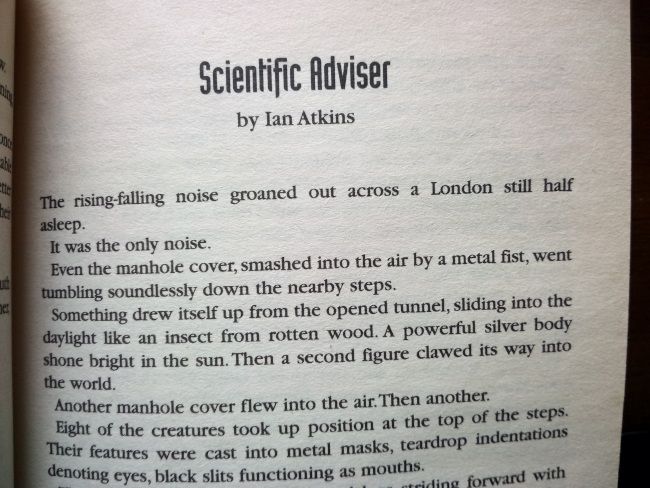
As the story begins, Cybermen are coming out of the sewers. A squad of them gather at the top of some stairs, which I presume are near St Paul's Cathedral. One tries to traverse the steps but falls on its Cyber Butt. Laughs all around on the set of a movie portraying the Cyberman invasion of Earth.

The Doctor is the scientific advisor on the film and, in between offering suggestions for the plot, he meets the director's young daughter, Kate. She is not happy with life on the film set. For his part, the Doctor is attempting to diminish the script's verisimilitude by offering scenarios that the Cybermen did not use in "The Invasion" and ones that probably wouldn't be all that handy for another Cyber invasion of Earth.

The Doctor realizes that Kate isn't just an introverted, withdrawn little kid. Rather, like the girl in "Remembrance of the Daleks", she is under the control of aliens. But instead of Daleks, it's the Cybermen who have a reconnaissance outpost on Earth gathering intel for another attempt at taking over our fair planet. She is using Kate essentially as a bug, gathering all of the Doctor's suggestions.

Once the Doctor uncovers what's going on, he threatens the Cyber reconnoiterers with revealing their presence to U.N.I.T. so they release their hold on Kate and leave Earth.

While the Doctor is the central protagonist here, we do have a little girl in a prominent role which keeps in line with the previous few tales. The Doctor occasionally checks in with the Brigadier and those meetings are rather funny. I could see the Brig's eye rolls coming off of the page. Ian Atkins used a neat style here with the main Doctor-driven plot line alternating with Kate's interior monologue and the Cybermen noting the Doctor's script doctoring suggestions. Just a nice variety.

A fine little tale made all the more fun by picking out references to "The Invasion".

When was the last time we had Jamie in one of these Season 6b short trips?

A Nanci Cruz Mystery Story


This is the third short trip in a row to feature a female protagonist. But, just as last time, the author is a man.

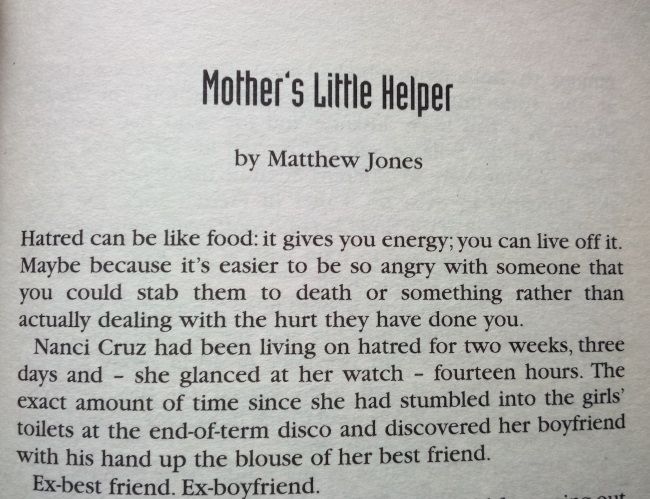
Here's it's Nanci Cruz, a teenager who has moved from American to England. Two weeks, three days, and 14 hours previously she caught her now ex-boyfriend with his hand up her now ex-best friend's blouse. Standing around moping, a boy literally runs into her and Nanci notices that, when he touches her, she gets a warm sensation and all of her misery disappears.

But the boy is being chased by an older woman as well as by a little man with a Beatles' mop top. It turns out that she wants to keep the boy around as an emotional analgesic, to literally suck her negative feelings away, while the Doctor is trying to rescue him. He wants the woman to learn to cope with the problems of life but she refuses.

The woman's hideout is at an old pier where the Doctor tracks her down. Nanci joins him as she wants to see the boy safe & sound. The Doctor manages to get the boy but Nanci is captured by this embodiment of immaturity. They begin a swap of the kidnapped but the woman activates a collar that she has placed around Nanci's neck which causes great and immediate pain. The boy rushes to her aid. He takes Nanci's distress and channels it back to the woman who does not want all of her garmonbozia. She is overwhelmed with creamed corn and spontaneously combusts.

Nanci realizes that, although the boy took away the pain induced by the collar, she still had other stressors such as school. But she accepts these pains and is determined to live with them.

A bit like "Blink" in that a non-companion is the protagonist here, though this is not exactly Doctor-lite. This one had a bit of a fairy tale feel to it with the woman as the evil stepmother and a lesson being learned at the end.


Polly, Pretty Polly


This story heralds the return of Polly Wright. She has gained a modicum of fame by working at a record company called GEZ, attending showbiz parties, and mingling with celebrities great and small. Her boss, John Maurice, dies in what sounds like a tragic BDSM accident and Polly assumes his duties. That is, his duties at the record label, not the ones having a piglet licking ice cream from his toes. One of those is to attend a funeral where she sees the proverbial white light and meets a spectral female lady, you know, kind of like the European in Russian Ark. But instead of accompanying her through British history at the British Museum, it sends her on a temporal shopping trip to find the perfect dress for a Millennium party.

She finds herself first in a medieval dungeon with Maid Marion when suddenly Ian and Susan show up followed by the First Doctor. In rapid fire, Polly is transported to a variety of other times and places including a ship where she knocks back a few with Benny, a cricket match with the Fifth Doctor, Peri, Erimem, and Tegan, as well as the 11th century where she inadvertently gets Adric killed thusly preventing him from being on a freighter that crashes into the Earth and extinguishing the dinosaurs.

It turns out some mysterious entity is having her carom around in Earth's history from one "nexus point", an important moment, I presume, to another causing all manner of havoc. The Time Lords eventually rescue Polly and have their best agents, the Second Doctor and Jamie, on the case. Polly finds herself back at the funeral where she's had some kind of health crisis. Luckily the Doctor and Jamie are there and they've brought Ben with them who gives her mouth-to-mouth resuscitation or the "kiss of life".

Ben and Polly pledge their love for one another and they whole gang see the new millennium in.

A very fun, irreverent little romp that veers away from convention and tells a tale from a companion's point of view. Polly is sassy, somewhat full of herself. We never spend a whole lot of time in any one situation and things move along nicely. Polly's son, Mikey, from whom she is alienated, seems never far from her mind. I think this provides a little grounding and helps her move from being a denizen of the world of celebrity to one enjoying her less celebrated but more real friends.

I think it was here that I noticed that, when an author notes that the Doctor looks older, has some grey in his hair, then we know it's Season 6b. Terrence Dicks noted the grey at the end of World Game to help retrofit "The Two Doctors" and I guess other authors picked up on this as a marker.

I also noted the protagonist here is a woman but that the author is not. No help for my theory here.

Close to the edge, down by a dome wall

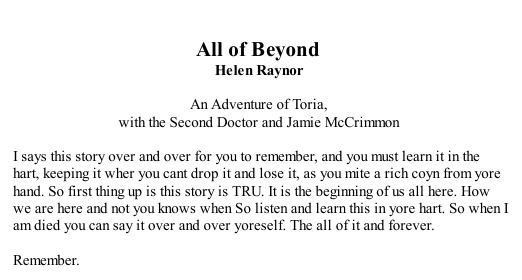
"All of Beyond" is one of those tales where the narrator speaks in broken English and the text reflects this with passages like, "I had a frend, back in the tyme of befor, in you knows when I had plenty frends, but Lissa was the most lyke to me." This kind of thing can take a while to get used to and I had to concentrate on the words throughout the whole of this story.

It concerns a girl named Toria who has wandered from her tribe to ponder the mysteries of life and in punishment. Her friend, Lissa, gave birth to a stillborn child and Toria was secretly happy because she wanted her friend back, to have life continue the way it was before Lissa became heavy with child. And then Lissa fell ill and died.

Feeling badly and blaming herself, Toria casts herself out into the wild, but never goes near the Edge, beyond which her world ends and there is nothing. So she's out in the woods doing some Thoreau-like contemplation when she stumbles upon the Doctor and Jamie. They speak about having landed in a dome, but it's all Greek to Toria. One sausage later, Toria is sitting around the campfire with our heroes and she tells them of how the world beyond the Edge is just a wasteland.

She takes them back to her tribe where the Doctor tells everyone that they live in a dome and that the world beyond the Edge is doing quite well and he intends to show them. He jury rigs some gizmo with parts from the TARDIS and creates a hole in the dome. Toria and her people step beyond the Edge and see a city far off on the horizon.

This is one of those tales that I felt would work better as a longer work. I mean, it was fine as a short story but I'd have liked to learn a bit more about Toria's tribe. I got some Sevateem flashbacks here as well as some vague Beasts of the Southern Wild vibes. While self-contained plot-wise and I think the open ending was a great move, it felt incomplete otherwise. It read like a skeleton waiting to have bits of characterization flesh hung on its bones.

Something I thought of while reading "All of Beyond" was that its protagonist was a female and the author, Helen Raynor, is too. This little literary critic voice in the back of my head commented that the women authors of Short Trips tend to focus on female characters (and eschew action). I don't know if this is indeed true but will try to take notice of this in the future.

08 September, 2023

A Final Supper

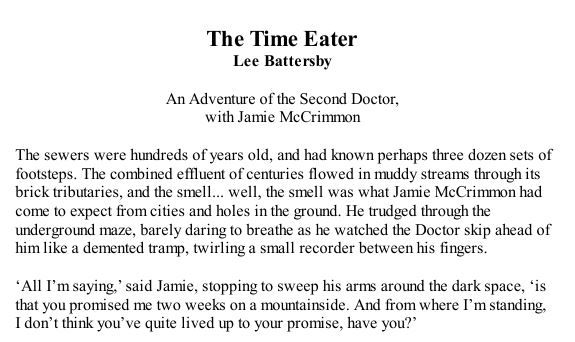
As "The Time Eater" opens, the Doctor and Jamie are wandering some old sewers. They emerge onto the street and the Time Lord thinks they've landed in London. But we, knowing that the book has "Prague" in the name, realize that it's likely not. Indeed, they have landed in the titular Bohemian city.

As they wander the streets, the city seems to move about in time beneath their feet. They zip back to the early 17th century and are then confronted by a tank during the time when it was behind the Iron Curtain. The Doctor pulls out a book of his that documents history and he finds that its pages are crumbling to dust.

The Doctor then has the revelation that this is all being caused by a Doredsor, a creature that feeds on time itself. They set out and find the Doredsor causing time to go all haywire but it is dying. While the Doctor just wants to leave it to its fate, Jamie insists otherwise and his friend relents.

One inertial stasis-inversion field later and the Doredsor is dangling from the TARDIS next to the sun eating its last supper of quantum phenomena. When its time finally comes, it drops into the sun and the TARDIS takes off for its next destination.

I made the mistake, quite innocently, of reading this a few days after one of my cats passed away and, after finishing it, I felt distinctly gloomy. That scene of watching the Doredsor have its last meal brought back memories of being with my cat, Grabby, shortly before her death last weekend. Just watching her in her carrier awaiting the attention of a vet.

Despite the story hitting a little close to home, I rather liked its version of a happy ending which was simply helping another life, another species meet its end with a modicum of dignity.

03 September, 2023

The Crimes of War

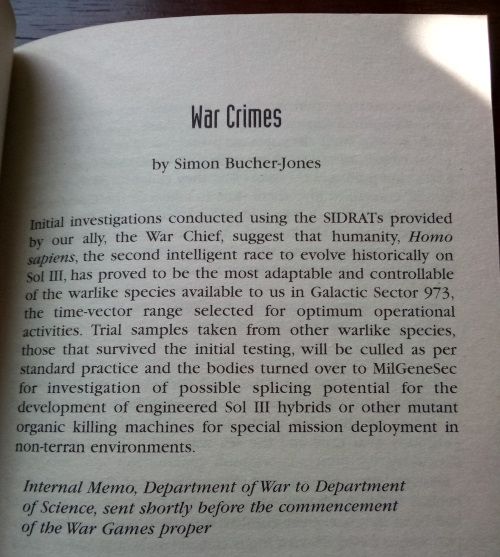
The first tale from Season 6b is a short story called "War Crimes" by Simon Bucher-Jones.

It's a bit of an odd one and begins with a memo written by the aliens responsible for the War Games. We learn that they had an interest in species other than humans. Next is a Time Lord memo indicating that the victims of all the aliens' machinations are to be sent back from whence they came.

The repatriation process went well, for the most part, but a creature named Ossu-male of the Aelcluk clan experienced some difficulties. His deprogramming didn't go quite as planned and he continues down the path set for him by the War Lord and his cronies. His species has a strange way of reproducing which involves the males sacrificing themselves in a poison sea so that the females can get on with the process of having babies without the fear of a male eating some of the young.

There's just enough of Ossu-male left in his brain and he does the right thing and throws himself into the sea.

Later his body washes up on a shore and the TARDIS lands there during the time when the Doctor is trying to evade the Time Lords after sending his SOS box. Ossu-male isn't quite dead and begins to come alive once more. The Doctor sees the pain in his eyes and hastily finds the creature's "off switch".

I guess I was expecting this story to focus on the Time Lords and our TARDIS crew trying to effect an escape but instead got a story about a strange creature and his species' odd mating practices. A neat postlude to The War Games.

18 August, 2023

Into the void

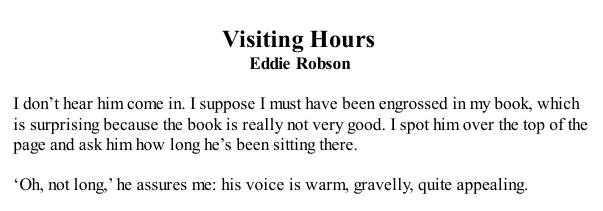
As the story opens, the Doctor is visiting a Miss Woods at some anonymous hospital. She tells him that, despite there being multiple patients there, no visitors ever pay a call. The Doctor learns that she reads only schlocky detective novels so he offers her some titles from his own library that is his capacious jacket pocket. I smiled when the first book he pulled out was Cancer Ward which I assumed was the Solzhenitsyn book. The Doctor, a bit embarrassed says, "You probably don’t want to be reading that."

Our Time Lord hero is there because Jamie is. The patients slip into comas and dream of a void, a "velvety blackness". The Doctor follows Miss Woods into this void using a trick he learned in Tibet, presumably when he wasn't fleeing from Yetis. With all of the strange hospital's patients in the void, the Doctor pulls out a bottle with a bubble wand thingy in it. He blows a bubble which touches the blackness and creates a hole that leads back to the real world.

Everyone is able to escape except for two patients whose squabbling is resistant to mediation and so they are left behind to be "consumed in a flash of light and a shattering roar" which I guess means they blew up real good.

The Doctor explains that everyone was part of some nefarious experiment but he doesn't really have all the details. With Jamie safe, they head out to find Zoe and just who is behind this ghastly research project.

This is a wonderful little tale. I really enjoyed how it began in media res with Miss Woods just suddenly noticing that the Doctor is in her room. Similarly, I appreciated the open ending with Zoe still lost and the minds and motives behind the experiment still unknown. Plus, it's a bit of a weird story with people or perhaps their consciousnesses being transported to a mysterious void. Eddie Robson does well to keep the details under wraps. The Doctor never really explains much and I was kept wondering just what the heck was going on. Well played!

A really fine example of what a Doctor Who short story can be.

27 July, 2023

The giants are not what they seem


When the Doctor reveals that they are frolicking on the top of a research station on the planet Mercury, Jamie frustratingly intones, "Oh, don’t tell me we’ve run out of that stuff again." I smiled a big grin upon reading this.

The TARDIS has landed on a mobile research station that is a bit like the Snowpiercer. But different. Instead of a train racing headlong against the deep frost of a new Ice Age, what we have here is a domed research vessel called the Sunwatcher that creeps like a tortoise along Mercury's equator keeping it in the twilight zone, an area that straddles the blast furnace of the day side where not even the crew of Icarus II would dare go in one of those big suits and the extremely chilly night side which puts our polar vortices to shame. And instead of the last remnants of humanity engaged in a Hobbesian class war of all against all, the Sunwatcher has but a handful of people engaged in much more peaceful pursuits such as looking out for solar flares.

Our heroes' dilly-dallying is interrupted when the Sunwatcher starts to shudder. Then a hatch opens and a woman pops her spacesuited head up. I chuckled when I read that Jamie expected her to blame them for a recent mishap. "Thank God you’re here," the woman, named Alison, says before ushering them inside.

As it turns out, the Doctor, Jamie, and Zoe are not the help she had radioed for. There's a creature onboard and, while it's not killing the crew one by one, people whom it touches go semi-catatonic and say little more than, "Help against the giants." It is described as being silver with a featureless face and I immediately thought that it was a Raston Warrior Robot gone soft.

Alison had found this silver man essentially frozen stiff out on the dark side and brought him into Sunwatcher to be probed and studied. Well, it thawed out and started laying hands on the crew. People are locking themselves in rooms as the creature stalks the hallways. Another researcher, Chelo, feels the silver touch but reveals to us that the creatures - and there are more of them now out on the tracks in front of the Sunwatcher - are locals. They were checking out the track that the Sunwatcher rides on one day when they came upon three giants and were frightened.

The giants, it turns out, are these big solar pylons that extend panels to catch some rays and power the Sunwatcher. One of these locals, described as not being the brightest of the bunch, was apparently scared out of his wits and accidentally ran towards the dark side where he froze only to be picked up later by Alison.

The natives receive full assurance that the giants are harmless and thusly our heroes are free to go on their merry way.

This was a really fun little story. It has some spooky Alien vibes early on with a creature roaming the Sunwatcher and the crew running scared. But it becomes clear fairly quickly that the threat isn't so threatening as Robson flips the base under siege trope on its head. This is another one of those short trips that would benefit from being expanded into a novel but is also quite satisfying as an amuse-bouche as I plow through most of the Second Doctor in the written word.

Werebears of Bergen

Whew! After some more lighthearted adventures which saw the TARDIS crew scrambling to break Martian camp as "Yakety Sax" played, taking on a cute, cat-like pet, and then showing some goodwill towards the folks of Los Angeles, "That Which Went Away" comes like something of a blow to the solar plexus as it is a return to the more serious and somber tones of the last couple of novels, The Indestructible Man and The Final Sanction, though not as apocalyptic as those lengthier stories.

My mind flashed back to Robert Egger's The Northman several times during this story which sees the TARDIS land in a foggy, fjord-less area of Scandinavia in circa the 8th century. A jolly stroll in the chill and fog turns into a nightmare as our heroes are confronted by a line of men who look like they arose from the pages of Beowulf. 

The Doctor and Zoe take off while Jamie stands his ground and fights. The young Scotsman proves himself to be quite the swordsman and manages to take out a few of the warriors before the BBG, Vignor, appears and proves more than a match. Jamie suffers a blow from Vignor's sword and goes down. Meanwhile, a few of the warriors have caught up with the Time Lord and his companion. One sweeps Zoe off of her feet and throws her over his shoulder as his booty. Er, plunder.

Just in the nick of time, another band of warriors appears to save the day. Led by Bior, they chase the brigands away and bring our heroes back to their village where Jamie receives medical attention from their shaman, Hefn. Treatment goes well but recovery takes several days. During this time, the Doctor notices Bior, Hefn, and the warriors sneaking away from the village under cover of only the stars every night. His curiosity and Spidey sense get the better of him and he follows them on one of their nocturnal ventures. He discovers that the men are into lycanthropy and that Hefn leads a ceremony involving bearskins and a mysterious red substance that he daubs onto the men's faces which seems to abet the transformation from man into bear.

One day Bior takes Jamie on his nightly trek to the pit where the transmogrification happens under the guise of "finishing" his course of healing. Jamie transforms and joins the sleuth, I guess you'd say. The Doctor worries for his friend and confronts Bior and Hefn about this vile magic. He is told that is only used to protect the village.

Soon enough, Vignor leads a raid against it which leaves Bior's son, Einar, dead. The distraught father rejects the comfort of his wife, Aella, and instead allows himself to be consumed by hatred and a desire for revenge. It isn't long before he decides to lead an assault on Vignor's people and orders Hefn to once again transform him and his men into ursine warriors. Hefn refuses but Bior says that, if he disobeys, he'll kill Zoe and Aella. The shaman accedes and begins the process, including on Jamie. The Doctor intervenes so that the laddie remains human.

The werebears head to Vignor's village and loose their vengeance upon it, even helpless women and children. Bior and his giant claws rip Vignor to shreds in a berserker rage. When all is said and done, the warriors leave the village in ruins and return home. They all revert to human form - except Bior.

The author of this tale, Mark Wright, sounded familiar. When I looked him up, I was delighted and highly unsurprised to see that he was co-author of the great Big Finish story, Project: Twilight. That was a dark and violent tale just like this one and they share a gloomy, sepulchral feel even though their settings are miles and centuries apart.

Just as Project: Twilight stood out for its rather graphic depiction of death in the form of bodies exploding, "That Which Went Away" features some of the most graphic death scenes in all of Doctor Who literature. Just as Cassie was the tragic figure in Wright's Big Finish classic, it it Bior here. He loses his humanity to become an ursine killing machine, but even after the killing stops, he never returns to human form. 

The TARDIS crew are rendered well here but quite differently from what we get onscreen. There's some playful banter at the beginning but it's chased away at the tip of a sword before long and it never returns. The Doctor is forced to compete with Bior as the primary father figure in Jamie's eyes. I viewed this through a Moorian lens with the Doctor providing the wisdom of the King while Bior could offer the excitement of the Warrior.

Jungian ramblings aside, this was a very good, very meaty tale. We never learn what the magic wielded by Hefn was but it didn't matter. Much more important was how it was wielded. There are some touching scenes with Einar and his father that stand in such great contrast to the bloodlust that follows. And the way that Bior rejects Aella after the boy's death was just heartbreaking. Some of the most intense Doctor Who around.


Peace in L.A. and

Ian Anderson once noted that the Christmas Spirit is not what you drink.

Our intrepid explorers, Zoe and Jamie, were reminded of this in the Los Angeles of the late 20th century on one Christmas Eve when the Doctor brought them to a soup kitchen, the Los Angeles Midnight Mission, to lend a hand. Zoe is appalled that in such an enlightened period "that a powerful country such as the United States of America, with such advancements as microtechnology and atomic fission" hadn't "learned to control their social problems. Or at least provide a decent welfare system." Jamie notes that even in his time, primitive in comparison, a laird would provide for the needy.

The Doctor replies, "Even the most powerful nation in the world, ahead of its time in its economy and its military, cannot afford to feed its most desperate and hungry."

At one point a homeless man named Charlie bursts in and threatens an employee of the Mission named Carl. He is desperate to give his son, Joe, who is at his side, a nice Christmas. The Doctor diffuses the situation and the would-be thief and his son join in and help out the other volunteers.

The TARDIS crew works through the night and leave the next day satisfied that they'd done good.

It's easy to dismiss this tale as being ham-fisted and preachy. Plus, Americans are often grossly misportrayed and/or stereotyped in Doctor Who but I think author J. Shaun Lyon avoided that pitfall here. One can also argue that the United States could very well afford to feed its most desperate and hungry in the late 20th century.

Regardless, I didn't feel the social criticism was laid on too thickly - it's a short story, anyway. The "most desperate and hungry" were neither devils nor angels but all-too human. At one point the Doctor says, "The human race didn't simply wake up one day and decide to end hunger and poverty, my dear. It took centuries of hard work and determination." This, I think, is the lesson that we witness Zoe absorb at the end.

I appreciated the sincerity here. The tale may wear its moral on its sleeve but it's genuine. During the late 20th century and early 21st - when this story was published - sincerity wasn't popular. Instead, ironic detachment, cynicism, and sardonic quippery ruled the roost and so it is nice to read something earnest from this time instead.
 

You are my companion more than you know


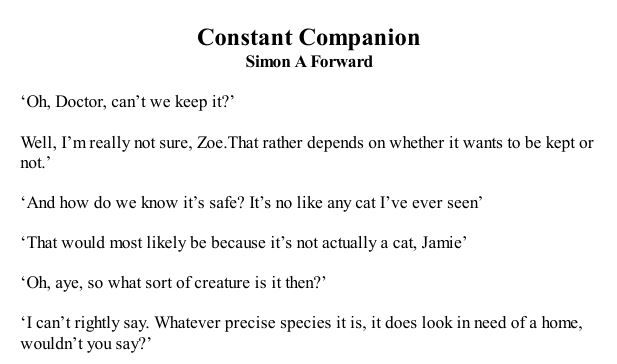
A story that all cat lovers can relate to.

The TARDIS lands on a mysterious planet that seems to have chased away winter but lets spring, summer, and autumn all happen at the same time. Upon opening the ship's doors, they find a feline-like creature sitting there, almost as if it was waiting for them. Zoe blurts out the traditional, "Oh, Doctor, can’t we keep it?"

They do and they name it Marmaduke because of its marmalade colored fur. The cuddly creature has the usual cat escapades like shredding all the cold weather clothing in the TARDIS wardrobe, using Jamie's bagpipes as a scratching toy, and opening roundels and ripping out the wires.

But the Doctor soon discovers another one of Marmaduke's behaviors: it broadcasts the thoughts of Jamie and Zoe into his head as it is telepathic. Hearing his companions' thoughts, especially just before they say them aloud, begins to drive the Doctor bonkers and he gets a little bit more than testy. And so it is agreed the cat-like creature has gotta go.

At first they attempt to drop it off on the planet where they found it but discover that it has mysteriously gone missing. And so they seek other options, including the Sisterhood of Karn, but each time the feline telepath returns to the TARDIS.

The Doctor then has a revelation. He can return the creature to its owner but he must land the TARDIS there at a different time than he tried previously. Doing so, he steps out onto the world and is greeted by an old woman. She admits that she is a telepath and created the lovable creature for companionship but that it just became all too much for her as she was forced to hear the thoughts of countless beings. So she used her powers to influence the Doctor and friends to abscond with her furry friend.

But she missed it and is glad the Doctor has returned the little bugger. Back in the TARDIS, the Time Lord sees marmalade out of the corner of his eye everywhere and realizes that now it is his turn to miss Marmaduke.

As someone who shares his home with two cats, the opening of this tale felt very familiar. You see a kitty who looks cute and lovable, has fur soft to the touch, and you bring it home. All seems well until it ignores the scratching post in front of it for your couch. Et cetera and so on. Cat owners know what I am talking about. I chuckled at the vision of Ohica pointing at the door as she gave Marmaduke the stink eye. While I hate to admit it, I smiled as the Doctor got more and more irritated with Jamie and Zoe while their thoughts flooded his mind.

A fun little story and one that all cat lovers can relate to.


26 July, 2023

Pulling up the stakes


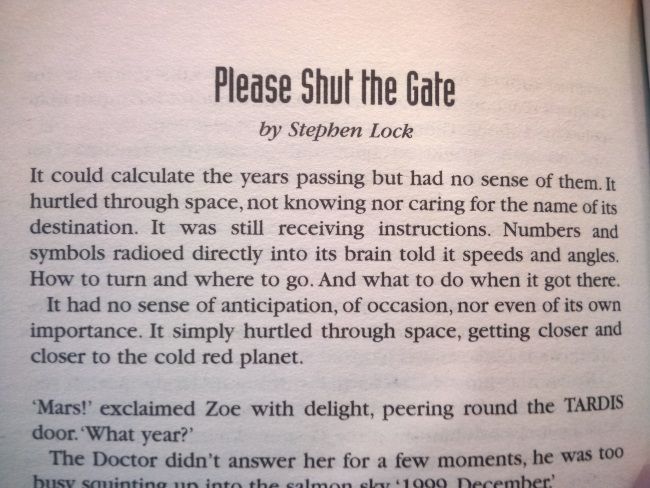
As far as I can tell, "Please Shut the Gate" is Stephen Lock's sole contribution to Doctor Who and it is a rather short Short Trip.

The TARDIS lands on Mars in December of 1999. There are no Ice Warriors about and instead our heroes find a tent and the remains of a campsite. Upon seeing a pipe - his pipe - the Doctor recalls that he had brought Ben and Polly here to see the Martian sunrise back when he was William Hartnell. But, while they were roasting marshmallows, the lateral drift compensators kicked in and they had to scramble lest the TARDIS leave without them.

Jamie and Zoe hear what they think are the sounds of a bombardment but the Doctor knows that those are the sounds of Martian probes landing. He also realizes that his former campsite would be an awfully big anomaly for the Earth probes of the 20th century so he enlists his companions in a hasty attempt to disassemble the old bivouac before a probe lands nearby and starts taking photographs that would make a good recruitment tool for the Boy Scouts but pose an existential crisis for humanity.

They are mostly done when the probe crashes right on top of the TARDIS and falls to the Martian surface in a state of severe disrepair.

At a mere 8 pages or so, this is truly a short trip. While insubstantial, it's still a short burst of fun to picture the TARDIS crew scrambling out of their asses to break camp and trying to stuff everything in the ship before doing something to cover their footprints and making a quick getaway.

17 July, 2023

Butterflies in Effect

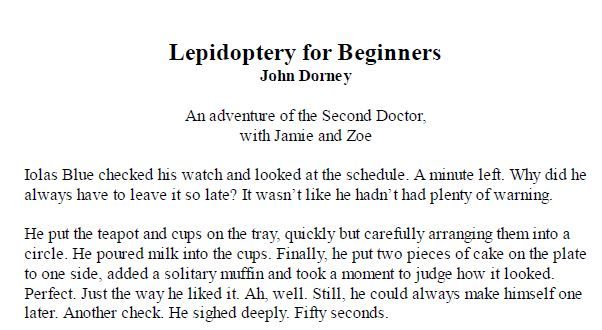
"Iolas Blue" is a rather neat name. The Iolas Blue in this story is a bit like Hari Seldon in that he has come up with a device, the accurately but boringly named Predicticon, that is able to predict the future. But instead of using it to find out when humanity will run into trouble and attempt to ameliorate it, Blue looked into the future to find out that what stood in the way of his megalomaniacal desire to rule the universe and discovered that it was the Doctor.

And so he plots a scheme to lure the Doctor and his companions (Zoe and Jamie) into his clutches so that he can dispose of them and thusly rule the universe unimpeded. The Predicticon comes up with a detailed schedule for this scheme which has 100+ steps including Jamie slipping on a puddle of oil and getting mild bruises as well as the Doctor reading out line 109 which reads "The Doctor reads out item 109."

Blue boasts about the Predicticon's power and illustrates it with the tale of Daniel Barnes, a rich and famous racecar driver today, and Blue's nemesis in school who bullied him. Blue transmats a futuristic thumb drive full of music to a woman and also takes a sandwich that has mayo infected with salmonella and transmats it to a deli. (Two more feet and I can fit it in the frig!) A customer eats it and becomes sick. He goes home and this prevents his wife from having a tryst with their neighbor. Had they schtupped, they would have had a son who would have gone on to be a renowned city planner. The planner would have devised an accident prevention system which would have saved the life of a fellow who was good at negotiating peace treaties.

Instead a war broke out between two races which destroys a planet that is split into several large pieces. The woman who got the thumb drive full of music cranked up the tunes which, in turn, kept her neighbor up all night. This fellow is tired at work the next day and makes many mistakes. One result is that an important guy in planetary defense is not at work when one of those pieces of that broken planet comes hurtling towards Daniel Barnes whose car is hit by the meteorite. R.I.P.

Whew!

No matter what the Doctor and his companions do, they cannot escape because the Predicticon has anticipated their every move. When the time comes for the TARDIS crew to meet their demise, nothing happens. The Predicticon admits that it has fooled Blue because he is rude, bitter, holds grudges, and is a murderer. Our heroes escape while Blue is left alone knowing only that he will die during a natural disaster.

A very fun little story! Blue is a comically evil pyschohistorian and I chuckled at his butterfly effect Rube Goldberg scheme.

16 July, 2023

Blinovitch Limitation Effect? What Blinovitch Limitation Effect?

Another short Short Trip. And, like the previous one, it also concerns a boy.

Here, though, the protagonist is a bit older. Norman Bean is writing one of those what-I-did-on-my-summer-vacation, er, holidays essays for class. But instead of days spent at the beach, the boy recounts seeing a ghostly apparition at home that looks an awful lot like his father. This phantasm claims to be Norman's future self and tries to convince him to buy toys and stow them away still sealed so that, when he is a grown man, he'll have a fortune in collectibles. The elder Norman even tries to convince the boy to steal money from his grandmother to buy the toys with.

It turns out that the older Norman has stumbled upon a time-rift and is using it to convince his younger self to be a smart investor. However, the Doctor, Zoe, and Jamie are hot on his tail and they eventually apprehend the time traveling Gordon Gekko wannabe.

At 6 pages or so this is not a substantial story but the running commentary by the teacher grading the essay was humorous. A mere hors d'oeuvre but a fun one.