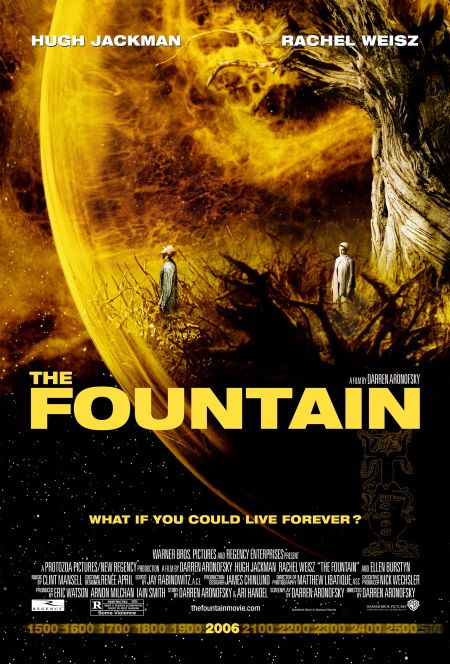
2007 has been a good year for me and the cinema. I haven't allowed myself into being conned into seeing a movie based on a comic book hero and that's always a good thing because those movies generally suck big-time. But that problem will rear its ugly head again come summer. Nothing I've watched so far has been uninteresting and made me leave the theatre feeling indifferent. And I have enjoyed everything until this point. My cinema going this month has really been an act of catching up with all those films from last year that take a while to reach Madison because we're not a large market.
The first was The Fountain. It is a tale of love & loss as well as one of bleak sci-fi psychology but it is trifurcated into three parallel stories. The story set in the present day concerns Tom Creo, a researcher who is attempted to cure a monkey of a brain tumor. This could be out of his desire as a scientist to discover new knowledge, but more likely it's because his wife Izzi also suffers from one. Their relationship and Tom's attempt to deal with the impending death of his wife are illuminated by the other two stories. One transforms Tommy into Tomas, a 16th century Spanish conquistador who sets out to kill a Mayan warrior for his queen who just happens to also be Izzi. This storyline comes from a book that Izzi has written and given to Tom. I appreciated that the film was ambiguous about whether these scenes were meant to be those from the book unaltered or whether, since Tom is reading the book, they are meant to be Izzi's story with Tom injecting his own elements into it. The last sees Tom recast as Tommy, an interstellar monk who is traveling towards a nebula that the Mayans called Xibalba. His chosen method of transportation is a giant bubble with a bucolic scene inside that includes a tree before which he meditates.
The three stories are connected by having some version of Tom and Izzi in each but also by things such as tree bark and gold rings. Having only seen the film once and three weeks ago at that, I can tell you that there's more to be had but I need a repeat viewing. Many reviewers have labeled the story as being ridiculous and characterize it as Faustian but I have to admit that I didn't see it that way. Izzi is "at one" with her fate – she has accepted it. But Tom cannot. Since the story is about Tom, it delves deeper into his psyche by splitting it in three parts. An advantage of this is that films have to convey interior mental states visually and I found that the split was effective. While I've never had a wife or girlfriend contract a terminal illness, I did see my father lose my stepmother. Besides her death, the two years prior and the three after forever changed the baggage, the preconceived notions that I bring into a movie theatre with me. Another thing I brought to the table were some ideas from King, Warrior, Magician, Lover by Robert Moore and Douglas Gillette. While I found a lot in the book to be this goofy pseudo-Jungian mumbo jumbo, I do find myself attracted to their general notions about those four elements and their relation to "mature" masculinity. This is why I think of The Fountain as being about gender in a small but significant way. I looked at the triumvirate of Tomas/Tom/Tommy in terms of king, warrior, lover, and magician. Tomas is the warrior who finds himself impotent against a superior power. Tom is the king and lover; the king attempts to order the world in a certain way but it resists while the lover part should be more obvious. Lastly, Tommy the monk is the magician. He is about transformation. Not only has Izzi been transformed into a tree in those scenes but they are also about Tommy being able to transform his life from one with Izzi to one without her.
As I watched Tom try to deal with loss, I immediately thought about my father. Not only did my stepmother die, I watched my father slowly unravel over the course of three years until he died. (If you've never experienced this, then what follows may make no sense so I apologize ahead of time.) His get-up-and-go attitude withered away until it got to the point where he rarely left the house, barely ate, and slept most of the time. He didn't mow the lawn for months at a time and I had to do it when I visited. I remember all the hate he had after my stepmom died. While no one would have accused him of being hyper-gregarious, he became incredibly spiteful of others. I also recall how his intellectual curiosity and his creatively just disappeared. So, when I think about The Fountain, I think of those storylines as representing these strands of Tom that are depleted and I see parallels between them and my dad. The various element's of Tom personality all try to deal with the same problem and they all run up against a wall. The key is Tommy, the bubble guy. He is the magician. If he prevails, this will allow our protagonist to mourn and grieve and then love again. But, if he fails, then it's over.
The ending of the film is quite ambiguous and no one is quite sure what it means. In my view, the magician was successful. If additional scenes in the present day were to be tagged on at the end, we'd see Tom mourn and then get back on the horse. Soon enough he'd be married to another Hollywood hottie. But maybe that's just me.
Unlike most film critics, I really liked The Fountain. It managed to do something to me that very few films do: make me forget. Most of the time when I'm in a theatre, my mind remains cognizant of that fact. No matter how I get into the story, there's still this something in the back of my head that reminds me that I'm in a particular room watching a movie. But with The Fountain, I managed to lose all sense of place for most of the time. My brain realized that it was enjoying a work of fiction but it got so caught up in the story and trying to understand it that it didn't bother to keep track of where it was located. It was one of those rare times when the lights go up and I find myself a bit disorientated. I got sucked in and found a lot to try and wrap my brain around.
I'd also like to say that the cinematography was great and I love the film's style with it's use of gold/amber hues. The soundtrack by Kronos Quartet and Mogwai was very effective as well. It provided great mood and it nudged, rather than forced, emotional cues.
Folks in Madison can still see The Fountain as Market Square on the west side.
25 January, 2007
The Fountain
24 January, 2007
Wood For Sheep
The trip down was fun. After spending some time BSing, we took advantage of the CD player and listened to some Doctor Who - Year of the Pig. It made for a fun traveling distraction with all of the Edwardian English, Nurse Bultitude making fun of the Doctor's clothing as she spies on him from afar, and the realization about 30 minutes in that one of the characters we'd been listening to is of a porcine nature. And when all of the cows suddenly appear on the beach, well, we were flummoxed.
Arriving in Chicago, we headed immediately towards Little India for lunch. We stopped first at a place that I'd noticed the last time I was down there which served Madras cuisine - Udupi Palace. Sitting down and looking at the menus, it dawned on us that it was a vegetarian joint. I didn't care because there were oodles and oodles of dishes that I'd never seen on a menu here in Madison. And so I convinced my companions to give it a go and that we'd hit a place oriented towards carnivores afterwards. I ordered the onion & chili uthappam; Charles got an appetizer assortment plate; and James got something I cannot recall the name of but was probably Masala Dasai. James' dish consisted of this huge crepe-like thing folded around a core of a spicy vegetable mix. The appetizers included samosas, pakora, and these flat slices of potato that were dipped in batter and fried. Charles reported that the samosa was very tasty with the vegetable mixtures being less "pureed" together than the ones here in town. For my part, I loved the uthappam. It was a large, thick pancake make of rice & lentils. There were chili slices dotting one side of it and it was served with coconut chutney and sambar, a lentil soup that was great. I really loved the tamarind. Digging into the uthappam, I found that there was plenty of sweet, tender onion to be had as well as the chilis. Surprisingly, it wasn't very spicy but was tasty nonetheless.
Then it was time for some meat. Much to our dismay, the Viceroy of India was buffet only so we ended up heading to a kabob joint, the name of which I cannot recall. We all had beef kabob on naan. They were really fucking good and Charles and I decided then and there that Madison needs a kabob joint ASAP. The tender beef was nestled in a pouch of soft, warm naan and it was just so good. Charles was reminded of the kabob stands he encountered in England and the pleasant memories put him in a much better mood.
Our last stop on Devon was the Argo Georgian Bakery where Charles stocked up on their pelmeni which he rates quite highly. From there it was back to the Kennedy and rush hour hell.
It took us a while but the weather was fine and we had my IPass so traffic wasn't a big deal. Arriving at Ted's, we found that only Don had beaten us there. We dropped the cooler off in the garage and brought the rest of our gear inside. As we waited for others to arrive, we played some Settlers of Catan. My brother, Carl, and Glen eventually showed up as did Pete and John. Carl mentioned that the Chicago Tribune did an article on the game a couple months ago and expressed his dismay that no one interviewed said "wood for sheep" or, if they did, that it was not quoted in the article. (You can read it here.) "Wood for sheep" is a very innocent phrase in the context of the game where players trade resources with one another. But it does tend to conjure up images of lonely Scotsmen.
With something more akin to a con quorum, we busted out Cirvus Maximvs, a chariot racing game. Carl had brought a bottle of Blanton's, which is a very tasty and very expensive bourbon. To start the race, we made a toast and had Letha, Ted's better ¾, drop the scarf. My chariot took some damage and I think I managed to cross the finish line with about half a wheel left, but cross it I did. Still, I've got a grudge against James because, when I tried to whip his driver in the face, he stole my whip. The bastard! I can't remember what else we did that night. Drank beer, obviously. Maybe a game of Thurn and Taxis? All I can remember is going to bed around 4.
Waking up around 8, I found that everyone else was awake too. We drank some coffee and I had me some lefse with butter and cinnamon sugar. Don wanted to really break his fast so he, James, Charles, and I went to a local restaurant for some grease. From there it was off to Sam's Wines and Spirits. It was one huge booze emporium. The beer in single bottles was to be found on shelves 30' and about 12' high. They were these walls of bottles. Ales dominated the imports with sections devoted to England and Belgium being the most prominent. The domestic wall had plenty of tasty choices including, oddly enough, Capital. Capital is not distributed in Illinois so obviously some wheeling and dealing was going on. It was good to see that the demand for it was so high that the store used some back channels in order to stock the product. I ended up getting a Finnish beer and a Belgian. Don bought nearly a case while James got some very fancy and highly expensive Italian brandy.
When we got back, I bowed out of a game of Puerto Rico in favor of a shower. But, when Greg, Greg, Scott, and Pete arrived, I eagerly jumped in for Formula De, a Formula One racing game. I think 8 of us raced. As we were playing, Pete pulled out a DVD which featured highlights of the 2005 Formula One season and Ted put it on his huge flatscreen TV. So we had the real deal playing in the background as the game wore on. I tried and tried to crash and take someone out with me but could not manage to do it. Never having played the game before, I have to say that it was quite a bit of fun, especially with so many people.
That evening, 6 of us gathered to play a Call of Cthulhu adventure GMd by Don. He began by taping Soviet posters and pictures of Lenin on the walls. He then placed some red lights around the room and finished by placing a bottle of vodka on the table. It would prove to be Machine Tractor Station Kharkov-37. It takes place in the Soviet Union in March 1933. Machine Tractor Stations were depots for Soviet kolkhozes or collective farms and we find that telegraph contact with Karkov-37 ceased in late December '32. And so a team from TASS, the Soviet telegraph agency, is being escorted by the Red Army to the station to reestablish communication lines. I played Lt. Electrician Nicholai Dugov; James was Captain-Technician Alexsandr Triepinov; and Charles assumed the role of Administrator-Major Yuri Kopolev. Escorting us were Scott as Snr Lt. Grigor Fyodorov, Greg as Snr Sgt. Dr Vissarion Ivanovich Liubimova, and a Commissar. When Don read out the parts to play and said "Commissar", my brother raised his hand immediately and it was a good choice. My brother is a big fella and he barked out orders all in the name of the Party. In fact, when he wanted me to pass him a sack of cookies that was next to me, he'd ask me to do so for the Party and/or the Motherland.
I can't recall where we started out from but it was a 10-hour drive to the station in the freezing cold with a bunch of young Red Army boys who tried to smuggle a 20 gallon barrel of kvas onboard. While it was left behind, the vodka wasn't. We stopped for the night out in the middle of nowhere and made camp. One of the soldiers went out hunting. We hear a shot followed shortly thereafter by a scream. Running to see what happened, we found the soldiers cowering by the animal's corpse. Only this was no rabbit that any of us had ever seen. It was completely malformed with one of its eyeballs being the size of a grapefruit and hanging out of its socket. And where it should have had teeth, there were tentacles. This didn't bode well.
We eventually made it to Machine Tractor Station Kharkov-37 only to find it deserted with some of the buildings burnt to the ground. Plus there were some funeral pyres out behind the barn. The curious part, though, was why one of the grain silos should be surrounded by makeshift posts with every light they could muster atop them. Opening the silo, hundreds and hundreds of gallons of the most foul-smelling water poured out. There were dead bodies on the floor. Plus there was a mummified corpse in the generator truck. Did I mention that we TASS folks weren't really TASS folks? No, we were really agents of a super-secret organization and were sent to find out what happened there, specifically, what happened to the agents from a not-so-secret organization who had been sent a few months ago to investigate the strange goings on there.
Curiously enough, I survived. But I did go quite insane. There was a garbage can just behind my chair and I got scared shitless when John came up and threw something into it. I just saw this shadow out of the corner of my eye and it made my heart skip a beat. Such are the perils of a good Cthulhu adventure, I guess.
It was another late night. Ted, John, and Mike blathered on about their high school days. This included a humorous story that happened after they graduated involving Ted and his former large-breasted French teacher. It was quite humorous. The next morning found folks either readying to head home or to Da Bears game. Snow can even make a suburb look nice and the couple inches that fell earlier in the morning made one forget that you were in Lombard. Since those folks who were going to the game had to catch a shuttle, James, Charles, and I headed out for Madison. After a stop at the pancake joint again. We even got the same waitress who remembered us. Back on the road it was more Doctor Who.
A Tough Row to Hoe
and racism is a slippery issue. we can shut down clubs and radio stations for all kinds of non-racist reasons, but if the people affected by those actions are predominately people of color, the overall effect is a racist one. that can be hard to grasp for a lot of well-meaning people, but that's the nature of racism today.
So there I was in a very interesting discussion about race here in my own backyard and now I read about white flight in Atlanta where a suburb of mostly whites wants to secede. It's a wonderful illustration of what el guante said.
The wealthy whites say it's an effort to create a smaller, more manageable government to address their concerns:
Supporters say it is a quest for more responsive government in a county with a population greater than that of six states.
"The only way to fix Fulton County is to dismantle Fulton County," said state Rep. Jan Jones, the plan's chief sponsor. "It's too large, and certainly too dysfunctional, to truly be considered local government."
Folks on the other side are saying that it will only lead to disaster:
Opponents say the measure is racially motivated and will pit white against black, rich against poor.
About 25 miles to the south in downtown Atlanta, the Rev. J. Allen Milner said he is afraid the tax revenue loss would have a devastating effect on those who need government help the most.
"If you take that money out of their coffers, human services will suffer greatly," said Milner, a black man who runs a homeless mission and is pastor of the Chapel of Christian Love Church.
Critics of a split also worry about the future of Grady Memorial Hospital and the Atlanta area's MARTA commuter-rail system — both of which have contracts with the county.
Madison has a comparatively easier situation to deal with when contrasted with Atlanta but, no matter where you are in this country, dealing with race and racism is a tough row to hoe.
22 January, 2007
Hip Hop and Madison Racism
Area hip hop artists and fans are disappointed and angry that the area's sole radio station dedicated to the music has switched formats and now plays rock music. Rob Thomas of The Cap Times wrote about the change recently. His article highlights two key points:
1) It was a commercial radio station and thusly made its money from advertisers.
The problem was that the station, owned by Beaver Dam-based Good Karma Broadcasting, couldn't attract enough advertising revenue.
"We're all personally attached to it," Williams said of the hip-hop format. "It was just not supported by the advertising community to the level that we need it to be to continue operating in the format."
2) The closing is a loss to Madison hip hop community and the overall cultural milieu of the area.
But losing a full-time outlet for one of the most popular musical genres around, as well as a cultural force in American society, is dispiriting for hip-hop fans in Madison. Willie Ney, director of the UW Multicultural Arts Initiative, said he wasn't necessarily a fan of the station's mainstream rap playlist, although his wife and kids enjoyed it.
He still said the format switch leaves a void for hip-hop fans, both those who enjoy the kind of rap they see on MTV and those who support the more positive-minded underground forms prevalent among local hip-hop artists.
"Even though a lot of it to me is not positive, is not empowering, it's still a vital cultural element within this new demographic of our community," Ney said. "Now with that shut off, it's a terrible reflection of how limited we are, culturally, in this area."
While I'm sure many people in the area have commented online about the change, the person with whom I am most familiar who can most likely comment on it with some authority is local rapper El Guante.
El Guante wrote about the station's format switch at his blog in an entry called "Hot 105.9's new logo". In it, he basically concedes that the change was motivated by money, i.e. – the station wasn't making enough. But he follows this concession with this:
My knee-jerk response was like many other people's: "yet another example of Madison trying to destroy hip hop and wage a proxy war on people of color." Maybe that response is still valid. After all, if local businesses aren't advertising on hip hop stations because they don't want to attract black and Latino clientele, or because they view the music as evil or whatever, that does reflect upon the city. If the owners of the station didn't understand the culture and were just pimping it for money, that does reflect upon the city.
While he questions his knee-jerk reaction, he doesn't question the basic assumption that "Madison [is] trying to destroy hip hop and wage a proxy war on people of color." These same general sentiments were echoed at the Capital Newspapers forum by "roboto" and reprinted by Hastings Cameron, who writes a blog at the same site called "Emcees Without Voices". Here are some quotes:
To continually ignore this group [minorities], and shut down all outlets for promoting this hip hop culture, shows how small minded and non-cosmopolitan this city truly is.
The reason why hip hop has a bad rap and why there is violence in Madison at these events is because people there are frustrated, and have been feeling belittled and ignored for years.
The closing of this station, with no feedback heard from the public, is not a surprise, its merely the perpetuation of ignorant practices that the powers that be in this city will not stop.
Finally roboto wishes "good luck to the city of Madison in their fight against diversification."
Here are some thoughts of mine. N.B. - I am a pale face and am not a hip hop fan, generally speaking.
Why are the Janesville and Rockford businesses & communities exempted from criticism? Truth be known, I never knew about the station until I heard about it switch formats a few days ago so I honestly do not know what businesses advertised on the station or stopped advertising on the station. (El Guante refers to the blog of an employee of the station who wrote "Our company was not getting the financial gains from it that it had once received from playing this format.") What companies stopped advertising and why?
To blame the move away from hip hop by a radio station in Janesville, some 45 miles away from Madison, by imitating Kanye West and saying that Madison doesn't care about black people is, in my opinion, wholly unfair. El Guante postulates that businesses don't want black or Latino clientele. Maybe they don't, I can't say with certainty. But neither can he. What were the demographics of the station? Did advertising rates change?
Hip hop probably has a bad rap for many reasons but violence at shows is certainly one of them. In addition, middle class white America has a view of hip hop that is one dominated by thugs wearing baggy pants & lots of gold chains who wave pistols around, consider all women to be hos, and liberally use the word "nigger". Do you suppose this is the image that Willie Ney was referring to as not being positive or empowering? Fair or not, hip hop has a serious PR problem that is not the creation of the ruling cabal of whities here in Madison.
What was the reception of the station here in Madison? Roboto wrote: "Another problem was it barely registered since the airwaves were stretched all the way to Rockford." Now, I think he lacks an understanding of the transmission of radio waves but point taken. This WI State Journal article states, "Hot 105.9 is a regional station; it reaches from Rockford to Madison, where it enjoys devoted young audiences of teens and twentysomethings even if the signal crackles at times in Madison." And how about this blog post by David Muhammad, an active participant in Madison's hip hop scene. In it he says, "It was almost too good for Madison, at least the half of Madison who could hear it." Is it possible that listenership in Madison wasn't particularly high because of the less-than-optimal reception? If this were the case, just how much incentive did Madison advertisers have? Again, I don't know anything about the station's ratings here in Madison. Perhaps the majority of listeners were in closer to proximity to Janesville and Rockford.
Reiterating that I never listened to 105.9, I must say that I'm confused. Was it the case that half of Madison couldn’t tune in to the station? Or did it just suffer a bit of static? Why is Madison the sole bad guy here considering that the station was 45 miles away in another city? All of the blog posts I've referred to view what happened here from the starting point that Madison is waging a war against hip hop and that the city is racist. These are the lenses through which all else is filtered. Notice the absence of any statistics. Just how many people in Madison listened? When you view the situation here with glasses of "if Madison cared about black people, then this station would never have switched formats", then you are only going to see racism because those glasses don't allow for anything else. For instance, it doesn't allow for Nick Nice's comment:
I used to do a Sunday night show a few years back on 105.9 called Fromage (which I built into their top rated show at the time). I actually sponsored my own show since they were so hard up for advertising dollars back then. I was pretty much free to do whatever I wanted since I was paying for it. So when my store closed, my sponsorship ended. The fact that it was a hugely successful show would have made one think that they could have done something with it and actually made some money from it. But did they do anything? Nope. Unceremoniously dumped.
No regrets on my end but this whole thing boils down to a station that is run by people that don't get the radio business and how to actually make money from it.
Instead of asking what the hell happened to the station, the bloggers above generally just launched into screeds against Madison. "Oh, Madison liberals aren't really liberal and their beloved 92.1 sucks too; Madison liberals are afraid of black people who aren't Uncle Toms." The possibility that the station's management lacked business acumen was never on their maps. Deftly avoiding the management and businesses outside of Madison, they immediately attacked the white liberals here. And that is what irks me about the comments of the bloggers I've quoted. Is there racism in Madison? Of course there is. No one in their right mind would deny it. But none of these bloggers proved to me that racism was at fault here. In addition, that little, if any, allowance was given to the possibilities that the station changed formats for reasons other than the evil of the latte drinking, tree hugging, "diversity" bleating liberals of Madison bespeaks a much more serious problem than a radio station going from hip hop to rock.
So, is Madison really waging a war against hip hop? Maybe it is and I just don't know about it. Can any readers comment? Also, is anyone reading that listened to the station? If so, what was the reception like for you? What companies advertised?
19 January, 2007
18 January, 2007
Pam Brews Up BS
I want to be happy about this, but this proposed token gesture by the city of Madison does nothing to soothe the real-world wounds of the gay and lesbian population of Wisconsin.
The gesture she refers to is the option for officials to voluntarily amend their oath of office and tag something on at the end indicating their disagreement with the recent change to our state's constitution outlawing gay marriage and anything substantially similar. What Pam doesn't seem to understand is that the amendment to the oath is not meant to soothe the wounds of Wisconsin's gay and lesbian populations. Instead, it is meant to assuage the consciences of oath takers who oppose it. And, contrary to the article she cites, the proposal would make the amendment to the oath voluntary, not a requirement.
Because of the constitutional amendment, Ms. Spaulding says that homosexuals "are now second-class citizens". Wrong again. Gays and lesbians have always been second-class citizens here. The change to the constitution affirmed what was already state law – that same-sex marriages are unlawful. If anything, they are now third-class.
Next she writes:
…for those whose families are now legally vulnerable due to the passage of the amendment, or people thinking about doing business with or moving to Wisconsin, they know that the voters have spoken, and now it's time for gays and allies to speak with their feet and wallets in response.
That, however, doesn't mean deserting those who are still fighting for equality in the state -- Fair Wisconsin did the best they could to defeat the amendment and will continue working for change.(Emphasis hers.)
So all gay people and folks who think the amendment to the constitution are shite should leave the state. Oh yeah, but send a nice letter of support to Fair Wisconsin. Didn't we just have a holiday in honor of a man who embodied something a little more positive, a little more hopeful than "Give up and move to Massachusetts or California"?
I do agree with her that speaking with one's wallet is a good idea. If you're bound and determined to avoid states that ban gay marriage, then all I can say is good luck because the vast majority of states in this country define marriage heterosexually and deny gays the right of civil unions as well. If you want to move to or do business with a state that is doesn't deny gay folk these rights, then you've got slim pickings - just a handful. Instead of avoiding Wisconsin, why not choose to give your money to gay-friendly businesses? If you want to move to Wisconsin, then move to a gay-friendly town like Madison. Two-thirds of Dane county voted against the amendment. Instead of avoiding our state by moving elsewhere and paying lip service to Fair Wisconsin, why not make that move and join the fight?
As Bill Lueders pointed out, Wisconsin's progressive tradition is as dead as a doornail. But telling people to run away is just plain ridiculous.
The Cinema Show
Tomorrow sees the opening of Guillermo del Toro's El Laberinto del Fauno (Pan's Labyrinth) at the major theatres here in town. Considering it is in Spanish and that Curse of the Golden Flower will also be playing in those same theatres, it' will probably mark the first time in a while that the non-arty cinemas in town will be showing 2 films that are not in English at the same time.
I'll be spending some time next week at Westgate as it'll be showing a couple films I am keen on seeing. Firstly is Letters From Iwo Jima, the second of Clint Eastwood's two-part look at the battle. Also is Tom Tykwer's Perfume: The Story of a Murderer. Tykwer is best-known for Run Lola Run, though I preferred The Princess and the Warrior.
In Chicago, the Gene Siskel Film Center has another great month ahead. February brings a retrospective of one of my favorite directors, Werner Herzog, including what will probably be the only showing of his 2005 "documentary", Wild Blue Yonder, within several hundred miles of Madison. There is also a look at Contemporary Croatian cinema and a lengthy look at African American Auteurs which runs through 8 May. Featured directors will be Oscar Micheaux, Spencer Williams, Charles Burnett, and Spike Lee. Who wants to join me in a roadtrip?
I've noted here previously that David Lynch's latest opus, Inland Empire, is now making its way around the country. It opens on the 26th of this month at the Music Box Theatre in Chicago. Lynch himself is scheduled to appear at the 2 late shows on the 27th, but they are currently sold out. If the film makes it to Madison, look for it next month.
Speaking of David Lynch, I recently got a hold of a copy of Mulholland Drive – the TV pilot. Before it was a feature-length film, Mulholland Drive was to be Lynch's foray back into television. For better or for worse, ABC rejected it and Lynch developed the pilot into the film we know today. As soon as I get the ability to screenscrape it, I'll do a post on the differences between the two versions. Actually, I hope to make this into an occasional feature with a review of a film or TV show that has been lost in the vaults or has had no US release to speak of.
17 January, 2007
Little Britain
That's Matt Lucas above as Daffyd, The character constantly laments that he's the only gay in the small Welsh village in which he lives but he isn't alone by any stretch. So, when other gay folk appear, he does his best to send them on their way as they are intruding on his turf. For example, when the gay Star Trek fan club meets at the local pub, he tells them that they're not wanted there. Considering his attire at that point, it was quite humorous.
That is David Williams as Ray McCooney, the proprietor of a Scottish hotel, who communicates in riddle and by playing the recorder.
Honestly, I enjoy all the characters and skits but I must admit that Williams is my favorite by a slim margin. This is because, when doing drag, Williams reminds me of Graham Chapman from Monty Python. Still, Lucas rocks as Marjorie Dawes, the leader of a weight loss support group.
Do check it out. And why do the British do drag so well and why does American TV avoid it almost completely?
Porcine Stamp Goodness
In order to celebrate 2007, the year of the pig, China has issued stamps whose fronts are scratch'n'sniff while the glue on the back tastes like the dish.
Beloit International Film Festival
Arbat is a Godsend
It wasn't long before we discovered that there were some new menu items, including a new soup, salad, and appetizer; the blini or crepe section of the menu was greatly expanded as was the selection of entrees. When ordering drinks we also found out that the beer list was incorrect and that there were, in fact, several new beers to be had. The Dulcinea opted for a Baltika #6, the porter, while I went with Obolon Premium, one of the newly available brews. The Baltika was nice and heady while the Obolon was a crisp lager.
For the main course The D went with the chebureki (after all, the menu said that "Life without chebureki is a pure waste".) while I opted for golubsti which are cabbage rolls stuffed with rice and meat. Having an open kitchen, we could watch the cook roll out the chebureki dough.
And here was our food:
The chebureki differ from a pasty most noticeably in that it's deep fried. Also, it contrasts with them and the meat pies I have had in the South in that they are very thin. The dough was very flakey and fried to perfection as they didn't leave much of a greasy footprint behind. The golubsti were also great. These are a food that I ate often as a child and are a component of basically every country's cuisine in Central and Eastern Europe. My Polish grandmother would make them as they were here – in a creamy tomato sauce – while my German father would cook them with crushed tomatoes and sauerkraut. Arbat also threw some shredded carrot in the filling which worked very well.
For dessert we went with the cherry pierogi (dumplings). They were served with sour cream.
They too were very tasty. If you should order them, beware the cherry-laced water squirting out when you dig into one.
While I enjoyed the food & drink very, very much, I do have a trio of gripes. Firstly is that they do not serve vodka. Not that I'm complaining about the beer, mind you, but a shot of fire water seems necessary. Secondly, they should ditch the white bread and lay down more of the dark rye. My last gripe is location. A strip mall in Fitchburg is not the optimal dining location for me but what can you do? I'd also like to note here that the staff on both occasions were exceptionally friendly and cute waitresses with a Russian accent are a big plus.
I have read a couple other reviews of Arbat and, while they were both informative, I was disappointed that neither gave any indication that the diners had had any previous run-ins with Slavic food. It gave me the impression that most folks would approach Russian food as being this weird exotic experience. Surely I am not the only person in town who grew up eating cabbage rolls. Being 50% Slavic, it is frustrating at times to live in a city whose buzzword is "diversity" yet seeing precious little when it comes to a significant chunk of my ethnic heritage. This being the case, Arbat is a godsend.
The other reviews are at Eating in Madison A to Z and Dane101.
Woodcuts at the Chazen
Color woodcut printmaking was not new to Britain or America when Japanese prints caught the European and American imagination in the nineteenth century. The fresh colors, the simplicity of the materials, and the departure from traditional compositions entranced western artists as well as the rest of the public. In France, this enthusiasm for all things Japanese was called Japonisme, and it influenced artists such as Toulouse Lautrec and Henri Rivière. Likewise, Japanese audiences and artists were intrigued by the possibilities of western art, which was broadly available by the end of the nineteenth century. Artists such as Hiroshige II created images of the strange foreigners and imagined what American cities looked like. However, by the beginning of the twentieth century, artists were not content to merely imagine what the other side of the world looked like. As a result, a growing number of artists traveled back and forth between the continents, seeing, learning from and teaching each other. From America, Arthur Wesley Dow and Bertha Lum traveled to Japan to learn the techniques of color woodblock printmaking, while from Japan, Hiroshi Yoshida, Mokuchu Urushibara, and Ohara Shoson traveled to the West in search of imagery and patronage.
I found this interesting because I happen to have a few Japanese woodblock prints. In fact, I brought them to the Chazen a couple years ago and had a couple professors give them a once-over. Unfortunately, I cannot find my notes so I cannot give you any names or dates. But here they are:
The exhibition runs through 25 February and there are a number of lectures being held about it. A list can be found here.
16 January, 2007
MLK Day (Belated)
This is King's famous "I Have a Dream" speech. While I'd always heard and seen bits of it, it wasn't until I took a rhetoric class in college that I got to hear and see the whole nine yards and began to understand exactly just how great a speech it is.
15 January, 2007
Polka Documentary to Screen in Wisconsin
When I noted last year that Madison is not a polka town, I also noted a new polka documentary called It's Happiness, which was partly (mostly?) filmed here in Wisconsin. After hitting the festival circuit, the film is finally going to be shown here in the Land of Cheese. Here are the venues and dates:
Milwaukee:
January 31st, 7 pm,Oriental Theatre
Tickets available 1/12/07 at box office.
Call 414-276-8711 for information.
Music beforehand by Riverwest Accordion Club and party to follow at Art's Concertina Bar.
Hartford:
February 1st, 7 pm
Schauer Center
Tickets available now at www.schauercenter.org or by calling 262-670-0560.
Music beforehand by The Goodtime Dutchmen and party to follow.
Pulaski:
February 3rd, 7 pm
Pulaski Middle School
Click here for contact information.
Music beforehand by 4 year old Zac Brzeckowski and party afterwards.
13 January, 2007
The Colored Faces of Humanism
Allen is the editor of a couple relevant books: The Black Humanist Experience and African American Humanism: An Anthology.
Allen discussed the stereotype of African-Americans as being hyper-religious as well the role of religion in slavery, amongst other topics.
Allen was also interviewed back in November for another godless podcast, Point of Inquiry. That show can be found here. I would also point readers to yet another podcast, Humanist Network News. Their third podcast features McKinley Jones and Taunya Hannibal-Williams of the Black American Free Thought Association.
12 January, 2007
47th Annual MadFest Juggling Festival
God Sleeps in Rwanda
God Sleeps in Rwanda is the second documentary I've seen in this still nascent year about the aftermath of the Rwandan genocide with Rwanda: A Killer's Homecoming being the first.
Rwanda must be an absolutely gorgeous country. I say this because of the opening shot of God Sleeps in Rwanda which is an aerial view of the countryside. It is stunning. The view then shifts down into a town and then to a road showing several women dressed in brightly-colored clothes walking towards the camera with urns atop their heads. We then meet the first of five women to be profiled, Severa Mukakinani.
A brief overview of the genocide follows and I learned that the genocide left the Rwandan population with 70% of it being women. Narrator Rosario Dawson notes that this was a great burden for the women of Rwanda but also an extraordinary opportunity. The focus then shifts back to Severa as she explains how she lost her entire family in the genocide. She watched as her husband and three sons were killed before her. Severa also tells how she was gang raped by more men than she could count which led to her becoming pregnant with Akimana.
While she wanted to abort the pregnancy at first, Severa found that she just couldn't go through with it. She had seen the death of too many innocents already and so she decided to keep the child.
Rape was a tool used in the genocide and it is estimated that a quarter of a million women were raped during that time. As a tool of war, it was coordinated by Pauline Nyiramasuhuko, the country's Minister of Women and Family Affairs at the time.
Nyiramasuhuko is standing trial for war crimes and is the first women to be charged with genocide. It is also the first time that anyone is charged with rape as a crime against humanity.
We are then introduced to another survivor and rape victim, Chantal Kantarama.
While Chantal was lucky to have escaped the ordeal without having contracted AIDS, her friend, Fifi Mukangoga, who was also raped, was not so lucky. She talks about her close friendship with Fifi and how they fled the genocide together.
After it was over, Chantel met the man who would be her husband. They now have three children. While Fifi died of AIDS, Chantel was able to build a new life.
As with Severa, Chantal found hope and meaning in her children.
Odette Mukakabera survived the genocide along with her husband and four children. But she found out afterwards that her husband was HIV+ and had infected her. He died in 1999. A former school teacher, Odette became an officer in the Rwanda's National Police Force.
Prior to the genocide, a women in such a position was unthinkable. Also unthinkable was Odette's decision to go public with the fact that she has AIDS. This is apparently taboo in most of Africa. Unfortunately, one of Chantel's children also contracted AIDS but she is unable to afford any medication for him. In addition to being a police officer, she is also a law student and hopes to one day be a lawyer so she can help those also infected with the disease.
Next we meet a pensive Delphine Umutesi. She lost her mother at the age of 10 and watched as her father was butchered. Being the eldest of five children, Delphine was forced to assume the role of mother to her siblings at the tender age of 12. She benefited from new laws in Rwanda including one which allowed women to inherit property and their own children.
Delphine tells of the old attitudes in Rwanda towards women which was that they should remain in the home while the husband supported the family. But the genocide changed that and forced women to do everything themselves. Although she obviously has more than enough responsibility with taking care of her brothers and sisters, Delphine dreams of getting married and having children of her own. She says that several men have proposed to her, which makes me wonder exactly what the cultural norms are in Rwanda for proposing.
The last woman to be profiled was Joseline Mujawamariya. She is her town's top development official with has six underlings. We see her and several others building a road from her village to Rwanda's capital, Kigali. Joseline's position in her village is quite an accomplishment considering her lack of formal education but, given the circumstances, anything was possible. But it was her own drive to do well and contribute to her community that put her where she is. Joseline speaks of men and women working together and of shedding the old ways which disallowed women from participating in the political process.
God Sleeps in Rwanda was quite a breath of fresh air when I watched it. The documentary provided some positive glimpses of Rwanda and offered hope. For these reasons it was an official selection of the United Nations Association Film Festival's "Statement of Courage and Hope". It was an official selection at many other film festivals as well and was nominated for an Academy Award in 2005.
As I mentioned above, there were changes in the inheritance laws and it seems these were instituted shortly after we left Odette and Theophile in Rwanda: A Killer's Homecoming. The changes should be no surprise considering the disproportionate number of women in the population. What a shame that it took a genocide for women to be able to gain these rights and for them to assume positions of authority as they are now.
One thing I noticed was how important children were to the women in the video. They survived a genocide and, in some instances, rape as well yet they were not left cold and heartless. These women still looked towards a brighter future while at the same time dealing with the past. Not only does their compassion show through but this emphasis on children also shows how a caring/nurturing side can co-exist with a side that is more about authority and leaderships. By this I mean that, here in America, we have this notion that women in positions of authority eschew a family life to pursue their career, that the two cannot co-exist. Yet here they seem to. Different societies, to be sure, but perhaps the notion is purely American.
Since the video is a short, only a few minutes could be devoted to profiling each woman. Yet I thought the filmmakers did a great job of presenting the women in a complex way. The women were given the chance to give a brief history of their lives, to explain what their lives are like now, and to talk about the changes in Rwandan society as well. One thing that was noticeably absent from the video was religion. I expected one of the women to talk about having been granted strength from God or something similar but that never happened. I have no clue as to their religious affiliations or lack thereof and the omission of religion here could very have been the prerogative of the filmmakers. Perhaps they wanted to emphasize the strength and accomplishments of their subjects without distraction.
Religious or not, these are some truly remarkable women.
Rwanda: A Killer's Homecoming
Even though 2007 is still young, I've already dived back into Rwanda by watching a couple documentaries about the legacy of the genocide. The books and film above tended to look at the genocide itself and its immediate aftermath. But what has happened in Rwanda since then? How are the people now here in the 21st century?
Rwanda: A Killer's Homecoming is, as best I can tell, a production of the UK. I believe it was shot in 2003 and released the following year. And so we're talking a time frame of 9 years after the genocide ended. It is the story of Odette and Theophile Ntaganda. Theophile is a Hutu while Odette a Tutsi and they had a happy marriage, which also included two sons, Kofi and Sharif, prior to the genocide. But, after it began, Theophile eventually found himself in a situation which ended in him killing his mother-in-law, two sisters-in-law, and a niece. Odette, meanwhile managed to flee and survived. "I was meant to die but God protected me," she said. Tutsi rebels took control of the country and the genocide ended after nearly a million people were killed in only 100 days. As the country put itself back together, it jailed tens of thousands of Hutus who were accused of participating in the slaughter, Theophile among them. Nice years later in 2003, there were still 100,000 prisoners waiting for a trial. With such a massive backlog, a program was instituted whereby prisoners who admitted guilt and showed remorse underwent 6 weeks of "reeducation" and then released. It was through this program that Theophile was freed and allowed to return home.
As her husband sat in prison, Odette (above) started to rebuild her life with the help of Theophile's friend, John. The couple eventually fell in love and were married. The picture above doesn't really get this across but Odette comes across as having incredible inner strength. Scenes with her often portray her as just getting on with life as opposed to dwelling on the past. She is remarkably restrained when talking about Theophile. While she wishes that justice was exacted by his death, she remains pretty calm when speaking about him. Taking the interviews with her and removing the subtitles, you'd never guess the hell she lived through. Odette seems like a very normal parent trying to provide for & raise children and to be a good wife - some of the normal struggles of life. The problem is that Odette and Theophile were never officially divorced so, in essence, she is a bigamist. On top of this, because of Rwandan law, the husband gets custody of the children so, upon release Theophile sets out to reclaim his kids and start life anew.
Odette likes her life as it is and news of her husband's release casts a pall over her. She despises the man and thinks he deserves to be killed in return for his actions. While he claims the Hutu mobs forced him to kill his in-laws and niece, Odette has no sympathy for him. She knows that, since Theophile is a man and they are technically still husband and wife, she could lose her children and potentially face jail time. And so watching as Theophile is released from prison I tensed up in anticipation of a dramatic reuniting. The story was kind of a cross between Matagari and The Monkey's Paw. Theophile wasn't exactly a revenant in the traditional sense but his return would surely splinter a family and inflict further pain on people who have already suffered enough.
Theophile sets out on the road back to his village. Upon arrival, he seeks out and finds his father who greets him with a hug. Having made this first contact, Theophile then sets out to find his children. He eventually finds them.
That's him with his youngest son, Kofi. The look in the boy's eyes says it all. He doesn't quite seem to understand what's happening and is very uncomfortable. In an interview, Kofi talks about how his father killed his grandmother and he also says that John is his father now. Sadly he adds, "I feel I don't have peace." The boys barely remember their father but know him from stories. Odette tells him how he used to be a fancy dresser but she is also honest with them and, when they hear stories from neighbors about what their father did, she tells them that the stories are true. The boys do not trust their own father and want their family as it stands to remain instead of being broken up.
Theophile returns to the home he shared with Odette and finds it abandoned and in ruin. But he vows to fix it up and to make it a home once again.
To say that he has a long row to hoe is quite the understatement. Upon release, he was hopeful but reality soon sets in and Theophile realizes that his future is going to be immensely difficult. I was impressed with the way that the documentary portrayed him. He admits to the killings on camera and is shown in church as well as expressing regret over his actions. He is almost a sympathetic character. While Odette surely has every right to feel as she does, I sat there thinking that perhaps he was one of the wretches that could be saved. I cannot fathom what it must be like to one day see society collapse around you and a genocide begin. And so, when Theophile says that he is essentially a victim of circumstances, I believe him. While I'm not trying to pardon his acts of murder here, I must admit that I saw him not so much as a brutal killer but more as a pathetic figure. Theophile is someone who didn't rise up to the level of heroic martyr but rather suffered from being an average human being who committed horrible acts in order not to become just another number in the list of the moderate Hutus who were cut down during the genocide.
As Theophile's attempts to reclaim his life fail, we witness John, above, go on a tirade. He dismisses Theophile's claims of being a victim of sorts himself and accuses him of being part of the militia that carried out the genocide.
The documentary ends with Theophile struggling to find work, a court case pending, and all optimism for a future slowly receding. Likewise, the fates of John, Odette, and their kids are left hanging. I'm ambivalent about this. On the one hand it is frustrating but on the other it is probably the situation in which of tens of thousands of Rwandans find themselves. The task of trying to reconcile must be enormously difficult. Even if men like Theophile are denied the custody of their children and driven to live far away from them, Rwanda still faces the burden of having to integrate these people into society. They need to work and must make a contribution to society. On the other side, genocide survivors are forced to have next-door neighbors who were or are murderers.
Nearly a decade had passed since the genocide when Rwanda: A Killer's Homecoming was shot. However, as Odette says, survivors can never forget. Perhaps this is the most important lesson to be drawn from the video, even though it is not explicit. I remember hearing of the genocide on the nightly news and I recall the footage of the refugee camps that arose in its wake. But, until last year, I barely gave the genocide a second thought. We in America have basically forgotten about it and we forgot about it long before 9/11. Of all the countries in the world who could have intervened, America could have done the most to stop the genocide. Rwanda: A Killer's Homecoming is a very focused and personal look at a family. It doesn't try to assign blame or chastise anyone. Memory is an important theme, though. Survivors cannot forget while the young cannot remember. But for me, as an American thousands of miles away, it also challenged my memory. It asked me to remember the genocide but to also not forget that the effects are not even close to being over.
Imports
The first is some German shower gel that I purchased in Chicago at Merz Apothecary. This particular scent is Traumland or Dreamland. The top was interesting in that the purple band you see pops up like a draw bridge with the spout positioned at about 11 o'clock on the bottle. It smelled nice and cleaned the Teutonic parts of my body just as well as domestic shower gels. The only difference that I could tell was that this stuff foamed up just a smidgen less than its American counterparts. But maybe this is a hallucination on my part as I tended to use this stuff in the morning before I had the requisite amount of coffee.
A shower gel is a shower gel to me, but it was nice to cruise around Lincoln Square in Chicago. I think that the 4700 block of North Lincoln Ave. has more German shops, restaurants, and stores than all of Madison.
Next up is Coca Cola. For many years I've heard that the Coke in the American South was sweetened with cane sugar as opposed to the stuff with corn syrup that we Yankees get. Well, I spent some time in Louisiana about 3 years ago and could not find Coke with cane sugar. This story would have died had it not been for an article I read a week or two ago about the market for Coke from Mexico, which is sweetened with sugar. Apparently our country's growing Latino population enjoys the Coke from south of the border as a little taste of their homeland. The Coca Cola company frowns on the importation of the product but, since it is not a counterfeit product, shipments cannot be stopped at the border. Coke officials deny any flavor difference saying that the syrup is the same the world 'round and that the sweetener of choice doesn't impact taste.
My culinary curiosity was again piqued and I found a site on the Net that sells Mexican Coke sweetened with cane sugar. I pointed this out to The Dulcinea only to have her respond by saying that Woodman's carries the stuff. It took a few days before I actually purchased the bottle above and, in the intervening period was actually at a Mexican grocery store - Super Tienda Latina. But somehow the notion of checking out their soft drink aisle escaped me. So they may very well stock it there.
On a side note, I do want to say that I went to Super Tienda Latina on a Saturday when they had hot, fresh tamales. No wonder I forgot to look for the Coke. The tamales were fantastic! I wish they had been a bit hotter/spicier but were great nonetheless. I was reminded of my childhood when I got to eat fresh tamales fairly regularly. First there was my friend Lalo's mom, Mrs. Valdez. The Valdez family moved from Mexico to a home just a few houses down the street from mine. She was often found to be cooking up a storm when I went over to Lalo's house which would be filled with magnificent aromas. She'd often make her own tortillas and her tamales are the gold standard for me. I was also able to eat tamales down at Independence Park because there was a guy who had a push cart from which he sold them. He'd lift up the cover to the hot well and beneath all the steam was a mound of unassuming corn husks...
Anyway...So how does Coke with cane sugar taste? Personally, I prefer Coke over Pepsi. Coke has a nice nutty, bitter flavor while Pepsi is too syrupy sweet for me. I found the Coke from Mexico to be a tad less sweet than the domestic stuff. But I also found the flavor to have been muted. It tasted the same but there was just less of it and it didn't have as much of a bitter bite. While I missed it, I also found that I could drink more of it. I am not a big soda drinker and I usually can only drink half a can of domestic Coke. My palate just gets overwhelmed at some point and I have to stop quaffing. Part of this is due to the soda becoming warm, I'd imagine. As it warms, it loses its crispness and begins to taste syrupy like Pepsi. However, I found that the Coke sweetened with cane sugar mellowed as it got warmer but didn't edge towards that syrupy taste I dislike.
I suspect that Coke with cane sugar can be found at one of the numerous Mexican grocery stores around town but I haven't looked. I found my bottle at Woodman's East in the ethnic foods aisle.
11 January, 2007
Support the Expansion of Stem Cell Research
Today is supposedly D-Day for the DeGette-Castle bill in the House of Representatives. The bill, HR 3, will expand federal funding to stem cell lines previously denied such by our Ignoramus-in-Chief since 2001. To find contact info for your representative, head here. For my fellow Madisonians:
Rep. Tammy Baldwin
Washington DC Office
1022 Longworth House Office Building
Washington, DC 20515
Phone: (202) 225-2906
Fax: (202) 225-6942
Wisconsin Office
10 East Doty Street
Suite 405
Madison, WI 53703
Phone: (608) 258-9800
Fax: (608) 258-9808
And for anyone who's never had a civics lesson or is a bit rusty, here's how a bill becomes law:
Faith-Based Initiative at the Grand Canyon
Grand Canyon National Park is not permitted to give an official estimate of the geologic age of its principal feature, due to pressure from Bush administration appointees. Despite promising a prompt review of its approval for a book claiming the Grand Canyon was created by Noah's flood rather than by geologic forces, more than three years later no review has ever been done and the book remains on sale at the park, according to documents released today by Public Employees for Environmental Responsibility (PEER).
“In order to avoid offending religious fundamentalists, our National Park Service is under orders to suspend its belief in geology,” stated PEER Executive Director Jeff Ruch. “It is disconcerting that the official position of a national park as to the geologic age of the Grand Canyon is ‘no comment.’”
David Prothero, writing for the Skeptic's Society notes that he has "been unable to confirm this report in my own enquiries among rangers and on the NPS website, but perhaps the order is still being considered at the NPS and has not yet been forced on the rangers."
If this thing gets in your craw, here are some folks to contact and to whom you can express your displeasure:
Ms. Mary Bomar, Director
National Park Service
1849 C Street NW
Washington, DC 20240
202-208-3818
Mary_Bomar@nps.gov
US Senate Committee on Energy and Natural Resources
354 Dirksen Senate Building
Washington, DC 20510
202-224-4971 (phone)
202-224-6163 (fax)
US Senate Subcommittee on National Parks
(a subcommittee of the above)
354 Dirksen Senate Building
Washington, DC 20510
202-224-4103 (phone)
202-224-4340 (fax)
08 January, 2007
"Selfless Consciousness Without Faith"
Upcoming Beer Events
18 January. Beer Class and Tasting. 6pm. Pale ales from around the world. Discuss nature of the style, examine similarities and differences in the samples. $15. Cocoliquot, Madison. Call Maduro 608.294.9371 to reserve. Class is limited to 16 people. Note that the tasting site is Cocoliquot, not Maduro.
05 January, 2007
LOST Returns Next Month
#1
#2
#3
#4
#5
#6
#7
#8
While the clips don't give anything away, they do a good job of introducing the conflicts we'll be seeing. Plus Cindy the Stewardess returns! Probably the most interesting of the bunch features Charlie and Desmond. We enter the action in media res with the pair on the beach when Charlie calls Desmond, who is walking away from him, a coward. Desmond rushes Charlie and tackles him. He then says something like, "You don't understand what happened when I turned that key!" What we know is that Desmond turned the key to activate the Swan hatch's failsafe mechanism, woke up naked in jungle, and now has precognitive abilities. That and that all that's left of the Swan is a hole in the ground. Desmond's precognition is apparently not a newfound ability but rather rediscovered. I suspect that this part of the story will be fairly important because, of all the Losties, Des is the only one with a tangible connection to the outside world - Penelope.
I'm also looking forward to the Losties meeting up with Joey Eye-Patch. He seems creepy enough and will no doubt have some good tales to tell. And we'll be introduced to another character named after an 18th century philosopher - Edmund Burke. If all of this and learning about The Others just isn't enough, Hurley apparently will find a junked car on the island. Oh, and The Others have a submarine. Presumably next season someone will find the remains of a monorail.
Tori Spelling Does Lovecraft
What Have I Ever Done to Bill Lueders?
OK, OK. Yeah, this blog is unimpressive. The folks at Post didn't approach me to contribute to the paper version. But why does Bill have to tell everyone? I gave his latest book a good review. What have I ever done to him?
04 January, 2007
Stimulating Your Angular Gyrus
Brains are so fascinating.
03 January, 2007
A New Year for New Glarus Brewing
Looking at the drawing of the New Glarus Brewing Company's expansion, I had a flashback to my childhood as I spent much of it in a German drinking hall or Trinkhalle. Well, a replica of one, anyway. You see, the house I grew up in was built in the 1920s by a German immigrant who did well for himself. He built a nice home on Chicago's north side and made the basement into a 19th century drinking hall. There was cobblestone painted onto the walls and the wood of the bar was stained a deep brown. Tables were scattered about and the doors, painted to look like they were made of sturdy oak planks, had rings dangling from them instead of doorknobs. On one wall was a cubbyhole enclosed by windows behind which stood a painted triptych of an old German village. The basement made for a suitably eerie place in which to play hide-and-go-seek and probably influenced me in ways the builder could have scarcely guessed at. Modeled after an old European village, the New Glarus expansion will no doubt make for a wonderful spot for me to emulate my German ancestors.
In addition to making a great environment for drinking, the facility will also allow the brewery to increase production. It should be noted that this increase does not mean that New Glarus will once again distribute their beer to our southerly neighbors in Illinois. For a look at why this is, check out "Bye-Bye Bell's" from the Chicago Reader. While the focus is on Bell's Brewery ceasing distribution in Illinois, New Glarus is also mentioned. The state's beer distribution laws are forcing the hand of some microbreweries who are choosing to stop distributing there. This leaves our beer drinking brethren with less tasty choices. But it also means that we Wisconssonians will get to enjoy the fruits of Dan Carey's labors all the more. And more there shall be.
The Careys have given us a tantalizing look ahead into the beer future of this still nascent year by posting a schedule of the brewery's releases for 2007.
Notice several new seasonal brews on tap as well as the reintroduction of an old flame. Things get going next month with the introduction of a new seasonal, Abbey Ale, and is followed by the return of Hometown Blonde, a pilsner. Bavarian Weiss is due in July to help cool down during the dog days of summer. And, to round out the year, Carey will release an organic pale ale.
But wait – there's more!
Notice the little brown bars at the bottom. That means there will be three new entries in the limited Unplugged series. And we won't have to wait long for the first one. Next month those bottles with the red foil wrapper will start appearing in coolers and be filled with Belgian Quad, a heavyweight Trappist-style ale. Get your snifters ready for this one. Sing praises to the distant sister Sun on the summer solstice with Bourbon Barrel Bock and enjoy Thanksgiving with Carey's Rauch Beer.
Until the expansion is complete and the new brews hit a shelf or tap near you, enjoy the current seasonal, Coffee Stout. It's made with organic coffee from the Just Coffee Cooperative right here in Madison. Ah, the Coffee Stout brings back memories of spending Easter 10 or 11 years ago at The Paradise Lounge…
02 January, 2007
UW Prof Talks Anti-Evolutionism
01 January, 2007
Headlong into 2007
The Intellectual Devotional. The Dulcinea gave it to me for Xmas. Christians have their devotionals of prayers and pithy Biblical phrases and now we non-religious folks have our own devotional. One tender nugget of knowledge a day for 365 days from one of seven areas: history, literature, philosophy, mathematics and science, religion, fine arts, and music.
Construction. Section 3 of the East Wash reconstruction project will be this year. This is from 3rd Street to Highway 30. There will also be tons of construction on campus: the new Ogg Hall (which will still suck like the old one), the addition to Grainger Hall, the new University Square, an expansion and remodeling of the Mechanical Engineering Building, a new Microbial Sciences Building, and the Interdisciplinary Research Center near UW Hospital and Clinics. Also, look for fundraising to continue for the expansion of the Chazen and designs for the Wisconsin Institutes for Discovery to be made public. Plus, of course, there will be more condos.
More Indian restaurants.
Sundance 608. Robert Redford is blessing Madison with the first Sundance Cinema. The net addition of 4 art house screens will be a boon for cinephiles like myself.
The third season of the new Doctor Who. David Tennant returns for his second year as the coolest Timelord since cryogenics. We can also look forward to another season of Torchwood, the Doctor Who spin-off.
More books taking on religion. Christopher Hitchens is entering the fray with God Is Not Great: Why Religion Poisons Everything. Steven Pinker will bring us The Stuff of Thought: Human Ideas and Where They Come From and, though it doesn't seem to be a strict attack on religion, I'm sure it will take no quarter when it comes to faith.
My roommates are getting married!
After a 12-week hiatus, LOST continues its 3rd season.
On the music side of things, there will be new albums by Porcupine Tree and Son Volt. Plus the reunited 3-man version of Genesis will again tour.
Cinema shows. Each year brings some much-anticipated films for me, as you can see from the sidebar. The ones I can't wait for? Rescue Dawn by Werner Herzog, Tideland by Terry Gilliam, and Inland Empire by David Lynch.
The Blue Man Group's "How To Be a Megastar" rock show will be coming to Madison.
Gaming. I started gaming on alternate Tuesdays this year but hope to get back into a regular RPG soon. I might just have to start a Call of Cthulhu campaign and make some investigator go insane.
New Glarus beer. The expansion of the brewery is slated to be finished in the autumn and that means a funky Old World-looking facility for quaffing.
I got a new mortar & pestle for Xmas so I shall have to concoct something tasty that requires things to be mashed up good.
A new TV. My old 52" rear projection screen TV died a little over a week ago and the TV fix-it guy quoted me $435 to install a new sweep module. It's just not worth trying to keep an old piece of electronics going. Best to be rid of it and start anew. To that end, Stevie and I are contemplating going in on a new big screen tele. But we're going to wait until after the Super Bowl when TV prices supposedly go down.
Visit my father's grave. His ashes are buried in Iowa so I think a spring trip is in order. There's a headstone now so it'll be all fancy.
Sex and more erotic writing.
Cooking medieval Polish food.
Con of the North.
Kith and kin.