I recently finished reading The Social Contract by Jean-Jacques Rousseau. It's a required text for ILS 206 - or was, anyway, when Charles Anderson was teaching it back in the day and I am reading along as I listen to the lectures. At least here in America, I'd venture to say that The Social Contract is Rousseau's most popular work. It's a cornerstone of social contract theory and was apparently big in Japan, er, France.
It was an interesting read for its historical value, mainly. For me as an American, discourses about monarchy is something very abstract and it is very difficult for me to truly grok the sections here on the subject. I have never lived under a monarch so critiquing that form of government is just way out of my purview and feels like a purely intellectual exercise. That monarchy is bad isn't an axiom for Americans; it is true ipso facto.
Rousseau's invocation of the "general will" gave me pause. I don't recall him ever defining it to my satisfaction. It's just this magical thing for him that manifests itself and is always right and thoroughly good. Concomitant to this is his promotion of participatory democracy. When people get together in a community and hash things out, the general will materializes. Maybe in some small Swiss canton or town but teasing out the general will by finding near unanimity on anything in a country of 340,000,000 seems like a fool's errand.
One area in which I was way out of my league came when Rousseau was talking about how regions differ from one another including in the fecundity of their women. For him, mountainous regions are hotbeds of fertile women. The resources there
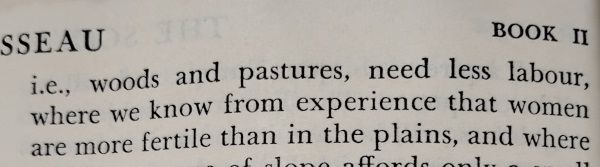
Poor women of the plains. One of the most famous and most influential political theorists of the West talks smack about them in his most influential work.


No comments:
Post a Comment