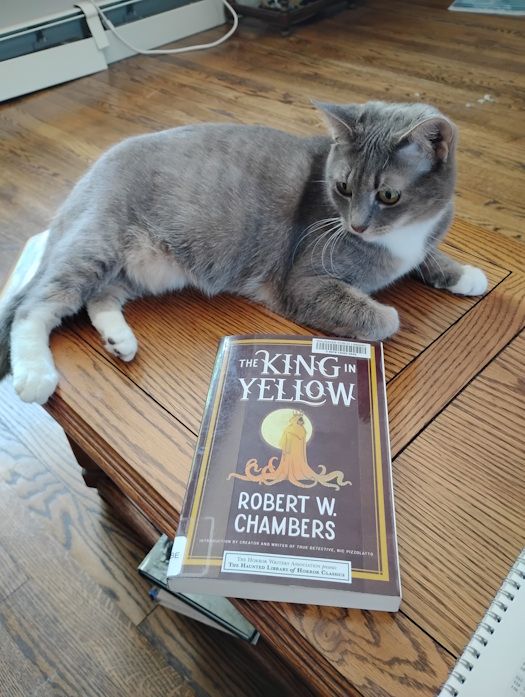
I watched season 1 of True Detective knowing that it was inspired by The King in Yellow but hadn't actually read the text. When I revealed this in a group chat with a bunch of other Call of Cthulhu GMs, I was roundly castigated. Well, not really but one was adamant that I do so.
Shortly after that bout of texting, I put it on hold at the library and, after what seemed like a long time but was actually only a couple of months, a copy was made available to me.
One of the things about that first season of True Detective that I noticed was how The King in Yellow was a menacing presence in the background and not an immanent threat. This I found slightly disappointing but, now having read the short stories from which the figure emerges, I am highly undisappointed and feel that the TV show got it right.
While the book has several short stories, it's really only the first four that reference The King in Yellow. It should be said that "The King in Yellow" is the name of the short story collection, a two act play mentioned in the stories that renders whomever should read it mad, and also a malevolent figure.
The first tale, "The Repairer of Reputations", relates the story of one Hildred Castaigne. We learn of a head injury he sustained when falling from his horse and that, while convalescing, he read The King in Yellow and emerged a changed man. So much so that he was committed to an asylum where he was treated for madness.
The treatment failed.
Hildred consorts with a blackmailer named Mr. Wilde who also is touched by madness and has strange ideas about "The Imperial Dynasty of America" and Hildred's place in its line of succession, let's say. The would-be king adopts all manner of delusions and conceives a grandiose scheme in a bid to become king.
I enjoyed "The Repairer of Reputations" as it chronicled Hildred's further descent into delusion and madness. We learn about the potency of the play and are introduced to The King in Yellow himself.
"The Mask" is about an alchemical love triangle. Alec and Boris both desire Geneviève but Geneviève loves Boris more. Boris, a sculptor, has come up with a potion that transforms living creatures into marble. Alec isn't keen on this transmogrification business and instead turns to reading The King in Yellow play.
Tragedy follows wherein Geneviève is turned to marble but there's a happy ending which I am unsure of because it is told to us by Alec who is surely not well mentally after having read the infernal play. Did Alec's love really become flesh once again?
The final of the four, "The Yellow Sign", was my favorite.
It concerns a painter, a Mr. Scott, whose model, Tessie, has the most macabre dream in which she watches a hearse go by her window. Nothing too strange, right? But A) the driver's face looks pallid - like he's dead and B) it is Scott's face that stares out from the open casket.
It also turns out that the churchyard watchman who stands just across the street from the studio is the same man in Tessie's dream!
Cue dramatic music.
I liked the comparatively slow burn here. First there is a strange dream followed by its seemingly impossible connection to the real world. Then Tessie gives the Scott a yellow pin with an unknown design on it. Not long afterwards a copy of The King in Yellow appears in Scott's home and it's all downhill for our artist. When he remarks that he and Tessie sat up all night discussing the infernal play, you know it's over for him.
I enjoyed how the story starts off with a bit of sexual tension and then a creepy dream gets thrown into the mix and it just gets weirder and more horrible from there.
Overall, I found these King in Yellow stories to be mysterious, creepy, and fun reads. The King in Yellow - the play and the figure - are menacing but opaque. People read the play but we only get a few lines from it here and there. These are strange, tragic tales with The King in Yellow influencing events from the shadows and driving people mad instead of being a monster that steps into the light to wreak havoc. The effect of reading the second act is what's important, not knowing the details nor coming face to face with the King himself. Nic Pizzolatto, the writer of True Dectective's first season did a wonderful job of transposing this aesthetic to a 21st century TV show.


No comments:
Post a Comment