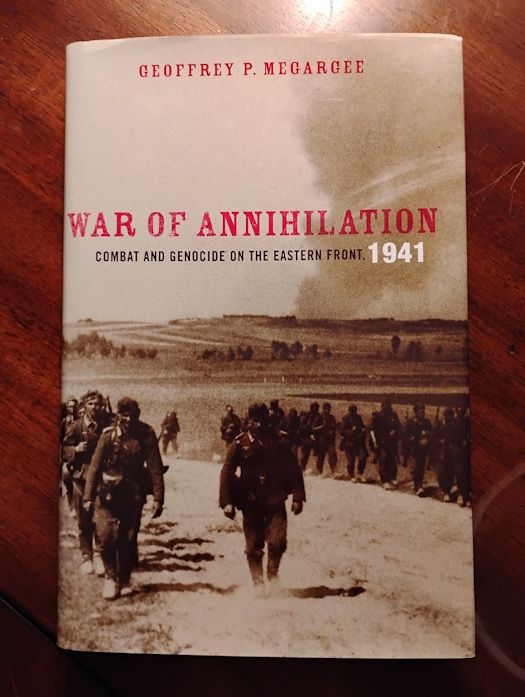
I'd swear that I've read a book dedicated to Operation Barbarossa or, at least the Battle of Stalingrad but cannot for the life of me recall which one. I scanned my bookshelf a couple times but nothing on the topic that I have already read.
What a horror story. The whole, um, shootin' match, so to speak. If two armies fighting isn't bad enough, there's life on the front with lice and boot shortages, and so on. Winter settles in and everyone - combatants and civilians alike - suffer from frostbite, if they don't freeze to death. In Stalingrad civilians endured the horror of urban warfare. If there weren't bombs being dropped on them, there were artillery shells. If death wasn't coming out of the sky, it was coming from Wehrmacht soldiers out on the street attempting to take the city block by block.
And then, when the Germans retreated, they raped and pillaged and destroyed what they could on their headlong flight back to the Fatherland. The Poles suffered horrendously when the Wehrmacht was making their way east and did so yet again with the surviving armies in retreat. Desperation, starvation, ripping fetuses out of pregnant women's bellies - the sheer horror and depravity boggles the mind.
And so I had some background going into Geoffrey Megargee's War of Annihilation.
The book's subtitle is "Combat and Genocide on the Eastern Front, 1941" and Megargee brings in the Nazi's attempts to kill the Jews they encountered as they plunged into the Soviet Union, a tact that I had never encountered before.
The photograph above doesn't really betray it, but the tome is fairly short - about 150 pages of exposition. It begins with the proximate origins of German antipathy towards Jews and Slavs.
Put simply, by 1900 many Germans had come to believe in their complete superiority over other peoples, while they also felt that Germany stood under threat from all sides. Foreigners, and especially the Slavs and Jews of central and eastern Europe, became the focus of increasing distrust and hostility.
This is followed by a section demonstrating how the Wehrmacht commanders capitulated to Hitler's demands regarding racial matters.
Let me back up a bit. Megargee notes how the history of Operation Barbarossa has come down to us in large part via the memoirs and testimonies of German commanders, that the losers have written a lot of the history here.
Thus, for reasons both innocent and insidious, their accounts constitute a mix of truth, half-truth, omission, and outright lies that has been difficult to untangle. Professional historians, for their part, skeptical though they were, often did not pick up on the problems in the Germans' accounts.
Wehrmacht generals, not unsurprisingly, blamed Hitler for basically everything. They were just following orders. But Megargee shows how the upper echelons of the Germany military had defied civilian authorities in the past yet they went along with Hitler's genocidal policies in World War 2. Their views were in accord with Hitler's.
What was new to me here was that the German invasion of the Soviet Union wasn't merely about Lebensraum and natural resources such as oil from the Caucasus.
This was to be, quite literally, a Vernichtungskrieg, a war of annihilation, in which the army would take an active role in pursuing National Socialism's racist goals.
The book proceeds to give a very high level overview of Operation Barbarossa in 1941 punctuated with episodes demonstrating how the horrific Nazi racial attitudes and polices were put into practice.
While there were field commanders who had no interest in pursuing the Nazi's genocidal intentions, very few protested. Some individual soldiers risked their lives showing kindness to the civilians caught up in the battles, but they were few and far between.
It's difficult to find words that have the emotional impact to describe the events in the book. So many people call those with whom they have a disagreement with "Nazis" that it feels like most people have little to no idea about real Nazis, what they stood for and what they did. Someone called J.K. Rowling a "nazi" for advocating for women-only spaces - biological women, that is.
This is what real Nazis did:
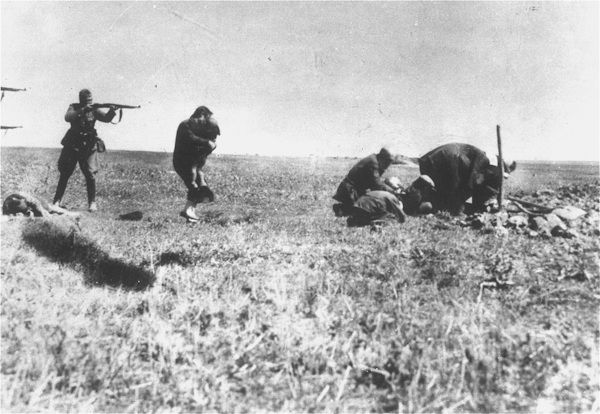
Here we see an SS death squad murdering a Jewish family in Ukraine. Can you imagine how deranged one must be to shoot a woman holding her child like that?!
Megargee documents the treatment of the countless Russian soldiers who surrendered to the Germans. The injured were left to die in agony, some were just shot on the spot, while others were sent back to Germany to fill the labor gaps left by the men sent off to fight the war. We learn of how some POW camps had no shelter whatsoever from the elements so Russian soldiers curled up fetal on the ground totally exposed to the elements. With food becoming an ever precious commodity in Germany, rations for the Russian laborers was constantly being lowered.
SS Einsatzgruppen, that is Nazi SS death squads, followed the Wehrmacht east to carry out Hitler's sadistic policies to eliminate Jews and they often times enlisted the help of the Wehermacht as well as local police to do their dirty work. The numbers are absolutely appalling.
The Einsatzgruppe, together with a battalion of Order Police, also killed another seven thousand Jews in the Mogilev (present day Belarus) ghetto on October 2-3 and 19. Fewer than one thousand of the inhabitants remained alive to be placed in a forced labor camp. Another seven to eight thousand Jews in Polotsk and seven thousand Jews in Borisov were also killed. To those figures one can also add over 1,500 mental patients that the Einsatzgruppe killed in improvised gas chambers in Mogilev.
The use of Zyklon B was pioneered during Operation Barbarossa.
In the Ukraine in addition to mentioning the shootings at Babi Yar (Ukraine) the previous month, Ensatzgruppe C reported killing 3,145 Jews in Zhitomir...A further 410 Jews were killed in Cherson...The report, which also included Einsatzgruppe D's operations, mentioned the liquidation of 4,891 Jews in the region east of the Dnieper - and actually we know that the figure only covers the first half of the month.
...
Other murder squads, for example, killed ten to twelve thousand Jews on October 12 in the city of Stanislau, in Galacia. The next day, Higher SS and Police Leader Jeckeln had an Order Police battalion shoot approximately eleven thousand Jews in Dnepropetrovsk. Including those figures, even this incomplete accounting brings the number killed in October to over ninety thousand, most of them Jews, and not including prisoners of war or civilians whom the army eliminated.
At one point Megargee describes how Wehrmacht commanders had to remove their soldiers from their grisly genocidal duties because killing thousands and thousands of civilians was taking its mental toll on the men. I cannot imagine what that does to a person.
German war planners used language in their correspondence filled with euphemism such as "necessary harshness" and "special tasks". Despite their hatred of Jews and pride at being part of Hitler's machine, many Nazis were reluctant to plainly describe their genocidal orders.
********
So much food for thought here. Let me begin with the banal.
While Operation Barbarossa brings to mind divisions of Panzer tanks rolling across the steppes creating safe passage for the German equivalent of deuce and a half's, the Germans used hundreds of thousands of horses for transport. The number 160,000 sticks out but I cannot recall if that was the number killed in 1941 or for the entire campaign. Perhaps even for a single month in 1941. Regardless, Operation Barbarossa was not kind to our equine friends.
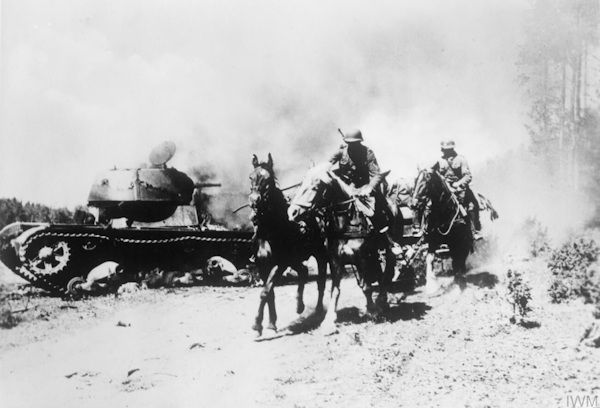
Another observation of the mundane: why did the Germans seek to replace the rail track in the Soviet Union instead of just capturing Soviet rolling stock? (I think German tracks were of a narrower gauge.) Jesus, laying thousands of miles of track was an enormous undertaking. No wonder it took ages for supplies and reinforcements to arrive. Not enough Soviet locomotives and rail cars?
Concomitant to this is Megargee's observation that German war planners gave logistics an inferior position beneath operations. They were outlining what they wanted to do on the battlefield heedless of whether the soldiers doing the fighting had enough ammo, food, or clothing. It's easy in retrospect to look at the Nazi's mistakes and say "Duh!" but I am very glad they made them.
Reading War of Annihilation reminded me that anyone linking someone to the Nazis - the real Nazis - over political disagreements is a fool who deserves all the slander and libel lawsuits that the law in their country allows. Their ideas are not to be taken seriously and should be viewed simply as someone out to hurt those with whom they disagree and not someone who has anything substantive to contribute to a conversation.
Secondly, I was reminded of the great capacity of your ordinary average non-megalomaniac to both ignore and to perpetrate the most heinous deeds. Most people aren't August Landmesser.
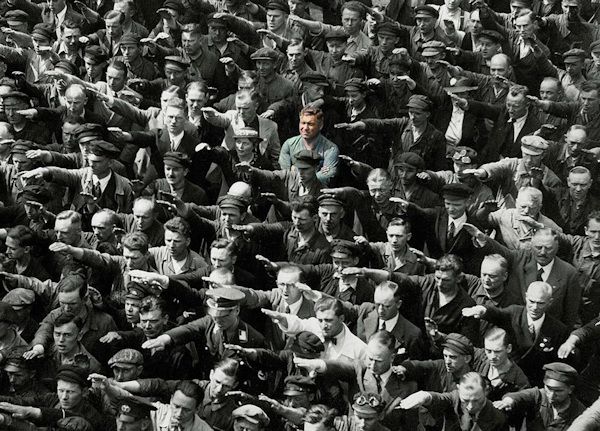
Most people are happy to go along with prevailing winds and very few are willing to risk tacking their own course. Good men do nothing all too often.
Lastly, a police officer killed a suspect last month here in Madison and the police chief's press conference was interrupted by protestors, at least one of whom yelled "Zero power to Zionists...." I find this injection of "Zionism" into a situation not all related to Israel to be profoundly disturbing. If we in the United States have our own Kristallnacht, it will be lead by zealots of the Left bearing placards featuring George Floyd's face and, I fear, a lot of good people will do nothing.


No comments:
Post a Comment