Showing posts with label BBC Eighth Doctor Adventures. Show all posts

08 December, 2023

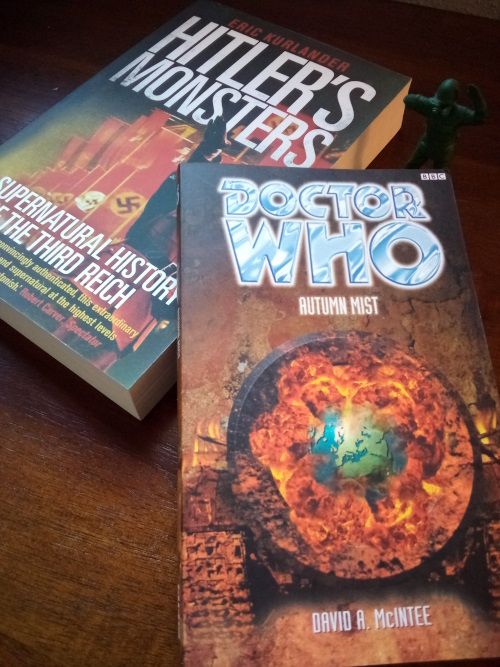
Unternehmen Herbstnebel

It's too bad David McIntee didn't have this story take place a week or so later than it did so we could have General George S. Patton as a character. Can you imagine the barbs he and Sam would trade? Woo boy! Old Blood and Guts would demean the Doctor as an effeminate dandy but they would come together after finding common ground in the maxim about making plans that fit the circumstances.

But McIntee didn't.

Instead it's 15 December 1944 and Patton's Third Army are still in Germany. Here in the Ardennes, beleagured American forces are doing their best to hold out against a desperate last push by the Germans into Belgium and France. Into the waning days of the war and on a bridge in the the Ardennes forest lands the TARDIS. Our heroes go wandering when suddenly the bridge is destroyed. The TARDIS falls to the bottom of the river and Sam ends up on the far side separated from her friends. Eventually the Doctor and Fitz get split apart as well when the latter ends up in the river just like the ship and is swept downstream.

Oh, and weird things are happening in the forest, namely, bodies are disappearing...

Sam runs into an American soldier named Kovacs who gets her a lift farther back from the front lines. That convoy is attacked by the Germans and everyone is captured. In retaliation for the Allied bombing of cities - I think the fire bombing of Dresden was still a couple months off but Hamburg had been turned into an inferno the previous year - the German soldiers decide to take no prisoners and shoot them instead. I was shocked when our beloved Sam was shot point blank in the heart.

Fitz eventually extracts himself from the water and finds some shelter in a small town. Unfortunately, the Germans move in and Fitz is forced to grab the uniform of a dead paratrooper. Although unterwasser, the TARDIS translation circuit works just fine and Fitz is able to integrate himself into the Wehrmacht unit that has occupied the town. His Spidey sense is activated when a trio of armored vehicles appear with strange-looking antennae that seem out of place in this time period. Ooh! The Ahnenerbe!

After having lost Fitz, the Doctor meets up with a Polish-American G.I. named Wiesniewski who is out of sorts and is mumbling something about a "Leshy in mist..." with a Leshy being a Polish spirit of the forest. The Doctor gets him to the town of Bastogne for medical care where a doctor of the medical kind named Garcia treats him. The Americans there are under a Colonel Lewis who is a bit of an odd duck. He appears to make a reference to the Philadelphia Experiment and seemingly has an invisible companion that he talks to.

Just as there was a scarred rip in the fabric of space-time in Unnatural History, there is a rift here in the Ardennes. This rift has exposed our world to that of the Sidhe, creatures that we ostensibly share the Earth with but who also exist in the rest of the 11 dimensions and out of phase from us and our limited perceptions. Thusly it's like we can kinda see them out of the corner of our eyes, but when we turn to get a better look, they're gone. If we were able to see them, they'd appear somewhat elven to our eyes. Lewis and the local Ahnenerbe rep on the ground with those armored vehicles donning strange antennae, Sturmbannfuhrer Leitz, have a pact. They will penetrate the rift with some tanks and troops and duke it out as an experiment.

I didn't think Sam's time had come and indeed it hadn't. Not unlike Richard Francis Burton in Riverworld, Sam wakes up in the land of the Sidhe. Alive. I was going to write that she'd dodged a bullet but she did no such thing. Sam meets Titania, queen of the Sidhe. The king is named Oberon and is her equal and opposite. Whereas Titania represents order, Oberon revels in chaos - vague shades of the Faction Paradox here. We learn that Lewis' invisible friend is Oberon who is meddling in human affairs.

OK, done with the synopsis.

McIntee does a really nice job here. The first chapters give you a good picture of the scene and build up mystery well. I was not expecting Sam to get shot and killed. That scene was done very well with people dying horribly and Sam trying to feign that she's dead so that the Germans wandering the bodies looking for any survivors to dispatch don't come to her. A very tense scene that left me incredulous.

The Wehrmacht soldiers are definitely the bad guys but they aren't cartoonishly evil devils while the G.I.'s come across as your average Joe put in a predicament they don't want to be in but must. OK, there's a dash of John Wayne heroics at the end when just a handful of them take on German infantry and heavy armor but that's fine, really. Even Lewis und Leitz aren't over the top.

McIntee treads well-worn ground here with his "war is hell" theme, but he does a good job and never gets preachy. The battle scenes were well drawn with tension filling the air as grenades are lobbed and bullets fly overhead. McIntee appears to have done his homework as his descriptions of military equipment seemed legit and I don't think the differences between Panzers and Tigers have ever elucidated upon before or since in Doctor Who.

Some things I noticed: Fitz worries about whether this Sam is the same one he slept with in Unnatural History. And, as in that novel, the Doctor here does not cast a shadow. I smiled when Fitz did his imitation of Sean Connery in Dr. No. It was a nice bit of fun when, needing a couple thousand tones of ferrous metal to close the rift, the Doctor heads to Philadelphia intending to snag the U.S.S. Eldridge. When told he cannot just steal a ship, he retorts, "Famous for disappearing, isn’t it?" And thusly he makes the Philadelphia Experiment come true.

At one point, Oberon takes on Sam's appearance (or, rather, alters everyone's perceptions so that they think they're seeing Sam) and heads off in the TARDIS with the Doctor and Fitz. The real Sam seems rather unperturbed when she is told that she was seen entering the TARDIS which promptly took off. You'd think she'd be a bit more worried about the Doctor and her lover boy stuck with a fake poseur Sam.

At the end, Sam declares that she is through traveling with the Doctor and wishes to resign her commission as a member of the TARDIS crew. "I don’t need to do this anymore...I don’t need to follow someone else to know who I am, now. I feel like I’ve been pulled apart and put back together again – literally – more times than anyone should have to put up with..." I guess Sam will leave at some point in one of the Interference books. We shall see.

Autumn Mist was a hoot. The action scenes were tense, the story didn't bog down when Sam ends up going to another dimension as in Dominion, the characters were well-drawn, and, overall, it was just fun. No big continuity issues to keep in mind; just bad guys to deal with.

07 December, 2023

The Discomfited Doctor

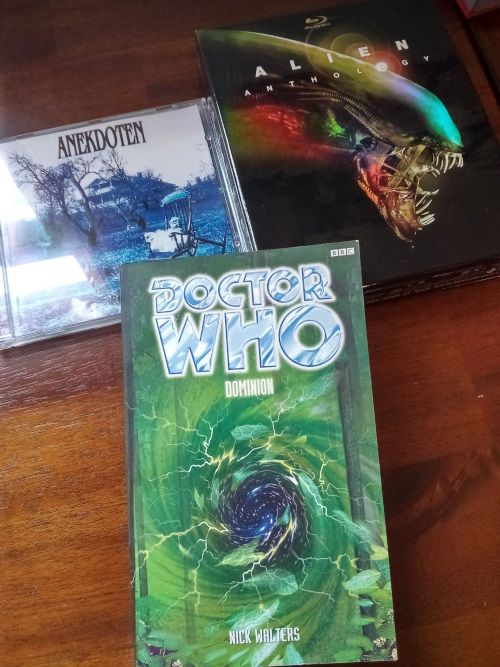
At the end of the previous story, Dominion, the Doctor announces that there's an anomaly in San Francisco, the site of his last regeneration, that must be investigated.

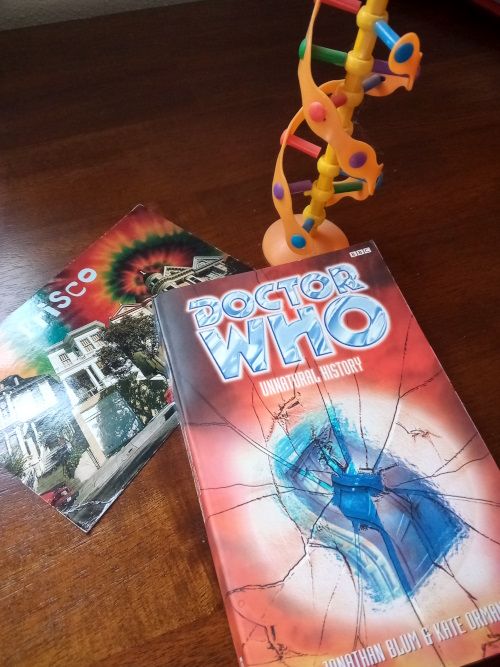
Unnatural History was a surprising tale for me and it has a rather complicated plot that I am not qualified to synopsize easily. It begins with the Doctor in London trying to convince Sam to come with him. But this is not our Sam, it's Dark Sam, the alternate version of the much-maligned companion that was first mentioned 16 books ago in Lawrence Miles' Alien Bodies. I don't know why no one investigated this avenue until Jonathan Blum and Kate Orman did here. Were the other authors not interested? Perhaps they figured Miles would take his own baton and run with it.

Then we find out that the events of the TV movie left a scar in the fabric of Time-Space that never fully healed. Various creatures are drawn to the portal such as Mandelbrot turtles and unicorns and a Kraken thingy which sleeps in the bay. Now let me see if I have this right. When our crew initially encounters the scar, the OG Sam falls into it and Dark Sam is created. The TARDIS seals the scar to keep it from getting ever more dangerous and preserve any possibility of getting blonde Sam back.

There's this unnatural historian, Griffin, who is trying to collect the odd creatures that have started to appear in San Francisco. He's a being from higher dimensions and quite mysterious. And he has these ominous henchmen. Griffin reminded me of Light in "Ghost Light" in that he wanted to collect and preserve. Light couldn't comprehend that beings changed and, similarly, Griffin is really big on taxonomy and seeks to simplify creatures so that they fit into but a single category.

Also, in perhaps a nod to "Remembrance of the Daleks", there's a boy running around who is not all that he seems. He is, in fact, with the Faction Paradox and he messes with the Doctor's head.

Griffin proves a very capable foe who is able to thwart the Doctor's plans pretty much up until the end. I liked that he was so enigmatic. We get some background but it's really a bunch of hints at this and possibilities of that. He collects his specimens and puts them into this transdimensional box. At the end, Sam opens the drawers of the box freeing the specimens who push Griffin into the scar. Will he survive? Boba Fett, after all, is supposed to have been able to escape the sarlacc.

With the TARDIS doing its bit as transdimensional duct tape to seal the scar, the Doctor is lost, not himself in certain ways. Detached from his anchor, he is not whole. At one point, he creates a pan-dimensional force field to contain Griffin, but it proves no match for the wiley collector who simply steps out from the field and kills a pagan hippie lady whom Fitz had enlisted to help the cause. In another scene, he sends one of those messenger cubes to the Time Lords only to discover later that the Faction Paradox kid has it. Blum and Orman really knock the Doctor off his pedastal here. Better than torturing him like the latter did in Seeing I, at least.

And then there's the mysterious professor at UC-Berkeley who says, "I’m Professor Daniel Joyce these days..." I thought he was a Time Lord at first, but he denies it at some point. He's obviously not human but I dunno what species he is a member of. And I was really thrown when he and Griffin have a little confab where Joyce seems to have some authority in a group that Griffin is ostensibly working for and so he can order the unnatural historian around. Or so he thinks, anyway.

Finally, there is biodata everywhere. Biodata are like DNA molecules but crossed with a computer program so you can modify it and thusly change the person - even their past. The events of the TV movie have spilled the Doctor's biodata all over San Francisco. The scar is full of it and there are whispy strands of the stuff dotting the cityscape. Joyce is tinkering with it, Griffin has some, the Faction Paradox...Well, if you're just going to leave your biodata lying around, you can't expect it to remain unmolested.

Unnatural History has a lot of threads running through it. There's the whole Sam vs. Dark Sam quandary, people tinkering with the Doctor's biodata, having to defeat Griffin, the Faction Paradox lurking in the background and occasionally making nebulous threats, etc. Lawrence Miles sowed the seeds in Alien Bodies and here Blum and Orman reap the harvest of twisty, paradoxical goodness.

While I appreciated all the timey-wimey uncertainties and wonder if it will be another 16 books before someone picks up on the threads here, the tone of Unnatural History put me off. It feels very 90s and has a slick casualness to it that doesn't do much for me. The tone is like what I think Joss Whedon's TV shows are like. The new Sam does drugs so she's "dark"; Griffin is more than a match for our hero but is he really all that interesting a villain? I really liked that he was such an enigma but he came across as rather a one note character.

I am having a hard time explaining it.

I won't say that I am against a flailing, helpless Doctor per se, but you have to do it right. Falls the Shadow felt like pure sadism to me. When you take away the Doctor's ability to help people and to overcome evil for too long, then the quirks and charm of the character tend to erode quickly. He just runs to point A where his plan fails so he drives his VW Beetle to point B where is next plain is foiled.

Perhaps the biggest contribution to Doctor Who lore and continuity is the way Blum and Orman tinker with the Doctor's identity. There's various chatter about our hero being half human and his biodata is littered around San Francisco with various groups tinkering with it. Are they changing his past? Are they modifying him? He was loomed yet had a human mother; he is The Other yet also just some Time Lord whose dissatisfaction with his society convinced him to bail on it just like a Gallifreyan Prince Harry. The book seems to take the whole concept of the origin story by the scruff of its neck and throws it out the window.

I should probably re-read Unnatural History at some point. Blum and Orman are fine writers with more neat ideas than you can shake a stick at. But there's just this ineffable problem I have with the tone. It feels American, it feels like the TV movie.

The fact that I have written much more about this story than I intended speaks to the fact that it is, at the very least, noteworthy - that it is worth considering and discussing.

I will end with this: Fitz gets into Dark Sam's pants in this story and I have to wonder how that's handled in the tales that follow.

Down the wormhole

It is fortunate that I decided to re-read Revolution Man because it is referred to here, albeit briefly. Fitz feels guilty for, well, all of his failings in the previous novel such as forcing the Doctor to get all medieval on Ed Hill, carrying pictures of Chairman Mao, etc. He wanders over to Sam's room with his tail between is legs when suddenly it is beset by this swirling vortex hole to another world and Sam is sucked in as of by some vorticial vacuum.

Meanwhile it's 1999 here on Earth and near the Swedish town of Strängnäs, the young, lithe Kerstin is spending some time at a cabin with her boyfriend Johan. (Curiously enough, Strängnäs is a genuine location in Sweden.) One night a big chunk of the cabin and a large swathe of the surrounding earth is suddenly gone. Just poof! Vanished. It turns out others in the area have also disappeared under similarly mysterious circumstances.

We meet a local farmer named Björn who finds a hideous reptilian creature attacking his pigs and chases the squamous beast away with his shotgun. Kerstin, in shock and with only half a cabin, goes to Björn's farm seeking shelter. He is reluctant at first but, being a widower, he can relate to her situation and so he relents and takes her in.

Sam is absent for something like the first half of the story which leaves The Doctor and Fitz to do the heavy lifting. They stumble upon a dead creature out in the woods that appears no less hideous than the one Björn encountered in his barn before being shooed away by hazmat suit clad folks claiming the authority of the State Biohazard Protection Unit, which, of course, doesn't exist. Instead they are UNIT and have a real nice underground bunker nearby where one Professor Jennifer Nagle has taken some alien technology and come up with a telecongruency warp generator. But instead of being able to teleport people and things between two points (I thought of Miss Kelly from "The Seeds of Death" here), she has created a wormhole between our world and another one.

It is unstable and threatens Earth's very existence! And just as chunks of the Swedish countryside and its inhabitants are being sent through the wormhole, inhabitants of that other world, the T’hiili, Bane, and the Ruin are brought here.

Sam is at that other world and has to figure out who is who and how to survive the menacing black Blight which threatens to overtake that world. The Doctor is in even more precarious position as he is tasked with dealing with Major Gareth Wolstencroft of UNIT who has a military mind even worse than the Brigadier's! He heedlessly attempts to deal with the threat to Earth as his training dictates, ignoring the Doctor's admonitions all the while.

Eventually the fecal matter hits the fan on both sides of the wormhole with the Blight joined by the threat of the Ruin on the other side while here on Earth, Ruin make their way into Nagle's lab. Things get dicey but the Doctor saves the day.

The first 40% or so of Dominion was excellent. Sam was on the far side of the wormhole so we get to witness the relationship between the Doctor and Fitz develop a bit. Plus Nick Walters does a very nice job of building up mystery in Strängnäs. Weird things are happening and nothing is as it seems. Plus we have no idea where Sam is or what she is up to. There's even a point where Johan mysteriously turns up again only to suffer the same fate as Kane and has a baby Bane burst forth from his chest in a scene full of disgusting glory.

I credit Walters for not simply having Kerstin brush this off to get on with the business of helping the Doctor save the world. But it's too bad Björn was killed so prematurely instead of being someone with whom Kerstin could commiserate. Walters didn't have to go full-blown Forbrydelsen here but I think he missed some opportunities to show that not everyone can just leave their traumas behind in an instant. On the other hand, Fitz thinks twice about hitting on her.

While I really enjoyed the scenes in Sweden - even if they tread some well-worn Third Doctor ground - the scenes with Sam on the other side of the wormhole, Dominion, were less interesting for me. Sam basically wakes up in a cave and is a stranger in a strange land. She's trying to grok where she is and what's going on with the help of a local named Itharquell. Itharquell is a bit pathetic at times, just resigned to die at the hands of the Blight without so much as putting up a fight. 

I liked the idea of the Dominion - a pocket universe with the Blight threatening its very existence being our universe creeping in and taking over - to be rather neat. But it all seemed a bit undercooked in the end. The Dominion's inhabitants seemed rather one dimensional in order to make Sam look heroic. But I will admit that the situation in Dominion is given a genuine sense of threat, of urgency.

Nagle's telecongruency hoolie punched a hole in the TARDIS that sucked Sam out and this damaged the our beloved ship severely. We are told it reverted to its original form, a grey slab, in order to use power that would normally be used to project an outer shell (or whatever) to fix itself. A nice dash of basic Doctor Who lore. I liked the appeals here to the UNIT-laden earthbound Third Doctor era. Here the Doctor has a mechanical blood drawing mosquito gadget. I also liked the evil UNIT. Instead of venerating the Doctor and seeking his help, they ignore and try to suppress him as they use a blunt instrument to fix the problem instead of something with a bit more finesse.

Despite the Dominion scenes being weaker, this was still a very fun tale. It ends with the Doctor announcing that there is some kind of dimensional anomaly in San Francisco that must be investigated...

You say want a Revolution Man

I recently finished a moderately dense history book that was made all the more complex by the fact that it concerned a place and time that were almost wholly unfamiliar to me. We're talking Japan in 950 C.E.-1050 C.E. or so and, while the text that was ostensibly written for a lay audience, methinks it was for one rather more educated than me. But it was a book that I'd been meaning to read for nearly 25 years and I figured that I had procrastinated long enough.

Having gotten it under my belt and indulged myself in some warm memories of the person who recommended it to me, I decided my next read would be something more easy going and, unsurprisingly, it was Doctor Who. I returned to the Eighth Doctor Adventures and Paul Leonard's Revolution Man.

I eagerly dug into the book but ere long got a feeling of déjà vu. Had I read it already? It would have been very easy to determine this but instead I continued reading thinking that I'd figure it out soon enough. Well, soon enough ended up being something on the order of 3 chapters before I was fully convinced that I had, in fact, already read it.

"In for an inch, in for a mile," I said. And so I plowed on reasoning that refreshing myself on the events here might come in handy when reading the next book.

It is the Summer of Love in London when the TARDIS crew land and find that some pseudonymous Banksy-like anarchist who goes by "Revolution Man" is taking responsibility for graffiti being carved into monuments around the world. Our heroes go meet Jean-Pierre Rex, a local anarchist, for coffee but he's all talk and Sam is appalled when he hits on her. For his part, Fitz has no luck hitting on the waitress there, Maddie, but he is invited back to the flat she shares with her boyfriend to crash.

Maddie's significant other is a musician named Ed Hill who just happens to have a stash of this funkadelic drug called Om-Tsor. It turns out that Om-Tsor is better known outside of Earth as Rubasdpofiaew, a telekinetic drug from Tau Ceti Minor where locals use it to catch their prey. The stash on Earth originated in Tibet and Maddie and Fitz have an adventure there - but not before a brief stop in Nepal - which results in Fitz being captured by the Chinese. There he becomes a Manchurian Candidate and sent back to England to see if he can retrieve more Om-Tsor.

Well, it turns out that Jean-Pierre Rex had indeed been the Revolution Man but forsook the title when he realized that Om-Tsor just wasn't the right tool for him to bring about change. The title then reverted to Ed Hill who had had an accident which left him paralyzed. But instead of becoming a kindly, avuncular rock music figure like Robert Wyatt, Hill turned to the dark side.

As the tale wound to an end, Fitz ends up shooting Hill, who has become deranged by the drug, onstage at a rock concert. It doesn't quite do the trick so the Doctor does his best Nathan Gale and shoots Hill to finally put an end to the dangerous predicament.

I think that Revolution Man is better than my inability to recall having read it last year would indicate. While I won't say it's great, I did like the portrayal of revolution as something that's perhaps not as obviously good as we've seen previously in Doctor Who and that revolutionaries are imperfect and sometimes not particularly nice, however worthy their cause. It was neat that Fitz ended up in China for a couple years doing struggle sessions and getting brainwashed.

The Doctor's rather uncharacteristic use of firearms and the sad fate that befell Maddie at the end made for a real downer. No happy ever after here. Will the events here temper Sam's idealism? Had it already been tempered in a previous novel and I just cannot recall?

It was disturbing to have the Doctor blast Hill to his demise after Fitz was unable to complete the job. The whole thing seemed so primitive and ungentlemanly. It came down to a bullet rather than application of intellect. The Doctor didn't lead a revolution leading to the poor and down-trodden finding dignity and freedom but rather a revolutionary spirit proved to be nothing more than Thanatos. Common Doctor Who conventions are inverted and twisted here.

I liked all that but found the plot lacking. The stuff between the good scenes just wasn't all that good. The non-TARDIS crew characters weren't all great either. Maddie especially came across as uncompelling despite the interesting milieu that she finds herself in. She's a puppet with the strings being manipulated by others.

Not great but certainly not bad. I have decided that this bout of EDA's will take me up to Interference - Book One.

01 December, 2022

Hear Me Discuss Doctor Who


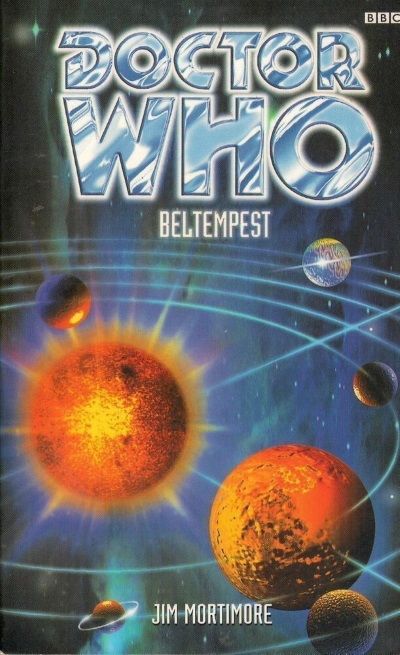
I am a guest on the latest episode of the Doctor Who podcast We're All Stories in the End. Host Iain Martin and I discuss Jim Mortimore's Beltempest, his BBC Eighth Doctor Adventures tale published in 1998.

This is the second time I've talked about this novel on a podcast so now I am an expert. Ha!

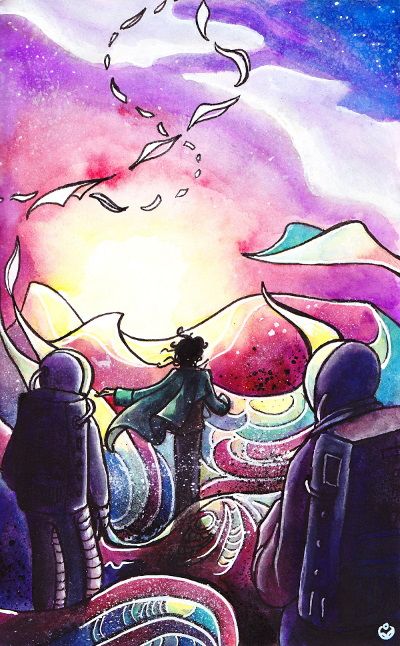
(Picture by JohannesVIII.)

Sunrise came to the new world in a kaleidoscopic iteration of life.

Things that might have been birds or fish flapped or swam through the air. They made a sound that was indescribable. It might have been laughter or machine noise. No one could tell. More life crawled and flapped across the surface. Again, no one could tell if this life was vegetable or animal - motile seeds seeking fertile ground or animals seeking to evade a vegetable predator. The world was a circus mirror of a real world, one in which the reflecting surface was constantly evolving, unbending, flattening with time, before assuming some new, evolutionary kink.

The rain stopped, then started again. The clouds changed colour as volcanic gases emerged to mingle with the sunlight. Yellow blotches of sulphur appeared on the ground. Some of them had legs and fled from the approaching heavy tread of the medics' starsuits.

04 August, 2021

Fiction Paradox: Fanfare for the Common Man

Check out the latest episode of Fiction Paradox, the world's only podcast dedicated to the BBC Books Eighth Doctor Adventures - that I know of. I do it with my pals Brooke and Sasha. This time around we review The Face-Eater by Simon Messingham.

It was a good tale and the name of our episode comes from the emphasis given to working class characters which was refreshing.

You can also get our show at Google Podcasts or Apple Podcasts.