Showing posts with label World War II. Show all posts

03 July, 2026

Just when you thought the Eastern Front couldn't get any more appalling

My current read is War of Annihilation: Combat and Genocide on the Eastern Front, 1941 by Geoffrey P. Megargee.

I am not very far in so it's been background so far but it will lay out how, contrary to popular perceptions, the Wehrmacht colluded with the SS to help carry out the Holocaust and just inflict heinous cruelty on civilian populations in general. Just when you thought the Eastern Front couldn't get any more appalling.

Here's Megargee giving a lecture on the subject.

24 September, 2025

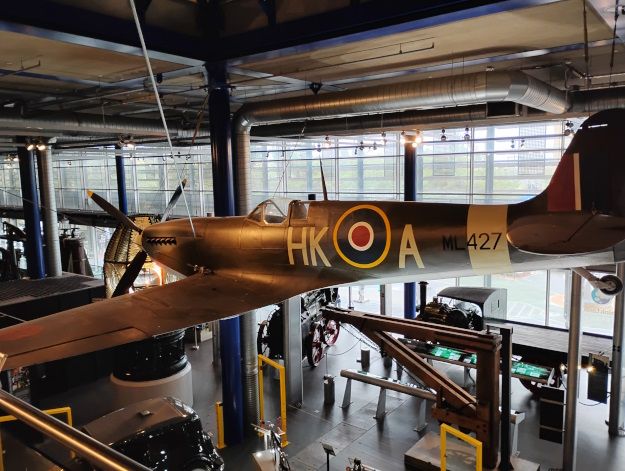
Ascending and turning our Spitfires to face them

At Thinktank in Birmingham I learned that factories there made 75% of the Spitfires built during World War II.

 
And you know Iron Maiden came to mind when I saw the Spitfire exhibit.
 

08 August, 2025

Der Tiger

Some fine German cinema! Das Boot in a tank? Looks like it's to get a theatrical release in Germany but probably not here beyond a special screening. Maybe the Goethe Institute can arrange a screening in Chicago.

17 April, 2024

Stoopid app

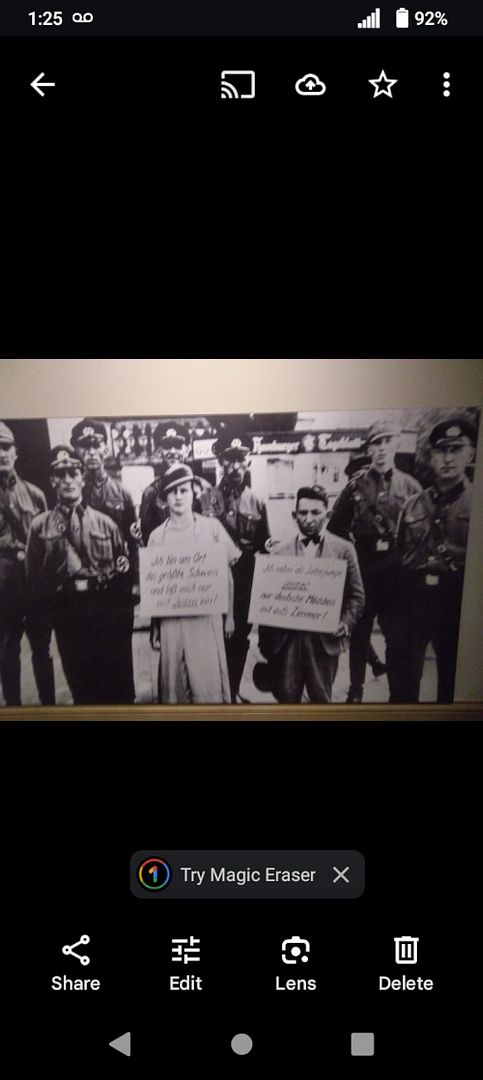
When I was at The National WWII Museum last week, I took oodles of photos. At one point I was looking at some of them on my phone and came across one taken in the gallery about the Holocaust. My photo app made an unfortunate touch-up suggestion for a photo of two Jews being humiliated by some Nazis.


08 December, 2023

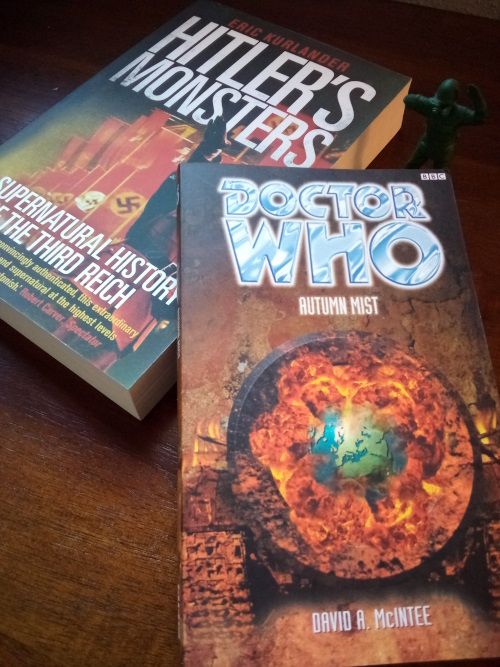
Unternehmen Herbstnebel

It's too bad David McIntee didn't have this story take place a week or so later than it did so we could have General George S. Patton as a character. Can you imagine the barbs he and Sam would trade? Woo boy! Old Blood and Guts would demean the Doctor as an effeminate dandy but they would come together after finding common ground in the maxim about making plans that fit the circumstances.

But McIntee didn't.

Instead it's 15 December 1944 and Patton's Third Army are still in Germany. Here in the Ardennes, beleagured American forces are doing their best to hold out against a desperate last push by the Germans into Belgium and France. Into the waning days of the war and on a bridge in the the Ardennes forest lands the TARDIS. Our heroes go wandering when suddenly the bridge is destroyed. The TARDIS falls to the bottom of the river and Sam ends up on the far side separated from her friends. Eventually the Doctor and Fitz get split apart as well when the latter ends up in the river just like the ship and is swept downstream.

Oh, and weird things are happening in the forest, namely, bodies are disappearing...

Sam runs into an American soldier named Kovacs who gets her a lift farther back from the front lines. That convoy is attacked by the Germans and everyone is captured. In retaliation for the Allied bombing of cities - I think the fire bombing of Dresden was still a couple months off but Hamburg had been turned into an inferno the previous year - the German soldiers decide to take no prisoners and shoot them instead. I was shocked when our beloved Sam was shot point blank in the heart.

Fitz eventually extracts himself from the water and finds some shelter in a small town. Unfortunately, the Germans move in and Fitz is forced to grab the uniform of a dead paratrooper. Although unterwasser, the TARDIS translation circuit works just fine and Fitz is able to integrate himself into the Wehrmacht unit that has occupied the town. His Spidey sense is activated when a trio of armored vehicles appear with strange-looking antennae that seem out of place in this time period. Ooh! The Ahnenerbe!

After having lost Fitz, the Doctor meets up with a Polish-American G.I. named Wiesniewski who is out of sorts and is mumbling something about a "Leshy in mist..." with a Leshy being a Polish spirit of the forest. The Doctor gets him to the town of Bastogne for medical care where a doctor of the medical kind named Garcia treats him. The Americans there are under a Colonel Lewis who is a bit of an odd duck. He appears to make a reference to the Philadelphia Experiment and seemingly has an invisible companion that he talks to.

Just as there was a scarred rip in the fabric of space-time in Unnatural History, there is a rift here in the Ardennes. This rift has exposed our world to that of the Sidhe, creatures that we ostensibly share the Earth with but who also exist in the rest of the 11 dimensions and out of phase from us and our limited perceptions. Thusly it's like we can kinda see them out of the corner of our eyes, but when we turn to get a better look, they're gone. If we were able to see them, they'd appear somewhat elven to our eyes. Lewis and the local Ahnenerbe rep on the ground with those armored vehicles donning strange antennae, Sturmbannfuhrer Leitz, have a pact. They will penetrate the rift with some tanks and troops and duke it out as an experiment.

I didn't think Sam's time had come and indeed it hadn't. Not unlike Richard Francis Burton in Riverworld, Sam wakes up in the land of the Sidhe. Alive. I was going to write that she'd dodged a bullet but she did no such thing. Sam meets Titania, queen of the Sidhe. The king is named Oberon and is her equal and opposite. Whereas Titania represents order, Oberon revels in chaos - vague shades of the Faction Paradox here. We learn that Lewis' invisible friend is Oberon who is meddling in human affairs.

OK, done with the synopsis.

McIntee does a really nice job here. The first chapters give you a good picture of the scene and build up mystery well. I was not expecting Sam to get shot and killed. That scene was done very well with people dying horribly and Sam trying to feign that she's dead so that the Germans wandering the bodies looking for any survivors to dispatch don't come to her. A very tense scene that left me incredulous.

The Wehrmacht soldiers are definitely the bad guys but they aren't cartoonishly evil devils while the G.I.'s come across as your average Joe put in a predicament they don't want to be in but must. OK, there's a dash of John Wayne heroics at the end when just a handful of them take on German infantry and heavy armor but that's fine, really. Even Lewis und Leitz aren't over the top.

McIntee treads well-worn ground here with his "war is hell" theme, but he does a good job and never gets preachy. The battle scenes were well drawn with tension filling the air as grenades are lobbed and bullets fly overhead. McIntee appears to have done his homework as his descriptions of military equipment seemed legit and I don't think the differences between Panzers and Tigers have ever elucidated upon before or since in Doctor Who.

Some things I noticed: Fitz worries about whether this Sam is the same one he slept with in Unnatural History. And, as in that novel, the Doctor here does not cast a shadow. I smiled when Fitz did his imitation of Sean Connery in Dr. No. It was a nice bit of fun when, needing a couple thousand tones of ferrous metal to close the rift, the Doctor heads to Philadelphia intending to snag the U.S.S. Eldridge. When told he cannot just steal a ship, he retorts, "Famous for disappearing, isn’t it?" And thusly he makes the Philadelphia Experiment come true.

At one point, Oberon takes on Sam's appearance (or, rather, alters everyone's perceptions so that they think they're seeing Sam) and heads off in the TARDIS with the Doctor and Fitz. The real Sam seems rather unperturbed when she is told that she was seen entering the TARDIS which promptly took off. You'd think she'd be a bit more worried about the Doctor and her lover boy stuck with a fake poseur Sam.

At the end, Sam declares that she is through traveling with the Doctor and wishes to resign her commission as a member of the TARDIS crew. "I don’t need to do this anymore...I don’t need to follow someone else to know who I am, now. I feel like I’ve been pulled apart and put back together again – literally – more times than anyone should have to put up with..." I guess Sam will leave at some point in one of the Interference books. We shall see.

Autumn Mist was a hoot. The action scenes were tense, the story didn't bog down when Sam ends up going to another dimension as in Dominion, the characters were well-drawn, and, overall, it was just fun. No big continuity issues to keep in mind; just bad guys to deal with.

11 December, 2022

The Corona Diaries Vol. 69: Dodging Horny Deer in Pursuit of a Mysterious White Dot

(early October 2022)

Although the autumnal equinox falls in September, I really think of October as the beginning of fall. September has vestiges of summer with still warm temperatures and trees only giving a hint of what’s to come but it’s October that really ushers in the change of seasons. The leaves change more quickly, decorative Indian corn is to be found, and Halloween beckons with store shelves filled with a billion cavities worth of candy. It’s also when deer mating season begins. Bucks go into rut, anxiously waiting for a doe who will put out for him to come along. And so horny deer are often seen carelessly crossing the roads in pursuit of some action.

There was a slight chill in the air on 1 October when I jumped in my car just after dawn and headed east to the fringe of Madison where it meets the Town of Burke. I was keen to take some photos of a couple Trachte buildings that I’d recently heard of and to explore a mysterious white dot.

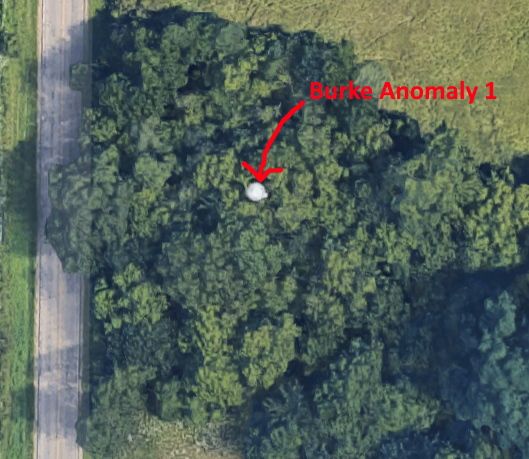
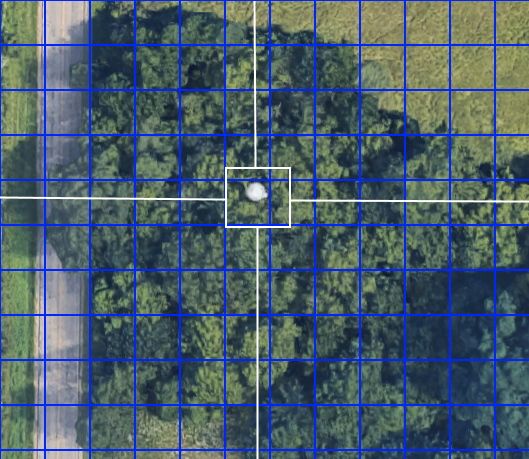
A couple weeks previously I had been checking out the far east side of Madison on Google Maps trying to get a handle on the growth of the housing developments that sprawled on the fringes of the city and lament how much of the countryside had been lost. At one point I noticed an anomalous white dot in a group of trees. I immediately made like Deckard in Blade Runner pretending Google Maps was an Esper machine and started calling out commands to enhance the image. 

Unfortunately, just like my cats, the site was not keen on responding to my voice and so, when I said, “enhance 224, 176”, absolutely nothing happened. And so I was forced to manually zoom in and rotate the view. Despite my best efforts, I couldn’t tell what this mysterious dot was but I assumed that the anomaly was the top of a silo poking out from the tree canopy.

Farm ruins!

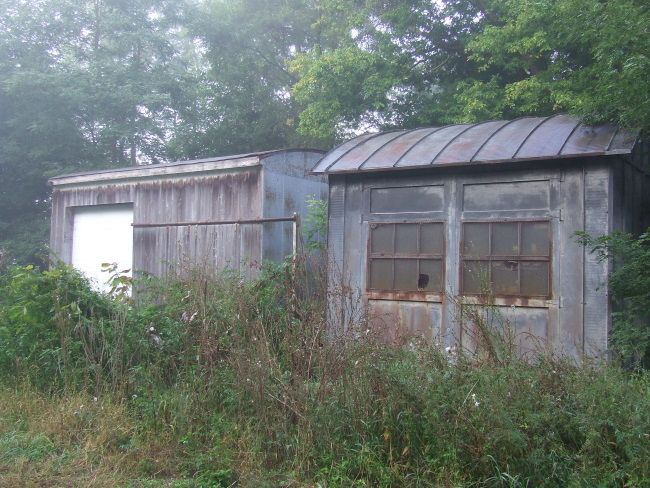
My first stop that morning, however, was just up the road from the anomaly where a pair of Trachte buildings sit nestled in the tress, slowly being consumed as grass and brush reclaim the area.

Nearby were a couple other outbuildings that looked as if they hadn’t seen use in ages either such as this one tucked a bit further back.

Having gotten my Trachte photos, it was off to find that mysterious silo. I drove slowly south along the road but didn’t see anything other than the new day’s sun peeking through the trees.


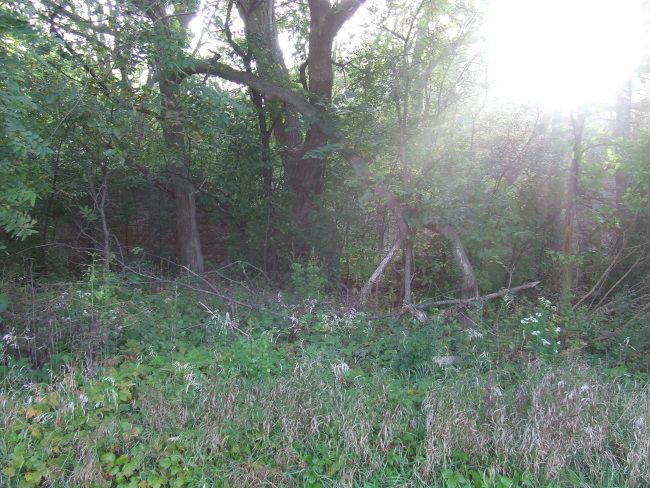
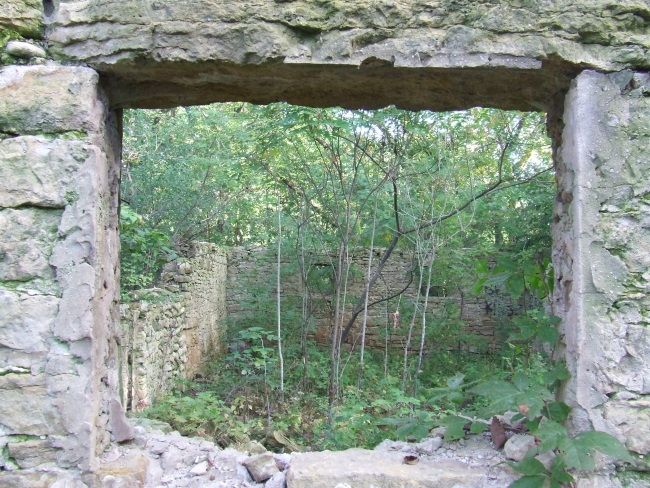
I pulled over to the side of the road, got out of my car, and started poking around on foot. Wandering into the ditch I finally caught a glimpse of a sandstone (or was it limestone?) wall tucked back in the brush.

I had driven this road many times over the years but never noticed the wall. It will no doubt be more obvious when the trees have shed their leaves, but I think it’s set back just far enough to not be visible at a casual glance when you drive past.

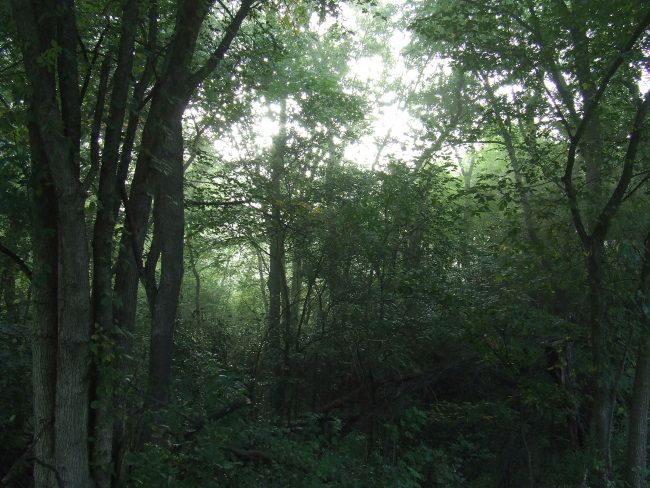
Despite the rising sun and the muffled roar of speeding cars in the distance, it was rather spooky setting out into the ruins. By the time I got to them, the din of the highway was completely absent and it got even more eerie as a silence settled upon me.

The wall was part of the remains of foundation of an old barn.

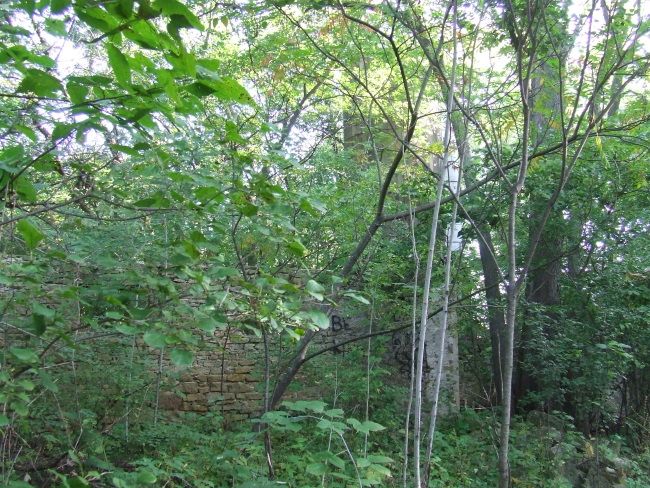
I saw no trace of any of the wooden structure. Looking around this area that is nearest the road, I couldn’t see the silo so I wandered deeper into the woods to the other side and voila! There it was hidden in the trees.

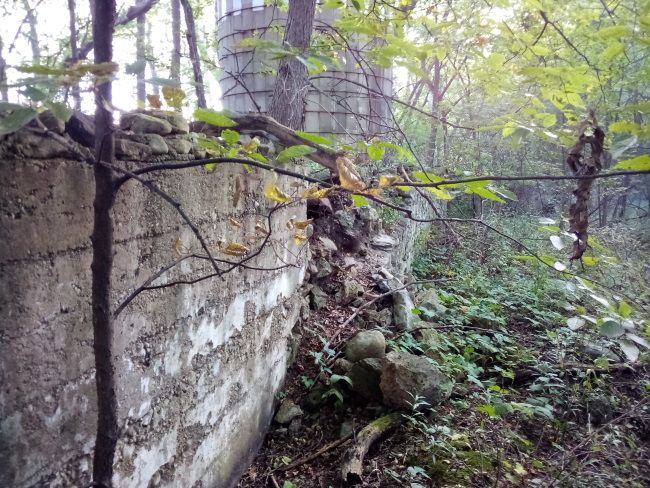
Walking towards it, I ran into the foundation of another barn. This one was set deeper and I had to step down.


This one was perhaps built after the first one as the walls were largely concrete instead of stones.

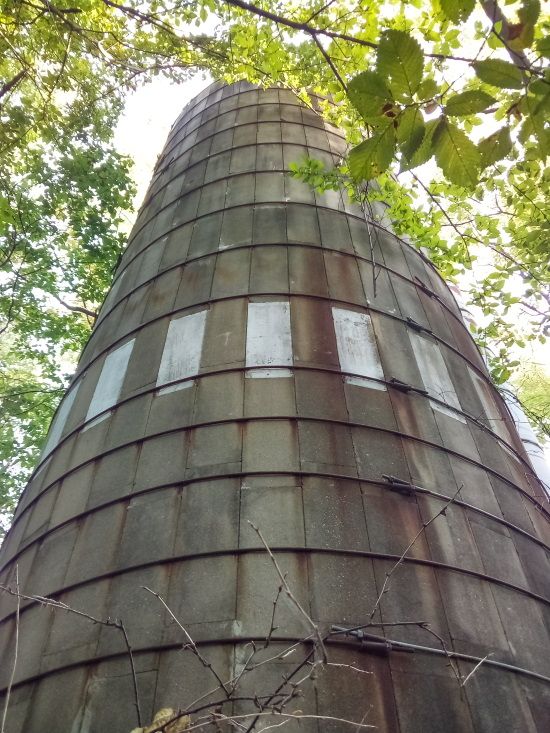
Finally, I was at the silo.


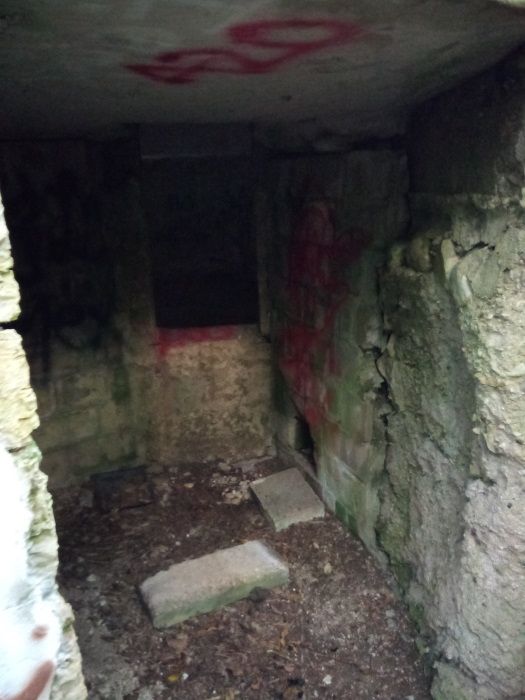
It looked to be in good condition so perhaps all of that concrete was poured when this silo was erected. Underneath was a spooky space, likely home to critters or maybe it was the workshop of a crazed serial killer…

There was a round concrete space next door which perhaps was the base of a silo at some point in the past. Just to the north was a large concrete rectangle that looked like it may have been a trough.

A cursory internet search didn’t reveal any history of the farm or who owns the land currently. The subdivisions are still mainly to the south but I suspect it won’t be too long before the area is subdivided and littered with cookie cutter houses.

On my way home – almost as if on cue – a buck ran out in front of my car.

********

The previous owner of my house put a carport onto the back of it and so there’s a small gap between a gutter and the side of the house itself. That end of the gutter gets runoff from a valley and fills up with stuff causing water to drip down onto a window sill. This is really annoying because the sill is made of metal so the dripping is a bit loud. The water then runs off onto the driveway where there is a 1” gap between the driveway slab and the foundation of the house.

My predecessor had filled part of that gap with some kind of grey goop that had the consistency of caulk. The remaining space simply had what appeared to be some leftover black plastic garden edging dropped into it. Perhaps this undergirded some kind of filler in the past but now it was doing little.

Having resolved to keep water away from my foundation, I asked some friends who are also homeowners about how to take care of this. Most weren’t sure but one recommended pouring sand into the space until there was just a little room at the top and then laying down this new-fangled gap filler. You place it atop the sand and then heat it with a torch or heat gun so it melts to fill in the space.

This would mean buying sand and a torch. Surely there was something cheaper. After an internet search, I found there was.

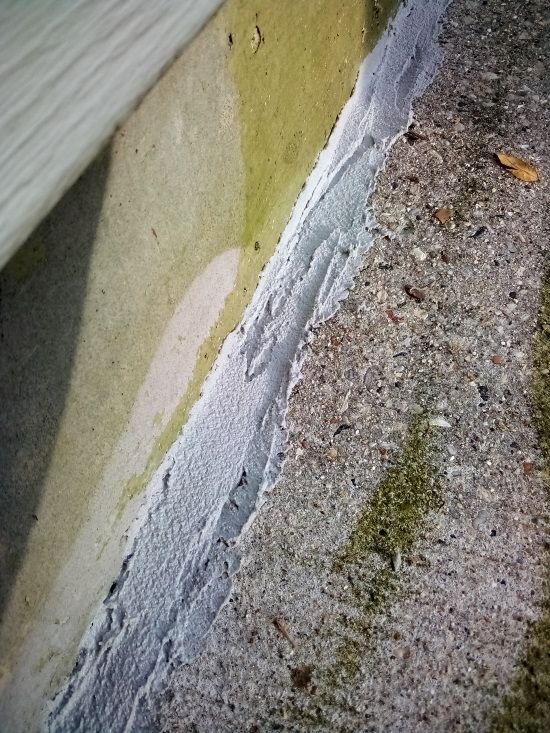
I bought some backer rod which is a tube of semi-rigid foam that’s ½” in diameter. A bit like those pool noodle floatation thingies. I made a braid out of it and stuffed it into the gap a bit less than ¼” below grade after power washing the foundation and a bit of driveway. Then I slopped in some concrete patch which I think is sand and limestone in some kind of petroleum-based goop. I am no whiz with a putty knife but I think I patched it well enough. Three days later it had hardened.

We’ll see how it takes to having a shovel being dragged across before long but it seems solid enough.

********

Our wedding anniversary was in the latter half of last month but, unfortunately, our plans to have dinner at the fancy, relatively new The Harvey House fell through. And the florist never delivered the flowers I had ordered. A real shame that the floral shop just a few blocks away closed. Never had a problem with them.

Shortly after this, I was exhorting my Frau to make reservations there again when word came down that The Harvey House had just been mentioned in the New York Times. Ooh. Might be a long wait to get a table now.

So our anniversary was a bust. But I have plans to make it up to my Frau…

********

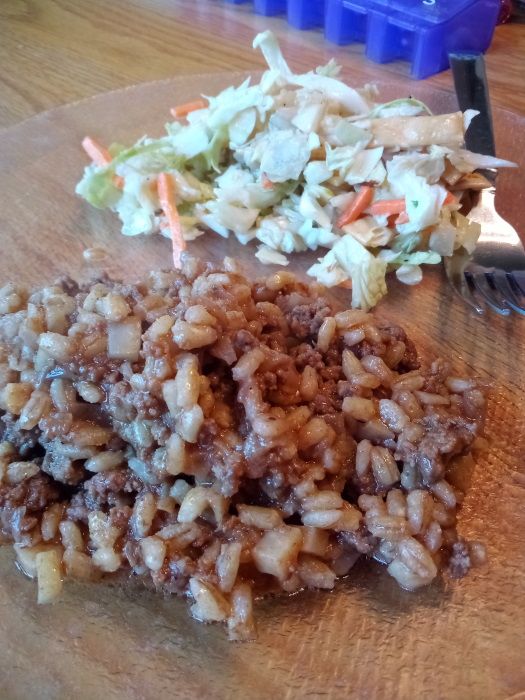
With the weather getting slightly chilly, it was time to start making the transition to winter cooking. For me, it chiefly means more casseroles, stews, and the like. The first thing I made was Graupeneintopf which I believe means “barley stew”. However, the recipe in my German cookbook is more of a casserole. It’s very simple but delicious. Brown some ground beef, onion, and celery root. Throw in barley, beef stock, and some tomato paste. Cook until done.


It is basic, hearty fare but is tasty enough and serves as a nice foundation for the hot sauce of your choosing.

********

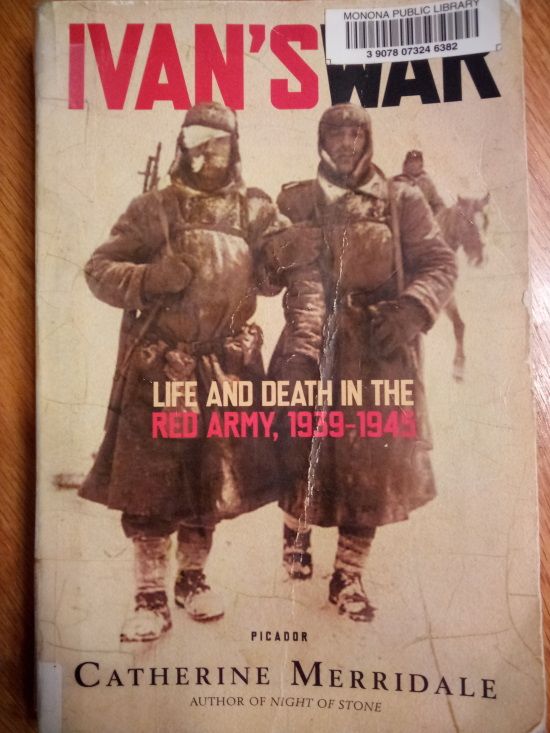
Back in September, a friend of mine down in Chicagoland who is a big World War II buff told me to choose one of his unread books on the subject and that we’d discuss it when I went down to his place again in early October. I chose Ivan’s War: Life and Death in the Red Army, 1939-1945.


The subject matter was grim. War is hell but I suppose one could argue that the war on the Eastern Front during World War II was grimmer than some other theatres, including the Western Front. Author Catherine Merridale approached the subject from a sociological point of view rather than a purely historical one. That is, it wasn’t a strict account of the battles, it was more about life for the average Soviet soldier. I take it that “Ivan” is a generic name for a Soviet soldier like “Tommy” was for English troops or “G.I. Joe” for Americans.

Merridale begins by noting that the Soviet army was made up of men from various parts of the Soviet Union, many of whom had no love for Stalin and/or weren’t ethnic Russians. Some even thought that German occupation might be a step up for them.

Being a soldier in the Red Army was sheer horror. When Germany began its march east to Moscow, the Soviets were ill-prepared, under-equipped, and had military leadership – including Stalin – who had no idea what to do. The Soviet Union was huge and so the one thing it did have in large supply were bodies. The Red Army could just throw wave after wave of men at the Germans.

The book talks about how party apparatchiks were assigned to the army to try to maintain morale and report on treacherous behavior. So the soldiers were being watched at all times as they dealt with a lack of food, lice, improper clothing, a shortage of munitions, et al. We also learn about some soldiers who would receive Dear Ivan letters in which their wives informed them they had found someone else.

Soviet doctors did not recognize what we call PTSD today so, if soldiers afflicted with it didn’t improve, they were simply sent back to the front or even executed if they didn’t obey orders.

The Red Army defeated Hitler at a great cost. It repelled the German invasion and fought its way to Berlin. For the first two thirds of the book, we feel a lot of empathy for the members of the Red Army as they take on the marauding Huns at a great cost. But the empathy becomes strained when restraint is abandoned as they raped and pillaged the whole way to the German capital.

Immediately after the war, Stalin hailed them as heroes and promised largess from the state for their service. But after a year, Stalin abandoned these heroes of the Soviet state and many veterans had a hard time finding housing, feeding themselves, and integrating back into society.

Certainly not a happy tale, but it was nonetheless very interesting. I have read about Eastern Front a bit, mainly about the Siege of Stalingrad, but those texts were all about the battles, the maneuvering, and the strategies. Ivan’s War told a story mainly at ground level and kept a human face on the combatants instead of rendering them into chess pieces. In film terms, think The Big Red One vs The Longest Day.

After reading this, I needed something lighter and so I decided to read something I should have read decades ago…

********

Bonus photo time! Here’s Grabby eyeing up the Frau’s new bag of candy corn.


19 March, 2016

The Mob Rules: Savage Continent by Keith Lowe

As I wrote last month, my brother's death has spurred me on to learn more about World War II, a favorite subject of his and of our father, who is also gone. It's like keeping a family legacy going. While I wrote about Douglas Porch's A Path to Victory first, it was Savage Continent that I read first. And so I belatedly present some thoughts on the latter.


I suspect that many Americans think of the end of World War II as having been like this:


The boys came home, went to school on the G.I. Bill, and then got homes and jobs in the suburbs. While there is certainly some truth to this highly rosy scenario, the situation was much more complicated. American World War II veterans did have what we now call Post Traumatic Stress Disorder but it was most often something that was not talked about and men kept their feelings bottled up inside.

Many American vets certainly went through hell. But they came home to heaven, in contrast to the people of Europe. In Savage Continent, Keith Lowe examines the cimmerian world that was Europe in the years following the end of World War II. In his introduction he asks the 21st century reader to use her imagination and contemplate a world without social institutions; one where there are no stores and no businesses - money is worthless; a world without police, judges, jails, etc. No law and order. "There is no shame. There is no morality. There is only survival."

Lowe begins by looking at the physical destruction. Warsaw is his first example. It was a city of nearly 1.4 million people in 1939. By the war's end about two-thirds of those people were lost. Lowe says that the Germans systematically destroyed the city and, when they were through, 93% of Warsaw's dwellings were destroyed or left uninhabitable. Here are some photos.


Warsaw was but one of hundreds of cities to lay in ruins at the end of the war. Watch this remarkable footage of Berlin in July 1945:

Sensationelles Filmmaterial! Berlin nach der Apokalypse in Farbe und HD - Berlin In July 1945 (HD 1080p) from Konstantin von zur Mühlen on Vimeo.


Beyond the destruction of buildings, there was the toll on human life. Some 35-40 million people died as a direct result of the war with some 6 million of those being Jews. Lowe concedes the difficulty in appreciating such vast numbers and so he includes the words of survivors to put the numbers into a more manageable perspective. For instance, there is the testimony of Alice Adams originally from Drohobycz, Poland. "...the whole population of Drohobycz was wiped out, about thirty thousand people, they were all shot...I watched somebody being killed every day – that was part of my childhood."

Europe was awash with widows and, with many children having lost at least one parent, kids were often found in packs wandering the streets like feral dogs. Hunger was rampant. Some 16,000-20,000 Dutch died of starvation while that number jumps to a quarter of a million in Greece. But Eastern Europe had it worst. Indeed, it seems that almost every infernal scheme the Nazis had was worse for Slavs. Much of the hunger in Western Europe was the result of Hitler simply giving preference to Germans, but in the East the Nazis were keen on starving Slavs to death out of spite and millions died.

Lowe devotes roughly a quarter of his book to vengeance. In countries throughout Europe people who collaborated with the Nazis were punished. Some were merely made to suffer opprobrium while others were given minor punishments such as the loss of voting rights. But harsher punishments were handed out both by reconstituted courts and by extrajudicial justice seekers. Collaborators were sometimes given the death penalty by judges while vigilantes meted out justice in the form of beatings and murder. And of course Germans were at the receiving end of the vengeful as well. For example, Allied soldiers often looked the other way so that concentration camp survivors could take revenge on their former jailers. Unsurprisingly, just being German was enough to incur someone's wrath. Innocent German civilians were often shown little mercy by their former neighbors and none whatsoever by the Russians moving ever westward.

Women from occupied countries who had consorted with Germans suffered at the hands of their own people. I was reminded of the tragic story of Izabel Laxamana, a 13 year-old girls who killed herself after her father punished her by cutting off most of her hair. Amanda Hess denounced the punishment as being "medieval" over at Slate. But as Lowe shows, women from all parts of Europe who had relationships with members of occupying German forces had their heads shaved. Often times this was done in a town square or other public space where the women were stripped naked (by men, of course) and had swastikas painted on them in addition to being shorn. Children from these unions were frequently shunned and written off as being evil Germans despite their mothers' heritage.

The sheer destruction of life and property was depressing. Add on to that the petty acts of vengeance and the situation is even more bleak. But it was really the book's third section on ethnic cleansing that almost sent me into the depths of perdition.

Since the concentration camps were located in eastern Europe, many people in the west were unaware of just what had happened. Jews returning home to Holland were often greeted with such sentiments as "You're lucky you weren't here. We suffered such hunger!" and "You have a roof over your head and food the whole time!"

But insensitivity was the least of all worries. Having survived the Holocaust, European Jews found that their tribulations were not yet over. The section called "The Jewish Flight" tells the tale of a Polish Jew named Roman Halter. He survived the death camps and was liberated by the Russians. On his trek back to Poland to search for his family, Halter encounters a Russian soldier who treats him no better than the Germans. The soldier "took out his revolver from his holster, pointed at my head and pulled the trigger. There was a loud click."

Jews returning to their homes often encountered resistance when trying to reclaim their property. The book has one of the darkest examples of black humor in the form of a joke. A Jew returns home to Budapest having survived the Holocaust. He encounters a Christian friend who asks how he's doing. The Jew replies, "Don't even ask. I have returned from the camp and now I have nothing except the clothes you are wearing."

In Kunmadaras, Hungary, tensions and anti-Semitism came to head when blood libel was invoked to attack an egg vendor. A mob would go on to surround the man's house and kill him before seeking vengeance on other Jews in a mini-pogrom.

Polish-Ukrainian hatred gets a section of its own. With German power declining, Ukrainians took to partisan groups such as the Ukrainian Insurgent Army and set out against Poles. In 1943-44 hundreds of Polish villages were beset by the thirst blood of such groups. Buildings were burned and some villages razed entirely while victims were beheaded and/or disemboweled.

The tables turned after the war illustrated by the fate of a village in Poland called Zawadka Morochowska which was inhabited by Ukrainians. The Polish army arrived in January 1946 and began a massacre. Dozens of villagers were murdered with some having been disemboweled or set on fire.

You get the picture.

Savage Continent does a remarkable job of describing the pandemonium of post-war Europe. Going in I tended to think of the time following the German surrender as being filled with people wandering urban ruins, the Marshall Plan, and the raising of the Iron Curtain. Upon finishing the book I felt a bit numb contemplating what the darker sides of our nature can accomplish. Lowe writes for the layreader here and the text includes plenty of photos portraying the chaos and destruction in graphic detail.

Lowe sets for himself some goals in the book's introduction. As a non-historian who has never read anything on this subject previously, I really don't know about the paucity of histories of the immediate postwar period and how Savage Continent fits into the larger study of this time. But he accomplished his goal of dedicating an ample number of pages to eastern Europe instead of focusing on the western half as, he says, most scholarship on the subject does. Lowe also mentions that he attempted to sort through the varying statistics in an even-handed manner. There are multiple times in the book in which he weighs differing stats and I felt he adjudicated fairly.

While I learned quite a bit from Savage Continent, there was one section which came across as pop psychology to me. In "The Shearing of Women", Lowe claims that "On the whole, European women slept with Germans not because they were forced to, or because their own men were absent, or because they needed money or food – but simply because they found the strong, 'knightly' image of the German soldiers intensely attractive". He proceeds to opine that French men were emasculated by the Germans and that they really began to shed the effeminate taint as the French and the Allies set out to liberate France. While I'd have to check out Lowe's source materials (and this book is well-researched), this section stood out for me because it felt like it had left history and statistics behind for baseless Freudian theorizing.

Lowe ends the book with a plea for truth and historical accuracy to prevail over falsehoods and national mythmaking, things which divide and can be used to incite hatred or worse. It was refreshing to read an historian talk about and give examples to illustrate why his profession and his area of study are important and what they can give to non-historians. Lowe writes, "It is not our remembering the sins of the past that provokes hatred, but the way in which we remember them."

There is much to chew on here. Not only does it help explain how the Europe of today arose, but it also makes you ponder the future. For example, can ethnic hatreds that abated after the end of the Cold War reemerge? What can a fuller understanding of history do for us?

25 February, 2016

Porch, you magnificent bastard - I read your book! (The Path to Victory by Douglas Porch)


World War II was a big deal in my house when I was a boy. My father was a voracious reader and he had a small library devoted to the subject. People like Chester Nimitz and George Patton were talked about as if they were great uncles. He had a particularly keen interest in the Pacific Theater and was always interested in meeting veterans of that part of the war. When he did, most did not want to talk about their experiences in places like Iwo Jima or Okinawa. But on he pushed.

It is no surprise that his interest rubbed off on his sons. While in elementary school I wrote a paper on the attack on Pearl Harbor. While I've always had more than a passing interest in the history of World War II it was really my brother who shared my father's passion on the subject. When our father died I was happy to let him keep all of dad's books on it. My brother became one of those WWII history nerds who could tell you exactly how many casualties there were at a given battle and recite a list of every model fighter plane Messerschmitt built and the precise date they were introduced into combat.

When my brother died last year I felt that the family legacy of interest in and knowledge of World War II only had me to carry it on. And so I decided to do some reading on the topic. However, I didn't just want to sit down and read something like Samuel E. Morison's multi-volume History of United States Naval Operations in World War II, a favorite of my father's. No. If I was not able to deny the ghosts of my father and brother then I at least would have to tack a course of my own devising. (To be expected, I suppose, since I had already tackled The Rape of Nanking by Iris Chang.)

Douglas Porch's The Path to Victory was not my first foray into the subject of WWII after my brother's death but it's the first I've written owing to circumstance. The subtitle of the book is "The Mediterranean Theater in World War II". While the Mediterranean was certainly spoken of in our house, it did not have the cachet of the campaign to take the Solomon Islands or the Battle of the Bulge, for example. And in American culture today it is over-shadowed by the Ambrosian-approved D-Day landings. A perfectly suitable subject for me.

A military historian, Douglas Porch, the back cover tells us, "is a professor of national security affairs at the Naval Postgraduate School". The book's text is just shy of 700 pages with another 100 or so of notes, index, and whatnot. This is not a slim introductory volume. Indeed, the book is not aimed at your average lay reader but at students of military history although I would say that interested people – like me – along with the Internet can get through it with good comprehension.

The book's thesis is that the Mediterranean was the pivotal theater in the war though not the decisive one. Events in this theater prefaced, influenced, aided, and abetted the more conclusive ones in theaters to the north. Not being a military historian, I am unqualified to judge the success or failure of Porch's argument. Instead I want to highlight some elements of Porch's story that caught my attention. Some directly relate to Porch's thesis while others do not.

One thing I found interesting was that Porch has a wide view of what constitutes the Mediterranean Theater. He included Eritrea/Ethiopia as well as the greater Middle East. While Italy controlled East Africa, FDR could not send aid through the Red Sea as he was not allowed to put American ships into combat zones. Once Britain had cleared the Horn of Africa of Italian forces, U.S. ships were free to sail the Red Sea and onwards towards Suez.

One significance of the Middle East was, unsurprisingly, oil. Gasoline was rarely in short supply for Allied troops in North Africa while it was so very often for the Germans and Italians whose oil came from across the Mediterranean in Romania. I was unaware that Britain invaded Iraq in April 1941. In addition to preventing German intervention in the region, it would "showcase its [Britain's] value as an ally for the United States." Indeed, Churchill and the British army did a lot of the equivalent of a peacock displaying his tail feathers to get the attention of the United States and lure it into the war. Rommel running roughshod around North Africa was an embarrassment to the British, not only from a purely operational point of view, but also a strategic one. It made Britain look bad and perhaps not like a worthy ally for Americans watching from across the Atlantic.

North Africa is generally thought of as the first act of the Mediterranean Theater. While I knew about the dramatic and perhaps romanticized duel between Rommel and Montgomery in supra-Saharan Africa, it was interesting to get the details of their encounters. It was also interesting just how awful Montgomery's predecessors were. They used the same losing strategy over and over again – charging head on into the ranks of Rommel's panzer tanks which demolished the British foes. Montgomery's victory over Rommel at El Alamein was due in no small part to letting artillery and air support get first crack at the panzers which then drove forth into an arena populated with British tanks and anti-tank guns dug into the desert and lying in wait for their prey.

North Africa is also where American soldiers made their debut in the West and it was not exactly pretty. Operation Torch was the Allied invasion of Algeria and Morocco. While thankful for being joined in the war, battle-hardened British soldiers were less than impressed with the green G.I.s. Porch says that "Infantry attacks often became murderous undertakings". He also notes "poor infantry-armor cooperation", American tanks that "charge[d] off unsupported on their own, and commanders "reluctant to seize battlefield opportunities."

Although I probably shouldn't have been, I was surprised at all of the animosity amongst the ranks of upper command. Not only between Americans and British, but amongst the Americans and amongst the British. Take the British Lieutenant General Kenneth Anderson. Montgomery described him as being "neither skilled nor gifted" while Patton thought that he "seems earnest but dumb".

With the efforts of Stephen Ambrose, Tom Brokaw, Steven Spielberg, and the media generally to portray America's "Greatest Generation" as having won the war with the D-Day invasion, it was thrillingly refreshing to read a much less romanticized account of some Americans and American efforts in WWII. As Commander-in-Chief of Allied Expeditionary Forces Dwight Eisenhower is described by Porch as having a "natural reluctance to make hard decisions." Then there's U.S. Army Major General Lloyd Fredendall who shuffled papers bravely out of range and chose to "disparage 'Jews, Negroes, and the British' from his concrete-encased bunker well to the rear."

And these comments are just the tip of the iceberg. Sometimes I found myself amazed that we and the British managed to fight a common enemy.

Operation Husky was the name of the Allied invasion of Sicily and is usually thought of as being Act 2. While the Allies took the island, the thing I recall most vividly is that they let the Germans successfully retreat to Italy. Porch puts the Allied inability to prevent this down to "poor organization, lack of imagination, and inactivity."

This is probably as good a point as any to declare that I didn't know that Mussolini was such an incompetent boob. The guy would not listen to his generals and ignored the reality on the battlefields. I felt sorry for the Italian troops most of whom were ill-equipped and undertrained with Il Duce telling them to fight or be killed for cowardice.

One upshot of Mussolini's numbskullery, which forms part of Porch's thesis, is that it obligated Hitler to send troops and supplies to do what the Italians were incapable of doing. Hitler worried about Italy and the Balkans – his southern flank – and he dedicated many divisions along with tanks and air power to the Mediterranean Theater and away from Russia. For quite some time the only battles being fought between the Allies and the Germans were in the Mediterranean. They helped instill confidence in Stalin that the Allies were attempting to help the Soviets. The Allies feared that Stalin would make peace with Hitler depriving them of a very big and powerful ally which kept many German soldiers occupied in Eastern Europe.

With the Germans expelled from Sicily, shipping became much safer in the Mediterranean which meant that many more American supplies reached the Soviet Union. And as the Axis were increasing pushed back, Hitler diverted air power from Norway south to take on the encroaching Allies. This meant Arctic convoys had a much easier time getting supplies to Murmansk.

The generally perceived final act of the Mediterranean Theater is the invasion of Italy. Again, Porch proved quite enlightening. Monte Cassino, Anzio - I'd heard of these places but here I got all the gory details. Yet again I must admit to ignorance – I didn't know what a long, hard slog Italy was for the Allies. Field Marshall Albert Kesselring and (who had been allowed by Allied bungling to escape Sicily) his German troops put up heinous resistance. The worst fighting of the whole theater seemed to have been in Italy.

Aside from the particularly hellish campaign that was the invasion of Italy, three things stick out for me. First is the contribution of Moroccans in defeating the Germans. The Germans took advantage of the mountains and create defensive lines with bunkers high up making the valleys into kill boxes. It was the Moroccans who proved adept at scaling the heights and taking out German installations. As Porch says, "German POWs were so intimidated by the bunker-busting techniques of the Moslems that they declared the experience worse than Stalingrad."

On a tangential note, Porch mentions more groups of valorous non-white combatants – the Fourth and Seventh Indian Divisions (OK, not wholly non-white) - which "were considered among the best troops fielded by any army in the war."

The other thing that sticks in my mind about the invasion of Italy is the behavior of Lieutenant General Mark Clark. In May of 1944 the Allies launched Operation Diadem which saw opposed by the German Tenth Army. Clark put his quest for personal glory above Diadem's strategy by focusing on taking Rome – which would be a publicity coup – instead of defeating the Germans. Porch says, "...he both allowed the escape of the Tenth Army and did nothing to advance the capture of Rome, while at the same time taking heavy casualties."

Lastly, Porch notes that VD ran rampant amongst Allied soldiers in Italy. May Italian women (and girls) were eager to please for food or money and by the summer of 1944 there were 19 VD hospitals in Italy to help cure the Greatest Generation.

I think that Porch would agree that North Africa, Sicily, and Italy are the three main elements of the Mediterranean Theater but that there was much more to the theater than these three campaigns. In addition to what I've already mentioned, there was Operation Dragoon, the Allied invasion of southern France in August 1944. And the general rehabilitation of France as a fighting ally.

To reiterate Porch's point, the Mediterranean Theater was the handmaiden to decisive campaigns of the war. It forced Hitler to commit troops, tanks, and planes which had to be taken from other areas, most notably the eastern front. Significant amounts of American supplies were able to reach the Soviet Union only by virtue of the Allied success in the Mediterranean. And it was this theater in which American commanders and soldiers cut their teeth and learned their trade. Porch argues they needed the training and practice of the Mediterranean to be ready for the invasion of France on D-Day.

As I mentioned at the beginning, The Path to Victory is not really aimed at those starting out on the subject. It's more for students of military history. One example illustrating this is that Porch compares a situation to that of the Battle of Passchendaele during World War I. If World War I is not your strong point, then you'll be running to the Internet to assess Porch's comparison. Porch also has a penchant for French phrases which may send the reader to a dictionary. Beyond these things, Porch writes clearly and presents his material in a linear fashion.

The book looks at the big picture. By this I mean that it was written in a fairly traditional style whereby the generals are personalized with brief biographies given while the grunts, the G.I.s are generally generic people who are parts of larger units moved around by the generals. Occasionally, however, Porch does get down to the grunt level to illustrate a point. I say this not to disparage Porch because the text of the book is almost 700 pages and his goal was to present a broad view of an aspect of the war generally given short shrift. Porch has no problem presenting commanders in a less than flattering light while, as I noted above, lavishing praise on non-white soldiers, people often left out of lay histories of the conflict.

I have barely scratched the surface of what Porch brings to the table here. The book ranges from really fun passages about larger than life characters such as George Patton to fairly dense, theoretical sections dealing with strategy. It's not just this battle happened on this date and this many men died. We get glimpses into Hitler's view from the north as well as the struggle between Churchill's desire to preserve the Empire and FDR's ambition for the United States. Porch has a lot of balls in the air here and he juggles them well. You get just enough of peripheral issues and events to see how they fit in the Mediterranean Theater without ever going off into left field.

I do, however, have a complaint to register. My copy of the book was the American first edition paperback and the maps were of such poor quality as to be useless. By this I mean the print quality. It was like they started with maps that were originally 1"x1" and then blew them up for the book. Most of the words on the maps are tiny, pixelated, and illegible. This didn't render the book useless but a lot of the battles and the events Porch described blur together because, unless you find similar maps from another source, you're never quite sure which division went where and what road who is on and what the overall look of a campaign was.

My admonitions and criticisms aside, I highly recommend The Path to Victory. I only wish that I could talk it over with my brother and father.

23 October, 2013

Another Side of World War II: The Rape of Nanking by Iris Chang


Having read Iris Chang's The Chinese in America and found it quite engaging and enlightening, I was happy to find another of her books, The Rape of Nanking.

I was a bit perturbed while reading the introduction when I ran across this: “Yet the Rape of Nanking remains an obscure incident.” Chang goes on to list various well-known histories of World War II which mention the Japanese atrocities in Nanking only in passing, if at all. Having had a father who was a WWII history buff, I knew about the Rape of Nanking, so I am at somewhat of an advantage over many people regarding the conflict. Still, one would think the sheer cruelty on display those several weeks would have taken their place alongside other infamous acts of barbarity from the war.

The book addresses two broad aspects to the topic at hand. The first is a prelude to and then the Rape itself along with a diversion into the Japanese mentality that led to it. After this, Chang looks at the event as viewed from outside Asia as well as the aftermath on personal and geopolitical levels.

In July of 1937 Japanese troops stationed in the Chinese city of Tientsin took gunfire one night while training near the Marco Polo Bridge. The next morning of the soldiers was missing from roll call. This incident escalated and led to a full-scale invasion of China. Thus began the Second Sino-Japanese War. The battle for Shanghai lasted a few months before the Japanese ultimately retained control in November. From there the armies marched to Nanking, the capital of the Republic of China and home to 1+ million people. With the Japanese advancing, many fled the city but there were still some 600,000-700,000 people there when the Japanese assault started on 9 December. By the 13th, Nanking had fallen and the unthinkable began.

What the Japanese did to the people in Nanking would have made Genghis Khan proud. Prisoners of war could not be fed or housed so they were killed. Citizens were shot in the back indiscriminately. And this is just the beginning because the savagery of the Japanese army knew no bounds. Chinese men were strung up alive and used for bayonet practice. Some were nailed to boards and run over by tanks. Others were buried or burned alive, often after having had their noses and ears hacked off. A killing contest between two soldiers made it into at least one Japanese newspaper.

The women in Nanking suffered just as much as the men. It is estimated that some 20,000-80,000 females were raped. From young girls to old women, no age group was spared. Some of them were so brutally gang raped that they died from the assaults. Those who refused sex were often killed. And as the story of one Mrs. Hsia, illustrates, women were often killed after having been raped. Mrs. Hsia received a bayonet in the chest when the Japanese soldiers were done with her and a perfume bottle was shoved into her vagina. The same fate befell her teenage daughters while a baby was simply killed by bayonet.

While I knew of the Rape, one thing I didn't know was that, amidst the carnage, there was a safety zone set up by Western businessmen, clergy, et al in the center of Nanking. It sheltered tens of thousands of Chinese and the book profiles a trio of Westerners who bravely helped whomever they could. Surprisingly, one of them, John Rabe, was a Nazi. Also profiled are two Americans, surgeon Robert Wilson and Wilhelmina Vautrin, a missionary. Their stories have them confronting Japanese soldiers to save the lives of the Chinese who sought shelter in the zone. Wilson worked for hours on end to administer care to the wounded. Their diaries chronicle the horrors they witnessed and became important tools to counter Japanese claims that Rape never happened or was greatly exaggerated.

Almost as soon as the Rape had petered out, reports of it began to leak to the West and the Japanese began a propaganda campaign to cover up what they had done. Reporter George Fitch risked his life to smuggle out 16mm film of the Rape while the Japanese gussied up small sections of the city and held it up as an example of how well they had treated the Chinese and the city.

After the war ended the Tokyo War Crimes Trial began in 1946 and, while it would bring a measure of justice to the survivors in Nanking, it was not a complete victory. Guilty verdicts were handed down for some military officers and they paid the ultimate price, but the terms of surrender for Japan with the United States meant that neither Emperor Hirohito nor any of the royal family would be tried for war crimes.

The final chapters show the further indignities foisted on the survivors of the Rape of Nanking. Many of the Chinese survivors fell into poverty and never got out of it. The Westerners who are profiled suffered from extreme mental anguish and had to deal with an incredulous public. Rabe, for his part, fell out of favor with the Nazis and died a pauper. But perhaps the greatest indignity comes from the many Japanese people, from politicians and academics on down the line, who deny that the Rape of Nanking ever happened. The book was published in 1997 and at that time there were still men in power in Japan who would gainsay despite all of the evidence to the contrary.

The Rape of Nanking was a subject near and dear to Iris Chang's heart. (She died in 2004.) This certainly doesn't make this book unreliable but she does tend to favor the larger estimates of death tolls and the like. She also advocates the idea that the Emperor and other royalty knew of the atrocities but did nothing to stop them. This would seem to be little more than guesswork. While I'll leave it to historians to argue the numbers and lay odds on whether Hirohito knew about what his armies were doing in Nanking, Chang surely did a great service by writing a book for the layreader on this topic.

I appreciated how she asks her readers to enlarge their understanding of World War II. In the opening paragraph Chang addresses the notion of exactly when the war began. For Americans, she says, it was with Pearl Harbor. For Europeans, it was the German invasion of Poland. But to Asians it was the Japanese invasion of Manchuria in 1931. This is a very simple yet effective way to introduce the idea of differing perspectives which is so important in the story here. The Japanese felt themselves to be a master race while the Chinese were sub-human; Americans had to deal with political vs. moral perspectives; many Americans couldn't believe that the Rape had occurred which spurred the organizers of the safety zone to act, etc.

So why did the Rape of Nanking fade into relative obscurity? It's a tough question and Chang offers various answers. For one, the American government tried to juggle moral outrage for the crimes and a desire to rehabilitate Japan after the war. The Tokyo War Crimes Trials were low-key when contrasted with the Nuremberg Trials. The U.S. kept Hirohito in power and shielded him from prosecution in order to get Japan on its feet more quickly. Another reason was the communist takeover of China which cut off the survivors of Nanking from the outside world and the outside world from any historical documentation regarding the events. Books have been written about the incident, Japanese officers were tried and found guilty but there were perhaps too few books and too little attention paid to the trials for the Rape of Nanking to enter American consciousness the way something like the Holocaust did. Chang doesn't explain why Winston Churchill and others gloss over or omit the Rape from their histories of World War II. Perhaps they don't consider the event to have been a part of the war – it was part of an intra-Asian conflict that is more of a prelude than an actual battle in the war itself. I wouldn't doubt that recognition of it faded in America because it did not involve many Americans and pre-dated America's entry into the conflict.

The Rape of Nanking may have its flaws as a history but it does tell the story of a rather forgotten episode of World War II. I can imagine that, at the time of its publication, it must have stood out in contrast to Stephen Ambrose's barrage of books as a stark reminder that there was more to WWII than D-Day. And this, I think, is the book's real triumph. It tells a story about World War II for the layreader that isn't about the "Greatest Generation" fighting evil on a battlefield. It's not Anglo-centric and the heroes aren't trained soldiers dying for their country but civilians taking a stand for humanity.

29 August, 2013

Stalingrad Trailer

There's a new trailer out for Stalingrad, an epic 3D IMAX love story set in the midst of the Battle of Stalingrad. It looks to be a really intense experience. Unfortunately director Fedor Bondarchuk apparently reckons himself the Russian Zak Snyder with actions being slowed down in media res. Too bad.

It has a Columbia Pictures logo in the opening so it will presumably get a release here in the States.


23 May, 2010

Hitler's Thirty days To Power: January 1933 by Henry Ashby Turner Jr.

Reading Henry Ashby Turner Jr.'s Hitler's Thirty days To Power: January 1933 is an exasperating read at times. We all know the ending so there's no surprise there, but I often found myself wanting to yell at the page, "No!" when reading about how Hitler went from a doomed leader of a doomed political party as 1933 began to chancellor before the month was out.

Turner's book was a fascinating read as well which dispelled a lot of myths and notions that I had about Hitler's rise to power. Until this point, I'd always been told that Hitler got into office because of his steadfast determination to build his party and take advantage of anti-Semitism and the economic problems faced by Germany after World War I and the worldwide depression at the time. He got the momentum going and then inserted himself into the chancellorship. But Turner ably shows that the rise of a former army corporal was contingent on a multitude of people and that the Nazi party was essentially on life support in January of 1933. What I thought was a slow ascension to power topped off with a coup was actually very sudden and seemingly freakish considering how many points there were along the way to prevent it. Moreover, Hitler assumed office under completely legal circumstances.

The first chapter is introduces the reader to the key actors in the story and summarizes important events prior to 1933. Included here is the governmental structure of the Weimar Republic. You had a president who appointed a chancellor, the head of the government, and the Reichstag, the legislative branch. The Reichstag could give a vote of no confidence and force the chancellor to resign. Similarly, the president could depose of the chancellor and his cabinet at will but he could also 86 the Reichstag and force a new election. Paul von Hindenberg was President at this time. He was in his 80s and an aristocratic throwback to the German Empire. In addition, he had tipped the balance of power away from the Reichstag towards a more potent presidency.

The largely ineffective Franz von Papen became Chancellor in May 1932 but was succeeded by General Kurt von Schleicher late in the year. In the elections of July 1932, the Nazis did well but saw defeat at the polls the following November. Come January 1933, Schleicher was on the outs with just about everyone. His relationship with Hindenberg was awful and his policies tended away from job creation and towards establishing national military service. Papen had remained in the President's favor and was scheming to return to power. For his part, Hitler watched popular support for his party dwindle and dissension develop in the ranks of the Nazi Sturmabteilung or SA, a paramilitary branch of the party which had many members who were dissatisfied with their leader's desire to obtain power through political means rather than violent overthrow.

So how did Hitler get into power when Hindenberg had denied him the chancellorship before and show disdain for the man? The short of it is that Schleicher was incompetent, Hindenberg didn't really pay attention, and Papen proved much more able than anyone had ever given him credit for being. Papen told the President what he wanted to hear and revived Hitler's fading prospects by secretly meeting with him on January 4. The former chancellor got Hitler his old job under the notion that the Nazi would essentially be a figurehead and that he, Papen, would actually wield authority as Vice Chancellor. Schleicher's pursuit of his own goals and his chronic underestimation of others left him defenseless. Papen's scheming was certainly abetted by the President's son, Oskar von Hindenberg as well as the elder Hindenberg's advisor, Otto Meissner. They greased a lot of wheels for Papen to get most of the parties involved to go along with the plan and to secure the approval of the Reichstag to avoid a vote of no confidence.

Again, this is the short of it and Turner gives an almost day-by-day account of the activities of these main players during January 1933. In the last chapter he apportions blame and there's a lot to go around. While the German people voted for the Nazis and gave Hitler and his party some political clout, Turner notes that this was one of those times when the fate of an entire country essentially rested in the hands of a few elder statesmen. And, for their part, they were blinded for their own lust for power having discarded any notions of the greater good. While it's easy to judge in hindsight, I often wondered while reading the book how it was that any of these actors would have even considered Hitler with his demagoguery and anti-Semitism. It turns out that there is no evidence to show that the main players here had ever read Mein Kampf and that they were likely ignorant of just how heinous an individual Hitler truly was. Turner also goes after various moderate/liberal groups. He is critical of them for not defending their republican ideals and instead letting the country move towards political power residing in executive authority. And, finally, I'll give some credit to Hitler himself for being one of the most determined individuals in history in addition to having charisma and being able to lie/hide the truth very well.

Turner notes all-too well that there were many junctures where Hitler could have been relegated to the dustbin of history if only someone had bothered to investigate who they were attempting to install as Chancellor, had relegated their own self-interest down a notch, etc. Hitler was almost completely marginalized until Papen decided to meet with him and, from then on, people kept Hitler in the picture. He did not seize power nor was he fated for the Chancellorship because of his tremendous popularity, hard work, and good looks. At every turn Hitler's ambitions could have been thwarted yet no one did so. He is even reported to have marveled at the turnaround of his fortunes.

When reading history I like to find analogues to the present time or try to glean some lesson from it. In this case, the thing which struck me most was how many people in German politics at the time were dismissive of republican rule and that people like Hindenberg, Papen, and the other main actors here were in favor of consolidating power in the Chancellorship and weakening the Reichstag. For example, in August 1932 Hindenberg granted Papen the authority to dissolve the Reichstag and was willing to forego the constitutionally mandated elections within 60 days giving the Chancellor and his cabinet the full power of the German state. Well, excepting that reserved for the President.

This incident and others reminded me of Bush and Obama in their use of executive authority. (Mind you, I am not calling anyone a Nazi or fascist here.) In prosecuting the "War on Terror", both Bush and Obama have taken on powers which seem anti-republican - warrantless wire tapping, orders to assassinate an American citizen, etc. None of these are equivalent to calling off elections and I don't think we're in the same position of the Weimar Republic in 1932 but it feels like we're taking anti-republican baby steps and yielding to the less-than democratic demands of our presidents with more frequency. I'm not sure how much of our democracy would be left if there were another terrorist attack on the scale of 9/11.