Showing posts with label Weizenbock. Show all posts

23 February, 2023

Thumbprint 6: Weizen Doppelbock by New Glarus Brewing Co.

Back in 2021, New Glarus Brewing bid good riddance to the worst of the pandemic and its lockdowns with Gyrator, a doppelbock that eased me into winter with a rush of malty goodness and a nice buzz. Apparently others were similarly smitten and we collectively made Gyrator into a hit. Well, as big a hit a New Glarus beer that isn't Spotted Cow can be, I guess.

Realizing they had stumbled onto something good, Dan Carey and his brewhouse minions (with the blessing of Deb Carey, of course) went the doppelbock route again last fall and loosed Weizen Doppelbock upon us late in the autumn.

The weizen doppelbock is, as far as I know, a bigger, chewier, more potent version of the venerable hefeweizen/weissbier, a.k.a. - the German wheat bier. The style involves boiling a bunch of wheat that has been bolstered with some barley and then letting the resulting proto-bier mingle with a particular type of yeast that poops out tasty phenols and esters that your tongue thinks are like banana, clove, bubble gum, et al. Today I learned that this yeast strain is called Torulaspora delbrueckii. I suppose a weizen doppelbock is just this formula with more ingredients.

While hefeweizens are fairly common, their doppelbock cousins are not. When it comes to this style, I immediately think of Tap 6: Mein Avenitus from the German brewery Schneider Weisse - G. Schneider & Sohn. It is the platonic ideal of a weizen doppelbock from a brewery that turns the popular drink into an art form. They seem to have weissbier in their blut and brew various takes on the style: cloudy, clear, bocky, eisbocky, extra hoppy, aged in wine barrels, und so weiter.

In addition to increasing my yeast knowledge today, I have also learned that the name "Aventinus" refers to the Bavarian historian of that same name, a.k.a. - Johannes Turmair, who lived from 1477-1534. Now, why the bier was named after him is as of yet unknown to me. Perhaps it's just a tribute to a local boy who done good for himself.

For their part, New Glarus seem to have taken a cue from Tap 6. Their weizen doppelbock appears to be rather traditional, if the text on the bottle is to be believed. No mention of added fruit nor the use of experimental hops; no kveik-torulaspora hybrid yeast for that Norwegian farmhouse weizen taste.
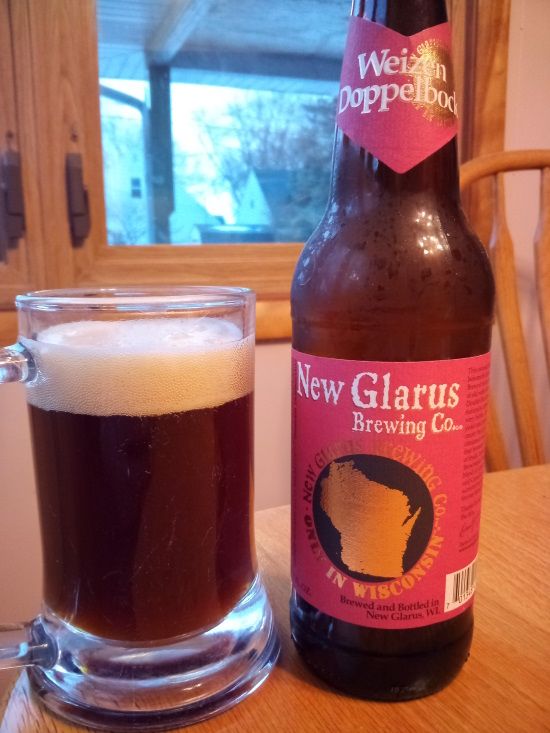
 
The beer came with a lovely firm, light tan head of no small volume. And it had staying power too, owing, no doubt, to all of the protein from the wheat. (60% wheat, I hear.) It was deep copper in color and cloudy. I could smell banana even though my glass was several inches from my nose. Moving it closer, I also caught bubble gum and a wheaty-grainy aroma. Although it had been a while since I'd had an Aventinus, I felt my memories of it come flooding back in every sip of estery goodness.

Although it had a medium-full body, there was also a hefty dose of fizz here that kept my tongue from being cloyed by all the malty sweetness. Banana and bubble gum were the most prominent flavors from that special yeast, but there was a hint of clove in there too. That sweetness was a bit like raisin and balanced by some hops which had a herbal, vaguely minty taste. And there was the taste of wheat as well.

The fruity flavors lingered on the finish as the sweetness faded. Something like mild cinnamon entered the picture here as the hops gained in strength. They, along with some boozy heat, made for a nice dry, bitter finish that stood in stark contrast to the big malty sweetness that I had just swallowed.

My tasting was done in February and this weizen doppelbock made a fine companion on a chilly night. Furthermore, I can recommend its muscle relaxing qualities after shoveling snow. The label notes that it was double decocted but I didn't detect much, if anything, in the way of the toasty bread flavor I associate with that process. Maybe it was just me because, when I see "weizen", I immediately start thinking of banana and clove and all of the flavors from the yeast and how I prefer the former. Perhaps I was concentrating on that and not any traces of Maillard reactions and this steered by tastebuds in a certain direction.

Regardless, this is a very fine beer. I hope that the trend continues this autumn with a roggenbier brewed to bock strength so I can have a taste-off with Tippy Toboggan.

Junk food pairing: When drinking one of these Weizen Doppelbocks, shake hands with beef and pop open a bag of Lay's Kobe Steak flavored potato chips.

31 March, 2016

The Tap X-Files: Mein Cuvée Barrique by Schneider Weisse


Whenever I see a bottle of German bier here in the States that features citrus-tasting hops or openly and proudly defies the Reinheitsgebot, I always wonder if that bier is sold in Germany. I get the impression that, while pilsners by the Bitburgers and Krombachers still rule the roost, biers with fruit, very hoppy ales, etc. are slowly appearing on store shelves and on taps.

The bier I'm reviewing today, Schneider Weisse's Tap X Cuvée Barrique, is a weizenbock aged in pinot noir barrels for eight months. While I gather that the bier was brewed in accordance with the infamous bier purity laws I have no idea if aging in a wine barrel leaves the finished product Reinheitsgebot-compliant or not. Even if it isn't, I'd imagine that Schneider Weisse brewmaster Hans-Peter Drexler has managed to profoundly irritate many of his fellow Bavarians who think that this bier violates the Reinheitsgebot in spirit, if not in practice.

Schneider Weisse brews – what else? - weissbiers and is best-known, here in the States, anyway, for its Aventinus, a weizenbock, and Aventius Weizen-Eisbock. These are generally considered to be world-class biers. I don't know if Drexler saw the writing on the wall or is merely a curious fellow, but he has taken Schneider Weisse on jaunts away from tradition. For example, there's Hopfenweisse, an extra hoppy weissbier that was the result of a collaboration between Drexler and Garrett Oliver of Brooklyn Brewery.

The Tap X series, which appears to be an annual release, takes things out into left field. The first entry back in 2011 was a weissbier brewed with Belgian yeast and Nelson Sauvin hops, a variety from New Zealand. The following year came this brew, Cuvée Barrique, which is a blend of Aventinus and Aventinus Weizen-Eisbock which was "matured" in pinot noir barrels for eight months.

Mein Cuvée Barrique pours a deep brown with red highlights which I guess makes it chestnut. I was rather surprised that the bier was clear. Perhaps I shouldn't have been but I figured weizenbocks are hazy and sitting in a wine barrel must surely leave behind grape must detritus or tannin scree or some such thing, right? My pour produced a moderately sized head that was tan and lasted a little while. Due to the dark color, I wasn't able to see inside the glass and collapse the wave form so the bier was both effervescent and still at the same time.

Have you ever smelled a beer, read a description of that beer's smell by someone whose nose caught a totally different set of aromas than yours, and then sniffed the beer again only to find that you're now smelling what that other person did? I hate it when that happens so I purposefully avoided reading the little card that came draped around the bottle's neck until I was done drinking it. That card says that Mein Cuvée Barrique smells like "fighs [sic] and dried pears." Since I haven't taken a whiff of figs in years and don’t recall ever having come across dried pears, I can only imagine how my brain would have dealt with this cognitive dissonance. As it was, I thought the bier had an aroma of sour cherries and plum. It was all stone fruits for me – no pomaceous ones.

The tag said my tongue would meet "cherries, balanced by a hint of vanilla and chocolate and a pleasantly sour and liquorice taste." I definitely caught the cherry and that hint of chocolate. Vanilla, not so much. There was a little bite of fizziness from the carbonation along with a little tartness. I did not catch liquorice but I did get some clove. One of the great beer tasting conundrums for me is why I taste vermouth in certain beers. I tasted it here but didn't find it surprising as vermouth is fortified wine. The bier had a medium body and was very smooth.

For the finish the cherry and vermouth flavors were joined by a little boozy heat and some tannin dryness. There was no Schaumhaftvermoegen to be had as all of it slid down into the bier.

To be honest, I was surprised at how much I enjoyed Mein Cuvée Barrique. I don’t mean to damn Schneider Weisse with faint praise, it's just that I am not a wine drinker. I'll have a glass of Riesling every once in a while but red wine is verboten. That stuff is too dry; it's like drinking chalk. In addition, I couldn't taste much weizen here beyond some clove so the emphasis was firmly on the vinous flavors. But I still enjoyed the rich, tart fruitiness bedecked with some spice and accented with just enough tannin dryness for a nice contrast. I think the bier's medium body and smooth mouthfeel also helped differentiate it from wine in my head.

Junk food pairing: Pair Mein Cuvée Barrique with some of Herr's Kansas City Prime Steak Flavor potato chips and/or dark chocolate covered pretzels.