Showing posts with label Rogue Ales. Show all posts

16 August, 2016

Farm to Glass: Honey Kolsch by Rogue Ales


I have not exactly plumbed the depths of Rogue Ale's (and Spirits) catalogue of brews. It seems that I've reviewed only two of their beers and one wasn't even really a beer. Sadly, when I hear Rogue's name mentioned or see their logo, I still think of "novelty" beers first. You know, that Voodoo Doughnut beer – whatever it's really called, the one they brewed using yeast from the brewmaster's beard, et al.

This is quite unfair and Rogue offers more than quirky novelty beers and they should be judged on their own merits instead of standing in the shadows of a Sriracha beer (which is pretty tasty, if I do say so myself). I would think that I'd be more into Rogue as a brewery, more interested in delving into their portfolio because I've come to think of it as the consummation of much of the promise of microbrewing. Allow me to explain although I will probably over-romanticize by filtering my hazy memories through rose tinted glasses

In the first half of the 1990s when I was developing my new-found taste for quality beers, the microbrewing movement was, in my opinion, much more aligned with the Slow Food movement than it is today. Back then small breweries – they were micro, after all – that were local was an ideal valued much more 20+ years ago, to my memory. It was understood that there could be variation amongst batches of the same beer because microbreweries weren't like Bud or Miller or Coors. Their production facilities weren't based on Taylorism. Microbrewers were like cobblers with their pegs and awls, not Nike factories.

As time went on microbrews became craft beer and that sense of drinking beer deliberately, drinking beer as an act akin to buying organic carrot from a local farm has faded. I am thinking of a quote from a brewer I heard on a recent episode of The Beer Temple Insiders Roundtable. Sadly I cannot quote it verbatim but it stated that refraining from brewing an IPA was like throwing money away. It was an irrational act.

I feel that locality, understanding where ingredients come from, and the like have taken a back seat to satisfying a hop fetish. People want their Citra and don't seem to really care where it comes from or what else may be in the beer. However, I have to concede the fact that people can name a hop variety and seek it out is to be counted as a victory for the Slow Food Movement. After all, how many friends of Spuds Mckenzie could name the hops used in Bud?

To bring this back to Rogue, the brewery/distillery/cidery/soft drink maker has farms. I don't know if Rogue owns them outright or who but they're called Rogue Farms and they supply the brewery with some of the ingredients used in their brews. And so I give Rogue credit for making good on the promise that the mingling of the microbrewing and Slow Food movements held back when the two were more aligned. Farm-to-brew was the logical endpoint when the two movements were combined.

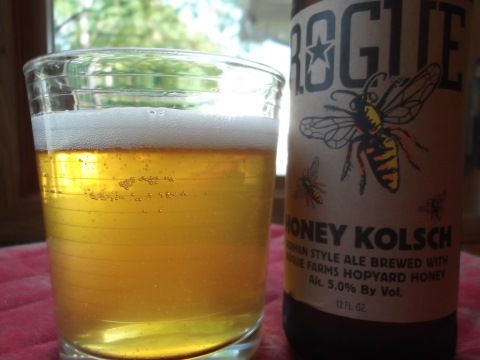
Rogue Honey Kolsch is made with malt and hops grown on Rogue Farms and honey made by Rogue bees. I liked the idea of this combination from the moment I read about it and was keen on trying it. I found a six pack at Steve's on University Avenue and haven't seen it anywhere else in Madison.

It pours a medium yellow and was definitely on the hazy side. Rogue uses some wheat in the brew which I presume is producing the haze. A traditional German Kölsch, however, would be clear. I got roughly an inch of loose white foam atop my glass (I still need to unpack my stangen) while there were bubbles galore inside the bier.

That distinctive floral, sweet-yet-savory smell of honey shone through on the nose. I'm no honey expert nor do I know where Rogue's bees were getting their nectar but it was less floral to me and more earthy, for lack of a better description. There was also a little bit of lemony citrus and a touch of grain.

All those bubbles translated into some healthy carbonation. I was really happy add the honey flavor. It seems that most of the honey beers I've had don't use much. And so it becomes a minor accent in both the aroma and taste. Here the flavor is rather prominent and leans more to earthy and maybe woody than floral yet it also gave a sweetness like apple. The malt tasted dual-layered with both lighter biscuit as well as a sweeter, more doughy flavor.

If the bier's smell and taste were decidedly not traditional because of the honey, then at least the finish was more like the German import. It was moderately dry with grassy and spicy hop flavor pushing any lingering malt out of the picture. The bitterness was not big but was abetted by the carbonation. Rogue's in-house Alluvial hops are very Noble-like. My glass finished all gussied up with lots of Schaumhaftvermoegen. There were thin streaks almost everywhere and specks of foam in between.

A really tasty brew. The honey is perfectly toothsome and was used judiciously. Not too much nor too little but rather just the right amount. The bier tasted clean and fairly crisp as if it were lagered for a while. On the malt side, there was a bit more doughy flavor and less of that light, crackery taste that I prefer in a Kölsch. Still, the bier managed a fine light body. If I have a realcomplaint it is that it didn't taste very much like a Kölsch. But perhaps there's a tradeoff to be made: you can have your typical fruity yeast flavors or you can have a moderate big honey taste but not both at the same time. Or maybe that apple sweetness I tasted wasn't all honey but was rather the yeast as well.

Regardless of how well or how poorly Honey Kölsch adheres to German or stylistic tradition, it is a tasty brew that goes especially well in the heat.

Junk food pairing: Having a light sweetness and a splendid honey flavor means Honey Kölsch will go well with other honeyed foods. Try Lay's Honey Barbeque potato chips or some Snyder's Honey Mustard & Onion Pretzel Pieces.

03 May, 2016

Melobraggot? Bragomel?: Marionberry Braggot by Rogue Ales


The final entry in my short run of brackett tastings is a fruited take on the style - Rogue's Marionberry Braggot. A mead made with fruit is called a melomel so perhaps this could be called a melobraggot. A bragomel? They just roll off the tongue, doesn't they? If you use it like a mouthwash, does it become a Gargamel?

I'm here all week. Tip your servers!

Rogue Ales is located in Newport, Oregon and I will cop to not being particularly familiar with the brewery. I have reviewed only one of their beers - Roguebier Rye Ale, which I liked. And that is about it as far as my Roguish knowledge extends. Marionberry Braggot is apparently part of the brewery's Rogue Farms series which I presume means that some percentage of the ingredients in the brew were grown on a Rogue farm. Rogue farms grow grains, hops, fruit, nuts, and also raise animals. I am sincerely hoping that I never see a Rogue free range chicken beer on offer.

The label indicates that several of the braggot's ingredients were grown on a Rogue farm including marionberries. I had to look them up because the name didn't sound at all familiar. Marionberries are a variety of blackberry brought to life in Oregon in 1956 which makes them hyper-local for Rogue.

As with the other bracketts and braggots I've sampled recently, my bottle of Marionberry Braggot has been aging in my cellar since I bought the bottle in 2014. That was a big year for braggots, apparently, as my previous two were also vintage 2014. That trend petered out quickly.

Marionberry Braggot pours a deep brown that has a reddish purple tint. Just like Sprecher's brew, this one was very turbid. I got a small light tan head that lasted for 20 seconds or thereabouts. If I held my glass to the light just right I could see some bubbles going up.

The aroma was very sweet with a lovely honey scent being supported by the marionberries. This certainly had the sweetest aroma of all my braggots.

The same can be said of the taste. Not only was the honey prominent but also fairly sweet. This braggot is 11.42% A.B.V. which makes me wonder exactly how much honey was used to make it that big and with that much sweetness. The berries were not shy about making themselves known either. They added a touch of sweetness and a bit of tart berry goodness. I was happy to taste some carbonation as well because it really helped tone down the sweetness.

This is a big, boozy beverage and I could most certainly taste it. That boozy heat was fairly restrained until the finish. Here the honey faded leaving the marionberry to deal with the alcoholic heat. I'd swear there was also a little bit of spicy hop bitterness in there for good measure. Lacing was completely absent.

Just like Sprecher's Braggot, Marionberry has large booze component to it. I think the marionberries and the marionberry juice helped tone down the alcohol sting here but it had still a very warm, astringent taste, especially at the finish. Beowulf could have made Molotov cocktails with this stuff and dispatched Grendel and his mother with ease.

In addition to having a great honey flavor that of the perfect level of sweetness, I really liked the fruit in this braggot. It made the brew a little more toothsome but also added some tarteness at the same time. However, just as with its Sprecher cousin, the alcohol taste was just too strong for my palate. It was too strong and stood out from the honey and fruit too distinctly. It may very well be my lack of cellaring know-how but, considering that Honey Queen didn't seem to suffer from a similar period of aging in my basement, I am beginning to think that high potency braggots are either fated to be fire water because grain somehow throws a spanner in the works or Rogue and Sprecher need to practice braggot making. Meads/melomels with higher A.B.V.s than 11% don't taste like this nor do (all) beers of double-digit potency.

Surely this means I must conduct more research.

Junk food pairing: Marionberry Braggot pairs well with Hostess fruit pies or their nearest generic equivalent. They will help take the edge off and complement the fine marionberry flavor of the brew.

23 April, 2013

Chatoe Rogue's Roguenbier Rye Ale


Chatoe Rogue is a series of beers from Oregon's Rogue Ales which feature ingredients grown by the brewery itself on land that it leases from local farmers. Here, Roguenbier Rye Ale is brewed with barley, rye, and hops that Rogue grew themselves. Considering just how much this much this endeavor must cost, I am surprised that bombers of Chatoe Rogue beers are only $7 at Jenifer Street Market. Contrast this with the $15 bombers of The Great Dane's barleywine this past winter.

Roguenbier is a roggenbier, a German rye ale. A cousin of the hefeweizen, the roggenbier replaces the wheat with rye but uses the same type of yeast. Although Germans have been brewing with rye for ages, my understanding is that the roggenbier as we know it today is a very modern invention, dating back to the 1980s. I suppose that in a nation so steeped/mired in tradition the roggenbier is the black sheep of the deutsche bier familie but I think it's a wonderful idea.

Rogue's take on the style begins with its deep reddish brown color that borders on the opaque. It looks like a heady elixir that means business. The stuff is bubbly and I got a decent head but it didn't stick around long. It certainly had one of the odder aromas my nose has taken in for some time. The smell was toffee-like but a musty, smoky toffee. But there was also that banana-tinged ester aroma lurking in there.

On the tongue, Roguenbier has a medium body. The first thing you taste is the sharp, black peppery rye flavor. Soon enough, however, the spicy hops appear and join the show. While not at IPA levels, the hops here are much stronger than I thought they'd be and compete with the rye for your tastebuds in a spicy-bitter showdown. Sadly, the mellow banana flavors of the esters produced by the Weissbier yeast are quite subdued and only make an appearance near the finish which is slightly bitter and dry.

Vintage's Tippy Toboggan (Full disclosure: I know Scotty the brewmaster.) takes a different tack by letting the rye give a firm accent to the beer without overpowering the yeast or the other grain. And the hops contribute to the balance instead of competing for dominance. Truth be told, I could barely taste the malt here. TT is a bountiful medley of grainy, spicy, and fruity flavors that is quite sessionable at 4.7% ABV while Roguenbier is TT's older, wilder brother that emphasizes the bolder flavors and packs a bit more punch at 5.5% ABV.

I personally prefer Tippy Toboggan but Roguenbier is a good brew. The former I can drink all night while splitting a bomber of the latter with The Dulcinea proved to be just the right amount.

Junk food pairing: Let the moldy, spicy goodness of the creamy cheese food product filling of Buffalo Blue Cheese Combos melt over your tongue while drinking Roguenbier.