Truth be known, I did not give multiple proper listens to these Yes albums in chronological order. For example, when Mirror to the Sky came out in 2023, I had given The Quest the odd, hesitant hearing but had never attempted to truly get to know it. One day I decided to give this new, Alan White-less (he passed away in 2022) album a listen, a purposeful listen. As I wrote previously, I had a moment.
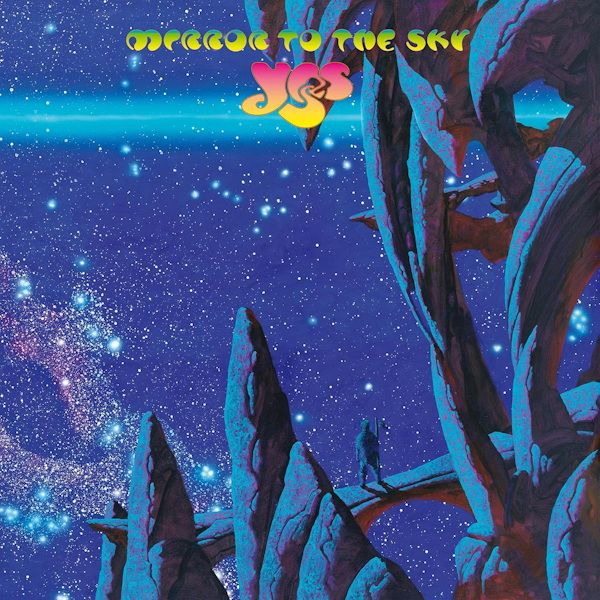
Roger Dean again provided the album cover and I love it. A deep blue night sky is aglow with oodles of stars, a gorgeous stellar landscape that was familiar to our ancestors but is virtually unknown to today's city dwellers. Standing there looking skywards in awe is a lone figure right out of that Caspar David Friedrich painting.
Jay Schellen took over on drums after White's passing. I do believe that I've read somewhere that the percussionist pair were friends. Schellen added percussion to The Quest and performed on most of the tour in support of that album due to White's failing health. Once again the band kept it in the family.
The cover is invoked on the opening track, "Cut From the Stars". The strings are back and briefly open the song before the band kicks in. Schellen makes an enthusiastic debut as Sherwood, co-writer here, gives us the bass gymnastics he was destined to play. Davison invokes the wonder and majesty of the night sky at international dark sky parks, places where the lights of civilization are kept a good distance away allowing folks to see the sky more or less as our ancestors did.
Howe adds sundry effects to his guitar sound that give a vaguely psychedelic feel that complements the spacey synths well. A (very) spirited start.
Howe and Downes combine for a brief introductory fanfare on "All Connected" before Schellen gets the proceedings going with his percussive kick. Howe's glissando on steel is soothing. At just over 9 minutes, this surely counts as a mini-epic. The song goes through multiple sections including a lovely chorus. While I dunno what "karmachromatic" means, it seems that Davison (or whoever wrote the lyrics) is getting all Jon Anderson-y with a made-up wordplay that simply sounds good or just fits. The soaring instrumental section midway through is all-too short. Great stuff! Also great here are the harmony vocals. I think Sherwood elbowed his way into the vocal recording room at the studio because it sounds like he sings more on this album.
The song ends with more lilting steel guitar. Listening to this song I am agog at the array of instruments that Steve Howe brings to Yes. Steel guitar, your standard 6-string electric, that Portuguese 12‑string or whatever that thing truly is, acoustic guitar with 6 strings - heck, there was a koto on The Quest. He's, if not an orchestra unto himself, a string section, at least.
"Luminosity" is another 9-minute mini-epic with a bouncy melody courtesy of the FAMES Studio Orchestra who also contributed to The Quest. A wonderful opening couple minutes slows down and Davison makes his entrance a cappella though what sounds like harp peeks in eventually. Did Jon Anderson sneak in?! I don't see the musical credit equivalent to Alan Smithee so it must have been the orchestra's harpist.
I recall really enjoying the chorus on this song on an early, if not first, listen. It's upbeat & positive without being gooey New Agey kind of stuff. And it has the virtue of being blatantly catchy. Schellen keeps things mid-tempo yet exciting. And Howe deftly orchestrates his army of stringed instruments. The orchestra returns towards the end to fill things in as Howe goes off on an extended solo on steel guitar.
Not only is this song simply gorgeous lyrically and musically, but it keeps things interesting for 9 minutes with various sections getting shoved up against one another as tempos hasten and then slow down. Plus there's lovely harmony vocals (go Mr. Sherwood!) and a great variety of sounds and tones. Howe plays about 20 different instruments, Downes is all over with piano, synths, and even celeste, and it's all held together with Sherwood's sinewy basslines.
After a couple 9-minute tunes, the band gives us a break with "Living Out Their Dream" which is about half that. The opening sounds a bit over-eager to me but the song eventually hits its stride. I must confess that the couplet "Living out their dream/Covered in ice cream" just doesn't land for me. Still, Schellen's muscular drumming here keeps the tune from lapsing into twee territory as does some spectacular bass from Sherwood. He's not as high up in the mix here most of the time as on other tunes but, if you listen, you will here some crazy runs.
I really have respect for Billy Sherwood. First for stepping into Chris Squire's shoes which no doubt has earned him the ire of many an old Yes fan. I am sure he knew what he was in for yet he took the plunge anyway so good on him. Second, he doesn't have a rubbery Rickenbacker tone. Lastly, he plays in a Squire-like way but his little flourishes and runs and all the stuff that leaves me amazed as a non-musician don't sound like they were composed by Chris Squire. Sherwood is putting his own spin on things. Brilliant.
The title track is the first song that really grabbed my attention. Howe's opening guitar refrain gently builds tension and then releases it. He's joined by piano and bass that kept me wondering where the song was going to go. At nearly 14 minutes, I expected to be taken places. After about 50 seconds Schellen comes crashing in. Downes plays what may be a simple organ part, but it adds a palpable excitement to the song which sounds like it has just taken off and is headed for the stratosphere. As the guitar takes on a menacing kind of feel, like Howe is summoning beasts from the earth itself, Sherwood is given room to have fun. It sounds like his hand covers every inch of the bass' neck.
This. THIS. This opening instrumental section just effin' rocks. It is some of the most exciting music Yes has ever made with or without Jon Anderson. As the kids say these days, it is just sick.
The song then shifts to an acoustic backdrop for Davison to starting singing the song's refrain, "Dreams of a sky without fire". It's just a plucked acoustic guitar and the orchestra for a verse or 2 before the band returns as does the song's main melody. Really nice harmony vocals precede Howe's soloing. We're 5 minutes in and the song has already taken us on several twists and turns.
The orchestra then kicks up a fast, lively rhythm for Howe to slowly build a solo upon. It's the first time that the orchestra really went beyond a novel bit of ornamentation for me and sounded fully integrated into the Yes sound.
About halfway through, the opening guitar motif returns briefly before a slow, delicate section takes the song in yet another direction. The orchestra inveigles its way back into the fray for one last hurrah before the song kicks back into a jam like the one that opened it.
If you've been reading my Yes reviews then you know what I am going to say next. "Mirror to the Sky" should be played at every Yes show. It would sit just fine in a setlist next to "And You and I" or "Heart of the Sunrise" or anything else. This song is bookended by some of the most fun and exhilarating music in the Yes canon. The orchestra is a well-oiled machine here and is at last fully integrated into the band's sound. Over the course of nearly 14 minutes I was taken on a musical journey as the song moved from section to section, everything held together with lyrical refrains and the melodic recapitulation.
Classic.
In the previous album's "Future Memories", Jon Davison sang "Time encircles time" and I guess in some proggy Möbius strip event, we get his "Circles of Time" to close out the album proper.
It's a mellow tune, almost a lullaby, that brings us down from the frenetic jamming on the previous song. A very pretty song and I appreciate Davison's earnestness ("Not lost on me/How bittersweet the mockery of irony") yet it still feels like a bit of a let down after a slab of epic prog manna.
As with The Quest, Mirror to the Sky came with a 2nd CD of bonus tracks and we get 3 of them here.
Some lovely acoustic guitar opens "Unknown Place" and is followed up by some tribal vocals as the song heats up. There's some nice soloing from Downes and Howe and the song never gets boring but it never really hits me like the other mini-epics here. Still, it's nice to hear more of Downes who seemed to get pushed out by the orchestra on occasion earlier. Also, the section about three quarters of the way through where the pipe organ comes in is great stuff. The song never seemed to be able to capitalize on the tension of that passage, though. Regardless, someone should Pro Tools that bit into the title song.
"One Second Is Enough" is a good enough song where Downes really gets to shine but it never gets beyond being just fine. Is Sherwood wielding a Rickenbacker here? "Magic Potion" feels much the same to me although Sherwood is doing something a bit funky in there. And I certainly cannot argue with the sentiment "It's a good day to be had by all". There's an 80's synth bit here too that got my attention in not a good way. At least it's a bonus track.
With this album the Jon Davison version of Yes really comes into its own by making good on the promise of The Quest. New drummer Jay Schellen acquits himself well by filling the rather large shoes of Alan White quite ably. There were times when it felt like he sat back biding his time as a steel guitar was wailing and then, when he'd had enough, he spat on his hands and it was off to the races.
It was great to hear such vitality in Yes again after so many years. Maybe the new guys lit a fire under the old duffers. The playing here is uniformly excellent, Davison's voice is again angelic and soaring, and the songs are well arranged with the individual sections of longer songs sounding like they belong together, binding into a dynamic whole.
How do you follow up a near masterpiece?


No comments:
Post a Comment