Showing posts with label BBC Past Doctor Adventures. Show all posts

08 September, 2023

Hate the Game and the Players

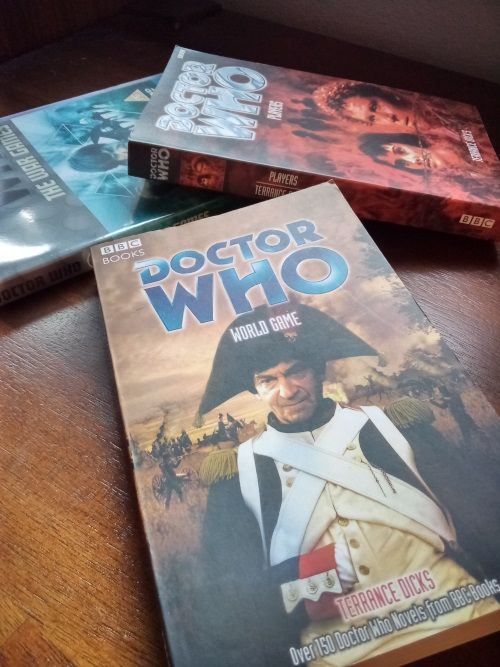
World Game is the last Second Doctor novel, chronologically speaking, and the first & only full-length literary foray dedicated to Season 6b. Terrance Dicks kills two birds with one stone here as this tale stands as a sequel to two of his other works, the TV story "The War Games" and Players, a Sixth Doctor PDA.

When the story begins, the Doctor is seemingly before the same Time Lord tribunal we saw in "The War Games" where he is being tried for stealing a TARDIS, using it to interfere in the course of time, and giving TV viewers something fun to watch. He pleads guilty as charged with the extenuating circumstance that he does good in the universe, unlike his prosecutors. On TV he was sentenced to exile on Earth and forced regeneration, but here the sentence is death. I guess the lesson is that antagonizing the judge, jury, and executioners is perhaps not the best way to begin your defense.

However, he is offered a deal. If he helps out the Time Lords, his sentence will be commuted to exile on Earth. He agrees on the condition that he is allowed to return to Earth in 1917 to see that the friends he made in "The War Games" are safe and sound. While he is checking up on Lady Jennifer and Lt. Carstairs, the Time Lords or, rather the Celestial Intervention Agency, are recruiting a Time Lady to be his assistant on the mission, the Romanadvoratrelundar-like named Serenadellatrovella, a.k.a. - Serena.

Serena's handler, Sardon, kind of like a Gallifreyan M, is giving her the spiel and introduces her to the Doctor by showing what he's up to on Earth in 1917. In the book's only moment of real humor that I can recall, they find that he is before a firing squad and Sardon quickly retrieves our hero just in the nick of time.

The Doctor and Serena are sent to investigate and halt some temporal interference on Earth involving Napoleon, Sir Arthur Wellesley (a.k.a. - Duke of Wellington), and Lord Nelson. We learn that it is the enigmatic Players from the book of the same name who are sticking their fingers into the pie that is the course of the Napoleonic Wars.

We met the Countess, who goes by Madame Lefarge here, in Players. She and her cohorts are these immortal, ethereal beings from another plane of existence who are so bored that they come here to the prime material plane and mess with people just for the fun of it. The games they play with we mere mortals make The Great Game look like peanuts in comparison. I don't know that these Players are ever really, truly explained but they are quite reminiscent of the Eternals that the Fifth Doctor met in "Enlightenment".

The story here is a big cat-and-mouse game where the Doctor and Serena bounce around various locations in France and England making sure that the Players' attempts to alter history are foiled. At first, one going by the name Latour tries to kill Napoleon but he is himself killed by the Countess who is being aided and abetted by her pal Valmont.

When in human form, the Players become mortal and so the Countess' shooting of Latour is deemed outside the boundaries of their Game and she is brought before her fellow Players to account for her misdeed. We learn that she has a man on the inside on Gallifrey and that she has come up with a so-called "Grand Design", which is really her meddling rendered a bit more interesting for her with the inclusion of the Doctor and Serena trying to foil her plans.

And so the Countess and Valmont devise various stratagems to aide Napoleon and to get Wellesley and Nelson killed before their time, ensuring that the Battle of Waterloo does not become Napoleon's, er, Waterloo and thusly deprive ABBA of a Eurovision-winning song and UK #1 hit.

For instance, we meet Robert Fulton who has constructed a submarine for Napoleon to use against Nelson's fleet. His boat's major flaw is the propulsion method but the Countess steps in and brings him an atomic engine of some kind to jury rig into the submarine. The Doctor foils this attempt to supercharge the early underwater vessel, of course.

As the Doctor and Serena foil more of her plans, she attempts to have them killed. In one instance, they are escorted from a cotillion and left in the woods where they are confronted by a vampire, the mortal enemies of the Time Lords as we learned in Dicks' Fourth Doctor TV story "State of Decay" and his Seventh Doctor New Adventure Blood Harvest. Thankfully the Doctor ate every chicken canape on offer at the soiree which were laced with plenty of garlic and his breath repels the vampire just enough for him to improvise a stake from the handle of a carriage driver's whip. Later our heroes are confronted by a Raston Warrior Robot which beheads French soldiers instead of Cybermen in a rather grisly scene.

The presence of the vampire and the RWR leads the Doctor to conclude that they were brought to Earth from Gallifrey using a Timescoop, a la "The Five Doctors". This bit of intrigue is all but forgotten until the end and really adds nothing to the plot except a chance for Dicks to refer to some of his previous stories.

Serena does a whole lot of nothing for most of the book until towards the end when she jumps in front of the Duke of Wellington after noticing that one of the pipers (perhaps an ode to Jamie?) sent to play a tune is really Valmont armed with a rifle. She leapt at just the right angle as the bullet pierces both of her hearts and kills her outright.

At the end, the Doctor returns to Gallifrey victorious with the threat to Earth's history having been eliminated. There the traitor is uncovered and the Doctor is given a new mission: to go to Space Station Camera and convince his old pal Dastari to delay his time travel experiments until the Time Lords can evaluate them. To accompany him will be his beloved Scots companion, Jamie. Thusly "The Two Doctors" has been nicely retrofitted for us.

For me, World Game is a thoroughly mediocre book. I did like how Dicks arranged the story. There are 37 chapters here and I was reminded of The Glass Books of the Dream Eaters in that the most of chapters end with a cliffhanger and would make great fodder for serializing in a periodical. Dicks' writing style is clear and concise and he doles out detail well, giving you a good feel for the setting. And, although it's not really played up (ahem), there is an interesting parallel between Napoleon and the Doctor as they both know the pain of exile.

The main problem for me is the rinse and repeat nature of the plot here. Countess does X and Doctor & Serena foil X. Well, maybe not the main problem. This repetitive plotting style might not have been so bad had the characters not been so thinly drawn. The Doctor could have been the one from The Infinity Doctors, he is just that generic. It's weird that Dicks would write our hero so blandly. In a similar vein, Serena was simply a boring companion. We know she is a real beauty with a face that could launch 1,000 Battle TARDISes but she does next to nothing and bemoans this fact out loud.

The name "Valmont" brought the movie Dangerous Liaisons to mind and I pictured the Countess' sidekick as John Malkovich. Natürlich, with Serena's great pulchritude, I envisioned her as Uma Thurman. I've had a crush on Uma Thurman for decades so that was nice.

The Countess is not a bad villain, by any means, but she is a rather pedestrian one. Rather than being an immortal who loves to play a good game of chess, it's more like she's a little girl figuring out Tic-Tac-Toe. If you want to see the Doctor not interfere, how hard was it really to kill him? Why would you have him help? Serena is taken hostage to force the Doctor to help Fulton out with his submarine. About 4 paragraphs later she has escaped. I grant you, this was Valmont's fault, but it ties in with this notion that the bad guys here lack some basic villain skills. They just come across as being cartoonishly incompetent.

At one point, the Doctor and Serena need to attend a party/ball but lack an invitation. Psychic paper to the rescue! I looked it up and World Game was released in October 2005 so it was lovingly stolen from the new series, although I don't recall when it debuted exactly.

I am hoping to bid the Second Doctor farewell in better style with the remaining short stories.

01 September, 2023

Jamie vs. the Surly Teenagers

I was taken by surprise when The Wheel of Ice came out in 2012. This was a Second Doctor book. Zoe and Jamie were at the Doctor’s side, not Amy and Rory. What madness was this?!

Were the Past Doctor Adventures being regenerated? Was this merely the first entry in a newly resurrected series? Well, we did get a Third Doctor adventure, Harvest of Time, the following year and a Fourth Doctor novel, The Drosten's Curse, a couple years later but that was that. OK, you can argue that Scratchman and Doctor Who and the Krikkitmen count but, really, the PDA’s were not fully revived. Maybe there was an abandoned plan to tie things in with the show's 50th anniversary, I don’t know. But we did get a handful of new adventures with classic Doctors.

I wasn’t sure where to put The Wheel of Ice in the Second Doctor chronology so I read it just before watching The War Games. The author, Stephen Baxter, was unfamiliar to me but he is a science fiction writer by trade.

The book begins by introducing us to Arkiv, a thing or a creature that ran into a bit of trouble when Home was destroyed and it, well, she became embedded in an icy moon. We’re then in comfortably familiar territory – the TARDIS console room, where the temperamental ship is preparing to land on a moon of Saturn to investigate a Relative Continuum Displacement Zone that it detected. However, the moon isn’t there and the TARDIS refuses to move lest it get caught up in the RCDP. Instead, it is being bombarded by chunks of ice, the stuff that Saturn’s rings are made of.

Luckily a teenaged girl, Phee Laws, is out cruising the rings on her scooter accompanied by her AI robot pal, MMAC. MMAC is able to throw the Doctor a cable which he wraps around the console and the ship is towed to safety. Phee boards the TARDIS during this procedure and it detects Pedleron particles about her which means it has traveled through time. Curiouser and curiouser.

Our heroes soon find themselves aboard the Mnemosyne Cincture, a.k.a. – The Wheel of Ice, a structure that encircles Mnemosyne, one of Saturn’s smaller moons. The Wheel is home to a mining operation that is digging the bernalium out of the satellite.

Phee’s mother, Jo, is the mayor of the Wheel, who is struggling to keep the operation going and her children, Phee, Sam, a few years older than her, and the two year-old Casey, safe and on the straight and narrow. Helping her is the chief medical officer, Sinbad Omar, top cop Marshal Sonia Paley, and Luis Reyes from the Planetary Ethics Commission who is there to make sure everyone behaves, well, ethically. Oh, and there is also Florian Hart, the corporate representative from the mining company, Bootstrap, Inc., that is funding this venture.

Our heroes come to the Wheel and find that things are going missing and the colony’s teens are being blamed. They’re grounded en masse but escape out to a moon along with Jamie who tags along to keep an eye on Phee and her pendant which the Doctor suspects being the source of the Pedleron particles. Tailing Phee means our loveable Scotsman gets to have a few different adventures outside of the Wheel zipping through the void of space and on the surface of a moon of Saturn. The kids call him “grandpa”, which he finds irritating. Nonetheless, Old Man Jamie saves the life of more than one of the teenagers.

On board the Wheel, the TARDIS crew swear they catch sight of a little blue man but their observation is rebuffed. Then a review of an act of sabotage reveals the corpse of a little blue humanoid. Something else is afoot.

Things point to the icy moon, Mnemosyne, and a certain something at its center…

This was a good story, though not great. MMAC having a Scottish accent was a fine move and when it poked a little fun at Jamie, it was funny. The Doctor does an autopsy on one of the blue thingies and finds that they’re basically automatons and not living creatures. They don’t talk, they lack much in the way of distinct features, yet they huddle together as if sharing body heat. Those things are rather creepy. The little blue things are supplanted by big blue warrior things that are rather menacing.

I also liked how the Wheel itself has that gritty Alien aesthetic instead of the 2001 aesthetic where everything is shiny and new. The Wheel is cobbled together from chunks of ice and parts of older ships and space stations with interstellar duct tape and high tensile twine. It demonstrates that a bunch of uncaring, miserly bastards run Bootstrap, Inc. and the image of a patchwork orbiter instead of one with clean lines and smooth angles is just a neat visual in your head.

One of the things I didn’t like about the story was how the Doctor would decide he needs to go to the moon for answers so he and a group go down. Something happens and everyone returns to the Wheel. But, not having gotten the answers he needs, he goes down again. Rinse and repeat. These trips are just overly repetitive. But the lunar excursions do provide some harrowing scenes of the away parties encountering the blue things. The shootouts are thrilling and well-written while the scenes where they sneak through a cluster of the blue things that are simply lying on the ground or hanging from a wall watching them are really harrowing.

And just as the Doctor gets stuck in his rut, so does Jamie. Surly, rebellious teens do X. Old Man Jamie saves the day. Then teens do stupid thing Y. Old Man Jamie again saves the day. These repetitive scenarios were fun in and of themselves but they piled up and made wish the Scot had more time to interact with Zoe and the Doctor.

Florian Hart ends up being a real two dimensional character. Just a corporate lackey that tows the company line until she can do so no more. While it’s not like Doctor Who isn’t full of these characters and Baxter can be said to simply be adhering to a convention, it was still disappointing. She goes from someone mindlessly promoting corporate interests to being almost psychotic as she commandeers some missile warheads and is prepared to satisfy her bloodlust and keep the mining going at any cost.

Baxter writes well and his prose reminded me of latter day Isaac Asimov. There was a modicum of scientific jargon as the physics of the Wheel gets explained and only a little more. The way the emotional lives of the characters is portrayed reminds me of those 80s and 90s Foundation novels. The emotions are explained and are comprehensible but I never felt them.

As for our heroes, Jamie is certainly a man of action here as he saves the day while ably, if not gracefully, flying a space scooter, multiple times. And his banter with MMAC was humorous. Zoe and the Doctor fare less well, though. It’s not that they were never portrayed this way on TV, it’s that those episodes are lesser ones. This is likely due, in part, anyway, to Jamie’s absence. Zoe and the Doctor just sort of get on with things with no playfulness and a lot of good banter goes missing.

I am still not sure where to place The Wheel of Ice in the Second Doctor’s chronology. There’s a reference to The Mind Robber yet Jamie tells Zoe something to the effect of, “You had better get used to this kind of stuff if you’re going to travel with us in the TARDIS,” which made me think it came earlier.

While I have my problems with this tale, The Wheel of Ice is still a fun read.

26 July, 2023

Now She Has Become Death, the Destroyer of Ockara


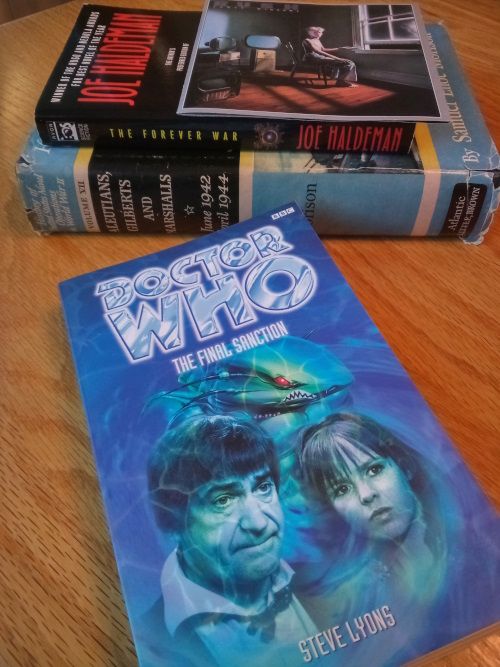
The Final Sanction
begins with Zoe hearing an explosion. Things get worse and really don't let up for 284 pages.

The TARDIS lands on a planet and it isn't long before the crew find themselves in a minefield. The Doctor manages to get himself out of a tight squeeze with the sonic screwdriver after he realizes he's stepped on one and any quick moves would spell the end for him. Extricating themselves from that deadly scene in exchange for a stroll along the beach, they stumble upon an abattoir on the shore filled with the bodies of P.O.W.'s who had all been shot in the head. They are all clad in the same uniform and the Doctor realizes that the dead are Kalarians and that they've landed on the planet Kalaya. He knows all-too well the history of this conflict and wants nothing to do with it. But the horrors continue to be piled Pelion upon Ossa as the TARDIS trio are captured by soldiers wearing armor that makes them look like sharks - the Selachians, whom we met in The Murder Game.

The Selachians throw our heroes into their version of an armored personnel carrier to bring them back to their underwater base. But the Terran Security Forces ambush the APC convoy. The Doctor and Jamie are rescued by the humans but the Selachians get away with Zoe.

Back at the TSF base, commanded by one Wayne Redfern, the Doctor reveals the horrible fate of the conflict that they've been dropped in the middle of to Jamie: the humans will retake Kalaya and then push on to the Selachian homeworld, Ockara. The Selachians are too proud a people to surrender and so Redfern will drop a new and very experimental bomb, the G-bomb, on Ockara which will destroy the entire planet, including thousands of P.O.W.'s. This means they've got to rescue Zoe and get the hell out of Dodge.

This sounds a lot like the Pacific Theater of World War II. The TSF has a strategy of taking one planet at a time which is just like the island hopping that U.S. forces did as they made their way from Guadalcanal to the Solomon Islands to Iwo Jima with the end goal being Japan. Kalaya is the equivalent of Okinawa here - next stop is the homeland/homeworld. The Selachians refuse to surrender just as the Japanese did. And that new, experimental bomb is just the atomic bomb with a different letter preceding it.

At this point, each of our travelers gets their own storyline, more or less, as they are separated and experience the horrors of war from different vantage points.

Ever protective of Zoe, Jamie volunteers to go on a mission to the Selachian base with the TSF in the hope of a rescue. Lyons does a fine job making it an intense battle scene demonstrating the fierce determination of the Selachians and the great killing power of their shark-shaped battle suits. Zoe is not rescued and Jamie is injured in the attempt so we get our first example of the futility of war. Our brave Scotsman suffers some PTSD as well.

Zoe ends up being taken to Ockara and thrown into a prison camp deep beneath the waves. But it's not like Stalag 17 where she sits there throwing a ball against a wall. Think Camp O'Donnell - the destination of the Bataan Death March. She is brutally interrogated but later manages to escape with a fellow prisoner named John Paterson. They make it to the surface and an island. Zoe wanders off into the forest where she encounters an Ockaran. (They become Selachians when they have the lower portion of their bodies amputated so they can fit into the shark suits.) It seems peaceful but, worried that it would give their position away, Paterson beats the hapless creature to death in one of the more gruesome scenes in a book with no shortage of gruesome scenes.

At first, Redfern and the TSF are suspicious of the Doctor and Jamie and the latter volunteering for a mission helped put their military minds at ease. But, when the Doctor is caught trying to make his way to the Ockaran surface (in a bid to exchange himself for Zoe, unbeknownst to them), Redfern becomes even more suspicious than before and paranoid that the Time Lord is a Selachian agent. And so the Doctor is held on Redfern's flagship and spends a lot of time, against his better judgement, trying to convince Redfern to seek a peaceful solution. He also confronts the inventor of the new, highly deadly bomb, Professor Laura Mulholland, the J. Robert Oppenheimer of the story. The Doctor can tell she feels guilt over the awesome power she has given the TSF and he attempts to convince her that it should never be used.

Amidst all of this, there is a lot of fighting and death. Lyons really makes the combat sequences kinetic with lots of close calls. He takes his time to let the fighting unfold instead of trying to get it over and done with. And there are a lot of red shirts who die horribly and graphically.

We learn that the Ockarans suffered greatly under the boot of the humans. Their world was formerly a vacation spot and the aquatic natives were thought to be barely sentient and so they were hunted and slaughtered a bit like seals here on Earth. After the Ockarans became Selachians and donned their battle armor, they gave no quarter to the humans they encountered and mercilessly killed as they conquered planets to give themselves some cushion between them and their human foes.

Lyons perches us on both sides in the course of the book so we get to know all-too well the blood lust that each has. But they also have understandable motivations. The TSF simply sees that the Selachians are killing innocent people and this must be stopped while, for the Ockarans, humanity has brought them nothing but pain, suffering, and death which also must end. Lyons also deftly alternates between the scenes showing the grunts doing the fighting and those with the commanders behind the lines giving the foul orders.

The Final Sanction spares nothing in telling the reader that war is hell. Arguably, it's goes overboard as it begins with horror and carnage and the bodies just keep piling up but Lyons writes a compelling and thrilling tale. What really makes it interesting, for me, is the fact that the Doctor knows the history of the war. He knows that Redfern will have Mulholland activate the bomb (it's not just dropped but rather needs codes from both of them) and that Ockara will be obliterated. All life on it will be returned to star dust. This awful knowledge changes the Doctor and he actively seeks to alter the course of history.

He seeks small changes, at first, rationalizing them away as being insignificant; nothing that Time can't easily recover from. But he throws caution to the wind and moves on to bigger, more potent alterations of the time line.

The Doctor is not the jovial hobo we've come to know and love, playfully poking fun at Jamie and challenging Zoe's knowledge in a kind, avuncular way. He's as serious as a heart attack. He is racked with guilt over Zoe being held prisoner and the fact that she will die if Redfern has his way and does the unthinkable. Knowing history, the Doctor has this tremendous weight on shoulders that he can and must bear, but it brings some things out in him that are usually held in check.

On the other hand, his most noble virtues - loyalty to and concern for his companions as well as a desire for good to prevail (or, at least, not lose) run smack up against all non-interference principles. I believe he even notes that the destruction of Ockara is a fixed point in time, it's one of those events that simply must happen in order for time & space to remain in good stead. Yet the Doctor tempts Fate. It's a fascinating portrait of a Time Lord suffering from a severe case of cognitive dissonance.

If anyone reads this book and concludes that it's a bit too much, that Lyons seems to have a grim and persistent determination to bash his readers over the head with "war is hell!", I understand. But I really enjoyed this book, even if the scene where Redfern and his squad run across an Ockaran village and lay waste to it brought scenes from the Vietnam War to mind and absolutely broke my heart. He's a very tragic figure and I think the book did a nice job of giving some back story to make him a complicated character instead of a simple warmonger.

There were flourishes of Starship Troopers here, such as how the humans referred to the Selachians as "sharks" just like as Heinleins soldiers call their enemies "bugs". Plus I caught some The Forever War  vibes as well. As noted above, I see many a World War II parallel in this story. With Christopher Nolan's Oppenheimer unleashed just recently, it came to mind during every scene with Mulholland.

This is a fine story with some really nice characterization. It is intense and somber but well-rounded. The Final Sanction puts paid to the notion that the PDAs are all simplistic and hokey and pale in comparison to the Virgin novels.

Chris & Matt from the All-New Doctor Who Book Club did an episode on this story and I am off to listen to it now.

10 July, 2023

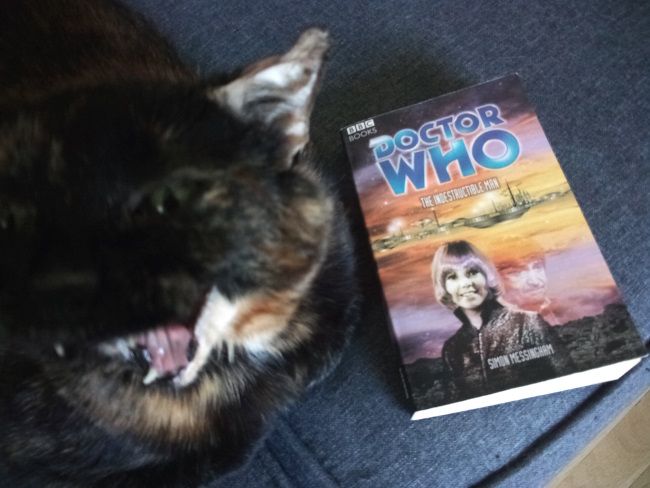
Indestructible Men and Inscrutable Myloki

I read Simon Messingham's Strange England several years back when I plowed through the whole of the Virgin New Adventures. Honestly, I don't recall a whole lot about that Seventh Doctor tale but I do remember it as being very weird and unsettling. It wasn't until I was a little way into The Indestructible Man that I found more info on Messingham and saw that he had written Strange England. Apparently putting the Doctor and his friends into very odd situations and having them run around worlds that are at once like ours and yet very different from it is his M.O. because this story sees him again transporting our heroes into another bizarro world.

And, now that I look again, Messingham wrote The Face-Eater. While I really enjoyed that book, it wasn't as, well, strange as Strange England.

Although it's a tale that is largely earthbound, I suspect continuity-loving folks would offer that The Indestructible Man takes place in an alternate universe. In the late 2060s, mankind fought a war with the enigmatic, unseen Myloki. They have an "outpost" on the moon which, in a very 2001-like scene, is discovered to be sending signals. But instead of them going to Jupiter, they go to the Earth and apparently control people. Many folks became these almost mindless zombies that are known as Shiners.

A secret military group called PRISM is created to combat the Myloki. Two of its members fall into the clutches of the aliens but not as Shiners. Captain Karl Taylor discovers the Myloki outpost on the moon which is indescribable and incomprehensible to mere mortals in the best Lovecraftian fashion. He ends up becoming a zombie too but his reanimated corpse cannot be put down. Oh, and he's anything but mindless. He's a highly effective undead killing machine. Captain Grant Matthews is killed but the Myloki create a copy of him that cannot die and it is he that gives the book its title. He brought Doctor Manhattan from The Watchmen to mind.

Once the signals from the moon are detected, the Matthews simulacrum is sent there with a rather large bomb attached to his person and he proceeds to take out the Myloki presence there. This, in turn, cuts the link to the Shiners and victory is declared.

Civilized society, however, was drained and devastated by the war with the Myloki and into this dystopian future, about 30 years after the alien menace is defeated, come our heroes. 

Rather than describing some kind of wheezing elephant sound, having the TARDIS materialize, and our time travelers alight to investigate where they've landed, we hear about them from afar and through the descriptions given by other characters. As it happened, they landed aboard PRISM's disused floating military base, SKYHOME, which gave me Thunderbirds vibes. PRISM's successor, SILOET, discovers the intrusion and The Doctor, Jamie, and Zoe are captured. They effect an escape but, while Zoe and Jamie manage to evade their captors, the Doctor is shot in the head.

From here, the story trifurcates and is told through the lenses of our heroes separately. The Doctor's companions think him dead and they try to assimilate into the world. Jamie joins a paramilitary group called the City Militia which policies the rather anarchic London. It is led by a demagogue named Mackenzie who has some weird eschatological views. Thinking the Doctor is dead and thusly that he's stranded in his own future, Jamie falls under Mackenzie's spell before being captured by SILOET.

Zoe, also under the impression that the Doctor is dead, is kidnapped and ends up in what are basically the remains of Canary Wharf where the Haves have walled themselves up and retain Have-Nots as slaves. She resigns herself to life there and eventually falls in love with the Haves' CEO, Mark Khan. Their romantic idyll ends when SILOET tracks her down. But her capture leads to Mark being shot dead. Zoe is brought back to SILOET and she ingratiates herself into their ranks using her mad computer skillz.

Although shot in the head, the Doctor remained alive. He gets injected with some kind of Shiner-dervied serum and this inhibits his regeneration. But it also puts the Doctor in contact with the Myloki, though only briefly. Upon his recovery, he is thought to be controlled by the revenant foes but another SILOET officer recalls some old U.N.I.T. reports and their descriptions of a certain scientific advisor.

The upshot here is that Zoe is working for SILOET, Jamie has been captured but also has had a psychotic break and disbelieves that the Doctor is still alive, and the Doctor comes to the conclusion that the Myloki are back and that the Matthews simulacrum is key to defeating them. He and a crack team of SILOET men begin their search for Matthews by seeking out a guy named Neville Verdana, a disgruntled former PRISM man who wrote a tell-all book that is excerpted at various points.

Ach!

I plot summarized much more than I intended. In my defense, The Indestructible Man is a knotty tale and, while it may be the normal 283 pages of a PDA, the type is small so this, by rights, is a 300+ page story.

The usual bonhomie that the Doctor and his companions bring to a story has been cut out here with no anesthesia. Zoe and Jamie witness their friend and mentor get shot in the head before their eyes (and Zoe saw Mark suffer a similar fate) so it's no wonder they become hardened and lose their genial demeanors. Without his young companions, the Doctor is stern and all business. There's no Jamie to poke fun at; instead, the Doctor can only mourn that he has broken with reality. Zoe ably demonstrates her computer skills but cannot indulge in playful banter with her friends so she comes across as the cold, calculating machine she was accused of being on the Wheel.

Jamie is certainly a man of action here even if it mindless, at times. He is confined to an underwater prison called OCEAN FLOOR and he effects an escape which causes enough damage in the process that another prisoner is able to escape - the indestructible killing machine that was Taylor. When the Myloki presence on the moon was destroyed, he went into a torpor that allowed him to be captured and placed into a titanium sphere which was then filled with cement. The sphere was then deposited deep in the ocean. Against all odds, Taylor is revived somehow and escapes on a submarine.

This leads to a really thrilling scene where the Doctor and a SILOET officer land on the island where Matthews resides in seclusion. Instead they run into Taylor who had piloted that stolen submarine there. He is a relentless killing machine in a Terminator kind of way. He doesn't run but he pursues his prey with a silent, unrelenting menace. This scene was really on the edge of your seat thrilling stuff.

I don't know if Messingham was a fan of H.P. Lovecraft's work or even knew of it but the Myloki are some of the most Lovecraftian elements of any Doctor Who story. Their foreignness, mankind's inability to understand them, and the way their presence on the moon was indescribable reminded me heavily of "The Colour Out of Space". 

In another great scene filled with palpable tension and excitement, Zoe figures out where the Myloki have been since their presence on the moon was destroyed. She surmises that they must be close and convinces the SILOET brass to initiate a scan which reveals them to be cleverly hidden and extremely close to the Earth. The Myloki start bombarding our home planet with beams of energy that don't destroy but instead mutate living things into hideous malformations that make a mockery of nature. The Doctor and a SILOET cohort visit one of the energy blast sites and I was creepily reminded of Jeff VanderMeer's Anniliation, a novel that shows a lot of Lovecraftian influence.

Rather than tentacles, Messingham used unknowability and mankind's seeming helplessness before the Myloki to create his own brand of cosmic horror. Even the Doctor is left to speculate about the aliens he faces rather than coming to hard conclusions backed up with a boat load of evidence.

While The Indestructible Man lacks the warmth and playfulness of the Second Doctor era on TV, it is still a fantastic story with a Lovecraftian menace wreaking havoc on a dystopian Earth. I haven't mentioned it much but he does a great job of characterization. Not in that Zoe, Jamie, and the Doctor are portrayed just like they were on TV, but rather we get into everyone's head and people get fleshed out. For instance, the Doctor comes to really appreciate just what wonderful friends Zoe and Jamie are and not just mere traveling companions. And Zoe falls in love which means moving beyond the emotionless calculating machine she was brought up to be. Plus, there's some good dialogue with Matthews and how he/it comes to terms with being a Myloki/human hybrid and one that is essentially immortal.

BBC's Past Doctor Adventures get a lot of criticism and unfavorable comparisons to the Virgin books. It may be true that the PDAs are conservative, generally speaking, and adhere to established conventions. But The Indestructible Man strays from the middle of the road off into the ditch and is a great side step from the Second Doctor stories we've generally had thus far. Just great Doctor Who.

05 July, 2023

Looking for Walden Pond on Axista Four

Back to the novels.

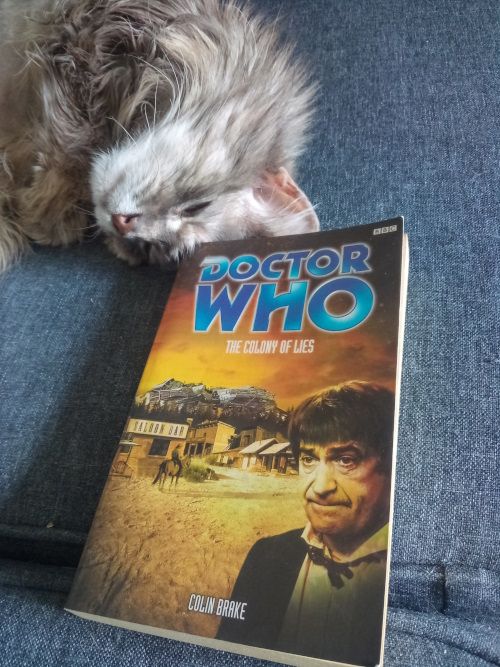
A sullen Doctor graces the cover of The Colony of Lies with an Old West town behind him and the hulking remains of a crashed spaceship in the distance. I was a bit ambivalent going in as I am not the biggest fan of westerns. The Past Doctor Adventures have gone into this territory before in Heritage which was not bad at all. I think I just need them to be light on the High Noon approach with good guys wearing white hats riding white horses taking on bad guys donning black hats on black steeds. Thankfully the western motif here is simply a backdrop.

The story begins with the Seventh Doctor and Ace at the Museum of the Tellurian Stain where our Nitro 9-loving companion learns about a fellow named Stewart Ransom, a 25th century rich guy who embraced the "Back to Basics" movement, influenced by some comments his daughter Kirann had made. The movement espouses less dependency on modern technology and more self-reliance. Sounds like Thoreau and Emerson made a comeback in the early 2400's.

He is so enamored of this neo-transcendentalism that he goes from being an Elon Musk type character into someone more like Stephen Gaskin. He packs thousands of adherents into a ship and flies them far off into space to establish a colony based on the Back to Basics principles, a bit like Gaskin establishing the hippie commune, The Farm.

Ace is intrigued but the Doctor says he has already visited the colony and doesn't want to return. The prologue ends with the Time Lord reliving those experiences via his Five Hundred Year diary.

The colony was established on a planet called Axista Four and eschewed pre-20th century technology, hence the Hadleyville vibes. It's been about a hundred years since the founding when our time travelers land at Plymouth Hope City. But all is not well. A group of colonists who feel that the colony's leaders are martinets whose rigid adherence to Back to Basics doctrine is ridiculous and will get them killed have formed a splinter group called the Realists. They have settled many kilometers outside of Plymouth Hope City in the ruins of an alien outpost. Those who remain in the town are deemed Loyalists.

The Realists occasionally pillage the wreck of the ship that Ransom and his adherents arrived in to help eek out an existence. It crashed and the site is a no go zone.

Not only do the Doctor, Jamie, and Zoe arrive into this situation but so does another ship, the Earth Colony Support Vessel Hannibal. We learn that Major Jonn Cartor (from Mars?) commands it and that one Administrator Greene is revived from suspended animation upon arrival at Axista Four. Greene is something of a mystery and, being a bureaucrat, is not well liked by the military folks. Needless to say, I pictured him as Paul Reiser in my mind. Their job is to inform the colonists that they are going to have company very soon in the form of thousands of refugees from the Dalek Wars.

While the colonists have no way of knowing of the Hannibal's arrival, others do. The ship is detected by a sensor array around Axista Four disguised as a group of orbiting asteroids. This in turn sends a signal to the surface to revive some of the aliens - Tyrenians - who slumber in a chamber underground that the Realists had stumbled upon. After all, they built their settlement on top of the remains of the Tyrenians'.

The Tyrenians have a rather neat suspended animation system which involves parasitic/symbiotic creatures called Alisorti which hug the chests of the sleepers and keeps them fed and whatnot. While 2 of the Tyrenians awaken just fine, another named Dyselt runs into some problems including a rather nasty one called an Intelligence Reducing Virus which results in him developing pandorum.  It turns Dyselt into a homicidal maniac.

Brake does a nice job of setting up a story with several protagonists and conflicts. You've got the colonists split into factions, the newly-arrived space marines, the Tyrenians, and our TARDIS crew. They spawn all manner of conflicts. For starters, there's the intra-colonist squabbling. Next, while it was Cartor's ship, it sure as hell was Greene's mission. This guy adopts a scorched earth policy and orders everyone on the planet too be exterminated in anticipation of the refugees' arrival. (A very Dalekian approach to resettlement.) Dyselt is running amok (and he threatens Zoe) which causes the Tyrenian commander, Lorvalan, and his sidekick Zenig to go on a rescue mission involving death and mayhem. In the middle of all this, Jamie ends up with the realists, Zoe is hurt, and the Doctor has to try and mediate all of the conflicts and figure out the truth behind this colony of lies.

Brake juggles all of this quite well. The Tyrenians aren't really monsters. We know that they got there first and so they're just defending themselves, really. Plus, as we learn, they are a hybrid race of humans created by a friend of Ransom's as super-soldiers who escaped the clutches of the military with Ransom's help. The Doctor finds the state of crashed colony ship to be rather odd and he eventually discovers that Ransom knew of the presence of the Tyrenians and followed orders to exterminate them. However, the ship was fired upon while in orbit by those defensive asteroid thingies and crash landed after sustaining damage.

Lies, lies, damnable lies!

Jamie and Zoe prove quite heroic here. The Scotsman challenges a Tyrenian to hand-to-hand combat while Zoe connects to the town's computer system via a neural connection that involves needles piercing her skin for the hook up. It's a deep connection that proves traumatic for her. For his part, the Doctor is all over the place trying to negotiate peace and figure out just what the hell is going on.

Our heroes are well done and it's a fun story with some mystery to it. I read along wondering about the motivations of characters and the history behind everything which was great fun. The story is pretty typical Doctor Who stuff - Brake doesn't break with the conventions of the show - but he layers it nicely.

The mechanics of the story aside, Brake introduces some interesting thematic material, namely, the role of technology. You've got the Back to Basics movement to start. I don't recall the book ever going into much detail about its philosophy. Instead it gave me a sense that its adherents feel humans kind of disappeared up their own collective ass via technology and that an excessive reliance on doodads and gadgets has a dehumanizing effect.

This idea is manifested in the Tyrenians. They're humans that have been genetically crossed with canines - literally dehumanized. Plus they're disposable. Once the type of genetic engineering that had produced them was banned, they had to go. One can imagine Kant going apoplectic upon hearing that their humanity was denied. "You are treating them as means to an end, not an end in and of themselves!!"

Later in the story, the Doctor manages to revive Kirann Ransom, Stewart's daughter, from suspended animation. She's been sleeping in the shipwreck for 100 years. The colonists had wanted to revive her after the death of her father, but they were too scared of killing her in the process. So she awakens to the horror that the colonists have taken the Back to Basics philosophy to, perhaps, its logical conclusion. I think she says that it was meant as a guide, not as rules set in stone.

The Loyalists have become slaves to doctrine instead of using the human gifts of creativity and toolmaking.

I am not arguing that The Colony of Lies makes any grand arguments one way or another on this topic. Instead, it offers up food for thought. And I was reminded that in the previous TV story, The Invasion, the Doctor expresses his dislike of computers. At one point he says he hates computers and refuses to be bullied by them. As an IT professional, I concur!

This subject has just been on my mind lately having written a few posts about things related to San Francisco and a former hippie girlfriend - the back-to-the-land movement of that time, Herbert Marcuse, etc. In addition, I've gone deeper into being an old geezer because I am really frustrated with the expectation that my life should be run from a smartphone.

To quote Neil from The Young Ones, "I wish there were no machines and we all lived a pastoral existence. Trees and flowers don’t deliberately call out and go beep in your ear."

12 April, 2023

Let's Bungle in the Jungle


One of the most gruesome Doctor Who novels out there. Second, perhaps, only to Falls the Shadow which I recall being more unrelenting in its sadism.

The tale begins mercilessly as a power rifle toting fellow approaches a brown-skinned woman washing her "primitive crockery" in a stream as her infant child looks on. She refuses to submit to his interrogation and her poor child gets shot in the head.

Our TARDIS crew lands on the planet Jenggel, more specifically, on the island of Batu. Before long, they find themselves in the middle of a colonial dispute. The Indoni, denizens of Batu, have decided to get in on the colonizing game and have taken over the neighboring island of Papul. Unsurprisingly, the Papul don't take kindly to this and a rebel group called the OPG has formed to throw off the chains of their oppressors. The OPG is led by the enigmatic Kurtz. Er, Krallik.

To further complicate things, the Indoni President, Sabit, has hired a band of mercenaries called the Dogs of War to take out the OPG. The Dogs are id and thanatos writ large as they whore and kill their way across Papul showing not one iota of mercy towards anyone.

Our heroes are in constant peril whether it be from the rebels, the Dogs, or cannibals who live deep in the jungle. Victoria gets sidelined early on when she is taken captive and becomes nothing more than a pretty face that the Dogs drag along with them. Jamie is well drawn here - a man of action as well as a stranger in a strange land. The image of him wandering a jungle full of creepy crawlies in a kilt is rather funny. Plus, he hits on a woman at a bar early in the story. Quite the ladies man.

Just as with his companions, the Doctor is dragged along by events and does not drive them. He talks and negotiates but doesn't do much jiggery-pokery. He lies in wait until the end.

There are definite Apocalypse Now/"Heart of Darkness" vibes here while the Dogs brought the soldiers in Predator to mind. With the cannibalism and a scene where one of the Dogs watches a movie called Zombie Flesh Eaters, a real movie, that whole cannibalism exploitation genre of the late 70s comes to mind with titles such as Cannibal Holocaust.

I think Lewis did some fine world building here. It's a fun exotic jungle scenario and it starts off with a Val Lewton horror feel but quickly transcends that with some serious killing and gore. So I like the setting and I like how Lewis handles the various factions at each other's throats. Of course, with a lot of characters and sub-plots, the TARDIS crew is often times relegated to the background.

I enjoyed the setup, I got anxious when our heroes were in peril, and found a lot to like about Combat Rock. My main gripe is the Dogs of War. The psychopathy and violence that they display are of cartoonish proportions and their brutality and sadism wore on me. Perhaps amusing or novel at first, it wore me down. Considering there's a sentient fungus on Papul that can do some very funky stuff, I feel that the story would have been more interesting had the jungle and its mysteries been exploited more instead of subjecting the reader to yet more sheer savagery. But I suppose Lewis was going for the exploitation movie feel here.

31 March, 2023

Et tu, Trayx?

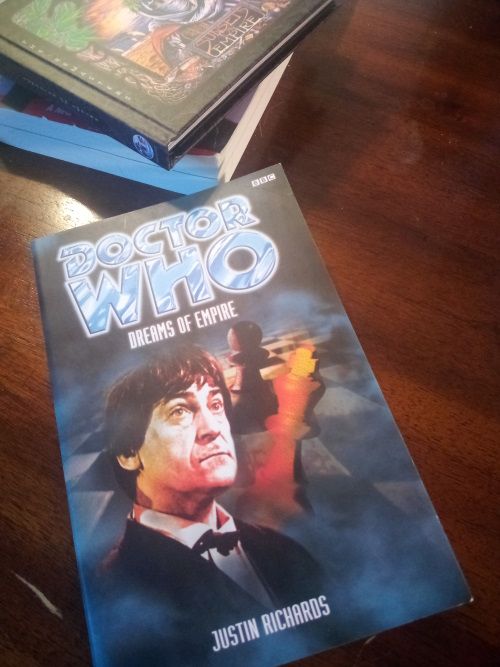
After two TV stories featuring a very alien villain, Dreams of Empire begins with a brief retelling of Shakespeare's The Tragedy of Julius Caesar set far, far away in time and space. The Haddron Republic is in crisis with one member of its ruling triumvirate, the familiarly named Hans Kesar, having decided that he is going make himself Consul General for life. All for the good of the republic, you understand.

His friend and co-consul, Milton Trayx, an ex-military man, speaks out against Kesar and Haddron is thrown headlong into civil war. Trayx and the Republicans prove victorious. After the loss of millions of lives, Kesar is brought to justice and sentenced to life imprisonment rather than death, lest he be martyred.

As they carried Kesar from the courtroom and were taking him away, a bomb goes off close to him in a hallway.

It is now several years after the trial as the Doctor, Victoria, and Jamie land in an oddly anachronistic castle. Think a medieval stronghold fitted with surveillance cameras, computers, et al. It turns out to be Santespri, a Haddron military fortress on an asteroid that has been turned into a prison for Kesar and his closest, most loyal supporters. Although he survived the blast after his trial**, it has left him severely disfigured and so he wears a mask.

There is subterfuge afoot as we witness cloaked figures meet in secret followed by murder. And so the TARDIS crew, in grand fashion, find themselves being accused of a killing. But they're quickly acquitted and the tale becomes a whodunit with the Doctor lending his Sherlock Holmes services to Trayx and the authorities.

Soon enough, however, they discover that a ship is approaching Santespri. Attempts to call for help are foiled and the story veers off into base under siege territory.

I found Dreams of Empire to be a really fun story. The murder mystery had lots of political overtones for color and I enjoyed how Richards gradually built up the suspense with the unknown ship's slow approach to Santespri. I appreciated that neither Trayx nor Kesar came across as stereotypical leaders simply hellbent on power. Trayx is not some George Patton or Curtis LeMay type (not sure who the English equivalents are) who knows only how to kill and Kesar came across as misguided rather than power hungry.

There's a scene that takes place just before civil war breaks out where the triumvirat meets at one of their homes and we see friendships strained to the breaking point over matters of state. I found this scene rather poignant despite the fact that an epic, tragic tale was being condensed into 17 or so pages. That scene just felt solemn and like it was allowed to unfold at its own pace rather than being forced. Richards is a very good writer and this scene really stands out for me.

Also of note is that the Doctor has a newly-minted sonic screwdriver here despite it not having been shown on TV yet, in the world of the story. Our heroes are well-written and the story is just a nice mix of mystery, political intrigue, and action-thriller. A fine read.

**Or did he...?

17 March, 2023

What have you gone and done to the basic underlying fabric of space/time now?

While I remember enjoying the 2 Virgin New Adventures by Dave Stone that I read, I don't recall much about them. So, I wasn't sure what to expect regarding the prose here. But, since it featured both the Second and Fourth Doctors, I expected it to be fun.

And it was.

Two is traveling with Victoria and Jamie. A failed attempt to land in 20th century London ends up depositing our TARDIS crew in the United States in an odd Midwestern town called Lychburg which bears more than a slight resemblance to Springfield from The Simpsons. It has a statue of its founder, Zebedia Lynchall, and is home to a Doctor Rick who enters a room saying, "Hello, everybody."

Meanwhile, 4 has Romana I by his side when they are confronted by a Time Lord with the vowelless name Wblk who tells the pair who should be out trying to piece together the Key to Time that a very old time machine from Gallfrey's ancient history met a controlled singularity on a populated planet. This meeting created a dimensional rift of some kind that has put the entire universe in peril.

Stone's writing is infused with jokes and casual absurdity a la Douglas Adams. In one scene, Two and his companions are enjoying some lunch while chatting. Imagining the Doctor gnawing on a chicken leg as he lectures to Jamie while the Scotsman is putting a deviled egg in his mouth made me chuckle. The Doctor mentions murder which surprises both Jamie and Victoria. The Time Lord protests that he had surely mentioned it before which prompts Victoria to say, "Possibly it would be simpler if we all pretended that you had told us, but we've forgotten, so you'll have to tell us all over again."

Four and Romana run into the Brigadier, which was a welcome surprise for me. But before that, they break into a museum to retrieve K9 in a manner that is less Mission: Impossible and more Keystone Cops. Another funny moment was when Four is confronting a bad guy and he quips, "Have you ever thought of seeing a specialist about that needlessly self-important and messianic tone?"

There's just a lot of this kind of stuff. Stone does a fine job of portraying our heroes faithfully to the TV show. For example, Romana is ever the aristocratic Time Lady: "And I really wish it was in aid of going somewhere other than Earth. I loathe Earth in that century. All those world wars and extermination camps. Things like that are always so miserable and depressing."

In addition to all of The Simpsons references, Lychburg is bursting with anachronisms, there's a drive-in playing schlocky sci-fi movies, and residents don't need much, if any, provocation, to murder one another.

"Romp" is a good, if overused, word to describe this book. I found myself smiling a lot while reading it. It has a lightheartedness to it and the familiar characters are well-drawn. Yet it has some substance too. There's weirdness and mystery to be had as well.

27 January, 2023

Was at first only MP for Huntingdon

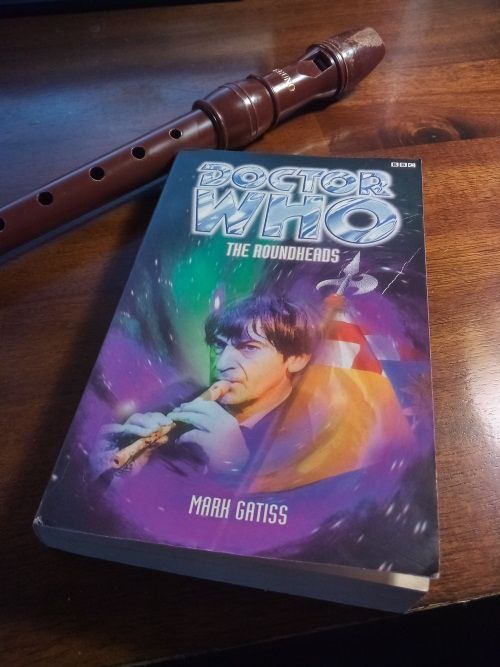
I don't think there's actually any recorder playing in this one.

Despite the cover sporting what I presume is an English Civil War era standard instead of an alien and the name simply being of the supporters of Parliament in that conflict instead of "The ___ of the ____" kind of thing, I started this book oblivious to it being a pure historical.

I liked this book a lot. Ben gets to be a pirate and seek vengeance on the man who killed his friend. There are tough choices and moral ambiguity. Polly must deceive someone she is attracted to in order to keep history from being dramatically changed. The movers and shakers here, the figureheads are not these larger than life, um, figures. The king is something of a pathetic figure - small and weak, while Cromwell's face is littered with warts.

The Doctor and Jamie are a kind of double act which I suppose presages what's to come. My man gripe is that they are essentially under house arrest for most of the story and don't feature very prominently. A lot of pages, however, are devoted to Roundheads and Royalists and the scheming all around. Ben and Polly are agents of action, they get their hands dirty, so to speak, in moving the story (and history) along. The Doctor plays a minor role and acts more from behind the scenes.

Despite the relative paucity of scenes with the Doctor, Mark Gatiss has a fine and fun tale on his hands here. Jamie is funny, if underused, while Ben and Polly really shine here.

29 December, 2022

An Alien Drawn on Celluloid

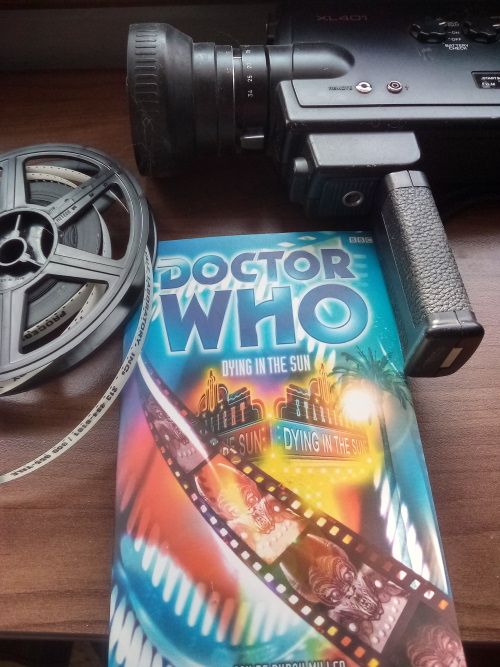
As someone who loves the movies, I found this to be a fun romp. It's Doctor Who paying obeisance to the likes of Dashiell Hammett and Raymond Chandler. The Doctor, Ben, and Polly find themselves in Los Angeles in 1947 where they stumble upon a cult looking to spread their gospel in the form of Midi-chlorian-like aliens smeared on celluloid to be projected to the unsuspecting masses.

Dying in the Sun is a very noirish affair. There's our (anti-)hero, Robert Chate, who's a drug dealer, Maria Coleman, a down and out actress who is the story's femme fatale, lots of sordid activities, corrupt cops, and plenty of murder.

Exposure to the aliens, whether by ingestion or watching a print tainted with them, imparts feelings beatific as well as egoistic to the person whose mind is being influenced by the creatures punningly called the Selyoids.

While this tale doesn't stray far from the conventions of Doctor Who, it is a really fun read. Our heroes are written well, even if the Doctor is a bit generic. I appreciated that the cult wasn't evil per se, but rather severely misguided. They weren't imposing the aliens onto people out of a desire to conquer or subdue, but rather out of a sense of paternal benevolence.

There's a scene that stays with me that involves Det. Fletcher. The Selyoids can animate corpses and they do so to interact with the cult leaders. As chaos reigns near the end of the story, Fletcher is under the influence of the Selyoids and gains an insatiable desire to have more of them inside of his body. Using a letter opener that he had filched, he punctures the skull of one of the corpses that has been brought to life...

A wide smile crossed his face and he scooped the Selyoid essence out of the corpse’s skull with his hands. He shoveled it in to his mouth and drank it, pools of glowing liquid spilling through his fingers.

Criticism of consumerist culture is a bit on the nose - at one point, Polly argues with the Doctor that people don't object to advertising so how is the tainted film any different?  (I think that's the gist of it. I cannot find that section.) - but I still enjoyed the story. That the cops are crookeder than a dog's hind leg while the ostensible evil villains are more deluded than malevolent was a nice touch. Plus, I simply liked the whole noir atmosphere, tropes and all.

21 December, 2022

Welcome to the Hotel Galaxian


I sure have a lot of reading to do before I get to the next Second Doctor story that exists on video in its entirety. But, if there are more tales like this one between now and "The Moonbase", the time will pass quickly because this was a really fun read. (The Doctor is in drag!)

It reminded me of one of my favorite Doctor Who stories, the Seventh Doctor PDA, Storm Harvest. That book is also a tale of a vacation spot under siege. (Storm Harvest was released about 2 years after the book at hand.)

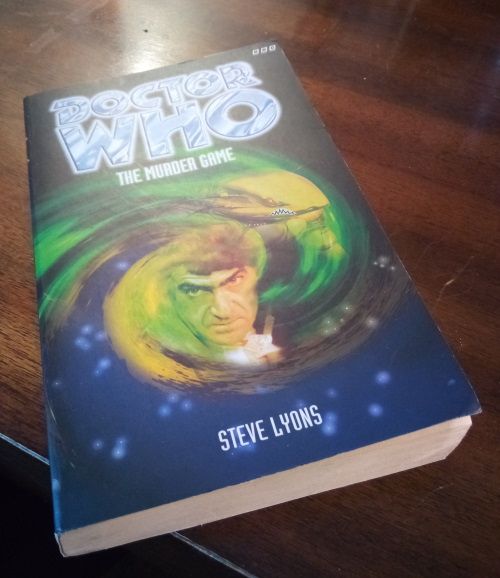
Steve Lyons' The Murder Game begins with the Doctor, Ben, and Polly being summoned to Hotel Galaxian by a distress call. Hotel Galaxian is an vacation hotel ship in orbit around the Earth. The once trendy spot has seen better days as off-Earth tourism has shifted to destinations much farther away leaving it to its fate as an outer space version of The Sands.

One Geoff Hornby is hosting a murder mystery game on the Galaxian but things get serious when one of the participants is found dead. I mean dead in real life. The story takes on an Agatha Christie tone as we struggle to figure out who dunnit. Things get even worse when creatures like this board the ship.

These shark-like creatures are Selachians. Perhaps not as mindlessly destructive as the Krill, they are still quite ruthless nonetheless. And they're strong and have good armor.

There's more of the Doctor here than in Invasion of the Cat People but he's basically all business with fewer moments of whimsy set to a recorder soundtrack. Ben and Polly have larger roles, especially the former. They both struggle with their feelings for one another and Ben for another character named Terri as well. In several instances, Ben's attempts to help prove futile such as when he tries to physically assault the Selachians. Their armor ensures his attacks did nothing. I felt rather terrible for Ben as he wanted to be heroic so badly but was unable to do a lot most of the time and he usually got banged up and bruised for his trouble.

The Murder Game didn't tinker with Doctor Who conventions much, if at all, and it seemed to be a story in line with the Second Doctor era as far as tone and characterization. Lyons did, however, make his story a little too big for the small screen with some underwater scenes. The story was well paced and really a lot of fun.osting.photobucket.com/images/v99/tim_archer/murdergame-cover.jpghttps://hosting.photobucket.com/images/v99/tim_archer/murdergame-cover.jpg

04 June, 2013

Goodbye Sixie: Spiral Scratch by Gary Russell


Being a big fan of the Sixth Doctor I approached Spiral Scratch with some anxiety. Yes, Sixie deserved to have a proper regeneration story but this was the end of the road for the Sixth Doctor PDAs. How would this farewell story hold up?

As with Instruments of Darkness Gary Russell devotes the opening chapters of the book to introducing a bevy of characters. First there are two alien children who find themselves in the medieval village of Wulpit. Then in Cold War Bucharest Prof. Joseph Tungard and his wife find themselves exiled to England after Joseph dares to go against the Romanian government. Over in England Sir Bertrand Lamprey loses his home and wife to a fire while in a different England two parents visit their daughter's grave.

For his part The Doctor gets it in his head to go visit his old friend Prof. Rummus who runs the Library of Carsus. But he and Mel both have surreal moments. Mel is in the console room when it plays host to various alternate Doctors and Mels including one incarnation of our hero clad in all black with a scar across one eye. This coterie of Time Lords act a bit like The Doctors in "The Five Doctors" as they try to put their heads together to puzzle things out but the new ones disappear before any answers are arrived at. The "real" Mel is left wondering who or what the Lamprey the other Doctors mentioned is. The "real" Doctor also had a strange encounter and is convinced that they must go to Carsus.

There they meet Rummus and experience more timey-wimey events including, disturbingly, the dead bodies of Rummus and The Doctor. With people's timelines running amok, Rummus and The Doctor postulate that the Vortex Spiral has been scratched and that something needs to be done pronto.

At this point I was completely enthralled with Spiral Scratch. Several characters have been introduced and time has gone all non-linear with alternate versions of the characters wandering into scenes, offering tantalizing clues, and then disappearing. Unfortunately, Russell can't keep the momentum going.

It turns out that Rummus stole an ancient Gallifreyan device called the Spiral Chamber and has used it to study the Lamprey, an inhabitant of the Vortex endowed with a voracious appetite for time. Rummus unknowingly allowed the Lamprey to cross from the Vortex into our reality and it is now running roughshod over everything and everyone, merrily eating timelines as it goes. This in itself is a fine story idea but the Lamprey – this eldritch creature from the Vortex which threatens the whole of reality – actually looks like a lamprey. Furthermore, while it's genuinely fun to read about The Doctor, Mel, and their various alternate incarnations running around in different time streams, the subsidiary characters just never quite gel for me. There's too much going on for the story to give them their due and they're just not that interesting.

It's not that they're horrible characters, but rather that Rummus and his relationship to The Doctor would have been more interesting to explore. He's not just some scientist meddling in areas which he shouldn't, he's a friend of The Doctor's who sets in motions events which could destroy everything. I'd much rather have had a more intimate story exploring the dynamic between these two as well as the Library on Carsus. It is billed as the largest repository of knowledge in the universe – what an interesting place! - and certainly could have been a wonderful jumping off point for investigation but instead is used sparingly.

I wish that Russell had narrowed the scope of the story a bit to include less characters and less worlds. There are some amusing moments but a bit here and a bit there in alternate timelines and other worlds just feels unsatisfying. It's like Russell dragged these places into the story more to broaden it and give it an epic feel than anything else. The alternate versions of The Doctor and Mel are a clever device here and I think it would have been more interesting to have them appearing leaving behind a tantalizing clue before disappearing throughout the story rather than being more fully-realized as they are here.

The setup in Spiral Scratch was great but the execution gets bogged down with too many people that aren't particularly interesting. To give Russell his due, the regeneration scene at the end was done well and leads directly into "Time and the Rani" with the Rani saying, “Leave the girl, it’s the man I want...”

Revenge of the Smythe: Instruments of Darkness by Gary Russell


Instruments of Darkness is the final book of a trilogy that began with The Scales of Injustice, which I haven't read, and continued with Business Unusual, the story which introduced Mel. I found the latter to be fun but it was a pretty standard DW story. Thusly I was rather surprised by this one which veered into territory that the New Series treads.

Russell opens his tale with a series of vignettes introducing us to various characters. We begin with a rather mysteriously with an albino and a blue light appearing at various points in the past with women being abducted each time. Finally in 1972 a "shadow man" steals away with a woman named Lori who, he proclaims, is his Ini-Ma. We also meet the aging Vice-Marshal Dickinson whose son disappeared while working for UNIT. Plus there's Captain Therese Gavalle whose mind is taken over by an alien.

The story moves into the present. Over in the village of Halcham the reclusive Sebastian Malvern provides shelter for the infamous Irish twins, Cellian and Ciara as well as a trio of teens who survived the nightmare of SenéNet in Business Unusual. Meanwhile in Park Gavalle responds to an anonymous invitation and finds herself in the employ of the Network, a secret organization that is a front for another secret organization bent on perpetrating evil and harnesses the power of psychics to do so. Trey Korte also returns here. He's been using his psychic abilities on behalf of UNIT and its doppelgänger C19. DI Bob Lines also makes an appearance here. He uses a beacon to signal The Doctor after Trey is abducted from a hospital.

Whew! That's a lot of characters and plot strands.

Luckily Russell is up to the task of bringing them all together. But what surprised me was that he brought Evelyn Smythe into the fold. She was a companion from the Doctor Who audio dramas from Big Finish. The Doctor and Mel meet up with her and it is revealed that The Doctor dropped Evelyn off on Earth to keep an eye out for the Irish Twins but that he did so without giving her any material support and left her there several earlier than he intended to. Unsurprisingly, Evelyn is angry. This leads to some wonderful prose delving into the relationship between The Doctor and his companions. Of her The Doctor says:

"But Evelyn... Evelyn was different. For the first time in some years, I met someone who was, well, an equal. Evelyn didn’t need rescuing too often – I can remember one or two ferocious creatures that needed rescuing from her. She used her brains, her wit and experience to get out of any real trouble and we faced things together. She’d had a lot of life experience you see – she was divorced, she had spent most of her life dealing with younger people, her students. Nothing fazed her.’ He laughed. ‘She even held her own against an entire Dalek army once. We read the same books, laughed at the same jokes. There was an unspoken respect and equality between us, I suppose."

Upon hearing this Mel begins to see The Doctor in a new light, one in which his bluster covers over "a very basic sadness". Perhaps The Doctor not only cared for Evelyn but cared about her as well.

The new series episode "School Reunion" comes to mind and I suppose that basic sadness is really a general theme of the New Series – last of the Time Lords and all that. Russell worked on the New Series although I'm not sure how much of this was his doing. What I like here is that this look into The Doctor's psyche comes courtesy of Sixie with all his outrage instead of the younger, hipper David Tennant. Moral indignation was such a defining characteristic of Colin Baker's Doctor that a look underneath the bluster and the chance that he had done wrong by Evelyn has more impact for me than what the New Series did. (Of course, I say this despite Sixie admitting to having misjudged Lytton in "Attack of the Cybermen".) That the Irish Twins are seeking redemption here adds another layer to the emotional core of the story and perhaps parallels The Doctor's movitivations.

All in all Instruments of Darkness was a fine PDA. The highlight is surely The Doctor and Evelyn's relationship laid bare but it's a fine adventure tale as well.

15 May, 2013

Doctor Who: Business Unusual by Gary Russell


I made the mistake of reading Business Unusual at the same time as I was listening to The Wrong Doctors by Big Finish which meant that I was consuming two stories at the same time both of which attempted to explain how Mel ended up traveling with The Doctor. It was confusing for a stretch as I kept thinking about Mel going to a play rehearsal while reading the book and wondering when The Doctor was going to head to SenéNet whilst listening to the audio drama.

Business Unusual begins with the rather gruesome death of Robert McLaughlin at the maw of a mutant dog of some kind which drools green saliva and has green eyes. McLaughlin was a member of C19, a Torchwood-like outfit, and his assignment was to investigate the technology company SenéNet. Next thing we know The Brigadier is doing the same thing. While spared the fate of being eaten by a mutant dog, he is taken prisoner.

Meanwhile The Doctor is helping out the Brighton constabulary by mopping up a mess that The Master had made in their computer system. While out and about he sees Mel from afar and does all he can to avoid her lest she become his traveling companion. If this is allowed to happen, he would move ever closer towards his own fate as The Valeyard. Time has a way of smoothing out changes made to it and of course our hero ends up meeting Mel. The Doctor runs into Trey Korte, an exchange student staying with Mel's family. Trey has some latent psychic powers which are discovered by the villains and this catches the attention of The Doctor. He is unable to avoid Mel at this point.

Together they take on SenéNet which is headed by a man named Townsend. He has stolen various bits of alien technology from C19 and appropriating them for his own ends. He had previously augmented his body with that technology but it is now showing its age and he seeks to upgrade his mortal coil. In Townsend's employ are the Irish twins Cellian and Ciara. I read afterwards that all three appeared in Russell's The Scales of Injustice, a Third Doctor novel but, not having read it, I cannot judge how well or interesting these characters develop.

The story here is reminiscent of The Green Death with the mysterious corporation and its equally mysterious CEO. But what makes Business Unusual different is how Russell gets into the heads of the supporting cast. Erskine is a former member of UNIT under Lethbridge-Stewart who was left for dead in one of the group's battles with invading aliens. As he seeks revenge against those who abandoned him and took his life away, The Brigadier contemplates the responsibilities of his job as well as the drastic consequences his decisions have at the human level. Cellian and Ciara had their minds manipulated by Townsend and are ruthless killers for most of the book but they eventually find what's left of their humanity.

In the books introduction Russell notes that he wanted to write a story that he "thought Colin Baker would have liked to be in". To this end I think he was mostly successful. While Mel and The Doctor bicker at first, they do settle in fairly quickly and develop a warm relationship. This is the kinder, gentler Doctor we saw in The Mysterious Planet and later in the Big Finish audios. His gaudy attire is remarked upon more than once plus it is revealed that he's a Pink Floyd fan:

Alan switched on the car stereo system, which included a CD player, and Mel automatically selected her father’s favourite Pink Floyd album.
‘Ah, Piper,’ murmured the Doctor. ‘Syd’s greatest hour.’

There is, however, a scene out of character for The Doctor. Part of Townsend's plan has a couple dozen or so kids turned into zombies attached to computers. In one scene as his scheme is being foiled by The Doctor, our hero seems to care little about their horrible fate. Indeed, other children also have horrendous things happen to them which Russell describes in heartbreaking detail.

A lot of Business Unusual is boilerplate Doctor Who but it is a very fun story. The Doctor-Brigadier combination was nice but it they are separated for most of the book so it was a bit of a letdown. What sets it apart is the way Russell treats the minor characters and gets into their heads and fleshes out their motivations and has them gradually change.

12 February, 2013

A Sixie Omnibus


When I met Kate Orman last fall at Chicago TARDIS, I was compelled to ask her if the references to Rush and Yes in this book were digs at progheads or if she enjoyed the music. I was pleased to discover that she too loves prog. Indeed, she was very friendly, as was her husband Jonathan Blum, and a joy to chat with and listen to at various panel discussions. Thankfully I can also report that Blue Box is a very fun read. The Past Doctor Adventures have been pretty kind to Sixie.

Blue Box plays with DW convention by having the story told by Chick Peters, a journalist. The book begins in late 1982 – about a year after the main events of the story take place – with Peters sneaking onto the grounds of Bainbridge Hospital in Virginia. There he spies Sarah Swan, a hacker who was recently at the top of her game but now is confined to giving a thousand yard stare from a wheelchair.

Peters then goes back and tells the story of how Swan ended up in her condition and that involves The Doctor, Peri, and some alien artifacts. Oh, and a lot of hacking. The Doctor has Peri contact a young hacker named Bob Salmon to recruit him to the cause which ends up being the theft of an alien device from Swan. There's a lot of cloak and dagger here and I'm told that Orman researched UNIX hacking on Usenet before writing the book so the scenes of Swan and The Doctor battling it out on keyboards is realistic instead of the usual stuff in fiction it takes the click of single button to bypass the most stringent security.

Having the story told from Peters' perspective instead of a generic third person works really well here. It gives Sixie something of the mysteriousness that his successor had in his novels. The Doctor is not always present but you know he's off somewhere scheming and he holds some stuff back. It's not that he's being manipulative in a bad way, but more that the narrator is not omniscient. It felt refreshing to have The Doctor give less explanations for everything or at least give them at much less regular intervals.


The return of Sabalom Glitz! And Frobisher too! The story opens with a bit of intergalactic larceny a la Mission Impossible as Jack Chance and his gang steal a Veltrochni artifact. We are then introduced to a couple of hit men, Sha'ol and Karthakh, whose next job is to kill The Doctor. Meanwhile our heroes are attending the premiere of Star Wars back in May 1977. After reading this far, I knew I was in for an entertaining romp.

Sha'ol and Karthakh somehow materialize inside the TARDIS but The Doctor is able to send them back from whence they came. They should never have been able to get in in the first place so The Doctor follows their time signature to the planet Vandor Prime. He and Frobisher meet up with Glitz and Dibber who are up to their old nefarious ways. They all run into trouble and, in order to extricate themselves from the long arm of the law, are recruited to reassemble Chance's team and steal the Veltrochni artifact, which is now in Vandorian possession, and return it to the Veltrochni who are on the war path.

McIntee spins a very fun tale here. There is political intrigue in the halls of Vandorian government, the Ogrons are running around causing trouble, an artifact is in need of being re-stolen, and all the while The Doctor is trying to figure out how those hit men got their hands on some extremely advanced technology – technology that only the Time Lords would have. As the Veltrochni and Vandorians find themselves poised on the brink of war, there are some asides in which Karthakh, a Veltrochni, ponders his relationship with Sha'ol, a Tzun. The two races do not exactly have a history of cordial relations. These bits of introspection aren't preachy and fit nicely into the story. They provided a little change of pace amongst all the other warring, conniving factions.


Apparently The Shadow in the Glass was a hastily written replacement for Instruments of Darkness which Gary Russell couldn't get done on schedule. While Mission Impractical threw in some seriousness, it was mostly good fun. This book, however, is pretty much all doom and gloom. It's not oppressive, mind you, but there is no shape-shifting penguin or Sabalom Glitz here for a bit of levity.

In the spring of 1944 the R.A.F. shoots down a mysterious object in the skies over Dorset and it lands in the village of Turelhampton. Less than a year later the Russians are taking Berlin and overrun Hitler's bunker. Curiously enough, they find a group of Tibetans dressed there in German uniforms who have committed suicide.

Back in the present – the books was published in 2001 – the army still keeps watch over Turelhampton. A reporter named Claire Aldwych, who works for the Conspiracy Channel, investigates the crash site and even gets some footage on video. They're discovered and flee. Claire gets away with the tape while her cameraman stays behind. The acting commander at Turelhampton calls in UNIT to find Claire and retrieve the tape which shows some mysterious imps.

Luckily for the reader, UNIT means the Brigadier who is retired here but brought on to help. He, in turn, calls The Doctor. It's a nice match. Lethbridge-Stewart keeps his friend on track when The Doctor gets all techobabbley. There's also a cult and it appears that Der Führer is alive and well. I liked how the book brought the occult into the picture along with the Nazis. Claire is a stand-in companion as we have The Doctor traveling alone here and she proves extremely capable.

I really enjoyed this adventure as it had a rather dark tone and it kept you guessing for a long time instead of giving the game away earlier and having a large chunk of the book being devoted to The Doctor simply racing against time to stop the bad guy. I appreciated the suspense. Plus the scene where The Doctor and the Brigadier meet Hitler was rather amusing.

I have only one gripe. In the process of trying to determine if Hitler could have really escaped Berlin ahead of the Russians, the Brigadier goes to Russia to investigate their archives. Claire plants a small camera in his briefcase since she is not allowed to accompany him. As I read it, I was completely flummoxed as to how the camera transmitted images from Russia to the UK. I kept asking myself, "How is she watching that in real time?"

Despite this, The Shadow in the Glass was another fine outing for Sixie.

04 January, 2012

Doctor Who: Relative Dementias by Mark Michalowski

While Relative Dementias was the eighth 7th Doctor PDA to be published, it is the first in order chronologically. Author Mark Michalowski places his story between Battlefield and Ghost Light both of which were part of the final season of the Classic Series.

Like most of that season and all of the 7th Doctor PDAs I've read so far, this story takes place on Earth. I liked how Relative Dementias opened with a burst of short scenes that fail to include The Doctor and Ace. The prologue introduces us to Graystairs, what I took to be an old folks home. It's a staccato series of bits of conversations that are derived from the elderly and the senile being left at Graystairs by their families. I was vaguely reminded of those "Camera Eye" sections of the U.S.A. Trilogy by John Dos Passos. This gives way to another short section in which we meet a female character who is on watch on a shoreline of some sort. We have no idea what she's keeping an eye out for or why she is in a new body that has a bum fingernail.

Next we meet Doctor Joyce Brunner. She is a member of UNIT and knows The Doctor. However, Dr. Brunner knows the Third Doctor (and Bessie too!). She has brought her mother to Graystairs, which is somewhere in rural Scotland, but has some "vague concerns" about the place. So she contacts The Doctor the only way she knows how: sends a postcard to the PO box in London that he gave her. And lastly before our intrepid time travelers enter the scene, we get a brief glimpse inside Graystairs with orderlies being ornery and fussing over the disappearance of one of their patients, Eddie.

I don't doubt that some people would find this rapid-fire introduction of places and characters, some named and some left anonymous, to be confusing. But it does lay out many of the story's building blocks from the get-go and, quite frankly, I don't mind being a bit confused. Indeed, I rather like that sense of bewilderment because it means that the game is afoot.

The Doctor and Ace finally enter the picture as they traipse around London in 2012. They make a stop at the residence of Countess Gallowglass who runs a little post office for aliens on Earth so that they can get their mail. The Doctor hasn't checked his in quite some time and is perturbed by something he received. He keeps his cards close to his chest and really pisses Ace off when he locks her out of the Console Room. She can hear him speaking with someone else but can't discern much more than that.

Just when we think that Michalowski is finished giving us the introductory material, he throws in a diver in some body of water somewhere who finds a dome underneath the surface. Yet another place and person to contend with.

With a highly irritated companion, The Doctor sets course for Muirbridge in 1982. He explains to Ace that an old friend of his, Dr. Joyce Brunner, has some reservations about a facility claiming to have found a cure for Alzheimer's disease and he's bound to investigate.

As you can imagine, not all is as it appears at Graystairs. A bald albino man sits alone on the top floor crying to opera while patients go missing and one even gets total recall. Ace and The Doctor investigate things separately which leaves the former on her own when she stumbles across a teleportation device in Graystairs' basement. She fends off the albino's henchwoman, Megan, with a frying pan before being teleported to an alien ship that features Graystairs patients neurally hooked up to a computer in what we later find out to be a parallel processing array. Ace gets to be a hero here, in addition to being something of a badass. She plies her heroics on the ship solo and eludes that albino, whom we find out is named Sooal and guess what planet he's from. His motives lie far away from curing Alzheimer's.

Ace ends up in the North Sea where she meets up with a certain diver and, if you don't want some major spoilers, skip this paragraph. She finds out that she's near the Orkney Islands, hundreds of miles away from Muirbridge. In a neat twist, Ace sends a postcard to The Doctor pleading for rescue. He gets it in 2012 along with Joyce's missive. There are eventually two Aces running around Muirbridge which, after you find this out and think back, explains some of the mysterious occurrences from earlier in the book. Michalowski handles this little temporal discommotion very well.

Spoilers over.

At one point in the story, The Doctor gets hooked up to the array on the space ship and has a couple visions. One involves Leela, which he realizes is a memory from his past, but the other is of a lone, baleful gray eye looking at him through a broken window that shimmered orange and brown and yellow. It whispers to The Doctor and asks if he'd forgotten him already. The Doctor ponders this vision at the end of the story and I am wondering if it will be addressed in another of these PDAs.

Being set in the time period of the show's last season, Relative Dementias does include some Cartmel Masterplany stuff. The mysterious vision is one element that can be ascribed to it. Another is Brunner's son, Michael. Michael is in UNIT, or rather was in UNIT. He's gone AWOL and is wrestling with telling his mother. His decision to desert his post came from much anger and confusion. Amongst the reasons is The Doctor who, although he has helped humanity, has also been responsible for the deaths of many people including Michael's friends and comrades in arms. It's a far cry from intimations about The Doctor's mysterious past but I think it fits in with an overall darker view of him and engenders some ambivalence about him as well. This is something that have fit well in the last season of the New Series.

 Michalowski generally keeps his characterizations of The Doctor and Ace within the boundaries set by the TV series. I've noticed that there's a general consensus amongst fans that, for the 7th Doctor, portraying him and Ace in a way that is consonant with how they were portrayed on TV is a good thing. (Conversely, fans of the 6th Doctor books praise authors who portray him in a less acerbic manner than he was on TV and more like the character that Colin Baker and Big Finish developed for their audios.) And I suppose it is. This certainly gives the books a certain familiarity. On the other hand, I am curious if any of the authors tweaked the characters a bit. I'm not looking for a 180 but for some development, some expansion. So far I haven't found that in the PDAs but it may happen yet. I'm not complaining, mind you. Perhaps the Virgin New Adventures take our beloved heroes in new directions. I shall find out.

With Ace being separated from The Doctor for quite a while and the fact that she takes charge, saves people, and kicks a little butt, it's easier to see how she is a precursor to the companions of the New Series. While there's no Nitro 9 here, Ace is a partner to The Doctor and not simply a damsel in distress and/or springboard for the Timelord to relay his deductions. Michalowski portrays her as capable, smart, and independent yet also as a teenager still figuring out what it means to be an adult. She blushes when meeting a cute young man yet is able to adjust to being thrust onto an alien space ship like a consummate pro.

Relative Dementias kept mostly to the blueprint established by the TV show but it tweaked the formula a little bit. There are more subsidiary characters here and it was fun to read as Michalowski established them independently and then drew them all together. Plus there's Michal who views The Doctor as someone who brings death in his wake as opposed to a savior to humanity. But it's mostly The Doctor and Ace battling an alien baddie. The time travel twist was icing on the cake.