Showing posts with label Freigeist Bierkultur. Show all posts

30 August, 2016

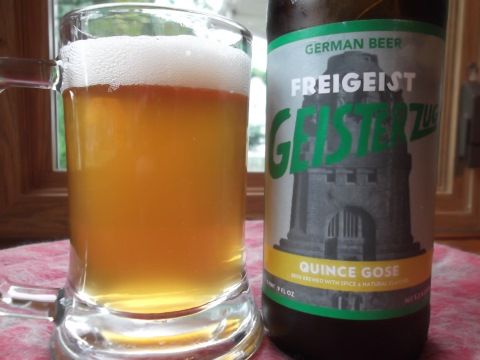
I Dined on Mince and Gose of Quince: Geisterzug Quince Gose by Freigeist Bierkultur


Another bier from Freigeist!

I have previously enjoyed Sebastian Sauer's spruced gose as well as one laced with rhubarb. He takes a – how shall I phrase it? - German approach to brewing gose. Rather than upping the sour to levels that would corrode metal or extreme doses of other flavors, Sauer retains the spirit of, in his words, "the classic, very balanced and nuanced beer" that is the traditional German gose. However, as you can see, he is happy to ignore any "purity" laws that would prevent him from using fruit or other flora.

This time around I have Sauer's Geisterzug Quince Gose. From what I've read, the quince is native to central Asia but gained popularity in the West during the Middle Ages. I gained a taste for it when I came across a Renaissance era recipe for quince marmalade and made it in my kitchen. Apparently it was fairly common here in America back in the day but now it seems to be more of a specialty/"ethnic" item. I don't believe that I have ever seen a quince for sale in Madison. Indeed, the fruit is so rare in these parts that even quince & apple, a local purveyor of preserves, offers none of the former. But quince's profile may very well have changed over the past several years as more ethnic grocery stores have opened.

Geisterzug Quince Gose is a lovely light gold color and hazy. My pour yielded a nice, frothy head. The white crown decided to stick around for a little while which made for a pretty sight as did a fair helping of bubbles inside.

The philosophy of brewing balance was apparent with the aroma. Lemony lactic sour came first. It was, however, not deathly pungent and found itself on equal footing with that wonderful floral apple-pear fragrance of the quince. My nose also discovered a slight sweetness here too.

Gentle carbonation joined a measured citrus flavored tartness making for a firm, but not overpowering, acidic tang. Again, balance is the key with the quince complementing the sour in strength while its floral fruity sweetness made for a nice contrast to the sharper citrus tartness. I also tasted a mellow spiciness which may have been coriander.

My sips finished with the quince fading and the tang filling the void. The salinity became apparent here as well. Lastly, my mouth was left with a mild fizzy acidic feel. Schaumhaftvermoegen came as a clutch of thin foamy streaks as well a smattering of spots.

Another fine brew from Freigeist. I suppose that going in with a taste for quince went a long way in predisposing me to enjoy this bier. Beyond that, however, I appreciate Sebastian Sauer's application of balance which allows sour to co-exist with sweet in harmony allowing each its place in the sun. As the bier warms the quince comes ever forward yet you never forget that you're drinking a sour bier. The balance, the light body, and the relatively moderate 5.2% A.B.V. all add up to an excellent brew.

Junk food pairing: Pair Geisterzug Quince Gose with lighter fare such as plain potato chips or, because we're talking German bier making pork almost mandatory, plain pork rinds.

24 August, 2016

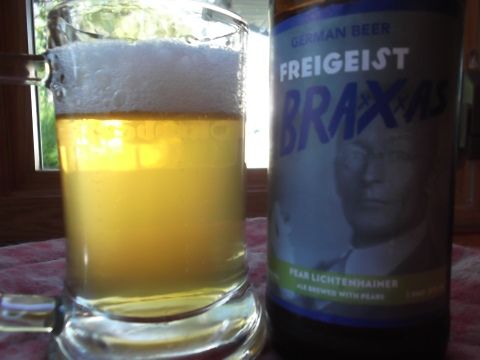
This Bier Belongs to the Realm of Light and Righteousness: Pear Abraxxxas by Freigeist Bierkultur


American microbrewers have yet to embrace the Lichtenhainer the way it has its cousins, the Gose and Berliner Weisse and I don't see this changing in the near future. Sour is acceptable – indeed, it is trendy. Smoke, however, is not.

As I noted when I reviewed the non-fruited version of this bier, its name comes from the central German town of Lichtenhain and was popular back in the day. The Lichtenhainer is a light, sour bier just like the Gose and Berliner Weisse but also smoky like the Grodziskie/Grätzer. The best of both worlds!

Freigeist Bierkultur seems the obvious choice to resurrect this near-extinct German bier style. Proprietor Sebastian Sauer obviously has a keen interest in his country's brewing history as he does his best to nurse historical styles that are on life support back to health. And he often does so thumbing his nose at any brewing regulations that seek to restrict the ingredients he can put in his biers.

I'm not sure exactly what regulations he flaunts because the more I read about German brewing laws, the more confused I get. It seems that the infamous Reinheitsgebot underwent some changes when Germany was reunited in 1990 and also that brewing laws vary by state. Unsurprisingly, I get the distinct impression that Bavaria's laws are the most restrictive. Witness Camba Bavaria beset by the Bavarian government who didn't take kindly to the use of lactose in their milk stout.

My bottle says that the bier therein was brewed at Eittinger Fischerbrau in Eitting, Germany. I looked up Eitting and discovered that it is located in Bavaria. I guess Sauer was trying to hide in plain sight. He must have had to barricade himself inside the brewery against the Brauereigendarmerie when he unleashed his Mango Gose Eisbock.

What we have here is Abraxxxas with pear. Coming in at 6% A.B.V. Abraxxxas is the big brother to Abraxas which is a shade lighter at 3.8%. Swiss-German author Hermann Heese adorns the label as he apparently referenced the gnostic deity Abraxas in at least one of his novels. (I don't recall any mention of god in Demian.)

The bier pours a light straw color and has a slight haze. Historically some brewers used wheat in their Lichtenhainers while others did not. Freigeist apparently has. The big, white, frothy head did not last long but there was plenty of effervescence as the plentiful bubbles in the bier attested.

That luscious temptress that is smoke made her presence known in the aroma. Not a deluge, but more than a simple tchotchke. The sour seemed to be lactic as there was a bit of citrus sour here too. The pear was on the faint side and was joined by vinous/tea-like smell.

All of those bubbles added up to a healthy carbonation. Lady Smoke was big and bold on my first sip but she mellowed as I continued to taste her. She has that rich, savory smoke taste which leads me to believe that we have beech wood smoked malt in Abraxxxas. The sour which was fairly prominent to my nose was on the mild side to my tongue, although it had a nice citrus taste. At first the pear was faint but there if you looked for it and it gave a nice bit of sweetness. However, as the bier warmed, the fruitiness gave up wallflower status came out to dance. Mind you, we're not talking Ballast Point levels of fruit but I didn't have to look for it.

At the finish the smoke faded but the tartness remained to greet a goodly dose of spicy hops which added some bitterness and made things rather dry. I also detected some salinity which I didn't expect as there was none in the non-fruited Abraxxxas. Schaumhaftvermoegen was notable by its absence.

The pear and the smoke reminded me of that tasty dish Bohnen, Birnen und Speck, auf Hamburger Art (Beans, Pears and Bacon, Hamburg Style) while the pear and spicy hops hinted at a saison. It is best to let pear Abraxxxas warm before quaffing as it brings out the pear flavor and sweetness and gives you this wonderful gestalt of smoke, sour, and sweet. The moderately sharp and acidic feel really helped give this bier a slightly dry, wine-like taste which was thoroughly unexpected and quite tasty.

Junk food pairing: Go with a bag of Steakhouse Funyuns with your pear Abraxxxas. The steakhouse part will add some complementary smoke flavor while the mild onion-esque taste enters into a synergistic relationship with the pear that results in gustatory delight.

19 April, 2016

Mama's little baby loves rhubarb, rhubarb: Geisterzug Rhubarb Gose by Freigeist Bierkultur


This year marks the 500th anniversary of the German Reinheitsgebot - the beer purity laws. There have been many articles written on the subject (mostly auf Deutsch, admittedly) including one published today at The Guardian called "Medieval beer purity law has Germany's craft brewers over a barrel" which caught my attention.

Now, I am certainly no expert on German bier and brewing laws, Reinheitsgebot and otherwise. And I have to admit that, the more I read about this topic, the more confused I become. The laws are like a mystery wrapped in riddle inside an enigma. If German brewers can't use anything but barley then how come there are weissbiers brewed with wheat? Roggerbiers brewed with rye? And how do brewers get away with adding salt and coriander to goses? Read the article above and try to guess what German law says can and cannot be labeled "bier". How does Germany's membership in the EU affect their bier/brewing laws? Why can't a German brewery brew a milk stout and call it "bier"? Do brewers in Bavaria operate under different laws than say their counterparts in Berlin?

One thing I found rather annoying about The Guardian article is that it gives the impression that German brewers have been adhering to Reinheitsgebot for the past 500 years when, in fact, many German brewers gladly ignored Reinheitsgebot or weren't affected by it because it was not the law of their land. They both adhered to tradition and innovated by using adjunct grains along with herbs, spices, fruits, et al for quite some time. Don't forget that there was no country called Germany until 1871 and the Bavarian Reinheitsgebot at issue here (there was more than one) didn't, if memory serves, have the force of law for the entire country until the early 20th century. And so there were all sorts of bier styles in Germanic lands for hundreds of years before the force of law turned the Bavarian way of doing things the German way of doing things. Check out the extinct and near-extinct German bier styles unearthed by Ron Pattinson and Andreas Krennmair.

And this leads me to today's bier, a Rhubarb gose from Freigeist Bierkultur, a German brewery that gleefully gives the Stinkefinger to the Reinheitsgebot. I've reviewed a handful of their biers previously and cannot recommend them enough. Geisterzug means "ghost train" and is the name given to their line of gose biers. Adorning the label is a photo of the Völkerschlachtdenkmal or Monument to the Battle of the Nations which commemorates Napoleon’s defeat in 1813 at the Battle of Leipzig. And Leipzig is the city most closely associated with the gose even though the style originated in Goslar. While this bier was brewed with rhubarb, the vegetable was added to Freigeist's base bier which is a spruce gose.

The bier pours a lovely gold and was quite turbid. My pour produced a small white head that was very loose and went away rather quickly. This stands in stark contrast to the non-rhubarb Geisterzug which had a big, firm, and lasting head. However, there was a goodly number of bubbles inside this bier.

Tartness reigned over the aroma. I could smell both the mellower rhubarb as well as the more sprightly citrusy sour from the lactic acid bacteria.

I noticed the carbonation on first taste before a wonderful, bitter rhubarb flavor kicked in. It was joined by some of that citrus lactic sour that veered towards lemon. This was not a sour overload and instead the sourness was on par with the other flavors. The spruce was prominent here and it often times threatened to overshadow the rhubarb and the lactic sour but, fortunately, it never carried through on it. Overall it had a really pleasant acidulousness to it – just a little lactic bite – and I suppose a touch from the carbonation as well. Unlike its un-vegetabled cousin, I didn't get much in the way of grain here. A hint of cracker but that was about it. Perhaps this was due to the age of either bier but I cannot say for certain. Salinity was moderate – I could just barely discern the salt.

On the finish that spruce flavor lingered well after any tartness had faded and the salinity stayed behind too. No Schaumhaftvermoegen was to be had.

This was a delightfully light, bitter, and tart concoction. A perfect drink for the warm weather we're having. At 5.2% A.B.V. it's not the lightest of brews around, but its bitterness, tartness, and resiny pine flavors all work well in warm weather. The Dulcinea didn't care for it very much, however. I think it was the spruce that turned her off and that she was expecting the rhubarb to be more prominent. I can respect that. Personally I enjoyed the piney flavor but wouldn't mind having it dialed back to allow the vegetable to take center stage. I mean, how often do you find rhubarb in beer? New Glarus' Strawberry Rhubarb is the only other one that comes to mind. (Hopefully Madison will have a rhubarb saison soon, though.)

Junk food pairing: What to pair with spruce? If it were simply rhubarb I'd suggest some kind of strawberry something but the spruce makes it more difficult. If there were such thing as reindeer flavored potato chips, I'd go with that. Since that's not available, try some Cape Cod Feta & Rosemary chips or Kettle Sea Salt, Rosemary, and Garlic chips. The rosemary will complement the spruce well while the fattiness will be pleasantly cut by the slight acidity of the bier.

14 December, 2015

Everybody Got to Deviate From the Norm: Pimock by Freigeist Bierkultur


Sadly, this marks the final Freigeist brew for me to review. For the moment, anyway. This last bier is one of the more experimental brews from Freigeist. It isn't a traditional bier dragged from obscurity into the 21st century nor is it a familiar bier tweaked a little bit. Pimock ("outsider") is labeled as a Rhineland Weizen. What is a Rhineland Weizen?

Freigeist may have invented a new style here. It takes the familiar Bavarian hefeweizen and turns it on its head by infusing it with the spirit of Cologne. (Cologne being the brewery's home town and in the Rhineland.) Instead of the normal yeast which imparts the characteristic banana and clove flavors, Freigeist uses Kölsch yeast to impart a whole new taste. The bier also has more hops than a normal weizen.


Pimock pours a lovely amber color – a bit darker than the typical hefeweizen. Like its Bavarian cousin, this bier is cloudy with all that yeast still floating about. My glass had a nice tan head of about ½ inch which stuck around and made for a pretty sight. There wasn't much in the way of bubbles going up, though.

It is said that the most important sex organ is the brain. Likewise the most important olfactory and gustatory organ must also be our gray matter. One's experience with a beer depends on many factors. Are you drinking in a social setting? Or are you alone? What mood are you in? What do you have a taste for at that moment? For example, Miller High Life is not my cup of tea yet it can taste really good when offered to me after I've been working outside on a hot day.

I mention this because I had one of those psych-out moments with Pimock. I put my glass to my nose and inhaled a nice malty smell that was like bread as well as corn. The aroma had a fruity sweetness to it which at first was like apricot to my nose. Then I began to think about how this is a Rhineland weizen so there won't be any of those banana/clove phenols. And just at that moment I started to smell banana. My brain just couldn't help itself. I don't care if you've achieved Elder God Cicerone status – your brain will play tricks on you. That Platonic idea of bier will always be just out of reach and we're stuck arguing about shadows on the tavern wall.

At this point my ability to smell had been compromised so I moved onto the taste. As you can imagine, there was a prominent wheat/bread taste to Pimock. Then came a fruity sweetness just as in the aroma. Thankfully my senses weren't seeing, smelling, and tasting bananas everywhere by this point. The fruity flavor here was like peach and nectarine to my tongue. There were definitely more hops here than in the typical weizen but you won't mistake Pimock for an IPx. I could taste a pleasing amount of peppery/grassy hops but there was little accompanying bitterness.

On the finish the grain flavors subsided allowing more of that hop flavor to come through. It took on a rather spicy edge here which added a good dose of dryness. On my glass was some nice Schaumhaftvermoegen with a slew of narrow streaks around it.

While the use of Kölsch yeast here is novel, it was really the hoppiness that caught my attention the most. I really enjoyed how the peppery hops contrasted with the stone fruit sweetness here. These two flavors simply went together well. Pimock has a light body and is 5.3% A.B.V. which seems in line with Bavarian weissbiers. It drinks a lot like its Bavarian counterpart except that I found Pimock to be less carbonated so it's missing that bubbly mouthfeel typical of weissbiers of the south.

Junk food pairing: Pimock will benefit from pairing with Mexican. Try some lime-chili puffed corn chips or jalapeno-tinged Cheetos.

Ridin' On a Ghost Train: Geisterzug by Freigeist Bierkultur


I have another bier from Freigiest Bierkultur here - Geisterzug, a spruced traditional gose. "Geisterzug" means "ghost train" and I'm not altogether sure what the name means. My guess is that since "geist" means "ghost" in addition to "spirit", it's a reference to the brewery. And the train part refers to Bayerischer Bahnhof, one of the last remaining gose breweries in Leipzig which is located in a former train station. This just can't be right so, if anyone out there knows the truth of the matter, please do divulge.

The building on the label is the Völkerschlachtdenkmal or Monument to the Battle of the Nations which commemorates Napoleon’s deafeat in 1813 at the Battle of Leipzig. Presumably this is the building that the city is famous for and the one everyone knows. A bit like the Capitol here in Madison, I would imagine.

And seeing that building the (German) drinker will presumably realize that the style is associated with Leipzig which indeed the gose is. Freigeist claims that Geisterzug is "Based on a recipe dating back at least six hundred years" and I have no reason to doubt this. Bayerischer Bahnhof brewed some spruce gose some of which made it to Madison this year. I had a glass at Hop Cat although someone at Freiburg Gastropub said that they too would be getting a barrel. That version was very tasty. The bier itself was heavier than an unadulterated gose with a deeper yellow color that was almost gold. Its bigger body played host to a big spruce kick. Unexpected but delicious.


I could tell that Freigeist's take was not going to be as bold. It poured a yellow hue that was turbid. This dull yellow bier may not win any beauty contests but was redeemed aesthetically with a big, firm, white head that was in no hurry to go away. I spied a few bubbles going up the glass but that was it.

The aroma was Himmely with a spalsh of lactic lemon scent that melded perfectly with the resiny spruce. Underneath these more piquant smells was a bit of cracker graininess. This was an appropriate prelude to the taste. My tongue caught the citrus/lemon tartness first. It was not a big blast of sour but instead provided a nicely tempered zestiness. Considering the bier's color and light body, I was surprised at the relatively prominent bready flavor here that was tinged with just a hint of sweetness. The spruce was, like the tartness, moderate, but it certainly helped to maintain a balance amongst the various tastes.

Malt flavors come to the fore towards the finish but quickly fade and yield to a new trinity of sour, spruce, and a newcomer – herbal hoppiness. There isn't much bitterness, mind you. These elements are well-balanced although that resiny spruce taste lingers long after the other flavors have gone. My glass had some nice Schaumhaftvermoegen with some thick webbing to be had.

Fantastisch! Geisterzug was very easy drinking yet the grains weren't hidden in the background. I think this was due in large part to the salt. There was enough of a malt backbone to play the foil to the tartness and spruce which were not overwhelming and complemented one another very well. Coriander was minimal, however, and seemed to get lost in the spruce. The trinity of grain, spruce, and sour were in perfect balance here. These flavors were given enough room to breathe yet never dominated one another. This moderation and harmony of flavors meant that I had no problem quaffing the half litre bottle by myself.

Junk food pairing: Try some Cheez-It Duoz Smoked Cheddar & Monterey Jack crackers with Geisterzug. Alternatively, the bier will pair well with sausages so hot dog flavored potato chips are a good match as well.

11 December, 2015

The Still Waters of Colgone Run Deep: Ottekolong by Freigeist Bierkultur


Sadly, my basement will soon be bereft of biers from the free-spirited brewers of Freigeist Bierkultur in whose mission is to liberate the German palate from the chains of industrial brewing conglomerates. They do this by mining Germany's rich brewing history and devising brews that at times respect lost traditions and embrace the microbrewing revolution at others. Sometimes their biers do both at once.

Today we have Ottekolong ("Eau de Cologne"), an unfiltered Kölsch. Since Freigeist is located in Köln (Cologne), it was their destiny to brew one, the city's official bier style. I wonder how this bier is marketed in its hometown, if indeed it is. "Kölsch" is an appellation reserved for biers from a select group of breweries in and around Köln. Since Ottekolong does not conform to the specifications of the style and is not brewed by a signatory to The Kölsch Convention , they must label it in such a way to escape the scrutiny of the bier polizei. Wie sagt man "Kölsch-style" auf Deutsch?


Ottekolong pours a lovely gold hue. In a violation of The Kölsch Convention it is unfiltered and therefore a bit hazy. My stange had a small ivory head that dissipated quickly while there was a fair amount of bubbly action inside the glass.

As one would expect, the aroma had abundant cracker and toasted grains smells along with the style's characteristic fruitiness from its unique yeast strain. But there was a Noble hop presence as well that was grassy and slightly peppery too. Although Ottekolong has a light body, the clean, grainy taste was a bit richer here than in the Reissdorf, Früh, and Gaffel that I've had. This was balanced by some carbonation and those hops which were also grassy and peppery to my taste. The fruitiness was quite subdued here with the hops looming over it, especially the peppery notes.

Those hops became a little spicier on the finish which, along with the carbonation, made for a nice, moderately dry ending. Most of the Schaumhaftvermoegen slid into the bier leaving behind just a few dots of foam.

Ottekolong was basically everything you could want in a Kölsch. It was very refreshing with its light body (4.8% A.B.V.) and some nice bubbliness. Still, it was not short on flavor. The malt was substantial enough for a good, solid cracker flavor yet it didn't weigh on my tongue. I'd have loved it if there was a bit more fruitiness but, as it was, I thoroughly enjoyed the peppery hop flavor. It wasn't overpowering but rather it turned Ottekolong into a more spicy/savory take on the Kölsch than I am used to. The real shame is that I drank this bier in December instead of June.

Junk food pairing: Ottekolong is light yet hearty enough to take on a variety of junk foods. For example, it will pair well with the sweet heat of Pringles Xtra Fiery Sweet BBQ or the savory goodness of their Cheeseburger chips.

25 November, 2015

The Third Time Is the...: Raspberry Sour Porter by Freigeist Bierkultur


Earlier this month I thoroughly enjoyed Freigeist Bierkultur's Salzspeicher Cherry Sour Porter and Lichtenhainer. In addition to Kirschen, they also brew the porter bier with Himbeeren, a.k.a. – raspberries. I guess this is a Himbeerbier. (Doesn't that just roll off the tongue?) Will the third beer be the charm?

As I noted with the Kirschenbier, the base is a porter that, according to the brewery, draws upon two historical porter styles. First is a sour German version and the second is a brackish British take on the style. Neither of these ur-styles is familiar to me but this is hardly surprisingly. From there Freigeist adds fruit juice and/or "real fruits during fermentation".

Salzspeicher Raspberry Sour Porter pours black and opaque. When you hold your glass up to the light at just the right angle you can see that it's a deep mahogany and appears clear. While I was unable to see what, if anything, bubbles were doing inside the glass, the beer was crowned with a nice ¼" tan head. This is a very pretty bier. My wife shared my aesthetic judgement and said as much after seeing my glass from an adjoining room. Either I unknowingly married Jaime Sommers or her spectacles are just that good.

The aroma was similar to its cherry counterpart in that the fruit was most prominent. I'd be lying if I wrote that it smelled just like fresh raspberries, but it did smell pleasantly fruity. On the porter side of things, I caught bitter chocolate in the aroma as well. This beer smells like pure Deutsch dessert decadence.

Unsurprisingly, the taste is similar with the raspberry up front while the malt contributes subdued dark chocolate and even more subtle coffee flavors. I found the raspberry to be rather sweet. Not cloyingly, but it tasted as if the fruit contributed only a hint of tartness with the sour porter doing most of the work in that department. I'm not sure what bacteria sour the beer. It doesn't take particularly funky as whatever strain of brettanomyces it is that gives you that wet blanket flavor nor is it citrusy like lactobacillus. Think New Glarus' Belgian Red. Or Raspberry Tart, for that matter. The porter is imbued with that kind of tartness.

I'd be lying if I wrote that the beer tasted of fresh raspberries. Instead I was reminded of the Frango Raspberry Chocolate candies you find at Marshall Fields. Or a raspberry liqueur. It just lacked that sprightliness, that zestiness that tastes fresh and real. The beer tasted raspberry-flavored as opposed to raspberry-infused.

Some salinity came through at the finish which accentuated the lingering raspberry and bitter chocolate flavors. There was also a tannin-like bitterness that added some dryness. Schaumhaftvermoegen consisted only of a few thin streaks.

For a brew that is dessert in a bottle on paper, it has a medium body that makes for a very drinkable beer. A 6% A.B.V. works well for a digestiv or to be drunk on its own outside of a meal. Sadly, after the fantastic cherry sour porter, this one was a real let-down. The porter part remained great but the raspberry just didn't take like real juice in the way that the cherry did.

Junk food pairing: As with the Cherry Sour Porter, I will recommend either some pork rinds or dark chocolate covered peanuts depending on your mood.

This Beer's Name is Abraxxxas and It Is Smoky and Sour: Abraxxxas by Freigeist Bierkultur


Oooh! Another bier from the free spirits at Braustelle in Cologne. The last (and first) bier of theirs I reviewed was a cherry sour porter and now I have a Lichtenhainer.

What is a Lichtenhainer? The name derives from the town of Lichtenhain in central Germany. Lichtenhain is a suburb of the city of Jena which is about the size of Green Bay. According to Ron Pattinson, students at the university in Jena did a lot of drinking in Lichtenhain. (For my fellow Wisconsinites, imagine if UW-Green Bay students headed over to De Pere to consume mass quantities.) The style was popular in Thuringia, the region of central Germany wherein lies Lichtenhain, and brewed in various cities in the area.

If you read Ron's post, you'll find that the style is described differently at different times by different people. For example, some say it should be brewed with 100% barley while others include wheat in their descriptions. Regardless, Lichtenhainer is a light, sour, and smoky bier with a de-emphasis on hops. Presumably it belongs to the same family as the Berliner Weisse, gose, and Grodziskie/Grätzer. Also like its cousins, I assume that Lichtenhainer fell out of fashion starting in the second half of the 19th century as lagers became popular and the Reinheitsgebot began to be applied outside of Bavaria.

Abraxxxas can perhaps be described as an imperial Lichtenhainer as it is the bigger (6% A.B.V.) version of Abraxas (3.8% A.B.V.) I have never had the latter so I'm unsure if the beer at hand is more sour, more smoky, etc. than its little brother.

If memory serves, the last few beers I've reviewed have had a golden hue and Abraxxxas is no different. The beer was hazy as well which led me to believe that there's wheat in it. My pour produced a nice off-white cap – about an inch of frothiness atop the turbid golden elixir. There was a modicum of bubbles going up inside the glass.

The aroma surprised me by being very fruity. First peach and then cherry were bound together by gentle wisps of smoke. The smell was an olfactory joy like no other I'd experienced before. The taste had a measured smokiness to it and not a more intense one like a Schlenkerla rauchbier. Just as the smoke flavor was restrained so too was the sourness. It was a lemony lactic tartness but far removed from the near-lethal sours from Destihl that I've had lately. While they may both be sibilant words, smoke and sour aren't flavors that I generally think of as going great together. Chocolate and peanut butter they ain't, right?. Yet the contrast between a modicum of smoke and a little citrus sour is quite tasty. A bit of carbonation added a hint of dryness and there was a distinct grain/cracker flavor which became a bit sweeter and breadier as the beer warmed. This provided a more 'neutral" taste to the proceedings and some contrast to the smoke'n'sour.

For the finish the gentle, luscious smokiness lingered while the carbonation added a bit of bite. This dryness commingled with a hint of bready sweetness for a rather complex ending. The Schaumhaftvermoegen was pleasing as there were some large patches of foam lining my glass.

Truth be told, I adored this bier from my first sip. To start, I love smoke beers. From the smokier Schlenkerlas to this brew with its much milder smokiness, it is simply a flavor I love. Seemingly against all odds, the smoke and sour just blend perfectly. Abraxxxas' body is medium-light with the carbonation giveing the beer a nice bubbly mouthfeel. The A.B.V. aside, "imperial" is perhaps not an appropriate descriptor as there isn't anything heavy, über-intense, or otherwise dictatorial about Abraxxxas' flavor. Instead it is quite easy-drinking with a 500ml bottle being nowhere near enough.

Junk food pairing: Pair your Abraxxxas with a handful of Sriracha almonds. They add a little more complementary smoke as well as a bit of chili which melds well with the beer's smoke'n'sour fantasia.

18 November, 2015

Catching the Microbrew Zeitgeist: Salzspeicher Cherry Sour Porter from Freigeist Bierkultur


German brewers are not especially well-known for brewing porters. It is perhaps more correct to say that they are well-known for avoiding them like the plague. But The American microbrewing revolution is being felt across The Pond. And rather than genuflect before the pilsner clerisy, the insurgents at Freigeist Bierkultur are fomenting a little rebellion in their fermenters.

Freigeist means "free spirit" (or "free-spirited" or something akin to that) and Freigeist Bierkultur "is the experimental offshoot of Cologne's revolutionary small brewery, Braustelle. Here we strive to break the chains of industrial brewing by reviving and updating, Germany's unique, historical beer styles." Looking over the brewery's portfolio, it seems that they're doing a good job of it. For instance, I see a Doppelsticke Alt and, being in Cologne, this is must surely go beyond peccadillo into heretical territory.

Beyond being a brewing fifth column sent from Düsseldorf (however, they also brew Kölsches), Freigeist brews beers unlike any other German brewery. At least any other German brewery whose bottles reach the shores of Lake Mendota. Their brews occasionally pop up at Riley's which is where I picked up a bottle of Salzspeicher Cherry Sour Porter.

"Salzspeicher" means salt warehouses, specifically, the ones on the bottle's label which are located in Lübeck. They achieved notoriety for being used in the classic silent film Nosferatu and are featured because this porter was brewed with salt. Freigeist maintains that the beer is based on an East German sour dark beer crossed with an old English porter style which had salt in the recipe. I've not encountered mention of these types of porters previously. This isn't surprising as the style has a convoluted history that's beyond my ken. (And outside that of most drinkers, I suspect. Recall the hubbub surrounding New Glarus' Old English Porter.) Despite this, I was quite intrigued by a salty-sour porter brewed with cherries.

My Salzspeicher Cherry Sour Porter had a rather small tan head when I poured it. Holding my glass to the light, the beer had a deep mahogany hue and was opaque when looked at straight on. From what I could tell the beer was clear but I couldn't discern effervescence owing to the aforementioned opacity. Tart cherries dominated the aroma at first. It gave way to a hint of salinity in addition to the expected roasted malt scents that were akin to well-done and burnt toast.

As with the nose, cherry was prominent in the taste but there was no sweetness to be had. Instead the fruit lent a wonderful tartness to the beer. Underneath the fruit I could taste more sourness but I could not identify it. The overall sour profile reminded me of New Glarus' Belgian Red. Perhaps a bit of some strain of brettanomyces but it was mild. The cherry tartness was more prominent but there was a hint of funk behind it. Musty but not a whole barnyard's worth.

I cannot speak to the historical porters upon which this beer was based but it had the typical malt flavors one expects from a modern porter. That is to say that black malt flavors prevailed with coffee and dark chocolate undergirded by a tinge of that ashy, burnt bitterness. I could also taste the carbonation but only just.

The beer had a medium body and was rather smooth. It finished with the cherry tartness and chocolate flavors from the malt lingering. As the chocolate faded, cherry was joined by a touch of grassy hops. My glass was left with very little Schaumhaftvermoegen – just some small patches here and there.

Salzspeicher Cherry Sour Porter mixes an abundance of chocolate malt flavor with cherry to make a velvety smooth beer. This may read very dessert-like but the tartness of the cherries and the additional yeast/bacteria add just the right amount of funky sourness to dispel that notion. This isn't a lip puckeringly sour beer. Everything is kept on an even keel with just enough tartness to put it on equal footing with the malt flavors which are highlighted by the salt. Not being an extreme beer, it was quite easy to drink the entire half liter bottle myself. And I could do so as the beer is 6% A.B.V.

When I finished the bottle I found myself wondering if this beer is actually distributed in Germany. From what I've read it seems that the bottled "craft" beers of Germany are export-only or, at least, not widely available in Deutschland. I sincerely hope Freigeist Bierkultur's biers are available in its homeland because, if Salzspeicher Cherry Sour Porter is any indication, this new wave of German brewing is not to be missed. Freigeist also gets my respect for not simply aping American IPA culture and tacking its own uniquely German craft beer course.

Junk food pairing: If you're in the mood for something savory, then pair Salzspeicher Cherry Sour Porter with pork rinds. The fatty goodness with complete a flavorful trifecta. For dessert, pair it with dark chocolate covered peanuts. You can get these is large quantities rather cheaply at Farm & Fleet.