Showing posts with label Hefeweizen. Show all posts

25 June, 2026

The Highlanders sowed their seeds where exactly?: Zasiali Górale by Browar Błonie


My introduction to Polish craft brewery Browar Błonie's folklore brews was highly successful. And so when I was at a Polish grocery store in Chicago back in May and saw more of the series I snagged a few of them. At the check out, the Polish lady at the register said in her accented English that these were some very good piwos. That pretty lady has good taste.

This wheat beer's name, Zasiali Górale, apparently translates to "Sowed by Highlanders". Now, when I think of the Polish Highlands, I think of the Carpathian Mountains and gentlemen with big, bushy mustaches, not amber fields of wheat. Perhaps it's a pun or an allusion that is lost on Google Translate and me alike.

The English label only said "Wheat Ale" and I wasn't sure if it was just an ale made from wheat or if it was a Polish take on the hefeweizen with all the funkadelic flavors from the yeast. Going to the brewery's website and finding the description "A light unfiltered top-fermented beer with hints of bananas and cloves" answered that question.
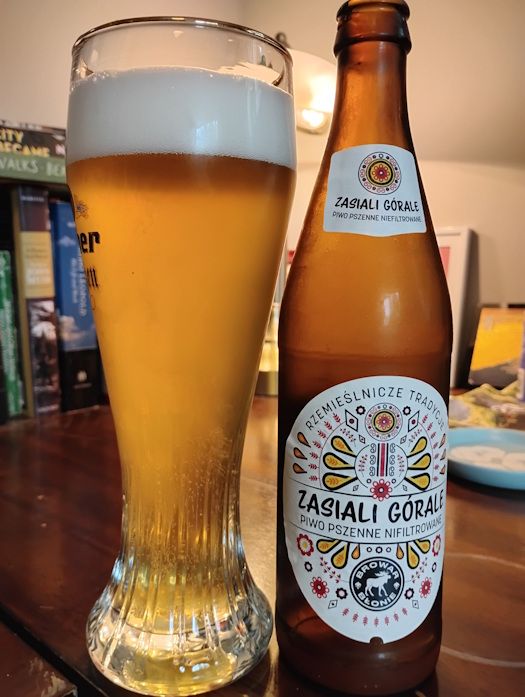

As luck would have it, I had a Weißbier glass to show off this piwo. And as with another recent brew review, the photo here tricksies you. Insted of a gold color, Zasiali Górale is actually of a light yellow hue and hazy. The Weißbier glass proved a nice bit of luck because this beer had lots and lots and lots of bubbles in it and the tall glass meant I could watch them stream upwards like schools of salmon swimming upstream to their spawning destiny. The head was a big dollop of loose, white foam. This was a gorgeous beer.

The aroma smelled of wheat along with a generous dose of bubble gum and a fainter bit of banana. No clove to my nose. There was also a bit of spicy hops to be had as well. All familiar hefeweizen territory.

My first sip revealed a light-medium body with a nice fizziness to it, although I had expected more considering all those bubbles. Like the nose, I tasted wheat and found that bubble gum was the primary flavor from the yeast with a hint of banana lurking underneath. Clove came into my mind but I didn't taste any and my brain didn't just throw some in there simply because the label said so. There was just enough spicy tasting hops for balance but they were not a prominent flavor.

The wheat and bubble gum flavors lingered on the finish until they faded out due, no doubt, to a combination of being washed from my tastebuds and the spicy hops which were not potent, but not impotent either. Just enough for a spicy-green taste to prevail and add a modicum of bitterness.

Zasiali Górale is a fine traditional hefeweizen though I am still flummoxed by the name. The part of Poland that abuts Gremany is near Berlin while the Highlands are separated from Bavaria by whatever Czechoslovakia is these days. I greatly appreciate the bubble gum-banana flavors from the yeast instead of something more clovey.

Junk food pairing: This fine piwo deserves to be paired with fine foods. Grab a bag of rye pretzel crisps and apply a big helping of bacon horseradish dip. You won't regret it.

18 August, 2021

Hefeweizen Time: Unshadowed by Ale Asylum


A few days ago when I ripped a page from my Cat-A-Day desk calendar and noticed that it was now August, I thought to myself what most people in the Northern Hemisphere were thinking that day: summer's really going by quickly. While the autumnal equinox swiftly approaches, there is still plenty of time for those days when simply walking outside leads to profuse swearing and the near instantaneous creation of a thin layer of sweat around one's entire epidermis. This being the case, I still have plenty of seasonally appropriate beers in my refrigerator.

At some point last year, I think it was, I came to the conclusion that New Glarus' Kid Kölsch and Bubbler from Next Door Brewing should form the core of my Aestival Beer Arsenal™. They are both lighter beers with some grainy taste complemented by a dash of hops and dab of fruitiness. A pilsner of some kind is also usually available. And this year I have been keeping Weißbier on hand more often than in summers past.

Looking at this blog's archive, it seems that I have never posted a review of a beer by Madison's Ale Asylum. They have the dubious distinction of brewing the beer that bears most of the responsibility for me becoming sick and tired of very hoppy beers. Their pale ale Hopalicious was everywhere and I drank it frequently. Eventually its hoppiness wore me out and I stopped drinking it which led me to abandon American pale ales altogether.

While Ale Asylum brews more than hoppy pale ales, they brew a lot of those. It seems like there's a new one out every month that can only be distinguished from its predecessor by the order in which hops are listed on the label. One month Citra comes first and the next it's Mosaic or Sultana. But once you dig past all of the beers that try to kill you with hops, you find some stalwarts that are more friendly to those of us with grain-loving palates. I've always enjoyed their malt forward brews like Madtown Nutbrown and Contorter Porter, though I honestly don't know if they are still brewed. Another non-pale ale which seems appropriate with more oppressive heat looming is Hatha-Weizen, er, Unshadowed, a Hefeweizen.

This was actually the first beer served at Ale Asylum back in the day and was originally called Hatha-Weizen in honor of co-proprietor Otto Dilba's wife, Hathaway, who apparently is a fan of the style. It was only available to those who checked themselves into the Ale Asylum taproom until 2014 when it was re-christened Unshadowed and put into bottles for the first time.


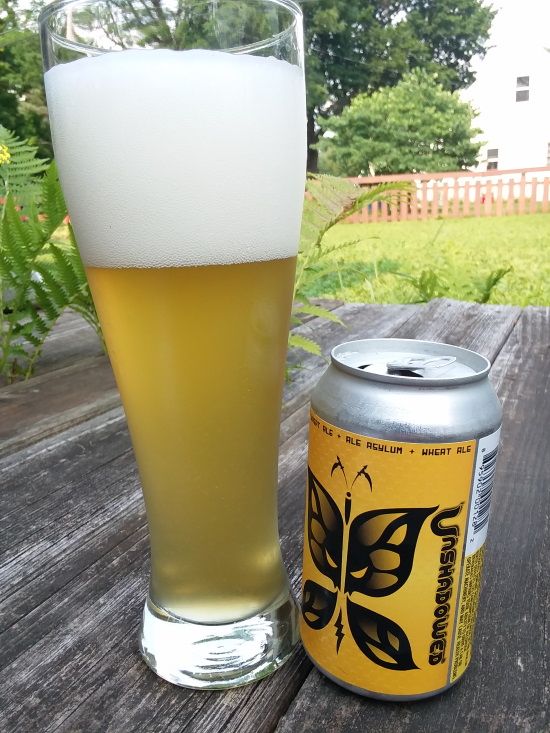
It's easy to see why someone invented the Weißbier glass: you get a ginormous, thick, white head when you pour Hefeweizen and you need the appropriate containment system. The foam atop my beer was pretty rigid and it barely moved when I tilted the glass. The liquid was a hazy lemon color and it featured lots of bubbles. This was volatile stuff as I could smell the beer even when my glass was several inches away from my nose. The aroma featured a big, bright lemon scent along with the style's usual banana and bubble gum. Oh, and there was wheat too.

I found that it had a light body with wheat and zippy citrus/lemon flavors at the fore. Those archetypal Hefeweizen yeast flavors of banana and bubble gum sat underneath. With all of those bubbles, I was not surprised at the beer's firm fizziness. The carbonation and that lemon tartness lent an astringent edge to beer that was greater than I am used to in the style. On the finish, the yeasty fruit and gum flavors faded to reveal lingering wheat and lemon tastes which were joined by some spicy/herbal hoppiness. Those hops and the tartness made for a pretty dry ending.

My glass was left with some very fine lacing.

In contrast to the last Hefeweizen I indulged in, Unshadowed is lighter with an emphasis on the lemony tartness that relegated the banana and bubble gum flavors from the yeast to supporting roles. This stuff has an acidic bite that is stronger than I've ever tasted in a Hatha-, er, Hefeweizen. Despite this deviation from the norm, Unshadowed is a great brew and a perfect fit for the sultry days of a Wisconsin August.

Junk food pairing: Pair Unshadowed with a bag of Andy Capp's Cheddar Fries. Let the beer wash away the salty, starchy goodness of the fries. Repeat.

29 July, 2021

I'll Be Your Weißbier: Hefeweizen by Dovetail Brewery


There I was at my local purveyor of barley pop, trapped in the indecision of another cooler full of colorful beer labels all jockeying for my attention. Fortunately, it didn't take me long to shake that kid in a candy store stupor after seeing $18 4-packs of "imperial" hard seltzer and one of those wapatoolie beers that admonishes you to keep it cold lest the can rupture and you ignominiously get your eye shot out by a chunk of mango. Oh, and there was also a beer brewed with marshmallow flavoring. Nothing says "craft" like a phial of flavoring solution from a chemist in New Jersey.

There was a stark contrast on those shelves. Near chest level (For me. Closer to eye level for your average person.) was that imperial hard seltzer made by somebody who pushed a few buttons on a Jetsons-like food synthesizing machine which filled a vat with water and them dumped in corn syrup and yeast. After a few cycles a robotic arm gently lifted an eye dropper and dipped it into a bottle of flavor and applied liberally. This was then put into cans and sold for $17.99.

Unless you are so short that you have to stand on a box to kick a duck in the ass, you'll have to bend over or crouch down to get a view of the shelf near the bottom of the cooler to find the beer which was the product of monk-like dedication to the art of brewing. I refer to stuff that was imported from an exotic, faraway place - Chicago - and not simply shuttled over from across the lake. The crew at Dovetail lovingly crafts their beers the old fashioned way – sans flavoring solution – and infuses the terroir of Chicago into every batch by letting their brews lounge in a coolship. And the love was available for a comparatively paltry $9.99.

That choice was clear. I squatted down to see if Dovetail had loosed any Rauchbier upon us but, alas, they hadn't. Instead there was a very tasty Kölsch(-style ale), a wonderful Helles – both of which I'd tried – and a hefeweizen which I had not yet poured into my maw. Which to choose?

I went with the hefeweizen but you know this already because it's in the title of this blog post and there are pictures of it too. I did so mainly because my dearly departed brother loved the style and I'd been thinking about him a lot in the days before walking into that store. Truth be told, he always comes to mind when I see a hefeweizen whether it be in a cooler, on a menu, or in a glass. My brother did not drink a lot, but when he did, it was always a hefeweizen. I can still see him pouring a Weihenstephaner Hefe Weissbier that last time we enjoyed a brew together. And so Weissbier brewers have that sentimental marketing advantage over me. "Buy me…it's what your brother would have wanted…you know it is…"


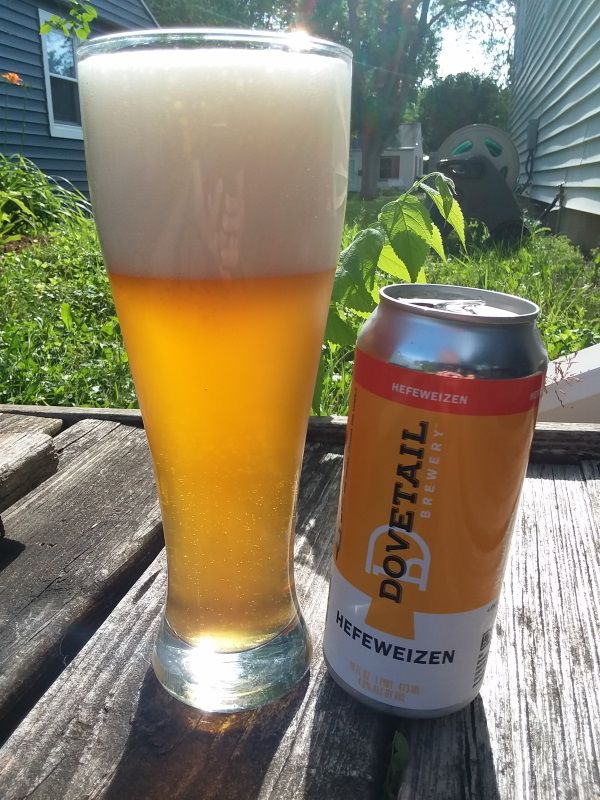
It was a lovely, sunny day when I poured my Dovetail hefeweizen into a proper Weißbier glass. (My brother would have expected no less.) The pour wasn't too bad as I ended up with a big crown of firm, white foam atop a sea of hazy gold. Very pretty. And the foam lasted a long while so it remained a lovely sight even as I supped. As hefeweizens go, I prefer mine to be on the estery/banana side versus the phenolic/clovey side and so I was very happy to smell banana in addition to bread and a dose of grassy hops.

I was further gratified that there wasn't much clove taste and rather more banana and some bubblegum. And a yeasty/bready wheat flavor. These were all complemented by a firm fizziness and one of the more overlooked aspects of the hefeweizen: its tartness/lemony taste. I've never understood the desire to serve this bier with a slice of lemon because that taste is already there. It's like bringing your own Gideon's bible to a hotel. Dovetail endowed its hefeweizen with a slight zesty lemon flavor. I think that it and the bubbles conspired to give it a bit of an astringent bite.

That banana/bubblegum combo hung on after I swallowed as did some wheat. It was fairly dry at the end with a bit of spicy hop bitterness.

After taking a tentative sip, I rather eagerly quaffed this stuff because it is excellent. I've had heavier versions of the hefeweizen (Lust, for example, from the now defunct Saint Francis Brewing Co.) and lighter ones (e.g. - Hatha-Weizen from Ale Asylum) and this hit a comfortable spot in the middle. It's 4.8% A.B.V. and was light enough to ardently sip on a hot day yet wholly satisfying with its rich, full flavor.

My brother was a Chicagoan through and through. Had he lived long enough to see Dovetail open its doors, I have no doubt he'd have enjoyed drinking this beer from our hometown. Prost, mein Bruder.

Junk food pairing: Dovetail's hefeweizen goes well with cheese popcorn, especially white cheddar. If you're inclined to go off the beaten path, try a spicy hot cheese popcorn such as Jays O-Ke-Doke variety for that authentic Chicago experience.

16 June, 2021

I Like Hefeweizens and I Cannot Lie: Sandy Cheeks by Wisconsin Brewing Company


Recent plans for the Frau and I to meet a friend at the Olbrich Biergarten were quashed due to rain. While it was a bummer to have a chance to be social with someone we hadn't seen in quite a while denied us, I was happy to have Mother Nature water the new tree that the city planted in front of our house instead of me doing so. But in addition to missing out on seeing our friend and all the Gemütlichkeit that a trip to a biergarten entails, it was to be a tap takeover by Wisconsin Brewing Company which meant I also missed my chance to finally try Wisconsin Vacation, their pils.

Now that I look at their webpage, it's billed simply as a "lager". Well, crap. More specifically, "Lager.  Behold-a classic lager.  Refreshing, crisp and bursting with joy." How blatantly unhelpful. (Are there any ales that are given the minimalist moniker of simply "ale"? I look forward to the John Cage Brewing Company putting out empty beer bottles labeled only with "12oz".) Is this stuff Supper Club redux? My experience lately has been, if a beer is simply labeled "lager", then it's an American pilsner, i.e. – a crafty Miller/Bud/Coors simulacrum. Back in 2016 a WBC beer release calendar showed a Czech pilsner as a new year-round offering. This never happened, as far as I know. It seems that Wisconsin Vacation is the end result of that initial attempt to put another pale lager into the WBC line-up.

Well, to try and makeup for having missed WBC at Olbrich, I recently decided to give their Sandy Cheeks, a pineapple hefeweizen, another try. I had it on tap a couple of years ago and thought that it wasn't bad. Just a little too much pineapple for my taste ensured it would be a one pint only deal, though. But that was then and this is now. Perhaps the formula had been refined or The Great Curse of 2020 had slowed pineapple imports or made the fruit quite expensive leading to its more judicious use in Sandy Cheeks. I mean, hope springs eternal, right?

Pineapples are a common enough (and cheap enough) sight down at the supermarket these days that we forget that it (and many other fruits) were once rare and precious. Although native to South America, Columbus encountered them in the Caribbean in 1493 and they became an instant sensation when he brought the tasty, sweet, pinecone-looking fruit back to Spain. It wasn't long before every Tomas, Ricardo, and Haroldo with a greenhouse was trying to grow them. Expensive to ship from the New World to the Old, pineapples were once the province of the rich alone. In Europe, anyway.

They became a very coveted fruit perhaps by no one more than 19th century essayist and poet Charles Lamb who wrote of them in an erotic way that puts that My Octopus Teacher guy to shame. Eating one, he wrote, was "a pleasure bordering on pain, from the fierceness and insanity of her flesh, like a lover’s kisses she biteth." I like pineapples and hefeweizens but, if there's any pain involved in drinking Sandy Cheeks, I am hoping it simply means I cut myself on the can.

If, like WBC, you're keen on adding fruit to your hefeweizen, you could do worse than pineapple. (Notice how the coolers at your liquor store aren't being overwhelmed with durian hefeweizens.) Like the hefeweizen, pineapples contain fruity esters and a phenol which adds a clove-like taste. The fruit also contains citric acid which is how she, er, it biteth you. So it's rather complementary to the bier.

It is my understanding that Sandy Cheeks was first offered a few years ago but was a draught-only brew until last year when it was canned for the first time. As I noted above, I had it on draft a couple years back and found it to be tasty. While the pineapple flavor was just a touch shy of cloying, it was still sweet enough to mask some, but not all, of the hefeweizen taste. I was happy to have a pint and then move on to something else. Is the 2021 version any different?

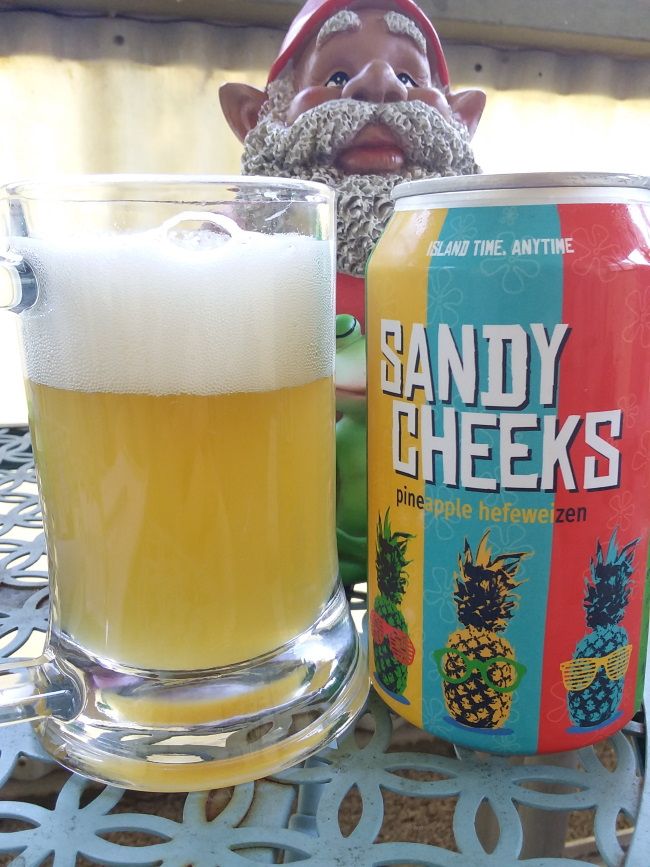
While it is surely the case that my photography is lacking, my picture still does a decent job of showing you what a pretty beer Sandy Cheeks is. It's a very hazy light yellow and I got a big, frothy, white head that was in no hurry to leave my mug. This is a very pretty beer – one that looks like summer in a glass.

It smelled almost exactly as I imagined it would. Brewmaster Kirby Nelson preaches balance in beers and the aromas are all in harmony here with a bit of wheat and a little of the pineapple here and your typical hefeweizen bubblegum and banana there.

Sandy Cheeks is a late spring/summer seasonal and it was brewed to spec. It has a medium-light body that was perfect for a recent balmy day. A medium dose of fizz fit well with all of the fruit, esters, and phenols. As with the aroma, pineapple, bubblegum, and banana were well-balanced with one another. I was quite pleased that the application of pineapple was done with a bit more care than in the past as there was no sweetness that even approached slightly excessive. A little wheat came through towards the end as did a velvety smoothness which was unexpected.

Some spicy hops and their attendant bitterness appeared on the finish as the fruity flavors lingered.

The moderation in the pineapple addition here paid off. There's nothing remotely cloying about Sandy Cheeks these days and more of the excellent hefeweizen reached my eager tongue. The flavors are all in their places living in harmony. I could definitely drink more than one of these.

Junk food pairing: With a Sandy Cheeks in one hand, you'll still be able to grab handfuls of hot and spicy pork rinds with the other.

28 April, 2017

Gateway Beer: Schnickelfritz by Urban Chestnut Brewing Company


Last month I spent a little time in St. Louis. While there I got to sample some fine food, see the tourist sights, and drink some of the Gateway City's beers.

Amongst the brewies I visited was Urban Chestnut and I brought home a 4-pack of their weissbier, Schnickelfritz. According to Wikipedia the name "is a Pennsylvania Dutch term of affection usually for young mischievous or talkative children". It is part of the brewery's Reverence series which consists of traditional style beers.

Urban Chestnut, founded in 2011, was one of the larger establishments I visited in St. Louis though not as old nor as large as Schlafly. Brewmaster Florian Kuplent cut his brewing teeth in Germany and so Urban Chestnut unsurprisingly offers plenty of German biers. But they also have a variety of other and newer styles on their roster. The Midtown Brewery & Biergarten was a nice spot to take in a brew on a sunny almost spring day.

In addition to the beer, the cans showed some reverence to old packaging styles with their pull tabs. My mind was immediately cast back to my youth and the pull tab chains in the workshops and garages of family and friends' fathers. (As well as the cans of Old Style my friends and I stole from our dads.) These were neo-pull tabs, however, as they removed the whole top of the can.


With my weissbier glasses still packed away in the basement, I ended up drinking from a plain mug.

Schnickelfritz was certainly traditional in appearance. It was a lovely light yellow and hazy. Sadly, the head was small and disappeared with some haste. There was a fair number of bubbles inside.

My preference in weissbiers is for more of an emphasis on those estery banana scents and flavors with phenolic clove and bubble gum taking supporting roles. Schnickelfritz did not disappoint as banana took pride of place on the nose with clove lurking in the background. I also caught the wonderful, toasty, smell of wheat. Not even having tasted it, the bier had me pining for warmer, sunnier days.

As with the aroma, the taste was full of that banana goodness with just a touch of clove and a hint of bubble gum. It had an eminently quaffable light body with a sizable wheatiness. There was a little acidic bite to it and a firm fizzyness.

The banana and wheat stuck around at the finish while that acidulous tang was heightened taking on a prominent lemony tartness. There was no Schaumhaftvermoegen to be had.

Schnickelfritz is a fine weissbier. But I'd expect nothing less than a bier from a Reverence series formulated by a brewmaster who trained in Germany. If Urban Chestnut distributed here in Madison this would definitely be in my refrigerator summer long. Light-bodied and a modest 4.8% A.B.V., it was still flavorful with plenty of my preferred banana taste while clove and bubble gum took back seats. A perfect balance, to my palate. Plus it was nice'n'fizzy. Simply wonderful.

Junk food pairing: In keeping with the reverence theme, pair Schnickelfritz with soft pretzels and plenty of warm cheese food product dip.

07 September, 2016

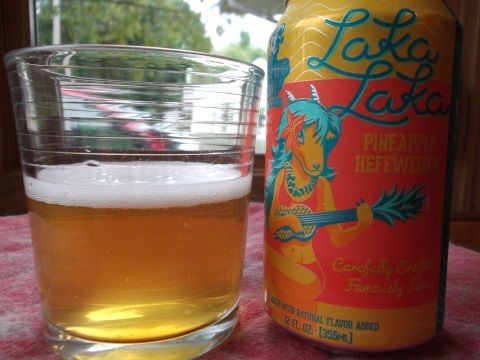
You Got Hala Kahiki in My Bier: Laka Laka by Horny Goat Brewing


I am embarrassed to admit that I didn't realize this was a Horny Goat beer until I took it out of the refrigerator to drink it. It was purchased in late July down in suburban Chicago as part of a mix'n'match set, although it was The Dulcinea that chose it. A pineapple hefeweizen sounded tasty and I just didn't take notice of the brewer as she put the can into the six pack holder.

Once I was aware that this was a Horny Goat brew, it occurred to me that I have not seen their beers around Madison in a while. Or at least I cannot recall doing so. Surely my eyes just wander past them and the brewery hasn't left the market.

Horny Goat was founded in 2008 in Milwaukee and is a brewery that hires other breweries to make their beers. My can indicates that they are City Brewing in La Crosse and the Stevens Point Brewery in – where else? - Stevens Point. However, the company opened a brewpub called the Horny Goat Hideaway in the Cream City but it closed last year. Presumably a period of retrenchment is over and now it's time to rebuild.

Laka Laka is, as I noted above, a pineapple hefeweizen and appears to be a summer seasonal. "Laka" is, according to Wikipedia, the name given to two different heroes in Hawaiian mythology while "laka laka", according to Urban Dictionary, means to have sex or to f*ck off. Presumably the former is being invoked here.

Laka Laka pours a medium yellow/light gold. Its slight haze did not prevent me from seeing a copious amount of bubbles inside. A small, loose, white head dissipated quickly. To be honest, I was not expecting this bier to be great but it sure got off to a nice start because it looked really nice.

Unsurprisingly, the aroma was heavy on the pineapple. It smelled like pineapple juice, actually. There was also a little bit of honey. Combined, they gave the bier a very sweet, though not overly cloying, scent.

The taste was similar with pineapple juice taking the lead. It was quite sweet but the generous carbonation helped take the edge off as did a hint of some spicy hops that were like a wallflower in the background. I struggled but was unable to taste any flavors that make a hefeweizen a hefeweizen. No banana, clove, or bubble gum.

For the finale, some of the sweetness stuck around and was joined by vanilla – the first sign that this was a weissbier – while the hops gained traction and came out to the dance floor. Bitterness was still retrained but the contrast was stark considering how sweet this bier is. Schaumhaftvermoegen consisted of a sizable group of spots towards the bottom of my glass.

I will admit that I liked Laka Laka but this is because it tasted like pineapple juice and pineapple juice is good stuff. On the other hand, I couldn't taste any wheat nor any of the fine flavors that the yeast produced such as banana or clove, excepting a dash of vanilla on the finish. All of that juice de-hefed the bier.

I don't want to deny hard pineapple juice a place in the pantheon of summer thirst quenchers but I ws expecting and hoping for more hefeweizen. If you add so much fruit or fruit juice to your beer so as to obscure the hallmarks of the style, is it still that style? I thought about this when I was drinking that mango Kölsch last month. With that bier, the light, delicate fruit flavors from the yeast were supplanted by a light, delicate dose of mango. Yet I liked it greatly.

Here I think the difference isn't simply that pineapple supplanted an estery taste here or a phenolic one there. It's that, excepting the hops, the tell-tale characteristics of beer were in absentia.

Junk food pairing: Go for the authentic Hawaiian experience and pair your Laka Laka with some Spam flavored macadamia nuts.

05 July, 2016

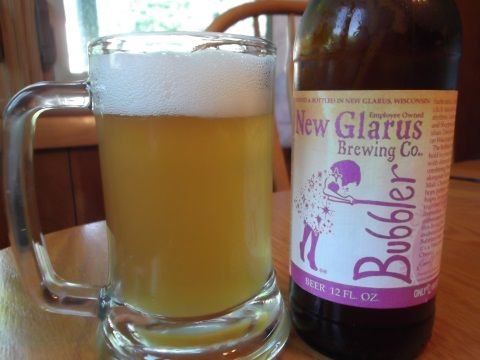
The Bubbler from Green County: Bubbler by New Glarus Brewing Company


Quite frankly I'm surprised it has taken until 2016 for this to happen. Wisconsin beer drinkers are confronted with no less than three different brews with the name "Bubbler".

A bubbler, for non-Cheeseheads, is a drinking fountain and the term is southeastern Wisconsin one, from my experience. The original trademarked Bubbler from the Kohler Company (in Kohler, Wisconsin) shot the water directly upwards about an inch. But health concerns prompted designers back to the drawing board where they overhauled the Bubbler so that the water came out in an arc instead of straight upwards - the design we see today.

Why such a beloved bit of regional language took decades to become a microbrewing moniker in these parts is beyond me. Well, I wouldn't be surprised if the name was used previously but so long ago – like the mid-90s – that it has long since been long in the mists of time.

Plymouth Brewing Company, a brewpub in Plymouth (not far from Kohler), seems to have capitalized on the idea first in this modern age of craft brewing with their blonde ale emerging a few years ago. N.B. - Plymouth does not package their beer.

This past winter Madison's Next Door Brewing piloted a blonde ale which would capture the hearts and livers of Next Door denizens and eventually be christened Bubbler. Not only did it become a regular offering on tap at the brewpub but it also became available in bottles late this spring.

Lastly there is the bier from New Glarus Brewing in (gasp!) New Glarus. Debuting last month, the Bubbler from Green County is a hefeweizen, a German wheat bier. I was really happy to hear about it because I missed Laughing Fox, a wonderful light Kristallweizen that came and went. Brewmaster Dan Carey and his crew make fantasic weissbiers and Dancing Man Wheat is still around but it is just too big of a bier for July. And so I was happy to hear of a hefeweizen on the lighter side for hot weather quaffing.

Bubbler pours a lovely light yellow that takes on a gold tint from the right angle. It was quite turbid – no Kristall here – with proteins from the large amount of wheat making the bier cloudy. As expected for the style, my mug found itself with a big, pillowy, white head that lasted a fair stretch. And Bubbler is quite effervescent with lots of bubbles inside. A beautiful, refulgent bier.

I was quite pleased with the aroma. The hefeweizen is known for the scents and tastes provided by its particular strain of yeast. My own preference is for banana to be primary followed by clove and whatever else you may get such as bubble gum. Here I caught a rather nice banana scent followed by a touch of clove. And with 50%+ wheat, you couldn't help but smell the grain.

For the taste it was banana again at the forefront followed by some clove and some bubble gum too. But there was also a hint of vanilla. A distinct breadiness rounded out the flavors while a generous portion of carbonation made for a fizzy experience on the tongue.

The hefeweizen is not a hoppy bier, generally speaking, but some nice grassy and spicy hop flavors came out on the finish after the wheat and yeasty ones faded. The hops made for a little dryness in concert with all those bubbles but there was also a mild citrus-like tartness here too. My glass looked really nice after the first pour and it looked nice again empty with thick webs of Schaumhaftvermoegen lining the inside.

Fantastisch! Bubbler is light and fizzy making it perfect for the dog days of summer. I appreciated the banana flavor from the yeast being up front while the clove and bubble gum trailed behind. And the vanilla was unexpected but quite willkommen. It added a little extra smoothness to the bier. Underneath the carbonation Bubbler is a very smooth bier and I liked the interplay between that feel and the bite that the bubbles provide. It's like the duality of man - that Jungian thing.

Bubbler is a great little brew that keeps a variety of flavors in balance while never taking anything to an extreme. Another brew for your summer thirst quenching toolkit.

Junk food pairing: Bust out a bag of Jays Krunchers! Sriracha potato chips. They add a little zing but are not five alarm hot and they complement Bubbler perfectly.

06 June, 2016

The Two Gentlemen Return to Verona: Hefeweizen by Wisconsin Brewing Company


I once read an interview with Wisconsin Brewing Company's brewmaster Kirby Nelson in which he described his beers as not being about extreme flavors or chasing trends but rather he wanted them to be the perfect accompaniment to the pursuit of happiness. Sitting around with friends and family, enjoying their company, laughing, and sipping a cold one. A cold one at the time of the interview was a Capital brew and Nelson has since taken to brewing extreme beers at his current gig but WBC retains the laid-back Gemuchlikeit of the Capital biergarten.

And so it is always a pleasure for me to visit WBC and pass the time with good company while sitting on an Adirondack chair overlooking the pond with a cold one. The brewery's Forward! series, consisting of very small batches of trial brews, featured an ESB a couple of weeks ago which drew me and a friend out to Verona and a hefeweizen last week which did the same.

Kirby brewed a fine hefeweizen when he was with Capital – Kloster Weizen. I believe it went into hibernation around 2006. It reemerged in 2012 as Weizen and Kirby left for WBC shortly thereafter. To the best of my knowledge WBC has not brewed this style until now – certainly not bottled one – although there could have been one earlier in the Forward! series. Truth be known, I don't know that the current weissbier was even brewed by Kirby or if it was done by one of his minions.

The placard at the bar described the bier as having "notes of banana, clove and bubblegum". And yes, the sign lacked a serial comma. (Long live the serial comma!) Now, these flavors are all well and good but which one would be most prominent? The sign had it in the correct order as far as I am concerned. My preference is for banana accented by a little clove with a hint of bubblegum being optional.

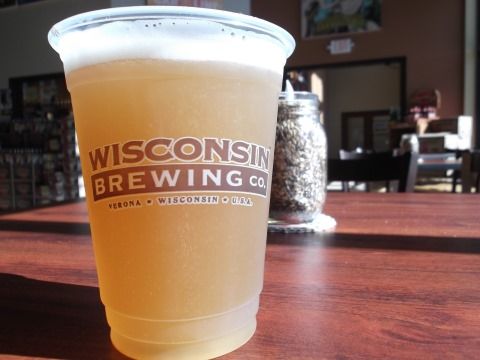
Hefeweizen was a lovely light gold color that shimmered in the evening sun. Being unfiltered, the bier was quite cloudy. My glass (plastic?!) had a decent-sized white head that was very creamy and lasted a good while. There were plenty of bubbles inside the bier heading upwards.

I was slightly disappointed to smell a pretty big bubblegum bouquet. Banana followed while the wheat hovered in the background. Let me clarify my tastes and say that I don't dislike that bubblegum flavor in a hefeweizen but rather it is the least desirable of the flavors that the bier's yeast produces.

The taste followed suit with bubblegum at the fore trailed by the banana and a succinct bit of clove too. The bier had a light body with a nice mild wheat/grainy flavor beneath the trifecta of yeasty tastes. It was well-carbonated which made for a very refreshing bier out in the sun.

On the finish there was some lingering maltiness which was slightly sweet. This was joined by some grassy hop flavor and a modicum of bitterness – just enough for a slight dryness. There was also some lemony-citrus here which added a little zesty sharpness to complement the hop bitterness.

Hefeweizen is, if I may quote from the Supper Club can, not bad. Banana esters are my preference for the style. Not only for their taste but also because they add body. While it can certainly be overdone, I do like just enough to give my weissbier a little chewiness. Now, having given an account of my Platonic ideal of a weissbier, I will say that I enjoyed Hefeweizen. Its light body and fizziness definitely made it refreshing while sitting out in the sun. (It's 4.8% A.B.V.) Even if the bubblegum isn't my preferred flavor, it tasted fine and, besides, there was banana too. And the little bit of lemon on the finish was just perfect.

Junk food pairing: WBC's Hefeweizen goes well with lighter foods. I suggest guacamole flavored tortilla chips as well as Cape Cod Sweet Red Chili potato chips.

25 May, 2016

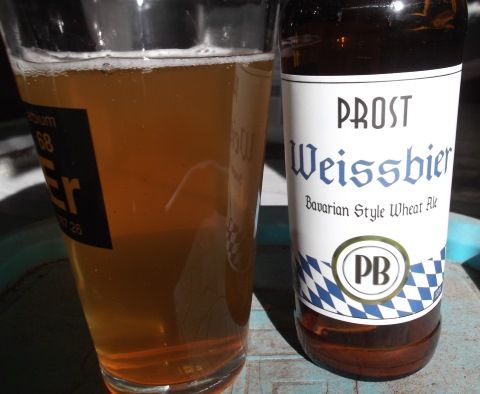
Beer Review: Weissbier by Prost Brewing Company


I am slowly working my way through the beers of Prost Brewing out in Denver – at least the ones that end up here in Madison. My introduction to their biers began with the very unimpressive Altbier. Prost rebounded with the very tasty Pils. And now I am ready to spill the beans on their Weissbier. The brewery strictly adheres to German styles, if you haven't noticed by now.

Ah, the weissbier. A wheat ale whose yeast produces distinctive flavors that can taste like banana, clove, bubble gum, et al. It was my brother's favorite bier and, since his death last year, I've been unable to drink one and not think of him. It's a bit like that song from your youth that is ineluctably linked in your brain to the bad old days of high school or perhaps to your first special someone. With a good weissbier comes my brother's smiling face and many a happy memory such as when he was singing "Squonk" by Genesis in my kitchen several years back. Objectivity and weissbier are forever separated for me.

Prost's Weissbier – they're pretty utilitarian when it comes to naming their bier – pours a lovely cloudy light gold. The haze is from yeast left in the bier as well as protein from the large amount of wheat used to brew it. I expected a bigger head than I got from my pour. What can you do? But it was a brilliant white. Sadly, it didn't stick around very long. There was, however, a goodly number of bubbles in the bier itself going up. Unfortunately, my weissbier glasses are all packed away and I'm sure they would have helped Weissbier put its best foot forward visually. Still, it looked pretty good in a shaker pint.

The aroma was great filled as it was with banana and clove. More on the banana side of things, though, which is my preference. And of course there was also wheat/light graininess too. I believe that the stylemeisters decree Weissbiers should be made from at least 50% wheat but even more is not uncommon.

Much to my delight the preponderance of banana in the aroma carried over to the taste. There was definitely some clove too, but it was less pronounced and in fine proportion for my taste buds. The wheat and malt gave a bread-like flavor which offered a moderate bit of sweetness which went well with the fruity flavor from the yeast. I tasted a little grassy hop flavor but little bitterness. And a good weissbier needs a lively dose of carbonation which this one has.

The hops are applied moderately on the finish as those tasty banana and clove flavors from the yeast fade. They take on a pepper flavor which adds some bitterness and makes for a dry finish. Sadly there was no Schaumhaftvermoegen left on my glass.

Weissbier is a very fine brew and I am beginning to think that my encounter with their altbier was an anomaly. I appreciated that the banana flavor was stronger than that of clove and they achieved a really nice balance between the two. While the yeast flavors were up front, the wheat wasn't too far behind. And the hops got their chance to shine at the end. The bier just had a nice flavor all around. The body was medium-light but leaned towards the latter. Add in a generous, but not too generous, helping of carbonation and you have one mighty refreshing bier. And it's a easy-going 4.5% A.B.V. to boot.

I have no doubt that my brother would have heartily approved.

Junk food pairing: In keeping with my brother's proclivities, I am going to recommend his favorite snack - some pretzel rods - dipped in a fine processed cheese food product sauce.

21 December, 2015

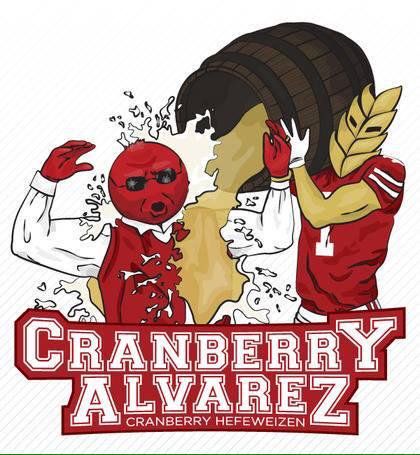
This Bier Has Been Censored: Cranberry Alvarez by MobCraft Beer


I was a bit hesitant buying this bier, I must admit. MobCraft is one for two on the weizen front to my taste. Don't get me wrong, Batshit Crazy is a very tasty beer, in my humble opinion - the folks at MobCraft are not untalented. And that the other beers of theirs that I've had range from awful to good is not a hanging offense. But none of their brews really jump out at me as having that special, ineffable something that makes any of them extraordinary. Sometimes I get the impression that the brewery spends too much time brewing the often novelty crowd-sourced beers that they're known for.

Don't get me wrong, I am not suggesting that MobCraft quit fielding ideas for beers from the unwashed masses. You gotta dance with the one that brung ya, after all. However, I do feel that MobCraft's beers are largely middle-of-the-road and sometimes I wonder what would happen if they were forced to brew straight-up beers. I am going to review a hefeweizen here. Can MobCraft brew a good hefeweizen without tea, fruit, or elements of a gose? I don't know and MobCraft don't seem eager to try. With most of their beers being very hoppy, barrel-aged, having coffee, vanilla, fruit, and so on, it's hard to gauge the level of talent that MobCraft has. 

Let's move onto Cranberry Alvarez which was renamed Cranberry Censored for reasons unknown to me. Presumably Barry Alvarez or another bigwig at the UW was unamused.


Cranberry Alvarez pours a dull light red. The dullness is the result of the bier's cloudiness which, in turn, is the result of proteins from the wheat. I got a big pink head on my pour. It was one of those stiffies – a rigid head that you get a little bit of with each sip but there will be a bit of left when all the liquid is gone. There were oodles of bubbles coming up from the bottom of the glass. I thought it was a nice looking bier.

Wisconsin leads the nation in growing cranberries and I'm going to assume that MobCraft used native fruit in this bier. If this is the case, then Cranberry Alvarez's aroma smacks of Wisconsin with a wonderful tart cranberry bouquet accompanied by some wheat/bread in there too. The hefeweizen is often a well-carbonated bier and Cranberry Alvarez is no exception. It's a light and bubbly bier with some nice cranberry tartness hitting the spot. But I could taste only a little grain and even less of the trademark yeast flavors which here was a shade of banana. Overall the bier was thin. As it warmed some grapefruit hop flavor came out (the Mosaic hops, I presume).

The finish was quite dry with the lingering cranberry tartness joined by the carbonation and moderate grassy hop flavor and a fair amount of bitterness. My glass was lined with webs of Schaumhaftvermoegen which made for a pretty ending.

While I liked the cranberry in Cranberry Alvarez, the bier was watery. There was very little of the expected phenolic flavors, although I give them a modicum of credit for using yeast that gave more pungent banana flavors than clove ones. If not tasting much like a hefeweizen is this bier's cardinal sin, then its venial one is being overly hoppy, especially on the finish. To me, hops in a hefeweizen should basically be also-rans. The style is about a wheat/malt stage to showcase the flavors born of the yeast. Even lacking the latter, I think the hoppiness present would have interfered with a fully armed and operationa hefeweizen.

Junk food pairing: Pair Cranberry Alvarez with some trail mix. A little salt to help bring out the subdued grain taste and some dried fruit sweetness to make up for the lackluster yeast flavors.

A Rauch Weizen from Minnesota? Oh Yaah, Doncha Know, Hey: NEIN by Surly Brewing Company


Wowzers! Zwei rauch dunkelweizens in one week. Life is good.

From Surly Brewing in the Twin Cities comes NEIN, an imperial smoked dunkelweizen brewed to celebrate the ninth anniversary of the brewery. Apparently Surly brews a big beer every years to celebrate their founding.

NEIN keeps up that tradition with its 10% A.B.V. According to Surly, the inspiration for the bier came "from a trip that head brewer Todd Haug took to Bamberg to visit the Weyermann (Malting) facility." That facility is in Bamberg, Germany, the epicenter of that most luscious of libations, rauchbier. In addition to the smoke malt, NEIN was aged on charred oak for extra flavor before being put into 750ml bottles. In terms of potency and volume, this is definitely a bier to share.


It pours a deep, dark amber that appears brown in your glass. Holding my glass to the light, NEIN appeared, oddly enough, to be clear. I guess it's a rauchdunkelkristallweizen. How do you like that for a compound noun? As I held my glass up, I noticed a goodly number of bubbles moving upwards towards the rather small dark tan head that sat atop the bier. The crown disappeared with some haste.

Every time I review a weizen I feel obliged to confess that I prefer that banana flavors from the yeast prevail over ones that are more like clove or bubble gum. Thusly I am always a bit apprehensive when trying a weissbier because, if notes of clove are dominant then I feel disappointed. I won't pour the stuff down the drain or any such thing but that bier is, fairly or not, stigmatized in my eyes. Luckily NEIN had an aroma that was chock-full of those banana-smelling phenols. In addition there was a pronounced smokiness that was redolent of bacon and a woody smell that reminded me of sherry.

That wonderful banana-bacon combination came through in the taste as well. What a divine pairing of flavors! I've seen more than a few people take one sip of a rauchbier, not enjoy it, and then denounce the whole concept of smoke beer. But I find that the more I drink a rauchbier, the less assertive the smoke becomes. NEIN has a pronounced smoke flavor but it steps back the more you drink ceding space on the tongue to vanilla and woody flavors. The woodiness in the flavor is less vinous than it was in the aroma. Here it's more like oak. Carbonation added a kiss of dryness atop it all.

NEIN finishes much drier than I thought it would with the banana-smoke fading as hops with a grassy/spicy flavor but a modicum of bitterness take over. I also tasted the boozy warmth of this big bier for the first time in the finish. Lastly, the woody/sherry element turned back towards sherry here. Curiously enough, there was no Schaumhaftvermoegen to be had.

As someone who is rather ambivalent about Surly, I must admit that NEIN was ausgezeichnet! It is a bier deserving of a snifter and your time. The medium body is slightly deceptive as the bier holds a medley of big, bold flavors. Each sip unfolds like a narrative with yeasty phenols melding with smoky malts at first. Then they are joined by woody notes from the aging vessel until a gustatory climax is reached. At the denouement hops prevail along with a satisfying boozy warmth that lingers as you enjoy the fellowship of those with whom you share this heady elixir.

Junk food pairing: NEIN is big bier with assertive flavors. Find yourself some chipotle potato chips – the thicker, the better. The gentle smoke of the chips will accent the smokiness of the bier. On the sweeter side, drink NEIN with Nilla Wafers or their generic equivalent. The vanilla flavor goes well with the bier's woody flavors and the vanilla-like ones from the arboreal aging process.

18 December, 2015

When In the German South, Smoke Gets in Your Mouth: Roog by BraufactuM


Today we have another rauchbier from Germany that I purchased on a recent trip to Chicago: Roog, by BraufactuM. Roog is a rauch weizen while Braufactum, whose motto is "Das Craft Bier", seems to be a subsidiary of Radeberger which is the largest brewing company in Germany as of whenever the websites I found saying as much were published. That makes BraufactuM the Teutonic equivalent of Blue Moon or Shock Top, I suppose. The off-shoot seems to have come into existence back in 2010 with their biers making it to these shores three years later.

I admit to knowing little to nothing about the German brewing industry. However, this doesn't stop me from speculating. American craft brewing seems to have made its mark (ahem) in Germany. This combined with declining bier consumption must be making the big German brewers a bit nervous. Not only has Radeberger created a microbrewing subsidiary, but so has another large German brewing concern, Bitburger. Their subsidiary Craftwerk, goes beyond the pale (lager) and into American territory with hoppy pale ales as does BraufactuM. And no, I don't know why the terminal "m" is capitalized.

My mostly baseless speculation aside, I am happy to support some German brewers if they're going to leave me with more rauchbiers at my disposal.


Roog (no idea what that means) pours a lovely deep mahogany. Holding my glass to the light, the bier appeared to have the characteristic weissbier cloudiness. A crown of about a ¼ inch of tan frothiness topped my bier. It lasted about a minute before disappearing.

This bier had one of the best aromas I've ever encountered in a brew: it smelled just like banana bread. Well, smoky banana bread. Mind you, that bacony smokiness was very mild here in the aroma. Mostly it was mouth-watering banana bread. As someone who is more enamored of banana flavors in weissbier than of clove-like ones, I took this to be a good portent.

While the bier didn't taste like banana bread, it did have that banana phenol flavor. Joining the yeasty contribution were a moderate smokiness, some wheat/grain, and some unexpected sweetness. The bier is brewed with caramel malt and caramel wheat which surely explains the latter. There is also dark wheat in the grain bill and it blended with the smoky flavor well. Smoke flavor in beer is rather divisive. People tend to either enjoy it or loathe it. I am of the former but must say that the rauch here has been tempered. This is nowhere near as rauchy as Schlenkerla's Weizen. Folks in that small group who are in the middle about rauchbiers will likely find a friend in Roog.

The smoke and banana flavors faded at the finish which allowed the hops to come through. They had a herbal/grassy flavor which wasn't overly bitter yet, in concert with carbonation, they made for a fairly dry ending.

In a word: ausgezeichnet! Roog has a medium-light body (yet weighs in at 6.6% A.B.V.) that handles the myriad of flavors here very well. I loved how the smoke and banana flavors, present in roughly equal measures, did this graceful pas de deux on my tongue. They just mixed perfectly. One may take the lead but then it would hang back and let its partner do so. In addition, there was just enough sweetness to enhance to the yeast flavors while dark wheat complemented the smoke flavor with hints of coffee. Sheer gustatory joy.

Junk food pairing: Pair Roog with Snyder's Bacon Cheddar Pretzel Pieces to accentuate the smoky aspects of this bier. You can also can stuff some dark chocolate covered pretzels in your maw to complement the banana flavor. Alternate them or, if you're brave, eat both at once and see what happens.

14 December, 2015

Everybody Got to Deviate From the Norm: Pimock by Freigeist Bierkultur


Sadly, this marks the final Freigeist brew for me to review. For the moment, anyway. This last bier is one of the more experimental brews from Freigeist. It isn't a traditional bier dragged from obscurity into the 21st century nor is it a familiar bier tweaked a little bit. Pimock ("outsider") is labeled as a Rhineland Weizen. What is a Rhineland Weizen?

Freigeist may have invented a new style here. It takes the familiar Bavarian hefeweizen and turns it on its head by infusing it with the spirit of Cologne. (Cologne being the brewery's home town and in the Rhineland.) Instead of the normal yeast which imparts the characteristic banana and clove flavors, Freigeist uses Kölsch yeast to impart a whole new taste. The bier also has more hops than a normal weizen.


Pimock pours a lovely amber color – a bit darker than the typical hefeweizen. Like its Bavarian cousin, this bier is cloudy with all that yeast still floating about. My glass had a nice tan head of about ½ inch which stuck around and made for a pretty sight. There wasn't much in the way of bubbles going up, though.

It is said that the most important sex organ is the brain. Likewise the most important olfactory and gustatory organ must also be our gray matter. One's experience with a beer depends on many factors. Are you drinking in a social setting? Or are you alone? What mood are you in? What do you have a taste for at that moment? For example, Miller High Life is not my cup of tea yet it can taste really good when offered to me after I've been working outside on a hot day.

I mention this because I had one of those psych-out moments with Pimock. I put my glass to my nose and inhaled a nice malty smell that was like bread as well as corn. The aroma had a fruity sweetness to it which at first was like apricot to my nose. Then I began to think about how this is a Rhineland weizen so there won't be any of those banana/clove phenols. And just at that moment I started to smell banana. My brain just couldn't help itself. I don't care if you've achieved Elder God Cicerone status – your brain will play tricks on you. That Platonic idea of bier will always be just out of reach and we're stuck arguing about shadows on the tavern wall.

At this point my ability to smell had been compromised so I moved onto the taste. As you can imagine, there was a prominent wheat/bread taste to Pimock. Then came a fruity sweetness just as in the aroma. Thankfully my senses weren't seeing, smelling, and tasting bananas everywhere by this point. The fruity flavor here was like peach and nectarine to my tongue. There were definitely more hops here than in the typical weizen but you won't mistake Pimock for an IPx. I could taste a pleasing amount of peppery/grassy hops but there was little accompanying bitterness.

On the finish the grain flavors subsided allowing more of that hop flavor to come through. It took on a rather spicy edge here which added a good dose of dryness. On my glass was some nice Schaumhaftvermoegen with a slew of narrow streaks around it.

While the use of Kölsch yeast here is novel, it was really the hoppiness that caught my attention the most. I really enjoyed how the peppery hops contrasted with the stone fruit sweetness here. These two flavors simply went together well. Pimock has a light body and is 5.3% A.B.V. which seems in line with Bavarian weissbiers. It drinks a lot like its Bavarian counterpart except that I found Pimock to be less carbonated so it's missing that bubbly mouthfeel typical of weissbiers of the south.

Junk food pairing: Pimock will benefit from pairing with Mexican. Try some lime-chili puffed corn chips or jalapeno-tinged Cheetos.

02 December, 2015

That's a Peach, Hon: Peach Hefeweizen by Stevens Point Brewery


This is the final entry in my late-year weissbier triptych. In my previous post I pondered the customary slice of lemon that is duly affixed by bartenders across America to weissbier glasses. For better or for worse, I skip the zitrone. It's just not my thing although I can see the appeal of it. Having said this, I am not ideologically opposed to blending a weissbier with some fruit or using your bier to steep tea or adding a floral dimension to brew.

This past summer Point introduced Peach Hefeweizen via their Whole Hog series which features various brews made in limited quantities aimed at the craft beer drinker. The pumpkin ale enjoys a glowing reputation from what I can tell. I miss the imperial pilsner which seems to have been brewed once in 2009 and then disappeared.


Peach Hefeweizen pours a light gold hue and was hazy as expected. The beer was crowned with 1"+ of nice ecru head. This was a nice effervescent brew with lots of bubbles going upwards. And I mean lots. It was bubbly like a fine pilsner. Very pretty.

On appearance, Peach Hefeweizen gets high marks. The problem started when I smelled the bier. At first I caught peach. But as my brain tried to discern some evidence of this being a weissbier such as a bit of banana or clove, it realized that it had also gotten a big dose of butter. Diacetyl! D'oh! To the best of my knowledge, and anyone reading this from G. Schneider & Sohn please correct me if I'm wrong, but there should be no diacetyl in a weissbier. I could probably live with a little but this smelled like a lethal dose.

The beer's taste matched its aroma with the peach coming first followed by the dreaded butter. I could also taste the carbonation. What I failed to taste, however, was any indication that I was drinking a weissbier. I am loathe to make any proclamations about a beer so severely compromised by diacetyl but the prominence of the peach left me with the impression that, had the diacetyl not been present, I wouldn’t have tasted much in the way of phenols anyway. The peach flavor was strong instead of being at a lower dosage where it would complement any banana or clove flavors.

My drinking experience, such as it was, finished with the buttery flavor dying out leaving the peach to linger for a short time until a nice dryness from carbonation and some grassy hops entered the scene. Schaumhaftvermoegen was oddly light. So light, in fact, that there was but a smattering of small spots.

Did anyone else out there run into diacetyl in this bier? I'd hate to think it was just me and my poor beer storing habits. Aside from the off flavor, the peach wasn't bad. The label says both "Beer with Natural Flavor Added" as well as that peaches were used. Does this mean that only peaches were used? The peach flavor of the beer didn't exactly taste like fresh fruit but nor did it taste fake.

Junk food pairing: If this bier had no diacetyl, I'd pair it with either some Kartoffelchips or pretzels with mustard and/or horseradish. You'll need something to cut through all that peach.

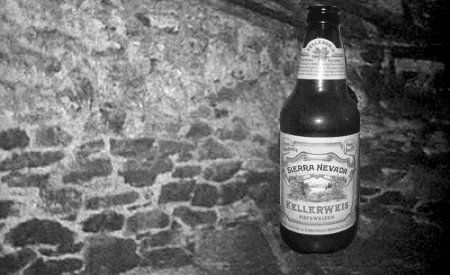
Out of the Cellar: Kellerweiss by Sierra Nevada Brewing Company


As I noted yesterday, I've been sampling some weissbiers lately in memory of my brother who passed away earlier this year and was a fan of the style. Unlike me, he enjoyed the lemon that commonly garnishes glasses of weissbier here in the States. For many years I've been under the impression that slapping some citrus onto the glass was a misbegotten practice that originated here in America where the mantra "more is better" is an almost ineluctable part of life.

I haven't found anything to indicate when or where the practice started but Michael Jackson encountered glasses adorned with lemon slices in Germany during the mid-60s so it seems unlikely that we Americans can take credit for the innovation. (After all, lemon slices also garnish schnitzel in Germany so it's not like there's a great anti-lemon sentiment over there.) However, it seems that the practice has fallen out of favor in the beer's homeland while it remains strong on this side of the Atlantic. Indeed, it is so ingrained that I was given a slice of lemon when I ordered a Schlenkerla Rauchbier Weizen a couple years ago at the Essen Haus. My brother, on the opposite end of the table, was enjoying his unsmoked weissbier mit lemon.

My foray into the world of weissbiers continues with Sierra Nevada's Kellerweiss.


Kellerweiss pours a light gold. (My photograph makes the beer appear a bit darker than it really is.) As to be expected, the brew is turbid with all the yeast having been left in. Also expected was the large white head. Wheat is laden with proteins which are dragged kicking and screaming out of suspension by the carbonation. I love the foam on weissbiers. It's rather thick – almost like meringue – and it sticks around until the last of it slides into your gaping maw. Weissbiers should be effervescent and my Kellerweiss had lots of bubbles going up the glass.

The beer's aroma was instantly appealing with a delicate lemon-citrus scent stealing through pungent banana phenolics. Underneath the fruity bouquet was also some grain that was cracker-like. Kellerweiss has a medium-light body and I was happy to find that the banana-like scent came through in the flavor. This is strictly a personal preference of fruitiness over clove-yness or bubbleguminess. There was a hint of clove, however, which is well and good and probably a necessary accent to keep the flavor from becoming overly fruity.

Also handy in keeping the taste on the straight and narrow is carbonation. One can definitely taste it in Kellerweiss. Rounding out the flavors was more cracker-like graininess. Not very strong but definitely there beneath all that the yeast had wrought.

Dryness from the carbonation overtook the lingering banana in the finish. It was abetted by a small dose of spicy/peppery hops. Schaumhaftvermoegen was plentiful with strands of it lining my glass.

I praised Saint Francis' Lust weissbier yesterday for being fairly substantial. Kellerweiss has a lighter body (4.8% A.B.V.) and slightly less intense flavors overall. This in addition to the drier finish from more piquant hops yields a beer that I can imagine would be quite easy drinking in warmer weather. Mind you, I don’t mean to imply that Kellerweiss is lacking because it isn't. It is flavorful and delicious and I'm sure my brother would have enjoyed it.

For a brewery whose reputation, as I discern it, rests on hoppy pale ales, Sierra Nevada superintends an array of fine German-style biers. They brew a wonderful pilsner, an Oktoberfest conceived with a German brewery, a great Kölsch, and a very tasty weissbier. To top things off, they are introducing a gose next month. I regularly drank Sierra Nevada Pale Ale back in the first half of the 1990s but eventually my tastebuds wandered as microbreweries sprang up. Rediscovering the brewery over the past few months has been a real treat.

Junk food pairing: On the savory side, pair Kellerweiss with some Wasabi & Soy Sauce Pringles. For dessert, pair it with dark chocolate covered pretzels.

01 December, 2015

The Principles of Lust Are Easy to Understand: Lust by Saint Francis Brewing Company


My brother died earlier this year and I miss him more than words can say. I spend at least a little time each day struggling to get used to his absence and looking back at his life. He did not drink much alcohol but he did enjoy a good weissbier. When I see bottles of the stuff on a tap list or a store shelf I think of him. And so I've decided to try a few examples of his favorite bier style in his memory.

The German "weissbier" means "white beer". The term developed at some point in the dim and distant past and referred to any pale brew which, several hundred years ago, meant that it used air dried malt. At some point – which looks more and more like the 19th century – the term began to be reserved for Bavarian wheat ales which had been brewed for a long time. These beers are also referred to as weizens as "weizen" means "wheat". (And "hefeweizen" means "yeast wheat", those cloudy yellow iterations of the style.)

Weissbier is known for the phenolic compounds produced by the particular strain of yeast used to brew it. These phenols give the beer flavors that are like clove, banana, bubble gum, et al. The style also has a signature glass which is hourglass shaped but narrower at the bottom than at the top.

The Saint Francis Brewing Company is located in St. Francis, Wisconsin which is just south of Milwaukee. The beer served at the brewery's restaurant is brewed on premise while bottles are filled with beer made up in Black River Falls at Sand Creek. Saint Francis is a brewery that seems to fly under the radar. Or just doesn't seem to get much press. I don't know what the brewery's reputation is in the Milwaukee area but it doesn't even seem to have one here in Madison. The only time I can recall a tavern promoting their beer was this past summer during a pre-Great Taste event at Buck and Badger. But considering the brewery's expansion plans, people are drinking their beer. They just don't write about it much, I guess.


Lust pours a light gold color. Being unfiltered the yeast makes the beer cloudy. Wheat is high in protein so you are guaranteed a nice head no matter how slowly you pour your weissbier. I got a big frothy white head that was like the Energizer Bunny – it lasted and lasted. There were a goodly number of bubbles heading up my glass.

Truth be known I am not a huge fan of clove. I don't hate it, by any means, but I much prefer my phenols to be of the banana smelling/tasting variety than clove. Lust endeared itself to me from the get-go as my nose caught banana when I opened the bottle. In addition to that fruity scent there were some vanilla notes as well as grain/cracker. It was difficult not to think of Nilla Wafers as I inhaled Lust's mellifluous aroma.

That wonderful banana scent translated into the taste as well. Lust has a medium body and is apparently 6.5% A.B.V. so this is no small bier. Correspondingly, the banana taste was moderately intense. A mild dose of clove was underneath it which was perfectly fine to my taste. A biscuit/grainy flavor made its presence known as did the carbonation.

Recently I've become much more cognizant of carbonation and what it does to a beer's flavor. In some brews it will add a small acidic bite while in others you end up with a little dryness. (And I suppose a cicerone out there can also tell me a dozen other things that carbonation does to a beer's taste that are beera incognita to me.) Here the carbonation adds a touch of dryness which takes the edge off the phenolic rush. Lust has some heft and the bubbles help keep the flavor from drifting off into cloying mess.

At the finish, the banana/clove flavors fade into a coda of mild grassy and peppery hops. The carbonation adds a bit more dryness as well. When I had finished the beer my glass was left with a couple large blotches of Schaumhaftvermoegen along with a fair amount of webbing.

In a word, ausgezeichnet! While it's true that I've not done an in-depth survey of Wisconsin weissbiers, Lust is at the head of the pack to my taste. In contrast to the last couple I've had, Lust has a bigger, more rich body, which I liked. In addition to not having a thin, watery taste, Lust also abounds in banana flavor instead of clove or bubble gun. This beer just hits all the right weissbier notes for me. I'm sure my brother would approve.

Junk food pairing: Although you cannot go wrong with pretzels, Lust is flavorful enough to stand its ground against more intense junk foods. For something different, try lime-chili tortilla chips or plain ones with a spicy pico de gallo or salsa.

26 October, 2015

Keep the Linalool. I'll Have the Malic Acid: Appleweizen by Pearl Street Brewery


While I may not be writing about Oktoberfests again this autumn, that doesn't mean that brews of the season have fallen off my radar. To wit: Pearl Street Brewery's Appleweizen.

Despite the fact that I like both apples and beer, I don't get overly excited about apple beers. The ones that I can recall having are Furthermore's Fallen Apple and New Glarus' Apple Ale although I'm sure I must have drunk others at some point. The former combines apple cider with a cream ale while the latter does so with a brown ale. Both beers are okay by me although the apple tends to overshadow the beer. Malt sweetness isn't given much of a chance to stand in contrast to the tartness of the apple. I can drink one and am happy to move onto something different.

Pearl Street takes yet another tack and combines the juice from Honeycrisp apples with a hefeweizen. The German wheat bier is known for its fruity esters and phenols so I was intrigued enough to buy a six pack. That and the Appleweizen just looked so lonely sitting next to empty shelf space where the shiny new Linalool IPA had been.

One thing that I like about summer is that there's more daylight and thusly it is easier for someone like me who is completely incompetent at still photography to take decent photos. Now with daylight on the wane, my pictures are, generally speaking, plummeting to new depths of lousiness. This one, however, isn't too bad. You can see that Appleweizen is a lovely beer that radiates a golden hue. You can also tell that it is quite clear. My pour produced a small frothy head but what little there was lingered for a spell. My photo also shows that the wealth of bubbles there were moving upward through the brew.

What my picture cannot show is the wonderful aroma. Unsurprisingly, apple was the first thing that caught my nose. It smelled like fresh cider with a moderate tartness. After that I caught some of the expected esters/phenol aromas that one normally gets from a hefeweizen, namely, clove and banana. It was quite a fruity extravaganza. There was also some grain/wheat scent to be had but, really, the smell here is all about fruit.

Appleweizen is a paragon in truthful advertising. As with the aroma, a fresh apple cider taste stood out in the taste with a nice moderate tartness. The hefeweizen yeast provided a wealth of esters/phenols for my tongue with banana and bubble gum flavors. Much to my delight, the apple flavors were prominent but not overwhelming. I could taste the beer underneath. In addition to all the fruit and a spot of wheat and malt, all those bubbles gave the taste a little dryness and an almost champagne-like sparkly sensation.

The beer finished slightly dry with the carbonation, apple tartness, and some herbal hop bitterness all pitching in. Sadly, my glass was left with very little Schaumhaftvermoegen. Just a spot here and there as most of the foam slid gently back into the beer.

Pearl Street has brewed a really nice apple beer. It has a medium-light body which was fairly smooth and when combined with all the carbonation makes for something that goes down easily. It's just very light and nimble on the tongue. Yet it also has lots of flavor. The apple was tart and tasty but it did not consign the hefeweizen flavors to an estery oblivion. Appleweizen is 5% A.B.V. and is a fine "salute to the fall harvest", as the brewery advertises, and a great late summer/early fall beer. Drink it now while our thermostats still reach near the 60 degree mark.

Junk food pairing: Pair Appleweizen with Buffalo Blue Cheese Combos. You'll love the pas de deux that the sweetness from the beer and the saltiness of the Combos engage in. in addition, the sharpness of the blue cheese flavoring and the gentle chili heat contrast nicely with the more restrained fruitiness of the brew.

02 September, 2015

The Brew of Dr. Moreau: Orange You Glad? by MobCraft Beer


It's been a while since I've even tasted a beer by MobCraft. The Madison brewery is famous for crowdsourcing recipe ideas that often times transgress more style boundaries than Lady Gaga and involve so many herbs, spices, nuts, twigs, berries, and fruits that Rheinheitsgebot proponents are sent into apoplectic fits by merely contemplating the existence of such beers. I've had some MobCraft brews that I thought were almost, but not quite, entirely unlike beer. Others have been quite tasty. They say that absence makes the liver heart grow fonder so I was rather keen on trying some MobCraft after a hiatus.

Orange You Glad? won the vote back in February of this year and, I presume, was released in the spring. Described on the label as a "sour hefeweizen", it is really a Moreauvian concoction with a gose having been grafted onto a hefeweizen that is the half-sibling of a San Pellegrino. Its original name was apparently "Orange You Glad You Weren't Beat Up By a Banana?" with the orange on the label giving that right hook to a banana. The Alcohol and Tobacco Tax and Trade Bureau, the federal folks that approve beer labels, nixed the initial one so the beer was rechristened and the banana was replaced by a door (?!) - kind of like how Stanley Kubrick CGI'd a bunch of shadowy voyeurs into the big orgy scene in Eyes Wide Shut.

Orange You Glad? pours a very cloudy yellow. There were even some bits of sediment floating around in my glass. I'm not sure what they were but I have lived to tell the tale so, whatever they may have been, deleterious to one's health they were not. I got a goodly sized white head that looked like it belonged to a glass of 7-Up. The bubbles were large and POOF! Gone in a few seconds. There were also lots of bubbles in the beer itself going upwards and onwards.

On the nose I caught a moderate amount of lemony sour from the lactic acid bacteria, a lovely bit of blood orange fragrance, and some doughy/honey malt sweetness. On my first sip my tongue was accosted by the carbonation. It then latched onto a mild lemony tartness from the lacto and wheat. Faint but still discernable were orange zest, coriander, and some of the trademark hefeweizen esters that taste like banana. It was light and refreshing but merely passable with the carbonation almost overpowering the other flavors, none of which was particularly prominent.

I discovered that the secret here is to let the beer warm up a bit. This did not take too long in the 85° heat, I can assure you. It was like drinking a whole different beer. The carbonation struggled against the other flavors that had a newfound potency. Most pronounced was the revivified lactic sour which took on mouth puckering proportions. The fruity esters took their rightful place near the top of the flavor heap with the orange zest receiving a boost as well. Perhaps most tasteful to me was that the coriander went from being barely discernible to glaringly obvious. I enjoy coriander very much and thought it was in harmony here with the sourness and fruity flavors.

The beer finished dry with the sour trailing off leaving a slight blood orange tartness behind to meld with some mild Noble hop spiciness. Considering that the beer's head disappeared in no time flat, I was unsurprised that my glass was left ohne Schaumhaftvermoegen. Perhaps citric acid inhibits protein foam building. Or some such thing.

Once Orange You Glad? warms up a bit and reaches beerlibrium, it is a light, refreshing (5.4% A.B.V.) blend of fruity flavors complemented by sour and some spice. It's just a really nice mix. I do wish that I was able to taste the grains more, however. The emphasis here is clearly not on the malt but I do think it would have benefitted from a bit more of a bready base. Still, this was a rather tasty brew.

Junk food pairing: Orange You Glad? has a lot going on. Ergo you are going to want a junk food that is up to the test. I recommend some Cheez-It Extra Toasty crackers smothered in Sharp Cheddar Easy Cheese. I love the surplus Maillard reaction toasty goodness of the crackers and you get extra processed cheese food product to pierce the cornucopia of flavors in the beer.

20 January, 2014

If You Listen to Fools: Blood Orange Tea Weizen from Mobcraft


Madison's Mobcraft bills itself as the world's first crowdsourced beer company. Giotto Troia, Henry Schwartz, and Andrew Gierczak started Mobcraft with the Internet-age idea of having customer submit recipes or ideas for beers. After the wheat is separated from the chaff, those that remain are put up for a vote via social media sites and the winner is brewed. These crowdsourced beers are released once per month and brewed over at House of Brews by brewmaster Page Buchanan.

I recently found a bottle of crowdsourced batch #2, Blood Orange Tea Weizen, over at Trixie's Liquor and figured I'd give it a go. I like weizens and blood orange and tea sounded like interesting additions.

My beer photos are usually pretty crappy and this review will be no exception. The usual spot for my photographic disgraces, the dining room table, was occupied by two cats so it was off to the kitchen where harsh white was the order of the day making it look like I took the snap at a hospital. The beer looked really nice – take my word on this. It was clear a deep amber, perhaps more of a golden brown. My pour didn't produce much of a crown and the beer didn't have much in the way of bubbles either.

A caveat here: my nose was fairly stuffy when I drank this beer. That aside, I mainly smelled grass and citrus when I took a whiff. There was just a bit of sweetness in there as well which was bready to my stuffy proboscis.

I found the taste to be very similar to the nose. On the tongue, this beer is very smooth – almost velvety – with a medium body. The blood orange comes first followed by a bit of the grassy tea flavor. I didn't taste much carbonation but did catch a faint hint of what I thought was bubblegum. The beer got a bit sweeter as it warmed up, mainly citrus-tinged sweetness. The finish was grassy and bitter. I believe that the tea became a bit more discernible and that there was a bit of hops in there as well.

I wouldn't be at all surprised if the lack of a nice, pillowy head, a trademark of hefeweizens, was due to something brought in by the tea or fruit. Not really a big deal. The beer wasn't cloudy like a traditional hefeweizen nor was it as light on the tongue. Again, not a big deal. What is a big deal, however, is that I couldn't taste much of a hefeweizen here. It really tasted like blood orange iced tea but with more body than tea delivers. Aside from a fleeting hint of what I think was bubblegum, there's none of the phenols or esters giving the typical banana and cloves flavors. Hefeweizens generally have a lemon-like flavor to them and I thought the blood orange would complement that. Similarly, the style is not usually very bitter but green tea can add a little grassy bitterness to the proceedings. It's not that this is a bad beer but I was expecting/hoping for the citrus and tea to complement the flavors I enjoy in a hefeweizen instead of beating them into submission.

Junk food pairing: Munch on some lime chili tortilla chips with this stuff.


07 October, 2013

Don't Move Your Lips - Hips Don't Lie from Lucette Brewing


Lucette Brewing up in Menomonie have a generally good reputation as near as I can tell and I found myself intrigued by Hips Don't Lie, a weissbier with honey and rose hips. This, their first German-style brew to my knowledge, sounded like a good combination of flavors. I found myself in Eau Claire recently and purchased a six-pack at the Just Local food co-op which had what I thought of as being very reasonable beer prices and a nice selection of brews from the northern part of our fair state.

Hips Don't Lie pours a beautiful gold and is clear making it a kristallweizen. There was a goodly amount of bubbles in my glass making their way up. I got a nice fluffy head which lasted a fair amount of time. The smell was wonderful. I caught mostly that wonderful estery banana goodness but I also discerned a bit of phenol in there with a moderate bit of close in there. The aroma also had an earthy sweetness which I presume comes from the honey as well as a faint floral aspect which was probably the rose hips peeking through. My experience with rose hips comes mostly from jelly which means I am no expert.

The taste is mostly like you'd expect from a weissbier. I found those banana esters to very prominent and really couldn't taste the more clove-like elements which were present in the aroma. The honey was easy to taste and added a mellow sweetness which complemented the fruity aspect of the bier plus the carbonation gave it a slight dryness that made a nice foil to all the fruitiness. All of this came in a brew that had a medium-light mouthfeel. It was very tasty and refreshing up to this point. Things took a turn for the worse as the beer made its way back on my tongue. An off taste began as an overdose of noble hops but quickly became a very prominent astringent taste took over as we neared the finish. It's was a bit like the taste of very cheap, very potent hooch. I presume the flavor came from fusel alcohols. Whatever they were, this taste ruined the whole beer. It finished with a bit of dryness, a bit of lingering banana, some of the floral essence first encountered in the nose, and astringency.

What a disappointment. Had the astringent flavor not been present, it would have been a wonderful bier. Hips Don't Lie is 6.2% ABV, which is a bit high, but it's fall so I can't complain. It's fairly intense banana flavor melded with the honey very well and the rose hips made a pleasant addition to the aroma and finish. Unfortunately, the off flavor consigned this bier to the drain.

Junk food pairing: If you can look past the paint stripper flavor, then pair Hips Don't Lie with Snyder's Buttermilk Ranch pretzel pieces.