13 June, 2006

A Night at the Symphony


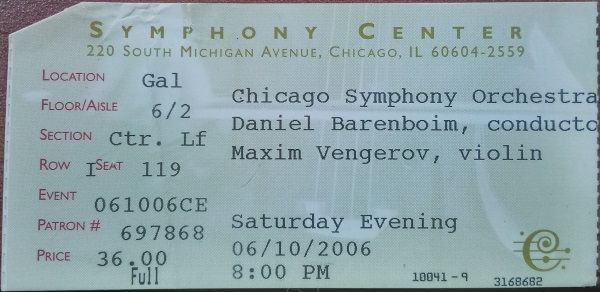
This past weekend, my girlfriend and I went to Chicago. Amongst other activities, we saw the Chicago Symphony Orchestra perform. Gathering ourselves together after dinner, we walked down Michigan Avenue. Millennium Park looked really neat with a colonnade at one corner and the mirrored jelly bean just down the block. On one street corner, there was a puppet show ongoing. A big box was strapped to the back of a bicycle and two cats were dancing in the hole at the top. On another corner, a guy dressed kinda like a 21st century Tin Man was doing his shtick – standing perfectly still. The crowd got noticeably wealthier as the Art Institute went past us across the street. Finally we arrived at Symphony Hall.

Standing there made me think of my dad as he had once commented to me that he and my mom would go to Symphony Hall quite frequently in the early and mid-1960s to see Joan Baez, et al. It was an eerie feeling to be in his shoes some 40 years later.

We went in and The Dulcinea smelled coffee and had to have some to ward off the post-prandial lethargy. She darted to the concession stand. Done sipping, we grabbed a few throat lozenges and walked up to the 6th floor where our nosebleed seats awaited us.

If you're not familiar with the place, the seats in the upper levels are positioned at a steep angle and I think this gave The Dulcinea a small case of vertigo. On the other hand, being so far up, I could not discern the features of any of the violinists of the fairer sex. Thusly I could not swoon over any of them like I do with Samantha George of the Milwaukee Symphony. I also want to add that, while, I like Overture Hall here in Madison, the home of the Madison Symphony Orchestra, Symphony Hall just looks a million times better. A writer for the Chicago Sun-Times wrote, after the CSO had played in Overture Hall, "Several CSO players reported that they could hear themselves and each other with greater clarity than at perhaps any hall they have played." I certainly believe this as OH was constructed from the ground up for acoustic greatness and it was achieved. But it looks like an Ikea showroom. Symphony Hall, on the other hand, actually looks like a place where the composers of most of the music the CSO plays could have actually been in their lifetimes. There's that antiquarian in me.

The program featured Anton Webern's Symphony, Op. 21, Mozart's Violin Concerto No. 4, and Igor Stravinsky's The Rite of Spring. I came for the Stravinsky but was pleased with the other pieces as well.

Webern's piece was first. (The program notes indicated that Webern was shot and killed by an American soldier in the final days of WWII as he stepped outside of his house to have a cigarette. We smokers just don't get no respect.) One of the founding fathers of serialism, his 21st symphony clocked in at 10 minutes with an orchestra of 9 performers. I'm not a huge fan of serialism but I do like the odd Schoenberg piece and the night's bit of Webern was pretty good. I enjoyed how the string and horn sections played off and against one another with the harp adding the odd bit of color to the mix and making transitions between sections. I think. The music would just go somewhere else after the harpist played a precious few notes. It was definitely music I had to concentrate on. Perhaps after hearing it several times, I won't need to listen so intently. But, for the first go-round, I definitely paid attention to what each section was playing and how the parts contrasted with one another. Mozart was next on the bill and the concerto featured the fantastic playing of Maxim Vengerov. The guy is younger than me and he can play a mean fiddle, lemme tell ya. I liked the feel of the piece – it was like a folk-like jig.

The crowd was very different than those I encounter here in Madison. Similar people, I suppose, but, they took every advantage of the pause between movements to cough. The first movement of Webern's piece came to a quiet close and the whole audience erupted in fits of coughing. I think it's just quaint how they hold it all in and wait for the right moment.

After the intermission came The Rite of Spring. It is one of my favorite classical pieces and I'd never heard it live previously so I was in for a real treat. It's one of those pieces that aficionados of classical music recommend to lovers of rock music to get them into classical. With the emphasis on rhythm and the fact that there was a riot at its premiere in France back in 1913, it seems like a natural gateway song. Some guy wrote a book 10-15 years ago in which he tried to match rock songs to classical pieces. He even gave an equivalent classical song for Allman Brothers fans. While I can understand such an approach, part of me feels like it's a waste of time. It's all music, on the one hand, but they're very different, on the other. Classical music should be appreciated as music and on its own terms. Rock and classical are both great genres of music. They have a lot in common but also have differences in modes of presentation, instrumentation, and demands made of the listener. Big whoop. Neither is better than the other. It's a real shame that rock critics like Dave Marsh, Simon Frith, and Lester Bangs have done so much to portray classical music as being "bourgeois" with rock music being more "natural" and unmediated because of it having sprung from the taproot that is the blues. The upshot of this is that white people are overly-intellectual and make music devoid of emotion while black people are so primitive that they cannot endow their music with an intellectual aspect thusly it provides a "true" path to raw emotion. What utter bullshit! Well, enough of this.

Needless to say, I really loved the performance of The Rite of Spring. I love the pounding rhythms and the dissonance. A chill ran up my spine when the strings started the insistent rhythm part just a few minutes in. I'll never forget the close of the first part, "Adoration of the Earth". The final section of it is called "The Dancing Out of the Earth" and it features this pounding rhythm. The bass drum player was hunched over his drum beating it. To go back to the rock analogy, he was playing like Keith Moon. I mean, the guy just wailed on the thing. Plus, did you know that the piece uses the guiro? I didn't until I read the program. The Rite of Spring is a ballet and I'd love to see it performed instead of just hearing the music. From the Wikipedia entry:

The complex music and violent dance steps depicting fertility rites first drew catcalls and whistles from the crowd, and there were loud arguments in the audience between supporters and opponents of the work, and were soon followed by shouts and fistfights in the aisles. The unrest in the audience eventually degenerated into a riot… Although the music and dance were considered barbaric and sexual and are also often noted as being the primary factors for the cause of the riot, many political and social tensions surrounding the premiere contributed to the backlash as well.

There was no riot Saturday night but the crowd gave catcalls and applauded for a good long time as this was one of Conductor/Music Director Daniel Barenboim's last performances with the CSO.

Growing up in Chicago, I was aware of Barenboim's predecessor, Sir Georg Solti. I recall very clearly listening to my dad's copy of an album of Solti conducting Ravel's Bolero and Tchaikovsky's 1812 Overture. It was one in this series that CBS Records put out called "Great Performances". He wasn't just any schmoe conductor – he was Sir Georg Solti. Plus he was from Chicago and I just thought the connection was neat. Barenboim took the reins from Solti in 1991, a few years after I had moved away from Chicago so I never became familiar with him. There was a good article in the Chicago Tribune yesterday assessing Barenboim's legacy. Although completely unfamiliar with Barenboim, I found it very interesting nonetheless. I appreciated how it described his job. McDonald's folks fry burgers and French fries; I'm a PC tech so I install software, swap out memory, tinker with Windows etc. in my job; but what the hell does a Music Director do? (S)he conducts, chooses pieces to be performed, and is to be the public face of an orchestra.

Barenboim has long been a polarizing figure in the classical music world, held in the highest esteem and affection by his colleagues and music professionals but, as a conductor and interpreter of the symphonic repertory, not universally admired outside his worldwide circle of close friends and political allies.

His Chicago years brought lively, sometimes contentious debate about the improvisatory nature of his conducting, the inconsistencies of his performances and his often cavalier regard for what was explicit in the score. The contradictions between what he said and what he did could be glaring. Barenboim, for example, seized on every opportunity to belittle the level of musical sophistication of the Chicago concert public but did next to nothing to address the alleged problem from the podium.

Relations between Barenboim and the administration had gone downhill since the arrival of Deborah R. Card, as CSO Association president, and William H. Strong, as board chairman. The board was disinclined to renew the $2.2 million contract of a Eurocentric music director with an arrogant disdain for building audiences and a penchant for programming modern music certain to have just the opposite effect at the box office.

I never really thought of an orchestra's music director as being the point man for a community's music education and doing outreach to the community and its young people. What does John DeMain, the Music Director of the Madison Symphony Orchestra do besides conduct? The MSO's webpage explains their outreach programs well enough. It's just that I don't hear or read about DeMain standing up for music education in our schools, especially when their budgets are threatened with cuts which is all the time. Maybe it's just me not paying attention but it just seems like he has a very small public presence here in Madison. Perhaps this is because he moonlights as an advisor to an opera company. After all, he is best known for putting on operas. DeMain isn't much of a personality around town. It seems that, for most of Madison, the MSO is just there. It does its thing and the hipsters of the city fawn over the High Noon Saloon and worry about a lack of places for "indie" rock bands to play. Nothing against DeMain (nothing against the High Noon either), mind you. Next season looks to be really great with The Rite of Spring, Carmina Burana, Beethoven's 8th, a pair of double bass concertos that sound highly intriguing, and Shostakovich's 5th. You can bet your sweet ass I'll be there for the Shostakovich performance!

12 June, 2006

How Would Terry Gilliam Program a Film Festival?

Now we know.

On the Popularity of Football/Soccer

Lost in the Limitless Rise

This past weekend, The Dulcinea and I went south to Chicago. It was an extended birthday present for her and a chance to indulge in some culture unavailable here in Madison. Saturday night would be spent at the symphony while we had plans on Sunday to meet up with an old friend of mine in Chinatown for lunch and to do a spot of shopping. After that we'd go see that muckraking gadfly Greg Palast.

I made the hotel reservation late in the game and we ended up at the Hard Rock Hotel on Michigan Avenue. Here's the view from our room on the 19th floor:


Down Michigan Ave. in the distance on the left, you can see the big mirrored jelly bean at Millennium Park. This is my super-zoom of it. Perhaps you can see that there's a bride standing before it.


The Hard Rock Hotel is for hipsters. Those in its employ were all in his or her 20s and most of the guests I saw were about the same age. It is in the old Carbide and Carbon Building and has been thoroughly remodeled. Areas by the elevators had glass cases with guitars and pictures of rock stars. And there was a gift shop full of items with the Hard Rock logo for folks to take home at a price to commemorate their brush with hipness in downtown Chicago. I went in there to get change and found a man and a woman both in their early 20s behind the counter. Tattooed and clad in black, they seemed completely out of place on Michigan Avenue. To me, they appeared as if they should be hanging out around Belmont & Clark instead. But a job is a job, I guess. The décor was nice as I liked the color scheme of blacks, greys, and gold. It was, however, a bit disconcerting to be moving my bowels and having David Bowie looking down at me.


And, when in bed, we could look up and see Angus Young:


The room was fully-stocked with a wet bar and snacks.


Notice the $11.50 jar of gummy bears.

Need to cover your Johnson? Is the good lady experiencing some dryness? Luckily there are intimacy kits. (Not that we had any problems in this area.)


The buildings are lost in the limitless rise.
My feet catch the pulse and the purposeful stride.


We got settled and headed out. While I can find all the usual tourist spots and stores, I am not familiar with the restaurants of The Loop. Art Institute? Marshall Fields? Gene Siskel Film Center? No problem. But finding a decent restaurant proved a challenge. We wandered around for a bit with the El clamoring overhead and taxis threatening to run us over at every crosswalk. Plus there were lots of homeless folks begging. Being a bit of an antiquarian, I enjoyed the opportunity to see so many old buildings. And big ones. I work downtown here in Madison in an 11-story building, which is tall for this town. But the skyscrapers in Chicago are virtual walls. They're offset by Lake Michigan, Grant Park, Millennium Park, and the fact that the streets are pretty wide so I never get an overbearing feeling of being enclosed. Walking by the intersection of Wabash & Wacker, I saw Marina Towers and Wilco's Yankee Hotel Foxtrot came to mind. As did my dad. His ultimate visit to Chicago was about 3 years ago and he stayed with friends at Marina Towers. That he had such a good time was always odd to me considering he hated cities – that's why we moved to Wisconsin from Chicago, after all.

The scene also made me think about the brouhaha over Archipelago Village here in Madison. AV is a proposed development of tall buildings, including one of 500'+ or so which would have office space, apartments, and be a transportation hub. Personally I think the plans of the buildings are absolutely gorgeous as I love the Victorian style of the architecture. AV will never be built here unless the developer, Curt Brink, pays off a lot of people. Common cries of "It's too tall", "It doesn't fit the neighborhood", and "It blocks the view of the Capitol" will kill any chance of the plan coming to fruition. Standing there in downtown Chicago, I just chuckled to myself. Just across the river from Marina Towers I saw that the construction of Trump Towers Chicago had started. It's scheduled to be completed in 2009 and replace Aon Center as the second tallest building in Chicago at 1,362ft./415m. Plus the Fordham Spire looks to be a go. At 2000', it would be the tallest building in the land. Yeah, I just have to chuckle.

We walked by a Gold Coast Dogs and I thought a Chicago dog would be tasty but The Dulcinea wanted something different. We settled on a Mexican restaurant.


The empanadas were alright but the sauce that was served with them was quite good. My carne asada proved better. Surprisingly, the peach daiquiri wasn't bad. Artificial crap flavor but not too sweet. After dinner, we went back to the hotel feeling all lethargic but the symphony beckoned.

Gathering ourselves together, we walked down Michigan Avenue. Millennium Park looked really neat with a colonnade at one corner and the mirrored jelly bean just down the street. On one street corner, there was a puppet show ongoing. A big box was strapped to the back of a bicycle and two cats were dancing in the hole at the top. On another corner, a guy dressed kinda like a 21st century Tin Man was doing his shtick – standing perfectly still. The crowd got noticeably wealthier as the Art Institute went past us across the street. Finally we arrived at Symphony Hall.

I had one last choke before going inside. Standing there made me think of my dad again as he had once commented to me that he and my mom would go to Symphony Hall quite frequently in the early and mid-1960s to see Joan Baez, et al. It was an eerie feeling to be in his shoes some 40 years later.

We went in and The Dulcinea smelled coffee and had to have some. She darted to the concession stand for a boost of caffeine. Done sipping, we grabbed a few throat lozenges and walked up to the 6th floor where our nosebleed seats awaited us.

If you're not familiar with the place, the seats in the upper levels are positioned at a steep angle and I think this gave The Dulcinea a small case of vertigo. On the other hand, being so far up, I could not discern the features of any of the violinists of the fairer sex. Thusly I could not swoon over any of them like I do with Samantha George of the Milwaukee Symphony. I also want to add that, while, I like Overture Hall here in Madison, the home of the Madison Symphony Orchestra, Symphony Hall just looks a million times better. A writer for the Chicago Sun-Times wrote, after the CSO had played in Overture Hall, "Several CSO players reported that they could hear themselves and each other with greater clarity than at perhaps any hall they have played." I certainly believe this as OH was constructed from the ground up for acoustic greatness and it was achieved. But it looks like an Ikea showroom. Symphony Hall, on the other hand, actually looks like a place where the composers of most of the music the CSO plays could have actually been in their lifetimes. There's that antiquarian in me again.

The program featured Anton Webern's Symphony, Op. 21, Mozart's Violin Concerto No. 4, and Igor Stravinsky's The Rite of Spring. I came for the Stravinsky but was pleased with the other pieces as well.

Webern's piece was first. (The program notes indicated that Webern was shot and killed by an American soldier in the final days of WWII as he stepped outside of his house to have a cigarette. We smokers just don't get no respect.) One of the founding fathers of serialism, his 21st symphony clocked in at 10 minutes with an orchestra of 9 performers. I'm not a huge fan of serialism but I do like the odd Schoenberg piece and the night's bit of Webern was pretty good. I enjoyed how the string and horn sections played off and against one another with the harp adding the odd bit of color to the mix and making transitions between sections. I think. The music would just go somewhere else after the harpist played a precious few notes. It was definitely music I had to concentrate on. Perhaps after hearing it several times, I won't need to listen so intently. But, for the first go-round, I definitely paid attention to what each section was playing and how the parts contrasted with one another. Mozart was next on the bill and the concerto featured the fantastic playing of Maxim Vengerov. The guy is younger than me and he can play a mean fiddle, lemme tell ya. I liked the feel of the piece – it was like a folk-like jig.

The crowd was very different than those I encounter here in Madison. Similar people, I suppose, but, they took every advantage of the pause between movements to cough. The first movement of Webern's piece came to a quiet close and the whole audience erupted in fits of coughing. I think it's just quaint how they hold it all in and wait for the right moment.

After the intermission came The Rite of Spring. It is one of my favorite classical pieces and I'd never heard it live previously so I was in for a real treat. It's one of those pieces that aficionados of classical music recommend to lovers of rock music to get them into classical. With the emphasis on rhythm and the fact that there was a riot at its premiere in France back in 1913, it seems like a natural gateway song. Some guy wrote a book 10-15 years ago in which he tried to match rock songs to classical pieces. He even gave an equivalent classical song for Allman Bros. fans. While I can understand such an approach, part of me feels like it's a waste of time. It's all music, on the one hand, but they're very different, on the other. Classical music should be appreciated as music and on its own terms. Rock and classical are both great genres of music. They have a lot in common but also have differences in modes of presentation, instrumentation, and demands made of the listener. Big whoop. Neither is better than the other. It's a real shame that rock critics like Dave Marsh, Simon Frith, and Lester Bangs have done so much to portray classical music as being "bourgeois" with rock music being more "natural" and unmediated because of it having sprung from the taproot that is the blues. The upshot of this is that white people are overly-intellectual and make music devoid of emotion while black people are so primitive that they cannot endow their music with an intellectual aspect thusly it provides a "true" path to raw emotion. What utter bullshit! Well, enough of this.

Needless to say, I really loved the performance of The Rite of Spring. I love the pounding rhythms and the dissonance. A chill ran up my spine when the strings started the insistent rhythm part just a few minutes in. I'll never forget the close of the first part, "Adoration of the Earth". The final section of it is called "The Dancing Out of the Earth" and it features this pounding rhythm. The bass drum player was hunched over his drum beating it. To go back to the rock analogy, he was playing like Keith Moon. I mean, the guy just wailed on the thing. Plus, did you know that the piece uses the guiro? I didn't until I read the program. The Rite of Spring is a ballet and I'd love to see it performed instead of just hearing the music. From the Wikipedia entry:

The complex music and violent dance steps depicting fertility rites first drew catcalls and whistles from the crowd, and there were loud arguments in the audience between supporters and opponents of the work, and were soon followed by shouts and fistfights in the aisles. The unrest in the audience eventually degenerated into a riot… Although the music and dance were considered barbaric and sexual and are also often noted as being the primary factors for the cause of the riot, many political and social tensions surrounding the premiere contributed to the backlash as well.

There was no riot Saturday night but the crowd gave catcalls and applauded for a good long time as this was one of Conductor/Music Director Daniel Barenboim's last performances with the CSO.

Growing up in Chicago, I was aware of Barenboim's predecessor, Sir Georg Solti. I recall very clearly listening to my dad's copy of an album of Solti conducting Ravel's Bolero and Tchaikovsky's 1812 Overture. It was one in this series that CBS Records put out called "Great Performances". He wasn't just any schmoe conductor – he was Sir Georg Solti. Plus he was from Chicago and I just thought the connection was neat. Barenboim took the reins from Solti in 1991, a few years after I had moved away from Chicago so I never became familiar with him. There was a good article in the Chicago Tribune yesterday assessing Barenboim's legacy. Although completely unfamiliar with Barenboim, I found it very interesting nonetheless. I appreciated how it described his job. McDonald's folks fry burgers and French fries; I'm a PC tech so I install software, swap out memory, tinker with Windows etc. in my job; but what the hell does a Music Director do? (S)he conducts, chooses pieces to be performed, and is to be the public face of an orchestra.

Barenboim has long been a polarizing figure in the classical music world, held in the highest esteem and affection by his colleagues and music professionals but, as a conductor and interpreter of the symphonic repertory, not universally admired outside his worldwide circle of close friends and political allies.

His Chicago years brought lively, sometimes contentious debate about the improvisatory nature of his conducting, the inconsistencies of his performances and his often cavalier regard for what was explicit in the score. The contradictions between what he said and what he did could be glaring. Barenboim, for example, seized on every opportunity to belittle the level of musical sophistication of the Chicago concert public but did next to nothing to address the alleged problem from the podium.

Relations between Barenboim and the administration had gone downhill since the arrival of Deborah R. Card, as CSO Association president, and William H. Strong, as board chairman. The board was disinclined to renew the $2.2 million contract of a Eurocentric music director with an arrogant disdain for building audiences and a penchant for programming modern music certain to have just the opposite effect at the box office.


I never really thought of an orchestra's music director as being the point man for a community's music education and doing outreach to the community and its young people. What does John DeMain, the Music Director of the Madison Symphony Orchestra do besides conduct? The MSO's webpage explains their outreach programs well enough. It's just that I don't hear or read about DeMain standing up for music education in our schools, especially when their budgets are threatened with cuts which is all the time. Maybe it's just me not paying attention but it just seems like he has a very small public presence here in Madison. Perhaps this is because he moonlights as an advisor to an opera company. After all, he is best known for putting on operas. DeMain isn't much of a personality around town. It seems that, for most of Madison, the MSO is just there. It does its thing and the hipsters of the city fawn over the High Noon Saloon and worry about a lack of places for "indie" rock bands to play. Nothing against DeMain (nothing against the High Noon either), mind you. Next season looks to be really great with The Rite of Spring, Carmina Burana, Beethoven's 8th, a pair of double bass concertos that sound highly intriguing, and Shostakovich's 5th. You can bet your sweet ass I'll be there for the Shostakovich performance!

Anyway, The Dulcinea and I made our way back to the hotel. I'd been up since 4(!) and found myself to be tired. As we lay on the bed talking, I drifted into the arms of Morpheus.

R.I.P. - György Ligeti

Hungarian composer György Ligeti passed away today. In the popular mind, he is best known for pieces that ended up in a trio of Stanley Kubrick films: 2001: A Space Odyssey, The Shining, and Eyes Wide Shut. You know when the Monolith appears to the apes and there's that infernal chorus singing? That's Ligeti's work. He was initially influenced by Hungarian folk music before he developed micropolyphony, dabbled in electronic music, and then became influenced by minimalism as well as African polyrhythms. He has quite a varied body of works.

You can learn more about him by checking out this page (Shockware required). Also note that the Chicago Symphony Orchestra will be performing some Ligeti next season in February - Lontano and Atmospheres, both of which were featured in 2001.

Creepy

OK, this is creepy. It's called Morgellons.

Imagine sweating beads of a black, tar-like substance; pulling colored threadlike strings from sores all over your body; or feeling like your skin is crawling with bugs. Worst of all, not only are doctors unsure of what it is, many tell patients they're making it all up.

Sufferer Annette Riaubia said, "They start out like little pimples or something and you scratch them, and they bust open and they spring forth these weird fibers like a strand of a piece of cotton."


That is just too fucking weird. Fibers growing out of your body...It's like something out of an H.P. Lovecraft story - the impending rise of Cthulhu. And most doctors think it's all a delusion. I think a movie needs to be made of this and David Cronenberg is just the guy to do it.

You have to admit that it's more than a little ironic that L.A. is the hot bed of Morgellons activity.

10 June, 2006

Cthulwho

Roadshowing The Shining

Netflix is presenting their Rolling Roadshow in which viewers can see famous movies in famous places. For instance you, can see Escape from Alcatraz on Alcatraz Island. Closest to home, Ferris Bueller's Day Off is going to be shown at Cedar Road Water Tower in Northbrook, Illinois. Personally, I'd like to see The Shining at the Stanley Hotel in Estes Park, Colorado.

Odds are that's not going to happen but I may get the chance to see it on the big screen again at the Orpheum as part of the Summer Camp series.

Four Star Video Heaven and the Orpheum are teaming up for the Summer Camp film series. Every few weeks, a cult film from the '70s or '80s is screened over Friday and Saturday night at the Stage Door, at midnight and 9 pm respectively.

The next wonderfully awful film to be shown will be Shiver, David Cronenberg's 1975 feature about oversexed suburban zombies. Other films under consideration include Switchblade Sisters, a femsploitation flick also from 1975, as well as Stanley Kubrick's take on The Shining from 1980.


How Kubrick's opus could be considered camp or "awesomely awful" is beyond me. But it would be nice to have it here instead of having to drive to Chicago to catch it on the big screen. And anything by David Cronenberg is welcome too.

Currently playing is 1990: The Bronx Warriors.

09 June, 2006

Weekend

I'm not really sure what's happening in town this weekend because I won't be here. The Dulcinea and I are heading to Chicago to hear the CSO. Here's the program:

Webern - Symphony, Op. 21
Mozart - Violin Concerto No. 4
Stravinsky - The Rite of Spring

I chose this concert because of Stravinsky but how can you go wrong with Mozart? I'm not very familiar with Webern's work so it will be neat to explore some musical terra incognita. It looks like we'll also be able to catch Greg Palast as he promotes his new book, Armed Madhouse. His stop in Chicago is his only one anywhere near Madison. For info, go here.

I'm spending an arm & a leg for us to stay downtown on Michigan Ave. in the North River area. I'm not sure when we'll be swinging into town so I'm unsure what else we'll do. We will be near the Art Institute and Millennium Park and a short bus ride from everything else downtown Chicago has to offer. Presumably there will be something going down at Grant Park. Since the Palast hoolie is near the UIC campus, perhaps we can make a trek to Chinatown. I'd like to be able to get my arse to the north side and hit some store but I dunno if we'll have time. My buddy Charles is trying to get me to go to a Russian grocery store to get him some pelmeni as he's jonesin'. The re-opened Pelmeni on State Street isn't for shite, according to him.

The theme for Rooftop Cinema tonight at the Overture Center is On Public Life. Also in cinema, Robert Altman's A Prairie Home Companion opens today.

I'd swear there's a neighborhood festival or some such thing going on this weekend but I cannot recall. Have a good weekend.

Welcome CAID & Fry and Hitchens Get Down to Brass Tacks

Kudos to the folks at Conservatives Against Intelligent Design. While the site owner and I probably disagree on many matters, it is nice to see conservatives speak on behalf of the truth of evolution and against foisting bullshit on kids in their schools.

Tangentially, I would also like to direct readers to a wonderful discussion on blasphemy. Joan Bakewell moderates the discussion featuring Christopher Hitchens and Stephen Fry. I expected philippics against religion from Hitchens and I wasn't disappointed. The surprise was Fry who is exceptionally articulate. (I knew was intelligent and that he'd be funny.) It was an absolute pleasure to listen to him - when Hitchens would allow him. hehe He has the same slow, deliberate way of talking that William F. Buckley does. I loved that he would expound upon a proposition by drawing on history as well as throwing in jokes as well.

07 June, 2006

The Primrose Path To Be Traveled

My roommate Stevie proposed to my other roommate, Becca, this evening and she accepted! The date is next November and they're planning on tying the knot in Mexico. And so I've got me some plans for next fall.

Word of the Week

sprachgefühl (shprä[k]-g&-"f[UE]l) n. an intuitive sense of what is linguistically appropriate

On the Gramophone

A little Nord Musik - "Lutefisk's Revenge" by Andrea Een.

Bad News From Tyranena Brewery

Rob Larson, brewmaster at Tyranena Brewery, says that it's likely that he'll be discontinuing Fighting Finches Mai Bock. On the bright side, in the July, 2006 issue of ALL ABOUT BEER magazine, author K. Florian Klemp proclaims Fighting Finches Mai Bock one of three of the best in the country.

He also notes that he started his next batch of Bitter Woman From Hell yesterday on 6/6/06...

I'm thinking of borrowing a friend's hound for this:

In conjunction with our first Annual Dog Wash on June 24, we're having a raffle, the prizes for which have been generously donated by local community members and businesses. But, oh yeah baby... we're offering up the Grand Prize: FREE Tyranena beer! That's right, one case of cold Tyranena beer per month for an entire year. (Sorry folks, no Brewers Gone Wild! beers will be included! Must be 21 years of age, a legal resident of Wisconsin - skip that one, illegal residents are eligible as well - heck, we'll even let someone from Illinois or Iowa be eligible, employees of the brewery are eligible, volunteers for the brewery are eligible, but there may be other restrictions that come to us up to the point of drawing) That's approximately a $350 value. Tickets will be sold for just $1.00 each or 6 for $5.00 and may only be purchased on the day of the Dog Wash (in case you missed it, that's Saturday, June 24 from Noon until 4). Visit our website for more details and a listing of all the great prizes. Proceeds benefit the Humane Society of Jefferson County.

Detritus

The BBC radio dramatization of Kurt Vonnegut's Thanasphere.

Pharyngula reports that Richard Dawkins is the latest member of the advisory board of the Secular Coalition of America. Speaking of the SCA, check out the 3 June episode of Freethought Radio as it features an interview with Lori Lipman Brown, the first full-time secular lobbyist in D.C., who works with the Secular Coalition for America.

Bill Maher has an internet-only program this summer over at Amazon. It's called Amazon Fishbowl with Bill Maher. It will run on Thursdays through 17 August. The 1 June show features Dean Koontz, Ward Serrill & Darnellia Russell, Steve Schirripa, and the Dixie Chicks.

If you've ever wondered what The Da Vinci Code would be like if Geoffrey Chaucer had written it, now is your chance. It's up at Chaucer's blog.

Where are you in the Geek Hierarchy?

Check out The Sarong Theorem Archive:


You'd better not lay a finger on Bilbo's Butterfinger.

An idea I like: free beer while shopping.

Caged Death Match: Palast v. Coulter?

The Battle of the Books began yesterday as Greg Palast released his latest tome, Armed Madhouse! while Ann Coulter did the same with her screed, Godless. Today Palast issued a challenge to Coulter: "I suggest this, Anne: let’s debate. Set the time, set the place, and I’ll be there. Nose to nose, my facts versus your fanaticism."

While I commend Palast for his willingness, I don't think Coulter is up for a debate. I can imagine it now. Palast would talk about disenfranchised voters and Coutler would say that they shouldn't be allowed to vote anyway. And so on.

Polka Redux


I wrote recently that Madison is not a polka town. As a bit of a follow-up, I wanted to note a recent article in The Capital Times. It notes how the Roger Bright Polkafest is no more. Instead it's now the Roger Bright Memorial Music Festival.

The polka festival has been a tradition for over 15 years in the little Swiss town and attracts polka fans from all over the Midwest. Organizer Mike Nevil said that they decided to shake things up in order to appeal to a wider selection of fans.

"We've mixed it up a bit -- it's not 100 percent polka," Nevil said. "Maybe we'll attract a bigger crowd and some different people..."

The festival will switch gears on Saturday with the country sound of the Eric Nofsinger Band, followed by Copper Box's unique blend of zydeco, swamp blues and Cajun rock described as "accordion swamp rock."


So a polka festival is now a music festival that has polka bands (admittedly, a goodly amount) in addition to other types of music.

I would also draw readers' attentions to a thread in The Daily Page forum. An annoucement was made regarding the 3rd Annual Sugar Maple Traditional Music Festival. I asked one of the organizers why there was no polka to be found at this year's event while a cajun band was to perform twice. (There was 1 polka band last year.) The answer was quite revealing:

On our post-festival evaluations, patrons have most requested more Cajun/Zydeco music. Meanwhile, the entertainment committee was interested in having a band perform and workshop both days. Lost Bayou Ramblers were able to fit the bill best.

I then asked about the general attitude of the Four Lakes Traditional Music Collective (the folks who put on the festival) towards traditional music from places other than the American South. Looking at the line-ups of the three festivals and at the bands & musical styles/traditions promoted at their webpage, virtually everything is from the American South. Here's a good chunk of the reply I received from the group's president, Evan Murdock:

We're very interested in representing a broad spectrum of traditional music, and are certainly looking for more ideas for bands and styles to represent. We hope to increase our diversity over time, and actively welcome your input... Please understand that booking bands is the single most difficult thing we do (as well as the most enjoyable). So the lineup in no way reflects a lack of interest in any particular style or region, but simply a balance of schedule, budget, and, frankly, our own experience. We have worked with Rick March, the state folklorist, who is well versed in the traditional styles of the area; he turned us on to Norm Dombroski, and a number of other styles from the area we'd like to feature.

That said, I think it's true that on both a regional and national level the traditions of the Midwest are underrepresented, and it's utterly appropriate for you to suggest that we should work to address that.


I certainly have nothing against the FLTMC or the Sugar Maple festival. The organization promotes great music and all three festival line-ups look fantastic to me. I'd attend the festival on the strength of Guy Davis' appearance alone. The point is that a small, young organization isn't going to establish itself by heading out into left field by promoting the folk music of the Upper Midwest. And this is because of what was said in the first response by "Jeb" - people don't want it. The attendees wanted more Cajun music.

I commend the FLTMC for at least being amenable to the idea of exploring and promoting the music of the American Midwest. It is no doubt a difficult task. Some folks may be familiar with the term "Americana" with reference to music. Americana means "American roots music based on the traditions of country". Just look at the PBS series American Roots Music. It explores blues, country, bluegrass, gospel, cajun, zydeco, tejano, and Native American. Perhaps excepting the contributions of Native Americans, the program promotes the widely-held view that equates American music with the music of the American South. However, it should be noted that the producers of the program recently approached the International Polka Association in Chicago:

Paul Lovelace of New York visited to Chicago in May, 2006, to do research for the "American Roots" television show on PBS, expected to be broadcast in the Fall.. He conferred with International Polka Association President Ken Gill (center) and Chet Schafer, known as the Dean of polka DJs, in the Polka Hall of Fame and Museum.

Later, IPA Director T. Ron Jasinski-Herbert was advised that excerpts from remote broadcasts of his "Polonia Today" TV show at the 1985 IPA Festival of Polka Bands and IPA Festival may be used as part of the program.


I presume this is the same show and that PBS is producing more episodes. So while the traditional music of the American South flourishes, that of the Upper Midwest is left to flounder.

So what of polka? How is it doing outside of Madison? While I think that a thorough examination would need to be done by the Center for the Study of Upper Midwestern Cultures or a similar group, I did find this article in the Milwaukee Journal Sentinel called "Polka still has a few twirls left". The subtitle reads: "Despite losing ground in major cities, music still thriving in rural areas". So there is some hope. I personally don't expect polka to ever become popular again. But it would be nice if our state dance could at least gain a little respectability here in Wisconsin generally and Madison specifically.

The Trials of Evan Z

Watching "Facing Life: The Retrial of Evan Zimmerman" was quite a roller coaster ride. The show concerns the retrial of Evan Zimmerman, an Eau Claire man who was arrested and found guilty of murdering an ex-girlfriend, Kathy Thompson. Thompson was found strangled to death on her wedding night back in Februrary 2000. Just prior to her murder, she and her new husband got into a fight which resulted in him spending the night in the pokey and thusly unable to be the murderer.

Zimmerman still pined after Thompson and he became the prime suspect in the case. After 11 months of investigation, including phone calls by the police to Zimmerman saying that they know he's guilty, he was finally arrested. The first trial resulted in a guilty verdict. Three and a half years of prison time later, during which he suffered a stroke, Zimmerman was back in court with the Wisconsin Innocence Project on his side. The DA had offered him a plea bargain in which Zimmerman would plead guilty to a lesser charge and have his jail time suspended but he refused. The program stuck to the retrial and the preparation immediately beforehand so one doesn't get a sense of how WIP decided to take his case. What viewers did get was a very compelling bit of drama and a glimpse of our legal system in action.

One thing to note is that Zimmerman was no angel when the murder occurred. He was an alcoholic and estranged from his children. This aspect of the story resonated with me personally. Seeing the streets of Eau Claire, he reminded me of the countless faces I saw at the Ten Pin Tap there as my own father indulged his penchant for the drink. Hearing Zimmerman's son talk about how his father's alcoholism ripped the family apart and how he coped with this by distancing himself from his father was eerily familiar as it mirrored my life. His son also said that this case was about his father trying to redeem himself...the show took on a very personal edge for me. Plus, it wasn't just some guy in another state going to court; it was a guy from a city in which I used to live (well, I lived a bit south of Eau Claire but was there often enough); and he was being defended by lawyers from my alma mater right here in Madison.

There are some fairly wrenching scenes in which Zimmerman nearly collapses from exhaustion and nerves when some UW law students prepare to prep him for trial with a mock cross-examination. The filmmakers had the head defense lawyer give brief introductions to the court proceedings before actually showing what happened. While it was no O.J. Simpson trial, this one had its own twists & turns and surprises. For instance, the medical examiner (I think) was, according to the defense attorney, one of the big factors for the guilty verdict in Zimmerman's first trial. He was brought back and again gave his description of how he thought Thompson was strangled in Zimmerman's van with a phone cord. The defense team brought out that blue cotton fibers were found on Thompson's neck (and underneath her fingernails). They didn't come from a phone cord and yet the medical examiner didn't know about the fibers. When another investigator was questioned, he admitted that he didn't try to match the fibers on the neck with those under the nails.

Another surprise came with one of the prosecution's witnesses. The trial was moved from Eau Claire to Dodge County (I think the courthouse is in Juneau) to avoid a tainted jury pool. Both sides agreed not to tell the jurors that there had already been a trial. While Thompson's husband was being questioned, he let it slip that there had been a previous trial. I give credit to the filmmakers for not having put music here (or indeed anywhere else in the trial footage). Instead of turning this into a Perry Mason moment, they chose to just show the disbelief on the face of the lead defense attorney - a great stylistic decision, in my opinion. If this show is any indication, real trials are a lot less hyperbolic than those portrayed in fictional TV shows and films. There was drama, to be sure, but dramatic moments punctuated long periods of dull, rote questioning and legal procedure.

SPOILER ALERT SPOILER ALERT SPOILER ALERT


At the end of the day, Zimmerman was exonerated. I don't know the legal term for it but the judge got the opposing sides together and basically let Zimmerman go free after saying that the prosecution has no case. Watching his face when being informed of this was very emotional. As he hugged everyone, tears welled in my eyes. Almost 4 years of his life were wasted and now he was found not guilty and his name would be cleared.

But he still had the task of integrating himself back into society. The prologue indicated that he was denied a janitorial job a few months after the trial. A background check revealed that he had been arrested. I don't know what a background actually reveals but either his exoneration was excluded from the check or ignored by the company. Zimmerman was told that, because he was arrested, he must have done something wrong.

Stylistically, I give kudos to the filmmakers for letting the story tell itself. The first half hour or so gave the background of the case but the rest of the program stuck to the trial at hand. And I was happy at the sparse use of music in the film. There was music during brief interludes which indicated a passage of time or a change of location but, when the trial was on and when things got down to brass tacks, there was no non-diagetic music. I really appreciate that the filmmakers let the drama of the story carry the film and that they didn't try to "artificially" move the viewer with music.

One thing the film only touched on was the responsibility of the police. The conclusion was that the authorities didn't have any good suspects outside of Zimmerman and that they pinned the crime on him. (Remember, they took 11 months to actually arrest Zimmerman.) An innocent man went to jail and three and a half years of his life. And now his reputation is tarnished and is having problems rebuilding his life. Yet the people responsible for this tragedy aren't being held responsible for their actions. At least the film gave no indication to this effect. Looking on the Net, however, I see that Zimmerman filed a suit against the City of Eau Claire for wrongful conviction.

Another long row to hoe.

06 June, 2006

666

Well, it's 6 June 2006 and, while I've got Iron Maiden's "The Number of the Beast" playing, Satan is hard at work making the world a horrid place. Oddly enough, Lake Monona hasn't turned to blood and no dragons are rising from its depths. Still, the world does look a little topsy-turvy today.

Firstly, note that the United States is giving nuclear technology to a member of the Axis of Evil - Iran.

Angelina Jolie and Brad Pitt fly across an ocean to Africa in order to avoid the press as they become parents and now they're hogging the spotlight by selling pictures of their kid.

Yahweh apparently decided to forsake a man in Kiev and so his visit to a lion's den ended in his desmise.

Did anyone else see Noam Chomsky on BookTV this past weekend speaking to cadets at West Point? The talk itself was actually given in April and you can read an account of it here. I thought it was quite interesting. This wasn't his usual philippic against U.S. foreign policy, but rather it was akin to a course lecture. He spoke about Just War Theory and made reference to a book on the matter which the cadets were reading. I don't personally know much about it so all I can really say is that Chomsky thought it to be rather meaningless as it's not grounded in a sound argument. His other basic point was one of universality. That is, if it is just for one state to launch a pre-emptive or preventative strike, then it is just for all states to do so. If it is just that the United States invades Iraq in a preventative war because it feels threatened, then Iran is justified in launching an attack on the U.S. in some fashion if it is sufficiently threatened by using the same logic.

A lot of food for thought.

05 June, 2006

Moyers On Faith and Reason

Bill Moyers will be looking at faith and reason starting on the 23rd of this month.

Bill Moyers returns to PBS with a seven-part series focused on the hot-button issues of faith and reason. Are fear and violence the inevitable consequence of clashing beliefs, or is a more tolerant world possible? Moyers will explore the ideas of leading thinkers on the relationship between religious fundamentalism and democracy, equality and human rights.