07 December, 2011

Chicago TARDIS 2011: Diversity and the Doctor

Another Chicago TARDIS has come and gone. But less than a year until the next edition.

I really got a lot out of the fan panels this year so allow me begin with a gripe. We attended one called "Diversity and the Doctor" which asked "How does the current series really stack up in its treatment of anyone who could be considered 'other'?" On the panel was Quiana Howard, a woman of color whom I recognized from past cons because of her wonderful costumes. Let me say this in no uncertain terms:

I was absolutely fucking appalled when she related some of the comments that she received over her Leela costume from last year:


Some people gave her grief saying, essentially, that only white women should cosplay as Leela. WTF? Who are these nimrods? As Grady from The Shining might say, they need to be corrected. It is 2011 and yet some DW fans find themselves in a micro-Kulturkampf over whether it is "appropriate" for a black woman to dress as a white TV character.

Quiana had multiple costumes again this year. Here she is with some other 5th Doctor afficianados.


(Photo found at the making my 11th doctor costume blog.)


For a look at the rest of her outfits from this year, including one of the Rani, check out the DW Cosplay Livejournal page.

Moving on, I think that there was a consensus at this panel that Martha kicked ass. I know that The Dulcinea loved her and Quiana did as well. They both expressed delight at seeing someone like themselves – a woman of color – as a companion of The Doctor. Unfortunately, there also seemed to be a consensus that Martha got a raw deal in terms of how she left the show. Yeah, she did an amazing job of carrying on when The Master was ruling the Earth (this was shown briefly in "Last of the Time Lords" but elaborated upon only in the book The Story of Martha) but the whole unrequited love thing was just weak – too weak for a character of Martha's strength.

There was also agreement that Matt Smith's tenure as The Doctor under executive producer Steven Moffatt is far too alabaster. My impression was that people enjoy the 11th Doctor as well as Amy and Rory but there are hardly even any secondary characters of color. Rita from "The God Complex" was the big exception to the rule. "Battlefield" from 1989 and featuring the 7th Doctor may have had more racial diversity in that one story than all of the last season.

So, Steven Moffatt, put more people of color in DW!


06 December, 2011

The Sparrow by Mary Doria Russell


My copy of The Sparrow is one of those enhanced versions with a set of questions for reading groups as well as an interview with author Mary Doria Russell. In the latter we find that Russell returned to religion (converted to Judaism) shortly before writing this book. This isn't surprising since The Sparrow is all about religious faith.

It concerns the Job-like Jesuit priest named Emilio Sandoz. The book opens in December 2059 with Sandoz being released from the hospital and transferred to a private residence to continue his recovery. He is the lone survivor of a Jesuit-sponsored mission to the planet Rakhat and he returned to Earth scarred physically and mentally. Scurvy and malnutrition wreaked havoc on his body during the long voyage home but his hands were mutilated on Rakhat and he is unable to use them. Sandoz is withdrawn as well as angry and bitter. He rebuffs attempts by the Jesuit hierarchy to get his testimony about just what happened on the mission to Rakhat.

Chapters relating to Sandoz's recovery more or less alternate with those that tell the story of how the mission came about and the events that transpired on Rakhat. In 2019 Sandoz, whom we discover is quite adept at learning new languages, is back in the land of his birth – Puerto Rico. Considering that he is a priest, he doesn't seem particularly pious. He has become good friends with Anne and George Edwards who retired there to do some good. Anne works in a hospital while George helps out at the Arecibo Observatory. Also at Arecibo are some friends of the Edwardses': Jimmy Quinn and Sofia Mendes.

One day Jimmy discovers a signal coming from a distant planet and it is revealed to be music of some kind. Sandoz is transformed and becomes convinced that it is a message from God so he approaches the Jesuit higher-ups about funding a mission to the planet which is the source of the transmission. They agree to his plan. Sandoz will be accompanied by Quinn, Mendes, the Edwardses, and a few other Jesuit scientists.

Because what happens on Rakhat is a central mystery of the novel, I won't go into exactly what left Sandoz in his pitiful state. But, the short, (mostly) spoiler-free version is thus. The crew land on the planet and discover that it is rather Edenic with lush, verdant vegetation. This section is on the hard sci-fi side of things with Russell detailing the missionaries' first tentative steps on a new planet and adjusting to a new diet and whatnot. Soon they discover a village inhabited by being known as Runa. However, they are rather "primitive" and not the ones broadcasting music into space. Eventually another alien named Supaari visits the village. Supaari is of another race called the Jana'ata and he is a businessman. After some time of getting to know one another, Supaari brings the humans to Gayjur, the great city where he lives and plies his trade. It is a Jana'ata individual whose singing was heard on Earth.

To paraphrase Marvin the Paranoid Android, the mission ended in tears. Much of what happened was the result of cultural misunderstandings but Sandoz emerges from the horrors visited upon him and his companions hating God, perhaps having lost his faith, his belief in God. At the beginning of the book his faith was intact but it was based on rather nebulous footing. Anne and George are atheists and Anne amicably discusses spiritual matters with Emilio. He wrestles with his faith. He questions it and basically comes to detente with doubt. Then the music from across the cosmos is heard and he takes it as a sign from God. This is the purpose of his life as ordained by his deity. Then it all comes crashing down.

I don't think Sandoz lost his faith because of the hardships he endured, per se. As it is noted in the book, Jesuits have been tortured and killed in the past while spreading the word. Rather it's the sense that the mission to Rakhat was not divinely inspired or his life's mission that causes Sandoz to lose his faith. It's that he was wrong and that others paid for his mistake.

Russell's take on faith here was, for me, like the wishy-washy BS that Karen Armstrong purveys. She seems to be saying that, at its core, faith is about engaging and being entangled with mystery. Or, perhaps more cynically, faith is the Sisyphean task of attempting to reconcile the unknowable and the unreasonable with reason. As an atheist who has never really had religious devotion – the kind of faith on display here – I find this conclusion to be unsatisfactory. On one hand, I can appreciate that this vision of faith is something that that the faithful struggle with. It's one element of our humanity. But on the other hand, as an atheist, it seems tragic to wrack your brain over what a mythical deity may or may not do or want of you.

Despite my misgivings about the concept of religious faith, I enjoyed The Sparrow immensely. The mystery of what transpired on Rakhat is carried to the end and Russell keeps the reader wanting to know. Plus she creates some great characters. Anne, a godless heathen, is tremendously likable. She is perhaps the lynchpin of the mission and of the group of friends. She holds things together and offers advice. And she can really turn a phrase. Being a godless heathen, Anne presents her own challenge to Emilio. Anne is a good person. She helps others and she is happy. But she doesn't worry about an afterlife or feel compelled to reconcile her existence with an enigma called Yahweh whereas Sandoz does.

Sophia Mendes presents a mirror image of faith. In the future, there are brokers who pick out intelligent children from poor families. The kids are taken away, cared for, and educated. Their sponsors recoup their investment and more over the course of several years when the child has become an adult with a good job. If faith is about dealing with an unknown and unknowable force in your life, then Sophia's predicament is about dealing with a known person who rules over you in very transparent ways. Her salvation, so to speak, comes when her sponsor is paid off. How is her servitude qualitatively different from that of Sandoz's?

Personally, I find these inverted representations of faith more interesting than the predicament of our Jesuit priest.

Are the Folks at Valkyrie Brewing Jethro Tull Fans?

And your only reply is slàinte mhath...

Central Waters has submitted a new label for approval, a Scotch ale called Slàinte.


I presume we'll see this next year sometime.

Rhinelander Brewing apparently has designs to enter the craft market with Underworld. I like the Cerberus on the label. Is Rhinelander owned by Minhas or do they just contract to have Minhas do their brewing?


Valkyrie Brewing continues to expand their offerings. According to their website, Rubee lager is the only beer they're bottling but Big Swede (Swedish Imperial Stout) and Dragon Blade (American Steamed lager) are available on tap. Big Swede was made when the brewery was Viking and I am wondering if Dragon Blade is simply the new name for Viking's LES Beer.

The site also lists some beer to look for in the future with some returning from the Viking rotation and others being new. Invader (doppelbock) is set to return while War Hammer is Whole Stein redux. Night Wolf, a schwartzbier, was formerly known as Mørketid. Lime Twist retains its old name while Rauch has been renamed Whispering Embers. New beers include Crimson Wonder, a Scotch ale, a weizenbock called Golden Horn, an IIPA made with Galaxy hops called Supernova, and Velvet Green which is a dry Irish stout.

Looking at some of these names I have to wonder if somebody at the brewery is a Jethro Tull fan. For starters, "Velvet Green" is a Tull song. The label for Crimson Wonder is a gold chalice and brings to mind the song "Cup of Wonder". Whispering Embers? Tull has "Fires at Midnight". Invader? See Tull's "Broadsword".

What other names could they use with a Tull connection? How about Songs from the Oud Bruin? Here are some others that come to mind:

Weatherbock
Magus Perdé Porter
Mother Gose
Slip Steam Beer
Dr. Roggenbroom


Dr Who Night Before Christmas


(h/t Dangerous Minds)

05 December, 2011

Destiny Disrupted: A History of the World Through Islamic Eyes by Tamim Ansary


Considering that my country has been at war with a nebulous band of Muslims called "terrorists" for 10+ years, I'd have thought that I would have read something like Tamim Ansary's Destiny Disrupted: A History of the World Through Islamic Eyes a lot sooner than I did. Growing up, Islam is not something I gave much thought to. I had a classmate whose family was from, I think, Saudi Arabia. Her parents spoke Arabic but I really didn't think much of this because other classmates would go home to parents who spoke Chinese, Polish, and Spanish. I simply knew that not everyone's family spoke English all the time. As I grew older, my impressions of the Middle East and Islam were mostly shaped by news reports of Muslims hijacking the Achille Lauro, blowing up Pan Am Flight 103, and bombing Marine barracks in Beirut. Oh, and various rich men in OPEC. I don't think I held it that all Muslims were oil barons or terrorists but rather that there's a lot of oil and violence over there with "over there" being the operative words. Islam just never seemed to encroach on these shores.

Of course 9/11 changed all that. And while I meant to learn more about the Middle East and Islam in the wake of those events, I never did. Luckily Ansary wrote Destiny Disrupted and my partner urged me to read it. Ansary was born in Afghanistan but moved here to the U.S. in his teens so he has one foot in the West and the other in the Islamic world and this gives him a valuable perspective. He is a gifted writer but not a historian. This too gives him a valuable perspective but it's one that works both ways.

Destiny Disrupted is aimed at ignorant people like myself who want to learn more about the Islamic world, the world which spawned Osama bin Laden and where our troops are fighting wars. He seems to be saying, "You want some context? Well, I'll give you context. 1,400 years worth of the stuff." But, in a larger sense, he is attempting to illuminate one strand of the great tapestry of human history. As he notes, "Islam can be seen as one world history among many that are unfolding simultaneously, each in some way incorporating all the others." We in the West have our story of civilization starting in Egypt and Mesopotamia, coming to an early climax in ancient Greece and Rome, continuing through the Middle Ages until the Industrial Revolution. A couple world wars and then America is on top. Destiny Disrupted is about creating a narrative like that but for the 1+ billion Muslims of the world.

Ansary begins by stating that, instead of using the term "Middle East", he's adopted "Middle World". "Middle East" may make sense to Westerners but not to folks living there. He also brings in the Islamic calendar so dates are placed within the familiar Western calendar of Common Era years as well as in years After the Hijra. The Hijra is where the book really begins. We learn of Mohammed's revelations and his accumulation of followers and of the machinations of his enemies in Mecca. In 622C.E. Mohammed and his followers fled to Medina and this is the Hijra. Destiny Disrupted explained a lot about Islam but it shouldn't be viewed as a guide to the religion. It gives you the general currents and the prominent figures of the story but this isn't an exegetical work. Ansary isn't out to throw quotes from the Qur'an at the reader but he does want you to understand that Islam is about more than a supernatural figure called Allah. It is a religion but it is also a prescription for daily life in a way that, I, at least, don't think of Christianity as being.

Without wanting to elaborate too much on 1400 years of history, I will say that it's a fascinating story. Mohammad's life encapsulates one era of Islamic history and the first four khalifates comprise another. Islam expanded its reach both in the hearts of people and in square miles. Then came dynasties such as the Umayyad and Abbasid. Things were looking good. Then the Seljuk Turks started invading Muslim lands in the 10th century (C.E.) and conquered the Islamic world. In the 13th century Chengez Khan and the Mongols gave a brief and exceptionally bloody encore. And let's not forget the Ottomans.

While the Islamic world was never wholly separated from the West, it isn't until (the Crusades aside) what we call The Age of Exploration that events take on a more "modern" patina. Western Europeans come to trade but, over the course of a few centuries, they insert themselves into Muslim societies and essentially colonize them with comparatively little bloodshed thanks to corrupt leaders, lopsided, no-bid contracts, et al. What started before the Industrial Revolution bloomed when oil was discovered and the history begins to sound really familiar. Destiny Disrupted is mostly a political history but Ansary gives the reader generous doses of cultural history as well such as how Western intervention and colonization spawned various reform movements.

Because Ansary is not a historian by trade, he is free to write in a very conversational tone. For instance, when Arab victory over a Sassanid army was assured, a Pheidippides-like messenger rides to Medina to deliver the news. Ansary writes: "Approaching Medina, he passed a geezer by the side of the road..." I think that this kind of approach helps readers who generally find history incredibly boring or who are unfamiliar with the material at hand to ease into the subject matter and hold their attention. On the other hand, his approach can elide nuance and give an incomplete impression. Take what he writes about Saladin, the Muslim leader who basically put the final kibosh on the Crusader Kingdoms and started his own dynasty. Ansary describes him as living an ascetic lifestyle and being a pretty nice guy who "often went out of his way to perform acts of hospitality and grace." "His power," we are told, "ultimately lay in the fact that people simply adored him." This allowed him to let "his reputation unite his people and soften his enemies."

While I'm not out to say that Ansary is wrong, the description of Saladin here omits the fact that Saladin got his ass handed to him by Baldwin IV, King of Jerusalem, at the battle of Montgisard and that Saladin encountered some rough spots in trying to keep his holdings consolidated. You can't deny Saladin's accomplishments or his reputation in the Islamic world, but I think that Ansary makes things out to be a bowl of cherries when things were actually more complicated.

Exactly how many more instances like this there are in the text, I don't know. But I don't feel that this diminishes the larger story being told. Ansary is out to provide a history for the lay reader and he accomplishes that well. He's not trying to place the Islamic world above Christendom, though he does take some well-deserved jabs at Western imperialism and arrogance. The story of the world through Islamic eyes runs parallel to and intersects that of the one seen through Western eyes. Destiny Disrupted doesn't answer the question that was asked so many times in the aftermath of 9/11 – why do they hate us? – with a litany of grievances but rather with the idea that the Islamic world and the West tend to talk past one another. There are some definite incompatibilities between the two cultures but collectively we have no way of beginning to mediate differences. Each views the other as The Other – that depersonalized bogeyman – and it seems that we can only communicated with greenbacks or at the point of a gun.

Lakefront on Brewing TV

A nice portrait of Lakefront Brewery in Milwaukee. It was cool to see that they're trying to isolate some Wisconsin yeast so that Local Acre will be made of 100% Wisconsin ingredients. Also neat is the brewery's support of local homebrewers by giving away free wort and allowing their recipes to be used in making homebrew kits. And they do offer a great tour.

Brewing TV - Episode 50: Lakefront Brewery from Brewing TV on Vimeo.

02 December, 2011

Coming Soon in Horror Theatre: KILL ME

Playwright Scott Barsotti's KILL ME will be the next production by Chicago's horror theatre troupe, WildClaw Theatre.

Upon awakening from a post-traumatic coma, Cam is convinced that she has lost her ability to die. As her reaction to immortality rapidly shifts from invincible wonder to cosmic terror, her sanity begins to break. Fearing life eternal, Cam attempts suicide…again…and again…causing her sister and lover to grapple with nightmares of their own, born in the dream world, and the real one. Are the demons plaguing these women real or imagined…and is there ultimately a difference? Through relentlessly shifting dimensions, soundscapes, and mental worlds, KILL ME presents a lyrical horror story in which unending life proves worse than death.

WildClaw previous staged Barsotti's The Revenants which was great.

I would definitely go the theatre more often here in Madison if troupes staged some horror like this.


Central Waters + Local Option = A Little Death

Central Waters has teamed up with the bierwerkers of Chicago's Local Option to create La Petite Mort. (Is "la" a definite or indefinite article?)


La Petite Mort is a Belgian inspired Weissenbock brewed as a one off collaboration between The Local Option and Central Waters Brewery in Amherst, Wisconsin. A bourbon barrel aged version of La Petite Mort will be available in spring 2012.

When Central Waters decided to open its brew house for its first collaboration beer, Chicago’s Local Option was the obvious partner in crime. The resulting brainchild, La Petite Mort – a Belgian inspired Weissenbock – maintains the traditional characteristics of its Bavarian forbearer, with the added complexity of Belgian ale yeast. La Petite Mort is dark amber in color; maintains a rich, full-bodied mouth-feel augmented by caramel; mild and dark fruit. Rounded out by an unostentatious bourbon driven aroma from brief bourbon barrel aging, La Petite Mort is a complex ale, a marriage of distinctive styles, and an orgasmic experience for the taste buds that revel in its glory.

I Am Tried And True - Trust Me

Yay for prejudice.

(/sarcasm)

A recent study found that atheists were about as trustworthy as rapists. It was one of six studies which examined why believers distrusted non-believers.

"Where there are religious majorities -- that is, in most of the world -- atheists are among the least trusted people," says lead author Will Gervais, a doctoral student in UBC's Dept. of Psychology.

The researchers conducted a series of six studies with 350 American adults and nearly 420 university students in Canada, posing a number of hypothetical questions and scenarios to the groups. In one study, participants found a description of an untrustworthy person to be more representative of atheists than of Christians, Muslims, gay men, feminists or Jewish people. Only rapists were distrusted to a comparable degree.

"Outward displays of belief in God may be viewed as a proxy for trustworthiness, particularly by religious believers who think that people behave better if they feel that God is watching them," says Norenzayan. "While atheists may see their disbelief as a private matter on a metaphysical issue, believers may consider atheists' absence of belief as a public threat to cooperation and honesty."

01 December, 2011

State "Loans" Spectrum a Few Million

I read today that there's a report going around saying that the state of Ohio has offered Sears Holdings Corp. $400 million to move its headquarters from suburban Chicago. That's a pretty big chunk of change.

It reminded me that the state of Wisconsin recently extended a bribe of its own to Spectrum Brands:

On Tuesday, the former Rayovac Corp. announced a deal with the state to invest $40 million in its Wisconsin operations, hire 60 new staffers immediately and keep its headquarters in Madison through 2016.

For help, Spectrum Brands is receiving an interest free, $4 million forgivable loan from the Wisconsin Economic Development Commission.

If Spectrum follows through on its plans and maintains at least 470 full-time employees in Madison until Oct. 1, 2016, it doesn't have to pay the money back.


So, is any of this $4 million interest-free, forgivable loan taxpayer money? Or is the private side of WEDC ponying up the bill? I'm thinking the former. Yet, it was not long ago that our illustrious governor said, "The state’s broke. Local governments are broke. They don’t have anything to offer." So we're broke yet we still have $4 million to lend at 0% interest and it may just end up being a gift.

One thing I don't like about Mike Ivey's article is that it doesn't say what happens if Spectrum is unable or unwilling to follow through on its plans. So, if they fall short for whatever reason, what then? Does the state simply get its money back? Money that could have been put to another use to grow the economy. I sure hope that, if Spectrum can't uphold their part of the bargain, that the state at least gets our money back with a little interest.

Another aspect of the article that bugs me is its lack of context. Did Spectrum ask for a loan? Did the company threaten to leave the state if no financial incentives were put on the table? Ivey notes that the company is on the "rebound from a 2009 Chapter 11 bankruptcy reorganization." It laid off 29 people this past June and posted a fiscal fourth quarter loss. But look on the bright side. It's full year loss was only $75.2 million.

Not having been a business or economics major in college, it is possible that I am missing something here. Perhaps Spectrum is just having some post-bankruptcy teething pains and is really on track to a healthy future. But considering that the company currently has 420 employees here in Madison and is being given $4 million to keep 470 jobs here for a few more years, I see the state basically subsidizing 50 of those jobs to the tune of $80,000 apiece. Can that $4 million be spent in a way that would enhance Wisconsin's economic future beyond 2016?

What Is Your MP3 Player Saying?

Last weekend at Chicago TARDIS I attended a couple panels with freelance writer and DW geek Graeme Burk. Never having heard of him before, I looked up his website. I found a blog post there called "Ten Songs Shuffled On An iPod" and it begins:

I don’t think there is a better indication for how eclectic, how varied, how diverse a human being can be than to trawl through an individual’s MP3 player.

At first I was given to agreeing with him when I remembered that I don't have any music on my MP3 player and haven't for many months. Perhaps more than a year. Instead my Sansa Clip has several lectures on medieval history stored on it. Currently I am listening to Era of the Crusades by Kenneth Harl with aural goodness about the Vikings and Byzantium on deck.

I prefer to think of this not so much as a reflection of a lack of diversity or eclecticism on my part but rather that I have superseded Mr. Burk in geekery. Furthermore, I feel that not owning an Apple product as he does also counts in my favor.

Movies to Return to Orpheum?

It's been months since the Orpheum Theatre here in Madison was regularly screening films but now I have a glimmer of hope that the projector will be fired up again.

In the new Isthmus Linda Falkenstein writes that the Orpheum Lobby Restaurant has closed until the spring for remodeling. But the interesting part is a quote from the theatre's event co-ordinator Jeff Ketterhagen.

Ketterhagen says the vision is for more of a cine-dine-style experience. That is, "people come in, have dinner, and then see a movie, whether it be old or new," something the Orpheum has done from time to time in the past, Ketterhagen notes.

Does this mean that cinema is returning to the Orpheum or does eating there and then walking to campus or driving to another theatre for a flick count as "more of a cine-dine-style experience"?

30 November, 2011

So Long Leine's Fireside Nut Brown


Word is that Leinenkugel is dropping their winter seasonal, Fireside Nut Brown, after this year's batch. It's apparently going away to make room for another beer as yet to be determined.

While Fireside was never a regular purchase for me, I have had it and it's not bad. Like most of their brews, the stuff is kind of watery - lacking a real malt backbone. And it's not that potent so I have to wonder why it is their winter seasonal. Hopefully the Big Eddy series will get some more exposure by being introduced full-time.

Wisconsin Senators Vote For Indefinitely Detaining U.S. Citizens

Matt Rothschild has a disturbing article about the National Defense Authorization Act, S. 1867 which, if passed, would give the government the power to throw U.S. citizens into Gitmo.

Section 1031 of the bill gives the President and the Armed Forces enormous power to detain people they believe were involved in the attacks of Sept. 11 or supported Al-Qaeda, the Taliban, or “associated forces that are engaged in hostilities against the United States or its coalition partners.”

That section empowers the President to detain such persons indefinitely without trial or to try them before a military court or to transfer them “to the custody or control of the person's country of origin, any other foreign country, or any other foreign entity.”


Sen. Mark Udall of Colorado introduced an amendment would, according to Human Rights First:

...would have removed three troubling sections of the defense authorization bill, proposals that the Obama Administration has warned could result in a Presidential veto. One section authorizes the military to indefinitely detain without charge individuals – including American citizens apprehended on U.S. soil – who are suspected of involvement with terrorism. A second section forces law enforcement officials to transfer a large category of terrorism suspects into military custody, against the advice of counterterrorism professionals. A third section will further institute restrictions on the transfer of cleared Guantanamo detainees.

Much to my chagrin, both Wisconsin senators voted against the amendment. I expect a jagoff like Ron Johnson to be all gung-ho and vote against it but so did Herb Kohl.

Don't let the door hit you in the ass on the way out, Mr. Kohl.

28 November, 2011

So Ole Says to Lena by James Leary


Prof. James Leary is, to my mind, one of a triumvirate of big names that really put the history of Wisconsin into the popular realm. John Gourda chronicles Milwaukee's past, Jerry Apps works to keep the state's rural past alive, and Leary is a folky anthropologist who eschews the well-worn symbols such as beer, cheese, and barns for equally pervasive but often ignored cultural markers such as Wisconsin folk music and jokes. Gourda covers Wisconsin's largest city, Apps works in a general rural/small town frameworks, but, as near as I can tell, it is Leary who looks at Wisconsin in the context of Upper Midwest region. Such is the case here with his So Ole Says to Lena: Folk Humor of the Upper Midwest.

Having grown up in Chicago, I was familiar with Polock jokes. (E.g. – "How did the Germans invade Poland? They walked in backwards and said they were leaving.") But, after moving to west central Wisconsin where there were mostly Olsons, Nelsons, Johnsons, Skogstads, etc., I soon encountered Old and Lena jokes such as this one in Leary's book.

What was that one about Ole and Lena? Oh, they were going to get married.
And they asked Ole, they says, "Are you a...what nationality are you?"
He says, "I'm a Swede."
He asked Lena, "What are you?"
Says, "I'm Norwegian, but I have a little Swede in me, too. Ole couldn't wait."


While there are plenty of Ole and Lena jokes in this book, Leary provides a comprehensive survey of jokes of various stripes here. Let me backtrack for a second and note that the book's introduction is by W.K. McNeil of The Ozark Folk Center. It's less than 20 pages long yet has 42 footnotes. He describes jokes as "complex, many-sided folk narratives" and provides a short history of academic joke collecting. Generally speaking, humor has been ignored until recently by scholars and some of the work that has been done in pretty shoddy. Furthermore, it would seem that Leary is breaking some new ground here as Upper Midwestern humor looks to have been given short shrift but Leary provides the remedy to this problem.

The jokes here were recorded by the author himself over the course of many years in the 1970s and 80s and are presented in chronological order of nationality as they appeared in Wisconsin. That is, American Indian tales come first followed by French, Cornish, and so on. Once ethnic jokes are dispatched with, we move on to those relating to vocation such as logging and farming. Humor directed at townsfolk and hunters & fishers round things out.

Leary annotates the jokes as necessary, explaining homophones, place names, and pointing out recurring motifs such as "Drunk as usual". Leary explains how jokes can deal with many topics. One common one is how they are windows into times when traditional culture meets change. I personally like the Ojibwa joke about Wenabozho, a mythical being, going to see a psychiatrist. Lots of humor is directed by one ethnic group at another so you get examples such as Norwegians telling "dumb Swede jokes".

On a more personal note, I have to admit that my own experience with Wisconsin humor is consonant with the picture that Leary paints here. When I first moved to Wisconsin, Norwegians were usually the butt of ethnic jokes. It's like you could just swap the word "Polack" for "Norwegian" or "Stash" for "Ole". About a year after I moved to Madison I met a Finnish-American who was a co-worker. He worked hard and drank a lot – a trait you find in Finnish jokes. (He took to the description "blue-faced drunken Finn" from John Dos Passos' USA Trilogy.) And he liked saunas so I was very amused by the Finnish joke in the book called "The Cannibals' Sauna". During one conversation in which Stoughton came up, this Finn told me something along the lines of "There's just a bunch of Norwegians on acid down there." Lo and behold Leary includes the following:

What do you get when you cross lutefish with a hit of LSD?

A trip to Stoughton.


The book also includes a variation of a tall tale I heard more than once living up nort – that of the hunter whose gun wasn't working so he had to jump from a tree onto a buck and kill it with his bare hands. Lastly, I'll note that it was interesting to see how jokes that rural folk made about town folk morphed into jokes that Cheeseheads make about FIBs.

Leary excludes the humor of African-, Asian-, and Hispanic-Americans as these groups haven't been in Wisconsin long enough or in large enough numbers. But there will no doubt be a companion volume at some point in the future when the jokes of these cultures lose their "Old World skin". I can only recall one Hmong joke that I heard when living up by Eau Claire. I think it was one of the city's high schools that had a bulldog mascot and the joke was "Why did the school take down the bulldog statue? Because too many Hmong pulled up thinking the school was a restaurant." Ba-dum bum. Surely there are jokes out there that aren't nasty like this one.

So Ole Says to Lena was not only funny, but I also appreciated that it filled in the picture of how Europeans settled the Upper Midwest generally and Wisconsin specifically. We tend to think of the story as simply that a bunch of Germans and Scandinavians came over and farmed but there were rivalries brought over from the Old World that persisted and you can get a glimpse of them in folk humor. The same can be said of how American Indians adapted to their fate when the territory was overrun with pale faces and how their traditions ran headlong into the dominant culture. So Ole Says to Lena is not overly academic, the introduction aside, and is some fine reading for denizens of Wisconsin, Minnesota, and Michigan's UP. (Along with some folks from Illinois, Iowa, Lower Michigan, the Dakotas.)

18 November, 2011

The Whole Nine Yards


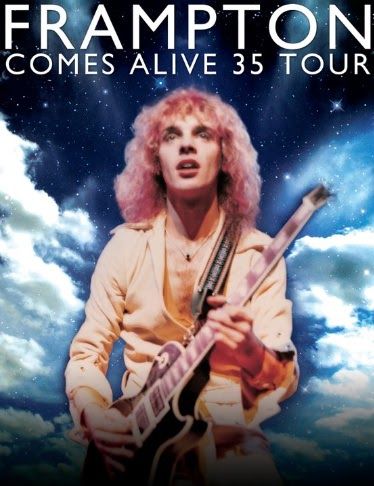
I recently received an e-mail stating that Peter Frampton was coming to the Pabst Theatre and that he’d be performing his 1976 live album, Frampton Comes Alive!, in its entirety.

At first, I thought that this was the first time a classic rocker has replicated a live album in concert (how meta) as opposed to performing a studio album in its entirety but then I recalled that the Allman Brothers did it earlier this year. After seeing the ad I wondered when this trend of performing the whole of a classic album from a band’s past started. I immediately thought of Steely Dan who, back in 2009, devoted each show of a multi-night to playing one of their old albums so that you might get The Royal Scam the first night and Gaucho the next. In 2010 and again this year, Rush did Moving Pictures. Jethro Tull included all of Aqualung on the album’s 40th anniversary tour and Ian Anderson’s next solo outings will feature Thick as a Brick – all 40+ minutes of it. (No word on whether the bunny suits and phone call will also be present.) Metallica recently announced that “Enter Sandman” and the rest of Metallica (a.k.a – “The Black Album”) are getting the treatment next summer at the Download Festival. And we can’t forget that Roger Waters is taking The Wall out on the road again next year. On the neo-proggy side, Fish gave Misplaced Childhood a workout back in 2005 for that album’s 20th anniversary while IQ recently dusted off Subterranea – costumes and all – for a special gig and that album is only 14 years old.

This article notes that Van Morrison “flogged Astral Weeks” back in 2008 but it also blames Brian Wilson for his 2002 during which Pet Sounds was performed in its entirety. Now, some shows on Pink Floyd’s Division Bell tour – I think they were later in the itinerary – featured Dark Side of the Moon done from beginning to end, though it didn’t seem to have started the trend as I can’t think of any bands from 1995-2002 that pulled this same stunt. Now that I think about it, The Who weren’t afraid to perform all of Tommy back in 1989 but, again, these shows didn’t seem to have kicked off a frenzy of other bands doing the same.

I’m not opposed to the idea of a band playing an entire album culled from their back catalogue. Indeed, some of them demand it, i.e. – concept albums, especially those that weren’t banded. (Is banded still a word? I mean there were no spaces between songs.) And no doubt some songs that haven’t been played live in a while or perhaps not all get an airing. On the other hand, I can see there being instances which reinforced the idea that the songs/albums that dominate classic rock radio are the apex of a band’s career and, in a sense denigrate the rest of the band’s catalogue. For example, I’d much rather hear Animals or Meddle than DSotM or The Wall and the fact that the latter two albums have gotten the played-in-its-entirety treatment and have dominated the band’s setlists for decades tends to, in my mind, relegate the rest of Floyd’s catalogue to second class status.

Depending on the band and the album, there are probably many reasons why any given album gets this treatment. Returning to Pink Floyd, I gather that the Gilmour-led incarnation chose the material it chose because they didn’t want to play a whole lot of stuff that Roger wrote and they also wanted to play songs for which they still held an affinity. Hence Animals is ignored and “Echoes” was dropped after a dozen or so shows back in 1987.

At the end of the day, a band can play whatever it wants. But, as a fan, I’d rather there be more variety at a concert instead of the bulk of a show going to greatest hits and albums that are already and have been for some time overrepresented on classic rock radio.

16 November, 2011

La Rocca's Moving to Oregon

It was a bummer to read the news that La Rocca's is closing shop here in Madison and moving south to Oregon. (The town not the state.)

This is too bad as I liked their food. Best of luck to the La Rocca family. Hopefully this family restaurant won't suffer the same fate as Bev's - leave Madison for a small town and then go out of business shortly thereafter.

I also hope that some place interesting moves in. The neighborhood could use a good ethic eatery. I know Linda Falkenstein is pulling for Bolivian food but I'm hoping for a Polish restaurant. It'll probably be a cafe.

Lukas Diaz is Wrong About the Economy

Lukas Diaz tees off on Dave Cieslewicz in a post called "Citizen Dave is Wrong About the Economy". Cieslewicz was critical of the economic development group Thrive in one of his recent blog posts.

Diaz begins by attempting to discredit Madison's former mayor by citing some development failures of his administration and noting that Epic's move to Verona was squarely at odds with Cieslewicz's Richard Florida-inspired views. The crux here is Cieslewicz's disagreement with the idea that Madison and Janesville are optimal Thrive partners for economic development:

So why are Madison and Janesville both part of the same “region” as defined by the private-public economic development entity called Thrive? There is simply no good reason for it, and the wrong definition of the region is hurting Madison and Dane County, while it isn’t doing much for the other seven included counties either. Thrive is a fine idea, and a good organization led and staffed by bright people, but it’s fatally flawed by its size.

After attempting to argue that Cieslewicz is not the most knowledgeable person to be commenting on the issue, Diaz says:

The difference between Madison and Janesville are much smaller than the difference between Madison and the whole world. We are in a global economy, regional cooperation is a good thing. So Thrive, keep doing what you’re doing.

The first sentence hangs on how you define "difference". Sure, Madison and Janesville are geographically close to one another, are bound by a common language, et al, but these are not the things Cieslewicz was talking about because they aren't that important when it comes to Madison deciding where to pin its economic future. Yes, Madison has fewer "differences" when compared to Janesville than Shanghai, but so what?

Take a look at the second sentence. What can Janesville contribute to a partnership with Madison that will give everyone a leg up in competing in a global economy? Parker Pen and GM are gone and I'd bet that most of the suppliers to these industries are also gone. I don't have statistics other than an unemployment rate of around 9% to determine what Janesville would bring to a marriage; instead all I have are anecdotes. My mother goes to visit family there and has concluded that it's a city on life support. A friend has a sibling who works at a Rock County job center and this person has nothing but horror stories. So, while the plural of anecdote is not data, I am sticking with my story until someone comes up with some data that show how Janesville would be a good partner for Madison in a global economy.

If Janesville has something to add to our economic future, great. We here in Madison should be ready to partner with anyone. But in terms of focusing efforts, Madison needs more of this, an energy research consortium linking facilities and researchers in Milwaukee and Madison together. The southeast corner of Wisconsin accounts for about a third of the state's economic output with Milwaukee being the northern frontier of an economic mega-region with Chicago, a global city, at its center. That's where Madison should be seeking partnerships.

15 November, 2011

Vladimir Putin Named Peacemaker of the Year

This is just rich. Vladimir Putin has won an award for promoting peace. It's almost as big a joke as Obama winning the Nobel Peace Prize.

After two wars in Chechnya, one conflict in South Ossetia and two of the deadliest hostage relief operations in modern history, the former KGB officer was named on Monday as the winner of the second Confucian peace prize.

It is unclear if Putin is even aware of the award which was chosen by an obscure cultural organisation, the China International Peace Research Centre, from a field of nominees including Bill Gates, Angela Merkel, Kofi Annan, Jacob Zuma and a Tibetan Panchen Lama imposed by Beijing.

The 16-judge panel said that Putin deserved the award because his criticism of Nato's military engagement in Libya was "outstanding in keeping world peace", regardless of the fact that it had no bearing on the outcome of the north African conflict.

Madison's Polish Film Festival is On!

The 21st Annual Polish Film Festival takes place here in Madison beginning this weekend. It's going to come in two phases this year with the second coming next month.

Admission is free.

Here's the schedule:

Cinematheque, 4070 Vilas Hall, 821 University Ave.
Saturday, November L9
1:00 PM Joanna with director Feliks Falk


3:30 PM Black Thursday (Czarny Czwartek)


Great Theatre, Memorial Union; 800 Langdon St.
Sunday, November 20
2:00 PM The Officer's Wife


Eastgate Cinema, 5202 High Crossing Blvd.
Thursday, December 8
7:00 PM 1920 The World's Most Important Battle (192O Bitwa Warszawska)
Poland's premier 3D film...3D glasses will be provided


Marquee Theatre, Union South, 1308 W Dayton St.
Saturday, December 10
3:00 PM Wonderful Summer (Cudowne Lato)


Sunday, December 11
7:00 PM "Winner" (Wygrany)


11 November, 2011

Batch 19 Hits Madison & Other Brews News

Yesterday the Wisconsin State Journal reported that MillerCoors has added Madison as a test market for Batch 19, "pre-Prohibition style lager". It's on tap around town at the following locations:

Bonfyre American Grille, 2601 W. Beltline

• The Cannery Grill, 315 E. Linnerud Drive, Sun Prairie

• Whiskey Jacks, 552 State St.

• Lazy Oaf Lounge, 1617 N. Stoughton Road

• Club Tavern, 1915 Branch St., Middleton

• Lucky's Bar and Grille, 1421 Regent St.

• Chasers, 319 W. Gorham St.

• Namio's Sports Pub, 5956 Executive Drive, Fitchburg

• The Draft House, 1010 Enterprise Drive, Verona

• Nitty Gritty, 223 N. Frances St.

And earlier this week I found some new labels from Milwaukee Brewing Company.


Hop Happy looks to be an IPA while Polish Moon is apparently a milk stout. No idea about Booyah. Anyone know if these are on tap at the brewery or at the Milwaukee Ale House?

A couple other miscellaneous things.

Firstly, a friend of mine who loves Ale Aslyum's Mercy Grand Cru told me that he thinks this year's batch is great and much better than last year's. I'll give the credit to Joe Walts because, if I don't, he'll never let me drink his homebrew again.

Lastly, I was in Palmyra earlier this week. I stopped in at the BP there for gas and found that there was a display in the aisle near the coolers for Potosi beer. Just a stack of 6-packs out to meet the customer. Despite how boring Jeff Glazer thinks Wisconsin breweries have been lately, I think it's great that one can get craft beer at gas stations in just about every podunk town in this state.

09 November, 2011

Welcoming a Boy Into Manhood

This past weekend I found out that my 12 year-old stepson has started listening to Disturbed. All I know about them is that they're a metal band from Chicago and that they did a cover of Genesis' "Land of Confusion". Prior to this revelation, he only listened to early Beatles ("Love Me Do", "Eight Days a Week", &c.) as far as I knew. I guess the testosterone is flowing.

With puberty immanent, I've been thinking about how to celebrate his first step into manhood. American WASPy culture doesn't have much in the way of rituals to celebrate entrance into puberty. A talk about birds and bees or a trip to the store for tampons is about all this culture can offer. There's no equivalent of Bar/Bat Mitzvahs for us gentiles. I had a friend who's Catholic family had him confirmed when he was around 12 but I'm not sure confirmation really counts. And we're not Catholic.

Looking around the Net, I see that some cultures initiate boys into manhood with a beating or a tattoo. While I think a beating would do the kid good, that won't fly. And neither will taking him to a brothel. I've gotta find something good and manly. I don't hunt so I can't take him deer hunting. I'd take him camping and let him do some fishing and maybe shoot a real gun for the first time but it's too late in the season.

I never had a Welcome to Manhood rite so I've no personal experience to draw upon. Maybe I could take him to a bar like Wiggies, buy him a root beer, and then take him to an R-rated movie.

Somebody help me out here with suggestions.

New Liquor Store Coming to Madison?

Binny's Beverage Depot, a Chicago-area chain of liquor stores, is looking to into Wisconsin.

Binny’s CEO Michael Binstein says he’s seeking sites in other downstate Illinois markets and is preparing a push into neighboring Wisconsin. “We’re looking at moving into both Madison and Milwaukee,” Binstein told Shanken News Daily. “There are some exceptional opportunities in Wisconsin.” Binstein also disclosed clear ambitions to expand regionally and then nationally. “Once we set up the internal infrastructure to expand to Wisconsin, we can use that as a springboard to go national,” he said.

I've been to Binny's in suburban Chicago and they are quite the stores. A great selection of beer. While it all depends on the store and on distributors, I am hopeful that a Binny's here in Madison would have a decent German bier section, unlike basically every retailer in the city.

Spring Cinematheque Schedule Taking Shape and Other Cinematic Ramblings

I noticed recently that The Innkeepers will be playing at the UW Cinematheque next semester on 17 February. Looks like we have some good scares to look forward to.


The following month on the 31st Cinematheque will screen François Truffaut's The Soft Skin.


And then on 28 April the Cinematheque will usher in spring with The Makioka Sisters by Ken Ichikawa.


Hopefully Beyond the Black Rainbow will make its way here next year as well. It sounds like a real mindfuck kind of flick – check out the synopsis from the Tribeca guide:

Panos Cosmatos brings a bold, Kubrickian vision to the screen in stunning detail in this sci-fi fable of a young woman imprisoned in an experimental laboratory and the enigmatic scientist who is her captor. Set in a futuristic 1983, Elena finds herself held against her will in a mysterious facility under the watchful eye of the sinister Dr. Barry Nyle. Pushed to her limits, Elena is left with no choice but to navigate an escape from her labyrinthine prison, in the process revealing its hidden secrets.


Notice the shot here in the trailer of the tunnel. Makes me think Cosmatos is a Tarkovsky fan as well.


A couple film festivals start soon at the UW. First comes the 1st Annual Reel Love LGBT Film Festival. It begins tomorrow night and here's the full schedule:

Thursday, November 10
7:00 pm: We Were Here (USA, 2011, 90 min., digital, dir. David Weissman)

Friday, November 11
4:30 pm: Paris is Burning (USA, 1990, 78 min., digital, dir. Jennie Livingston)
7:00 pm: Tomboy (France, 2011, 84 min., digital, dir. Céline Sciamma)
9:30pm: The Birdcage (USA, 1996, 118 min., digital, dir. Mike Nichols)
11:59 pm: Pink Flamingos (USA, 1972, 92 min., digital, dir. John Waters)
Midnight: Dance at DMF. Plan B’s Video DJ Amos Smith performs for free at the Sett in Union South

Saturday, November 12
4:30 pm: For the Bible Tells Me So (USA, 2007, 100 min., 35mm, dir. Dan Karslake)
7:00 pm: Bloomington (USA, 2010, 83 min., digital, dir. Fernanda Cardoso)
9:30pm: 3 (Drei) (Germany, 2010, 120 min., digital, dir. Tom Tykwer)
11:59 pm: Codependent Lesbian Space Alien Seeks Same (USA, 2011, 75 min., digital, dir. Madeleine Olnek)

Sunday, November 13
4:30 pm: Were the World Mine (USA, 2008, 95 min., digital, dir. Tom Gustafson)
7:00 pm: Beyond Gay: The Politics of Pride (Canada, 2009, 85 min., digital, dir. Bob Christie)

Good to see that Tom Tykwer's Drei will be screened. I like Tykwer but it's pretty far removed from the stuff that earned him his reputation.

And then on the 19th is the Celtic Film Festival.

Saturday, November 19
1:00 pm Cornish shorts (52 minutes)
Y Fargen (10 minutes)
3:00 pm The Runway (95 minutes)
5:00 pm Parked (94 minutes)
7:00 pm Blazing the Trail (86 minutes)
Followed by Q & A
9:30 pm NEDS (124 minutes)

Sunday, November 20
1:00 pm Irish shorts (81 minutes)
3:00 pm Jig (99 minutes)
5:00 pm Kings (88 minutes)
7:00 pm Patagonia (118 minutes)

Sundance has updated their calendar.

Take Shelter opens this Friday.


The Skin I Live In will arrive on the 18th.


Lastly, Werner Herzog's Into the Abyss hits Madison 2 December.

The Musical Box @ Pabst Theatre, 29 October 2011

(Photo by Leon Alvarado)

A couple weekends ago my partner, The Dulcinea, and I caught The Musical Box at the Pabst in Milwaukee. They were doing The Lamb Lies Down on Broadway again and I’d seen them do it back in 2005 while she had never seen them do The Lamb previously.

This time around I paid more attention to the theatrical part of the concert. Having seen it already before, the novelty of it was gone and I was able to concentrate a bit more on the presentation because I wasn’t sitting there thinking, “Holy fuck! This is what the legend is all about.” I came away with an even greater appreciation for both the Lamb concerts as rock theatre and the album as a story.

First let me get a purely musical thing out of the way. The air in the theatre was electric before the band went onstage and this feeling was dramatically heightened when the lights went down, the New York skyline appeared on the screens at the back of the stage, and the piano opening of the title track began. It’s a rather innocuous way to begin a 90+ minute musical journey and I say “journey” because, for me, The Lamb is one. It’s not simply a concept album where the songs tread a common thematic ground but rather one with a narrative, however odd it may be. So you have this down the rabbit hole kind of moment at the beginning. But what really sent shivers up my spine was when the “pharoahs going down the Nile” jam on “Fly on a Windshield” kicked in. The opening of the song is quiet yet tense. The pictures of New York are folded back like the pages of a book. “And I’m hovering like a fly, waiting for the windshield on the freeway…” Lights go out and BAM! The drums crash in. That Mellotron string sound cuts the air and the bass pedals make your whole body shake. You feel them. Every part of your body feels them. I absolutely love this song and think that, live, it is simply amazing.

Moving onto the theatrics of the show, there’s really a lot going on in addition to the slides and costumes. To begin with, there are risers at the back on either side of the stage and Denis Gagné would alternately sing from both of them. It wasn’t until this second go-round that figured out that this fits into the theme of the album, i.e. – Rael finding another side of himself or whatever it is that The Lamb is about. I didn’t pay enough attention to discern whether or not the side of the stage he sings from correlates to something in the lyrics which would indicate we’re hearing the tough kid Rael or another side of him. Regardless, I think it reinforces the notion of Rael having more than one side to him.

“The Waiting Room” is quite remarkable live. Once the free form evil jam ends and the melodic part takes over, some very bright white lights at the foot of the stage come on. Since they’re pointed at the audience, it is rather hard to see. I had to look away. This simple lighting setup illustrates the lyric from “Lilywhite Lilith” – “Two golden globes float into the room/And a blaze of white light fills the air.” Gagné then dons a Lamia costume and does a little routine in the center screen. You can see it unfold in below but the video doesn’t do it justice. The lights truly are disorientating and, combined with the spooky music and the costume, the performance creates this mini gesamtkunstwerk moment that moves it away from a standard rock concert. The lights caused my eyes to tear up and they darted around looking for view of the stage that didn’t involve staring into them. Combined with the loud music that dominated my hearing, it was, like I said, really disorientating. So, when the Lamia appears on the screen, it was genuinely creepy.

During “Back in NYC” Gagné picks up a bottle as he sings ” When I take out my bottle, filled up high with gasoline” he picks up a bottle from the drum riser and, after finishing the verse, throws it at the prop at the back of the stage which looks like a rock formation. Now, when it lands, there’s supposed to be a flash of light and a small explosion that emanates from the rock. At the Milwaukee show, a flash went off before he threw the bottle and there was no flame.

Now, The Musical Box recreates the experience of old Genesis shows but I’ve also heard that they occasionally throw in some of the mistakes that actually happened back in the day. But unlike, say, Dark Star Orchestra, I don’t think TMB actually attempt to recreate individual concerts. For example, Peter Gabriel face-planted during the performance on 10 April 1975. Now, if Gagné were to do the same thing at the same point (during “And the lamb lies down…”) I wouldn’t expect the rest of the show to be a replica of the way Genesis played that night. Or should I?

Along these same lines, "IT" didn’t end with Gagné on one riser and a dummy on the other. How often was that done back in the day? Or has my memory failed me? I thought that that was the standard ending of the show and one infamous night a naked roadie took the place of the mannequin. And they included “The Musical Box” in the main set with “Watcher of the Skies” as the encore. I don’t think they did that very often. I’ve gotta say, it was a blast to hundreds of people sing “Why don’t you touch me, touch me…”

Overall, it was quite simply a remarkable experience. The costumes, the slides, the set piece, and, above all, the music just take you away into the world of the story.

Lastly, I want to mention that I saw a woman at the show who was wearing Gabriel’s flower costume. Pretty silck. Now, if we could just get someone to wearing a homemade Slipperman outfit, we’d be set.

04 November, 2011

US Bank President to the Little People: "Get over it."

U.S. Bank President Richard Davis was in the Twin Cities a couple days ago and spoke at a Minnesota Chamber of Commerce event. There were protestors outside but he mainly ignored them as everyone enjoyed their hot dish. However, his one comment about them was enlightening:

"'Everybody's breaking the rules, blah blah blah,'" Davis said at one point, admonishing the assembled business leaders to "get over it."

Who are these people wondering what the OWS movement's demands are? Let's start with prosecuting assholes like Richard Davis for what Yves Smith calls "bank looting".

1. Violation of REMIC (real estate mortgage conduit) rules, which are IRS provisions which allow mortgage backed securities to be treated as pass-through entities...Moreover, when the senior enforcement officer in the IRS was alerted last year, she was keenly interested. But the word that came back was the the question had gone to the White House, and the answer was to nix going after these violations...this is prima facie evidence of an Administration policy of protecting the banks.

2. Consumer fraud under HAMP. Catherine Masto of Nevada has already delineated this case in her second amended complaint against numerous Bank of America entities (in fact, the evidently clueless President could find a raft of other litigation ideas in her filing). All the servicers engaged in similar egregious conduct.

3. Securities fraud by mortgage trustees and serivcers. While the statute of limitations for securities fraud for the sale of toxic mortgage securities in the runup to the crisis has now passed, securitization trustees and servicers are making false certifications in periodic SEC filings. In layperson terms, the trustee certifies that everything is kosher with the trust assets. As readers well know, in many cases the custodians do not have the notes or they were not conveyed to the trust as stipulated in the pooling and servicing agreement (as in they were not properly endorsed through the chain of title).

4. Widespread risk management failures as Sarbanes-Oxley violations. As we’ve discussed, Sarbox provides a fairly low risk path to criminal prosecutions. And we believe the SEC has been incorrectly deterred by an adverse ruling in the early stages of its case against Angelo Mozilo.


"A tax upon house-rents, therefore, would in general fall heaviest upon the rich; and in this sort of inequality there would not, perhaps, be anything very unreasonable. It is not very unreasonable that the rich should contribute to the public expense, not only in proportion to their revenue, but something more than in that proportion" (Adam Smith, An Inquiry into the Nature and Causes of the Wealth of Nations)


While I don't mean to simply appeal to authority here, I thought it was a nice quote considering reports I've read today which detail just how little income tax many corporations pay. Andrew Leonard up at Salon looked at a new report from the Citizens for Tax Justice and the Institute on Taxation and Economic Policy.

37 of the United States’ biggest corporations paid zero taxes in 2010...The list of companies that paid zero taxes is only the beginning of the travesties documented by the report. The authors looked at the tax filings from 2008-2010 of 280 of the nation’s biggest, most successful corporations. These companies reported $1.4 trillion worth of profit during a period when most Americans were struggling to stay afloat. The authors discovered that the average effective tax rate — what the companies really paid after government subsidies, tax breaks and various tax dodges were taken into account — was only 18.5 percent, less than half the statutory rate. Fully a quarter of the 280 companies paid under 10 percent.

But this isn't just the case with IBM and Verizon; it's nearly the same here in Wisconsin as Mike Ivey noted:

Now, the IWF is out with a report showing four nameplate corporations in Wisconsin are avoiding state taxes at the same time they are booking huge profits, cutting local workforces and handing out fat paychecks to top executives.

The four firms also booked a combined $29 billion in profits and paid $0 in state corporate income taxes -- save for Kimberly-Clark, which did pay in three of those 10 years, according to the IWF report.


Isn't that just tits.

Matt Taibbi has another reason to hate Wall Street - those people cheat:

FREE MONEY. Ordinary people have to borrow their money at market rates. Lloyd Blankfein and Jamie Dimon get billions of dollars for free, from the Federal Reserve. They borrow at zero and lend the same money back to the government at two or three percent...

CREDIT AMNESTY. If you or I miss a $7 payment on a Gap card or, heaven forbid, a mortgage payment, you can forget about the great computer in the sky ever overlooking your mistake. But serial financial fuckups like Citigroup and Bank of America overextended themselves by the hundreds of billions and pumped trillions of dollars of deadly leverage into the system -- and got rewarded with things like the Temporary Liquidity Guarantee Program, an FDIC plan that allowed irresponsible banks to borrow against the government's credit rating.

STUPIDITY INSURANCE. Time after time, when big banks screw up and make irresponsible bets that blow up in their faces, they've scored bailouts. It doesn't matter whether it was the Mexican currency bailout of 1994 (when the state bailed out speculators who gambled on the peso) or the IMF/World Bank bailout of Russia in 1998 (a bailout of speculators in the "emerging markets") or the Long-Term Capital Management Bailout of the same year (in which the rescue of investors in a harebrained hedge-fund trading scheme was deemed a matter of international urgency by the Federal Reserve), Wall Street has long grown accustomed to getting bailed out for its mistakes.

UNGRADUATED TAXES. I've already gone off on this more than once, but it bears repeating. Bankers on Wall Street pay lower tax rates than most car mechanics.

GET OUT OF JAIL FREE. But we do still have about 2.3 million people in jail in America.

Virtually all 2.3 million of those prisoners come from "the 99%." Here is the number of bankers who have gone to jail for crimes related to the financial crisis: 0.


Getting back to Mr. Davis, it seems he and his institution have no problem kicking people when they're down as this article at Huffington Post shows. U.S. Bank imposes some pretty hefty fees on the debit cards used by some states as a method for paying unemployment insurance.

Out of work and living on a $189-a-week unemployment check, Rob Linville needs to watch every penny.

The state of Oregon, where Linville lives, deposits his weekly benefits on a U.S. Bank prepaid debit card. The bank allows him to make four withdrawals per month free of charge. After that, he must pay $1.50 for each visit to the ATM and $3 to see a teller. Managing his basic expenses, including rent, bus fare and groceries, typically requires more than four withdrawals, he says. Unexpected needs -- Linville recently bought a sport coat for $20 to prepare for a job interview -- entail more. He's afraid to withdraw his full benefits in one shot, knowing that the bank could sock him with a $17.50 overdraft fee if he exceeds his balance. So he pulls out small amounts of cash as he needs it, incurring about $15 in fees in the last two months he says.


Crucifixion is too good for Richard Davis.

31 October, 2011

Rumors Abound Regarding DWD Departures

The rumor mill continues to grind out the bread and life of destiny.

It was not even a week ago when I received news that WI Department of Workforce Development Secretary Scott Baumbach resigned after a paltry four months on the job. Today I heard a rumor that he took one for the team and resigned because he is being investigated for tax fraud.

Just last Friday it was reported that Allison Rozek, the administrator of the Administrative Services Division, departed. The rumor says she was escorted out of her office in handcuffs.

The first rumor is at least plausible but I haven't been able to find a news article indicating that Rozek had manacles slapped on her. You'd think that this would be newsworthy and that some reporter somewhere would have stumbled upon this if it had happened.

No word on whether these two events are related, however.

A-Crusading We Will Go

Historian Peter Frankopan has a book due soon called The First Crusade: the Call from the East. It's being promoted as a revolutionary book as you can read at this article at The Australian. The publisher, Harvard University Press, contends that Frankopan is "countering nearly a millennium of scholarship" with his new book.

The old story supposedly goes like this: Pope Urban II decided it was high time to free Jerusalem from those dastardly Muslims 450+ years after they took it. And so in 1095 he put on his rhetorical hat and gave a speech at the Council of Clermont which urged his most beloved brethren of Western Christendom to venture east and take up his cause.

Frankopan's supposed revelation is that the First Crusade was actually more about helping out the Byzantine Alexios Komnenos who was having a hard time of things.

For Dr Frankopan, the First Crusade was therefore not a religious war, but instead a "very specific, targeted military expedition against the cities of Nicaea and Antioch", two former Byzantine possessions that the crusader army swore an oath to hand over to Alexios. Jerusalem was just a carrot.


While I'm not scholar, I am confused as to what is actually new about this idea. I've been listening to a wonderful lecture called "Era of the Crusades" by Professor Kenneth W. Harl and I'd bet a dollar to a doughnut that this notion of the First Crusade being rooted in the realpolitik of the time instead of solely being a religious endeavor wouldn't be new to him. In short, Harl says that Emperor Basil II's heirs were a bunch of fuck-ups, including Emperor Romanos IV Diogenes who got his ass stomped at the Battle of Manzikert in 1071 by the Seljuk Turks. Not only that, they took him prisoner. After this, the Turks took Anatolia and Byzantium was in a bit of a pickle.

Alexios I Komnenos became emperor in 1081 and started to get the empire's shit together. However, he couldn't do everything. Ergo he appealed to Urban II for help. As Prof. Harl said, "He asked for mercenaries and he got a crusade."

And so I am not sure exactly what is new and novel about Frankopan's thesis.

We Never Learned These Stories in History Class

Ghost stories go way back as evidenced by Debbie Felton's Haunted Greece and Rome: Ghost Stories from Classical Antiquity.


“I think these Roman stories are great, and most people don’t realize that ghost and werewolf stories like these were being told 2,000 years ago,” says Felton. “There are many reasons why people enjoy them and enjoy being scared by them. There’s certainly a cathartic effect to hearing a ghost story and being scared out of your wits without ever being in any real danger. But, more essentially, ghost stories ultimately reflect religious beliefs concerning the importance of a proper burial and the survival of the spirit after death. The dead have a need to rest in peace, while the living have a need to believe in an afterlife; who really wants to think about eternal non-existence? And the humor in a lot of ghost stories is a good way to deal with the disturbing reality of death.

“For example, the Roman author Pliny the Younger tells a wonderful little ghost story about a haunted house in Athens,” she says. “It’s a prototypical haunted house story: the horrific ghost of an old man scares everyone away, the house is deserted and falling into disrepair. Finally a brave man comes along who dares to spend the night in the house. He is not afraid of the ghost, and instead realizes the phantom wants to communicate. He follows the ghost to a spot where it disappears; he digs up the spot, finds bones, buries them with the proper rituals, and the ghost never appears again.”

Aural Terror

Slate has an article today about horror radio drama, specifically Tales From Beyond the Pale.

Just released as a five-CD set containing all 10 episodes, Tales from Beyond the Pale looks backward into nostalgia while offering glimpses of futuristic ambition. Some of the episodes are content to ape old-fashioned radio dramas, only with better production values and more cussing, offering fun twists and turns on a narrative level, but staying literal-minded in terms of sound design: Doors open and close, footsteps are created by a recording engineer with a shoe on each hand, and actors describe sea monsters that viewers can’t see for themselves. They’re a lot of fun and offer a kick of straight nostalgia, especially in the case of “This Oracle Moon” by Jeff Buhler (writer of The Midnight Meat Train) and featuring Ron Perlman (Hellboy) and Doug Jones (the faun from Pan’s Labyrinth). Its cannibal cavemen on the moon, insane androids, and grizzled spaceship captains are ripped right out of an old-school EC Comic.

Going retro has its charms, but a handful of these episodes push the state of the art to the next level. In Sarah Langan’s “Is This Seat Taken?” the old-fashioned declamatory style of line-readings is abandoned for a creepily intimate dialogue between two repressed psychopaths who meet cute on the Long Island Railroad. Him: “My parents thought I was too shy for college and that made it hard so I dropped out and the only job I could get was stringing telephone lines? Along the West Side Highway? I rode the train, like, ten times a week dressed as a construction worker, smelling terrible. It’s like something snapped and I started writing about shooting up all these people. You know, like the fancy people, with lucky lives? And friends? And inch-deep souls? I picked the 5:38 to Mineola and I even got the gun and bullets. And the morning I planned to do it I showered, shaved, brushed my hair and I slit my wrists. My parents found me.” The actors wisely underplay their lines and it sounds so natural that the unfolding drama sucks you in the way eavesdropping on the subway does.


I've never heard of this outfit but it sounds like good stuff. The author, Grady Hendrix, makes a good point.

But with podcasts and audiobooks surging in popularity as more people don earbuds and spend more time in their cars, the radio drama should be primed for a comeback. Except it’s not happening. The image of the traditional radio drama is one held over from the ’30s: attenuated organ music, tinny sound effects, and actors speaking in a kind of non-naturalistic sportscaster’s voice (“It’s a bear! Look out! He’s coming right at you and—what’s that?—he has a gun!”). They’re as comfortably old-fashioned as your grandfather’s cardigans, but they shouldn’t be.

Radio drama does have a reputation as being something purely retro – I've noted this here in Madisonpreviously. A lot of the time the idea is to reproduce an experience from the 1940s by dressing in period clothes or replicating Orson Welles' War of the Worlds broadcast. All is not lost, though. This article on radio drama in Madison shows some signs of artists looking to move beyond pure nostalgia. Still, it's time to move beyond the notions of what radio drama was like 70+ years ago. Even the Friends of Old-Time Radio Convention had its last go-round.

Anyway, here are some of my favorite horror audio dramas. All of these scared the bejeezus out of me.


One of the first audio dramas I ever heard was The Mummy by Monterrey Soundworks. It's an adaptation of Bram Stoker's The Jewel of Seven Stars. "All at once the gates of Sleep were thrown wide open…" I love the Victorian English ("gums, spices, and bitumen"!) and how the story starts in media res with Abel Trelawney unconscious, his body being attacked in the middle of the night with someone or something trying to get that bangle off of his wrist. The voice acting is great. I can just picture Sergeant Daw's sideburns when he speaks.


For more chills and spills in a Victorian/Edwardian way, check out Atlanta Radio Theatre Company's The Shadow Over Innsmouth or any of their H.P. Lovecraft adaptations. Everything has a pall over it. People losing their sanity, cultists running amok, and words like "hideous" and "eldritch" get used a lot.


Set in Antarctica in the near future, Simon Bovey's Cold Blood will make you freeze your ears off in the middle of summer. It's not horror per se but you will feel cold listening to it and there are some good scares such as when a couple characters are chasing the villain through a deserted research base and when someone gets stuck out in a blizzard and nearly freezes to death.


There are a few incredibly spooky Doctor Who audio dramas from Big Finish. For example, Chimes of Midnight is chilling in a very Sapphire and Steel kind of way while Night Terrors' name tells you all. I recommend all the Big Finish adventures but I'm going with Embrace the Darkness today. You've The Doctor and Charley wandering the corridors of an isolated scientific base in total darkness with creepy noises off in the distance, creatures that have lost their eyes, and an approaching ship that will spell doom. A classic.

Hey Madison Public Schools, Teach Our Kids

My stepson has popped me up in chat twice today. At first I thought he was at home but, no, he was at school. He was in homeroom where he has access to a computer. The second time he even invited me to a chat room.

So, kids get out early every Monday, excepting weeks that otherwise have days where there is no school, he had two days off last week because teachers were supposed to be at a convention that was cancelled, and now he and his friends have time to sit around in chat rooms during school hours. If it were lunch time or recess, that's one thing. But if a kid's ass is in a seat in a classroom, he shouldn't be in a chat room.

MPS IT can start rectifying this situation by blocking ports 5222 and 443.

28 October, 2011

The Morality of Double Dipping

Shawn Rajanayagam of The Badger Herald has me confused. Earlier this week he penned an editorial in support of a bill which would "ban the practice of double-dipping, whereby state employees can retire and later return to their jobs".

First he says:

While double dipping may not be as financially burdensome as it appears on the surface, to claim that it isn’t unethical is patently ridiculous. Workers should not be able to “retire” for just one month and then regain their employment with the added perks of retirement benefits. Professor Burden’s suggestion that it’s not all that bad is morally abhorrent.

So to say that the practice is ethically sound is "patently ridiculous" and to say it's "not all that bad" is "morally abhorrent". Then later on he opines:

Technically, what these employees have done is legal, but it is certainly not ethical, and they should not be prosecuted. After all, they were only doing what the budget cuts had, to some degree, forced them into — but it is still a morally ambiguous practice, to say the least.

The notion that double dipping isn't all that bad is morally abhorrent yet the practice itself goes from being "not ethical" to being "morally ambiguous, to say the least". Let's go over that again. Defending the practice is abhorrent yet the practice itself is merely morally ambiguous. How odd. To say the least.

So what exactly is the ethical problem with state employees retiring and then returning as LTEs?

This is an important fact to note; the fiscal argument against double dipping is based on the fact that these people are embezzling taxpayer dollars for their own benefit.

Here's an important fact to note, Shawn: what "embezzle" means.

Here's how Miriam-Webster defines embezzle: "to appropriate (as property entrusted to one's care) fraudulently to one's own use".

Dictionary.com: "to appropriate fraudulently to one's own use, as money or property entrusted to one's care."

Oxford dictionary: "steal or misappropriate (money placed in one’s trust or belonging to the organization for which one works)"

Do you see a pattern here, Mr. Rajanayagam? Embezzlement involves fraud and theft whereas retiring and returning to state service as an LTE with no benefits involves two parties in which one exchanges his/her labor for pay. Where is the fraud here?

I know a gentleman who recently retired from state service and returned as a part-time LTE. He gets a pension because he and the state entered into a contract decades ago which said, in part, if he worked for a certain amount of time, he'd get a pension. This guy put in 30+ years and he is reaping the reward of that service. When he retired, that first contract ended. Bang! Zoom! Gone. Now that he has returned, he is working under a new contract which says the state will pay him X dollars an hour to work, no benefits. He is not getting an "added perk" of a pension; he earned that pension by working at the state longer than you've been alive. Where is the fraud here?

So when you write "these people are embezzling taxpayer dollars", you are accusing them of fraud and theft. If you have proof of fraudulently activity, then do come forward with the evidence. Otherwise writing what you wrote amounts to libel. What kind of jejune moral world do you live in where working for pay is ethically suspect?

Dem Bones

I heard an interview with art historian Paul Koudounaris about his new book The Empire of Death: A Cultural History of Ossuaries and Charnel Houses. Very interesting stuff. Here are a couple samples from the book.


He focuses on the Western cultural traditions but apparently there are some Eastern examples as well. Most of places he visited were created post-Renaissance but the Christian practice dates back to the 6th century or so and he includes some photos of Medieval sites and a modern example or two as well.

The use of bone as "decorative veneration" seems so foreign, so morbid to us today. Yet, as Koudounaris explains, these places were meant to be beautiful works of art. Many of these places were hidden away in churches so the intended audience was composed of priests, monastic officials, &c. and not a bunch of aberrant goofballs out on the fringe. This was serious, mainstream Christian stuff that had a role in salvation.

26 October, 2011

The Mill and the Cross


It's been a good year for me and my love of difficult, contemplative cinema. First there was The Tree of Life and over the weekend I saw The Mill and the Cross by Polish director Lech Majewski. Art historian and critic Michael Francis Gibson had originally asked Majewski to shoot a documentary about Pieter Bruegel's 1564 work The Procession to Calvary but the director did one better by creating a narrative film that explores Brugel's motivations and takes the viewer inside the painting thanks to some imaginative green screen work.

The Mill and the Cross stars Rutger Hauer as Bruegel, the 16th century Flemish painter. As the film opens the painter is wandering an unreal rural landscape with Nicholas Jonghelinck, his patron as played by Michael York. Bruegel discusses his plans for a new painting and the camera pulls back allowing us to see them wandering the landscape of The Procession to Calvary. (For a look at the painting, see here.)

"My painting will tell many stories," the artist tells us. "It should be large enough to hold everything." At the center is a crucifixion but it is off in the distance and thusly small from the viewer's perspective. Furthermore, the man is ignored by most of the people in the painting who simply go about their lives. He will place a mill high atop a small promontory because it will be the miller, he who grinds "out the bread of life and destiny," that shall look down upon the scene instead of God gazing down from the clouds. On the left we see a town encircled by wall – the Wheel of Life. Also on that side is a tree – the Tree of Life. The sky overhead is bright and sunny. On the right we have a gloomy sky and beneath it is a circle of people – the Wheel of Death. A Catherine wheel stands in for the Tree of Death. And there is a Christ figure in the center of the painting bearing his cross and ignored.

There is very little dialogue here. Bruegel outlines his painting, Jonghelinck laments the cruelty of their Spanish overlords, and Charlotte Rampling as Mary ponders the fate of her son. We are left to cull meaning from watching the people that populate Brugel's work live their lives. Two men fell a tree in the woods. A woman with a basket on her head wanders the countryside only to be groped by a lecherous man enjoying the music of a roving musician. In another scene, a young couple finishes breakfast and then loads a calf into a large basket on a sled which they drag out onto the plain. The man is then rounded up by Spanish soldiers clad in crimson and is handed his fate atop that Catherine wheel set on the tree that those men felled. An old couple awaken and, after breaking his fast, the man kicks at a younger man sleeping on the floor who stirs and gets up. He, in turn, walks up a seemingly interminable flight of stairs and sets the mill in motion. In several scenes, the old miller looks at the gears of his machine with pride like God admiring his own handiwork on Earth.

Majewski deftly blurs the line between Bruegel's world and the world of his painting. When he wanders the painting sketching out his ideas, it's easy to say the latter. But when our painter wakes up one morning, he goes into the bedroom where most of his children are sleeping to grab his papers. Outside the window is the mill but it is the depiction of it from his painting. After this, that mill seems to be just off in the distance from every window and doorway. What is Flanders and what is Bruegel's imagination?

The film seemed to me to be ambivalent thematically or, at least, I had trouble making the images conform to any single idea. On the one hand, there is the cruelty. In addition to the man who has his flesh picked at by ravens atop the Catherine wheel, we also witness a woman being buried alive for heresy. And there's the Christ figure hounded by the Spaniards who carries his cross into the center of the painting. On the other hand, there is tenderness such as when a child suckles at its mother's breast. Plus the film is not hesitant when it comes to mirth. When Bruegel leaves that room with his papers, 3 or 4 children erupt from a mass of blankets and pillows on the bed and begin playing. Musicians perform and people dance. There are many stories here. And, high above, the miller alternately watches the gears of his mill churn like the Wheel of Fortune and gazes down on the scene.

The ending of the The Mill and the Cross only served to reinforce the ambivalence in my mind. We watch as throngs of people on a hillside dance to music in a circle. It is an ostensibly joyous occasion until you realize that this is the Wheel of Death that Bruegel noted would appear in his painting.

Bruegel's painting may have been devotional in however an unconventional way for his time, but Majewski seems to use religion as a lens to focus more earthly concerns. At one point, the miller stops the scene below him. People and horses come to a stop in mid-motion. But it was Brugel who gave him the signal to do so. And take that last scene. The Wheel of Death is comprised of joyful people dancing. What does that say about us?