08 December, 2020

The Corona Diaries 2: Perambulating

Late August 2020

The Frau stumbled upon an old photo of our abode shortly after it was built:


Our house was one of the model homes built by the A.A. Elkind & Company who developed much of our neighborhood, Eastmorland.


I've written about the Eastmorland neighborhood previously. In the intervening 3.5 years since that post, some things have changed. There are shiny new apartments along the southern boundary on Cottage Grove Road. An "affordable housing" or "low income" apartment complex sits across the street from brand new single-family homes, some of which are valued at nearly a half a million dollars with more square footage in their basements alone than my entire house.

We have a new neighborhood library. The Pinney branch had its grand opening scheduled the same week, if not the exact day, that the state announced the pandemic lockdown back in March. I've heard that it's really nice but have never been inside. My sole experience with the new library has been to retrieve DVDs from a table out back.

There's also been some action on Milwaukee Street. The old Swiss Colony warehouse is now an Amazon Hub. Sadly, El Poblano, a nice little Mexican restaurant, closed shortly after the pandemic hit. It was in the parking lot of Woodman's Market which has gobbled up the land and is now building an expanded gas station/oil change facility.

For more on development in Eastmorland and Madison in general, check out "Keep the Home Fires Burning", an episode of the podcast I do with my pal Old Man Schuck. You'll also hear some great tunes about houses, homes, neighborhoods, and whatnot.

********

Willkommen to part 2!

The Frau and I started working from home in mid-March. I felt very lucky as neither of us had lost our jobs nor lost any hours as this was my immediate concern. My job doesn't actually require me to be in the office very often. When I am there, I sit at a desk and log into other computers remotely to do a lot of my work so remoting in from home isn't all that different from being in the office. My boss is very anti-telecommuting but I am hoping that, when the pandemic ends (or ends enough) I will be able to work from home 3-4 days per week.

Since I was going to be working from home, my daily ritual of walking to the bus stop and spending 8+ hours on the other side of town needed to be replaced. I simply had to make sure I spent some time away from the old homestead. It was part of a larger stratagem on my part, really. There wasn't a formal plan and what scheme there was wasn't particularly grand. And, truth be told, it was something of an extension of an attitude I've had for a while - indulging in some telos.

I found a good example of what I mean in a recent read. The author, who is English, was at an august museum or library in Paris or Copenhagen or some such place and he noted how you can always tell which tourists are American because they will look at an exhibit only briefly before moving onto the next one. We Yanks apparently have a short attention span and little patience for reflection and contemplation.

Perhaps a good way to say it is that I tried to live a little more deliberately. With those basic levels of Maslowian needs seemingly secure, I was free to work on the upper levels. I strove to be more thoughtful in choosing the paths to take - in the Thoreauian sense of direction in life but also in a more mundane way.

Werner Herzog once opined "The world reveals itself to those who travel on foot." I used to walk a lot in college. For a while, work was a little more than a mile from home while most of my classes were a bit farther. At some point I stopped walking. Then several years ago I began once again to go out on leisurely walks of moderate distances. And then a couple years ago I started taking lengthy treks on foot. Not like a pilgrimage to Santiago de Compostela, but a few miles.

Last spring as the weather was getting warmer, I started walking more frequently. On the vernal equinox I took a walk to the Starkweather Conservation Park which is just a few blocks from home.

I'd walked through the western half of the park before and it is mostly wooded. But I had never taken the bicycle/walking path that goes along the park's eastern perimeter up to its northern border.

There were some mallards because mallards are everywhere here. Our baseball team is named after them. And I spied a few Canada geese as well because they're ubiquitous just like mallards. Shorelines can be overrun with them and their poop in the summer. A Sandhill crane pair were hanging out by a nearby office building.

(The International Crane Foundation is about 40 miles north of Madison up in Baraboo.)

Also to be found were the obligatory red-winged blackbirds.

Someone somewhere somewhen posted a map of the Starkweather Creek area online as it was in 1892. My neighborhood was largely marsh before becoming farmland and the park seems to be the last remnant of that.


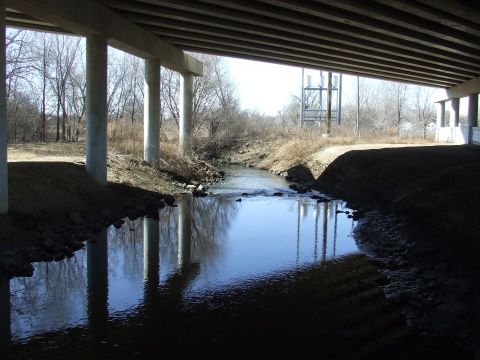
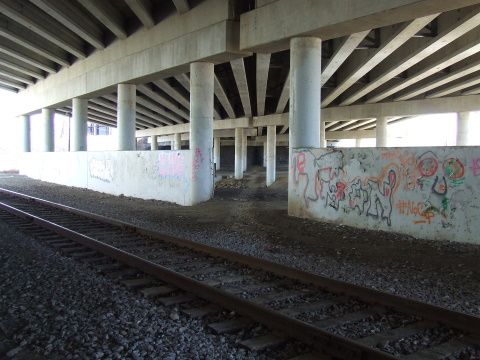
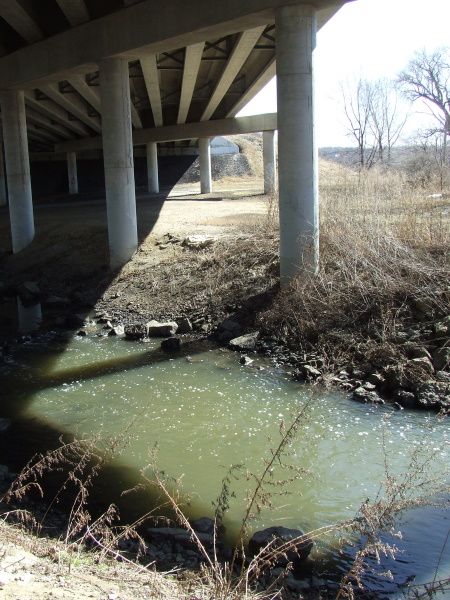
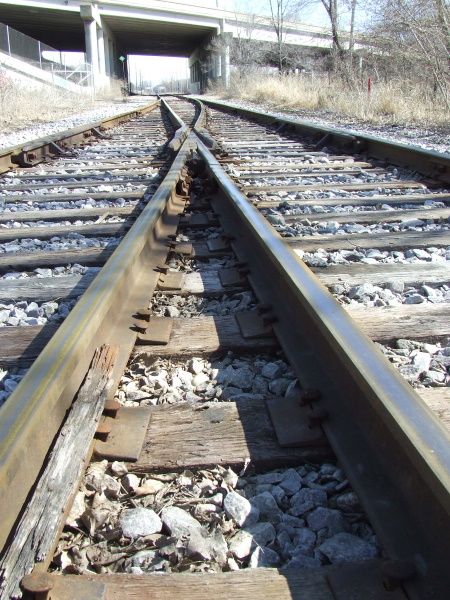
The path around the park leads under the Highway 30 overpass where there was the usual graffiti. It was a sunny day and some of the sights reminded me of The Conformist by Bernardo Bertolucci. I like to think that his cinematographer Vittorio Storaro would be proud of the use of light & shadow and all of the straight lines here.


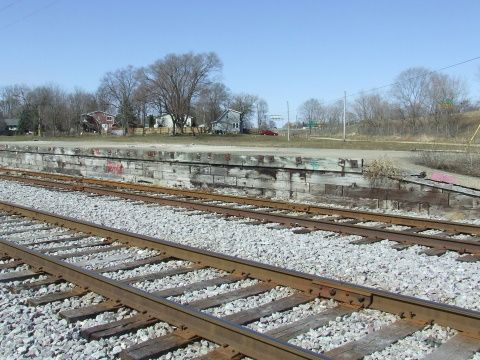
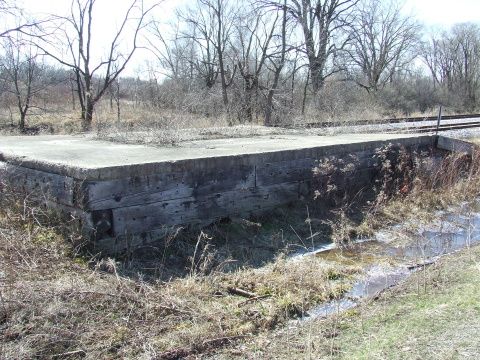
Some rail tracks go underneath the overpass so I followed those and came upon a couple of disused loading docks next to a siding.


Trains used to be loaded here at some point in the past but I'm not sure when. The Wisconsin & Southern Railroad PR person was not overly helpful in this matter. But that is Commercial Avenue there in the background running along Highway 30 so I wouldn't be surprised if this area was much more industrial/warehousey back in the day.

A couple of years ago there was an article in our local alt-weekly about Trachte buildings which are a piece of vernacular Madison architecture. They are known for their steel walls and barrel roofs. I've noticed them around town since I moved here but never knew their history until reading the article.

Walking home on this trek I noticed a couple Trachte sheds and have been taking their pictures whenever I see them ever since. 


It occurred to me one day that, since I enjoy going for walks, I should do so every day before work. Just get outside before being stuck behind my desk for hours on end. We live a couple blocks from Starkweather Creek so I began walking down there and then heading home along the bike path. This allowed me to watch as the magnolia trees down the street started to bud and then bloom.


The creek had the occasional mallard on it just after dawn but the birds were always very noisy.


Red-winged blackbirds are a sure sign of spring and they nest near water. And so they were tweeting away. I believe they were mostly males announcing their presence and marking their territory. They would also sit on the electric line along the bike path for several minutes at a time chirping or singing or whatever it was that they were doing.


One morning I heard an odd bird call coming from a tree. I am no expert on birds but I knew what a red-winged blackbird sounded like by this time as well as cardinals and robins. After walking back and forth along the railroad tracks for a couple minutes I eventually tracked down the tree where it was coming from. I got out my binoculars and eventually discovered that it was a woodpecker and that I had stumbled upon its nest. I believe it was a red-bellied woodpecker.


The woodpecker seemed to hang around for a couple weeks and then disappeared.

It was really fun to take these walks through most of the spring. Doing so every day, I was able to see the incremental changes in the flora and in the creek. Schools of minnows appeared in the concrete stream by the bike path that carries runoff water and they'd abruptly change course when they saw me hovering over them.

I think these walks helped me ease into the abrupt change in my morning schedule that the pandemic brought.

Just as I had developed a routine outdoors, routines were also developing indoors…

********

Bonus photo! I found a picture of the Buffalo ice cream parlor that I went to as a young boy in Chicago along with an old model Big Green Limousine. Note the "Key Punch Computer Program School" sign in the window.


07 December, 2020

Tis the Season for Weihnachtsbier

While winter has not started yet here in Wisconsin, the temperatures have fallen and highs are generally in the 30s. The ground is bereft of snow so I am hoping for a few inches to cover up all of the leaves I didn't bother to rake up last month. As the weather gets colder, beers usually get stronger.

I believe that Weihnachtsbiers - Christmas beers - are a Bavarian thing. My understanding is that they're dark amber bock biers with an A.B.V. in the 6-8% range and that they become available by 4 December so that one can have a few and terrorize the neighborhood kids on the eve of St. Nicholas Day in your Krampus costume. Or for mellower folks to have a little warmth while strolling around a Christkindlmarkt.

The Germans are an orderly people and surely have well-defined parameters for what constitutes a bock and a doppelbock. (Or maybe they're all simply Starkbiers.) Now, whether the Weihnachtsbier is similarly defined or not, I don't know. It could be that merely slapping "Weihnachtsbier" on your label makes it so. Does it count as a doppelbock if it's not "Weihnachtsbierator"?

For all of the German heritage here in Wisconsin, I don't know of any breweries that proffer a Weihnachtsbier. Lakefront brewed one several years ago in their limited My Turn series because an employee named David chose the style.


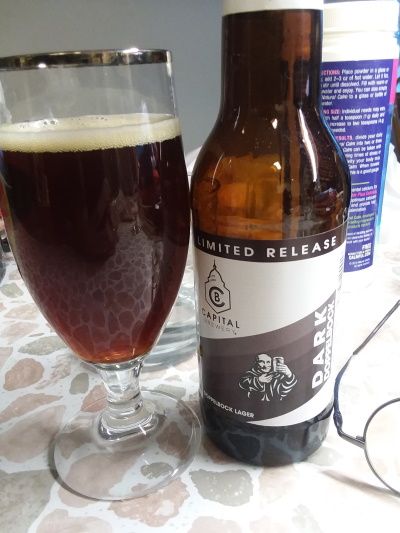
Despite the absence of Weihnachtsbiers, there are plenty of bocks to be had. Zum beispiel, Next Door has Integrator, a doppelbock, albeit one with a Lenten bier name. And Capital has doppelbocks aplenty as it has for years. Varieties available now are apple, pumpkin spice, and this classic:


It's a weird world where a brewery with Kirby Nelson at the brew kettle doesn't have a doppelbock ready for patrons seeking a respite from the chilly weather. Perhaps he brews one now and again but the Wisconsin Brewing Company webpage is bereft of them. It's a shame that he has seemingly abandoned the style. Recall that Kirby's Manoomator, a wild rice doppelbock, was wonderful. Personally, I think a wild rice bock would be a great late fall brew. You can get your fill of Oktoberfests from July into Oktober but, when Halloween is around the corner and Thanksgiving on the horizon, a wild rice bock would really hit the spot after raking leaves. (If you do such a thing.) Plus wild rice is largely an upper Midwestern crop so it would be a regionally specialty that could sit nicely next to a cranberry lambic or a venison hazy IPA.

So what to drink when winter settles upon the Land of Cheese?

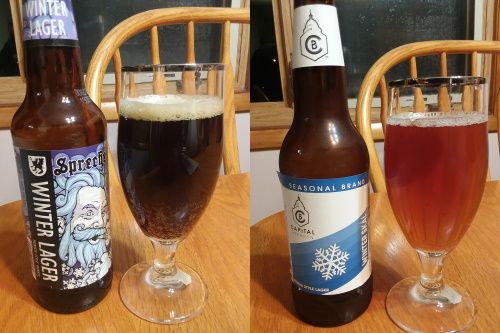
The old standbys for me are:


The funny bit is that, although Sprecher and Capital declare these to be their winter seasonal brews, they're not particularly heady beers. Winter Lager is a Bavarian Dunkel while Winter Skål is a Vienna lager. Each brewery has an annual, Black Bavarian and Wisconsin Amber, respectively, that I feel are more appropriate for this season. To my taste, Black Bavarian has a bigger body than Winter Lager while Wisconsin Amber is sweeter than Winter Skål, though slightly less potent. I would lobby for Winter Lager and Winter Skål to be available year-round after being christened with less frosty names.

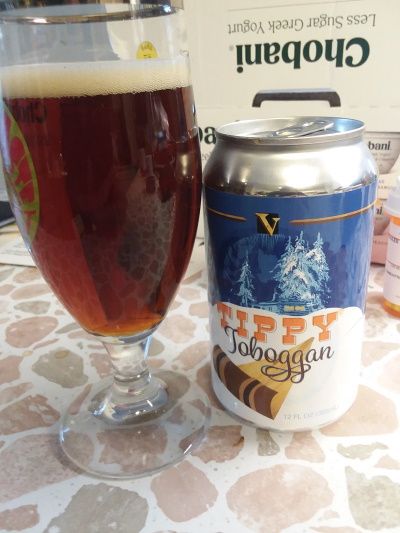
Another bier that I look forward to every year when the leaves have fallen and snow is immanent is Tippy Toboggan from Vintage Brewing. It's a bock strength Roggenbier - think a weissbier with rye brewed to bock potency.


It's got that taste of banana and clove flavors that is familiar to weissbier drinkers the world over but it also has some spicy, earthy rye flavor. And I love rye. Just a great beer.

These are my holy trinity of winter brews. New Glarus' Back 40 Bock is a runner-up as it's not brewed with regularity. This time of year also brings a slew of beers flavored with various spices and sometimes fruits. I find these beers to be fine, if drunk in moderation. Great Lakes' Christmas Ale seems to be held in high regard but I am unsure if it's ever been in my mouth. I do like Sam Adams' Winter Lager, though.

While the Wisconsin Brewing Company neglects the bock at wintertide, they did brew a Pfeffernüsse spiced ale a few years back. Did anyone try this?

Can you recommend a good winter brew?

06 December, 2020

Investigating Stanislaw Lem

A few months ago I came across the Twitter feed of Rachel S. Cordasco. The name was familiar to me but I couldn't immediately place it. After some searching, I discovered that she was employed at the Wisconsin Historical Society for at least some of the time that I was there. I had no idea back then that she translated Italian speculative fiction into English and ran a website called Speculative Fiction in Translation.

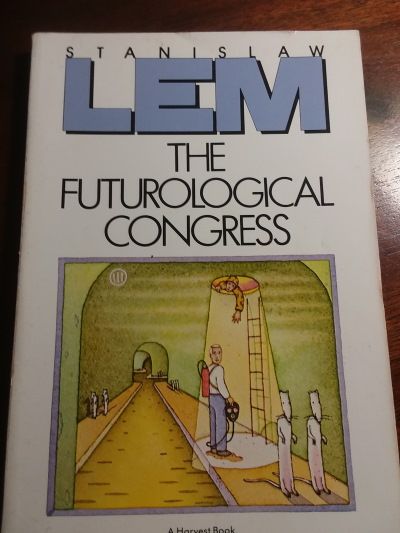
October is Polish-American Heritage Month and Cordasco featured Polish speculative fiction writers this year. The only one I had even heard of was Stanislaw Lem. I read his novel Solaris long ago after having seen the Andrei Tarkovsky's film based on it but didn't read another one of his books until this past summer when I read The Futurological Congress. It served as the basis of the Ari Folman film The Congress starring Robin Wright.

It was a blatantly surreal trip and, while I enjoyed elements of it, the surrealism was overly scattershot for my taste. My next taste of Lem's oeuvre will be The Investigation, ostensibly a mystery/police procedural that takes a left turn into metaphysical realms. Should be interesting.


05 December, 2020

The Corona Diaries 1: The Best Laid Plans

Back in August I started my Corona Diaries - a series of missives sent to family & friends who live out of state. I am adapting and expanding them for the blog.

Late August 2020

2020 started off well enough.

I have been hoping to visit Germany for a while so I enrolled in a non-credit adult enrichment German language course thinking the time was nigh. The Frau and I were looking forward to drinking Rauchbier in Bamberg and seeing what else Germany had to offer a couple of American tourists. Perhaps the Altstadt in Heidelberg as well. Or Berlin. How can you go wrong with Berlin? I could see the sights I've only read about in the Gereon Rath novels. Ever since learning that my German ancestry goes back to my great-great-great grandfather Heinrich who hailed from Hannover, I've had a desire to drink a Breyhan (a beer style native to Hannover and very popular from the 16th-19th century) and to visit the city from which I get my German blood. The first ur-drops, anyway.

I took German in college and actually became fairly proficient for a short time. One of my roommates had taken German in high school and was majoring in German literature so I was able to come home and practice with him. It got to the point that I started to dream in German. The next year my friend went to study in Germany for a year and so there went my tutor and conversation partner. (Accompanying him was Scott Manning of Vintage Brewing. I believe that Scottie's Schwarzbier, Schwarzfahren, was named in honor of one of their adventures.)

It wasn't long before I found that I recalled much more than I thought I would. Over the years I've always used a bit of German here and there, e.g. – yelling "Achtung!" at the kids when they were little.

Speaking of my stepsons, they are doing well overall. The oldest turns 25(?!) in the autumn. He lives very close to where we lived before buying our house – on the isthmus not too far from downtown. His girlfriend moved in with him when the stay at home orders came down in March. He was doing some acting as well as teaching when the pandemic struck. I am very proud of him as he has gotten his stuff together and become quite responsible. It's as if he's an adult or something.

The youngest turned 21 this summer. Instead of volunteering to buy beer for his stepfather so he doesn't have to venture out to the Covid-laced liquor store, he is moving to Eau Claire at the end of this month or early September. As young men often do, he is following a woman - his girlfriend is returning to school there.

Having an interest in medieval history, I took another class last winter called "The Art of the Medieval Book." I learned the difference between parchment and vellum and how they're made, about medieval inks, and so on. Plus, I was excited to handle a codex for the very first time!


Being a big fan of The Name of the Rose – the novel, film, and TV series – it was thrilling to actually touch and leaf through some codices. To be able to feel the parchment, look at the detail in the illuminations with my own eyes, and whatnot was really neat. Luckily my fingers and tongue did not turn black.

2020 was also supposed to have included other travel plans beyond a potential trip to the Fatherland. I had carried a week of vacation time over from last year and had plans aplenty. The spring was to have involved a trip to New Orleans to visit The National WWII Museum with friends, a couple of whom I got to know through my brother and were, like him, big World War II history buffs.

My father was a huge WWII history buff and passed this down to my brother. I couldn't help but develop some interest in the subject and recall writing a paper on the day that will live in infamy at Pearl Harbor when I was in 4th or 5th grade. But I never came close to the devotion to the subject that they had. For instance, they'd be able to watch a WWII movie and point out that the Panzer Mk III onscreen was not yet in service at the time of the events the movie is portraying. I can still picture my father sitting before our TV in back of the house with mentholated smoke streaming from his nose and curling around his head as he gleefully watched Kelly's Heroes or Tora! Tora! Tora! for the 40th time.

After my brother died, I felt strangely obligated to keep the family interest in WWII alive so I started reading about it. I inherited some of their books but I've also been buying my own. Rather than retreading the well-worn, I've been trying to avoid the battles and aspects of the war that the likes of Steven Spielberg have made into blockbuster movies so that means no D-Day, no Pearl Harbor, no Holocaust, and no Battle of the Bulge. Instead I've read about the Rape of Nanking, the Battle of Stalingrad, the North African theater, and about Europe in the immediate aftermath of the war's end. 

Here are my latest purchases:


I've not yet read the book on the invasion of Poland but reading about The Battle of Okinawa sure makes life during the pandemic look like a cakewalk, I can tell you.

I had hoped to visit The National WWII Museum with my brother at some point – perhaps also head over to the National Museum of the Pacific War outside of San Antonio with him since we'd be down south. We'd check out the exhibits, he could lecture me about the war, and we'd reminisce about the old man. Much to my dismay, that never happened. So, I had a crew of friends lined up to board an Amtrak train for a spring trek to New Orleans…

Those plans fell through when The Frau announced she needed surgery. I moved the New Orleans trip to the autumn so I could be around for her recovery. (All went well and she has recovered fully.) In addition, she wanted to go to London for her X0th birthday in the summer. I had applied for my passport in December and it arrived in February.

And then came COVID-19. All these plans were shelved along with my annual trek to Indianapolis for the Gencon gaming convention; the gaming convention here in Madison, Gamehole Con, was soon canceled too and, most recently, so was the Doctor Who convention held out in Lombard, IL on Thanksgiving weekend, Chicago TARDIS. It's depressing to see my virgin passport and be reminded of all the plans I had. I really need to stow that somewhere out of sight.

Instead of venturing far and wide, I have spent the past five months working on short trips. Yesterday the Frau and I visited our favorite dairy, Sassy Cow. The farm and creamery are only about 20 miles north of Madison. We were there several years ago when the creamery opened but haven't been back since. That trip is notable in our minds for the cow who was in labor.


I had recently read an article about the plight of dairy farmers here in Wisconsin and thought visiting a farm would be a fun, if short, getaway.

Sassy Cow is not an industrial farm – more like a large family farm. The tour is only about 30 minutes but it's always nice to get out to the country. The smell of a cow barn never fails to take me back to living up north by Eau Claire while in high school. We left after having spent more money than I had hoped and are now very well stocked with ice cream, half & half, cheese, and yoghurt.


04 April, 2020

The Other Side of the Tracks

You are coming from The Other Side of Starkweather Park.

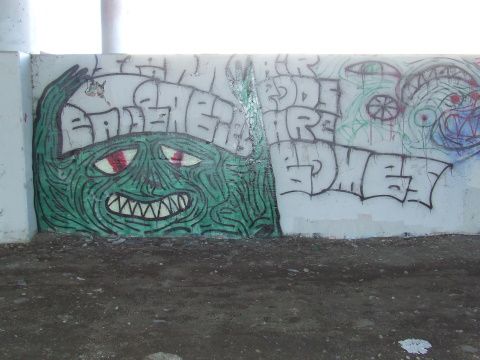
The north side of Starkweather Park is bounded by Highway 30. Underneath the overpass the Marsh View path, Starkweather Creek, and rail tracks owned by Wisconsin & Southern all converge, more or less. There was the obligatory graffiti everywhere. "Kode" was painted everywhere. Sagacious advice like "Eat pussy not animals" was interspersed among words and shapes I could not discern.


Graffiti aside, the overpass was rather neat. Sun and shade made for some striking contrasts while the overpass and the rails created a neat tableau of harsh lines.


The scene reminded me of The Conformist. Any Vittorio Storaro fans out there?

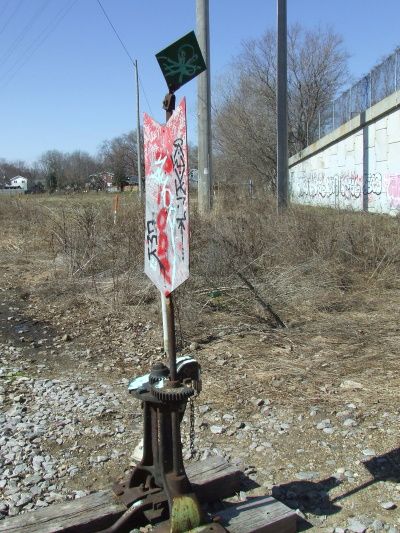
I took the rail tracks southwest and encountered a rail switch which looked to be manual. Not being an expert in rail infrastructure, I wasn't sure. But a friend of mine who drives trains for a living has told me stories about rail infrastructure in use today that engineers who voted for Grover Cleveland would have used. This switch directs trains to a siding that runs most of the way to Fair Oaks Avenue.


Along the siding were two platforms with a ramp on one side.


Presumably freight was taken off of rail cars here at some point in the past. As you can see from the top photograph, the area beyond the ramps is a grass field along with a retention pond that's out of view. Google Maps show this spot as being wooded so the clearing was done fairly recently. There's also a gravel road that runs to Jacobson Avenue parallel with the tracks. Besides the trees, Google Maps also shows a Stock Avenue here running one short block north-south to the end of Commercial Avenue which has a stretch that runs south of Highway 30 as well as north of it. I wonder if this area was more industrial/commercial in the past. There is very little commercial to Commercial Avenue here and a lot of the houses look like they date from the 1950s. I'd bet that this area pre-war looked a lot different. Surely Highway 30 got a big facelift when the interstates were constructed too.

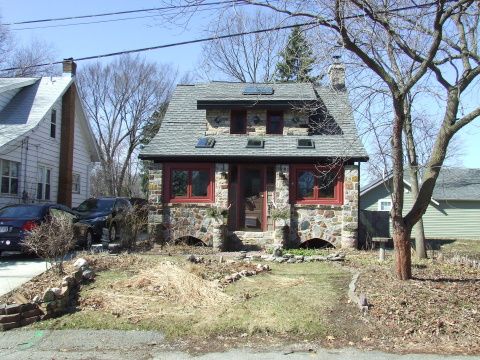
Once you go west you enter a little section of the Town of Blooming Grove. I believe the City of Madison will annex this and other bits of the town in 2027. If you go through this area, you'll notice how the street signs are blue instead of green. There are some nice older homes here in amongst the ones from the 1950s and 60s. This one caught my eye.


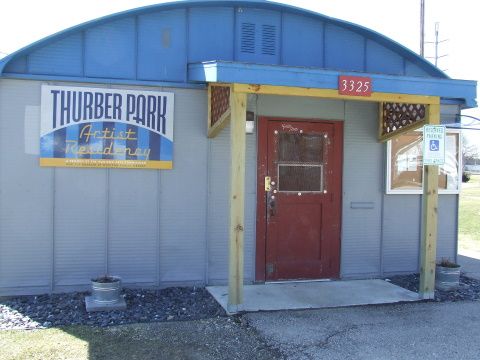
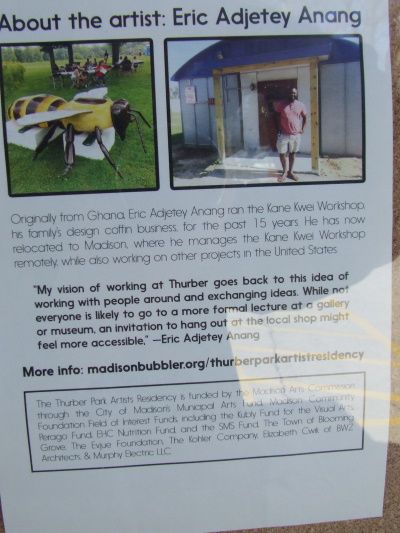
Unbeknownst to me there was an artist residency at Thurber Park.


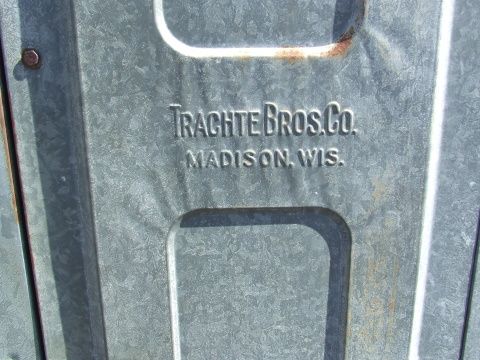
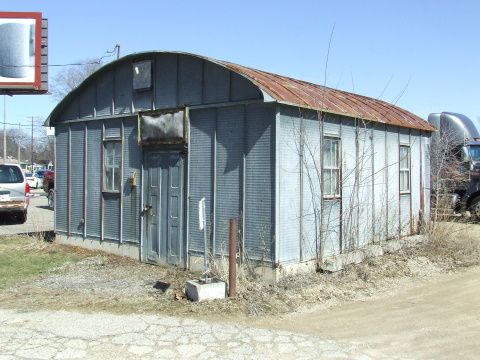
I suspected this was a repurposed Trachte shed but didn't spy a nameplate. However, there was a verified Trachte shed just down Fair Oaks Avenue.


I presume it's storage for one of the businesses there.

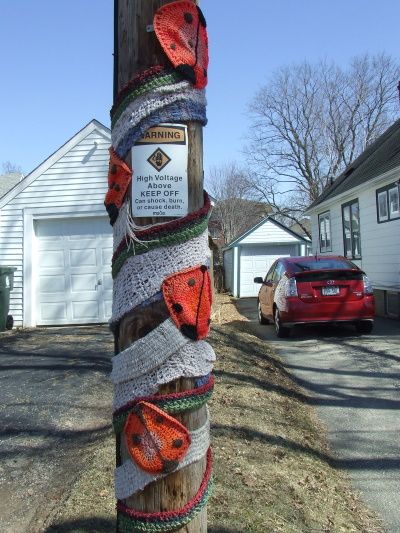
I took the long route home, going through O.B. Sherry Park. On the way there I found a utility pole that got a lot of love from the neighbors.


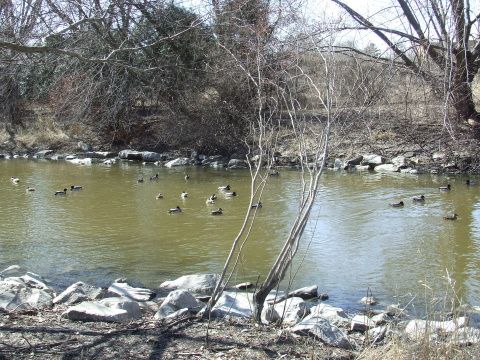
I had intended to wander the park a bit but the ground was much too wet. And so I wandered along Starkweather Creek which was looking pretty good, lacking the PFAS foam that we'll no doubt see in a couple of months. Instead there were mallards everywhere.


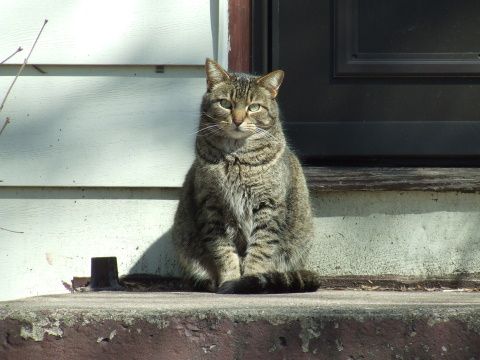
A couple blocks from home I spied a feline taking in the sun.


My hope is to walk this route again when there is more foliage and I have my binoculars with me so I can peer deeper into the marsh and see more birds. The plan is also to learn how to use this camera, specifically manual focus. I've got a whole pandemic to figure it out.

The Other Side of Starkweather Park

It seems likes it has been a couple weeks since we've had a day here in Madison with more than a few minutes of unadulterated sunlight. It's bad enough being cooped up inside in a bid to flatten the curve and avoid Covid-19 but the constant cloudiness has seemed as oppressive at the stay-at-home order, at times. Still, this spring seems like the most normal one we've had in years. My local weatherperson can probably prove me wrong, but it feels to me like spring here in southern Wisconsin the past few years has been a period of highs just above freezing abruptly ceding to 60°+ temperatures overnight. Instead we've had some lovely days in the 40s this spring, with lows dipping just below freezing. No wonder I've seen people collecting maple sap around town.

The last day we had extended sunlight I took a neighborhood stroll. It wasn't long before I noticed that my neighbors have more log cairns in their yard for growing mushrooms. I presume there will soon be shiitake shrooms bursting from the spore holes on them.


My destination was Starkweather Park. I had previous done some wandering around the west side of the park but now I would do the east and north bits. So I headed east on Milwaukee Strasse. The little strip of the park that abuts the street looked so forlorn with the leafless trees and bushes. Plus there was garbage – empty drink containers, mostly – scattered about. The old Swiss Colony warehouse was waiting impatiently to have tenants once again. Plans for it to become an Amazon distribution center are moving forward to the dismay of many who were hoping for that area to become housing and commercial. But the land is still zoned industrial or whatever classification you need for a warehouse.

However, the land owner was quoted as saying that "a low-cost housing development" was going to be built adjacent to the warehouse. This got the Urban League of Greater Madison to bite. Of course the proof of the pudding is in the eating. We will just have to wait and see if those 145 jobs materialize. I'd bet a lot of those are given to robots. But housing there isn't a bad idea as it's very close to the East Transfer Point meaning public transit is a hop, skip, and a jump away for people of more limited means.

Speaking of which, it was rather odd in a Twilight Zone kind of way to see the transfer point completely deserted.


The retention pond by Corporate Drive was full of melted snow. There was a smoking area tucked into a shady area next to the pond.


Once I was on the Marsh View path, the marsh that is Starkweather Park was to my left.


To my right I saw my first robin of the season. Unfortunately, it was hanging out in a sea of parking.


What a waste. On the bright side, there was a brace of sandhill cranes wandering the grass between the expanses of concrete.


Starkweather Park is mostly marshland and the main attraction is birdwatching. There are benches dotted along the path to accommodate practitioners of what is surely one of the more sedentary hobbies around. I did not have my binoculars with me but I still caught site of some of our flying friends, including my first sighting of a red-winged black bird.


As you get to the north side of the park, the path veers away from the marsh and continues underneath Highway 30. After crossing Starkweather Creek and some railroad tracks, it's but a short stretch until you hit Commercial Avenue.

I, however, took a different route.

Continue to The Other Side of the Tracks...

07 December, 2019

I Am Tired of Your Creative Class Civics Act

After finishing the latest piece by Madison's former mayor, Dave Cieslewicz, in Isthmus - "Civic Envy" - I sat there wondering what the point of it was.

His argument is that Madison is green with envy because Milwaukee has a public market and a streetcar. Further, these aren't just nice amenities, they are development tools. Add these things and you get real estate investors building new buildings and gussying up old ones to be repurposed. And, when you do that, Millennials will come flocking to your city like a junkie to the needle.

Where to start?

Let's begin with a quote from the article:


One of the things that is little understood about fixed rail systems, like streetcars, is that they aren’t just about transportation. They are a very visible and permanent public amenity that sparks other development.


Permanent? Ask the folks in the Santa Clara Valley just how permanent rail is. One of their light rail route will cease to operate a few days after Christmas and be replaced by bus.


The Almaden Spur Light Rail, Route 900, will no longer operate, beginning 12/28 when VTA's new transit service starts.

Almaden Spur Light Rail is being replaced by Bus Route 64A.


Also note that Cieslewicz affirmatively states that streetcars "spark other development". Is this true? Cieslewicz himself doesn't seem to know as he states in the very next paragraph:


…since the streetcar was approved, new development along the line includes 435 new apartments, 660 new hotel rooms and a 28 percent growth in property values, not to mention numerous restaurants and bars that cannot be directly attributed to the streetcar but might well not have happened without it.


So...maybe. And maybe is the conclusion of the research done into whether streetcars spur development.


The literature regarding empirical measurement of actual changes in economic activity, such as changes in retail sales, visitors, or job growth, is almost nonexistent for streetcars.


So Cieslewicz categorically states that streetcars spark development and then proceeds to admit that development along Milwaukee's streetcar route may not be the result of the streetcar. In an op-ed weighing in against the streetcar up at Urban Milwaukee, Samuel Jensen, director of the Milwaukee Transit Riders Union, addressed this issue. He wrote:


What the data does point to, however, is that streetcars tend to concentrate development that would have occurred anyway along specific corridors. If Milwaukee’s streetcar was planned to run through blighted, underdeveloped, or impoverished areas of the city (for example, a route to spread development from the east side to the west side of downtown) then that might be good enough. When the route is planned to go through some of the wealthiest and most rapidly developing areas of the city, though, it just amounts to an investment that further centralizes wealth in a city already grappling with appalling levels of segregation and inequality.


In my opinion, it boils down to how our former mayor view public transportation more generally. It really seems like he views it primarily as a development tool whereas I would offer that it is an urban mobility tool. I would have loved it if, during his 8 years as mayor, he would have given a fraction of the political capital, blood, sweat, and tears to improving Metro Transit as he did to getting a 15-storey addition to a luxury hotel built that ran afoul of the building guidelines of the historic district that it now stands in. I recall his major contribution to bus service in Madison being a fare increase.

This is nothing new. Cieslewicz drank long and deep of the Richard Florida kool aid many years ago and this article seems to be a justification for his rejected policies/mindset. When your lens is that of your city being "in the race for coolness", it's no wonder that your teleological premise is that public transit is primarily a development tool, something that should be "hip" as opposed to a tool that gives people the freedom to go where they need to go when they need to go. As urban planner Christof Spieler noted in his book Trains, Buses, People – An Opinionated Atlas of U.S. Transit about the Milwaukee streetcar, "…it will do nothing to speed up the trips of current transit riders or link Milwaukee residents to suburban jobs."

Cieslewicz quotes one Bob Monnat, the COO of a company that is a large real estate developer in Milwaukee as saying, "We're trying to attract the millennial population." As mayor, this was one of Cieslewicz's prime fixations with his logic being that millennials will move to your city if you have cool stuff like public markets and streetcars. (And bike lanes too.) So how is that working out for Milwaukee?

From the Milwaukee Biz Times:


Let's contrast that to Madison. From the Milwaukee Business Journal based on a Brookings Institution study:


A study by the National Association of Realtors, as detailed in this Bloomberg article, shows that Madison is the 2nd most popular destination for Millennials who are relocating. And that is the case despite not having a public market nor a streetcar.


“In comparison to other areas, Madison offers one of the highest wages for millennials,” Lawrence Yun, NAR’s chief economist, said in a statement. “This income level combined with the robust employment opportunities and the affordability, make Madison among one of the most appealing locations for millennials who are looking to stay longer and raise families.”


Jobs and affordability. Jobs and affordability. Jobs and affordability. Jobs and affordability. NOT public markets, and streetcars, and other amenities. Cieslewicz writes that "Milwaukee offers much more diversity across a much broader spectrum" of cultural offerings. True enough. But they aren't attracting the vaunted Millennial cohort nor enough of any other group. Here's is Milwaukee's historic population:


Now here's Madison's:


Things may be even worse for Milwaukee than the above graphic betrays. The city's population went up during the first half of this decade so that the estimate in 2014 was above 600,000. But it has lost about 2,000 people a year since 2015. (See here.) Do keep in mind these are population estimates and that we'll have to wait for next year's census to get the real story. Still, these numbers don't bode well for our state's largest city.

Earlier this month the Wisconsin Policy Forum released a report which showed that Madison's tech sector was "booming". Milwaukee's? Not so much.

The latest Quarterly Census of Employment and Wages from the Bureau of Labor Statistics shows that Dane County (wherein lies Madison) is generating more private sector jobs than the rest of the state, including Milwaukee, combined. And we're doing it without streetcars and public markets.

And there is no shortage of real estate development in Madison. Just take a gander at this article chronicling the transformation of the Capitol East District. All done without streetcars and public markets. Instead one of the primary impetuses was land banking done by the city and Cieslewicz admits this in a comment on his article.


The sad part is that, when he was "Mayor Dave", Cieslewicz oversaw great growth in Madison – done without his streetcar plan coming to fruition and the public market still a dream. He knows a city can prosper without having all of the "hip" amenities. And so it is farcical to suggest that we in Madison should be envious of Milwaukee's "development tools" when we are growing in population while the Cream City is not; while we are attracting more Millennials, and creating more jobs.

A couple final thoughts.

First, I want to say I am in agreement with Haven McClure who left a comment on the article. Do read it. In it they argue that Cieslewicz's preoccupation with streetcars, public markets, and the race to be cool did not help in the push for sustainability. Further that his desire to make downtown/isthmus living ever more luxurious was to ignore Madison's southwest side with its increasing struggles with poverty, violence, etc. You can read the author's reply in the screenshot above. It is striking to me that his reply stuck to urban development at the core and completely ignored the argument that such an approach does little to help the most disadvantaged. Cieslewicz certainly does seem be a trickle-down economics adherent. Is the economic success of the Third Ward, Bayview, or Walker's Point helping alleviate the poverty on the largely black north side in Milwaukee, one of America's most segregated cities? You can see the same in Chicago where things are going very well in The Loop and North Shore but that success hasn't trickled down to poorer communities. (See here.)
Lastly, Cieslewicz admonishes his readers against dismissing Milwaukee. ("And yet to dismiss Milwaukee is to cheat ourselves.") This is a straw man, it seems to me. He wrote this after having posited that "Madison and Milwaukee might despise each other, if they bothered to think about the other place at all." He begins his article this way which helps explain why it seems to be so silly to me.

Perhaps the situation has changed but it wasn't long ago that Milwaukee County was the biggest provider of in-migration to the Madison area. People from Milwaukee come here to Madison to see UW Badger games while Madisonians travel to Milwaukee to catch the Brewers and Bucks in action. Amtrak even ran football specials between Milwaukee and Madison until 1976. Speaking of Amtrak, I would not hesitate to say that a lot of people in both cities thought quite a bit about each other when plans to extend Amtrak's Hiawatha line to our fair burg were announced. Cieslewicz just wrote about this a few days ago in a piece about the fine Wisconsin Public Radio podcast Derailed which chronicled the demise of the planned extension. Badger Bus, which provides rides between Madison and Milwaukee, now has 8 trips from either city every day of the week. Madison and Milwaukee are solidly Democratic and are routinely demonized by many rural residents in Wisconsin and their Republican representatives.

We think about each other a lot and I see signs that the old rivalry between these two cities is slowly going away. Check out this podcast from Tone Madisonwhere Milwaukeeans and Madisonians discuss the views we have of one another through and arts & culture lens.

But we need to act. Since Milwaukee wants to be the freshwater research capital of the world, we here in Madison should help. We need more things like the Freshwater Collaborative and less like Cieslewicz's article.

I did find at least one point of agreement with his article, though. He ended his piece by writing "We can learn from each other" and I am complete agreement with that.