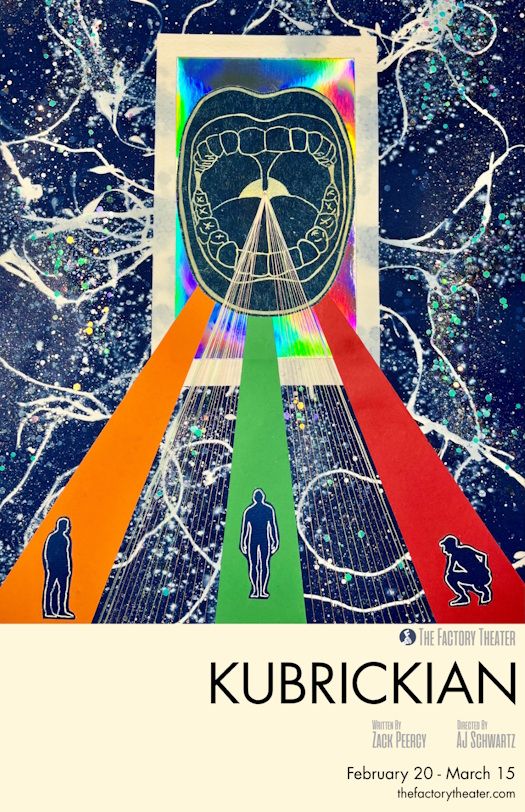
When I read about Kubrickian, I felt that it was right up my Straße. A trio of guys stuck in a mysterious white room (with no black curtains) arguing about the movies of Stanley Kubrick. Having watched Jim Henson's The Cube just a couple months back, it sprang to mind, especially the stuck in a mysterious white room bit.
I also loved the poster which had a distinct 1970s Eastern Bloc look to it, like it was used to promote Zardoz in Poland back in the day.
Here's a shot of the stage a little before the performance began:

But it didn't.
Instead the lights come up and we see that Chris, the guy in the track suit above, has what appear to be burns on the insides of his arms. He is an outgoing cinephile who loves Kubrick. Howard is catatonic and sits in the corner staring blankly into the distance. Danny is scared and becomes Chris' interlocutor, his antagonist, and then later his fellow performer.
As Chris discourses on the genius of Kubrick, Danny confesses to not remembering much of Kubrick's work despite having seen a film or two of his. Chris seems in denial of their situation with his rapid-fire declarations of love for Eyes Wide Shut, The Shining, etc. and perhaps hides his fear behind smartassery. Danny, on the other hand, is open about his fears and his need for conversation to keep his sanity.
The play's description is of "a haunting and hilarious look at masculinity, creativity, and capitalism" and these two seems at opposite ends of masculine stereotypes. One appears strong and at the ready - after all, Chris did attempt to capture the jailer and has the burns to prove it - while the other is more feminine and expresses vulnerability.
All the while Howard sits in the corner expressionless.
Suddenly a crevice appears in one of the walls that confines them. Chris steps through leaving Danny alone with his silent companion.
But it isn't long before Chris mysteriously reappears. He now has burns or scars on his throat and we learn that he has been rendered mute. Slowly he and Danny learn to communicate via hand gestures and sounds not produced by the larynx. And as they learn new ways to communicate with one another they learn to be friends.
Another opening appears and this time Danny plunges into the dark. Upon his return he too is mute. As the play reaches a denouement, the pair reenact the opening of 2001: A Space Odessey with the newly bonded friends taking on the roles of the apes and using their hands to pound out Also sprach Zarathustra on their chests and thighs. Howard is used as a stand-in for the monolith.
Having apparently passed a test of some kind, the trio are allowed to leave.
As a Kubrick fan, I found Chris' fanboy diatribes to be fun and funny. Danny was a bit too weak, in my opinion, as if he had capitulated long ago and now refuses to fight. Howard seemed wasted as he sat in the corner far too long and was rarely the object of conversation by the other two.
I appreciated the uncanny, existential feeling engendered by starting the play with the characters already in confinement, of limiting our knowledge of their situation to an enigmatic jailer but I felt the dialogue could have been stronger. The characters offered little, if any, contemplation about their situation and not much about their lives before the white room.
By and large, the story tantalized us with ideas but rarely examined them in any depth. There was a fair bit about masculinity but it seemed a jumble rather than a coherent theme. Creativity seemed more well-developed as we witness Chris and Danny work with one another to communicate via creative means. As for capitalism, nothing more than a line here and there about their jobs pre-white room come to mind that actually addressed this.
It seemed to be a play more about a blossoming friendship, the scene where Chris and Danny kiss notwithstanding, than anything in the ad copy.
Lastly, I felt the pacing was off. There was too much down time with the characters laying and sitting around staring into space. When Danny suggests exercises he and Chris run from side to site of the stage for far too long, the activity being rendered inert and boring to watch.
Henson's The Cube had a vaguely similar premise but it kept things moving and articulated social commentary more robustly.
There were definitely some funny lines and the Kubrick references were most pleasing to this fanboy. Maybe not a diamond in the rough but certainly there's a lot more to be done with the premise. Fun but didn't quite live up to its potential.


No comments:
Post a Comment