Sorry. I was listening to Tales From Topographic Oceans earlier and just had to.
Aurora came out this past summer and, after a few listens, I thought I had it down. I took a shine to certain songs instantly while others just didn't work for me and I was content to leave it at that. However, subsequent listens opened up the songs that I at first felt were weak, insubstantial and revealed that there was more than meets the ear. I've really come around on these tunes.
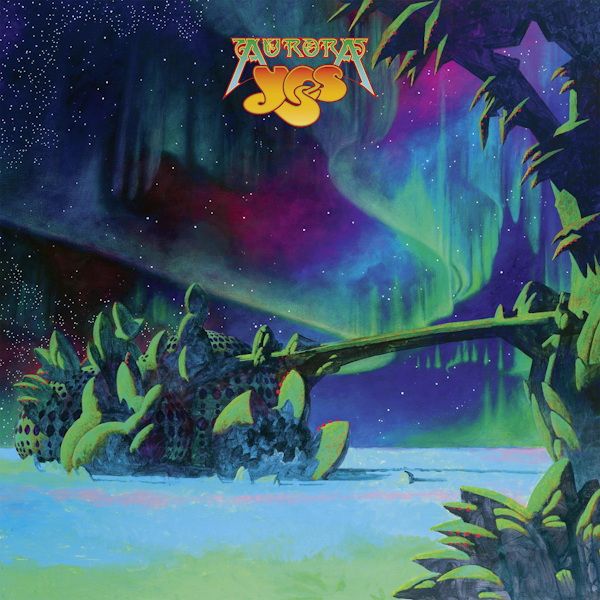
Another great cover by Roger Dean that made me wish I had the record in front of me. Has anyone ever researched the experience of listening to music when you have a colorful and mysterious 12"x 12" print in front of you vs., well, not having one? I recall looking at Dean's covers while listening to Yes' classic 70s albums, for instance. But I never did so for 90125 or Big Generator. OK, it was and remains impossible to look at the Big Generator cover for very long with that "I was doodling on my Commodore 64 and had a fluorescent accident" aesthetic. The band's logo here is much simpler this time around with just solid colors and no funkadelic patterns. The font for the title looks familiar but I honestly cannot recall if Dean has used it for an album cover in the past or not.
On paper Aurora looks to be much in the vein of its predecessor, Mirror To the Sky. There is a nearly 14-minute track along with a couple longerish tunes, though we're talking about 7 minutes rather than 9. Plus a smattering of shorter songs. Here that means they clock in at under 4 minutes rather than being 4-5. No line-up changes (yay!) excepting that the orchestral contributions are from a different orchestra.
Since that initial burst of listens, I've really come around on "Turnaround Situation", "All Hands On Deck", "Emotional Intelligence", and "Jambustin'". Shorter songs all.
"Turnaround Situation" follows the lengthier title track which begins the album. At first I simply had this issue with the refrain - it just sounded, for lack of a better word, quaint. As if it needed to be tweaked a bit to sound more adult, more proggy. Or something. Davison does the organ intro and plays rhythm guitar throughout.
At some point the chorus stopped bothering me and I learned to enjoy it. There's some fine fuzzy guitar that helped me get over my block. As lyrics go, what can be more Yes than:
Guiding every conscience home, the cosmic mighty Aum
To a full loop back to life
Back to light!
?
Some lovely harmony vocals and a gentle steel guitar for the win.
Does anyone remember listening to Drama for the first time and going "Whoa!" upon hearing the big, heavy guitar on "Machine Messiah", that nod in the general direction of Black Sabbath? "All Hands on Deck" elicited a similar response from me with its big, ballsy hard rock riff from Howe that was bolstered by some organ. When was the last time there was such a riffy tune on a Yes album? The Trevor Rabin era? I was immediately reminded of a German band whose name I could not recall that played heavy psych, I guess you'd say, that reminded me a bit of Benefit era Tull. I think they came up as a recommendation on Bandcamp while I was listening to some Rosalie Cunningham.
Davison sings the verses while Howe does the chorus. Great synth solo followed by great guitar solo. A tad funky. Where did that come from? Lovely, though too short, organ/acoustic guitar bit to end it.
"Emotional Intelligence" seemed, at first, to have a bit of an affect to my ears. But the tuneful organ-piano opening grew on me. Maybe it was the acoustic guitar that filled in the sonic picture and, in some way, added something more genuine-sounding to my ears. Schellen's snare has a hollow, wooden sound to it instead of a forceful metallic snap so it accommodates the more acoustic, gentle feel of the song. Having said that, Sherwood's bass chugs along at a good clip there for a little bit. It even sounds rubbery and Rickenbackery. Nice steel guitar.
The last couple albums have had bonus tracks and Aurora is no different. The first of those, "Jambustin'", opens with a bouncy kind of alt-country riff that is paired with some spacey synths. Imagine The Bottle Rockets doing ELP to a surf beat. After the song slows down for the pre-chorus, it returns with a more muscular, straight-ahead beat that has shades of funk - especially that bass - even if only a couple. For a song that isn't even four and a half minutes, it goes through a few different moods and is really just a lot of fun.
What is Howe doing to his guitar on "Watching the River Roll", the other bonus track? Gah! It was used on at least one Beatles song but I cannot think of which one. It's like reverb and something to give it a watery sound like the ripples on the surface after you toss in a stone. This is Sherwood's first solo composition for the band and I loved it from the first listen. It has the feel of being on a raft as a gentle current takes you downriver at a lazy pace and not into a heart of darkness. There's a really nice synth solo that starts slowly and changes tempo all along the way. Lovely vocal harmonies and I really enjoy Sherwood's twists and turns on bass. I wish this were on the album proper but dunno what song it should replace, if any.
The title track opens the album overflowing with catchy melodies, orchestral swells, and a big, soaring chorus. A lone piano opens the song as the strings warm up in the background until they burst forth with the song's main melodic theme. Then the band tacks a rock oriented course gets and the tune starts zipping along at a good clip with Schellen's snare having that wooden sound that would be heard later. Mr. Howe is scratching out his rhythm while there's organ aplenty. Howe's soloing is tasty as usual and the orchestra gives us a big, bombastic close.
Schellen really shines on "Love Lies Dreaming" as he's all over the place during the minute and a half instrumental opening. Howe and Sherwood trade these speedy runs and it's just glorious. Overall, the sound is natural with piano and acoustic guitar being prominent. There's a soft, floating feel to the melody that reminded me of what it was like when I was on opioids. At a hospital under supervision of medical professionals, that is. A very pretty song.
"Countermovement" is the epic here and I knew this even before seeing its running time as it comes in 4 sections. The band waste no time with any kind of introductory noodling and launch straight into "Taro". Howe is soloing right out of the gate and builds his guitar orchestra as he goes on. Overall this instrumental prelude is upbeat and sprightly though the occasional dark thought creeps in. Schellen's snare has that wood sonority again and Howe just won't stop.
Some mellow synth brings us to the second section and yields to Howe's gently strummed acoustic guitar and vocals. Once the band comes in, Downes plays some really nice synth parts. Davison eventually (and thankfully) comes in to help Howe on vocals. What I think is a mandolin does its best laúd imitation as the venerable player of all things with strings invokes "Your Move" and is joined by some gorgeous harmony vocals.
The third movement slows us down as acoustic guitar is accompanied by flute. Seeing no flute in the credits I presume this is Downes wielding his Mellotron. Mellotron! The lyrics turn towards a distrust of technology and invoke the AI boogeyman.
In the age of AI, there goes you and I
Note the reference to the classic tune from Close to the Edge.
As the song slows a bit, a piano enters and struts along. Howe throws in a "Siberian Khatru"-like guitar line which left me wondering why there were all these references to early 70s Yes and then I listened to the lyrics.
I don't want to be a false identity
Simulation, imitation me
Downes does some fine synth work trading licks with Howe.
The final movement, "Freedom's Edge", has a slow marching beat over which Howe gracefully solos on steel guitar. It's vaguely ominous and quite the opposite of how the song began.
Another classic. And, yes, it should be played live when the band hit the road again. They cancelled their 2026 dates due to Howe's health problems. It sounds like they're going to be playing all of Fragile again so let's hope they leave room for "Countermovement" and other great songs from this album.
Ariadne was a Cretan princess that lent a hand to Theseus when he was in that Labyrinth, the one with the minotaur. A triumphant sounding orchestral section lingers before it is joined by guitar that Howe has given this weird, squeaky, warbly sound. It's almost as if he got a new effects pedal for Christmas as gave it a spin during the recording sessions. Then it's Davison singing over orchestra before more weird guitar. When the band comes in they are not messing around. The song really moves! The orchestra returns and I love how Sherwood's bass adds some low end as the strings recapitulate the main melody. Davison tells the princess' story with just the strings and it's quite pretty.
Howe joins the string section on acoustic guitar towards the end and the result is wonderful. Acoustic out, weird electric in briefly before it's a big orchestral ending.
"Outside the Box" is only a bit over 4 minutes yet has 2 discreet movements. The opener features some absolutely lovely a cappella singing that hearkens back to the early 70s which is joined by acoustic guitar. A snare fill quickly moves us onto the second movement where the electric guitar alternates between droney phrases that bleed into one and sharp, staccato stabs. Is that a phaser he's using? Some great bass lines running underneath as Downes' synth joins the fray. More fantastic vocal harmonizing. Schellen is great here with some nice work on the toms to heighten the vocals.
What an odd little ditty. It's like building a song by blending all the doo-da, doo-da bits in "Siberian Khatru" with perhaps a dash of the similarly wordless parts of "Leave It". I love the dynamics with the soft start being led into something weirder and rockin'. Everyone really shines here.
Aurora is another success for these venerable proggers. Davison continues to impress as he contributes on a lot more instruments here in addition to using his pipes and he plays marvelously. Howe's playing always impresses but his sounds here expand the Yes sonic palette, even if only incrementally. Nothing on Aurora sounds completely outside of the Yes wheelhouse like, say, "Owner of a Lonely Heart" did in 1983. Yet a dash of fuzzy riffing comes across as a bit novel here and it seems implausible that the trippy, phased metronomic slashes on "Outside the Box" that sound like they were being played by Gort and his band emerged from the same hands that fill Yes songs with soaring steel guitar passages that are the perfect soundtrack to souls being raptured unto Heaven .
Schellen's drumming continues to propel the songs ahead. The more I listen to his work with Yes, the more I do so just to hear him play. He is moving into that group of drummers whose playing makes me want to listen to songs paying special attention to the percussion.
Aurora and Mirror to the Sky establish this incarnation of Yes as a powerhouse. The music vibrates with energy while the lyrics resonate with hope and positivity just as strongly as those that Jon Anderson penned.
I think I have one more post about latter day Yes, an epilogue, of sorts.


No comments:
Post a Comment