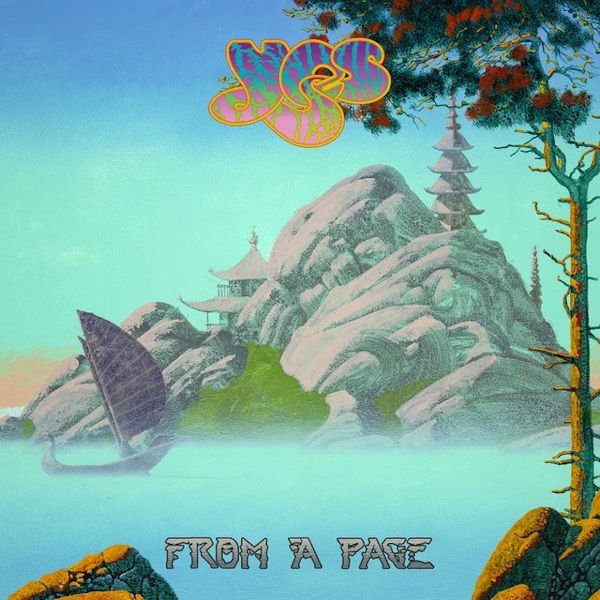
I've been meaning to write about post-Jon Anderson Yes for a year or more now. At some point I gave their 2023 album Mirror to the Sky a listen and had a moment. Not quite a road to Damascus moment but I found myself becoming enthusiastic about latter day Yes. When I decided to buckle down and write about this era of the band they quite fortuitously re-released this EP which documents their first attempt at an album minus their longest serving singer and a founding member to boot with a slew of additional songs not on the initial 2019 release.
It's hard to keep up with all of the drama in this band (sorry), all of the bickering, and line-up changes. Here's what I've gleaned from Wikipedia and the official Yes site.
Going into 2008, the band was comprised of its "classic" line-up of Jon Anderson, Chris Squire, Steve Howe, Rick Wakeman, and Alan White. An anniversary tour was being planned but Wakeman was advised not to do it for health reasons. And so he opted out but recommended a suitable replacement: his son Oliver. The rest of the band accepted and moved forward with touring plans. These, in turn, were cancelled when Anderson was beset by respiratory problems. Rather than waiting for him to heal, Benoît David, a Canadian singer in a Yes cover band, was recruited to fill his shoes.
A couple years of touring followed and this new Anderson-less Yes began recording a new album in March 2010. By that autumn, however, Wakeman was gone and Geoff Downes returned to the fold. From A Page is a collection of songs recorded during sessions with Oliver Wakeman filling his old man's shoes.
The initial 2019 release had 4 tracks on it: "To the Moment", "Words on a Page", "From the Turn of a Card", and "The Gift of Love". The 2026 version adds 4 more completed tracks plus a bunch of demos. The 4 additional songs that theoretically would have been on the final album had the band not pulled up stakes and gone running into the arms of The Buggles are: "The Man You Always Wanted Me to Be", "Into the Storm", "Hour of Need", and "Aliens". The first 3 were reworked for 2011's Fly From Here while the last ended up on Squire's collaboration with Steve Hackett, Squackett.
"To the Moment" kicks things off with some buzzsaw riffing from Steve Howe that reminds me of "Shock to the System" from Union/the 2nd Anderson Bruford Wakeman Howe effort. Wakeman mirrors the riff on organ as Alan White comes in on drums. This Wakeman guy puts synths behind everything. The song slows down and some pulsing, wooshing sounds provide the backdrop for Benoit David's voice to enter. It's warm and in a high register like Jon Anderson's but is definitely distinctive. Squire's bass joins the fray playing the main riff.
The chorus is big and upbeat - "From the moment that the dream sets in...To the moment that you start to pierce the gloom". In classic Yes style we get 3 voices in harmony to complement the lead vocals. Howe's brief solo yields to Wakeman's 70s sounding synths and the song slows down once again for one final breather before it kicks in again and Wakeman is off to the races to take the song home.
What a wonderful tune! The guitar-keys interplay, the expansive harmony vocals, lyrics about dreams - this is archetypal Yes. It was as if there was a Spiritus Ita Est for the band that everyone had tapped into. As my introduction to the younger Wakeman, I have to say he sounds a lot like his old man with those synth sounds. Minimoog? ARP? The playing here feels purposeful and muscular. Everyone sounds in fine form and there's not a note wasted.
Squire's "The Man You Always Wanted Me To Be" comes next. While it's more of a poppy song, Howe contributes some wonderfully melodic playing and Wakeman fills out the sound with his army of electronics and some tasteful piano flourishes. Squire's voice sounds clear & expressive and his bass comes to fore near the end to provide a rhythmic foundation for Wakeman and Howe to solo. Plus Squire is joined by David and Howe and maybe even Wakeman for some vocal harmonies to close things out.
Piano opens "From the Turn of a Card" and remains the lone instrument. I presumed that this was Wakeman on lead vocals here but the internet is telling me that this is, in fact, David singing in a lower register. I don't believe it; this must be Wakeman. Regardless, the first vocal part where he's singing "Tell me what you would say, when things aren't going our way" had some Phil Collins vibes for me - think "Don't Let Him Steal Your Heart Away". The piano playing is majestic and the harmony vocals are wonderful.
"Into the Storm" is wonderfully retro nouveau Yes. It kicks off with a bang and there's those Moog (or ARP or whatever) sounds again. Howe plays his lead line in single notes with a padding of organ underneath. White keeps the song moving at a good clip and Squire's bass weaves in and out of what his bandmates are laying down with typical Squirely aplomb. His Rick sounds like it's all phased with that extra squishiness as on "On the Silent Wings of Freedom". Wakeman throws in some great piano as the full Yes harmony choir intones "Come on and make it now/Into the storm".
The band are hitting on all cylinders here and, for me, this is a grandchild of "Siberian Khatru". It brims over with energy and everyone's performance is full of confidence and an eagerness to help fill the sonic picture. Wakeman is a beast here with every keyboard at his disposal getting a workout. When the song hits its stride the organ plays some simple yet effective chords that help evoke driving down the highway with the top down or, at least, the windows rolled down. I can feel the wind in my hair. A bit of piano here and some fantastic synth that builds tension in the middle verses.
I absolutely adore this song. Listening to it is so much fun and it's a sin and a shame that it hasn't been played live on every tour since they recorded it. Crackling with proggy energy, this tune has everything Yes you could want: Howe's burst of guitar, waves of keys, the drive of 3 (or 4?) voices in harmony, big, squishy Rickenbacker, and a relentless beat.
The song goes out with David singing the refrain "And we can fly from here" so I presume the band were working on "We Can Fly From Here", the old Buggles tune that Yes had demoed long ago, before Wakeman's departure.
In "Aliens" human beings from the 41st century visit us here in the 21st. Another Squire tune, it sees his melodic bass runs accompanied mostly by piano with White's steady playing making the verses flow along with some added synth backdrop. The song builds up to a big final verse with some string-like synths giving a mild epic feel to the proceedings as White's fills punctuate Squires voice.
This song took a little time to grow on me but, at some point, I just became enchanted with Wakeman's piano and how it was enmeshed with the vocal melody. I knew the tune had wormed its way into my brain when I started singing it using the names of my sadly departed cats, Grabby and Piper.
Grab and Pipe are only cats from the future
I like to think that Squire would approve.
His playing on that instrument is marvelous throughout the album. Busy but never too busy, a grand melody here, a workmanlike fill there. The way he layers and builds his parts is simply fantastic. This song was played live many a time in 2008 which I think speaks to Squire's influence in the band but also to the beauty of the piece.
"Hour of Need" was written by Howe alone and it begins with him on his Portuguese 12-string guitar or laúd or whatever it is and it adds a totally different flavor. His playing is alternately gentle, pretty and then rhythmic & energetic. A lovely, hopeful song that pleads for us to address the problems of the world. I loved the synth work here which stood in contrast to the acoustic melody from Howe yet complemented it well.
Wakeman's majestic piano returns to the fore on "Words On a Page" where it's joined by some lovely acoustic guitar. White's drumming here is appropriately restrained - are those brushes? - and, while Squire isn't doing any of his trademark bass gymnastics here, his playing too is melodic and bolsters an arrangement that sounds deceptively sparse initially but whose lushness and fullness are revealed upon repeated listenings.
Considering that Wakeman is listed as the sole songwriter here, Howe sure gets in some generous soloing on electric guitar and, methinks, pedal steel, that really lifts the song and adds something dramatic to it, something a little more muscular. The orchestrated vocal parts in the last minute or so of the song as what sounds like pedal steel plays these soaring, heavenly notes are just magical.
The album closes with a nearly 10-minute track, "The Gift of Love". An orchestra of Moogy sounds usher us into this slow burning epic with White providing a leisurely beat before Howe's lovely notes enter and the songs picks up. Wakeman and Howe share melodic and soloing duties. There are also some gorgeous harmony vocal parts. At one point, I heard a familiar melody and, after pondering it for a bit, realized that it was used a couple albums later on Heaven & Earth in "The Game".
"The Gift of Love" is a very nice song. The playing is strong throughout, it has some great vocal harmonies, Wakeman's army of synthesizers is impressive as ever, and Howe does what he does and does it very well. I like this song but wish it had a little more variation in tempo. It's little too mid-tempo for a 10-minute piece.
From A Page goes to show that Yes were anything but a spent force creatively back in 2009-2010. This album was my introduction to Oliver Wakeman's playing and I am besotted by every ivory he tickles, every synth note that sounds like the future circa 1972. His tonal palette is pure classic prog so these songs have a retro feel to them but the writing and playing are so good that the listener cannot complain. Wakeman left me infatuated with his piano playing whether it was in lead such as with "Aliens" or one of an array of keys such as in "To the Moment". I love how he sometimes takes an everything including the kitchen sink approach to orchestrating his parts but never does his playing feel in excess, the songs are never bloated with keyboards.
Benoît David is no mere Jon Anderson imitator. He's in the same general range but his singing is more direct to my ears. Each line seems discreet whereas Anderson would have words bleed into one another. The lyrics are more direct too with none of the playful word choice merely for the sound present here. David's voice can soar when soaring is what's needed too.
This is a fantastic album to my ears and "Into the Storm" is a stone cold classic. It has so much energy and such a propulsive rhythm - White and Squire are in perfect synch here - and it really puts the rock in progressive rock. The song just cooks!
Truly, this album feels ebullient, the band kinetic. Sadly it was shelved.


No comments:
Post a Comment