01 June, 2022
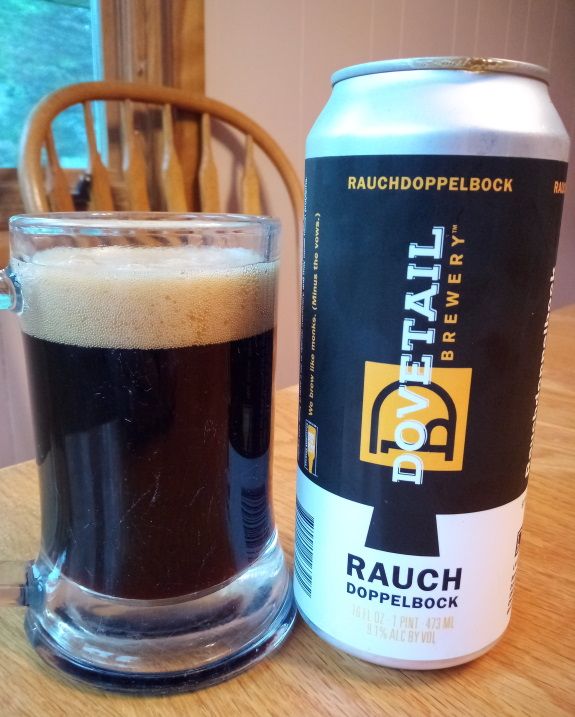
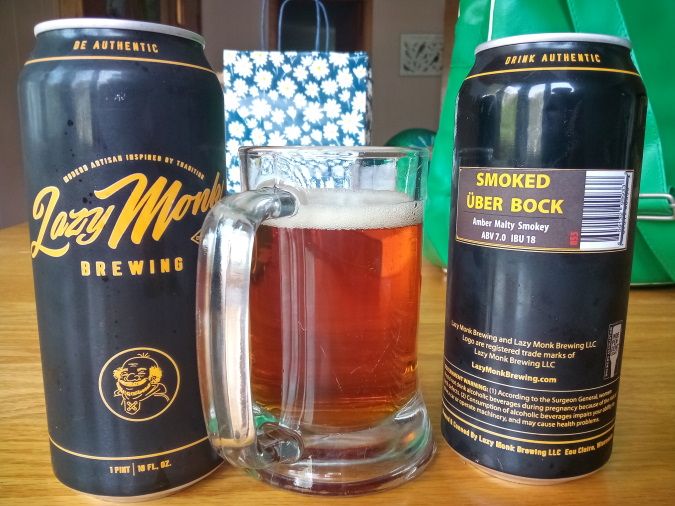
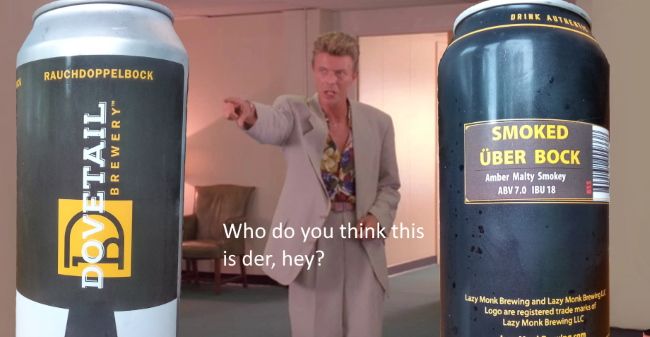
We Drink Inside a Dream: Smoked Über Bock by Lazy Monk Brewing and Rauch Doppelbock by Dovetail Brewery
08 December, 2021
Slow Spiral Into Winter: Gyrator Doppel by New Glarus Brewing
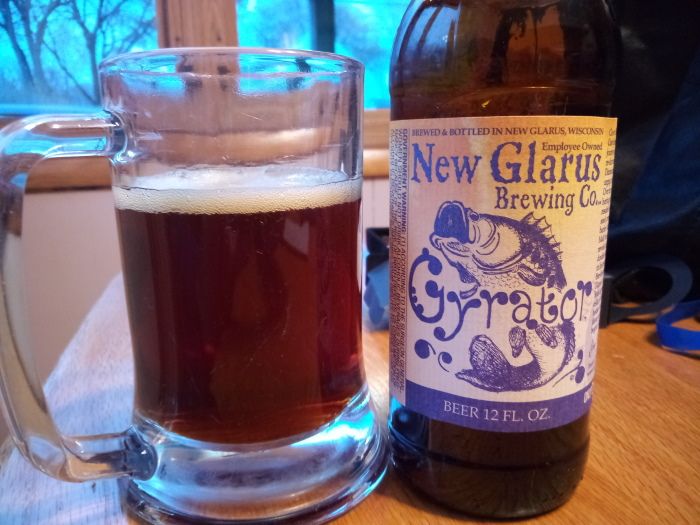
The beer's label is interesting and may be the brewery's
first to have an ichthyological theme as I can recall no Walleye Weiss nor a Small Mouth Sour. ("That's good bass!" - Dan Carey) Let's look at the description and start
with this bit: "Dan’s re-discovery of whole cone Diamant hops grown at his
urging in Hallertau, Germany". Wait, wait, wait. Dan Carey, co-owner/brewmaster/whatever
of New Glarus Brewing Company can get a foreign hop grower some 4,200 miles away to do his bidding?! Does Dan
have some compromising photographs?
It vood be a real shame if diese Fotos ended up on der
Internet…
When Carey isn't "urging" German hop growers, he can be found Googling
long lost grains. To wit: "Over ten years of his personal heritage barley
research…"
The blurb on the label then goes on to note that the brew was double
decocted, lagered for 10 weeks, and then took some R&R in the bottle for
another 6 months. This is not just some brief diversion from brewing endless gallons
of Spotted Cow.
If all of this time and effort wasn't enough, Gyrator was
released in 6-packs for the same price as Cow. I don't mean to knock Spotted
Cow here (I like it much more now that the corn has been removed), but rather to
express astonishment that what could have been a fairly expensive limited
edition release available only at the brewery instead sits on store shelves
next to and at the same price as New Glarus' more workaday beers that weren't
made with obscure heritage grains and bespoke hops. I think my sixer cost
$7.49. Craft beers are luxury items, to be sure, but this is like getting an Aston
Martin for the price of a Lexus.
As with most beers, the doppelbock has its own lore. In
short, the story is that the monks of the Paulaner monastery in Munich (or its environs) developed
the rich, malty sweet style in the 17th century to provide their daily
bread in liquid form during Lententide. As with countless other tales about the
origins of beer styles, this one too appears to be blatantly untrue. It seems that the doppelbock was initially brewed for a feast and eventually became a regular part of the monks' diet year-round instead of being reserved for a mere 40-day stretch of cenobitic austerity. Still, it's an engaging bit of legerdemain that is sure to be repeated by beer-loving doofuses like me for some time to come.
Those scents made their way to my tongue with raisin and milk
chocolate being most prominent. Caramel brought up the rear along with a smidgeon
of roasted grain. Fizziness was middle of the road but enough to keep the
sweetness from becoming cloying and give the beer a mild astringency. The
sweetness faded on the finish leaving a little lingering raisin/caramel and allowing a hint of bread to come through. Then a herbal-floral hoppiness kicked in and added a firm dryness which makes you forget that you just drank about half of your recommended daily dose of carbohydrates in one sip.
I was surprised to discover that Gyrator wasn't as sweet as I had
expected it to be. Sure, it was full of rich malt goodness and was chock full
of sweet flavors but the sweetness itself was moderated perfectly. And that toasty bread flavor at the end (a result of decoction, surely) was a treat. In addition,
I really liked how the hops came in and made for a dry finish which pleasingly
contrasted with all of the grainy flavors.
I am not well-drunk when it comes to doppelbocks. My brain's
entry for them is "Something-ator. Oh, it's a big, malty sweet doppelbock!"
But I think I am going to have to revise it to include language about Gyrator
being the Platonic ideal of the style.
Just food pairing: With such a great beer, be sure to pair
it with something a cut above your typical junk food. Since I like to drink
doppelbocks in cold weather, I suggest something warm with my favorite being SuperPretzel
Soft Pretzel Bites filled with Pepper Jack cheese.
30 January, 2021
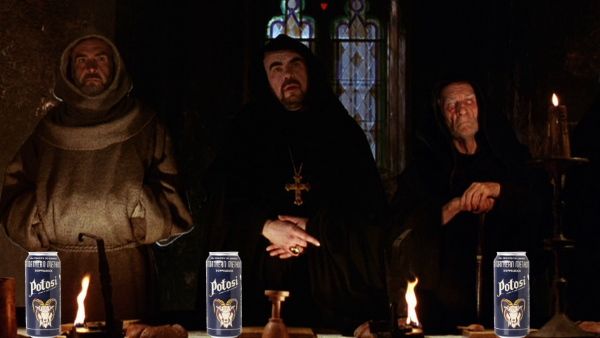
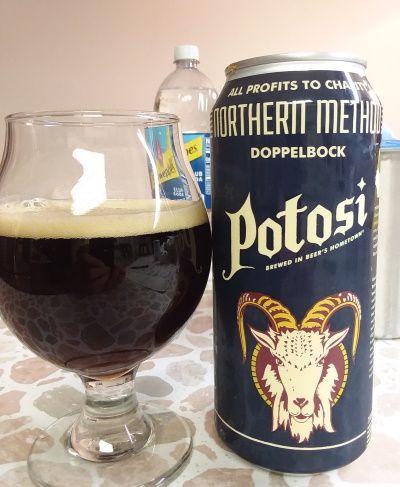
Great Taste, More Filling: Northern Method by Potosi Brewing Company
Upon closer inspection, this doesn't seem to really have
been the case although there are monks involved in the beer's history and they did do stuff like
drinking beer during Lententide.
The genesis of the doppelbock dates back to 1651 and the
friars of an order founded by Saint Francis of Paola. Their monastery was in
suburban Munich and for the feast day in Frank's honor on 2 April they brewed a
special beer which they called Sankt-Vaters-Bier (Sacred Father's Beer or something like that). This was the ur-doppelbock.
The beer would be brewed for this day every year. While 2 April fell during Lent
most years, sometimes it was after Easter. So there were indeed friars drinking
this stuff during Lent.
As the years went by this special feast day brew became
known as Salvatorbier and the brewery became Paulaner. And Paulaner exists today
and their doppelbock is called Salvator. From what I've read, doppelbocks have
gotten less sweet but more potent over the years. A little less liquid bread
for lent and more booze to ward off the chill of late winter/spring.
Regardless, doppelbocks today are generally about the malt and very sweet.
In addition to associating them with monks, I also think of
doppelbocks as something consumed around Lent. But I recently spied one by
Potosi called Northern Method and figured I'd give it a shot even though it was
only January and Catholics were still whoopin' it up to celebrate the conversion
of St. Paul.
The Potosi Brewing Company has, to the best of my knowledge,
absolutely nothing to do with monasteries, ascetic lifestyles, or celibacy. Located
in the southwest corner of the state within spitting distance of the Mighty Mississippi,
it opened in 1852 and closed 80 years later after becoming Wisconsin's fifth
largest brewery. A few decades later a non-profit group, the Potosi Foundation,
raised the necessary funds to resurrect the brewery which had been donated to
them. Potosi Brewing opened once again in 2008 and today the facility is also
home to the National Brewery Museum which is pretty slick if you're into old
beer cans, signs, and whatnot.
It smelled more or less like I thought it would – sweet like
raisins and caramel but also a bit boozy and astringent. It's 8.5% A.B.V., by
the way.
Raisin and caramel were also to be tasted along with a more
plum-like/stone fruit flavor. I discerned a little dark chocolate as well. And, in
keeping with its reputation as liquid bread, there was a bready flavor too. Some
sweetness lingered on the swallow as the hops finally decided to make
themselves known with a touch of spicy bitterness.
Despite being a big beer, I found Northern Method to be rather
easy drinking. Malt sweetness was the order of the day but my palate never got bogged
down in a cloying sludge. The beer had a medium body and I think the sweetness
was prevented from running roughshod over my tongue by judicious hopping and
just the right amount of carbonation.
Northern Method is a "Fall / Winter Seasonal Limited
Release" and so, oddly enough, it will be leaving store shelves in February
just as folks are really getting into the swing of Lent.
Junk food pairing: Christians refrained from eating meat
during Lent in the Middle Ages but "meat" referred to land animals with hooves. And
so, for example, beaver was perfectly acceptable. As was fish. So, head down to your local
Asian grocer and buy a pack of unagipai, which are essentially eel cookies.
You'll be in the clear as far as those pesky Lenten dietary restrictions go.
18 April, 2016
All the Goats Went Crazy Up in Cell Block #9: Jailhouse Bock by House of Brews
House of Brews has been and remains something of an underdog in Madison's microbrew scene since opening in 2012 insofar as none of proprietor Page Buchanan's beers has achieved a "must-have" notoriety. (Yet!) I've heard very little criticism of his beers but I also tend not to hear that any given House of Brews beer is the apotheosis of a particular style. My guess is that this is due in no small part to the fact that Page bottled only bombers until relatively recently and eschewed IPAs, by-and-large, until last year when he brewed four of them. The IPA cannot accurately be called a favored style of mine. In fact, my refrigerator is where IPAs go to die, generally speaking, but I rather liked Page's Pagoda IPA. (Full disclosure: I know Page and have spent a fair amount of time in his garage drinking his Prairie Rye.)
My understanding is that business has picked up for House of Brews now that
My taste in Page's brews leans towards his Prairie Rye, Kolsch-like ale brewed with the titular grain, and Bungalow Rye ESB. (I see a pattern there.) And while last year's IPAs didn't capture my interest, this year's promised series of lagers certainly does. First up is Jailhouse Bock, which I initially sampled back in February at the Great Dane's Bockfest. It was one of many, many bocks I drank that day so I was happy to recently revisit the bier.
Jailhouse is a doppelbock or "double bock". The style dates to the second half of the 18th century when the Paulaner monks of Cloister Neudeck ob der Au in Munich first brewed the style to help sustain them through Lenten fasting. Doppelbocks tend to be dark, potent, and full of calorie-rich malt sweetness.
Keeping in line with tradition, Jailhouse Bock pours a dark copper color. It was quite clear which gave me a good view of the abundant bubbles inside. The bier had a small ecru head that dissipated quickly.
The bier smelled much like I expected. It had a very juicy, fruity aroma up front – stone fruit to my nose. (Dear Messrs. Drosner and Rostad – some of us come to beer from food service where "stone fruit" is no more weird and exotic than "citrus". It was pretty rich hearing you guys complain about highfalutin writers who use the term as you waxed eloquently about a luxury food item. Pot. Kettle. Black.) Caramel came in a close second with toasted grain completing the aromatic trifecta.
Jailhouse Bock is one of the smoothest biers I've ever tasted. There may have been a lot of bubbles visible in the glass but they could not stem the tide of velvety malty sweetness. The caramel flavor was rich and buttery, not that it tasted like butter, an off-flavor in bier. This shouldn't come as a surprise considering the use of malts known for imparting sweetness: caramel, honey malt, and Special B which, I discovered, is a Belgian caramel malt. There was also some roasted grain flavor but Jailhouse is really about the sweetness.
It would be easy for such a heavy, sweet bier to become cloying but a healthy dose of Nugget hops really comes through on the finish. All that caramel is given a run for its money by surge of herbal/spicy hops that not only deliver a nicely contrasting flavor, but also a goodly amount of bitterness. Considering how sweet the bier begins, it's surprising just how dry your taste ends. There was no Schaumhaftvermoegen to be had.
I admit that I'm less than timely with this post. It is spring according to the calendar but it's summer outside. Eighty degrees is less than ideal doppelbock weather. My tardiness aside, do grab a bottle of Jailhouse Bock if you see one around. For such a big, (~8% A.B.V.) sweet bier, it was quite easy drinking because it is so buttery smooth. That and the sweetness confronts its hoppy nemesis on the finish and loses, giving the drinker a nice, dry ending to each sip.
Junk food pairing: Jailhouse Bock can handle whatever food you throw at it and will subsume lighter flavors into it hefty malt body. Grab a bag of garlic yuca chips or Herr's Kansas City Prime Steak flavored potato chips.
05 April, 2016
A Deadly Dark Ale: dark something by Wisconsin Brewing Company
The boreal winds cursed and whined one chill spring evening as I lumbered home from my local purveyor of adult beverages, Arkham Wine and Spirits. While there I had espied a new libation from the Wisconsin Brewing Company which snared my attention – dark something. The beers of brewmaster Kirby Nelson are well known to me and his tastes to some extent shared by me. The shop offered the beer in packs of four with the bottles ensconced in a carrying case that featured a photograph of the interior of what must have been the cranium of a madman with the word "CONSPIRACIES" emblazoned across the sides. Surely madness would lay ahead for anyone who dared decant this daemonic brew.
Upon arriving at home I hastened to bolt the doors and fasten the hasps on the windows. After setting my parcel upon the table, I carefully wrested a bottle from its eldritch packaging only to be confronted with the most disturbing label I have ever witnessed to be affixed to a beer bottle. The label's creator was of a parsimonious disposition as its abominable design was simple and cast in shadow with black and various shades of grey being most prominent. However, there was also a pallid circle outlined in ebon. It was as if the words "dark something" above begged to be segregated from the most luminous part of the label. Or perhaps the cadaverous circle required such segregation…? And those words bereft of capitalization – "dark something" - looked as if they had been transcribed from some grimoire, perhaps even by the hand of the Mad Arab Abdul Alhazred himself. In that circle was an amorphous black pattern. It was part Rorschach and part iron-filings-waiting-for-a-magnet. My mind wrestled with it for a few seconds before finally being overcome by the ever-increasing unease.
I fell into some kind of oneiric trance as I gazed at the non-Euclidian geometry of the loathsome pattern. All at once the doors of consciousness were thrown wide open as the sound of a passing omnibus shook me from my stupor. Against perhaps my lone remaining strand of sanity, I removed the bottle's crown and secured a drinking vessel.
Commencing the decanting of the beer, I noted its near-obsidian hue as its ululting roar filled the room. Although a deep brown, it appeared as an impenetrable stygian gloom in the glass. I was eventually able to ascertain that the beer was quite clear. My glass was bedecked with a large, creamy, tan head that lasted a fair while. My eyes could not penetrate the gloom to determine whether or not the effervescence penetrated the liquid or remained atop it. All in all, the beer had a saturnine appearance.
Perhaps against my better judgment I placed my nose above the glass and inhaled. My tulip glass concentrated the foetid stench of the brew and I was able to discern the aromas of swarthy chocolate, roasted grain, and a small amount of sweetness which reeked of stone fruit. I cannot explain my motivation but I then endeavored to taste the accursed distillation of all things dark and devilish.
My tongue was at once assailed by a potent blend of malt flavors. The first was of raisin but it was not particularly sweet. Next was an admixture of tastes from grains that had survived the unspeakable horrors of the flames and been transfigured into having an ink-like appearance. Their horrors had produced dark, bitter chocolate and coffee flavors. A modicum of spiciness from hops in concert with some carbonation lurking in the brew's depths added a slight dryness.
When the pitch liquid had finally made its way into my stomach, I noted a prominent taste of pepper from those same hops along with their attendant bitterness. These hops combined with the beer's potency (at 9.3% alcohol by volume this brew is not for the tremulous) made for a very dry terminal taste experience. Having emptied my glass of the rich concoction, I saw that it was filled with sheets of tan lacing. It was as if the vessel desired to remain opaque despite the absence of any liquid.
This so-called "porter-dooppelbock" mutation stands as the darkest beer I have ever witnessed. It seemed to absorb the refulgence from the room just as a Creole sucks the brains from a crawfish and trap it in its hideous opacity. Still, I was entranced by its primordial blend of the darker flavors of chocolate and coffee as well as its pleasing dryness that all but obscured a modicum of malt sweetness.
I am of the opinion that the Wisconsin Brewing Company ought to dedicate a day for celebrating the release of such a thick, cimmerian, and potent potable which channels rich, deep chthonic flavors so well. I suggest the moniker of "dark something Day".
Junk food pairing: dark something possesses the tongue and engulfs it so any food pairing should be robust. I recommend a hearty potato chip such as Kettle Brand's Sriracha or Herr's Peppered Bacon.
09 February, 2016
Fill My Glass With That Doppelvision: Doppelvision by Milwaukee Brewing Company
February. It's cold outside and Shrovetide is ceding to Lent. For pagans/wiccans it's time to celebrate Imbolc and rejoice that spring is on its way. Now this - this is the time for a doppelbock. Luckily I had a bottle leftover from last year that I opened recently.
Milwaukee Brewing Company's Doppelvision is a doppelbock aged for a month in bourbon barrels. The bier is one of a handful of the brewery's Destination Local series which features stronger brews in 750ml bottles that are for sharing with a fellow faster, heathen, kith, or kin. This is the 2015 version which was released last spring in the cruelest month. The bottle has been biding its time in my cellar which is relatively cool and dark.
"Doppelbock" means "double bock", an extra strong version of an already fairly strong brew. The legend that I've always read and heard was that the bock was invented in the 17th century by the Paulaner monks in Munich. To tide themselves over Lent, they brewed a strong bier, a.k.a. - liquid bread – that became known as bock bier. At some point in the next century the bier got stronger and the monks called it "Salvator" after their savior. The "-ator" suffix would go on to become synonymous with the doppelbock.
The doppelbock emphasizes the malt. I mean, how much sustenance can you get from hops? They average around 7% A.B.V. but some are much stronger.
Doppelvision was a lovely reddish brown color and a bit lighter than I expected. I tend to think of doppelbocks as being dark biers and barrel aging to add even more darkness. These are, of course, misconceptions that addle my brain. In reality, doppelbocks probably tend to be darker than bocks but rarely have the ebony appearance of a stout. The bier was clear. My glass had a beauty of a head that was big, firm, and tan. It stuck around for about half a minute. There were bubbles everywhere inside the glass going upwards and onwards.
That the bier had been aged in bourbon barrels was undeniable from the aroma which had a pronounced booziness to it. Much to my delight, roasted grain and even some bitter chocolate were evident as well. Looking at the brewery's website I see that they used basically every malt they had lying around which included chocolate malt so these scents were unsurprising. Also unsurprising, but quite welcome, was the smell of caramel. Doppelvision was made with no less than four caramel malts.
The booze reappeared in the taste and gave it shades of smoke, wood, and vanilla. I felt that the bier had a good, big bourbon taste but I've certainly had barrel-aged beers that tasted like someone forgot to take out the bourbon before putting the beer in. Despite giving it the old college try, the whiskey could not keep the malt down as the bier had a big caramel flavor from all of those aforementioned malts. Underneath all of this was some roasted grain flavor too. The carbonation perhaps took the edge off of the sweetness and added a little tingling to my tongue.
On the finish all of those malty flavors faded allowing an unexpected burst of grassy hops to pop through the layers sweet, grainy goodness. The hops brought with them a little bit of bitterness. It was here that the bourbon gave off a little more than flavor with some alcohol heat coming through as well. My glass was left with some really nice Schaumhaftvermoegen. Thick strands and big splotches of foam lined my vessel.
With the boozy heat on the finish and the presence of the whiskey on the nose and my tongue, it is surprising that Doppelvision is only 8% A.B.V. It tastes bigger than that. Quite aside from the potency that the whiskey had endowed, I really enjoyed the flavor of wood and vanilla from the gentle aging process. They harmonized well with the myriad of malts flavors here. I also appreciated that Doppelvision wasn't very sweet. Big malty beers can become cloyingly so and the brewer deftly avoided that pitfall here.
Junk food pairing: Being a big bier, Doppelvision can handle heartier foods. You can't go wrong with pork rinds and/or cracklin'. I mean, German biers and pork go together like peanut butter and chocolate. I also would recommend some jalapeño or jalapeño & cheddar thick-cut potato chips.
11 February, 2014
Thank you, Doug Hurst, for our daily liquid bread: Generator Doppelbock by Metropolitan Brewing
Here in the depths of winter it's always nice to have a stronger beer to help get you through the chilly nights. Doppelbocks are a good choice for me. These beers date back to the 17th century when the Paulaner monks in Munich brewed a "double bock" to sustain them through Lent. Mind you, in these days of double/trippel/quad/imperial madness, one might think that doppelbocks traditionally were gigantic beers but they were only slightly higher in alcohol than normal bocks, landing the realm of 7% A.B.V. The monks had their monastic duties to attend to, after all, and the abbot wouldn't take too kindly to his sheep showing up at vespers all shitfaced. Still, it's not unheard of for some varieties to hit double digit A.B.V. The Paulaner monks eventually named their liquid bread "Salvator" and the practice of adding –ator to the names of doppelbocks caught on.
The folks at Metropolitan Brewing in Chicago released their take on the style, Generator, back in December, if memory serves. I am unsure if this marks the brewery's first doppelbock but I do believe that it is the first time they've bottled one. I am also fairly certain that Generator is their first winter seasonal to be bottled. At 8.2%, it's perhaps a bit more boozy than tradition dictates but it will certainly keep you warm and provide enough sustenance until Metro's spring seasonal, Iron Works Alt, is released.
Considering the vast quantities of malt that go into this style, it should be no surprise that Generator pours a deep, dark sepia. And even my lousy photo reveals that it's clear. I got a nice tan, pillowy head which lasted a goodly while which I found surprising since I thought that alcohol tended to 86 foam. My glass was left with a modicum of Schaumhaftvermoegen. Doppelbocks are about the malt and Generator smells nice'n'sweet. I detected honey and stonefruit along with some black licorice and even a hint of grassiness from the hops.
Generator is sweet on the tongue as well - I caught toffee flavor as well as bread – but it's also clean. All of those fruity flavors were lagered away. It is a smooth beer and, considering all of the malt that went into it, it had a much lighter body than I thought it would have. Indeed, this stuff goes down easily – perhaps a bit too easily. Also surprising was the hop presence which is stronger than in most doppelbocks I've had. Here the spicy hop flavor is fairly intense veering near to black pepper and while it doesn't outdo the malt it does a yeoman's job in trying.
This is a very fine doppelbock. It tweaks the liquid bread formula a little bit with some extra hops but doesn't stray too far from the tried and true doppelbock legacy. It is also deceptively drinkable with a lighter body that means it'll go down easily for a while before the alcohol catches up with you.
Junk food pairing: A big beer like Generator demands spicy pork rinds.