Showing posts with label Dovetail Brewery. Show all posts

17 April, 2026

Not dead yet: print-only publications: the pub

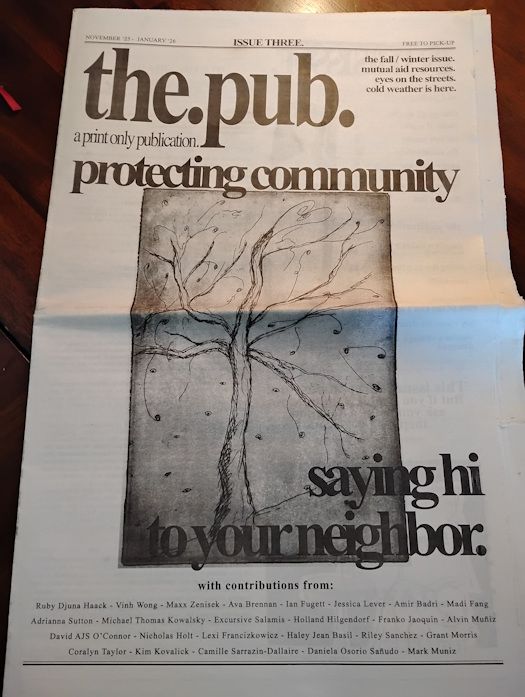
My first issues of the pub are here.

the pub is a print-only newspaper from Chicago and I subscribed after seeing an ad for it in the classifieds of County Highway, another newspaper that you cannot read online. When they arrived I felt grateful that I could receive a publication in the mail without my wife scrutinizing it and for not being accused of wrongthink as she yelled her fulminations up at me from the bottom of the stairs first thing in the morning. It saddens me to recall what an arrogant, self-righteous, insulting stormtrooper of the far left she became.

While County Highway has a libertarian streak, the pub is decidedly left-leaning and covers Chicago(land?) exclusively. For instance, I have read the article on Cut Cats Courier, a worker-owned bicycle delivery service in ChiTown.

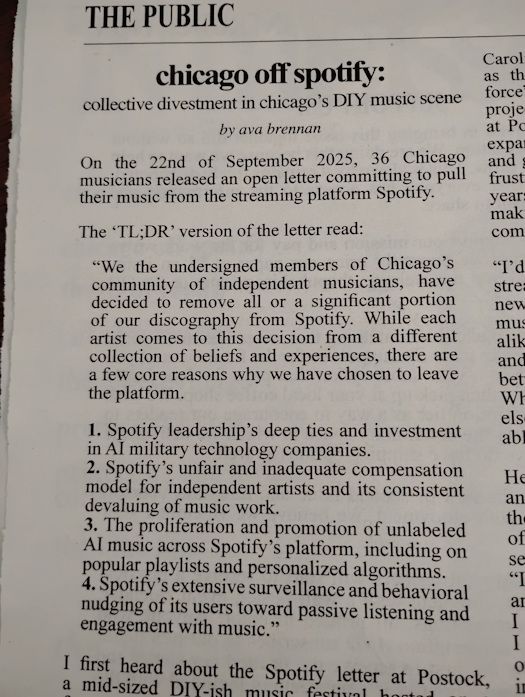
Another piece detailed how some Chicago musicians are leaving Spotify.

Honestly, these wouldn't be out of place in County Highway. I think the pub is a bit less polished, a bit more proletarian with fewer professional writers. Not a bad thing by any means, mind you.

In addition to getting writers and aspring writers into print, the pub sponsors many events such as a movie night and lino cut print lessons to foster offline community. To top things off, a favorite brewery, of mine, Dovetail, is one of their "distribution hubs" meaning the latest issue can always be found there. Just like Rauchbier.

07 November, 2025

Fud

One of things I've done a lot the past few weeks is eat out. Well, maybe not a lot but a lot for me.

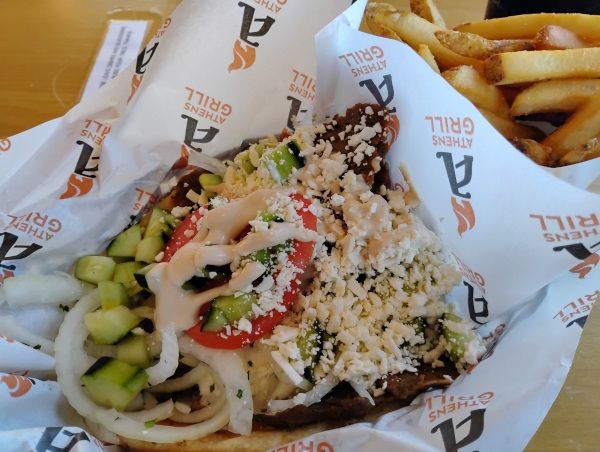
Last month I made my first stop at the standalone Athens Grill in Waunakee and I got their deluxe gyros or whatever they call it. The Grecian-American delight had the added bonus of diced cucumber and feta cheese. Well worth the extra couple bucks.

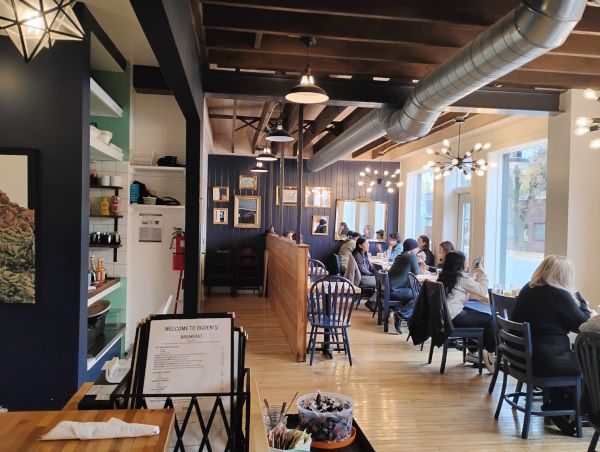
As a new resident of Eken Park it was only a matter of time before I'd make my first foray to Ogden's North Street Diner. As I write I can now boast that I've been there twice. 

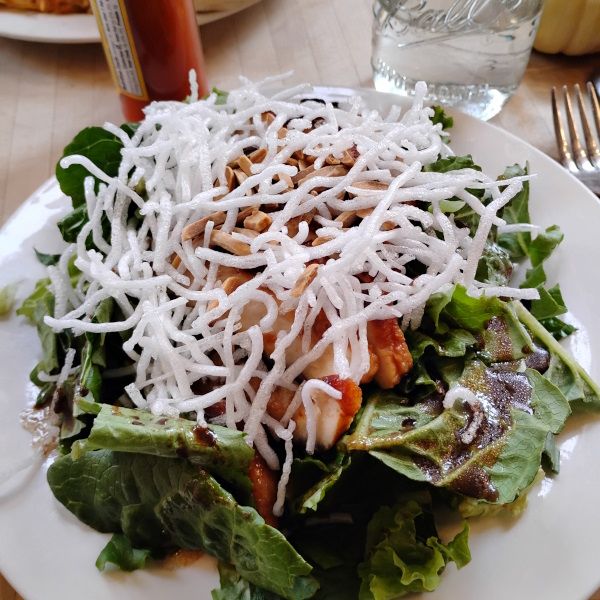
It's been the go-to spot for my friend who lives nearby and me for a quick lunch during the week when we're working from home. I've done the sesame chicken salad both times.

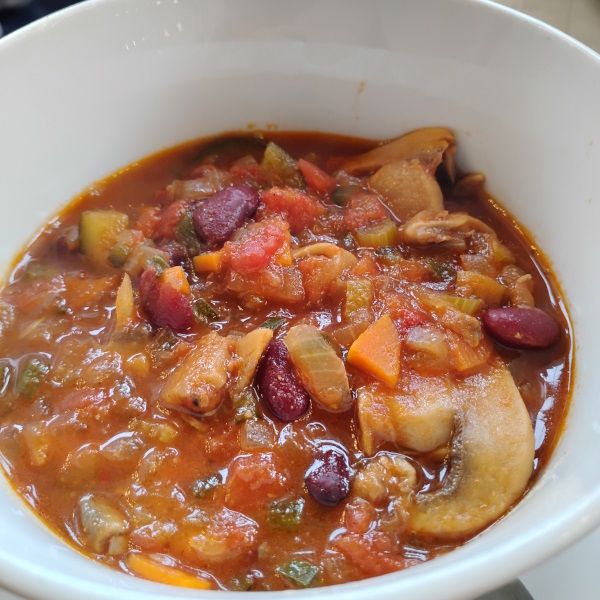
And on my most recent venture, the vegetable chili. 

The salad is fine but it wouldn't hurt to have more vegetables beyond lettuce. A little cucumber, a smidge of cabbage would do me just right. The chili was a veritable cornucopia of vegetables but was rather bland. It seemed all but bereft of any kind chili seasoning, oddly enough.

Last week I made my first appearance at Bierock. The restaurant's namesake is an Eastern European pasty.

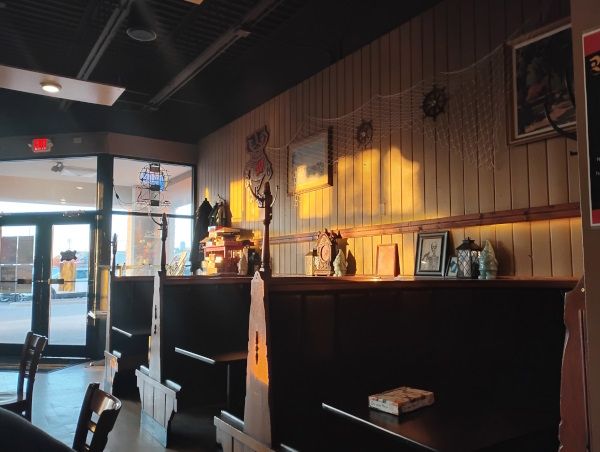
The evening sun cast an orange-tinted yellow glow about the room.

I ordered an Oktoberfest from Hop Haus in Middleton. This turned out to be a big mistake as it tasted not good. Maybe this stuff had been sitting around since July and had started going bad; or perhaps they just don't know how to make a beer where malt is the star instead of covering up the grainy goodness with hops.

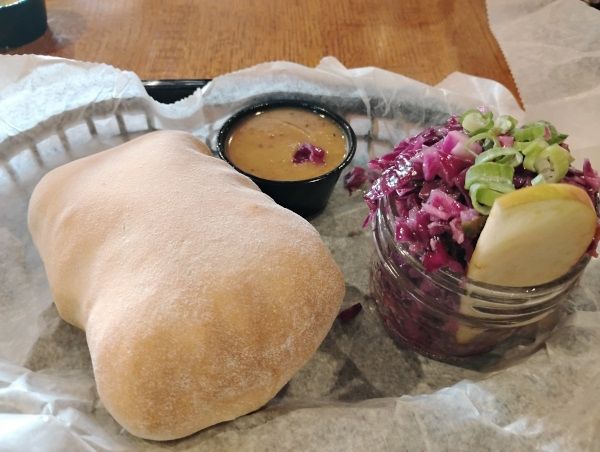
I ordered a classic bierock which was filled with ground beef, sauerkraut, and onion. Very tasty! The dough was less flaky than the pasties I've had and, while the filling was basic, it satisfied. The mustard vinaigrette that came with it was also very good. 

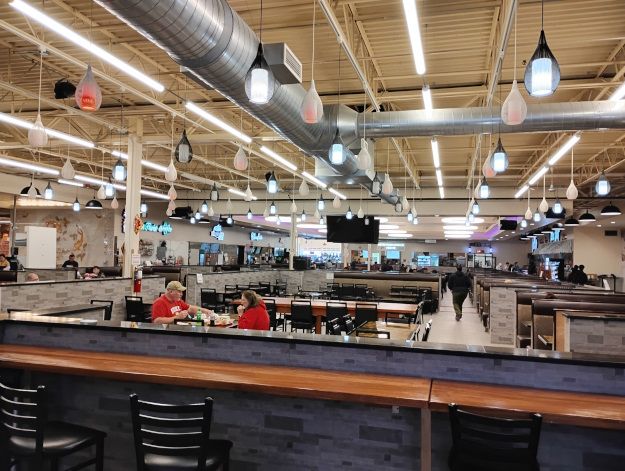
A couple weeks or so ago I accompanied a friend and her friend out on a thrift store shopping excursion. We hit the shops in Sun Prairie and a couple on Madison's east side. This, of course, made us hungry and so we stopped in at the food hall at Global Market.

Despite having shopped at the market several times, I'd never eaten at the food hall mainly because I tend to shop early and so the restaurants have always been closed when I've been there.

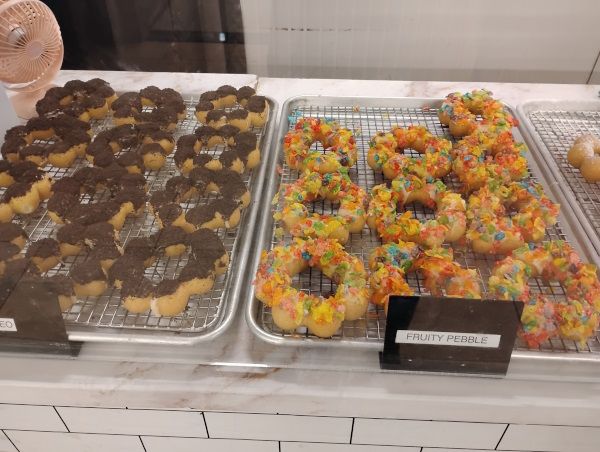
Glazed had mochi doghnuts on offer. I believe they're made from rice and tapioca flours. 

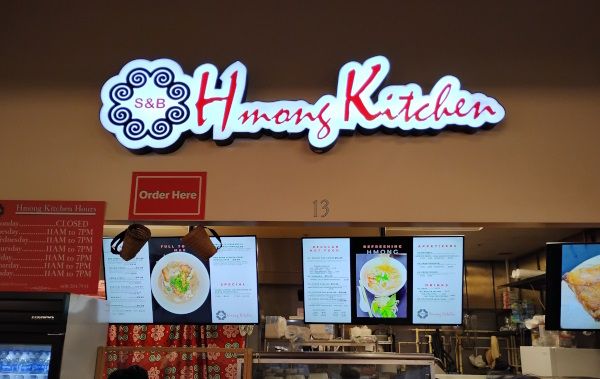
My friend's friend is Hmong so she stopped in at Hmong Kitchen.

It was nice to see her again as it had been years. Upon hearing that I needed to move out of the marital residence ASAP, she immediately offered a room to Piper and me in her home. Even though I didn't take her up on it, I am so grateful and humbled by her kindness and generosity.

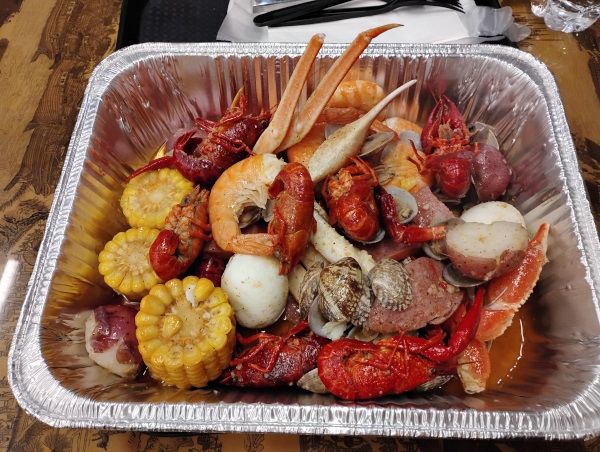
She ordered this: 

Not seen is a green papaya salad.

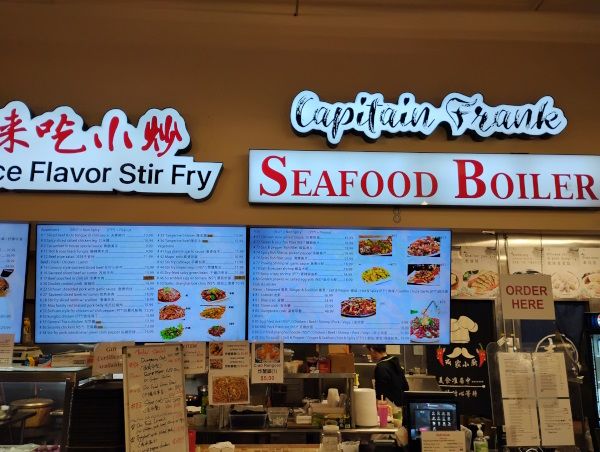
My friend and I put in an order here:

We split this:

Tastilicious!

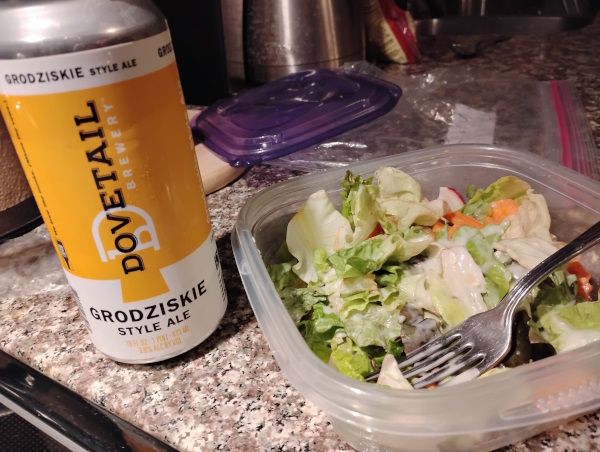
Tonight as I heated my meatballs, I ate the salad I brought to work but didn't eat as I had forgotten to bring my new bottle of dressing.

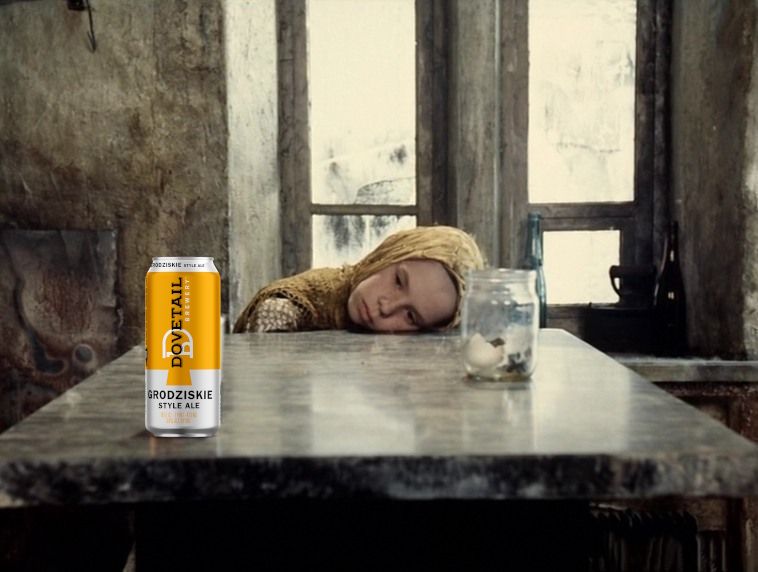
Why yes that is a Dovetail Grodziskie. I found some left over from the spring while I was down in Illinois last week. It still tasted wonderful. Light and smoky and smoky.

23 June, 2025

Pfäfflin, No: Summer Hopfenlager by Dovetail Brewery

I was quite surprised to run into this brew at my local bottle shop. The last time I was there I bought up their remaining stash of Dovetail's Rauchbier. On my way out, I stopped to ask the guy behind the counter what they'd be getting next from the venerable Chicago brewery and wouldn't it be nice if it was the Grodziskie. He replied that it would be a much less smoky brau, their Pils.

On a recent return visit I did indeed see the Pils in the cooler. But also this, Summer Hopfenlager, which is a hoppy lager for the lazy, hazy days of summer. While I might have run into mention of it at the Dovetail website, I had never seen it in the wild and so I grabbed a 4-pack. It wasn't until I got home that I actually read the label which noted traditional brewing methods - yay! - and modern hops - uff da! Oh boy. What was I getting into here?

The nouveau hops in the recipe were Vista and Strata. Strata rang a bell but Vista only registered bad memories of the much-maligned OS from Microsoft. While I knew that I'd have fruity flavors on my hands, I avoided researching them on the interwebs so as not to prejudice things or set any expectations. I wanted to drink this stuff and taste what I could taste instead of tasting what some hop dealer's webpage told me I should be tasting.

Beyond the hops, I wasn't sure what kind of brau we were looking at here. Was it their Old Country Helles given a New World hop makeover? Or perhaps it was more of a Landbier, some kind of bespoke lager brewed to accommodate a modern hopping regimen. Whatever it was to be, I expected a pale lager of some sort. And for my sins they gave me one.

Is it me or does the label have a Pet Sounds kind of thing going for it?

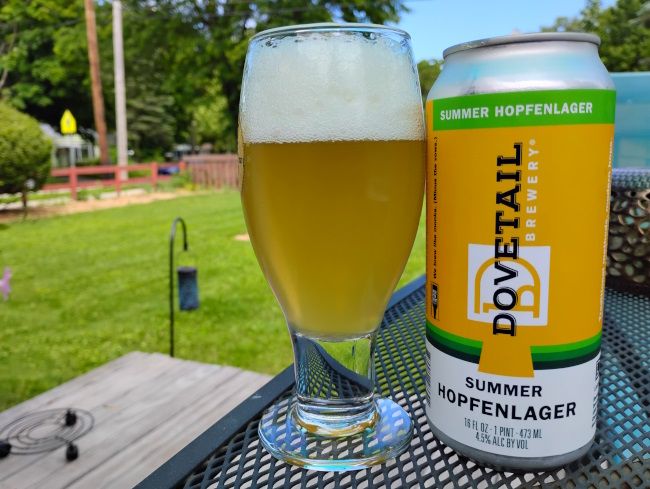
My tasting was done outside shortly after I had mowed the lawn which seemed wholly appropriate.

I think I did a heckuva job with my pour because I got a couple two tree fingers of firm, brilliant white foam and this stuff held out for a while so I managed to get some decent photographs. The brau was a hazy yellow and I spied a few bubbles here and there inside. On one hand, smelling grass in the aroma wasn't out of line as I had just mowed but I swear that this brew had a very traditional kind of smell to it: bread and grassy hops, in the main. Maybe a hint of fruitiness in there too but I thought I was smelling a Helles. Maybe the Strata and Vista were added to do more for flavor than aroma.

A light-medium body and a healthy dose of fizz greeted my tongue along with a luscious bready taste. Then came the New World hops. They were piney, at first, but also kept the grassy thing going. Fruitiness followed. It began as something like honeydew melon and became more strawberry-like on subsequent sips. While my tongue couldn't help avoid the fruit flavors, the beer didn't have a cloying resemblance to Hawaiian Punch or Froot Loops like a typical hazy IPA does for me. The fruity taste was more than an accent but less than the Kool Aid man running through a wall at me.

The piney-fruity hop combo lingered a bit on the finish with the malt bubbling beneath. Things turned towards the pine which left me with a moderate bitterness and a medium dryness.

I was not expecting the pine notes here and so I was a bit surprised at the West Coast kind of taste. At 4.5% A.B.V. this stuff is on the lighter side which befits a summer brew but there was still a rich malt flavor and enough hops to stand out but not overwhelm. It was hoppy but Dovetail wasn't trying to kill you with them. And for that, I thank them.

I enjoyed this brew and my notes say "very tasty". But one was enough for me. It was indeed refreshing and delicious but I had to find something else to follow it up. I suppose I should clarify and note that one was enough for me at that session, not in total. There's something about pine flavors paired with fruity ones that satiates me quickly. Citrus flavors are different as they're sharp and biting whereas strawberry and melon flavors from hops are really mellow and lack any kind of bite.

By no means do I regret trying this stuff. I enjoyed it one can at a time and found it to be a fine summer brau. And pine or not, it tasted damn good sitting outside after having put the mower away for another week.

Junk food pairing: Food pairing for beers with fruity hops is always difficult for me. I want something complementary yet to not go overboard with the fruit. I recommend pairing your Summer Hopfenlager with a bag of Rold Gold Flamin' Hot Honey Mustard pretzel twists.

06 June, 2025

My sincerest desire has come true here: Grodziskie by Dovetail Brewery

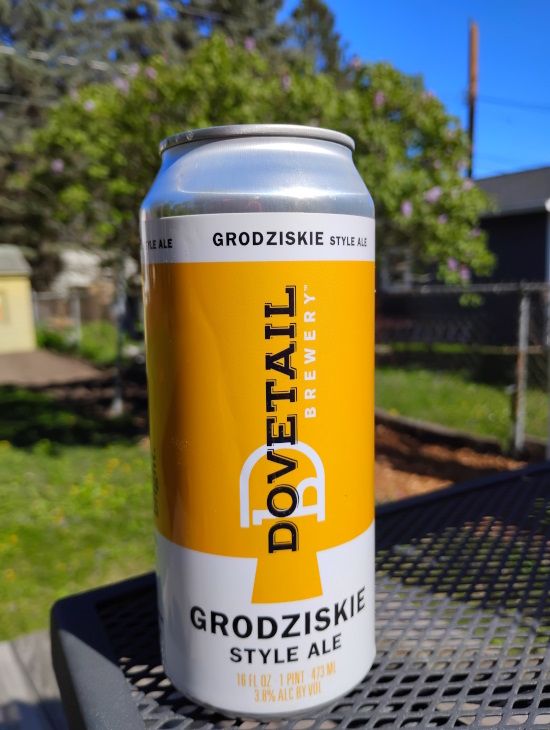
Tales of a Grodziskie by Chicago's Dovetail have long been told in these parts but I had never encountered it face to face until last month. I am guessing it's been my poor timing. Either I'd never make it down to Chicagoland when it was in season or the Binny's website proclaiming its availability had not been updated to reflect its absence. I also suspect that part of the problem is that Dovetail takes a very, um, European approach to seasonality. While most American microbrewers adhere to a strict release schedule for their seasonals, e.g. - their Oktoberfests hit shelves in late June, Dovetail seems to be the opposite and release their seasonals whenever they get around to it - within reason, of course.

Or maybe that's just my view from Madison.

Anyway, I was excited, perhaps a bit too excited, to find this Grodziskie. Being made with 100% smoked wheat, it was right up my uliczka as smoked beers are like manna from heaven for me. It is also perhaps the only native Polish beer style left these days and having some Polish blood in me means it's like drinking for the home team. Doubly so since Chicago is my hometown.

The Platonic ideal of Grodziskie was passed down to me from Ron Pattinson, if memory serves. It is to be light, smoky, hoppy, and fizzy. And I judge every Grodziskie style ale based on his description. Can one interpretation that doesn't exactly conform to this ideal still be tasty? You betcha! Tis but a starting point.

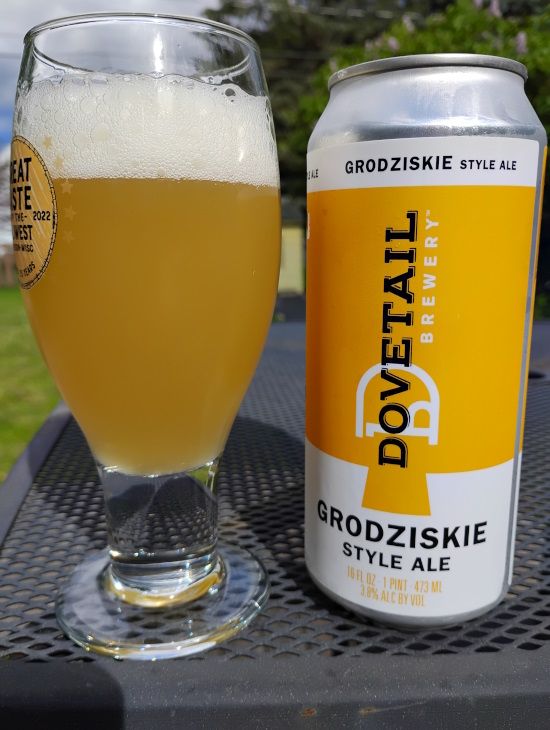
With a hazy yellow color and a very modest 3.8% A.B.V., this brew fit the light bill. A big, firm layer of foam rested atop the tantalizing liquid and, not being in a hurry to go anywhere, I was able to get a decent photograph. The aroma was of smoke along with a little bit of citrus.

My tongue was not surprised at the beer's light body which also had a very pleasant smoothness to it underneath a fairly mellow dose of fizz. The smokiness was delicious and not overwhelming which allowed for a tad of a grainy taste to come through. For their part, the hops tasted herbal-spicy and complemented the smoke well without overpowering it.

The smoky taste held fast for a bit on the finish before the herbal-spicy hop flavor came in to deliver moderate dryness and slightly more bitterness.

Since I don't know how to say "Oh mama, this stuff was good!" in Polish I'll just say oh mama, this stuff was good! While I am not sure, I do believe that the wheat used in the Grodziskie was traditionally smoked with oak. However, I am not sure what wood was used to smoke the wheat here. I don't think it was applewood or cherry, though. But, oh mama, it tastes great! And the smokiness is not particularly strong despite the whole grain bill having been given the treatment.

I'll never know how this stuff compares to the brew the inhabitants of Grodzisk Wielkopolski drank back in the day but I love Dovetail's take on the style. Maybe a touch more fizz but that's a very minor quibble. This is a fine brew and made the perfect companion on a few spring evenings.

Junk food pairing: Pair your Grodziskie with a bag of Old Dutch Onion 'N Garlic potato chips. They provide a nice contrast to the smoke taste yet somehow also complement the beer perfectly. 

09 May, 2025

Grodziskie: The Thirst Slaker

The lilacs are in bloom and the lawn has been mowed. This brew tastes wonderful! Light and smoky and refreshing and smoky. It has slaked my thirst with its smoky goodness.

I finally found some of Dovetail's heretofore elusive and smoky Grodziskie last weekend down in Geneva. Perhaps some will make its way up here. The gent at Harley's said they were to receive their Pilsner, however.

17 March, 2025

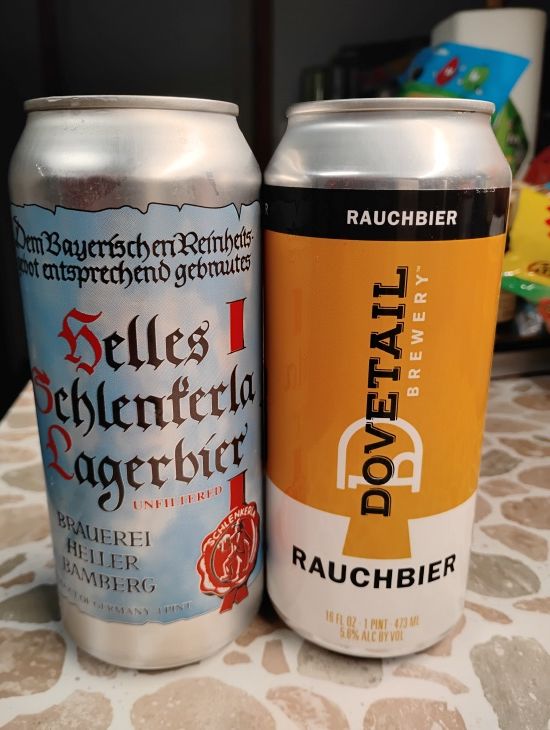
The Rauch: Rauchbier by Dovetail

It's a shame that the Steve's Liquor out on Junction Road is on the far west side instead of the more fashionable east side where I live. This is because that store is a reliable source of the elixir that is rauchbier. They always have Schlenkerla's Helles available, if nothing else, and are happy to stock rauchbiers from whomever may distribute them to Madison and not just Schlenkerla. Last year I recall going in and finding they had a rather nice selection of Schlenkerla's smoky brews.

On a more recent stop, I found some of Dovetail's Rauchbier which only has to make the trip from Chicago and not across the ocean from Bamberg. (Though I didn't see the Fastenbier on my this visit. But, it's not too late as it's still Lent.) I tasted it several years ago when I took a trek out to Ravenswood and stopped in at the brewery. Sadly, I had never seen it on a Madison shelf until now and had somehow always missed it on my various stops at Binny's.

It has been the Mr. Snuffleupagus of brews. The Dovetail website declares it's Rauchbier season and the Binny's website says, "Oh yeah, we've got some." Yet it's nowhere to be seen when I am wandering the aisles. It's as if another rauchhead always buys that last 4-pack just before I walk in the door so I just miss it by mere seconds.

And thusly I was thrilled to see it here in Madison.

My recollection of having drunk it several years back does not extend beyond "Ooh! This stuff is amber and tasty." so there was this sense of tasting it for the first time all over again.

The big tan head of loose foam that topped my pour lasted a goodly amount of time so you are able to see it in my photograph. The beer was clear and had a deep amber hue. Lots of bubbles were to be seen inside. Oh mama, did I smell the smoke! Others seem to describe every rauchbier they encounter as smelling and tasting like bacon. Yet no one seems to describe smoked beef brisket as smelling or tasting like bacon. Who among us thinks smoked cheddar has any bacon-like qualities? Does anyone add smoked paprika to their food thinking it will add the aroma and flavor of bacon?

It's just this beer piety that most people accept and generally ends further attempts to really dig into what the malt is laying down for your palate.

Here the smokiness is distinctly unbaconlike and more akin to smoked Swiss cheese. There was also plum in the aroma as well as a herbal hoppiness.

This stuff had a really nice fizziness and a big dose of rauch caressed my tongue into a smoky bliss. I also tasted a bit of caramel, though this was not a particularly sweet brew, some mild stone fruit, and a bit of bread. Oh, and those herbal hops added a nice bit of balance.

The smokiness lingered on the finish a bit before a wave of hops came in to provide what I thought was a moderate bitterness and slightly more dryness. This is not a particularly hoppy beer but there was enough to balance all those malt flavors and I liked how they came in and washed the smoke away.

Sehr schön! The smoky taste was the star of the show here with a clean, sharp flavor not dulled by sweetness. My hypothesis is that sweetness makes for a heavier taste that mimics fat in some way and gives rise to comparisons to bacon. Without the sweetness, the smoke flavor is cleaner and more woody and leans towards the fuliginous.

And thus ends my hypothesizing for today.

But, in truth, I loved all the malty flavors, especially that bit of bread. I wouldn't have minded a little more hoppiness but, as it is, they offered balance and a nice herbal-spicy flavor. The bitterness was nice on the finish too. Just a great mix of flavors.

Junk food pairing: Bleu cheese is the perfect pairing for your Rauchbier and I recommend grabbing a bag of Buffalo Blue Cheese Combos. The spicy heat complements the hops while the creamy, earthy taste of the cheese brings out new, albeit subtle, dimensions to the smoke.

27 December, 2024

One man's Baltic Porter is another man's Imperial Russian Stout: Baltic Porter by Dovetail Brewery

When I think of Baltic Porter, I think of crusty, disheveled 17th century fellows sitting at a tavern in Gdańsk on the shores of the Baltic Sea reminiscing about the good ol' days of the Hanseatic League and bitterly lament how the Atlantic trade with its cheap goods from America has just ruined everything. Over flagons of this hearty brew, they revel in the glory days when Finns traded saunas for Latvian pickled herring, the Germans traded their artisanal salt to the Swedes for potash in order to make industrial strength beer glasses, and the Poles offered honey and rye in exchange for silk for all the lovely Polish ladies to wear.

Also when I think of Baltic Porter, I think of a pitch black brew that looks like motor oil when poured into a glass. And it has a viscous feel to it when drank. A nice, full body. (Hint hint. Nudge nudge. Say no more! Say no more!) You know, Baltika #6 and the stuff from Żywiec. But when your Baltic Porter is just a hair from 10% A.B.V. like Żywiec's or Third Space, maybe it's become a Russian Imperial Stout. Baltika #6, on the other hand is only 7%. Looking at other Polish porters - Baltic Porter is a Polish invention, as I understand it - I see 7-8%.

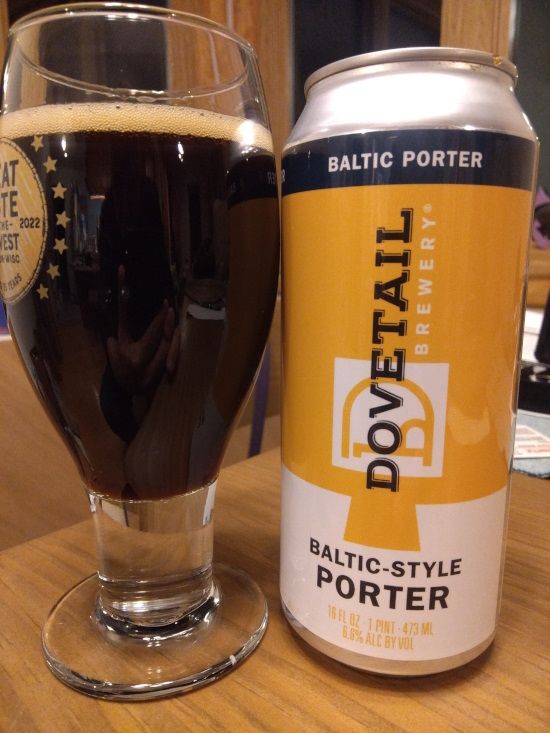
I was thrilled to be able to find some Baltic-style porter from Dovetail on a recent trek to Chicagoland as I just don't recall seeing any here in Madison. It is my impression that it's their late fall specialty, something to enjoy with the cooler autumn temperatures now that you've drunk all of your Festbier and are impatiently waiting on Jenny Pfäfflin to get that Holiday Bock out of the lagering tanks.

The label said it was 6.6% A.B.V. which was less potent than the Okacim Porter which lines Polish store shelves throughout Chicago while being significantly easier going than Żywiec Porter which is 9.5%.

Whatever strength a Baltic Porter may be, it will always be like a black hole in your glass. If you had giant glass vat of the stuff, you could stand behind it and no one would be able to see you. A fine beery hiding spot. My pour produced a lovely, but fast-fading, dollop of tan foam atop the Stygian suds. In addition to looking like its brethren, it smelled just as expected too with coffee and dark chocolate at the fore with a honeyed sweetness and something green bringing up the rear.

The medium-heavy body tasted somewhat restrained and did not simply make my tongue feel as if I had accidentally sipped from a quart of Valvoline. A firm fizziness probably helped. I tasted coffee, dark chocolate, raisin, and a little caramel while a herbal hoppiness proved to be just the right amount to balance those malty flavors. The coffee, chocolate, and mild sweetness lingered on the finish until the hops mustered just enough gumption for a bit of dryness here and a smidge of bitterness there.

Dovetail did a very, very nice job here as this is great stuff. The coffee and chocolate flavors were positively delicious and they didn't have that ostentatious look-at-all-the-black-malt-we-used-here bitterness. And it was hopped perfectly. Enough counterpoint to the roasty flavors but without trying to steal the show. I loved how it was as full-flavored as any counterpart yet, unlike some, one of these just isn't enough to last you throughout Advent.

Junk food pairing: Grab a bag of Utz's Pumpernickel Pretzel sticks and a big jar of spicy mustard for dipping to go with Dovetail's finest.

14 October, 2024

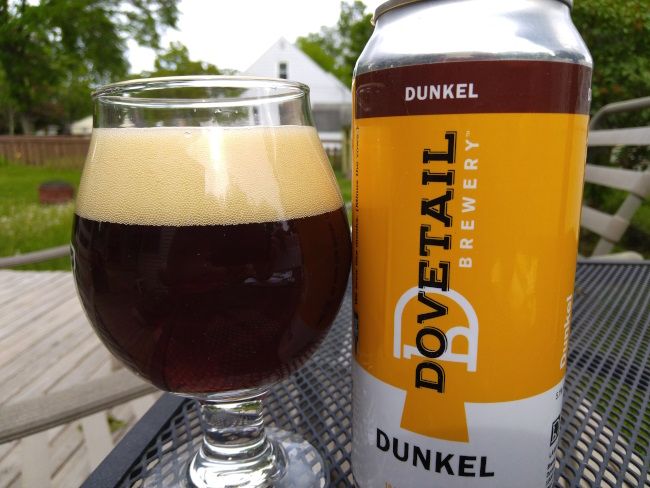
I may not be able to brew dunkels myself, but I have always gone after dark beers: Dunkel by Dovetail Brewery

In preparing for this post, I looked at my notes and saw that the date on my can was 3/1/24. Not sure if this was the canning or best consumed by date. Luckily for my tongue I did my tasting back in the spring. But this also means my review is around six months late and counting. Uff da!
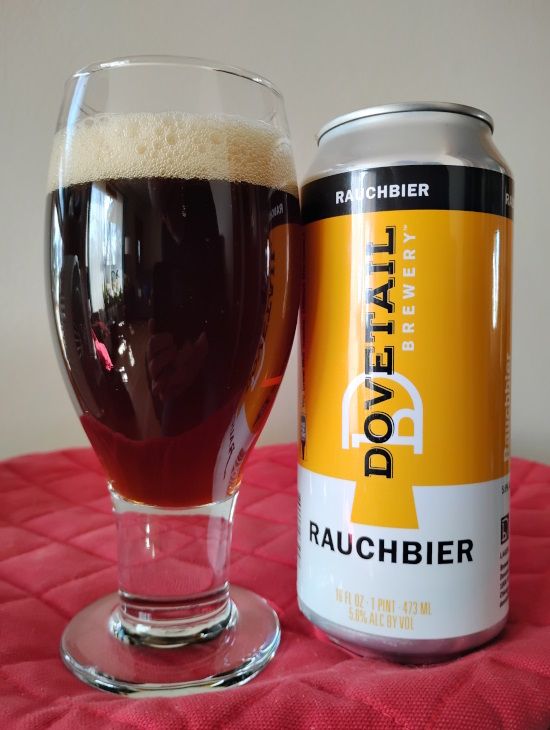
Although it appears that Dovetail has been brewing their Dunkel for several years now, it's not apparent when they do so. Is it a fall release? An easy-drinking winter surprise for those times when you need a break from the slew of Weihnachtsbocks you've been consuming to stay warm? Hell, it could be a spring treat for all I know. All mention of the bier seems to have been expunged from the Dovetail website so I guess I'll just have to wait until it's brewed again. Well, either that or I could write the brewery.

While I have not had anywhere near even half of the brews Dovetail have concocted, I have tasted several and found that they range from very good to superlative. How would their take on the Munich classic (was it even a Munich dunkel?) fare?

The head on this beer was just wonderful. Loose and light tan, it came in large quantities and had staying power. This is a good thing for those of us that lack dexterity when it comes to camera phones and/or have very cheap phones with camera apps that are less than fully functional. Someday I will master autofocus. The liquid was dark amber and clear. A sight to behold! As for the aroma, I'd say it was what I'd hope for/expect in a dunkel, namely, bready with coffee and toasty notes as well as some nice grassy hops.

A mild fizz greeted my tongue on the first sip and it noted a medium-light body. There was the expected bread from the aroma while the grassy hops also had a spicy alter ego. Malty sweetness was rather minimal while coffee and dark chocolate were more prominent. I also tasted a hint of vanilla in there. Likely because of the restrained fizziness, Dunkel was fairly smooth overall.

On the swallow, the roasty malt flavors lingered before a good dose of herbal hoppiness swooped in and made the finish a rather dry and bitter affair.

Dunkel comes in at a very good plus plus. I adored the roasty malt flavors and the overall dry profile. But I kept wishing for more bready taste. The hops were perfectly portioned to offer a brisk counterpoint to the malt. But I kept wishing for more bready taste.

Despite desiring more Maillard madness, this was a great beer. I would definitely drink it again as it hit the spot this past spring. The lighter body pointed towards spring while the roasty flavors kept the lingering chill at bay.
Junk food pairing: When Dunkel is next available, be sure to have a bag of Zapp's Voodoo Pretzel Stix on hand. They're ever so slightly sweet with an addictive tanginess that Dunkel will wash down perfectly.

14 December, 2023

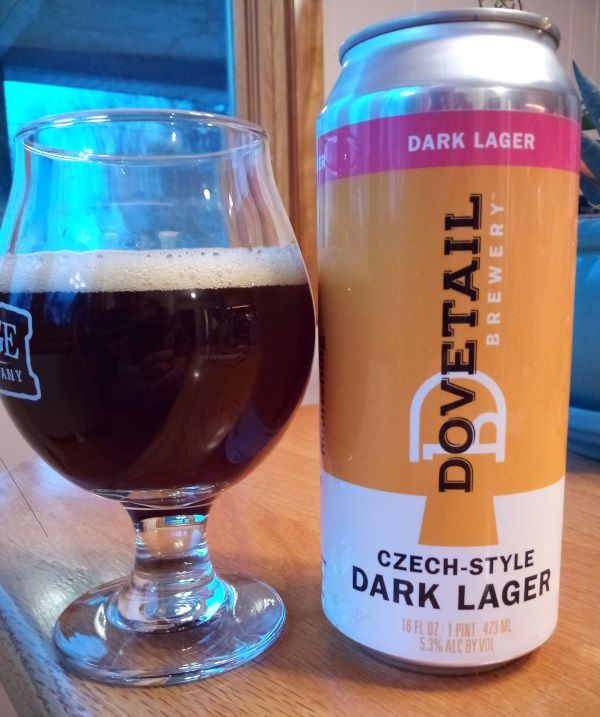
Another Ravenswood Brewery Morning: Czech-Style Dark Lager by Dovetail Brewery

 
Czech beers are having their moment in the sun or had it recently, anyway. Breweries happy to churn out IPA after IPA suddenly had to figure out how to put diacritical marks on their labels. Tmavé pivo seemed to be everywhere. OK, not really but it did pop up in places both predictable and unexpected in a nano-trend. Here in Madison, I don't think a genuine Czech dark lager has ever been on a store shelf. It's Pilsner Urquell and maybe Staropramen but that's it and I think that's the case in most of this country. Heck, the style is fairly rare in its homeland. I guess all those craft brewers went to The Czech Republic and learned the mad tmavé pivo brewing skillz.

If, as Evan Rail claims (see link above), "[tmavé pivo] should be brewed with a traditional decoction mash", then most American takes on it lack a big chunk of authenticity. However, I think we've been lucky here in Madison as both Next Door and Working Draft have brewed the style and, to the best of my knowledge, both breweries also decocted, at least while Next Door wasn't just a brand. Personally, I thoroughly enjoyed their takes on the style. Same for Lazy Monk's. Brewmaster Leos Frank is Czech so he may have had some first-hand experience with tmavé pivo back in its homeland to bring to his brew kettle.

When I was down in Chicagoland last month, I made my annual autumnal stop at Binny's and found a Czech-style dark lager from Chicago's Dovetail Brewery. Those people - I don't think there's an Old World brewing technique they don't practice. From what I've heard, Dovetail's brewers have weird dreams involving old brewhouses. My undercover contact there surreptitiously recorded the following, a recounting of one of these dreams by brewer Jenny Pfäfflin:

I was in a brewery I did not know, which had two storeys.  It was "my brewery".  I found myself in the upper storey, where there were sacks of Citra and Simcoe. On the walls hung a number of charts about hopping rates.  I wondered if this was really my brewery and thought, "Ewww!" But then it occurred to me that I did not know what the lower floor looked like. Descending the stairs, I reached the ground floor. There everything was much older. I realized that this part of the brewery must date from the 19th century. There were piles of malt scattered around, the floors were of red brick. Everywhere it was rather dark. I went from one room to another, thinking, "Now I really must explore the whole brewery." I came upon a heavy door and opened it. Beyond it, I discovered a stone stairway that led down into a cellar. Descending again, I found myself in a beautifully vaulted room. There were several copper kettles - more than enough for decoction - and horizontal lagering tanks. I looked behind a mash tun and discovered two steinkrugs, obviously very old, and half disintegrated. Then I awoke.

A beer hall
Some barley malt
It joins all
Dovetail Brewery

Dovetail lists their Czech-Style Dark Lager as a seasonal but they don't note which season. I hope it's a fall seasonal for goodness sake. The brewery's seasonals are not easy to find here in Madison. Or maybe they are and I just always miss them as if I were Gordon to their Mr. Snuffleupagus. Ms. Pfäfflin and the rest of the Dovetail Brewers probably decoct in their spare time for fun so I presumed Czech Dark Lager got the treatment. Every Dovetail brew I've had has been exceptional and I expected no less with this brew.


My pour produced a small head of loose, tan foam that didn't stick around. Putting my glass up to the light, I saw that the brew was amber hued and looked clear, from what I could tell, with a smattering of bubbles inside. Never having had a genuine tmavé pivo, I am unsure if this is what the style is supposed to look like or not. Regardless, it was pretty. Taking a whiff, I smelled some caramel, a general roastiness, a dash of dark chocolate, and a plum-like fruitiness.

That first sip revealed a medium-light body that perhaps was a bit more on the light side. A healthy level of fizz oversaw a medley a fine flavors - roastiness, coffee, bread, and a touch of caramel or more, if I was tasting from the back of my tongue. For all of the malt taste here, it wasn't very sweet. All of those roasty/coffee flavors faded on the swallow leaving some spicy hops to step to the fore. My tongue was not inundated with a flood of Saaz or anything but the hops dried things out and added a firm bitterness.

Is this beer anything like the tmavé pivo you get in the Czech Republic? I dunno. But this stuff is excellent. I love how the coffee and bread flavors lead the charge here and I also adore how that brisk wave of hops acts both in counterpoint to the bread/caramel flavors yet complements that vaguely bitter coffee taste. Plus, this pivo has a fairly light body yet is chock full of malty goodness.

As a big fan of the Dunkel and Schwarzbier, I suppose it's time to add the tmavé pivo to this Axis of Darkness. The only thing left is for Dovetail to make this stuff in a Rauchbier version or whatever you call a smoke beer in Czech.

Junk food pairing: With all the malty flavors here you'll need to pair it with something that is up to the task of being able to cut through them to stand on its own yet also harmonize with the pivo. That food, ladies and gentlemen, is Jays Hot Stuff potato chips. With roots in Chicago, their spicy paprika flavor lends an earthy, Central European goodness that complements both the roastiness of the malt but also the sprightly taste of the hops.

01 June, 2022

We Drink Inside a Dream: Smoked Über Bock by Lazy Monk Brewing and Rauch Doppelbock by Dovetail Brewery


I found something...in Altoona...at Woody's...
 
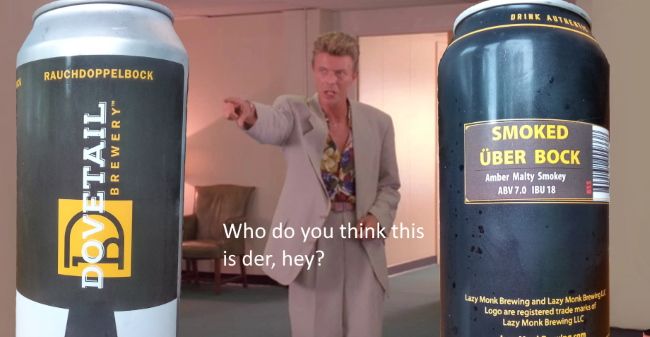
Not too long ago - well, it's been a little while now because I am behind on my writing - Chicago's Dovetail Brewery made some of their Rauch Doppelbock available here in Madison. I believe it was the first time any of their Rauchbier came to town and thusly cause for great celebration. We should have had a parade. Before long I found myself in Eau Claire and made a stop at the Woodman's in Altoona where I found Lazy Monk's Smoked Über Bock and immediately bought some because you take Rauchbier when and wherever you can get it.

Lazy Monk used to be found down here in Madison over at Trixie's Liquor but I stopped seeing their beer there years ago. While it would be nice to not have to go to the Eau Claire area to get Leos Frank's tasty takes on Czech and German styles, I have nothing against regional diversity. In fact, I am all in favor of it. Up north, I see offerings from other breweries that also have no distribution here in Madison such as Valkyrie, MoonRidge, and Bloomer Brewing. And, just as folks in Eau Claire are deprived of Dovetail, we miss out on a whole mess of Minnesota breweries that are happy to ship to the Chippewa Valley. It is a really nice treat to head up north and find all of these beers that I cannot get at home. Vive la différence!
 
Fans of The Brewing Projekt would be pleased to see that Woodman's devotes more craft beer shelf space to them than anyone save New Glarus. They never cease to amaze me with their ability to come up with different beers by simply adding the same hops as their other beers but in a different order. Or maybe with a dash of lactose or marshmallow flavoring.
 
In addition to being blessed with not one, but two ruachbiers, I had never had either previously so I was in for something new times two. It was like a dream come true.
 
I briefly flirted with the idea of asking Leos Frank to do a cage match with Dovetail brewer Jenny Pfäfflin but decided that not everything in life need be a competition and that I would just enjoy the guaiacol goodness of each without any headbutts or clotheslines.


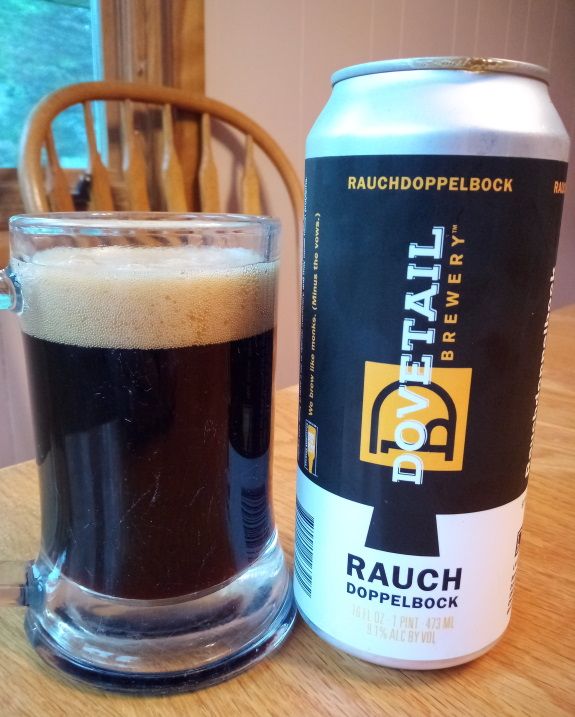
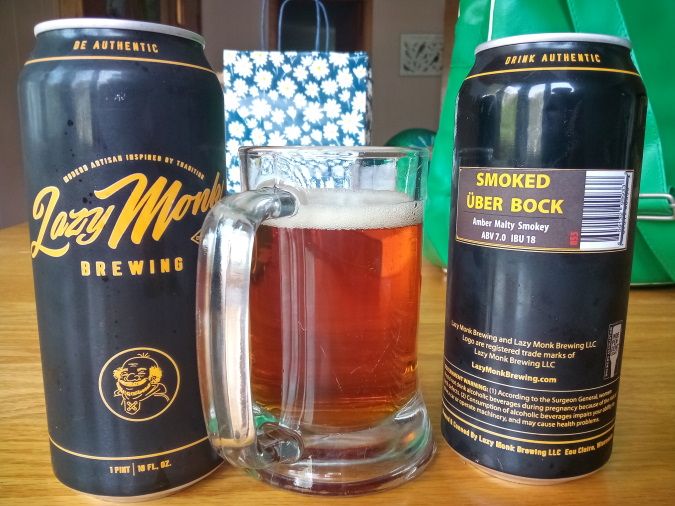
The first thing to notice is that these brews look quite different. Lazy Monk made a lovely amber beer that had some loose, light tan foam on top. Dovetail went the goth route with a Stygian brew that looked like it absorbed all light that dare go near the glass. It ended up being a deep, dark reddish brown and had a frothy tan head. Both of these big bocks were clear although the Über Bock allowed me to see some bubbles inside.

Not only did their appearances differ, so did their aromas. Über Bock smelled of honey, caramel, and some grass in addition to smoke. Rauch Doppelbock also had some caramel along with the smokiness, but it featured cherry as well. I couldn't discern anything hoppy.

Both beers had a nice fizziness to them which you need because doppelbocks are basically treacle otherwise. Each was also endowed with a big, rich, luscious, smoky flavor which I think was from beechwood but I am not yet a Cicerone of Smoke™ so that exquisite taste may have been courtesy of other woods. I tasted bread in both although it was stronger in Über Bock. Rauch Doppelbock had a little honey and stone fruit.

Each bock finished rather dry as the sweetness faded to be replaced by some hoppiness which was spicy - perhaps a bit more herbal with the Dovetail - that added welcome bitterness as well. Rauch Doppelbock comes in at 9.1% A.B.V. while the Über Bock was, in contrast, a paltry 7% (!) and the former had some boozy heat which made it a bit more astringent tasting.

I really enjoyed both of these beers greatly. They're rich and malty with a lovely smoothness that finds counterpoint in the fizz and hops. It's a pleasing interplay for my tongue. Plus they were chock full of smoky goodness.

Junk food pairing: I think these beers would pair perfectly with a mincemeat kettle chip but, since no one has bothered to make one, grab the biggest bag of Cheddar Cheese Bacon Combos you can find. Then slide them onto a skewer and garnish your glass in style.

04 April, 2022

Hagen Dost seemed combinedly possessed by all the waters from heaven: Pilsner by Dovetail Brewery


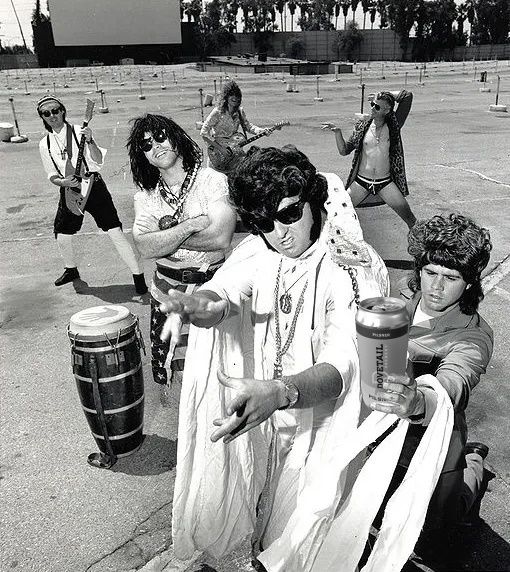
Tortelvis, the greatest singer of his generation, once confessed, "I've read this damn book 22 times, Charlie, and I still don't understand the thing." This admission, in the classic Dread Zeppelin song, "Moby Dick", is something I can sympathize with. I've never read Moby Dick, truth be told, so it's the sentiment of the statement that hits close to home, not the content. Just wanted to be clear on that point.

I've consumed various types of pilsners and I still don't understand all of the differences. There's Bohemian pilsners, German ones, American, Italian, CBD, French, Keller - who knows what other kinds. India Pale Pilsners are no doubt a thing somewhere. So, Czech pilsners are maltier than German ones, correct? And they are hoppier too with a bold Saaz bite, right? It's unclear to me what French pilsners are exactly. You'd think the French are too busy with wine, baguettes, and Jerry Lewis to brew beer. Are they a distinct style? Or just a German pils brewed with French hops? I drank one recently at Working Draft here in Madison called "Le Pils". I am clueless as to what made it French but I'd bet it's the hops. It had a delectable taste featuring lemon and spicy pepper flavors. Aramis hops, perhaps?

Yes, I just found those on a search.

Now that I think about it, I doubt that I've ever had an Italian pilsner. Certainly not one from Italy but there is an outside chance that an American one has passed my lips. I'm not sure what is particularly Italian about them. One moment...

Jeff Alworth says that there are a few elements that go into an Italian pilsner that give it a distinct Italian quality but that American brewers have basically reduced its uniqueness down to dry hopping. I am shocked - SHOCKED! - that American brewers would do such a thing.

Oh well.

This brings me to Dovetail's Pilsner which, to the best of my knowledge, made its way to Madison for the very first time recently. The can's label says only "PILSNER" and I was forced to go the brewery's website to find more info. There it is described as "a showcase for Czech hops" and the brewery's marketing team go on to boast that it was brewed with "heaven's water", which sounds like Chicago tap water that has had some chemistry voodoo worked upon it so that it was akin to the soft water of the pilsner's hometown, Plzeň, in the Czech Republic.

Man, water chemistry is not my thing and I am thinking I might have to summon the ghost of Robert Boyle to explain this to me.

Let's see if I can get this right. Plzeň's water is soft, i.e. - lacking in bicarbonates and pretty low in calcium too. This makes for water more on the acidic side which favors paler malts and brings out bready flavors. Now, why this should be is yet unknown to me but that sounds like the Bohemian pilsners I've quaffed. My searches yield lots of articles that merely say, "Want to brew a pilsner and have naturally soft water? You're golden." They are short on the details, though, about how x number of moles of some compound dissolved in the water yields a beer that is high in I.B.U.s - International Breadiness Units. As best I can piece it together, acidity levels are key to enzymes being happy and happy enzymes means tasty beer.

The water in Plzeň apparently also lacks sulfates which enhance hop bitterness so I guess Czech brewers have traditionally added more hops, hence the more intense spiciness of their pilsners, perhaps?

Ha! I probably have that all wrong but I am going with it anyway.

If Dovetail is going to go through all the trouble of mimicking the water of a city thousands of miles away, the beer is going to be good, right?

WRONG!

I kid! I kid!

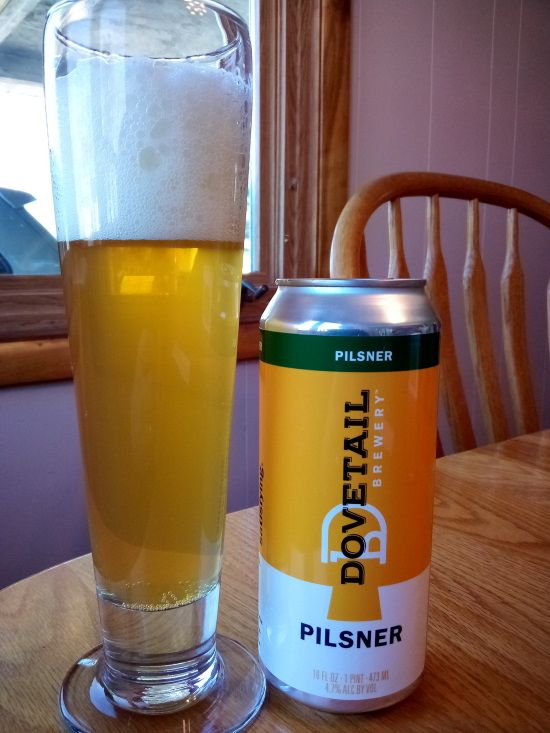
Dovetail's beers are always so pretty. I feel badly because I don't have a good camera that can really capture their alluring beauty. Long before this glass got anywhere near my mouth, I was entranced by the beer that could launch a thousand sips. At least I managed to find a pilsner glass for the occasion. Dovetail's Pilsner is a lovely light gold with a slight haze to it. I poured for the head and got a big one. Lots of firm, white foam was mine, all mine. It smelled as good as it looked with a delicate cracker aroma joined by grass and peppery hops.

The malt tasted like biscuit as a firm fizz made its way to the back of my mouth. That toasty, melanoidiny, bready flavor was here in spades. Yum! As expected, it had a light body. Oh, and the hops tasted spicy to me, just as advertised. (Or was that because I had read the description beforehand?) Upon swallowing, I found that the biscuit taste lingered a while but was eventually overwhelmed by some herbal-peppery hop flavors that were a bit dank and resinous. They were not wanting in bitterness and left things on a fairly dry note. My glass was decorated with some wonderful lacing.

Oh mama! This was an extremely tasty brew. I don't know what kind of hydromancy they performed to get that heavenly water but it paid off. The soft biscuit flavor was simply divine and it melded perfectly with those spicy hops.

Junk food pairing: just as Dovetail used some diablerie to transform ordinary tap water into heaven's water, Utz performed some kind of alchemical chicanery with fried dill pickles so pair your Pilsner with a bag of Utz's Fried Dill Pickle potato chips.

10 September, 2021

They deococted the mash - It was a Ravenswood smash: Helles Lager by Dovetail Brewery


This summer I investigated the cream ale a little bit as I was looking for something to add to my repertoire of aestival brews. They were light. They had a reputation for being crisp and refreshing. Just the thing! Along the way I learned that the venerable style was invented by American brewers in response to the German and German-inspired pilsners which were beginning to dominate the American beer world back in the latter half of the 19th century. "They want light and crisp?! Well, we'll give them light and crisp, dammit!"

And now I have learned of another brew that was invented as a response to the popularity of the pilsner. In this case, however, it was the OG pilsners of Bohemia that prompted a zymurgylogical riposte. It seems odd to me that a Czech brew would run roughshod over Germany's beer scene because, as we saw with the invention of the cream ale, it is the Germans who like to do the blitzkrieging over others.

From what I gather, Gabriel Sedlmayr II, who inherited the Spaten Brewery in Munich along with his brother Josef, devised the Helles in 1894 after he'd already come up with the Märzen. That's a 1-2 punch right up there with that of the guy who invented the hazy IPA and then followed it up with the juicy IPA.

While it's easy to find articles on the internet that maintain the Helles was the German answer to increasing Bohemian pilsner sales within its borders, I haven't found anything that gives firm numbers. Just how badly was German beer losing this Bierkampf to their neighbors to the east? And was pilsner on the rise only in the Munich area in 1894? Bavaria? The whole of Germany? We may never know. Well, not until Ron Pattinson and/or Andreas Krennmair investigate the subject and then blog about it.

However the history actually transpired, Sedlmayr's concoction is one of my favorite bier styles. It has a rich, bready grain flavor complemented by Noble hops or Noble-tasting ones, anyway. My love for the Helles started back in my freshman year of college when one of my new-found friends on my dorm floor offered to share his stash of German brews. And I don't mean a smattering of stray Beck's and St. Pauli Girl bottles he had snagged from some small town liquor store that was happy to sell to underage kids. He had spent his final semester of high school in Deutschland and smuggled some precious liquid bread back home. My memory tells me he and I drank all of the beers ourselves because everyone else to whom the offer of some fine imported suds was extended to refused on the grounds that there was still yeast in one of the bottles and that another was dark instead of light yellow like Miller and Bud.

What made me fall in love with those beers was all of the melanoidins. Those delectable molecules give beer that lightly toasted bread flavor, for want of a better way to put it. Apparently decoction is the way to create those molecules and the Germans love to decoct. Americans generally don't which is likely why I find most domestic versions of the Helles to be inferior. It's like brewers here think that if they just brew a pils but use less hops than they normally would, they've made a Helles.

I've already celebrated a few beers from Chicago's Dovetail here and I believe I noted at some point that they engage in more than a little decoction. So, when I opened my first can of their Helles, I figured that developing a fondness for this beer was a fait accompli.


As my cat Grabby looked on, I poured some in my mini-mug. I got a lovely frothy, white head that proved to be in no hurry to go away. Beneath it the beer was clear and yellow and the whole thing looked much better than my photograph portrays. Taking a whiff, I smelled fresh bread and hops that were mostly grassy but also slightly floral. Simply wonderful.

Upon taking a sip I was not disappointed. Melanoidin galore! While the beer was medium-light (leaning towards the light side) on the tongue, it had a great, rich malty taste full of toasty bread and a more general graininess. There was just a hint of sweetness. All of those malt flavors were complemented by some hops which had a slightly peppery flavor and provided a gentle bitterness. Swallowing I found that the malty flavors faded while the hoppy ones remained. The fizz dried things out just a tad making for a delightfully clement finish.

I will get down to brass tacks: this is the best American Helles I have ever tasted. Drowning in that decocted goodness on my first sip reminded me of that fateful day in the dorm when I learned what good beer tasted like. I could write an encomium to the toasty essence of the grain flavors here but I won't. Instead, I want to say that I also loved the hops. That fresh, green grassy/floral scent – oh, man! That is such a wonderful aroma. Evocative of summer and its verdant landscapes with life in full bloom.

Hopefully, as Dovetail's distribution here in Madison widens (and let us also hope it deepens with Rauchbier), their brews will be featured at a tap takeover at Olbrich Biergarten because that is how nature intended for them to be consumed. You just can't go wrong with Dovetail and the Biergarten is close to home.

Junk food pairing: With such a kickass beer decocted with ruthless German efficiency, go big on the junk food. I heartily recommend a central European theme by pairing Old Dutch Onion & Garlic potato chips (the bag is yellow just like Dovetail cans!) with Heluva Good!'s Bacon Horseradish dip.

29 July, 2021

I'll Be Your Weißbier: Hefeweizen by Dovetail Brewery


There I was at my local purveyor of barley pop, trapped in the indecision of another cooler full of colorful beer labels all jockeying for my attention. Fortunately, it didn't take me long to shake that kid in a candy store stupor after seeing $18 4-packs of "imperial" hard seltzer and one of those wapatoolie beers that admonishes you to keep it cold lest the can rupture and you ignominiously get your eye shot out by a chunk of mango. Oh, and there was also a beer brewed with marshmallow flavoring. Nothing says "craft" like a phial of flavoring solution from a chemist in New Jersey.

There was a stark contrast on those shelves. Near chest level (For me. Closer to eye level for your average person.) was that imperial hard seltzer made by somebody who pushed a few buttons on a Jetsons-like food synthesizing machine which filled a vat with water and them dumped in corn syrup and yeast. After a few cycles a robotic arm gently lifted an eye dropper and dipped it into a bottle of flavor and applied liberally. This was then put into cans and sold for $17.99.

Unless you are so short that you have to stand on a box to kick a duck in the ass, you'll have to bend over or crouch down to get a view of the shelf near the bottom of the cooler to find the beer which was the product of monk-like dedication to the art of brewing. I refer to stuff that was imported from an exotic, faraway place - Chicago - and not simply shuttled over from across the lake. The crew at Dovetail lovingly crafts their beers the old fashioned way – sans flavoring solution – and infuses the terroir of Chicago into every batch by letting their brews lounge in a coolship. And the love was available for a comparatively paltry $9.99.

That choice was clear. I squatted down to see if Dovetail had loosed any Rauchbier upon us but, alas, they hadn't. Instead there was a very tasty Kölsch(-style ale), a wonderful Helles – both of which I'd tried – and a hefeweizen which I had not yet poured into my maw. Which to choose?

I went with the hefeweizen but you know this already because it's in the title of this blog post and there are pictures of it too. I did so mainly because my dearly departed brother loved the style and I'd been thinking about him a lot in the days before walking into that store. Truth be told, he always comes to mind when I see a hefeweizen whether it be in a cooler, on a menu, or in a glass. My brother did not drink a lot, but when he did, it was always a hefeweizen. I can still see him pouring a Weihenstephaner Hefe Weissbier that last time we enjoyed a brew together. And so Weissbier brewers have that sentimental marketing advantage over me. "Buy me…it's what your brother would have wanted…you know it is…"


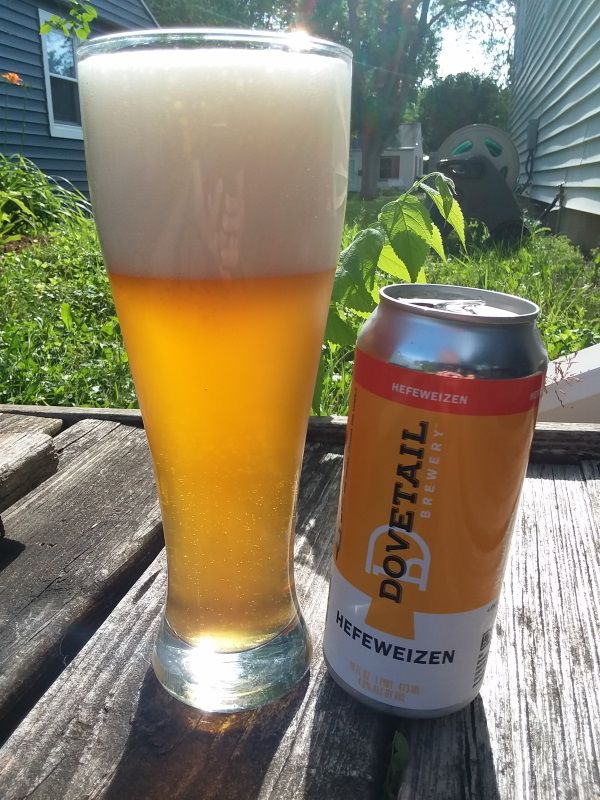
It was a lovely, sunny day when I poured my Dovetail hefeweizen into a proper Weißbier glass. (My brother would have expected no less.) The pour wasn't too bad as I ended up with a big crown of firm, white foam atop a sea of hazy gold. Very pretty. And the foam lasted a long while so it remained a lovely sight even as I supped. As hefeweizens go, I prefer mine to be on the estery/banana side versus the phenolic/clovey side and so I was very happy to smell banana in addition to bread and a dose of grassy hops.

I was further gratified that there wasn't much clove taste and rather more banana and some bubblegum. And a yeasty/bready wheat flavor. These were all complemented by a firm fizziness and one of the more overlooked aspects of the hefeweizen: its tartness/lemony taste. I've never understood the desire to serve this bier with a slice of lemon because that taste is already there. It's like bringing your own Gideon's bible to a hotel. Dovetail endowed its hefeweizen with a slight zesty lemon flavor. I think that it and the bubbles conspired to give it a bit of an astringent bite.

That banana/bubblegum combo hung on after I swallowed as did some wheat. It was fairly dry at the end with a bit of spicy hop bitterness.

After taking a tentative sip, I rather eagerly quaffed this stuff because it is excellent. I've had heavier versions of the hefeweizen (Lust, for example, from the now defunct Saint Francis Brewing Co.) and lighter ones (e.g. - Hatha-Weizen from Ale Asylum) and this hit a comfortable spot in the middle. It's 4.8% A.B.V. and was light enough to ardently sip on a hot day yet wholly satisfying with its rich, full flavor.

My brother was a Chicagoan through and through. Had he lived long enough to see Dovetail open its doors, I have no doubt he'd have enjoyed drinking this beer from our hometown. Prost, mein Bruder.

Junk food pairing: Dovetail's hefeweizen goes well with cheese popcorn, especially white cheddar. If you're inclined to go off the beaten path, try a spicy hot cheese popcorn such as Jays O-Ke-Doke variety for that authentic Chicago experience.

07 June, 2021

Then Came the Last Bocks of May: Maibock by Dovetail Brewery


The Maibock is one of those liminal beer styles. It's doesn't live in the realm of bold, heady brews that are able to fend off the -20° (-40° windchill) cold and snow of January. And it's not an easy going, sylph-like brew that is perfect for a 90° day in the sun. As its name implies, the Maibock is a beer for that time of year when the days are much milder than those of the Upper Midwestern fimbulwinter from which you have just emerged but still chilly at night to remind you that you're not out of the woods yet. It's a spring treat, perfect for sitting around the fire as your maple sap boils.

Personally, I am rather fond of Maibocks. For one, it was the first style of microbrew I can recall drinking back in 1991. For another, their appearance in stores is a bit like seeing a robin for the first time since the previous year: it heralds the arrival of spring.
This was the first year the Maibock from Chicago's Dovetail Brewery would be available here in Madison and I was greatly looking forward to it. The other beers that I have had from them have been uniformly excellent. They reliably decoct to perfection, bestowing upon their beers that toasty-bready flavor that I fell in love with while drinking the lagers my friend smuggled in from Germany back in 1990.  Well, I think they do, anyway. Either that or they use melanoidin malt which apparently obviates the need to decoct. Since Dovetail brag about decocting their beers on Twitter, I am going to discount the custom malt idea.

Although I scoured the internet from end to end, I was unable to find any evidence of who invented the Maibock as we know it today and when they did so. The bock style goes back to the 14th century or thereabouts and featured lots of malty sweetness, a dark color, a touch of hops, and a good kick**. It's for keeping the cold at bay or sustaining oneself through Lent. The going theory is that sometime during the 1800s a someone or someones had an epiphany which led to a Reese's Peanut Butter Cup moment that would be perfect for James Burke to put into an episode of Connections.

I can just see Burke strolling down the shadowy cloisters of some old monastery in Germany passing by serious looking monks who have taken a vow of silence as he intones, "The bock beer began life here in the northern German city of Einbeck in the 14th century. But by the 17th century the style had migrated south." The tonsured men then proceed to cast sideways glances at our inquisitive host. We then cut to Burke walking the streets of Vienna. "Fast forward to the 1830s when a chap called Anton Dreher in the suburbs of Vienna decided to combine the pale malts he encountered during his travels in England with the bottom-fermenting yeast he got from his friend Gabriel Sedlmayr in Munich who ran a little brewery you may have heard of – Spaten. He ended up inventing the pale lager." Cut to a big-breasted blonde with an armful of steinkrugs.

And so on. What it comes down to is that someone thought it would be a good idea to take the bock that everyone knew and liked and cross it with the new pale lager that was setting the brewing world on fire and we got the Maibock, a.k.a. – helles (pale) bock. Pale in color, not quite as much alcohol as a traditional bock, not quite as sweet either, and generally with a bit more hops.


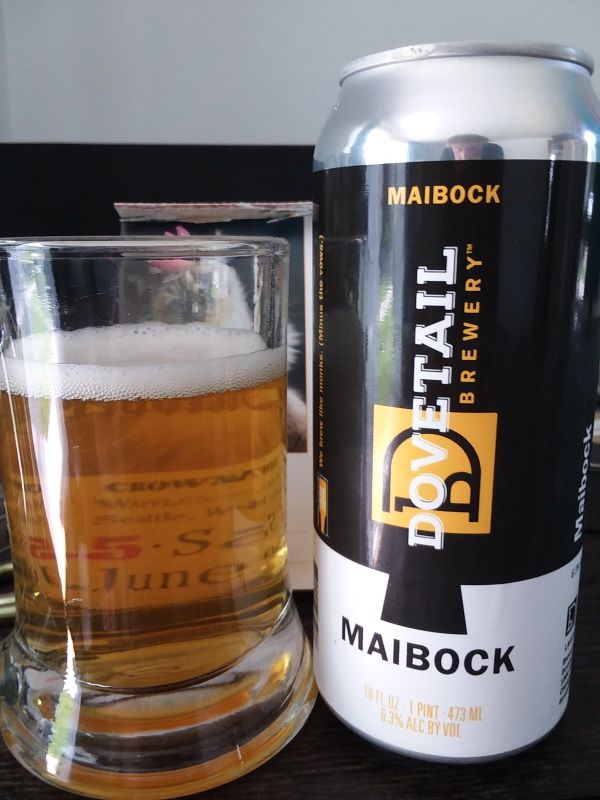
Dovetail's Maibock is a beautiful light gold that's clear as day. My pour produced a big, frothy, white head that went away rather quickly. However, the small head in the photo above is the result of me scrambling to find a good spot to take a picture for too long. It looked a lot better about 15 seconds prior to this photograph. And you can't see all of the bubbles making their way up. It looked mighty fine.

Smelling this beer brought me back to the days before 2018 driving by the Sara Lee bakery over on the 3400 block of East Washington here in Madison. If you went by at the right time, your nose was inundated with the aroma of freshly baked bread and this is what this Maibock smelled like in large measure. Simply wonderful. There was also a honey/fruity sweetness and a herbal/floral smell from the hops.

The first thing I noticed when drinking this beer was the toasted bread/melanoidiny goodness. The day someone figured out how to put that flavor into beer was a great day for humanity and we should all have a day off from work to celebrate. At least I should, anyway. John Stuart Mill would definitely have classified it as a higher pleasure. There was a honeyed sweetness, some herbal tasting hops, and some good fizz to be had as well.

On the finish some mild bitterness came onto the scene and the honey flavor took on floral overtones.

From the first sip it was apparent that Dovetail's Maibock would make its way into my top 2 microbrewed helles bocks. With plenty of that Maillard reacated toasty tastiness, how could it not? While there was the expected honey sweetness, it wasn't too much. I also really appreciated the herbal/floral tastes from the hops. My only gripe is simply that I wish there was more hoppiness, just a little more sumpin' sumpin' to go up against the sweetness. Maybe there is if drunk fresh. That experiment will have to wait for next year, however.

Despite the folks at Dovetail not brewing their Maibock to my exact specifications, I will grudgingly admit that it's still a great beer.

Junk food pairing: With toastiness the key word here, get family sized box of Extra Toasty Cheez-Its to pair with your Maibock. You can drown in melanoidin gluttony.

**This may not be an accurate description of a bock bier from the Late Middle Ages.

02 June, 2021

Now Where's My Kranz?: Kölsch-Style Ale by Dovetail Brewery


When it's a nice day and it's spring and there's Kölsch to be drunk and your passport hasn't been used yet, it gets frustrating when you realize that you're not in Köln. There is no surly Köbes keeping that Stange in front of you filled with the city's famous brew as you chow down on some Kölsche Kaviar and admire the old-looking buildings of Gereon Rath's hometown that were, in fact, built only sometime after World War II. Frustration becomes resignation eventually.

Having had a smattering of blonde ales lately, moving onto a Kölsch seems like a natural progression. These styles look the same and it's not uncommon to find a blonde ale labeled "Kölsch" – so what's the difference? The way I rate it, a genuine Kölsch from Köln will be lagered so sweetness and fruity flavors will be present but deemphasized. Plus the hops should be more grass/straw-like.

While there isn't a gothic cathedral or Köbes in sight, we do have good Kölsch-style beers here. In fact, one of the best, New Glarus' Kid Kölsch, returns this summer, if it's not already on store shelves. Sadly, some of the best domestic Kölsches I've ever had are either no longer brewed (Sierra Nevada, Big Bay) or not available here in Madison (Schlafly). Now we have a new Kölsch-style ale available here from Chicago's Dovetail Brewery.

I tend to rate Kölsches against the Platonic ideal of the style, Reissdorf. I have friends who prefer Gaffel und Früh and, while I certainly don't dislike them, they just don't reach Reissdorfian heights. Mainly I think this is because they don't get that nice, crisp cracker flavor. When I've had them, I taste something that's more doughy, almost mushy/paste-like. On the one hand, I am willing to give a lot of slack to imported beers because who knows when that stuff was brewed and what the conditions on the trek across the ocean were like. But Reissdorf makes that trip too.

Reissdorf not only has a wonderful grain taste in absolute terms, but also in relative terms. It comes in just the right amount to allow the fruitiness a little room and the hops too. Everything in its place. I've read that around 100 years ago the Kölsch was quite a bit hoppier than it is today. While I am happy to try a retro Kölsch, I will continue to adore the more modern iteration of the beer which, I suspect, dates back to the time when those old-looking buildings in Köln were being built.


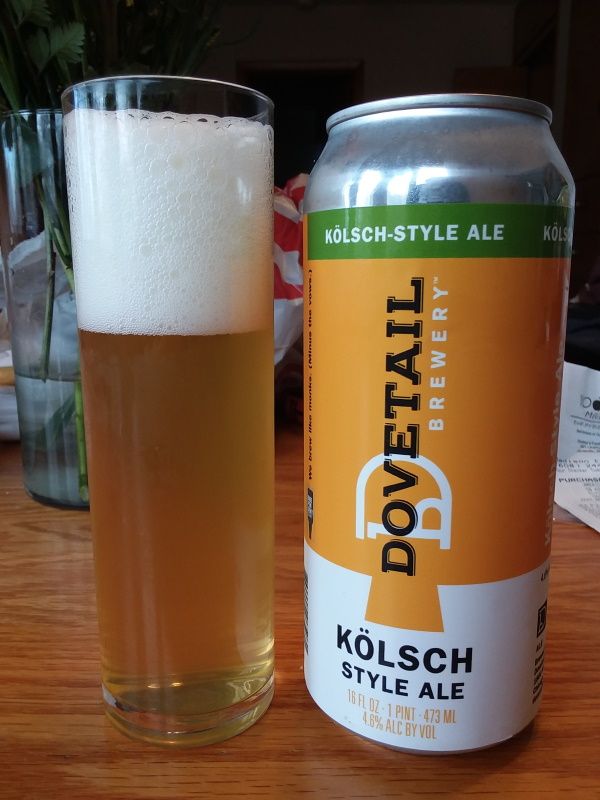
My pour of the Dovetail left my Stange with a big head of stiff, white foam. It sat atop the straw colored beer, which was a tad hazy, and looked wonderful. In the sun, it looked like the perfect vernal glass of suds. And it smelled wonderful too – very Reissdorfian. There was a strong smell of cracker along with grass and bit of berry-like fruitiness.

Unlike most of the beers I've tasted lately, it wasn't the fizz that I judged first. Instead, it was the tasty crackery grain flavor followed by some low-level sweetness that was honeyed on one sip and then more like berry on the next. It was all kept in check by a medium fizziness. On the swallow, I thought I tasted wheat as a mild, peppery bitterness kicked in which conspired with the fizz for a fairly dry finish.

Dovetail has concocted a Kölsch-style brew that is very similar to Reissdorf but with a slightly heavier malt taste and more fruitiness. It's like it took the Reissdorf template and embiggened the bier just a tad. I admit that there's a part of me saying that it just doesn't match up with my beloved Kölsch from Cologne but, really, this is a wonderful take on the style. It has got very tasty grain and fruity flavors doing that Kölsch-y pas de deux on my tongue, plus it's light, crisp and the brisk, dry finish was perfect. A most worthy addition to my Kölsch arsenal.

Junk food pairing: I like to pair my Kölsch with cheese so, after you pour yourself a Dovetail, bust open a bag of Cheetos Puffs. The lighter Puffs with their delicate crispness goes perfectly with the more restrained flavors of the Kölsch.

29 March, 2021

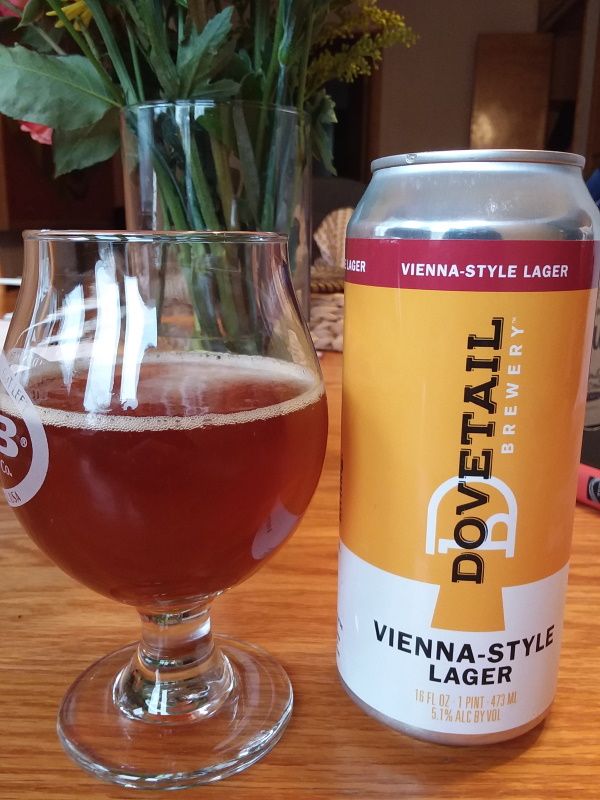
The goal of all life is good lager: Vienna-Style Lager by Dovetail Brewery

Let me begin by dropping some factoids that I just know will blow your mind:

1) I love Vienna lagers.

2) It is highly likely that I've never had a Vienna lager from Vienna or any other part of Austria.

Should I pause here so you can gather yourselves together?


I suppose that when I write "I love Vienna lagers" what I really mean is that I enjoy American-brewed amber colored lagers that sources such as the BJCP say is permissible to label "Vienna lagers". Whether the definitions of Vienna lager promulgated by the craft beer clerisy have any resemblance to the historical Austrian style of beer is questionable in my mind. I think the rise of craft beer here in the United States has propagated countless tall tales and outright falsehoods about beer and brewing history. See pretty much everything about the IPA. Due to my laziness and blogging deadlines** I've done precious little research and so the following nano-history of the Vienna lager may be completely bogus. Caveat lector.

The invention of the Vienna lager is a story worthy of an episode of James Burke's Connections as its genesis drew upon a myriad of technologies and techniques from outside of Vienna and invented in the past. Burke would, no doubt, start several thousand years in the past somewhere in deepest Mesopotamia. I am not.

Instead let's go back to the first time a Vienna lager made its way into the Kuchen hole of a paying member of the public: c. 1840. This was made possible by one Anton Dreher, proprietor of Brauhaus zu Klein-Schwechat which I think translates into English as the Klein Schwechat Brewery. (Klein Schwechat is a town near Vienna.) But before taking over the brewery from his father, Anton had a few adventures with his Freund Gabriel Sedlmayr, Jr. (Sedlmayr the Senior was the Braumeister at a little brewery in Munich called Spaten.)

Trekking through Germany and eventually Britain, Anton learned about bottom fermentation, speedy wort cooling, and kilning with indirect heat which yielded pale, non-smoky malt. He even used the humble thermometer which was, I have read, eschewed by early 19th century Viennese brewers because apparently they were a bunch of zymurgological Neanderthals.

The merger of new-fangled technology and new(er) methods in Dreher's brewery yielded the Vienna lager.

If we jump ahead to 2016 in Chicago's Ravenswood area, Dovetail Brewery is opened by two Chicagoans who met in Munich while studying the art of brewing. Together they brew continental European style beers with the occasional American technique or ingredient thrown in for good measure. This is not my first encounter with Dovetail's beer as I enjoyed their Rauchbier at their taproom a few years back and, more recently, their Helles. However, this is my initial taste of their Vienna-style lager and I didn't have to go to Chicago to get it as Dovetail started appearing on select Madison store shelves late last year or earlier this year, I cannot recall.

The beer is amber in color whereas the stuff Dreher was making was likely paler, more of a golden hue. It had a touch of haze and a lovely white head that went away rather quickly.

Its delightfully biscuity malt scent caressed my nosehairs and stimulated my olfactory bulb. Ooh la la! I also caught a little toffee and some grass from the hops.

The liquid was medium-bodied and featured a little toffee flavor. But the pièce de resistance was the rich biscuit taste that melded with melanoidins giving that lightly toasted flavor that my tongue covets so. My understanding is that Dovetail decocts, hence the melanoidins. When I finally stopped gushing over the grainy goodness, I noticed there was also a moderate fizziness and a tad of grassy-floral hoppiness.

At the finish there was a touch of lingering sweetness but mainly it was a bit dry with that fizz and some bitterness from grassy-spicy tasting hops.

As with the other beers I've had from Dovetail, their Vienna-style lager is superlative. I don't know exactly how close it is to the ur-Vienna lager from back in 1840 but it's at least on the right track with having the malt up front. Indeed, it's masterful in its melanoidin, terrific in its toastiness, and scarce in sweetness. This, along with the subdued hop presence, jibes with what I've read about Dreher's brew.

In the end, though, Dovetail isn't obligated to brew a beer that tastes like one from 180 years ago. It is however, obligated to brew tasty beer and they've certainly done that here. The sweetness is toned down and the bready/toasty malt flavors shine through, as is my preference in such matters, with some Noble tasting hops lending a little balance and dryness.

Junk food pairing: This beer is up for pairing with what is one of the best potato chips out there – Jay's Hot Stuff with its prominent paprika flavor and its heat.

**Hahahahahahahahaha

31 December, 2020

2020: A Year in Beer


As 2021 approaches, there are many Best of 2020 lists going around. A fellow Cheesehead who started a beer blog just this week made sure his first post was a list of his favorites from this year. I too thought I'd take a look back at some of the best suds I've had in 2020.

I drank many beers that I really enjoyed over the past 12 months. Certain brews, such as Tippy Toboggan, a Roggenbier by Vintage Brewing here in Madison, would make my list every year. It's just that tasty. I have sung its praises here previously so, while I drank my fill this year, I excluded it from the list. Looking back at the beers I drank from 2020, I see many that I've had in years past. They're good so I return to them. I even had a Sierra Nevada Pale Ale for the first time in ages.

New Glarus' Coffee Stout, one of, if not the, first of its kind remained highly tasty in 2020 as did Rocky's Revenge from Tyranena which is one of the first barrel aged beers I ever had and it remains a favorite. As a lover of smoked beers, I have to say Karben4's smoked porter, Night Call, is really great even if it is merely lightly smoked. I could go on in this vein for a while. But I won't.

Before I get to the list, let me add a few random observations:

1) The only Madison-area brewery that went out of business this year (due to Covid) was Rockhound. (To my knowledge, anyway.) I'd been there only a few times but I enjoyed their hefeweizen and thought they had good food. R.I.P.

2) Sprecher's Maibock and Oktoberfest stand out from those of other Wisconsin breweries because they have wonderful bready flavors instead of letting malt sweetness run amok. The new owners don't appear to have changed things too much out there in Glendale but they have brewed an NEIPA and it looks like they're continuing Sprecher's move towards being a beverage company as opposed to a brewery.

3) Breweries in the northern half of Wisconsin get too little coverage down here in the southern part of the state. While it's to be expected that they don't dominate beer chatter in the 608, it nevertheless sometimes feels like there are no indigenous breweries outside of the Milwaukee and Madison areas. To be fair, some joints up nort have limited or no distribution here. And I'm ambivalent about this. On one hand, I'd love to have some more boreal beers available here on Madison shelves. On the other, it's nice to be presented with something new and different when I travel north.

Now, on with the show.

I have both kinds of beer on my list: pale and dark. We will start with the former.

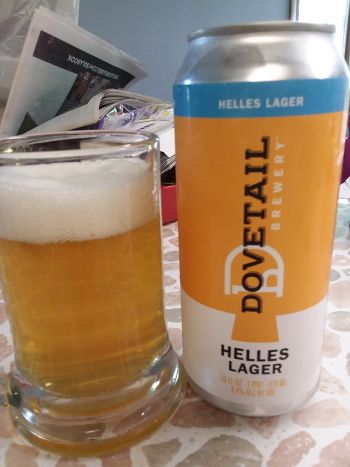
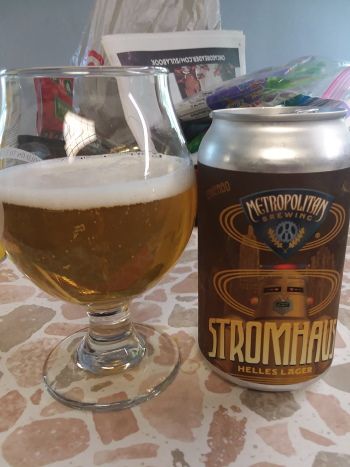
On a summer trek to Chicago I picked up Helles by Dovetail and Metropolitan, Windy City breweries both.


Helles is a fairly rare style these days for Wisconsin breweries, as far as I can tell. Capital stopped brewing their Bavarian Lager in 2010, or thereabouts and its replacement, Lake House, just isn't the same to my taste as it lacks the toasty malt flavor. Wisconsin Brewing Company had one called Ol' Reliable that went the way of the dodo. I see one from various breweries every so often but they generally taste like the amateur zymurgological experiments of a novice cicerone.

Two of our neighbors to the south each have a Helles that just oozes melanoidin-y goodness. These are the best Helleses I've had from American breweries and, if I didn't have to travel to buy them, they'd (mostly) obviate the need for those Paulaner Lager purchases I make. But, pursuant to #3 above, they do make for a nice treat when I go to Chicagoland.

Now onto the dark side.

I cannot honestly claim to know much about Czech beer styles. And beyond a Bohemian or Czech-style pilsner, the Czech Republic, sadly, doesn't seem to inspire American brewers the way Carmen Miranda's hats do. Reading Evan Rail's descriptions of Czech brews makes me thirsty but those beers have been very much a mystery to me. This year, however, I got to sample three different breweries' takes on Tmavé Pivo, or Czech dark lager.


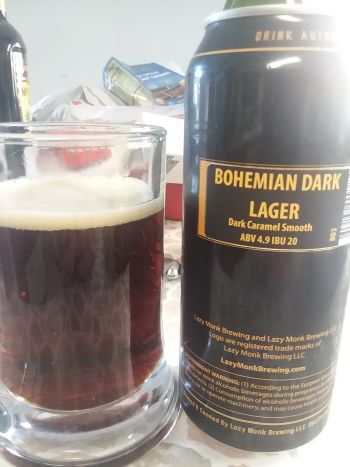
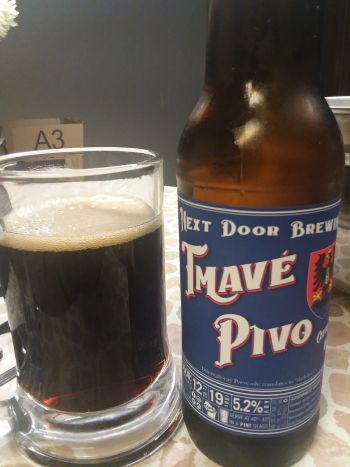
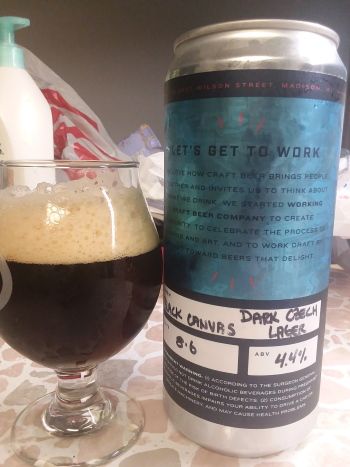
Now, whether any of these tasted like something I'll find in Bohemia when I visit, I cannot say. Leos Frank of Lazy Monk Brewing up in Eau Claire is Czech by birth so I have some reason to believe his brew has a measure of authenticity. And, truthfully, Next Door and Working Draft's piwos were very similar to Frank's with highly roasted malt flavors that ranged from coffee and chocolate to slightly burnt/fuliginous.

As a dark beer lover, this near cornucopia of piwos of a style new to me was sheer delight.

These brews stood out, not only for their sheer deliciousness, but also because they are rare or rarish styles. I certainly consumed other beers that were very delicious, but I have chosen to observe some brevity for this post.

And so that's my list proper. However, I do want to mention a couple runners up from smaller, lesser known breweries.


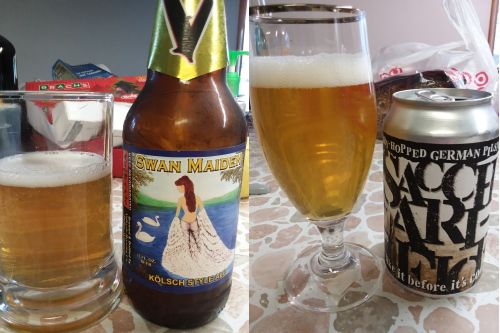
Valkyrie's Swan Maiden is a Kölsch-style beer and was really good. Located up in Dallas, brewmaster Randy Lee still brews on converted dairy equipment, to the best of my knowledge. When I visited the brewery there were no computers nor automated grain hoppers. Just Lee dumping sacks of grain into vats before grabbing a paddle to stir. Homebrewing writ large? Perhaps. But Swan Maiden was a wonderful beer with a delicate malt flavor and a light fruitiness from the yeast. Indeed, it was better than most examples of this style from American brewers who have much larger and more heavily automated facilities. Valkyrie's beers are a great bonus when I am in the northwest part of the state.

And then we have Saccharifice, a German Pilsner from Parched Eagle here in Madison. Brewmaster Jim Goronson has a small brewhouse in the basement of the building he rents that must surely qualify as nano. Lacking the space for extended lagering, Goronson still managed to produce a really good pils with a light malt touch accented by the fruity flavors of Hüll Melon and Mandarina Bavaria hops. The fruit taste is not overpowering and there's still some bitterness to be had.

(My podcasting partner and I interviewed Jim and you can find that episode here.)

There are some of my highlights of 2020. 2021 begins soon and we shall see what it brings. I predict lots of alfresco quaffing welcome in the spring.