Showing posts with label Wisconsin Brewing Company. Show all posts

14 December, 2024

The winter's bitterness is lost

I checked my email today and saw that Lake Louie has a new brew: Winter's Tale.

Taproom only. It sounds not bad. And it was the Genesis song that came to mind first and then the work by Shakespeare.

And now Robin Shepard informs me that Wisconsin Brewing Company's brewmaster Kirby Nelson has a barleywine and a wild rice doppelbock (Manoomator Mk II?) coming later this month.

He, Robin, also notes that Full Mile Beer Company and Kitchen and Working Draft Beer Company have collaborated on a smoked Helles. I look forward to tasting this brew. 2025 will be the Year of the Rauchbier, I just know it.

05 December, 2024

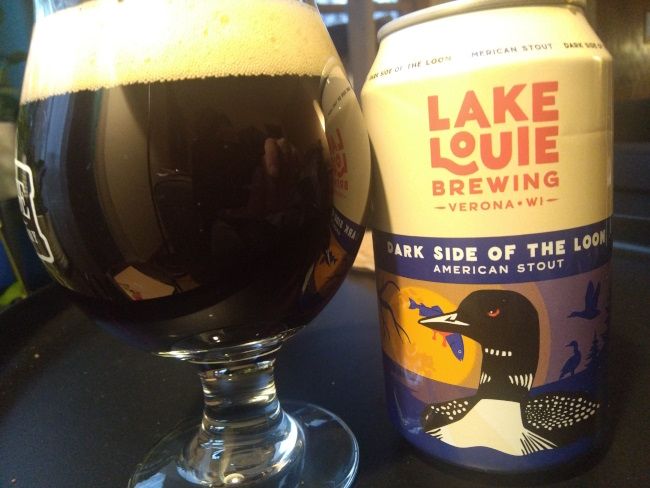
There is no dark side of the loon, really. Matter of fact, it's all dark: Dark Side of the Loon by Lake Louie Brewing

So what is the difference between Lake Louie's Li'l Louie Lager and their Wisconsin Vacation Lager?

This question came up as I was checking out their website in preparation for this very entry you have before you. They both appear to be Miller/Bud types of beers. Perhaps the former is akin to Miller Lite since it has a lower A.B.V. than the latter. Lake Louie's website is one where ad copy reigns and revealing the ingredients comes piecemeal, if at all.

This reminds me of an exchange I had on Twitter several years ago. A beer writer whose name I cannot recall (wrote for Forbes, perhaps...?) posted a tweet saying that Goose Island was coming out with a new beer, Four Star Pils. I asked him if it had been brewed with then new, fruity tasting hops or with more tried and true Nobley ones.

Bad mistake.

Almost immediately, if not in his first reply, the guy turned into a snide jagoff and began addressing me as if I was the Mrs. Grundy of the beer world. Accusations that I was an obstinate puritan unwilling to consider the new and novel came first. My retort was that I simply wanted to know the ingredients before I spent my money. I am merely a humble consumer and in no way was I opposed to the existence of pilsners with nouveau, fruity hops; I just wanted help in deciding whether to go all in with a 6-pack or to dip my toes in the water with a single bottle.

Before long, his pal Michael Kiser (the marketer behind Great Beer Hunting) waded in and went on the attack. At one point, I told the original fellow that he had changed the direction of the conversation and moved the goal posts - in order to be an even bigger jerk, in my opinion, although I didn't write that. He sneered back "I can move the goal posts if I want to." I could easily imagine the guy hunched over his keyboard writing in response to disaster victims who are short on potable water, "Let them drink Westvleteren."

What an asshole. So were they both, both assholes.

It took me years but I eventually learned my lesson and left Twitter. A few or more years ago I heard that my original interlocutor was no longer reported on beer for a living and I now see that GBH is on indefinite hiatus. I would be lying if I said I didn't feel even a smidge of schadenfreude.

So back to Lake Louie. Their site's description of the beer at hand, Dark Side of the Loon, says "This rich and complex American Stout finishes as smoothly as a majestic loon gliding across a moonlit lake in hunt of its prey." Just ad copy. Can I get a bit more than a simile, please? I don't know what makes a stout American beyond being made in America, perhaps. How does it differ from an Irish or English stout? My guess is that either it has been laced with Citra hops or it is very potent and I see that it's 7% A.B.V. Does it lean sweet or dry? Was it blended with a soured portion of IPA?

Dark Side of the Loon is a recent addition to the Lake Louie portfolio. I think heard tell of it a month ago or so. An email I received shortly thereafter features a picture labeling it as a seasonal so, once it's gone, it's gone until at least next fall. I was going to lament that a brewery that has Kirby Nelson as an employee lets an autumn go by without a doppelbock is a crime but I see that Lake Louie does now have one called Mallaggie, a Märzen doppelbock. Not sure if it's being packaged or is just available on tap. And, to be honest, I am not sure if Lake Louie operates independently of Wisconsin Brewing Company or who. Brewmaster Kirby Nelson may spend his time fulfilling brewing contracts while someone else keeps the Lake Louie lamp trimmed and burning.

Even if the Lake Louie website isn't particularly helpful, the can does note some roasty flavors in addition to the major selling point of smoothness.

How many other beer labels are there that depict nature all red in tooth and claw and bill?

This beer got brownie points right off the bat for having a head that stuck around while I fumbled with my phone's camera. It was a lovely tan hue and jiggled when I moved the glass. And the beer's name was true to its word as this stuff was positively Stygian. If I held my glass up to a light at just the right angle it appeared a deep mahogany but, for all intents and purposes, this was the kind of beer that H.P. Lovecraft would have had at his side as he chronicled the events witnessed by Randolph Carter. A strong smell of roastiness wafted into my nose as I took a whiff as did an astringent one. Was this stuff really only 7%? I caught some stone fruit too as well as faint bitter chocolate and some herbal hoppiness. No fruity hop aroma!

My first sip revealed a medium body and a decent fizziness. I tasted milk chocolate, plum, some roast, and that boozy taste. Oh, and some of that herbal hoppiness and absolutely no tropical fruit. The stone fruit and chocolate flavors faded on the finish allowing the hops to share some bitterness to make for a perfectly dry denouement. I found that the much-touted smoothness appeared as the beer warmed and indeed the stuff became positively velvety as it went down. The smoothness helped minimize the boozy astringency, which I appreciated.

Once up to temp, this is one very, very tasty beer. The chocolate/mild roasty flavors are really nice and I was happy Loon steered away from the more intense roasted flavors that lend more of a bitter/burnt taste. It's not that I don't like these flavors, it's that American brewers tend to overload dark beers with them whether they be stouts, porters, dunkels, or schwarzbiers. You don't need to use black malts in every dark beer. The hops lovingly balanced the overall taste perfectly. Plus they give just the right amount of dryness to complement the luscious, satiny finish.

Junk food pairing: Dark Side of the Loon will pair well with nutty, smoky foods such at Barbeque Nutchos or Smokehouse Nut-Thins.

19 April, 2024

Lame, Lake Louie, Lame

I was contemplating heading out to Wisconsin Brewing Company and enjoying a brew or two with some comrades - outside, if it was warm enough. So I head to the Lake Louie website and click on the big button that says "WHAT'S ON TAP" in friendly letters.

 
Expecting a list of what I could choose from on my visit, including limited test beers, I was disappointed to find that I had been unceremoniously dumped on the front steps of Untappd.

I am not on Untappd. Is there a way to get a list of what is on tap at the brewery if you're simply a visitor? I just see a list of what other people have supped and a short one at that. Presumably I could see more if I logged in.

If they've got Smoke Show on tap again, I am there.

This is lame. Why should I have to register with Untappd to try to scroll though a bunch of posts in the hope of being able to piece together a list of what's on tap?

This is lame.

15 September, 2023

Monk #47

I met some folks down at Wisconsin Brewing Company (or is that Lake Louie?) yesterday and was looking forward to trying out a couple newish beers. First was Move Ukraine, a pilsner made with sunflower seeds and some of my purchase would be donated to the titular charity to help Ukrainians rebuild homes destroyed during the war. The other was Dock Haus Gold, a Vienna lager.

Unfortunately, neither was available. Their Untappd page is woefully out of date.

Instead, I tried their Oktoberfest which, I am happy to say, seemed less sweet than in years past. I also saw a new beer or one that was new to me, at any rate: Monk's 47 Amber.

After viewing the description, it wasn't immediately apparent to me what differentiated this from their Badger Club amber lager or the late Dock Haus Gold. Cuz you know I'm all about Vienna and red and amber lagers these days.

Although rather generic and unspecific, it was not a bad description. Monk's 47 is not a super rich malt bomb, but certainly wasn't watery. It did have a pleasing malt flavor and just enough hops for balance. Went down easy.

30 June, 2023

The Corona Diaries Vol. 88: The proof of the brownies is in the eating.

(Listen to the prelude.)

(mid-April 2023)

The third of April is a red letter day in our house as it’s our youngest cat, Piper's, birthday. And this year she turned the big 1-0.

Here she is as a wee kitten. I remember well going to the cat adoption lady's house and seeing her newest litter. Piper was so new and so small and zipping around the room like a madman. Or madcat, rather. She'd charge at me as I sat on the floor and then carom off my leg before launching an attack one of her siblings or maybe a defenseless pillow.

And here she is on her big day 2023 trying to relax in one of our plush cat houses and looking irritated that one of her humans is sticking some device in her face. "Go away, hoo-man!"

Of course I gave her plenty of extra treats to celebrate. I tried to get a photo but she nommed them down too quickly to get a decent picture with my very basic phone camera.

We hope to have her for many years to come and, with all of the money I pay the vet, I expect we shall.

********

Earlier this month I was poking around the websites of local bakeries to see what my rye bread options were when I discovered that one of them offered rye brownies. I pondered this miracle food and suspect that one of those cartoon clouds appeared above my head as I did some quick culinary ratiocination. I came up with:

rye flour + dark chocolate = manna from heaven

So I set out to conjure some of these magical treats in my kitchen. I began by assembling a double boiler and melting the chopped bittersweet chocolate cubes and extra dark chips.

As the chocolate melted, I mixed the eggs, butter, sugar, and whatnot.

Everything got thrown into the same bowl and mixed together. I poured the batter into a pan and it looked rather half-assed, truth be told. “But,” I reasoned, “appearance is no measure of taste. Never judge a book by its cover and whatnot.”

The old adage was right. The brownies may have come out of the oven looking like my cat's (not Piper) diarrhea, but they tasted incredibly delicious.

I sampled, of course, but took the rest to work. I am just not to be trusted with brownies.

The whole brownie thing threw me off of my original task which was to find rye bread. While rye is less common, it's certainly not impossible to find a loaf of it in these parts. I think it's more the case that you have to get to a bakery for a good variety as grocery stores don't stock a lot of quality Central/Eastern European breads. Can I go to my local supermarket and find a pukka loaf of rye bread that my German, Ruthenian, and Polish ancestors would recognize and be proud of?

Yes.

Is there more than 1 or 2 varieties that fit the bill?

Nope.

And so, in the end, I decided to just bake my own rather than running around town trying to find the perfect loaf. I began by retrieving the bread maker that a cousin had given us from the basement. I gave it a good cleaning and then set to work.

The recipe in the manual for rye bread is quite lame, in my opinion. It called for a mere ¾ cup of rye flour but a whopping 2¾ cups of wheat. How is anyone supposed to taste the rye with that ratio? So I tweaked it a little bit.

Things went well at first. The dough rose as expected.

It smelled great too. And then I took another peek some time later and saw that it had fallen. Soon the bake cycle kicked in and I ended up with this.

Not exactly Martha Stewart level aesthetics.

Besides needing to have the flour ratio adjusted further, it tasted fine. Hearty and a bit dense with a rich, nutty wheat sweetness. It simply needed more rye. No doubt there is some arcane wisdom out there on baking bread which describes the best rye to wheat ratio, which wheat varieties taste like what, the best yeast to use, how to get a certain texture, and so on and so forth. My bready experiments shall continue.

In addition to baked things, I found myself with an inexplicable craving for pozole earlier this month. Pozole is Mexican pork and hominy soup. While I do not recall how or when, I nonetheless acquired a taste for it and have tossed around the idea of hitting all of the Mexican restaurants in the area to find out who does the best pozole.

I bought some pork and hominy thinking that I had the rest of the ingredients already. The recipe calls for dried ancho chilies which are boiled and then pureed before being added to the soup. Now, I’ve made pozole before and would have sworn that I had some dried anchos in the cupboard. But, when I went and looked, I found that I instead had a lifetime’s supply of guajillo chilies and had no idea why.

I tried in vain to recall what motivated me to buy those but couldn’t. My best guess is that they were leftover from an attempt to make mole sauce at some point in the dim and distant past.

Another trip to the store and I was ready. I made my pork stock.

As that cooked, I boiled, rinsed, chopped, and pureed until everything was ready to be thrown into the pot.

No, that cup of coffee was for the chef, not the soup.

Once the pozole was cooking, I thought it looked nice and hearty with chunks of stuff everywhere. It smelled great too.

I cooked it long enough for the marriage of the flavors to be consummated and then served myself a bowl.

It turned out very well and I was happy that I hadn’t gotten lazy and simply bought a can at the store. That stuff isn’t bad but it doesn’t have all the onion and jalapeno in it. Plus, I think my version has a more piquant chili taste to it, if I do say so myself.

Lastly on the food front, I’ll note that I recently discovered that the Wisconsin Brewing Company out in Verona, a Madison suburb, had brewed a Grodziskie once again and had it available in their taproom. I managed to convince a friend of mine to head to the brewery with me for a couple so I’d have some company.

Grodziskie is a Polish style of beer that dates back centuries. It’s traditionally brewed with 100% smoked wheat and “should” be light in body and color with a good dose of fizz and a nice hop bite. Usually it’s low in alcohol but that can vary according to the brewer’s taste.

It was delectable! Light, smoky, fizzy – I wish they’d brew it more often than once every couple of years. My only gripe, which really isn’t much of a gripe, is that I wish it were just a tad hoppier. A minor quibble. I wonder what would happen if some of that wheat were to be swapped out for rye...

********

Bonus photo. It was Easter not too long ago so here’s a rabbit I saw in a backyard. I am used to seeing what I think are Eastern Cottontails so I have to wonder if this was someone's pet that that was set free or if it escaped like a scene from Watership Down.


(Raise a glass and watch the postlude.)

19 April, 2023

Na Zdrowie 2023 Edition

I stopped in at Wisconsin Brewing Company yesterday and sampled their latest batch of Grodziskie which they now call Smoke Show instead of Nostrovia.

It was light and smoky and very tasty. Sadly, there was nowhere to get kielbasa and pierogi nearby. This should be an annual. Or at least a seasonal that gets packaged.

13 April, 2023

A Real Smoke Show

Ooh!

Now brewed under the Lake Louie banner and called Smoke Show, a Grodziskie is once again on tap at Wisconsin Brewing Company in Verona.

While not available year-round, this beer can be found at the WBC/LL taproom maybe once every couple of years, which is frequent when you consider the style. Last time it was called Nostrovia Grodziskie. Grab some now or you'll have to wait until 2025.

It's nice to have a fan of Grodziskie down in Verona.

15 December, 2021

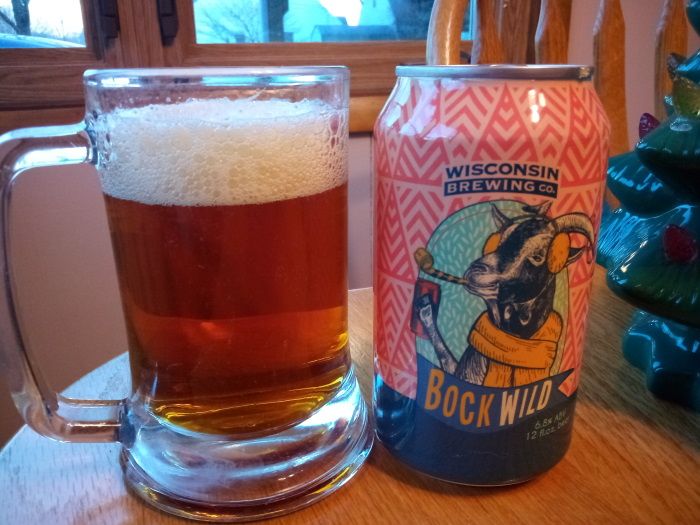
When your beer wanna get bock-wild: Bock Wild by Wisconsin Brewing Company


I recently discovered that The Beer Temple Insiders Roundtable podcast had been resurrected as The Beer Temple Podcast. Roundtabling has taken a back seat in this pandemic age, I guess. Instead of assembling a coterie of industry pros every week, Chris Quinn and Mike Schallau hold court and pontificate on various craft beer topics although guests do join them now & then. One episode features an extended discussion on IPA (well, a lot of them seem to, actually) and Quinn was talking about the evolution of the style during which he mentioned West Coast and New England varieties before mentioning the Midwest IPA.

What's a Midwest IPA?

While I think it had to do with the style's maltiness, I don't recall exactly.

Now, I realize that there are people on the coasts who think of everything between California and New York as this big, nebulous wasteland that is "Flyover Country". With such an attitude, I suspect that a fair number of journalists would be on the dole if unable to pen articles for all the sophistos that read the New York Times about their surprise at discovering we Midwesterners have coffee shops, fancy restaurants, hot yoga studios, and the other hallmarks of civilization.

But the Midwest is a sizable chunk of land. Chicago is a metropolis that dwarfs any other city in the region (and most others in the country) while elsewhere vast tracts of land are given over to corn. Surely being in close proximity to a Great Lake makes for a different ortgeist than what you find if you're smack dab in the middle of the Great Plains. Thinking (yet again) about regional beer specialties, I have to wonder if the Midwest is just too large for there to be a Midwestern style of beer.

Whether or not there is such a thing, I do feel that it's easier to make a case for Upper Midwestern beer specialties. And since I live in Wisconsin, I approach this issue with a distinct bias and people in Minnesota and Michigan and whatever else counts as the Upper Midwest will likely have some areas of disagreement with me. For my tongue, there are a few types of beers that just seem emblematic of the Upper Midwest generally and very Wisconsinesque specifically.

First there are cranberry beers. To the best of my knowledge, Wisconsin still leads the nation in cranberry production which gives New Glarus' Cran-bic and Cranberry Gose by Third Space a rather distinct Wisconsin identity and authenticity. Next are beers made with maple syrup. Yeah, those folks in the Northeast boil a lot more sap than we do but Wisconsin and Michigan still produce a fair amount of the arboreal treat. These brews seem to come and go and I am unaware of any Wisconsin breweries that produce a maple syrup beer with any regularity. The only brew of this kind that comes readily to mind is Lake Louie's Maple Surple, a brown ale with maple syrup. However, I recall O'so having brewed something with maple sap at some point in the not too distant past.

A hundred years ago Wisconsin led the nation in hemp production and so I think of hemp beers as being something of a regional specialty. Smokin' Hemp Porter by La Crosse's Pearl Street Brewery is the only one that I have encountered but it's tasty. I would suggest that there should be more hemp beer brewed in Wisconsin.

Lastly and most relevant to this post is wild rice beer. While some wild rice is produced here in Wisconsin, Minnesota rules the roost when it comes to cultivating this food. Wild rice it is not really rice, but rather a distant cousin of the stuff that we get in mass quantities when we order Chinese food. Botanists call it Zizania palustris and tell me that it is native to the Great Lakes area of the Upper Midwest. You just can't get any more regional specialty than that.

When I was developing a taste for microbrews back in the day, Capital brewmaster Kirby Nelson would make a wild rice lager every so often and I immediately adored this brew from the first sip. And then it seemed that ever more time would go by between appearances of this tasty elixir. He brewed it in 2009 and within a few short years he was at Wisconsin Brewing Company and I never heard of him brewing with wild rice at his new home until just recently. Doing a bit of internet sleuthing reveals that WBC has, in fact, brewed at least a couple wild rice beers - including a bock with Working Draft Brewing - but they appear to have been very limited releases and were never canned/bottled.

In November, WBC released their Bock Wild, a wild rice bock. This, as you can see, was canned but I have only seen it at one retail outlet – Brennan's Market. Perhaps it is slowly making its way through distribution channels as I haven't seen it Woodman's East and a friend saw neither hide nor hair of it at Woodman's West. Harumph.


Bock Wild is a lovely beer. It's a clear amber and my glass had a big head of loose, off-white foam atop it that lasted quite a while. There was a good smattering of bubbles inside. I could smell this stuff from several inches away which I believe is due to all of that effervescence. And it smelled just dandy! There was a large dose of that nuttiness that is the hallmark of wild rice plus sweet malt and an indistinct berry aroma.

The can's label notes that this fruity component comes from the additive here. I don't recall any of Capital's wild rice beers having a fruitiness like this nor any other such beers I've drunk having it either. Wild rice is known for its nutty aroma and flavor which are created during the parching (i.e. – roasting) process. The freshly harvested seeds are also left in piles to ripen and they are also cured so between these three processes, I suppose various aromas and flavors can be brought out of the rice including ones that are redolent of berries. Who knows. Perhaps the flavor here is just the result of some fine Minnesota terroir.

My tongue was greeted by a nice, medium fizziness upon first sip. There was a big berry-like flavor right up front with a herbal/peppery kind of hop taste there too. That nutty flavor that I crave so much came in mid-palate, I guess you'd say. (i.e. - I didn't notice it right away.) Some malt sweetness lurked underneath everything and gave it a medium body. And the fizz produced a moderate astringency.

The malt and wild rice flavors faded at the end leaving a not insignificant herbal hoppiness which lent the finish a firm bitterness and similar dose of dryness.

This is a really tasty beer. That berry fruitiness threw me off, at first, because I simply adore the nutty flavor of the wild rice so much and expect it to stand out. But as I continued to sip, the berry mixed with the malty tastes letting that toasted, nutty flavor stand out more. The rather dry finish made for a nice contrast with the grain and grass.

Junk food pairing: Bock Wild is a special treat for this season so pair it with something equally special. Grab some Nut-Thins and apply Cheddar Easy Cheese liberally.

17 November, 2021

Polskee Peevo: Nostrovia Grodziskie by Wisconsin Brewing Company


As a fan of smoke beers, I implore local brewers on this very blog to make more of them because they're almost as rare as hen's teeth in these parts. Generally speaking, though, my pleading is, as the Poles say, like throwing peas onto a wall. But brewers have better things to do than read my ramblings and who can blame them?

The Poles have another saying: hope is the mother of the stupid. And so rather than sitting around with my fingers crossed as the craft beer world became overwhelmed with IPAs back in 2012, I pestered Vintage Brewing Company's brewmaster, Scott Manning, because I wanted something special to drink when the Mayan calendar ended and the world turned into a Roland Emmerich film. He eventually surrendered and brewed his Grätzer Ale. "Grätzer" is the German word for Grodziskie, a Polish beer brewed with smoked wheat. The name comes from the Polish town Grodzisk Mazowiecki which used to belong to the Prussian Empire who called it Grätz, hence Grätzer.

I emailed noted punk rock aesthete and beer historian Ron Pattinson one time asking what the Grodziskie should taste like and he kindly replied, "smoky and hoppy, very well carbonated, too." "Smoky" and "hoppy" are two words I do not usually associate with Polish beers as pale lagers and Baltic porters seem to dominate the Polish brewing enterprise. And so, my interest in the Grodziskie was piqued by Pattinson's description. While certainly allowing for variation and interpretation, I generally expect any beer labeled "Grodziskie" (or "Grätzer", for that matter) to be smoky, hoppy, and fizzy.

Scott's take on the style was, to the best of my knowledge, the last one brewed here in the Madison area until earlier this year when I heard tell of a Grodziskie made by Madison's Working Draft Brewing. Unsurprisingly, I found that it was to have limited availability and I never got myself down to the brewery to try it. Bummer. The moral here is, as the Poles like to say, when bast can be torn, then tear it. Then a couple of weeks ago I saw that Wisconsin Brewing Company was offering one called "Nostrovia Grodziskie" as a limited release only in their taproom. Not wanting to miss out on the Precious again, I heeded the words of Steve Winwood who had a saying of his own - And little Sir John and the nut-brown bowl when you see a chance, take it.

It was a rainy afternoon as I drove to the brewery where I was to meet a couple of my co-workers. I was feeling a bit giddy cruising down the road because I had noticed a Trachte shed that I'd never seen before a few seconds previously when suddenly

THUMP!

My fight or flight instinct kicked in and then I noticed a streak of red had formed on the left side of my windshield. What had I hit? Investigating a bit more closely, it appeared to be rather viscous. Ketchup. Someone in a passing car had thrown their dinner at me. As Voltaire once wrote, "We are all formed of frailty and error; let us pardon reciprocally each other’s folly" and so I did and laughed it off.

I arrived at the brewery and met up with my fellow IT drones. We had a couple as we commiserated and used one another as an audience for jeremiads lamenting the capricious dictates of our tyrannical boss. I ended up going home with a crowler of the Grodziskie.


Nostrovia Grodziskie is a lovely straw color that reminded me of summer rather than the falling leaves and temperatures around us now here in Wisconsin. It was hazy too which is something I expect from wheat beers. My pour produced a lovely, frothy, white head that stuck around for a little while. There were few bubbles to be seen inside my glass. "Where is all the fizz?" I quietly asked my cat, Grabby, who was sitting on the table next to me. She had no answer beyond a big yawn of indifference to the plight of humankind so I plowed on and found that the beer had a lovely smoky aroma that wasn't quite as big as you get from a Schlenkerla beer.

The beer's paucity of bubbles belied a good, firm fizzy taste. While not to be mistaken with something from Schlenkerla, there was a nice smokiness to be had. Not overwhelming but not a token flavor relegated to a supporting role either. The beer's light body had a little wheat/grain flavor that brought with it a slight sweetness while a bit of lemony citrus held everything in check.

The smoke did a long fade on the finish while some grainy sweetness lingered. That lemony tang mixed with the fizz and a bit of herbal hoppiness to produce a mild, pleasant dryness.

Why this beer didn't see a tap until autumn is a shame. It's light body, relatively gentle smoke, and a citrus/fizz combo would have made this an ideal summer brew. Plus it's easy on the alcohol at 3.6% A.B.V. Still, I am glad that it reached my lips eventually. The server at WBC said that it was brewed by Kirby himself which was nice to hear. This doesn't seem to have been a thoroughly traditional take on the style as it did not have a big hop taste. Still, I greatly enjoyed the smokiness and its overall light touch.

Junk food pairing: Poles love their honey so grab a tube of Pringles Honey Mustard crisps to go with your Nostrovia Grodziskie.

16 June, 2021

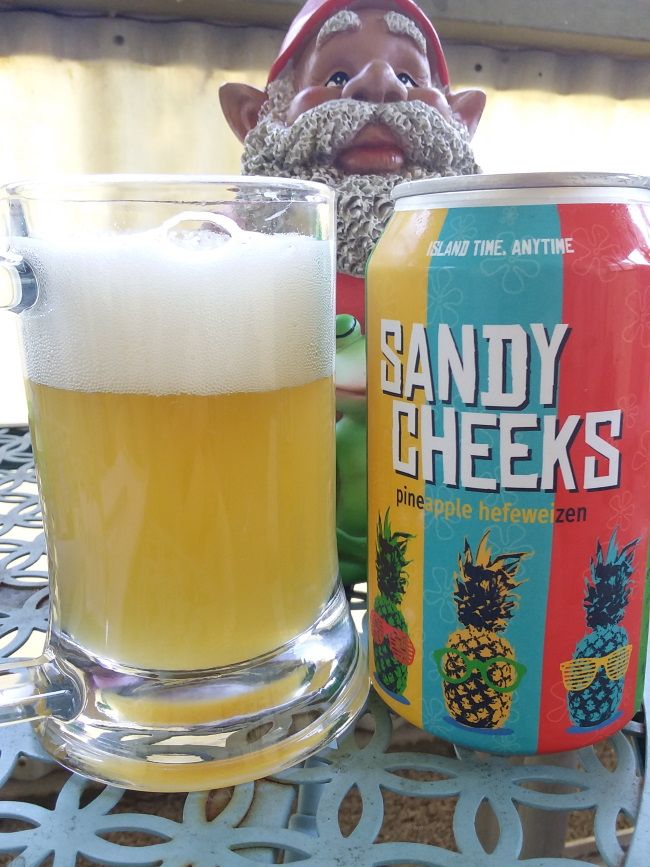
I Like Hefeweizens and I Cannot Lie: Sandy Cheeks by Wisconsin Brewing Company


Recent plans for the Frau and I to meet a friend at the Olbrich Biergarten were quashed due to rain. While it was a bummer to have a chance to be social with someone we hadn't seen in quite a while denied us, I was happy to have Mother Nature water the new tree that the city planted in front of our house instead of me doing so. But in addition to missing out on seeing our friend and all the GemĂĽtlichkeit that a trip to a biergarten entails, it was to be a tap takeover by Wisconsin Brewing Company which meant I also missed my chance to finally try Wisconsin Vacation, their pils.

Now that I look at their webpage, it's billed simply as a "lager". Well, crap. More specifically, "Lager.  Behold-a classic lager.  Refreshing, crisp and bursting with joy." How blatantly unhelpful. (Are there any ales that are given the minimalist moniker of simply "ale"? I look forward to the John Cage Brewing Company putting out empty beer bottles labeled only with "12oz".) Is this stuff Supper Club redux? My experience lately has been, if a beer is simply labeled "lager", then it's an American pilsner, i.e. – a crafty Miller/Bud/Coors simulacrum. Back in 2016 a WBC beer release calendar showed a Czech pilsner as a new year-round offering. This never happened, as far as I know. It seems that Wisconsin Vacation is the end result of that initial attempt to put another pale lager into the WBC line-up.

Well, to try and makeup for having missed WBC at Olbrich, I recently decided to give their Sandy Cheeks, a pineapple hefeweizen, another try. I had it on tap a couple of years ago and thought that it wasn't bad. Just a little too much pineapple for my taste ensured it would be a one pint only deal, though. But that was then and this is now. Perhaps the formula had been refined or The Great Curse of 2020 had slowed pineapple imports or made the fruit quite expensive leading to its more judicious use in Sandy Cheeks. I mean, hope springs eternal, right?

Pineapples are a common enough (and cheap enough) sight down at the supermarket these days that we forget that it (and many other fruits) were once rare and precious. Although native to South America, Columbus encountered them in the Caribbean in 1493 and they became an instant sensation when he brought the tasty, sweet, pinecone-looking fruit back to Spain. It wasn't long before every Tomas, Ricardo, and Haroldo with a greenhouse was trying to grow them. Expensive to ship from the New World to the Old, pineapples were once the province of the rich alone. In Europe, anyway.

They became a very coveted fruit perhaps by no one more than 19th century essayist and poet Charles Lamb who wrote of them in an erotic way that puts that My Octopus Teacher guy to shame. Eating one, he wrote, was "a pleasure bordering on pain, from the fierceness and insanity of her flesh, like a lover’s kisses she biteth." I like pineapples and hefeweizens but, if there's any pain involved in drinking Sandy Cheeks, I am hoping it simply means I cut myself on the can.

If, like WBC, you're keen on adding fruit to your hefeweizen, you could do worse than pineapple. (Notice how the coolers at your liquor store aren't being overwhelmed with durian hefeweizens.) Like the hefeweizen, pineapples contain fruity esters and a phenol which adds a clove-like taste. The fruit also contains citric acid which is how she, er, it biteth you. So it's rather complementary to the bier.

It is my understanding that Sandy Cheeks was first offered a few years ago but was a draught-only brew until last year when it was canned for the first time. As I noted above, I had it on draft a couple years back and found it to be tasty. While the pineapple flavor was just a touch shy of cloying, it was still sweet enough to mask some, but not all, of the hefeweizen taste. I was happy to have a pint and then move on to something else. Is the 2021 version any different?

While it is surely the case that my photography is lacking, my picture still does a decent job of showing you what a pretty beer Sandy Cheeks is. It's a very hazy light yellow and I got a big, frothy, white head that was in no hurry to leave my mug. This is a very pretty beer – one that looks like summer in a glass.

It smelled almost exactly as I imagined it would. Brewmaster Kirby Nelson preaches balance in beers and the aromas are all in harmony here with a bit of wheat and a little of the pineapple here and your typical hefeweizen bubblegum and banana there.

Sandy Cheeks is a late spring/summer seasonal and it was brewed to spec. It has a medium-light body that was perfect for a recent balmy day. A medium dose of fizz fit well with all of the fruit, esters, and phenols. As with the aroma, pineapple, bubblegum, and banana were well-balanced with one another. I was quite pleased that the application of pineapple was done with a bit more care than in the past as there was no sweetness that even approached slightly excessive. A little wheat came through towards the end as did a velvety smoothness which was unexpected.

Some spicy hops and their attendant bitterness appeared on the finish as the fruity flavors lingered.

The moderation in the pineapple addition here paid off. There's nothing remotely cloying about Sandy Cheeks these days and more of the excellent hefeweizen reached my eager tongue. The flavors are all in their places living in harmony. I could definitely drink more than one of these.

Junk food pairing: With a Sandy Cheeks in one hand, you'll still be able to grab handfuls of hot and spicy pork rinds with the other.

21 April, 2021

Bold? Brown? Robust?: Chocolate Lab Porter by Wisconsin Brewing Company


Ten years ago Carl Nolen was president of Middleton's Capital Brewery and he was quoted in an article in the Wisconsin State Journal about the brewery's perseverance and longevity, "I think one thing we can be real proud of is that we stuck to our roots. We started out as a German lager brewery and we've morphed into a traditional Wisconsin lager brewery."

A year or so later he decamped to Verona to found the Wisconsin Brewing Company and took Braumeister Kirby Nelson with him. Since the brewery was under construction, Kirby concocted his test batches at the Great Dane and Vintage Brewing. With the "traditional Wisconsin lager brewery" having given their very tasty Bavarian Lager the boot plus a hoppy cream ale and a beer called Hopbock having been introduced as late-tenure brews from Kirby at Capital, it wasn't totally surprising to discover that, in addition to an amber lager, a couple of IPAs were amongst the test brews. A porter rounded out the line-up.

While it was not surprising to see the IPAs here – this was, after all, the time of the IBU arms race when hopping beers to death with bitterness was all the rage – it was disheartening. My plea to WBC to not abandon us lager lovers on the questionnaire served along with the test brews proved to be a mainly quixotic skirmish in my Kulturkampf with hop fetishism.


But the amber lager was tasty as was the porter. It seems that in its test phase it was known as "Bold & Robust Porter" but became "Brown & Robust Porter" when it graduated to production at the brewery and was bottled. When WBC's marketing stratagem was changed to give their brews a more rural identity/use names that went beyond style descriptions, it became Chocolate Lab. And somewhere along the way, I'd swear it went from being an American porter to something more English.


Chocolate Lab is a lovely clear mahogany and my pour produced a small tan head that seemed content to stick around for an average length of time. The first hint that something unexpected was in my glass came when I took a whiff. A bit of malt sweetness and stone fruit – think plum – were the most prominent aromas followed by some roasty grain smells. And here I was awaiting a more intense roastiness steeped in coffee and dark chocolate aromas.

A medium fizz played well against a nice smoothness – are there oats in this stuff? Where I was expecting the almost fuliginous, bitter flavors of coffee and dark chocolate my tongue received moderate malt sweetness like caramel and milk chocolate. A modicum of grassy hop taste also provided a mild bitterness.

The hops took on a slightly spicy hue at the finish which boosted the bitterness a tad. This combined with the fizz made for a goodly dose of dryness.

I sure hope I am not hallucinating the changes to WBC's porter over the years. Otherwise I am going to feel foolish. Regardless, this is a very tasty beer. I appreciate its moderate sweetness, smooth chocolate flavor, and the grassy hop taste.

Junk food pairing: Chocolate Lab goes well with taco flavored Doritos – the kind in that ugly 70s bag.

If you have a hound with you, it can get in on the action with Porter's Biscuits, dog treats made with spent brewing grains from batches of Chocolate Lab.

30 December, 2020

I Didn't Want To Be a Barber, Anyway: Boom Run by Wisconsin Brewing Company


It has been many moons since I've had a beer from Wisconsin Brewing Company. I recall having one of their pineapple hefeweizens this past summer. Or was it in 2019? This whole pandemic situation has really messed with my mind. That beer, Sandy Cheeks, was fine. A little too much pineapple which limited me to one glass but not bad. So what else is new with WBC?

As someone who was introduced to microbrews via WBC brewmaster Kirby Nelson's Mindblock, er, Maibock back in 1991 when he was at Capital Brewery, looking at their available beer list gives me an odd feeling. It's a little disconcerting to see so many IPAs. Bleeding Heart was an amber saison when first released 7 or 8 years ago. Now it's a Belgian Haze IPA which features a "fruity, complex Belgian ale" that is "attacked with copious amounts of hops". This description stands in such stark contrast to Nelson's comments over the years that I've read in interviews. He's always preferred to eschew extreme beers or ones that have a very lengthy ingredient list and instead create brews that are balanced, approachable, and however else you care to put "not extreme/ostentatious" across. His beers were all about aiding and abetting GemĂĽtlichkeit and now he attacks malt with hops. What did malt do to deserve such treatment?

Ooh! Dark Something! I liked it back in 2016 when it was first released. A big rush of dark malty goodness that is now a barrel-aged imperial stout. Ooh! A Gose! D'oh! It's aged in tequila barrels and is 9%. I'll never taste any coriander through that agave miasma, if indeed any was added. Uff da.

One area that I think WBC excels in is dark beers. I really like their porter, Chocolate Lab, and have since Kirby was test brewing it at Vintage on the west side. Several years ago I heard a modicum of criticism of it, namely that it wasn't a true robust porter but I've always liked it robust or not. (It is no longer described as a robust porter, to my knowledge.) They added coffee to it and thusly Porter Joe was born. Again, I really like this beer with its nice balance of coffee and dark malts. And then there was the original iteration of the aforementioned Dark Something which was described to me as a porter-doppelbock mish mash, I think by Kirby himself. If memory serves, a batch of doppelbock didn't go as planned and it became a stygian ale with rich coffee and dark chocolate flavors.

Last on the available beer list is Boom Run, a stout which appears to be their winter seasonal. I first saw it last winter but didn't try it then for reasons lost in the mists of time. But, knowing how well Kirby and Co. do dark ales, I gave it a try this winter.

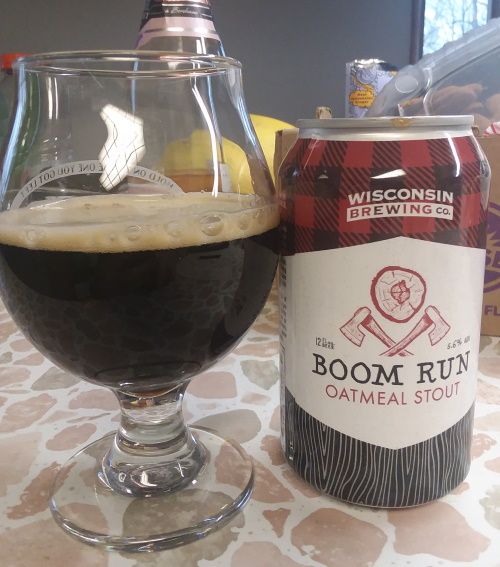
Boom Run's label features red flannel, a log, and a pair of crossed axes and probably could only have been made more Wisconsin by adding a blue ox. The lumber industry once ruled the northern half of Wisconsin and our fair state can (apparently) lay claim to having invented Paul Bunyan. A "boom" is a barrier in a river that catches logs as they float downstream. A boom run was, as near as I can tell, a bit of sport for loggers, at least the ones who worked on the water, in which they would run along the mass of logs trapped in the clutches of the boom.

As for Boom Run the beer, it is an oatmeal stout which also has lactose in it despite the WBC website not mentioning it.


It pours a deep, dark reddish brown that was clear as far as I could tell. The head was tan, though there wasn't much of it to speak of. I was reminded of dessert when I took a whiff with roasted grains and toffee coming through.

The dark chocolate and coffee flavors were tasty. Complementing them were some caramel-like sweetness from the lactose as well as some herbal hop bitterness. I am not sure what variety of hops were used, but I liked them immensely. No tropical fruit and no peppery spiciness. Instead, it had a greener taste with just enough bitterness to act as a foil to the milk sugar sweetness.

Indeed, the beer as a whole adheres to the Nelsonian Creed of brewing balanced, approachable beers. The oats and lactose make for a smooth beer but it's not too heavy on the tongue. Likewise, you can taste the milk sugar but it's never cloying. No one flavor towers over the others.

While full flavored, it's a moderate 5.6% A.B.V. so this isn't the heartiest of winter brews but it is quite tasty. Plus the chocolate notes and lactose lend the beer a nice dessert quality. I don't think I could drink Boom Run all night but it's nice to slip one in here and there. It certainly sits well alongside WBC's other dark ales and is further proof that they do them right.

Junk food pairing: It being winter, bust open a seasonal tin of Chicago mix. The magical combo of caramel and cheese popcorns is a lot like Boom Run but in snack form. You've got your sweetness along side the savory with dairy smoothness to boot.

03 September, 2016

A Wondrous Hypotyposis: Smoked Dubbel by Wisconsin Brewing Company


Last week Wisconsin Brewing Company unveiled another brew in their Forward! Series. This time out it was a Belgian dubbel, a smoked dubbel, no less. With the Summer of Rauch 2016 having precious few weeks left, The Dulcinea and I headed out to Verona to give the beer a taste.

The last time I reviewed an entry from the Forward! Series I found myself wondering who brewed these beers. Was it brewmaster Kirby or was it his minions? The veil was lifted last week as it was revealed that Smoked Dubbel was brewed by a production intern named Adam.

The beers of Belgium are certainly ones that require more of my attention and that of my mouth. It's not that I don't enjoy them, it's that, well, I've been neglectful. While I've read a tad about Belgian beers, I am probably on par with a proctologist's knowledge of the human heart. I know they're out there and I am happy for it. I just don't know a whole helluva lot about them.

As a style, the dubbel is apparently a Trappist ale or abbey ale, if you don't happen to be a Trappist monastery. "Trappist ale" is a legally protected appellation like "Kölsch" or the letter M printed in yellow and is produced by just 11 breweries around the world. As someone who enjoys medieval European history, I revel in the thought that contemporary monks are following in the footsteps of their forebears of many centuries ago. For my part, when drinking one of these beer I like to envision myself as a monk – think Remigio from Name of the Rose - having a quick pick-me-up before starting my shift at the scriptorium. It's like drinking history.

A small, white head that was very loose disappeared quickly leaving me with a glass full of a light copper color that had perhaps a very modest red tint. It was very cloudy and I didn't see much in the way of effervescence. I'm not sure if the beer should be clear or not. I tend to think of these brews as at least having yeast remaining in them so I wouldn't be surprised if clarity isn't an issue.

I had to do a double-take with the aroma. It was very sweet with caramel but also had a big banana scent which was joined by bubble gum. Now, I know dubbels should taste fruity but I didn't think that they resembled a WeiĂźbier so closely. I was just expecting some raisin to be in there too.

The first thing that struck me upon tasting the beer was the lack of carbonation which no doubt contributed to the very smooth feel on my tongue. While the banana made a return engagement, it was accompanied by stone fruit – think plum & apricot – and topped off with some caramel sweetness. The precious smoke was moderate at first and then quickly faded into the background to become a pleasant accent to the fruity flavors.

That banana taste lingered at the end along with some of the sweetness as some grassy hops made their presence known. While they didn't give a lot of bitterness or dryness, it was just enough to overcome the fruity sweetness for a nice contrast. There was no lacing left on my glass.

While I certainly wouldn't have complained about this beer having more smokiness to it, I enjoyed its subtle support of all the fruity esters and phenols and whatever other chemicals the yeast produced. This was cherry wood smoked malt which sounds like the perfect fit for this style. If you've ever had Karben4's NightCall, think that level of smoke. Although Smoked Dubbel had a lot of nice flavors, it was thin-tasting. I expected a much richer malt flavor as well as a fuller body than I got.

I give Adam credit for conceiving this beer but it just didn't come off correctly, to my taste. Hopefully he'll try again because a smoked dubbel sounds like a perfect autumnal alternative to "pumpkin beers".

Junk food pairing: Since Smoked Dubbel is only available at the brewery, pack your picnic basket with some Fig Newtons and Andy Capp's Cheddar Fries.

29 August, 2016

A Berliner in Verona: Berliner Weisse by Wisconsin Brewing Company


This past Wednesday the Wisconsin Brewing Company loosed a small batch of Berliner Weisse into the wild as part of their Forward! series. My understanding is that these brews are released and then feedback is solicited with the possibility that one of these test brews may make it to the big time and hit store shelves and tavern taps.

I am not sure who brews these beers and wouldn't be at all surprised if they are made by brewmaster Kirby Nelson's minions. Just look at WBC's partnershipwith the UW-Madison's College of Agricultural and Life Sciences and the fact that Blister in the Sun was concocted by the minion known as Clint Lohman. The brewery has a reputation for working with people new to the trade and allowing them to show off their chops.

The Forward! series has come up with a few beers these past two or three months that have interested me and this trend looks to continue into over the coming weeks. And so once more unto the breach…

Berliner Weisse poured a light yellow hue and was quite cloudy. There was about an inch of loose, white foam atop the glass that lasted just shy of a minute. There was a fair number of bubbles in the bier but not exactly what one would expect from the "Champagne of the North".

The aroma was puzzling because there wasn't much of one beyond a very faint citrus smell from the lactic sour. I encountered this same phenomenon last month with WBC's Czech pils that was devoid of scent just like Jean-Baptiste Grenouille. Perhaps there is some kind of olfactory quirk at play here. Breweries smell like, well, breweries – they smell like malt in hot water. Maybe one's nose becomes desensitized to certain beer smells if you are standing in a room with the aromas of the brewing process swirling and eddying around you. Still, I would think that hops and lactic acid smells would still be discernible even if more delicate malty ones were not. Do the Germans have a lengthy word for this kind of thing?

Upon tasting I noticed that there wasn't a whole lot of carbonation. Not too surprising given the relative paucity of bubbles. The tartness was middle of the road, although I don't mean that in a pejorative sense as when discussing rock music. There was some lemony citrus taste to the sour and I was surprised at how full the wheat flavor was.

At the finish the taste of the wheat lingered along with a mild lactic tartness. There was no Schaumhaftvermoegen.

While it may not rank with the greatest Berliner Weisses ever made, this bier was pretty tasty. It wasn't mega-knock-your-socks-off tart but neither was the sour so faint as to approach homeopathic strength. My preference is for a tad more tartness but I cannot complain as it had a nice, mildly acidic taste. However I will complain that the bier was short on citrus. I wish it had a little more of that lacto-lemon flavor. Oh, and more carbonation too. On the other hand, I enjoyed the wheat flavor quite a bit.

Whatever the flaws, it still made for a tasty and refreshing on a hot summer day. It comes in at 3.8% A.B.V., by the way, and the brewery has raspberry and woodruff syrups available for those wanting a shot of sweetness.

Junk food pairing: I thoroughly enjoyed the jalapeño white cheddar popcorn we had while quaffing our Berliner Weisses. The salt enhanced the sour which was complemented by the mild chili flavor.

26 July, 2016

A Chimeric Brew: Pilsner by Wisconsin Brewing Company


Earlier this week I made a trek out to Verona where the Wisconsin Brewing Company was debuting one of their Forward brews – the Forward series being limited trial runs of beers that are perhaps sometimes brewed simply to placate the desires of a brewer. Other times they seem to be pilot batches of brews in contention for bigger and better things.

This week there was a pilsner on offer, one that the brewery described as "a hybrid of Bohemian and German varieties". Upon reading this I thought back to the beginning of the year when a brew schedule showed that a new annual would be entering WBC's line-up apparently called Czech Pilsner and that it was due in July. The best laid plans, as they say. Apparently things changed and it remains to be seen whether a pilsner enters WBC's line-up or not. Maybe things have simply been delayed and the Forward beer is a prototype for a revamped pils to enter the fray. We shall see.

The taproom in Verona was doing a fairly brisk business when we arrived. I had invited a friend who is my usual companion to WBC on Wednesdays but he was unable to make it. In addition, he expressed fear in his e-mail to me that it would abandon tradition and be hopped with lupulin nouveau, teeming with tropical fruit flavor like a stick of Juicy Fruit. And so it was quite ironic to see that Golden Amber Lager was now being flavored with Cascade hops instead of Willamette(?). People can't get enough of those C-hops with their F-flavors, I guess.

Would the pils suffer the same fate?

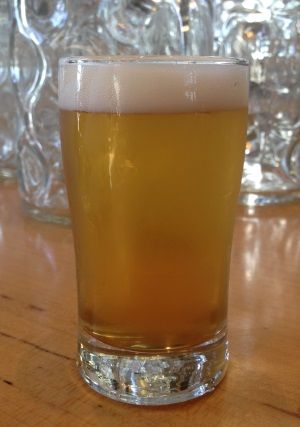
I asked for a pils and was taken aback when I saw the gentleman behind the bar grab a couple sample glasses when I suddenly recalled that you get a free sample of the Forward brews. Thus my photo.

Pils was a medium straw color and, curiously enough, hazy. I even wiped my glass a second time to be sure my eyes weren't being deceived. They weren't. It appeared that I had another keller pils on my hands. My sampler glass came with a fairly sizable white crown of loose foam which lasted a fair while. Long enough for me to get the glass to a table, fumble with an iPhone, and get a passable photograph. Keeping in line with the style, it was plenty fizzy on the inside.

The beer's aroma was quite simply fascinating or rather it's lack of aroma. I think water has more of a scent than this beer. At one point after several sniffs, I think I caught a hint of cracker, but I don't know if this was my incredulous brain doing a poor job filling in the massive blank or if there were genuinely a few malt particles wafting into my nostrils. Nothing like some philosophical skepticism to go with your beer. On the other hand, at least it didn't smell like violets violently mashed together with passion fruit.

Tasting the beer I realized what WBC meant by a German-Czech hybrid. Initially it tasted Teutonic with prominent grassy hops laid over a light biscuit flavor. The carbonation added a little bite and dryness while the hop bitterness was fairly restrained. Things took a turn towards the Bohemian on the finish when the grain flavor faded allowing a more spicy/peppery hop flavor to come to the fore. I'm not sure if this come courtesy of Saaz hops or a similar variety. Things got pretty bitter and dry here, although not as much as a true Czech pils.

My little glass was left with a whole lotta Schaumhaftvermoegen - streaks of foam everywhere.

This was a good pils although "pils" may not be the most fitting term to describe a turbid beer with an aroma that may not be grounded in reality. Hell, maybe someone had too much double eyepah and forgot to add some hops. Whatever the case, this beer is pretty tasty. It's got a nice light body and a fine clean malt taste that's complemented by a goodly amount of fizz. The hops are forward – no pun intended – but not overwhelming. And I like how they went from grassy to spicy.

This pils is surely a beta, if not alpha brew. While it would be nice if it were tweaked and refined and finally put into regular rotation, I just don't see that happening with its Noble hop flavors.

Junk food pairing: If you head to the brewery to give the pils a taste, be sure to bring some snacks with you. Try some Jays Sour'n Dill potato chips or Buffalo Blue Cheese Pretzel Combos.

06 June, 2016

The Two Gentlemen Return to Verona: Hefeweizen by Wisconsin Brewing Company


I once read an interview with Wisconsin Brewing Company's brewmaster Kirby Nelson in which he described his beers as not being about extreme flavors or chasing trends but rather he wanted them to be the perfect accompaniment to the pursuit of happiness. Sitting around with friends and family, enjoying their company, laughing, and sipping a cold one. A cold one at the time of the interview was a Capital brew and Nelson has since taken to brewing extreme beers at his current gig but WBC retains the laid-back Gemuchlikeit of the Capital biergarten.

And so it is always a pleasure for me to visit WBC and pass the time with good company while sitting on an Adirondack chair overlooking the pond with a cold one. The brewery's Forward! series, consisting of very small batches of trial brews, featured an ESB a couple of weeks ago which drew me and a friend out to Verona and a hefeweizen last week which did the same.

Kirby brewed a fine hefeweizen when he was with Capital – Kloster Weizen. I believe it went into hibernation around 2006. It reemerged in 2012 as Weizen and Kirby left for WBC shortly thereafter. To the best of my knowledge WBC has not brewed this style until now – certainly not bottled one – although there could have been one earlier in the Forward! series. Truth be known, I don't know that the current weissbier was even brewed by Kirby or if it was done by one of his minions.

The placard at the bar described the bier as having "notes of banana, clove and bubblegum". And yes, the sign lacked a serial comma. (Long live the serial comma!) Now, these flavors are all well and good but which one would be most prominent? The sign had it in the correct order as far as I am concerned. My preference is for banana accented by a little clove with a hint of bubblegum being optional.

Hefeweizen was a lovely light gold color that shimmered in the evening sun. Being unfiltered, the bier was quite cloudy. My glass (plastic?!) had a decent-sized white head that was very creamy and lasted a good while. There were plenty of bubbles inside the bier heading upwards.

I was slightly disappointed to smell a pretty big bubblegum bouquet. Banana followed while the wheat hovered in the background. Let me clarify my tastes and say that I don't dislike that bubblegum flavor in a hefeweizen but rather it is the least desirable of the flavors that the bier's yeast produces.

The taste followed suit with bubblegum at the fore trailed by the banana and a succinct bit of clove too. The bier had a light body with a nice mild wheat/grainy flavor beneath the trifecta of yeasty tastes. It was well-carbonated which made for a very refreshing bier out in the sun.

On the finish there was some lingering maltiness which was slightly sweet. This was joined by some grassy hop flavor and a modicum of bitterness – just enough for a slight dryness. There was also some lemony-citrus here which added a little zesty sharpness to complement the hop bitterness.

Hefeweizen is, if I may quote from the Supper Club can, not bad. Banana esters are my preference for the style. Not only for their taste but also because they add body. While it can certainly be overdone, I do like just enough to give my weissbier a little chewiness. Now, having given an account of my Platonic ideal of a weissbier, I will say that I enjoyed Hefeweizen. Its light body and fizziness definitely made it refreshing while sitting out in the sun. (It's 4.8% A.B.V.) Even if the bubblegum isn't my preferred flavor, it tasted fine and, besides, there was banana too. And the little bit of lemon on the finish was just perfect.

Junk food pairing: WBC's Hefeweizen goes well with lighter foods. I suggest guacamole flavored tortilla chips as well as Cape Cod Sweet Red Chili potato chips.

24 May, 2016

The Two Gentlemen Go to Verona: ESB by Wisconsin Brewing Company


Last Thursday Wisconsin Brewing Company offered a relative rarity on tap – an Extra Special Bitter. It was part of their Forward series which introduces small batches to drinkers and then solicits their feedback. I suppose it also allows the brewers to try their hand at something different - a new ingredient, perhaps, or a style which wouldn't warrant massive quantities.

I headed down to Verona with a friend who had lived in London for a year where he acquired a taste for English mild ales, bitter, and the ESB. He's fond of the ESB at The Great Dane downtown but, overall, doesn't get to indulge his taste for English real ales too often here in the land of the IPA. We were both a little apprehensive as the e-mail invite described the beer as having "a focus on bittering hops" which we thought may be their way of saying that it's really an India Extra Special Bitter Pale Ale. My friend quipped that he wanted something warm (well, cellar temp), flat (natural carbonation), and malty.

I've read quite a bit less about English beer styles than I have those from other countries and drank less of them too. (I have reviewed one ESB prior to this: ESB Amber from Saugatuck Brewing.) From what I gather, the ESB is a stronger and more full-bodied bitter. And a bitter, contrary to its name, is all about the malt. Your ordinary bitter is a true session beer, usually under 4% A.B.V. They have a healthy malt taste along with a fair amount of hops for balance. And so the ESB is the bigger cousin of the bitter. More maltiness, more hoppiness, and more alcohol. But this no imperial mega-quad that can fuel jet planes. We're talking more along the lines of 5%.

WBC's ESB is (or perhaps was, by now) 4.7% A.B.V. and 33 I.B.U. which perhaps comes in at the low end of ESB spectrum. My companion seems to have mistaken the ESB for the ordinary bitter as he felt the alcohol content was too high here. The beer was offered both on cask - served via a beer engine - and keg - your normal keg with gas pumped into it. The difference between the two is that a beer engine has a piston which goes up and siphons the beer out of the cask while your more familiar tap sees gas pumped into the keg which pressurizes it. Open the tap and the high pressure flows to the low.

We, of course, went with the brew from the cask. The beer was copper in hue, perhaps with a slight orange tint, and very turbid. I have to admit that I don't know if an ESB should be clear or not. My glass came topped with a big white head that lasted a good long time. I couldn't see any bubbles inside the beer.

The aroma was wonderful. There was some expected caramel as well as toasted grain. The great part was that it smelled like a brewery. That grainy smell that greets your nose when you walk into a brewhouse – that's what this ESB smelled like, in the main. Although the hops couldn't compare to the malt, they were not exactly slouches. Here I smelled floral/grassy hops with perhaps just a touch of citrus in the background. At this point we were convinced that this wasn't some kind of Americanized take on the venerable English style where it was dry hopped with Cascade and then aged on a bed of Citra inside a bourbon barrel with brett.

It was hard not to notice the relatively warm temperature the beer was served at. Quite a change of pace after having quaffed a bunch of pilsners recently. Similarly the rather low carbonation also stuck out to me. Just like the aroma, the taste had an emphasis on the malts with toffee and plum flavors lending a touch of sweetness but there was also a distinctly less toothsome biscuit flavor as well. WBC did not reveal any ingredients to use proles but the hops tasted like what I think of as being classically English – very grassy. They were quite tasty and kept the malt sweetness in check.

Those malty flavors faded quickly at the end allowing the hops to take on a slightly more intense straw taste and increase the bitterness as well which left my tongue rather dry. ESB left some really nice lacing inside my glass (plastic). There were streaks, patches, spots – the whole nine yards.

While I cannot compare WBC's take on the ESB to something I'd find at a pub in England, I really enjoyed it nonetheless. It had a light-medium body with a definite emphasis on the malts but it was not overly sweet. I don't know if WBC used traditional English hops like Fuggles or East Kent Goldings or the nearest equivalent. Regardless, the grass and straw hop flavors were wonderful and a welcome change from the spicier Noble flavors I've had recently. With the trend leaning towards tropical fruit tasting hops, these kinds of flavors are often lost in the shuffle. While by no means a big beer, it was not short on taste. But it wasn't about bullying your tongue. Rather, it gently plied it with malts and then some grassy hop bitterness to balance things out. Easy to drink more than one.

Junk food pairing: Crisps! Eat potato chips with your WBC ESB, especially the ones with weird flavors – those Lay's chips that were crowd-sourced. The current batch has gyros, reuben, and biscuits & gravy.

05 April, 2016

A Deadly Dark Ale: dark something by Wisconsin Brewing Company

Today I am pleased to present the first ever guest beer review here at Fearful Symmetries and it was written by none other than the masterful purveyor of horror and weird fiction, Howard Phillips Lovecraft - H.P. to his friends. He was a bit trepid when I initially approached him but I managed to convince him in the end. I hope you enjoy.


The boreal winds cursed and whined one chill spring evening as I lumbered home from my local purveyor of adult beverages, Arkham Wine and Spirits. While there I had espied a new libation from the Wisconsin Brewing Company which snared my attention – dark something. The beers of brewmaster Kirby Nelson are well known to me and his tastes to some extent shared by me. The shop offered the beer in packs of four with the bottles ensconced in a carrying case that featured a photograph of the interior of what must have been the cranium of a madman with the word "CONSPIRACIES" emblazoned across the sides. Surely madness would lay ahead for anyone who dared decant this daemonic brew.

Upon arriving at home I hastened to bolt the doors and fasten the hasps on the windows. After setting my parcel upon the table, I carefully wrested a bottle from its eldritch packaging only to be confronted with the most disturbing label I have ever witnessed to be affixed to a beer bottle. The label's creator was of a parsimonious disposition as its abominable design was simple and cast in shadow with black and various shades of grey being most prominent. However, there was also a pallid circle outlined in ebon. It was as if the words "dark something" above begged to be segregated from the most luminous part of the label. Or perhaps the cadaverous circle required such segregation…? And those words bereft of capitalization – "dark something" - looked as if they had been transcribed from some grimoire, perhaps even by the hand of the Mad Arab Abdul Alhazred himself. In that circle was an amorphous black pattern. It was part Rorschach and part iron-filings-waiting-for-a-magnet. My mind wrestled with it for a few seconds before finally being overcome by the ever-increasing unease.

I fell into some kind of oneiric trance as I gazed at the non-Euclidian geometry of the loathsome pattern. All at once the doors of consciousness were thrown wide open as the sound of a passing omnibus shook me from my stupor. Against perhaps my lone remaining strand of sanity, I removed the bottle's crown and secured a drinking vessel.

Commencing the decanting of the beer, I noted its near-obsidian hue as its ululting roar filled the room. Although a deep brown, it appeared as an impenetrable stygian gloom in the glass. I was eventually able to ascertain that the beer was quite clear. My glass was bedecked with a large, creamy, tan head that lasted a fair while. My eyes could not penetrate the gloom to determine whether or not the effervescence penetrated the liquid or remained atop it. All in all, the beer had a saturnine appearance.

Perhaps against my better judgment I placed my nose above the glass and inhaled. My tulip glass concentrated the foetid stench of the brew and I was able to discern the aromas of swarthy chocolate, roasted grain, and a small amount of sweetness which reeked of stone fruit. I cannot explain my motivation but I then endeavored to taste the accursed distillation of all things dark and devilish.

My tongue was at once assailed by a potent blend of malt flavors. The first was of raisin but it was not particularly sweet. Next was an admixture of tastes from grains that had survived the unspeakable horrors of the flames and been transfigured into having an ink-like appearance. Their horrors had produced dark, bitter chocolate and coffee flavors. A modicum of spiciness from hops in concert with some carbonation lurking in the brew's depths added a slight dryness.

When the pitch liquid had finally made its way into my stomach, I noted a prominent taste of pepper from those same hops along with their attendant bitterness. These hops combined with the beer's potency (at 9.3% alcohol by volume this brew is not for the tremulous) made for a very dry terminal taste experience. Having emptied my glass of the rich concoction, I saw that it was filled with sheets of tan lacing. It was as if the vessel desired to remain opaque despite the absence of any liquid.

This so-called "porter-dooppelbock" mutation stands as the darkest beer I have ever witnessed. It seemed to absorb the refulgence from the room just as a Creole sucks the brains from a crawfish and trap it in its hideous opacity. Still, I was entranced by its primordial blend of the darker flavors of chocolate and coffee as well as its pleasing dryness that all but obscured a modicum of malt sweetness.

I am of the opinion that the Wisconsin Brewing Company ought to dedicate a day for celebrating the release of such a thick, cimmerian, and potent potable which channels rich, deep chthonic flavors so well. I suggest the moniker of "dark something Day".

Junk food pairing: dark something possesses the tongue and engulfs it so any food pairing should be robust. I recommend a hearty potato chip such as Kettle Brand's Sriracha or Herr's Peppered Bacon.

29 March, 2016

She's Just an Ale - She's a Bomb: Nectarine by Wisconsin Brewing Company


Last weekend the frau and I took a trek out to Verona and visited Wisconsin Brewing Company. We did so as an act of nostalgia, to recall the days when Kirby Nelson was not a hophead and was instead someone who reveled in being the brewmaster at a "Wisconsin lager brewery". Well, that and I had two free brewery tour passes each of which came replete with a free pint. And Verona was on our way home from New Glarus so we'd be in the neighborhood anyway.

As someone who began drinking Kirby's beers over a quarter century ago, it is genuinely odd to be at WBC and see the beer menu. Moving past the paucity of lagers, there are the hoppy brews. Various IPAs, most of which have "HOP" in big, bold letters in the name, would surely have been anathema to Kirby not all that long ago. And his helles bock is dry-hopped. And then there are the Belgian-style brews. Anyone remember Prairie Gold or the experimental beer Kirby made which was basically Island Wheat brewed with a Belgian yeast? Back In 2010 anyone who proclaimed that he'd be brewing Belgian-style beers in 2016 - and ones that weren't bad at that – would have been spirited away in the night and committed to Mendota.

/waxing nostalgic

Our tour was conducted by a lovely young woman named Athena which is a wonderful name. (I wonder if her parents were classicists and teased her as a child by telling her that she popped out of her father's head.) She was quite friendly and knowledgeable about the brewhouse and what laid therein despite not being a brewer. Sacks of red wheat seemed to be scattered around the entire brewhouse. Presumably they'll be brewing S'Wheat Caroline anon. The cooler held some interesting sights. First there was a pallet of six carbuoys filled with proto-beers destined for Madison Craft Beer Week. There was little indication as to what styles they were but the carbuoys had labels with hop names on them – Saaz, Citra, Waimea, et al. And in the corner was a rack of whiskey barrels filled with Depth Charge scotch ale just aging away.

Before the tour we indulged in some breakfast brews. The frau got a flight while I had a pint of WBC's latest brew, Nectarine, a Special Pale Ale. I had noticed that it was billed as "Fauerbach's Nectarine" and asked Athena about this. She told me that the former Madison brewery (it closed in 1966) had a low-alcohol "hop and malt tonic" back in the day that was even marketed to pregnant women. The beer had nothing to do with the tonic beyond the name which was a tribute to local brewing history.

Nectarine pours a lovely light gold color. It's clear so I could see a smattering of bubbles in it heading up to a nice crown of white foam that lasted for a fair amount of time. Long enough, anyway, for me to actually get a photo of it.

It was still morning when we ordered our beers so the big citrus aroma of Nectarine seemed highly appropriate. I presume the grapefruit-like scent came from the Cascade and unnamed experimental hops while the orange came from the orange peel. I also caught a hint of grass in there too which I really liked as it contrasted with the citrus.

As with the aroma, so the taste. The hops really came through in the taste with grapefruit/citrus first followed by some floral flavor and even a bit of the grass. And the orange peel added to citrus madness as well. It became more prominent as the beer warmed lending a slight sweetness. Right out of the tap I couldn't taste much malt but, as with the orange peel, I began to taste a little malt sweetness as the brew warmed. Despite the name, the addition of orange peel, and the use of honey malt, Nectarine is not a sweet beer. I'm not familiar with honey malt but, from what I gather, it's a very sweet malt that gives beer a golden color. Presumably just a bit o' honey malt was used here.

The beer finished with a moderate bitterness as the fruity hop flavor faded to reveal more grassy hop taste. There were large patches of lacing all around my glass.

Nectarine is all about the hops. Well, and orange peel, to be fair. Citrus dominates both the aroma and taste. The beer has a light body and a clean, almost maltless, flavor which allowed the hops to shine. Having said this, Nectarine isn't a very bitter beer; it just has plenty of hop flavor. It's 4.9% A.B.V. and will no doubt be a fine summer sipper for many folks. Personally, one pint was enough for me. Not unlike Supper Club, Nectarine's not bad but comes across as being one dimensional and, of course, that dimension is trendy, West Coast hops. I wish it had more maltiness, more grassy hops flavor, or even just more fizziness. Just something to provide a little contrast to the citrus.

Nectarine is available on tap only at the moment (and only at the brewery, I believe) but bottles will

Junk food pairing: Pair your Nectarine with a bag of Doritios Dinamita Chile LimĂłn tortilla chips. Sure, it adds to the citrus onslaught but the salt and chili are complementary and help bring out the malt a touch.

14 October, 2015

A Beer Fit for a Feast Day: Patron Saint by Wisconsin Brewing Company


This was one of my most anticipated beers of 2015. Kirby Nelson's Oktoberfest at Capital was generally well-regarded and, when he left for new digs at Wisconsin Brewing Company, a coterie of friends and I were looking forward to tasting another fine rendition of the style. One friend met Mr. Nelson at a store last year and inquired about the potential for a WBC Oktoberfest. He replied that he was planning one "with a twist". We fretted that it would be an India Pale Oktoberfest or some such thing. Then news came that the beer had been brewed and was christened "Magic Marzeniac". More news came saying that it had all been promptly shipped off to Appleton. What the deuce?!

Wisconsin Brewing Company released an Oktoberfest this year and refrained from limiting its distribution to Appleton or indeed any city in the Fox River Valley. The beer was also renamed Patron Saint. I'm not sure if the beer was reformulated this year or not. I did find a website stating that Magic Marzeniac was 6% A.B.V. while Patron Saint is only 5.6% so it seems likely that the formula was tweaked, if only slightly.

Patron Saint poured a gorgeous copper color. Very much in the minority of Oktoberfests I've had this year with most so far being of lighter color and with less of a red hue. The beer was clear as expected. I got a rather large head that was tan and loose. It also seemed to stick around for a while. There were some stray bubbles making their way up the glass but only a few.

The aroma was not overly promising. It was rather sweet - as if Nelson let loose a bit too much caramel malt. My nose also detected a slight metallic smell along with a touch of herbal hoppiness. Fortunately, the taste was quite an improvement over the aroma. The beer had a medium body and was soft on the tongue. While there was some definite malt sweetness which was like toffee, my preferred flavors which were more like bread and melanoidiny toast were also present. Something also gave a slight nuttiness as well which I really enjoyed. A modicum of carbonation and a hint of some spicy hops made an honest effort to even out the malt assault but they could only do so much. There was also a vinous flavor which I had a hard time pinning down. I've tasted it before in beer and whenever I do I am reminded of vermouth.
This off flavor was a bit distracting but certainly not overpowering as the other malt flavors shone through. Furthermore it was not an unpleasant flavor, merely unexpected. The finish was fairly dry with grassy and spicy hop notes coming through. My tankard was left with some really nice Schaumhaftvermoegen with it being littered around the whole of the glass.

I'd imagine that Kirby Nelson must struggle at least a little bit to differentiate his WBC brews from those he brewed at Capital. I mean, there's little difference to my taste between the amber lager he brewed out in Middleton and the one he's brewing now. Maybe he's using Mt. Hood hops in the stead of Liberty or some such other minor variation. The same applies here. Vinous flavor aside, Patron Saint is much akin to the Oktoberfest he brewed at Capital for decades. The primary difference seems to be that Patron Saint is a bit hoppier. Mind you, it's not as hoppy as something like Milwaukee Brewing Co.'s Hoptoberfest but there's definitely more hop than I recall from years past in the taste and finish. There's just a bit more balance rather than letting the malt run completely roughshod over the hops.
Junk food pairing: You must pair any and all Oktoberfests with deep fried cheese curds. You will love how the salt accentuates the malt. It's like putting Pleasoning on your hot dish. It is just that good.