Showing posts with label Giant Jones Brewing. Show all posts

22 December, 2024

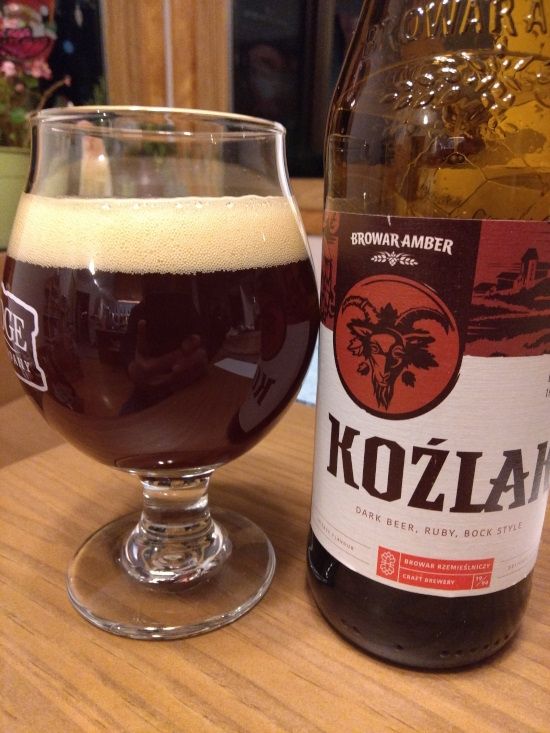
How do you say "bummer" in Polish?

I had a Polish bock beer and was all excited to find succor in it after wandering in the cold and write a review of it as a companion piece to the one of Giant Jones' version and then I find that the beer was bad. Long past its life expectancy with that worty-vermouthy taste. Bummer.

But I remain undeterred. As Douglas MacArthur once said, I shall return with a fresh bottle...

25 November, 2024

Biały Filip: Koźlak by Giant Jones Brewing Co.

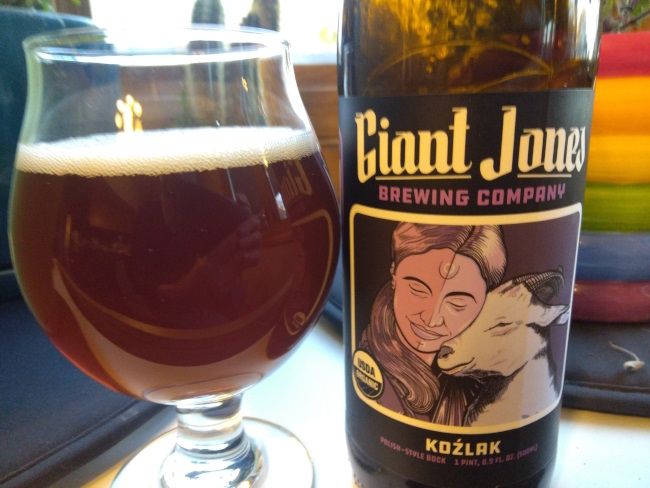
After seeing Black Philip on a can of hard apple cider leading us into dark temptation, we now have a label featuring a white goat snuggling contentedly with a young Polish gal beckoning us into inter-species conviviality. This comes courtesy of Giant Jones Brewing here in Madison.

The beer is called Koźlak and it conjures in my mind images of a detective, likely because it is close to Kolchak and Kojak. While "Koźlak" may look mysterious with its exotic diacritical mark, it is, as I have just discovered, a rather mundane word and simply means bock. Giant Jones calls it a Polish-style bock as it was brewed with Marynka hops.

I don't know if Polish brewers actually brew their bocks with Marynka hops or not. Since Giant Jones' brews are organic, this variety must be fairly common, at least in Poland, if there's an organic version. My knowledge of Polish hops extends no further than Lublin/Lubelska.

My assumption here is that, since my bottle was filled back in April, that this was meant to be a spring bock. I am not sure how long it was lagered but it sat around for 6+ months after bottling. Hopefully it was taken good care of during this time.

My pour produced a rather nice loose, tan head but it went away quickly and I fumbled with my camera so I wasn't able to get a decent photo of it. And, as you can see, I wasn't able to get a decent photograph of even just a tad of foam. The brew was a lovely amber color, which seems only fitting for a Polish beer, and was quite clear allowing me to spy a goodly number of bubbles inside. My initial sniff caught caramel and a fruitiness that I can best describe as a generic berry scent - something akin to Boo Berry cereal. My mind may have caught this latter smell because there was a box of that very cereal atop the refrigerator when I pulled the bottle out. Beneath all that was a hint of lemon and a dash of hay. That green aroma grew as the beer warmed.

Seeing all of those bubbles made me think my mouth was in for some nice fizz and indeed it was. Good thing too as the body was medium-heavy. I was surprised that it wasn't very sweet, though caramel and stone fruit were prominent flavors. The hops added something herbal. On the swallow, those malty flavors faded allowing a moderately potent hoppiness to emerge. Marynka must be a bittering hop as the finish was quite brisk with hefty doses of both bitterness and dryness.

Koźlak was a fine brew. Those hops surely added the lemon and hay scents, which I really liked, and their bitterness made for a very nice contrast to the big malt flavors. I am left to wonder what this beer tasted like fresh. As it was, Koźlak's 7.9% A.B.V. left me feeling nice'n'warm on a chilly fall evening. Maybe I can try it again next spring.

Junk food pairing: Pair your Koźlak with a bag of potato chips. I find that Jays Hot Stuff with its bold paprika heat stands up to the big bock.  Plus Old Dutch Dill Pickle chips provide a nice contrast to the mega-maltiness.

29 March, 2024

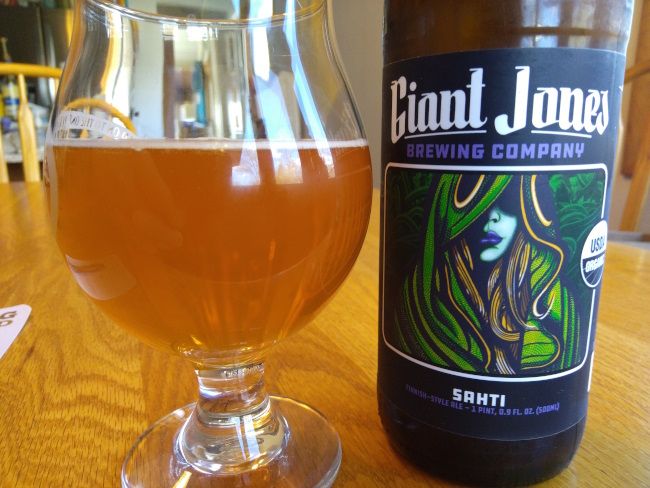
So Pekka and Jukka had been drinking in the wilderness for two weeks...: Sahti by Giant Jones Brewing

...during a very cold winter.

Back in their home village, their friend Matti began to get worried about them not returning so he decided to send a trained dog to rescue them. He attached a barrel of vodka to the dog and asked it to find his friends.

Pekka and Jukka were sitting around a camp fire, drinking, when the dog found them. Pekka shouted: “Oh there is the rescue, our best friend coming towards us... But, hold on, what an earth is attached to it?”. “Can't you see?”, answered Jukka, “It is Matti's dog!”

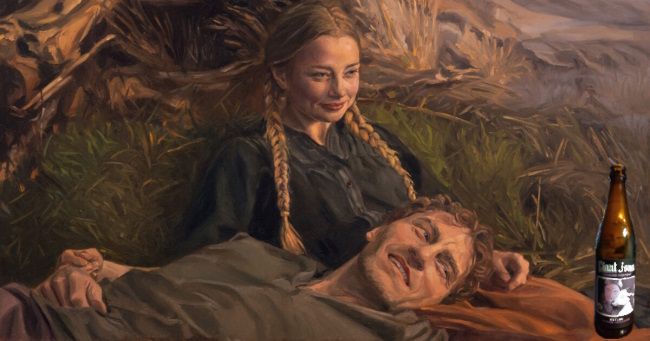
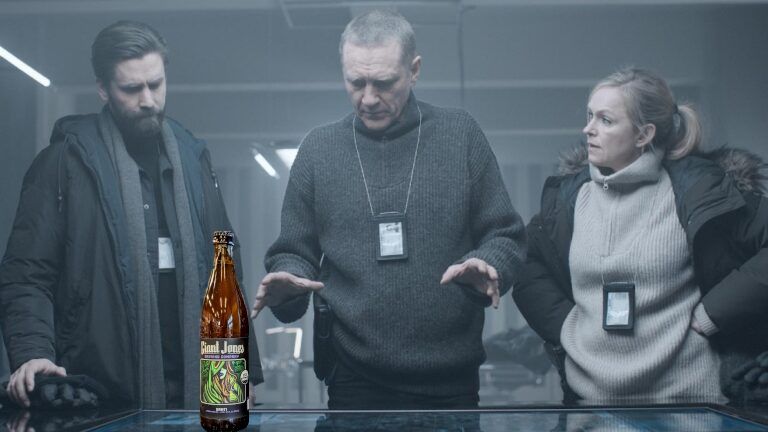
Several years back when I first started to investigate Scandi-noir, I noticed that police stations in Finnish shows such as Bordertown - see above - were these late-20th century bunker-like affairs. Dark, shadowy places with not a window to be seen so there was no natural light, just the fluorescent stuff. A bit like the Humanities building here on the UW campus. This stood in stark contrast to a French cop show called Spiral that I watched around that time where the cop shop was in an old building with open windows everywhere letting in plenty of sunlight and venting all the cigarette smoke as a "Voltaire slept here" sign hung from a wall in the background. 

Finnish cops, when not sitting in a sauna, were always dressed for the cold and snow and seemed ready to defend themselves from murderous reindeer. French cops, on the other hand, were mostly a bunch of bon vivants who wore berets and dipped baguettes into their wine as they puzzled out the next steps of their investigations and quoted Sartre at one another. Finns were serious and taciturn, if not outright dour, while the French were convivial and determined not to let a little thing like murder get in the way of a good time. Plus the French weren't as pale.

But it is the Finns who give us the beer that is sahti. Filtered through spruce boughs and generally made with bread yeast, it smacks of the Finns' boreal homeland and its hardy, unpretentious inhabitants.

A few months back in December I reviewed Giant Jones' Norwegian farmhouse ale, Kornøl. I noted then that Giant Jones also had a sahti on offer and that I hoped to be able to sample it. Well, I finally managed to do so. The thing about Giant Jones' beers is that they're all rather potent so, if you buy some that was bottled in August but don't get around to drinking it until several months later in March, it'll still be good.

Sahti seems to come in the 8%-10% range in its homeland, though there are certainly less potent variations. Rye is common but not all sahti brewers use it. Hops, from what I can tell, are minimal to non-existent. Spruce branches are traditionally used when filtering out the grain but I have read that juniper branches are also used. Sometimes branches are left out completely and berries do all the work. And so Giant Jones had lot of leeway when brewing their Finnish-style ale.

When I think of farmhouse type ales, I think of something unfiltered because it's beer brewed in primitive conditions for immediate or near immediate consumption. This sahti had the right look, to my eyes, with a substantial haze taking the shine off of the yellow liquid. (It appeared gold in the thicker part of the glass.) A tiny white head didn't take long to disappear while I spied a modicum of bubbles through the haze.

The aroma was like a hefeweizen with a prominent banana scent joined by a bit of bubblegum. A hint of something piney hovered in the background.

Beers with a cloudy appearance and/or having a lot of alcohol tend to have heavier bodies but I found the sahti to have a nice medium-light one instead. Fizz was of a similar intensity so it was rather smooth. The aroma bits swapped places here with bubblegum becoming more prominent than banana. There was a bit of rye plus a peppery tasting hoppiness to offer spicy counterpoint to the fruity yeast flavors and the (tempered) grainy sweetness.

Upon swallowing, a pine flavor came through - the stuff was filtered through spruce branches, if memory serves. Not strong but instead deliciously subtle. The yeast and grain flavors departed quickly allowing those peppery hops to take over and make for a rather dry finish with a modicum of bitterness.

I found that, when drunk cold, Sahti has more of a hefeweizen character minus the wheat. Those yeasty banana/bubblegum flavors had center stage. However, as the brew warmed, it lost some of the lighter, fruitier flavors and took on mellow, earthy ones with the hops, rye, and spruce coming together for a taste that was heartier, more redolent of a farmhouse.

And it was this flavor triad that makes Sahti such a great beer. They all came in just the right amounts and melded together just perfectly.

Junk food pairing: Crank up the Sibelius, pour a glass of Sahti, and grab a bag of Gardetto's Roasted Garlic Rye Chips.

15 December, 2023

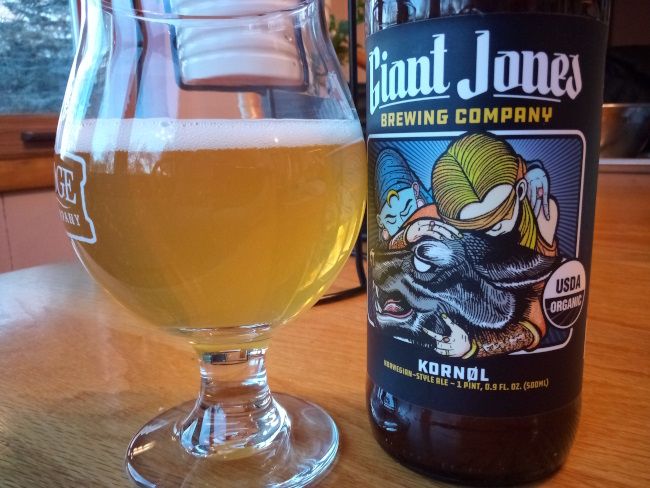
Down on Ole's farm: Kornøl Norwegian-Style Ale by Giant Jones Brewing

 
Ole and Sven walk into a bar and they order some beers. After drinking his, Ole looks into his shirt pocket. They order another round and Ole looks into his shirt pocket again. This goes on for a few more rounds.

Sven is curious, “Ole, why do you look in your pocket after each beer? Whatcha got in der?"

Ole confesses, "I have a picture of my Lena in der, and when she starts ta look good, I go home."

When it comes to beer, Norway's is not exactly near the top of most people's lists. And I don't mean that their beer is regarded as being low quality; it's that people outside of Norway don't seem to know it exists.
 
"They brew beer in the land of the midnight sun? I didn't think you could grow barley on a glacier."
 
Norway is about a-ha and Ole and Sven/Lena jokes. Their culinary traditions consist of lefse and lutefisk, right? I suppose I can say that, when I think of Norway, I also think of the biathlon (I got pretty good at it playing Winter Games on my Commodore 64) and a bunch of guys on skis blowing up a heavy water factory.

People in the American Upper Midwest, such as myself, might throw in rosemaling and sandbakkels at Christmas but that exhausts most Americans' knowledge of Norwegian culture.

Actual Norwegians know a bit more, though, I suppose. But how much about their indigenous beer styles to they know?

One Norwegian who knows about the brews of his homeland is Lars Marius Garshol. He literally wrote the book as his tome Tradisjonsbrygging av øl goes in-depth into the farmhouse ales of his homeland. Unfortunately, it's in Norwegian. On the other hand, his Historical Brewing Techniques: The Lost Art of Farmhouse Brewing is in English and it covers the farmhouse brews of Norway, as well other Northern European countries. It sounds like an interesting book that would shed a lot of light on the beer at hand. But I wouldn't know since I've never read it.

At some point in the fall, I spied Kornøl by Giant Jones Brewing in a beer cooler and was intrigued. I searched my memories for a time when I'd sampled a Norwegian style of beer but found none and so I eagerly bought a bottle. While I haven't read Garshol's book, I have heard an interview with him. He notes that kornøl is a beer style associated with the northwestern part of the country and has the following characteristics:

- wort is not boiled
- pale grist is used
- a juniper infusion mash
- very little hops
- kveik for fermentation
- very low carbonation

Of course it has juniper in it. It's a standard ingredient in more boreal brews.
 
Was Giant Jones' Kornøl brewed to these standards? Will it taste like it's "supposed to"?
 
 
Since I'd never had kornøl previously, I found myself enchanted with novelty at every turn. I had no idea what it looked like and was pleasantly surprised at a lovely light yellow liquid which was in start contract to the dark lagers and bracketts I'd been consuming lately. There was a slight haze to it. Despite my best(?) efforts, my pour produced only a small head of lively foam. Like the stuff in soda. It didn't last. With that haze being on the light side, I was able to see some bubbles inside. I was surprised by a lemony smell, as if it was a kettle sour. Was it? For all I knew, it was a sour beer, laden with lactic. I also smelled grain - yeasty, crackery - and a hint of pine. The label did mention local spruce.

The label mentioned that it wasn't boiled and was fermented with kveik so, along with the juniper, pale color, and small head, it seemed we were more or less in the kornøl ball park here.

When I tipple a stronger beer, and this stuff is 7.4%, I tend to go in thinking that it's going to be thick and sweet and really provide sustenance for the Fimbulwinter. But I found Kornøl merely had a medium body. It was a bit on the sweet side with a kind of sprightly honey taste but there was enough fizz to keep it from being cloying. The spruce was definitely there but it was not taiga in a glass. You couldn't miss it but it didn't dominate. I think I also caught a smidge of herbal hops in addition to that airy cracker taste.

The sweetness faded on the swallow which allowed a combination of the spruce and some herbal-spicy hops to finish things off with a prominent dryness and a firm bitterness.

For about half a glass I found myself pondering the mysteries of this beer. What was I tasting that was the result of the wort not having been boiled? Was I able to truly discern the hops from the spruce?

In the end, I never found any answers and, instead, just enjoyed the ride. The spruce was just the right amount for me (and may have been bolstered - the aroma, anyway - by the fact that I had hung a wreath in the same room just the day before) and while the brew had a little heft, it was never cloying nor ever tasted like liquid bread. There was a smooth sweetness to it but it wasn't like drinking syrup. Whatever the ratio of spruce to hops was, their combination was bracing and a fine antidote to the sweetness.

I thoroughly enjoyed Kornøl and only wished that I'd had someone to share my bottle with. Even if Giant Jones and brewmaster Jessica Jones deviate from tradition, they deserve a lot of credit, in my book, for brewing a plethora of more obscure styles, including this one. And this is just one of a couple farmhouse ales of Northern Europe in their catalogue. There's also a Finnish sahti to be had which I hope to try soon.

Junk food pairing: Pair Kornøl with some of Norway's finest: Sørlandschips Havsalt og Eplekjekk Eddik potato chips - salt & vinegar!

08 December, 2022

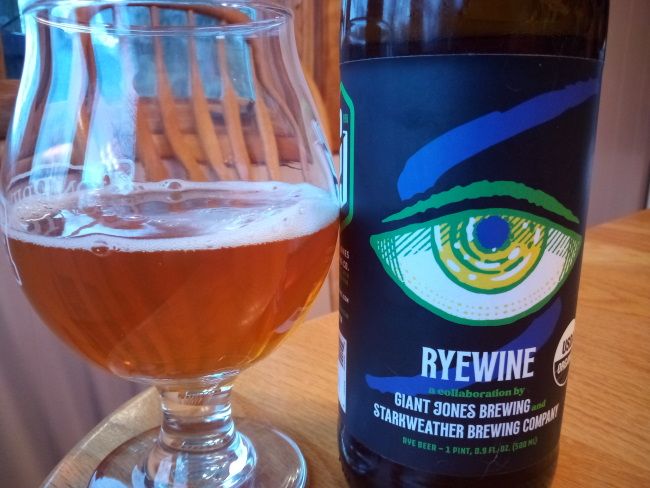
Strong Beers Reign Here: Ryewine by Giant Jones Brewing & Starkweather Brewing

Better late than never, I always say.

The last time I reviewed a beer by Madison’s Giant Jones was back in March when I gave the Baltic Porter they brewed with their neighbors down the street, Working Draft Beer Co., a spin. It wasn’t bad, but it wasn’t particularly Baltic Portery to me.

“No big shakes,” I thought to myself. “After all, they now have a beer brewed with the best grain ever to sprout from the ground out. I will follow this up with their ryewine shortly and that will surely be good.”

Well, that was the plan.

I eventually got my hands on the ryewine that Giant Jones brewed with then rather new Starkweather Brewing in late March. “It’s too warm for a ryewine today,” I’d say. “When another cold day comes around, I’ll pop that bottle open.”

You know what they say about the best laid plans…

Cold nights never arrived or I just wasn’t in the mood for a ryewine when there was a chill in the air or I simply had some excuse I cannot recall. The upshot is that, before I knew it, everything was all verdant outside and it had gotten warm so I put my small stash on the door of the refrigerator for safekeeping.

“Don’t you worry,” I told the bottle reassuringly, “I’ll see you again come the autumn.” And, just as it does every year, the autumn came and I made good on my promise one chilly night recently.

It says here that Germany, Poland, and Russia account for the bulk of the world's annual rye production. (Furthermore, Germany only grew more wheat than rye in 1957. Old habits die hard, I guess.) Now, I have German and Polish blood so I suppose it’s little surprise that I love rye.

Someone else who loves rye is (or was?) Peter Schieberle. A food scientist of some stripe, apparently, he has co-authored papers such as “Potent odorants of rye bread crust-differences from the crumb and from wheat bread crust” and “Quantitation of odor-active compounds in rye flour and rye sourdough using stable isotope dilution assays”.

What I gather from the abstracts of these papers is that some of the more potent contributors to rye’s flavor are octenone which offers a mushroom-like taste, methional’s cooked potato flavor, and the green, fatty flavor of nonenal.

Huh. The More You Know*.

The crack beer reporter of our alt-weekly Isthmus, Robin Shepard, broke the news in early November that Giant Jones would soon have a new bottling machine and more brewing capacity which will allow them to distribute to more areas around the state. Considering all of their beers are big, potent brews made from certified organic ingredients and that they seem to offer only 1 IPA, it’s heartening to see them expanding.

My pour was graced with only a small, white head of foam and it was not keen on sticking around very long. The beer was a lovely golden hue with a slight haze to it. There were a few bubbles to be seen inside. It smelled strongly of honey with another floral scent as well. Adding to the sweetness component was a hint of caramel. In opposition were spicy hops, the delicious & nutritious rye, and that astringent boozy smell. (This stuff is 10.4% A.B.V.)

Mild carbonation did its best against a medium-heavy body that had a strong honeyed flavor to it. Those spicy hops were rather prominent on the tongue and, when combined with the rye, made a nice, sharp riposte to the sweetness. A boozy heat was present too. On the finish those hops really came to the fore with a solid bitterness and dryness. That boozy heat lingered a bit as some of the honey flavor stuck to my tongue.

Man, this was really good stuff. It was very smooth and that silky mouthfeel only increased as the beer warmed. The brewers did everything perfectly to keep the malt sweetness in check as it never got cloying to my taste and they kept the body rather light. I was expecting something richer, chewier so this was surprising. Sweet but spicy.

Junk food pairing: pair this ryewine with a bag of Annie's Extra Cheesy Cheddar Smile Puffs. You will keep the organic theme going and all of that extra cheese will make a nice, mellow counterpoint to the beer's sharp hop and alcohol flavors.

23 March, 2022

It is the middle ground between ale and lager, between Baltic and porter: Baltic Porter by Giant Jones Brewing & Working Draft Beer Co.


It wasn't all that long ago that there was snow on the ground and I was reviewing another Baltic porter. But that one had vanilla in it. Too much, in fact, for my taste. Well, today we have another big, dark lager just like you'd find in the all the taverns and inns of Tallinn, but without any vanilla added.

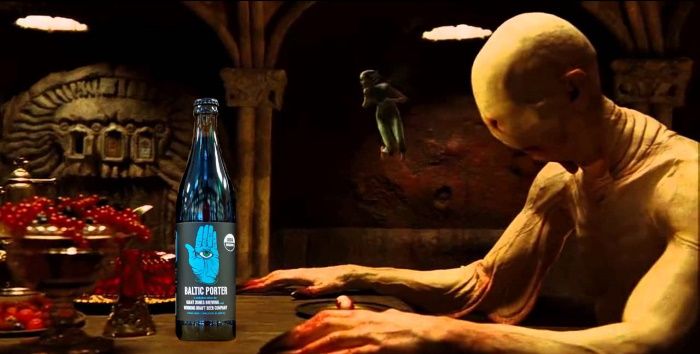
This one is a collaboration between two relative newcomers here in Madison: Giant Jones Brewing Co. and Working Draft Beer Company. As the bottle notes, both breweries opened in the same year, 2018, and, since they are located only about two blocks from one another, a collaboration was inevitable.

I will refer the reader to my review of Lakefront's vanilla Baltic porter for more but the abbreviated story behind the style is thus: the Poles got hooked on English porter in the 18th century and started brewing it themselves. A hundred years or so later, lager brewing was in vogue so they applied it to their beloved porter and voila! They ended up with Baltic porter, although the Poles didn't call it that. They probably just called it "porter". It was some late-20th century beer nerd with a taxonomy fetish who gave it the appellation we have today.

Most, if not all, brewing collaborations I've witnessed or been given the behind the scenes scuttlebutt by a participant consist of the brewmasters standing around drinking while brewing minions of the host brewery do all of the work. Once that's done, the brewers join their superiors in the quaffing. I have absolutely no idea what the collaboration here consisted of but, since I don't think Giant Jones has much capacity for lagering whereas Working Draft does as they release a new pilsner every week, it seems, these days, my guess is that brewmaster Jessica Jones and her crew walked down the street to Working Draft on brew day.**

While most of the press Giant Jones garners centers around the fact that the brewery is owned by women, the really neat aspect for me is that Giant Jones is an organic brewery. As CEO Erika Jones explained,  "All our ingredients and anything that has the potential to come into contact with our beer (such as no-rinse sanitizers) must be approved under the National Organic Program." Add in that GJ's beers are all 7%+ A.B.V. and you've got yourself some very niche products.

Organic beer hasn't taken off in the way other organic foods have. Go into your local food co-op and you're spoiled for choice when it comes to organic junk food. Organic cheese puffs? They've got them coming out of their tattooed, lobe gauged ears. Organic beer? Not so much. From what I've read, organic barley and hops are fairly rare. Still, Giant Jones offers a wide variety of beers at prices that are not ungodly so that situation may not be as dire as the articles I've read make it seem.

In an age when cans rule the packaging roost and hard seltzers and non-alcoholic beers are ascendant, Giant Jones with their big, organic brews in half liter bottles appear to be swimming against the tide. Let us hope they don't get eaten by a bear. You know, like some horny salmon do while swimming upstream.

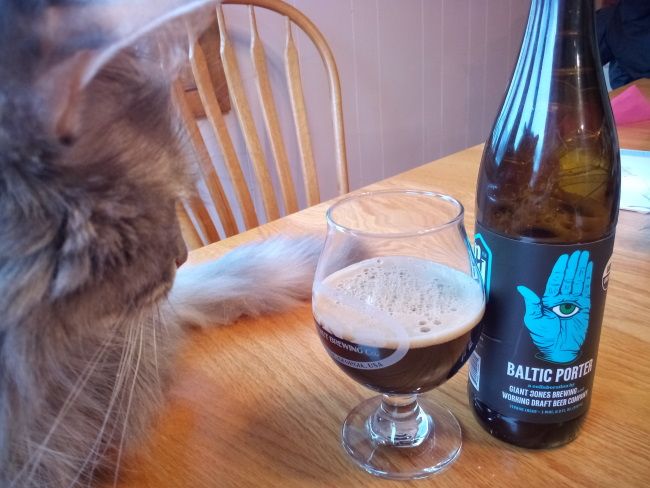
My cat Grabby looked on as the loose, tan head atop my pour dissipated quickly leaving a glass of deep brown liquid with a red tint. The beer was clear! Still, it was too dark to discern any bubbles floating about inside. Cats have very good olfactory senses but, since she cannot speak Human, I have no idea what she was able to smell. For my part, I caught plum, malty sweetness, dark chocolate, and something like carob.

My first sip revealed a medium-heavy body with a sturdy fizziness. It didn't taste as sugary as the aroma hinted that it might be but there was some caramel sweetness from the malt. Chocolate, carob, and a rather strong stone fruit flavor were present as was a touch of roasty malt taste. On the finish, most of those flavors faded away and a little coffee, which I expected to taste earlier, faded in. Spicy hop flavors made themselves known at last and helped make for a very dry finish. There was that boozy heat to help the dryness cause as well. The beer is 8.2%, which is fairly substantial, but not deadly, yet my mouth had this strong astringent feeling and I felt as if I could breathe fire.

This was not what I expected. The coffee and chocolate flavors which I had anticipated to be more prominent were instead relegated to supporting roles. For me, coffee and bitter chocolate flavors should be at equal or greater strength than fruity ones in this style. Otherwise it had a clean lagery taste. Admittedly, it had been a while since I'd had a Baltic porter that was brewed anywhere near the Baltic Sea so perhaps I was misremembering...? Plus, there's more than one way to brew a Baltic porter, right?

However close this beer is or is not to, say, a Polish take on the style, it's got too prominent a fruity taste for my, er, taste. It should be a co-equal flavor to coffee and dark chocolate, not its superior. Still, this is by no means an awful brew and, if you are, say, a big fan of Placek ze Śliwkami, then I recommend this one for you. For me, my half a snifter above was enough.

Junk food pairing: Pair your Giant Jones/Working Draft Baltic porter with a bag of Kettle Brand Korean Barbeque potato chips. Their sweet-salt combo goes perfectly with this beer.

**My guess was wrong. See this tweet

03 November, 2021

You're gonna need a bigger stange: Doppelsticke Altbier by Giant Jones Brewing


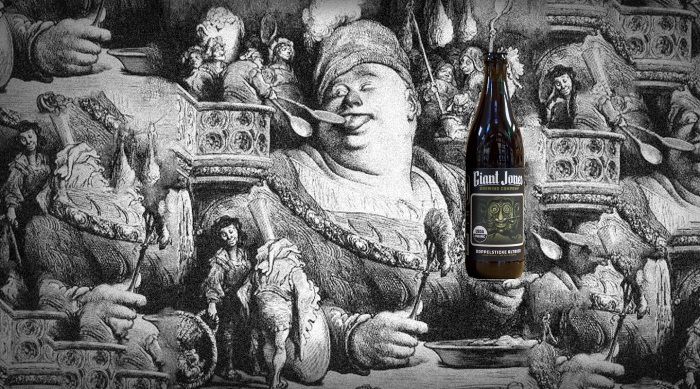
It would have been really neat had Madison's favorite purveyor of pantagruelian brews, Giant Jones, labeled this a mere Sticke Altbier and let a whisper campaign form amongst drinkers that brewmaster Jessica Jones had been extra generous and that it was, in fact, a Doppelsticke. On the other hand, Giant Jones only brews their Doppelsticke Altbier infrequently – a September-only release – so at least it has that element of tradition going for it.

I am struggling remember to the history of the altbier. It's an Obergäriges Lagerbier or top fermenting lager beer auf Englisch. It has this hybrid ale-lager persona because…because…something about northern German ales running into new laws imposed by lager-loving Bavarians after Germany became a country in the late 19th century and the brewers of Düsseldorf splitting the difference. They weren't quite ready to give up on the old ale styles but had to tweak things to conform to new laws. Maybe? Ron Pattison noted that Cologne once had laws that banned the production of bottom-fermenting beer and I wonder if altbier brewers labored under the same or similar laws. Or am I conflating the two styles?

Being from Wisconsin, laws dictating the production of beer are almost incomprehensible to me. Brewers can brew ales or lagers; they can sell it on Sundays; they can put in their brews whatever additive or adjunct they care to; they can brew a beer with whatever A.B.V. they like; and the beer tax hasn't been raised in my lifetime. So, when I read that it was illegal to brew bottom-fermented beer or that beer taxes were based on the original gravity of the wort, well, my mind reels. It seems that not only did a lot of beer history transpire the way it did because of the ingredients that were at hand, but also because brewers were looking to get around the law or avoid the taxman.

Perhaps the altbier was simply a result of changing tastes where "lager" attracted drinkers the way "hazy" does today. I can't recall.

Regardless, Düsseldorf got its altbier. Brewers are merely human like the rest of us and sometimes they deviate from the script. When they mismeasured their ingredients and ended up with a stronger than normal altbier, regulars would strike up a whisper campaign that the new batch was an even more potent potable. "Sticke" comes from "stickum", a word in a local dialect that means "whispering" and so these bigger altbiers became known as Sticke Altbiers.

The Doppelsticke is a double/imperial version of the Sticke Alt. I do see that one of the OG altbier brewers in Düsseldorf, Uerige, brews one but it is for the American market. (I love how Google's English translation of its description is "the yummy droplet".) I've never tasted it but I presume that it's über-malty with a very generous dose of hops.

Giant Jones (my progressive rock-addled brain keeps wanting me to type "Gentle Giant") brewed their Doppelsticke Altbier for the first time last summer for an episode of Wisconsin Foodie but it has since become an annual release in September.

My bottle was dated 9-22-21 so it was good'n fresh.


Most American altbiers that I've encountered seem to have been brown or amber ales that I suspect simply had a new label slapped on them and had never seen the inside of a lagering vessel. Not for long, anyway. Still, I had faith in Gentle Giant Jones and, this being a special occasion, it merited the use of an altbier glass.

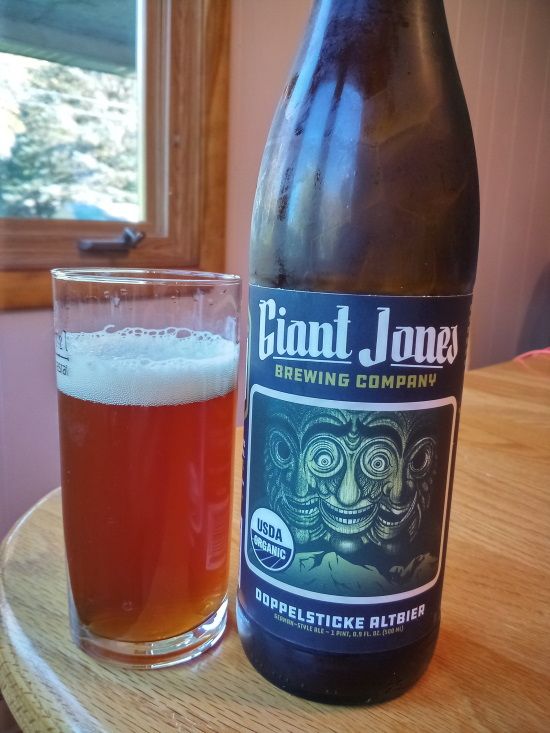
My pour looked rather nice with some loose, just off-white head that sat atop the copper liquid. Thankfully the head had some staying power and I was actually able to get a photograph showing it off a bit. The beer was slightly hazy and the odd bubble could be seen here and there. Caramel was prominent on the nose but I also sniffed out some stone fruit which was cherry-like. Plus there was just a hint of smokiness.

Considering the paucity of bubbles I saw in the glass, the beer had a nice, firm fizziness to it. There was the requisite malt sweetness but it wasn't as big or overpowering as I thought it may be considering the "doppel" and the "sticke" parts of the name. Yeah, there was a lot of malt taste here but the sweetness was balanced with dryness and some astringency. Presumably the hops, which didn't have a strong taste at this point, countered some of the sweet flavors as did that fizz. I also tasted some roasty grain flavor and a touch of that cherry that I had smelled.

On the finish, I was able to taste the spicy, Nobley hops and their bitterness was allowed to come to the fore. Like the malt, you couldn't miss the hops here but they didn't overwhelm. The bitterness gave way to dryness which mixed with the booze – it's 9.6%. I caught a trace of malty sweetness but that faded rather quickly.

This was a very tasty beer. The best part of it for me was how the fizz and hops played against all of that malt. They did their job perfectly. The beer had a rich malt taste but also a nice dryness which laid the sweetness to rest at just the right point.

Junk food pairing: With a beer fit for Gargantua himself, grab yourself one of those giant pretzels that's equivalent to a couple loaves of bread and apply nacho cheese food sauce liberally.

20 January, 2021

Hey Braggot!: Paint It Black by Giant Jones Brewing & Bos Meadery


With a pandemic raging, people afflicted with Trumpian madness storming the Capitol in Washington D.C., and a polar vortex set to swoop down upon us, these are the days that not only try men's souls, but also give them a thirst that can only be slaked by something a bit more pantagruelian than the average beer.

Thankfully here in Madison we have Giant Jones Brewing Company. Proprietors Jessica and Erika Jones figured they'd start a brewery. A very niche brewery. It opened in 2018 and offers only the headiest of beers brewed exclusively with organic ingredients. Everything is a barleywine or an imperial or a double or bock strength or a triple or what have you. While they offer a double IPA, they also brew styles that are much less common in these parts including weizenbocks (pale und dark) and a rotating selection of barleywines all the year long.

Just two blocks from Giant Jones is Bos Meadery where Colleen Bos, a "former" medievalist, transmogrifies honey, water, and yeast into mead. The meadery opened in 2012 and has been producing meads made with various varieties of honey, fruit, herbs, and spices ever since. Mead is a cousin of wine and most of Bos' are of similar strength to their vinous relatives.

And now, just like the gustatory congress of chocolate and peanut butter, Giant Jones got their beer into Bos mead. Or did Bos get their mead into Giant Jones' beer? Either way, they now give us Paint It Black braggot.

Braggot is like a cross between mead and beer and does not seem to be made particularly frequently, at least not here in Wisconsin. Paint It Black may be a first for Giant Jones but Bos has offered at least one braggot previously - during Madison Craft Beer Week in 2018 and it was excellent. They produced it in collaboration with St. Francis Brewery (R.I.P.) and it featured a rye stout, if memory serves, given the meady treatment.

Honey is one of those foods that I never thought about much until, quite frankly, I began to drink mead. Unless you grew up on a bee farm, I'd bet honey was just this golden, treacly stuff to you as it was for me. Then I drank mead made with single nectars and discovered that there is more to honey than meets the eye. Go to the Bos Mead Hall and sample the their Wildflower, Buckwheat, and Cranberry Blossom meads and you shall taste what I mean.


Paint It Black merges Giant Jones' winter seasonal, Extra Stout, with Bos' Wildflower Mead. My bottle was filled on 8 December 2020 so it was fairly fresh when I consumed it. As the name indicates, the braggot appears to be black. And, as usual, if you contort yourself just right, you can tell that it is a deep reddish brown. The tan head was soft & pillowy and hung around for an average amount of time. You know, a minute or so. It looked lovely.

In addition to its good looks, the brew smelled wonderful. (My notes say "awesome!") Coffee and bitter chocolate dominate here but the mead's floral-vanilla sweetness was certainly no slouch even if it wasn't as prominent. I was reminded of a box of fancy truffles, such as you'd get from CocoVaa, that use flowers as an ingredient. It smelled lovely.

At first, I tasted dark chocolate and honey sweetness but then came a touch of wildflower (which grew a tad as the braggot warmed) and a moderate bit of carbonation. Coffee and herbal hop bitterness came through on the swallow. A fizzy dryness and some boozy heat rounded my sips out. It tasted…lovely.

Really. I simply adored this stuff. It had all the roasty/coffee/chocolate flavors that are why I love dark beers so much plus some floral ones as well which are, to my taste, woefully underused in beer. At 9.4% A.B.V. it will take your cares away and warm you up but it doesn't taste heavy. Instead, it goes down smooth and easy.

Junk food pairing: Paint It Black is best enjoyed with a bag of dark chocolate covered pretzel thins. The chocolate complements the stout well while the pretzel adds more grain flavors plus salt which further heightens the meady goodness of the braggot.