Showing posts with label Mead. Show all posts

18 January, 2024

At the Meadery of Madness: Necro by B. Nektar

It's been a while since I've had mead. At about this time last year I went on a little honey wine jag but I lost the momentum. Not long ago I noticed a bottle of Necro mead at the back of our refrigerator just waiting to be opened. I felt like the Doctor in "The Awakening" stumbling upon the Malus as I poked around only to be confronted by the face of a demon when all I wanted was some cream for my coffee. I've had it before, back in the days when it was still called Necromangocon.

Necro is made by B. Nektar over in suburban Kadath, er, Detroit. It appears they are no longer a mere meadery and have branched out into beer and cider as well. I don't know that B. Nektar was ever content with making a plain mead as they've added fruit and spices to their meads for as long as I can recall. The words "modern" and "sub-pop culture" appear on their website more than once giving me the impression they hired a sociologist to do their ad copy. And seeing all of those pop culture references on their labels makes me wonder if that sociologist had read some Foucault. What is "sub-pop cultury" about zombies and AT-AT's from The Empire Strikes Back and H.P. Lovecraft?

There's just this precocious 12-year old kid vibe about B. Nektar, always saying, "Look how clever I am!" in a bid for attention. Maybe that's what a meadery needs to do to stay afloat, in addition to making cider and beer.

But what's important is the taste and quality of, in this case, the mead.

Necro is a mango mead, i.e. - a mead with mango juice added, though I don't know where it gets added in the process of making the stuff, plus black pepper. It is 6.2% A.B.V. which is much less potent than your typical mead/wine. A session mead? A small mead?
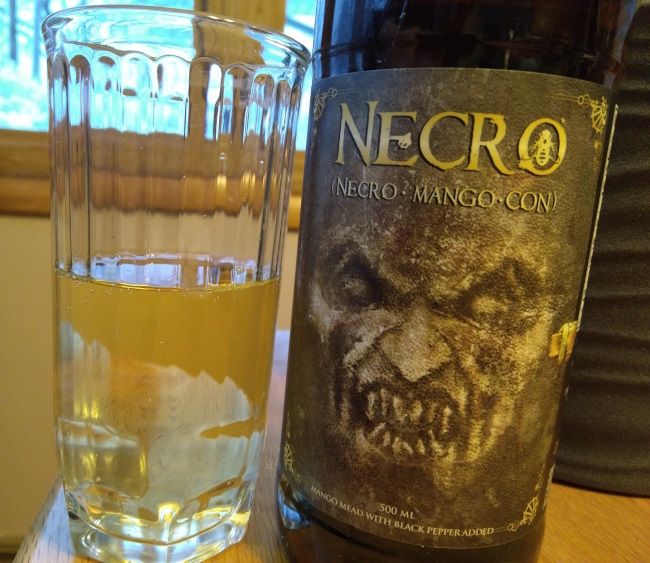
I am not sure how I managed such a canted angle in this picture. My excuse is that I'd been listening to a podcast about film noir and the genre's use of them. ¯\_(ツ)_/¯

Despite the daemonic label and the sepulchral name with its Lovecraftian overtones, Necro was no stygian spirit but, rather, straw colored. And clear. My pour produced a lively, though short-lived, head of soda-like fizz. It smelled rather sweet and of - quelle surprise! - honey and mango.

When fruit is added to adult beverages these days, I assume that it'll be a prominent flavor with plenty of sweetness behind it so as to give it that Hawaiian Punch sheen. I was pleasantly surprised here to find that the mango was fairly restrained, setting it on a more or less equal footing with the honey instead of being its superior. The honey provided not only its lovely earthy-vanilla flavor but also a nice floral accent. There was a hint of that fizz - just enough to give a medium body instead of something heavier.

On the finish, the sweet flavors faded to a surprisingly dry finish. Not very dry, mind you, but drier than you'd expect for a mead with mango juice. Cleared the sweetness away quite nicely. I think I finally tasted the black pepper here. Nothing strong and instead a nice, mellow woody undertone.

I may find B. Nektar's ad copy and brand image a bit cloying but Necro is anything but. This is wonderful mead. Not particularly sweet - I'd hazard a guess and say it qualifies as semi-dry - with the honey and mango flavors perfectly balanced and the pepper making for a really nice accent. With a lighter body than your typical/ normal strength stuff, it goes down quite easily.

A drink fit for Abdul Alhazred himself.

Junk food pairing: Pair your Necro (sounds a bit disgusting - sorry) with a bag of Lay's Kettle Cooked Maui Onion potato chips.

12 February, 2023

Watch your honey drip, can't keep away: Peach Mead by Wyldewood Cellars

Here we have my final review of a Wyldewood Cellars mead. For now. While I bought a variety 4-pack, the bottle of raspberry mead ended up at a friend's house.

I was listening to a podcast earlier today and the host remarked that the pigs my medieval European ancestors kept looked different from the ones we have today. It made me wonder if peaches are in a similar predicament. Apparently they are. Thought to have originated in China, they were in Mediterranean regions by the 4th century B.C.E. and spread from there. It seems the Spanish brought them over to these parts in the late 16th century.

It says here that peaches can have white or yellow flesh but that the latter are a product of the second half of the 19th century. I have also learned about peach stones. If the flesh adheres to it, it's called a clingstone. But, if the flesh is easily removed, it's called a freestone.

As I was reading that there are a couple thousand plus varieties of peaches, I thought about how we (i.e. - average American supermarket denizens) are presented and familiar with multiple varieties of apples but not so with peaches. Sure, we may not recall which variety of apple is best for baking, canning, or eating raw, but we are accustomed to seeing green ones and red ones; apple shaped ones and shorter, rounder ones that are shaped more like tomatoes. But, generally speaking, when we go to the store, a peach is a peach is a peach. We just hope the flesh isn't mealy, which, I just learned, happens when the fruit's pectin isn't allowed to breakdown due to cold storage.

Here is a sampling of peach varieties.

We have the Doughnut peach which is a bit flattened and its stem area is a depression that gives the appearance of a doughnut hole. Then we have the Brazilian Babcock variety that is missing the iconic fuzz. Indiana Jones' favorite peach is surely the Melting Flesh. I guess it take the freestone concept to the next level. There is also a Madison peach which is hardy enough for Wisconsin weather.

Lastly, I'll note that peaches taste like peaches because of compounds called lactones. It appears that gamma-decalactones are the main culprit as they taste like, er...um, peaches.

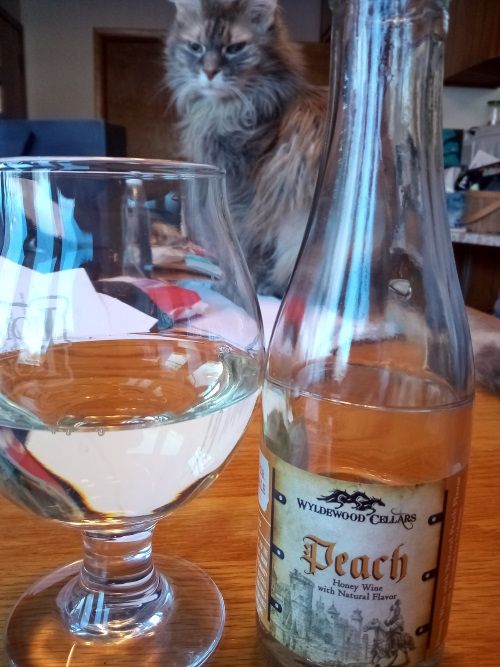
I guess Wyldewood used white-fleshed peaches because this peach mead looked like water. Actually, this mead is a blend of their sweet mead and peach wine so I suppose it's more correct to say that their wine must have been made with white-fleshed peaches. But shouldn't the mead have been yellow? There might have been the barest hint of yellow here but really, it looked colorless. It was also clear and unfizzed. While minimalism ruled the visual aspect, the olfactory one was much less ascetic as the mead smelled very sweet with the honey being floral and aided by a bit of earthiness. The peach was in the back somewhere.

As with the other Wydlewood meads I've tasted, this was very sweet and very smooth. The earthy-vanilla aspect of the honey seemed more prominent to my tongue. Just like their other meads, this stuff is 12% A.B.V. and there was some boozy heat to be tasted. The peach was mild, at first, but became much fuller as the mead warmed. The fruity/honey sweetness lingered when I swallowed but some gentle tannins eventually came through bringing a mild dryness that made for a nice contrast.

Another tasty wine from the folks at Wyldewood. Sweet but not like drinking Libby's Peach Nectar. I appreciated how the peach never totally obscured the honey. The ratio of these 2 flavors varied with temperature, but I could always taste both. A fine lactone-laced mead.

Junk food pairing: I recommend white peach & jasmine potato chips to accompany this mead. The jasmine adds a nice floral taste to the proceedings while the salt contrasts with sweetness nicely and enhances the flavors all around.

09 February, 2023

With the Honey and Berries United: Elderberry Blackberry Mead by Wyldewood Cellars

When I was composing my previous elderberry mead review, I wrote under the impression that elderberries were on the obscure side of things, that the folks at Wyldewood Cellars were nearly alone in their love of the fruit of the elder plant and that, for most, they were simply something mentioned in a Monty Python movie.

One day after having posted that review, I was poking around my refrigerator for some sport peppers because I was in the middle of a Chicago dog marathon when I came across a bottle of elderberry tincture or some such thing. It reminded me of my impression that elderberry juice was de rigueur in natural health circles. It may not be, but it seems fairly common to me, at least, with multiple people I know taking it whereas it was nowhere to be seen a few years back.

It also occurred to me that elderflower liqueur was trendy. (I believe we have a bottle of St. Germaine that my wife bought in the liquor cabinet.) Although I am not a big cocktail drinker, I've heard tell of tasty concoctions that have elderflower liqueur in them from some folks who frequent bars that have a cocktail menu that reaches beyond Old Fashioneds and rum & coke. Plus I've seen articles about craft cocktails that mention it in local publications.

I then discovered the existence of the Midwest Elderberry Cooperative, a group that promotes the growing and selling of elderberries. Although the coop is out of Minnesota, it seems that there are some Wisconsin members. The coop notes, "Over 95% of the elder ingredients found in American made products are sourced from outside our continent."

In addition to touting the elderberry's taste and health benefits, they also promote the environmental benefits: "Perennial native elderberry supports over 60 native pollinators, holds soils in place, sequesters carbon and sucks up nitrogen." My guess is that these qualities are basically the exact opposite ones of corn and soy beans, the biggest crops in this country.

It appears that the humble elderberry isn't quite obscure as I had thought initially.

Joining it here are blackberries. Along with raspberries, they are the main members of the caneberry family. I see here that cloudberries are also part of the family and my wife came back with a jar of cloudberry jam on a recent trip to Ikea. In a blind taste test, I think I'd be hard pressed to distinguish between a blackberry and a raspberry. To my mind blackberries are sweeter and less tart than raspberries. And I have just began my investigation of the cloudberry.


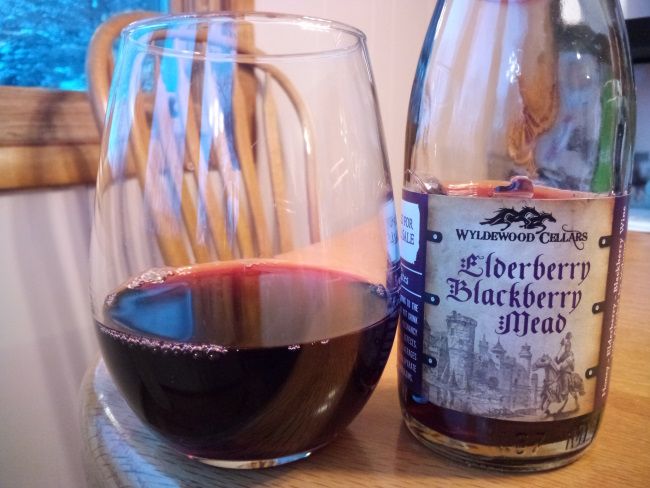
I'd be unable to distinguish the colors of plain elderberry mead and this elderberry-blackberry combo stuff even if I had a really detailed Pantone swatch book that was the OED of colors. They looked indistinguishable. Still, they also both looked lovely having a deep ruby hue. It was clear and had no fizz. The aroma was much the same as well. It smelled like berries along with a large dose of honeyed sweetness and that same vinous scent.

(I should make things easy for myself and just do some cutting and pasting here.)

The mead tasted smooth with a heavy body full of sugars as it was very sweet. Again, the honey had a prominent floral taste to it and less earthy. That vinous thing was present in the taste as was a nice tartness. I think this stuff was a little less tart than the mead made from elderberries alone. Not dramatically but noticeably.

I found that the honey-berry sweetness lingered after swallowing and the tannins took a little while to kick in and add moderate dryness.

I greatly enjoyed this mead as I did the version without the blackberries. The differences are subtle with the main one being that this stuff is a tad less tart. As I noted last time, I prefer dry mead but Wyldewood has a knack for using tart fruits to keep high doses of sweetness from being overly cloying.

Junk food pairing: To honor the coming together of two berries here, pair this mead with Lay's Funyuns Potato Chips which bring together two vegetables dug up from the soil.

21 January, 2023

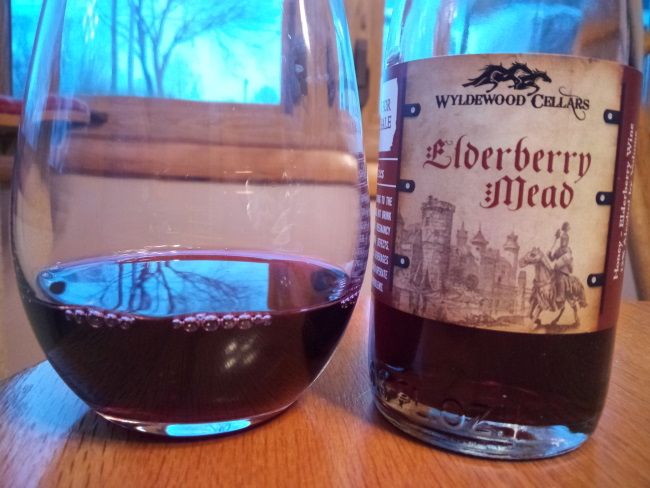
Your mead smelt of elderberries!: Elderberry Mead by Wyldewood Cellars

Surely I am not alone in first hearing about elderberries from that scene in Monty Python and the Holy Grail where the irritable French guard taunts Arthur, Patsy, and company with “your mother was a hamster and your father smelt of elderberries!”. I have laughed at this scene countless times despite not having tasted elderberries. It was funny and I just basically moved on to the next joke because they come at you in a steady stream in that movie.

But not everyone enjoyed the joke and simply moved on to the next one. John Brewer, his wife Beth, and his sister Merry really took elderberries to heart. They opened Wyldewood Cellars in 1995 out in Kansas and made elderberry wine. Their website says that they were moved to do so by nostalgia for the acres of elderberries grown on John and Merry's mom's ranch and the wine made from them. I suspect that the webmaster merely forgot to note the role of Monty Python in the story.

Over the past 27 years, they have branched out to other kinds of wines as well as meads. But they still offer elderberry wines and even sell elderberry concentrate. (You've gotta dance with the one that brung ya.) These folks seem to have elderberry juice in their veins. In 2010 they exported their sambucuphilia to east central Illinois and opened an outpost in St. Joseph.

And so last fall when I found myself at a liquor store in suburban Chicago, I ran across Wyldewood meads. As if the prospect of fruit-laced honey wine wasn't enough, I found that they offered their meads in 4-packs of 6.3oz(?) bottles. Not only that, they offered variety 4-packs so I could try various flavors. But I had to start with elderberry.

The elderberry is apparently a denizen of the Northern Hemisphere. It has a very tart flavor so no one picks them fresh and pops them into their mouth. In addition, they contain things called lectins which prevent your digestive system from absorbing nutrients and induce symptoms like those from food poisoning. I have found nothing to indicate that they smell bad, however.

Wyldewood's Elderberry Mead is a lovely deep ruby hue and clear. It is still, in mead parlance, that is, no fizz. I say this in the most loving way: it smelt of elderberries. Honestly and truly. Kind of like raspberries. It also had, in tautological fashion, a vinous aroma. Think red (grape) wine. My notes say "hint of vinegar" but I don't mean this in a bad way. I like to drink vinegar. Here I was referring to a slight astringency.

My first sip revealed a sweet wine with a medium-heavy body. The honey had a nice floral taste to it instead of a more earthy one and I discovered that elderberries taste akin to raspberries and their tartness. If elderberries are as tart as I have read they are, then this must have been a very sweet mead indeed. I prefer dry meads but this one was sweet - but not cloying. I think the berry tartness kept it from being too syrupy. That honeyed sweetness lingered a bit on the finish as some tannin dryness crept in.

This is a mighty fine ruby restorative. The elderberries were very tasty and paired with the honey well. It was sweet but there were enough tannins and berry tartness to keep things from spiraling into a treacley mess. I also really liked the mead's smoothness on the palate.

Junk food pairing: Since this is a wine and wine is fancy, you will want to go upscale with your food pairing. I recommend a box of Cheez-It Duoz Bacon and Cheddar crackers.

30 August, 2022

To slake my thirst on honey wine: Bonfires & Battlecries by Nottingham Nectar

While not swarming with meaderies, Madison is home to two producers of mead and has been for several years. I learned this only a few weeks ago as I was combing area liquor stories in search of new varieties of the venerable drink. Bos Meadery has been out of commission for a while due to the meadery having to move because of renovations to the building it was located in. However, it sounds like they're back on their feet and shipping mead once more, although its availability seems more limited.

It seems that during the Covid lockdown, Colony Nectar Co. collapsed and morphed into Nottingham Nectar under new ownership. Honestly, I can't say I recall ever having heard of Colony Nectar and am unsure if this is because of their poor marketing and distribution or my lack of inquisitiveness. The latter, most likely.

The name and the illuminated N on the label brought the Robin Hood legend to mind along with visions of Falstaffian fellows enjoying the stuff by the flagon. Truth be known, the new name came from the new owner, Patrick Nottingham. The meads are made on the far southeast side of town at Restoration Cider's facilities which must be a hive of activity with all sorts of meads and ciders fermenting away. All four Nottingham varieties are session meads. That is, instead of being full strength wines with full bodies and no carbonation, these are more spritzer-like. They have about half the alcohol at 6% A.B.V. and are fizzy.

The intricacies of the adult beverage market are beeyond my ken so I am left to ponder whether the decision to make session meads exclusively was made after poring over the latest market data or if was more along the lines of guesswork. Other meaderies make these fizzy, lower alcohol meads as well so there's got to be something to it, I'd imagine. Perhaps the regular stuff is viewed as "your dad's mead" by younger people who seem to regard beers like Sierra Nevada Pale Ale as relics of a forgotten age.

Well, I don't want to drone on about the business side of mead so let's get to the liquid.

Nottingham makes 4 meads: strawberry, cherry, semi-sweet, and semi-dry. I tried the last of these called Bonfire & Battlecries. The going rate seems to be $16/4-pack but I found it a couple bucks cheaper at a certain grocery store on the east side who had upped the price out in the coolers but not in the computers as it came up at $13 and change for "Colony Nectar".

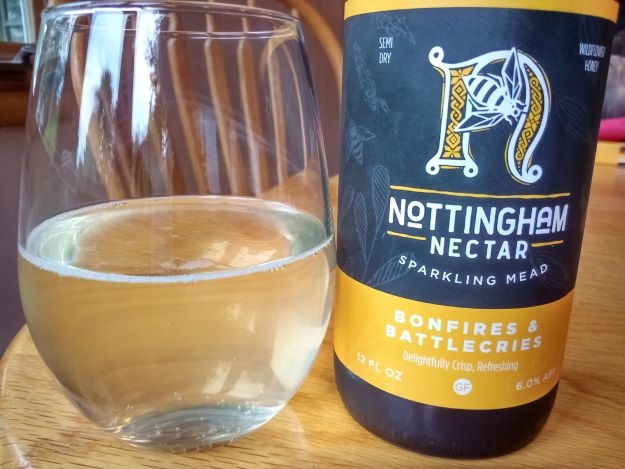
Bonfires & Battlecries is straw colored. Very light. If you were to casually look at the glass and then turn away, you might wonder why someone would put water in a wineglass. What a rube. It is clear and, while I have something of an idea of what to expect bubble-wise with beer, sparkling mead is a whole other kettle of fish, I guess. There was a smattering of bubbles inside but I expected more. I don't know why but I did. The aroma was of - drum roll - honey! It says "Wildflower Honey" on the label but I am unsure what expectations that should be setting up in the gustatory part of my brain. I smelled a scent that was earthy and floral with a dose of vanilla.

Despite the relative paucity of bubbles visible in the glass, this stuff had a firm fizziness to it. Underneath it, though, you could taste a smooth mead. The medium-light body yielded a mild honey sweetness, a little something floral, and vanilla. After a couple sips that vanilla taste became more prominent and the mead took on the complexion of cream soda, albeit a dry one. On the finish, the other honey flavors faded while the vanilla lasted a bit. All that fizz and presumably some tannins left a moderate astringency and a nice, dry ending.

This was tasty stuff! For my taste, it had the perfect dryness. You could discern some remaining sweetness yet it didn't become a tannin fest causing my lips to pucker and gyrate in a vain attempt to move some saliva around to moisten my poor parched mouth. The prominent vanilla taste was wholly unexpected yet quite welcome.

Junk food pairing: Bonfires & Battlecries pairs well with something cheesy. I prefer nacho cheese Bugles.

09 August, 2022

Romani bibeunt melomelium!

Whenever I hear or read the term “melomel” I start drooling because my mind’s eye is immediately filled with visions of fried chicken, mac & cheese, fried catfish, peach cobbler, and all the other soul food staples. That part of my brain that deals with food, the stomach – er, the hypothalamus, I mean -  my hypothalamus confuses “melomel” with Melly Mell’s, Madison’s premier purveyor of soul food.

Melomel has absolutely nothing to do with any of the tasty foods above nor their equally tasty associates like ribs, collard greens, banana pudding…well, you get the idea. Instead melomel is fancy term for mead made with fruit. Apparently it comes from the Latin word melomeli which referred to – would you believe it? – honey wine made with fruit juice. It sounds pretty fancy so I suspect it was reserved for the more patrician types like those senators who had their own luxury skyboxes at the Coliseum.

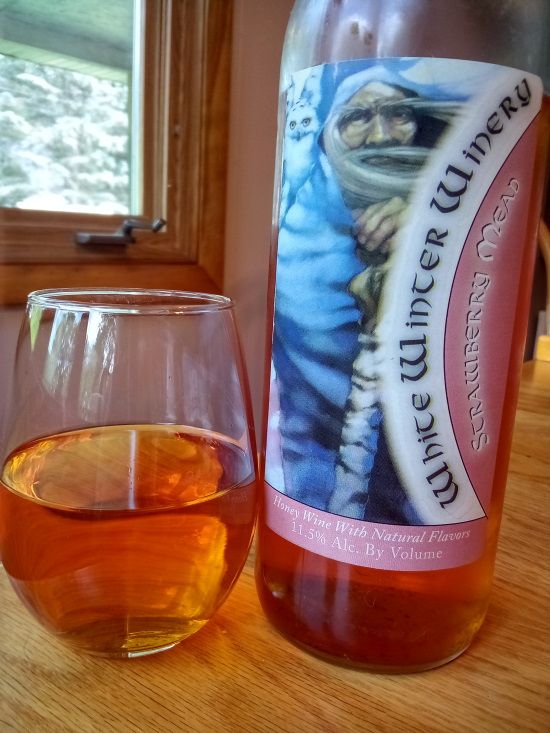
If the Romans were drinking strawberry melomeli back in the day, instead of, say, grape melomeli, which is known as pyment today for reasons unknown, it was surely a bit different than the strawberry melomel made by White Winter Winery, the subject of this blog post. Not only would the honey have been different but the strawberries as well. Apparently the delectable little red bundles of sweet, fruity goodness we know and love today were initially bred by a French person in the mid-18th century. This person let a strawberry from the American colonies schtup one from Chile or however you do it. (Fruit husbandry is not my area of expertise.) The Romans would have been using a different variety native to Europe, presumably.

The strawberry is a member of the rose family and, according to Wikipedia, those aren’t seeds on the outside aren’t seeds. They’re “actually one of the ovaries of the flower, with a seed inside it.” So remember, you’re eating ovaries when you pop a ripe, succulent strawberry in your mouth.

As with my previous mead commentary, honey here means what I think of as your garden variety sticky golden stuff with an earthy-vanilla flavor over here and a floral taste over there. The thing is, honey varieties can have rather different tastes depending on where the bees source their nectar. I can find no indication of what kinds of bees or honeys White Winter uses.

White Winter does say, though, that their Strawberry Mead is made with their dry mead, the subject of my last White Winter post, which has had the fruit added along the way at some point.

The odd thing is, for a drink with strawberries, it isn’t very red. It’s more of a gold with a red tint to it. Still, considering the straight dry mead looked almost like water, this stuff has a lot of color to it. This mead is clear and still, i.e. – no fizziness. As expected, the aroma was of strawberry and honey yet it wasn’t particularly sweet smelling. Also, it smelled boozy to my nose with it being 11.something% A.B.V.

With no carbonation, my tongue was treated to a mighty smooth sip. Like the dry variety it is built from, it has a medium-light body and this, along with the smoothness, makes it go down very easily. The honey flavor is most prominent with strawberry being little more than an accent when the mead was cold. However, as it warmed, the strawberry taste grew stronger and fuller. After swallowing, the honey flavor faded quickly but the strawberry hung on for a bit. Then the tannins and booziness kicked in to make for a rather dry finish.

I found Strawberry Mead to be a bit drier than the dry mead that was not fruitified. I have to wonder if a trick is being played on my tongue with the strawberry adding a touch of sweetness as well as a fruity flavor and this threw the dryness into sharp relief. Or some such thing. The key is to let it warm up a little so that the strawberry flavor becomes more pronounced because it is delicious. Still, the dryness, perceived or real, was just a bit too much for me. It didn’t render Strawberry Mead undrinkable, but I definitely liked the Dry better.

Junk food pairing: I like to offset the dryness of Strawberry Mead with my food pairings. A long-time favorite is chocolate whipped topping on vanilla wafers.

19 July, 2022

Honeymakers Local 151: Dry Mead by White Winter Winery


Perhaps, if Grendel had been treated a bit better in his youth instead of being cast out to stew in the toxic juices of resentment and bloodlust and Hrothgar and his pals could have had some courtesy and been open to keeping the noise down at Heorot, maybe, just maybe, Beowolf could have brought the aggrieved parties together over a glass of mead and found some kind of détente. You know, like Nixon going to China.

But no. Instead the bloodshed reached a fever pitch as some poor Geats became the plat du jour at Grendel's grisly table before Beowolf relieved the chef himself of one of his arms followed by his life. Heeding the Biblical injunction of an eye for an eye, Grendel's mother sets out to exact revenge but ends up losing her life too. A truly ghastly affair.

Luckily I can enjoy mead today without fear that some hideous, bloodthirsty monster is going to burst in and start eating my kith and kin.

I think I have some kind of atavistic impulse to drink the stuff with all of my Central and Eastern European blood. With the odd exception, I don't drink wine but rather enjoy mead. I do, however, feel bad for the bees. I mean, those bee ladies spend all this time and effort risking life and limb to gather nectar and make honey only to have some human hork it all. Let's hope honey bees never read Marx and learn about workers controlling the means of production or Locke and discover that the fruits of one's labors are your own or we could be in serious trouble.

While I don't doubt that mead's popularity has benefitted from the slow food and craft beer movements, the Boston Beer Company does not have a subsidiary dedicated to it so I think the venerable beverage has a long row to hoe before it finds wide appeal.

Although it's a niche product, there is still a fair amount of mead to be found on store shelves here in Madison. And much of it is made right here in Wisconsin. No doubt people have fermenting honey for ages here in the Land of Cheese but the progenitor of the modern meadery in our fair state is surely White Winter Winery up north in Iron River. I believe theirs was the first mead I ever tasted and I visited the place once back in 2005 returning with a large cache of fine honey wine.

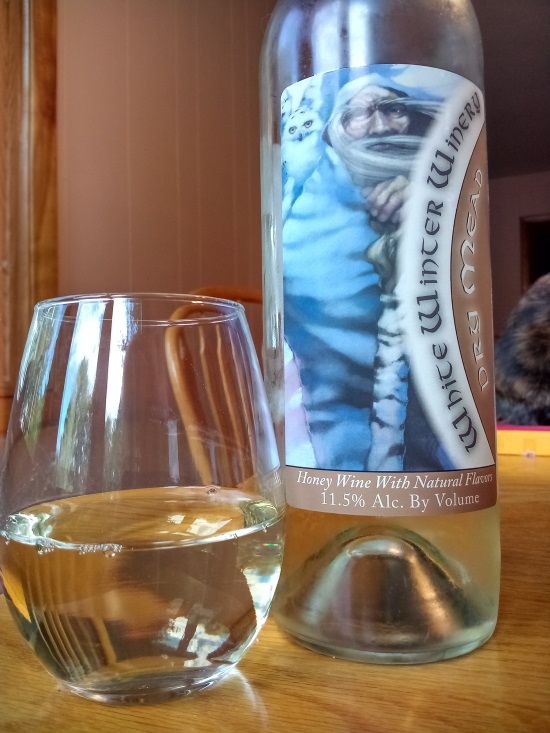
Founded in 1996, they began by offering mead, dry & sweet, fruited and not, with what appears to be Boreas' face on the label just to remind everyone of how cold it gets up by Lake Superior. They have since added less wine-like meads that have less alcohol and a generous dose of fizz to their portfolio. At some point, they got into the cider business as well.

For our purposes here, I am going to blather on about their dry mead.


Looking at it, the mead is nearly colorless with only a faint yellow tint. It was crystal clear and, as they say in meady circles, still, i.e. - not fizzy. Would you believe that it smelled like honey? I know that the scent and taste of honeys will vary depending on the flowers from which the nectar was drawn but I have no idea where the honey that made this mead came from. (Is there a word like "terroir" but for flowers?) It smelled like honey, mainly. There was a mild floral sent too along with strawberry. I could also smell that astringent alcohol scent, but it wasn't unpleasant.

This stuff was smooth with a medium-light body. Light sweetness was balanced by firm dryness. It tasted like honey with its floral/earthy flavors that included something vanilla-like. The sweetness lingered a long time after swallowing but a tannin dryness eventually swept it away.

I adore this mead with its fairly light, mild taste. It's dry but not mouth puckeringly so like a red wine, but it's also not cloyingly sweet. The label says that natural flavors were added but I have no idea what they were. It simply has a lovely honey flavor and is dangerously drinkable.

Junk food pairing: a light, dry mead like this one will pair well with white meats and mild cheeses so get yourself a box of Chicken in a Bisket crackers and dose them with the American cheese flavored Easy Cheese.

20 January, 2021

Hey Braggot!: Paint It Black by Giant Jones Brewing & Bos Meadery


With a pandemic raging, people afflicted with Trumpian madness storming the Capitol in Washington D.C., and a polar vortex set to swoop down upon us, these are the days that not only try men's souls, but also give them a thirst that can only be slaked by something a bit more pantagruelian than the average beer.

Thankfully here in Madison we have Giant Jones Brewing Company. Proprietors Jessica and Erika Jones figured they'd start a brewery. A very niche brewery. It opened in 2018 and offers only the headiest of beers brewed exclusively with organic ingredients. Everything is a barleywine or an imperial or a double or bock strength or a triple or what have you. While they offer a double IPA, they also brew styles that are much less common in these parts including weizenbocks (pale und dark) and a rotating selection of barleywines all the year long.

Just two blocks from Giant Jones is Bos Meadery where Colleen Bos, a "former" medievalist, transmogrifies honey, water, and yeast into mead. The meadery opened in 2012 and has been producing meads made with various varieties of honey, fruit, herbs, and spices ever since. Mead is a cousin of wine and most of Bos' are of similar strength to their vinous relatives.

And now, just like the gustatory congress of chocolate and peanut butter, Giant Jones got their beer into Bos mead. Or did Bos get their mead into Giant Jones' beer? Either way, they now give us Paint It Black braggot.

Braggot is like a cross between mead and beer and does not seem to be made particularly frequently, at least not here in Wisconsin. Paint It Black may be a first for Giant Jones but Bos has offered at least one braggot previously - during Madison Craft Beer Week in 2018 and it was excellent. They produced it in collaboration with St. Francis Brewery (R.I.P.) and it featured a rye stout, if memory serves, given the meady treatment.

Honey is one of those foods that I never thought about much until, quite frankly, I began to drink mead. Unless you grew up on a bee farm, I'd bet honey was just this golden, treacly stuff to you as it was for me. Then I drank mead made with single nectars and discovered that there is more to honey than meets the eye. Go to the Bos Mead Hall and sample the their Wildflower, Buckwheat, and Cranberry Blossom meads and you shall taste what I mean.


Paint It Black merges Giant Jones' winter seasonal, Extra Stout, with Bos' Wildflower Mead. My bottle was filled on 8 December 2020 so it was fairly fresh when I consumed it. As the name indicates, the braggot appears to be black. And, as usual, if you contort yourself just right, you can tell that it is a deep reddish brown. The tan head was soft & pillowy and hung around for an average amount of time. You know, a minute or so. It looked lovely.

In addition to its good looks, the brew smelled wonderful. (My notes say "awesome!") Coffee and bitter chocolate dominate here but the mead's floral-vanilla sweetness was certainly no slouch even if it wasn't as prominent. I was reminded of a box of fancy truffles, such as you'd get from CocoVaa, that use flowers as an ingredient. It smelled lovely.

At first, I tasted dark chocolate and honey sweetness but then came a touch of wildflower (which grew a tad as the braggot warmed) and a moderate bit of carbonation. Coffee and herbal hop bitterness came through on the swallow. A fizzy dryness and some boozy heat rounded my sips out. It tasted…lovely.

Really. I simply adored this stuff. It had all the roasty/coffee/chocolate flavors that are why I love dark beers so much plus some floral ones as well which are, to my taste, woefully underused in beer. At 9.4% A.B.V. it will take your cares away and warm you up but it doesn't taste heavy. Instead, it goes down smooth and easy.

Junk food pairing: Paint It Black is best enjoyed with a bag of dark chocolate covered pretzel thins. The chocolate complements the stout well while the pretzel adds more grain flavors plus salt which further heightens the meady goodness of the braggot.