Showing posts with label Norwegians. Show all posts

15 December, 2023

Down on Ole's farm: Kornøl Norwegian-Style Ale by Giant Jones Brewing

 
Ole and Sven walk into a bar and they order some beers. After drinking his, Ole looks into his shirt pocket. They order another round and Ole looks into his shirt pocket again. This goes on for a few more rounds.

Sven is curious, “Ole, why do you look in your pocket after each beer? Whatcha got in der?"

Ole confesses, "I have a picture of my Lena in der, and when she starts ta look good, I go home."

When it comes to beer, Norway's is not exactly near the top of most people's lists. And I don't mean that their beer is regarded as being low quality; it's that people outside of Norway don't seem to know it exists.
 
"They brew beer in the land of the midnight sun? I didn't think you could grow barley on a glacier."
 
Norway is about a-ha and Ole and Sven/Lena jokes. Their culinary traditions consist of lefse and lutefisk, right? I suppose I can say that, when I think of Norway, I also think of the biathlon (I got pretty good at it playing Winter Games on my Commodore 64) and a bunch of guys on skis blowing up a heavy water factory.

People in the American Upper Midwest, such as myself, might throw in rosemaling and sandbakkels at Christmas but that exhausts most Americans' knowledge of Norwegian culture.

Actual Norwegians know a bit more, though, I suppose. But how much about their indigenous beer styles to they know?

One Norwegian who knows about the brews of his homeland is Lars Marius Garshol. He literally wrote the book as his tome Tradisjonsbrygging av øl goes in-depth into the farmhouse ales of his homeland. Unfortunately, it's in Norwegian. On the other hand, his Historical Brewing Techniques: The Lost Art of Farmhouse Brewing is in English and it covers the farmhouse brews of Norway, as well other Northern European countries. It sounds like an interesting book that would shed a lot of light on the beer at hand. But I wouldn't know since I've never read it.

At some point in the fall, I spied Kornøl by Giant Jones Brewing in a beer cooler and was intrigued. I searched my memories for a time when I'd sampled a Norwegian style of beer but found none and so I eagerly bought a bottle. While I haven't read Garshol's book, I have heard an interview with him. He notes that kornøl is a beer style associated with the northwestern part of the country and has the following characteristics:

- wort is not boiled
- pale grist is used
- a juniper infusion mash
- very little hops
- kveik for fermentation
- very low carbonation

Of course it has juniper in it. It's a standard ingredient in more boreal brews.
 
Was Giant Jones' Kornøl brewed to these standards? Will it taste like it's "supposed to"?
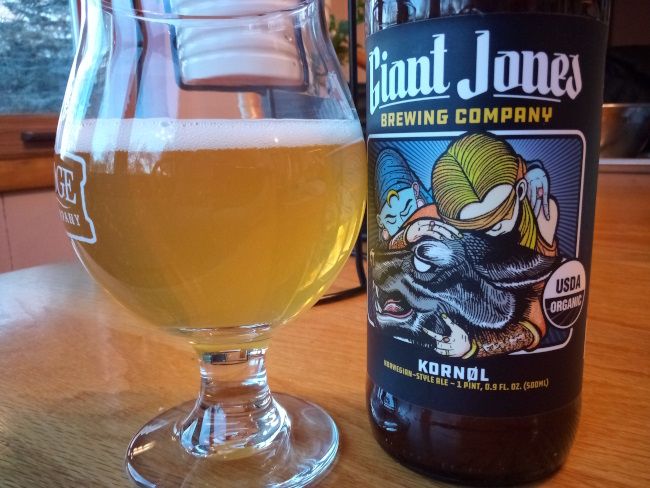
 
 
Since I'd never had kornøl previously, I found myself enchanted with novelty at every turn. I had no idea what it looked like and was pleasantly surprised at a lovely light yellow liquid which was in start contract to the dark lagers and bracketts I'd been consuming lately. There was a slight haze to it. Despite my best(?) efforts, my pour produced only a small head of lively foam. Like the stuff in soda. It didn't last. With that haze being on the light side, I was able to see some bubbles inside. I was surprised by a lemony smell, as if it was a kettle sour. Was it? For all I knew, it was a sour beer, laden with lactic. I also smelled grain - yeasty, crackery - and a hint of pine. The label did mention local spruce.

The label mentioned that it wasn't boiled and was fermented with kveik so, along with the juniper, pale color, and small head, it seemed we were more or less in the kornøl ball park here.

When I tipple a stronger beer, and this stuff is 7.4%, I tend to go in thinking that it's going to be thick and sweet and really provide sustenance for the Fimbulwinter. But I found Kornøl merely had a medium body. It was a bit on the sweet side with a kind of sprightly honey taste but there was enough fizz to keep it from being cloying. The spruce was definitely there but it was not taiga in a glass. You couldn't miss it but it didn't dominate. I think I also caught a smidge of herbal hops in addition to that airy cracker taste.

The sweetness faded on the swallow which allowed a combination of the spruce and some herbal-spicy hops to finish things off with a prominent dryness and a firm bitterness.

For about half a glass I found myself pondering the mysteries of this beer. What was I tasting that was the result of the wort not having been boiled? Was I able to truly discern the hops from the spruce?

In the end, I never found any answers and, instead, just enjoyed the ride. The spruce was just the right amount for me (and may have been bolstered - the aroma, anyway - by the fact that I had hung a wreath in the same room just the day before) and while the brew had a little heft, it was never cloying nor ever tasted like liquid bread. There was a smooth sweetness to it but it wasn't like drinking syrup. Whatever the ratio of spruce to hops was, their combination was bracing and a fine antidote to the sweetness.

I thoroughly enjoyed Kornøl and only wished that I'd had someone to share my bottle with. Even if Giant Jones and brewmaster Jessica Jones deviate from tradition, they deserve a lot of credit, in my book, for brewing a plethora of more obscure styles, including this one. And this is just one of a couple farmhouse ales of Northern Europe in their catalogue. There's also a Finnish sahti to be had which I hope to try soon.

Junk food pairing: Pair Kornøl with some of Norway's finest: Sørlandschips Havsalt og Eplekjekk Eddik potato chips - salt & vinegar!

24 April, 2022

The Corona Diaries Vol 45: Nights Growing Colder, Shadows Growing Longer

(Check out this entry's prelude.)

(late November 2021)

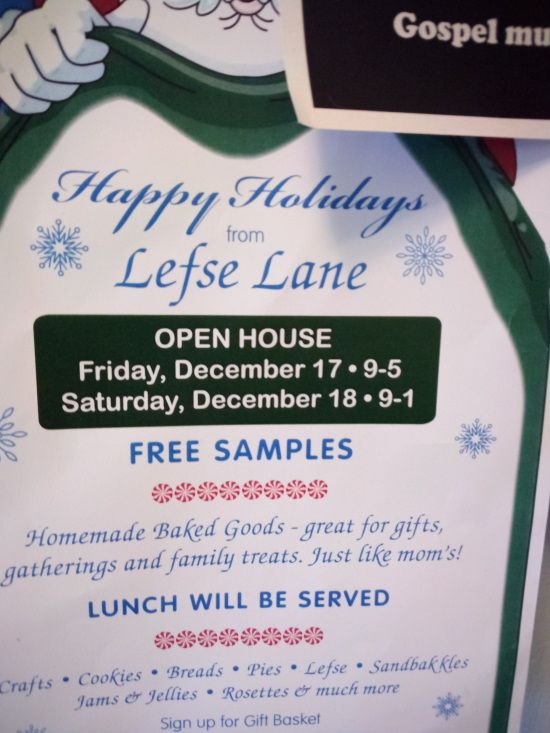
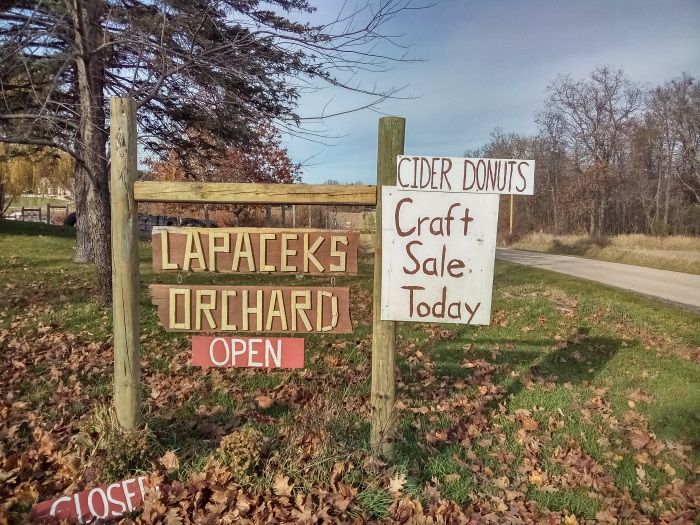
There were signs of the impending holidays when I was up north. Trailers stacked with Christmas trees were making their way to retailers as festive lights, wreaths, and other seasonal decorations were being mounted on light poles, hung on storefronts, etc. And I saw more than one notice such as this:


Lefse is a Norwegian flat bread made from potatoes while Sandbakkles are Norwegian (Swedish too?) almond butter cookies poplar at Christmas. I didn't look at the grocery store in Chetek for lefse but there are 3 brands of it at the supermarket I shop at here in Madison that are available year-round.

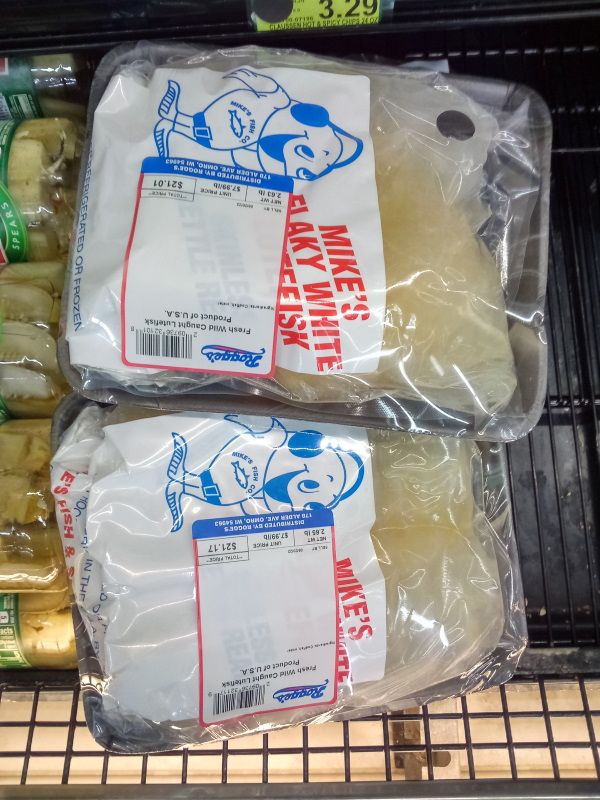
The impending holidays also mean that lutefisk starts appearing at the supermarket.


Lutefisk is a Norwegian delicacy(?! - ed.) made from dried whitefish that is then pickled in lye. After a rehydrating soak, it is thoroughly rinsed and then gently heated and served drowning in butter, from my experience. It's a Christmas "treat", if fish pickled in lye can be so described, and seems to be more popular with the older set. I am unsure if this is because people become more enamored of tradition as they grow older or that they lose their sense of taste as they age. Lutheran churches and Sons of Norway lodges across Wisconsin have lutefisk dinners come the holiday season. Well, they did before Covid struck.

Personally, I am happy with a ham or turkey for Christmas dinner.

********

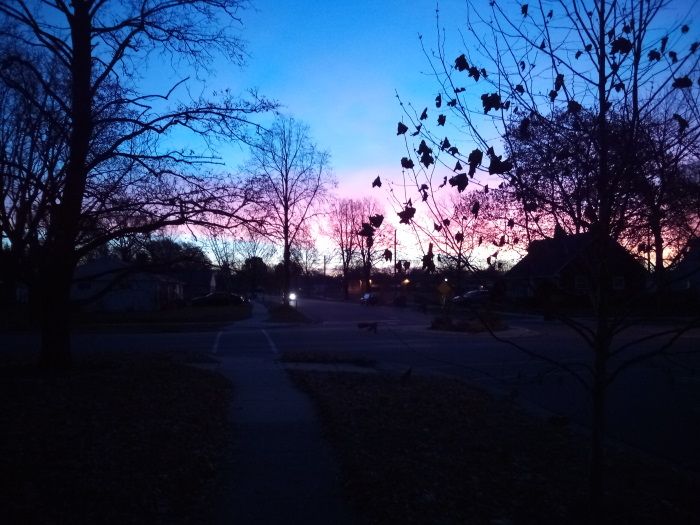
With my vacation over, it was back to the proverbial salt mines. The air had turned decidedly chillier so I started to bundle up a bit more for my treks to the bus stop. I don't mind the nip in the November air and there were some very pretty sunrises to greet me as I stepped out the door for my walk. Late autumn has a distinct smell to it. With the greenery gone and the humidity low, the air takes on a thin, almost minty scent as crisp breezes nibble at your cheeks. This is occasionally interrupted by the smell of a neighbor's fireplace or stove hard at work which makes me quite envious of people who can indulge their atavistic desires and safely watch flames from the comfort of their couch.


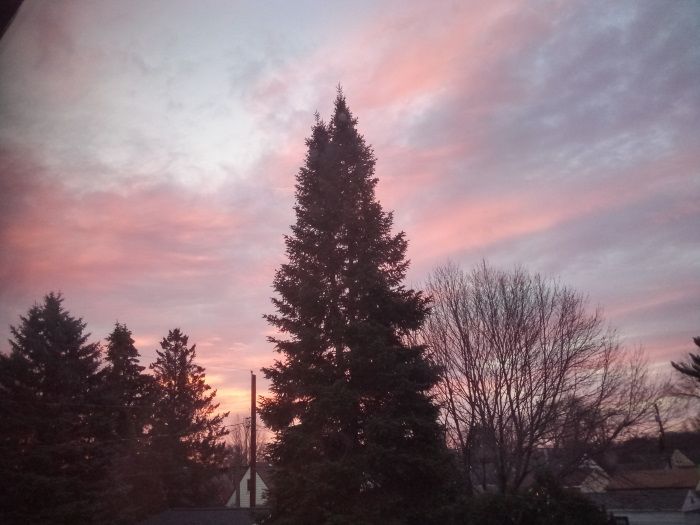
And on those days when I worked from home, I got to see the dawn from my seat upstairs. The window by my desk faces south and, with the sun rising in the southeast this time of year, I was treated to some wonderful views at Prime when monks all around Madison were praying in an easterly direction.

********

You may recall from an entry or 2 back that I bought a head of cabbage from a produce stand up north. With the weather turning colder, my stomach desires heartier fare. Isn't that the case for everyone? I suspect that the heavier foods of winter are more about feeling full and thusly having a good excuse to lie on the couch instead of going outside rather than actually being a bulwark against the cold. Regardless, I decided to make Polish cabbage rolls - Gołąbki - with the cabbage. If the Russian restaurants I've been to are any indication, then it would seem that all Slavic/Eastern European peoples stuff cabbage leaves in one fashion or another.

Shortly after making my intentions known to my Frau, she texted me a recipe for Gołąbki soup that promised all the flavor of Gołąbki with much less work. She continued her internet searches and found one for her beloved instant pot. It turned out very well. Very well, indeed.


Truth be known, it was more of a stew than a soup but was very tasty regardless of your gastronomic taxonomy. And it really did taste like well-sauced cabbage rolls.

********

One November weekend, my Frau, a friend of hers, and I headed out to our favorite orchard, Lapacek's, which is 20ish miles north of us in rural Poynette, for their holiday craft fair. Poynette is famous** for having originally been called Pauquette. Apparently someone had dreadful handwriting back in 1850 because an application for the Pauquette post office was misread as "Poynette" and the name stuck. Or rather, residents were stuck with the name.


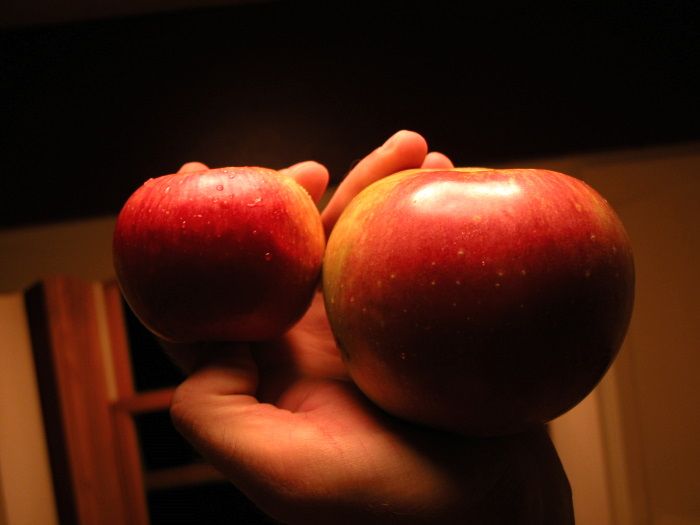
We first went to Lapacek's in 2007, if memory serves, when I heard tell of their Wolf River apples which were supposedly so large, that you needed only one of them per pie. This sounded like some kind of P.T. Barnum-esque chicanery so I simply had to investigate this extraordinary claim. Treks out there became a yearly ritual for us. Sadly, they pulled up stakes and moved to a new spot several years ago and I don't believe they have any Wolf River apple trees these days. Still, come August and September, we always have a surfeit of apples in the kitchen and plenty of pomaceous goodness on our plates.


Well, the one apple per pie claim turned out to be true. (That's a Cortland on the left, I think.) These apples were genuinely huge. They originated in the late 19th century up in northern Wisconsin and were bred by someone who lived in the town of Wolf River.

The Frau and her friend perused the crafts while I contemplated the foodstuffs. Doughnuts are more my thing, you see, although there were some candles that tempted me. At checkout, we said hi to Kim who is the leading craftsperson in the Lapacek enterprise. We chatted with her that first year we visited the orchard and I explained to her that we'd been lured by the promise of the Wolf River apples. Shortly after I blogged about them, Kim found the post and made the connection. And so we've been the Wolf River apple couple to her ever since.

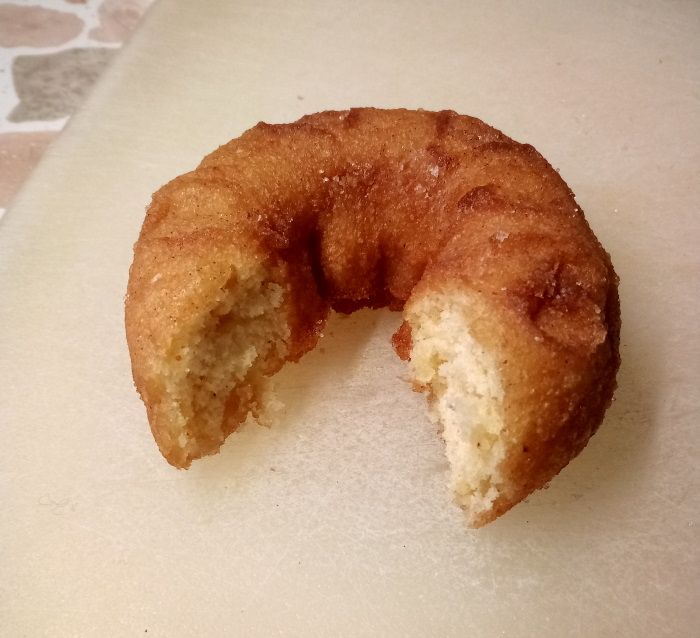
I look forward to their apple cider doughnuts every autumn and they certainly didn't disappoint this time around.


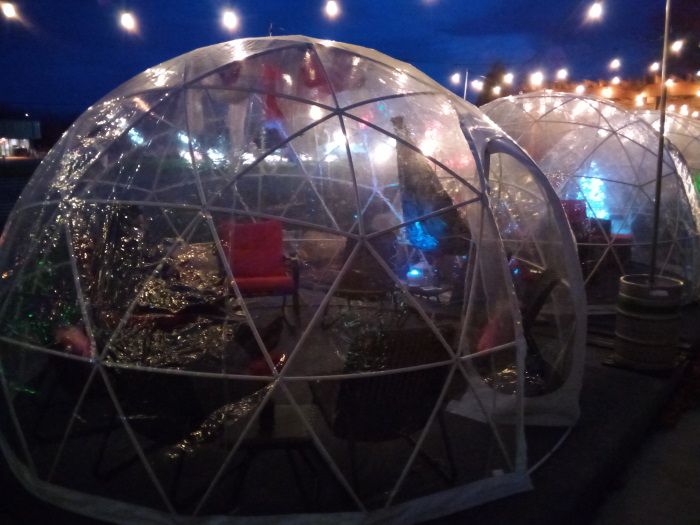
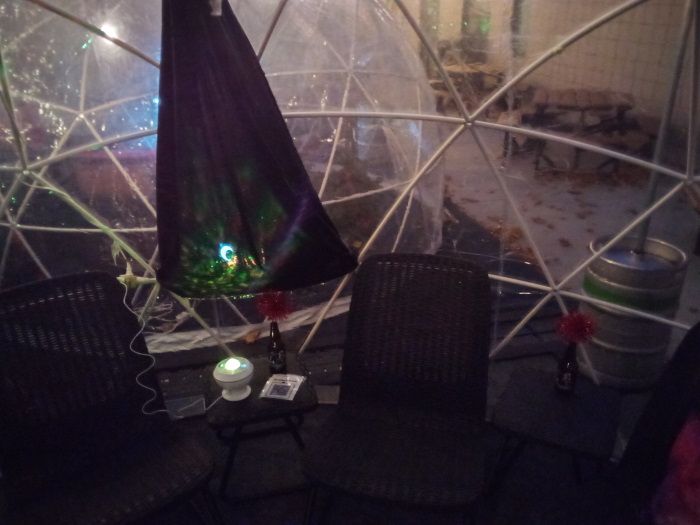
That evening we were invited out to a local brewery, Karben4, with some of the Frau's friends to hang out in one of their Covid protection dome thingies. It's for those who don't want to risk going maskless in their taproom with the hoi polloi. (Full disclosure: one of the Frau's friends won a 2-hour stint in the dome.) At first, I had flashbacks to Bio-Dome and was unsure about this whole endeavor. But, with no Pauly Shore in sight, I soon came to believe that R. Buckminster Fuller would no doubt be proud to see folks hanging out in geodesic domes drinking finely crafted beer.


There were 8 chairs, a space heater, a few small tables, and a ceiling light projector to add some psychedelic mood lighting. I guess each dome has a theme and ours was space. Thusly there were little astronaut figures hanging here and there from the lattice work.

While it was certainly a chilly night, we stayed rather warm. I suppose the beer helped in that regard. My favorite was the Oaktober Ale. It's a bit like an Oktoberfest lager - but an ale. And it's aged on oak to boot. The woody flavor is subtle but extremely tasty.


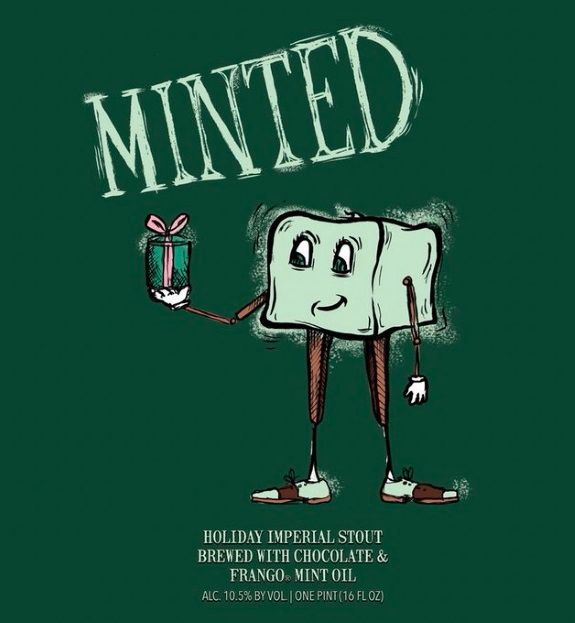
Speaking of beer, I have heard that a Chicago brewery, Hop Butcher, is making a special holiday brew this year:


Yes, it's a stout brewed with Frango Mint oil. This will no doubt bring back lots of memories for many Chicagoans. Does Macy's sell Frango Mints or did the brand die along with Marshall Fields? When I heard of it, I thought of eating those mints and of all the good childhood memories of going downtown to look at the window displays at Christmastime.

Well, enough about food. I am making myself hungry and I have done more than eat and drink lately.

********

Back in college, I took a world literature course. One of the books we read was Matigari by Kenyan author Ngũgĩ wa Thiong'o. If I recall correctly, the story took place in the immediate aftermath of the Mau Mau Uprising. I knew nothing about Kenyan history then (and barely more now) but thoroughly enjoyed that book. I am not sure what it was about it that attracted me so. It was an intriguing story of revolution and how sometimes things don't go as planned. Change is complicated. Plus I enjoyed Ngũgĩ's writing style. It had a directness to it that I liked. In addition, there was lots of singing.

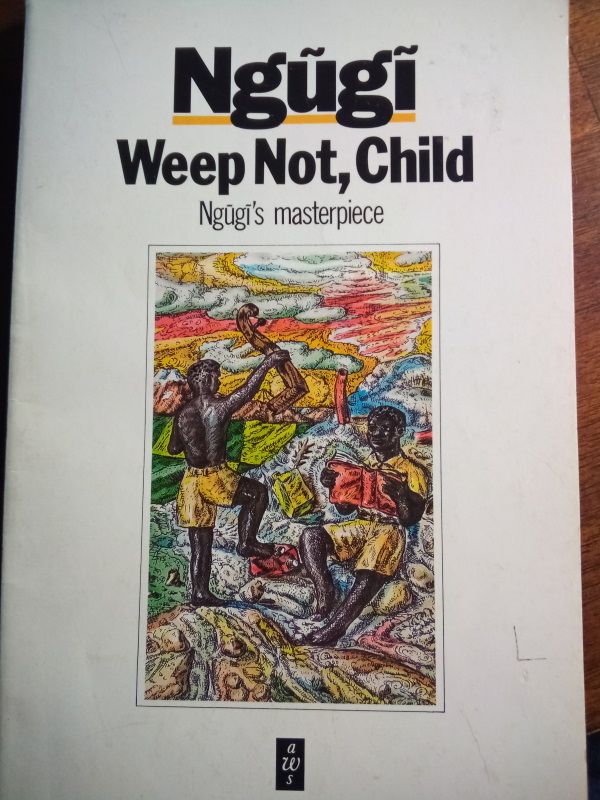
Anyway, I decided back then to read more by Ngũgĩ. Now, some 30 years later, I finally did so. I recently completed his debut novel, Weep Not, Child.


It was really good. This story takes place during the Mau Mau Uprising and deals with colonialism. Not just the awfulness of the British lording over the Kenyans, but also how that colonial mindset creeps into the minds of the oppressed. Family and the importance of land are other themes here. I probably missed quite a lot not knowing much about Kenya but Ngũgĩ's direct style lent the themes an emotional starkness that was riveting. Highly recommended!

********

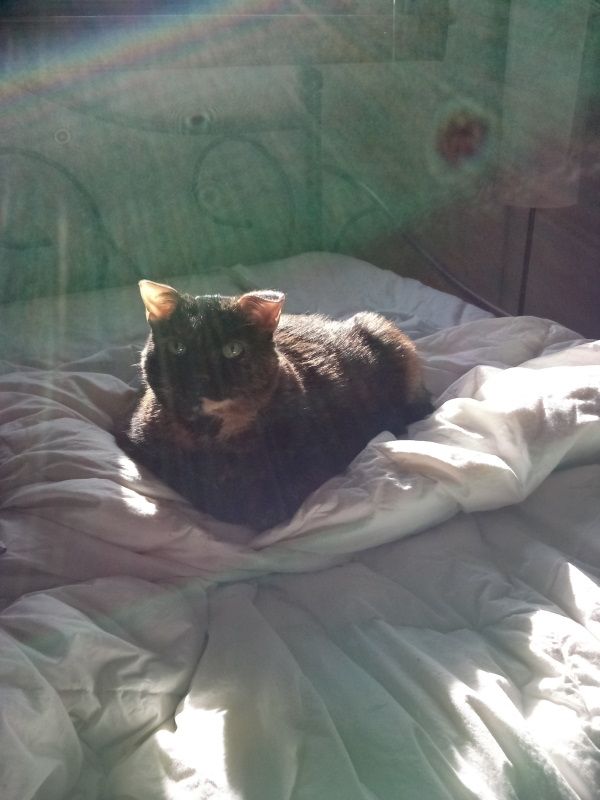
Bonus photo! We're back to Piper. I caught her on the guest bed recently enjoying the sun.


**Not really.

03 March, 2014

Riots in Stoughton, Minnesota Over Obama's Nominee for Ambassadorship to Norway

Norwegian-Americans in Stoughton and all over Minnesota are marching down the streets accompanied by Grieg on the hardanger fiddle, burning and pillaging as they go.

OK, not quite. Those Norwegians are a bit too mild-mannered to riot. But they are highly unamused by Obama's choice of George Tsunis for ambassador to Norway.

In Minnesota, home to the largest Norwegian population in the U.S., Norwegian organizations and public officials reacted with alarm to a series of bumbling answers and non-answers that George Tsunis, a Long Island businessman who raised $850,000 for the president’s reelection campaign, gave to the Senate Foreign Relations Committee in response to basic questions about the Nordic nation’s economy, culture and political system.

Tsunis, who has never been to Norway, blanked in response to a question from Sen. Ron Johnson, R-Wisconsin, about how to increase trade with the oil-rich Nordic nation. And when Sen. John McCain, R-Arizona, asked him what he thought about the anti-immigration Progress Party that is now a member of the governing coalition in parliament, Tsunis claimed that the party was a fringe element that the government had been “quick to denounce.”

Representatives of the Norwegian-American Chamber of Commerce and the Sons of Norway, both of which are based in Minneapolis, as well as Minnesota’s two U.S. Senators, Al Franken and Amy Klobucher, have voiced dismay at Tsunis’ apparent unfamiliarity with the nation in which he hopes to represent American interests.

And a stop by the Norwegian-American Genealogical Center on W. Main St. in Madison revealed no shortage of disappointment from the local Norwegian community to the perceived slight.

“It doesn’t sound like he knows anything about the culture,” said Solveig Quinney, the head librarian at the center, which keeps records on Norwegian immigration to the U.S. and holds classes on Norwegian culture. “He kept referring to the prime minister as ‘president.’”


Speaking of Norway, when is Pioneer going to open here in the States? And two co-workers of mine are considering starting a lefse wrap food cart. One mentioned meatballs so I asked what the difference between Norwegian and Swedish meatballs were thinking that perhaps one had more nutmeg or some juniper but instead he replied, "Norwegian ones are better." I have helpfully suggested that reindeer and lingonberry be added to the menu.

26 July, 2006

A Taste of Telemark

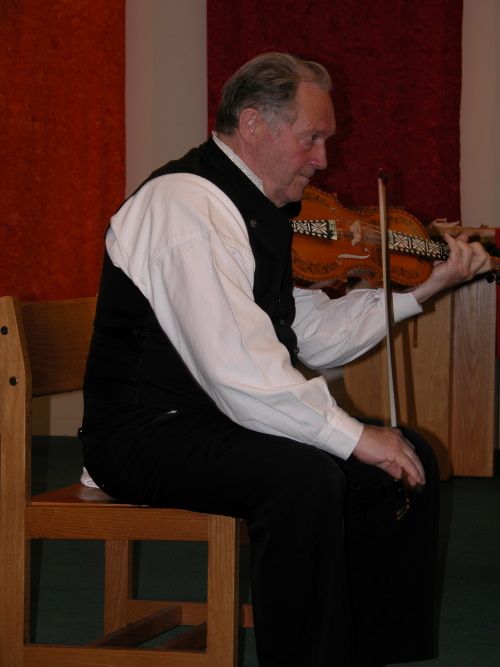
On Sunday night The Dulcinea and I took in some Nord musikk with a performance by Hauk Buen. Buen is a master of the Norwegian Hardanger fiddle. The Hardanger is a type of violin but has 8 or 9 strings. The melody is accompanied by a drone, which gives the Hardanger a very unique sound.


I admit ignorance when it comes to Nord musikk and Hauk Buen so let me quote from the Hardanger Fiddle Association of America:

Hauk Buen is regarded as one of the foremost Hardanger fiddle (hardingfele in Norwegian) players today in Norway.

Hauk was born in 1933 on the Buen farm in Jondalen. At that time the farm was in Telemark; the border has since changed and the farm is now in Buskerud county. He was surrounded by the music of Telemark all his life and comes from a family of outstanding Telemark folk musicians.

Hardanger fiddle tradition is to learn tunes in the style of a particular fiddler. Olav Løndal (1904-1986) marked Hauk’s playing style forever. Through Olav Løndal, Hauk became the particular bearer of the tradition of Lars Fykerud (1860-1902) and Svein Løndal (1864-1949). Hauk early on also came in contact with Rikard Gøytil in Rauland who gave him the original tradition of Myllarguten, transmitted through Tarjei Skinan, the grandson of the master. Through Hauk, the tunes of Myllarguten are known and learned by fiddlers today.


Last night's program was a tribute, of sorts, to Lars Fykerud who is mentioned above. Because of my ignorance, I really can't tell you much about how the songs displayed the hallmarks of Fykerud. What I can say is that I enjoyed the show very, very much. It was my introduction to the Hardanger as well as to traditional Norwegian dancing.

Buen sat in a chair for the performance and next to him was Andrea Een, a music professor at St. Olaf College in Northfield, MN. St. Olaf is the only place in the States where you can learn to play the Hardanger for credit. Since Buen did not speak any English, Een translated his introductions to the songs for the audience. There were, however, a smattering of folks who spoke Norwegian as, when he would smile at something he'd said, certain members of the audience would laugh along with him. No doubt something was lost in translation.

The introductions to the pieces varied quite a bit. For a couple, he talked briefly about the life of Lars Fykerud. Fykerud was a popular musician at the end of the 19th century and, odd as it seems now, was tremendously so here in the United States. He played many a concert here in the Madison area a little over a century ago and I presume that he made his way to Stoughton on most of those trips. Buen also commented on the origins of the songs themselves. I can't recall everything but I do remember him saying how a dream inspired one of the pieces he played. In addition, he would comment on the place of origin of a particular song, whether it be Telemark or another region. I recall Telemark well because of the Telemark Lodge up nort, near Cable, Wisconsin. I have to admit that, when he struck his first notes, a shiver ran down my spine. There's just something about folk culture with which I am unfamiliar - my introduction to it can sort of be overwhelming. I'm not sure what it is, exactly. Maybe it's being able to share in something that obviously means so much to those around me who are offering.

The last song of the first set involved the dancers accompanying him. There was Karin Brennesvik:


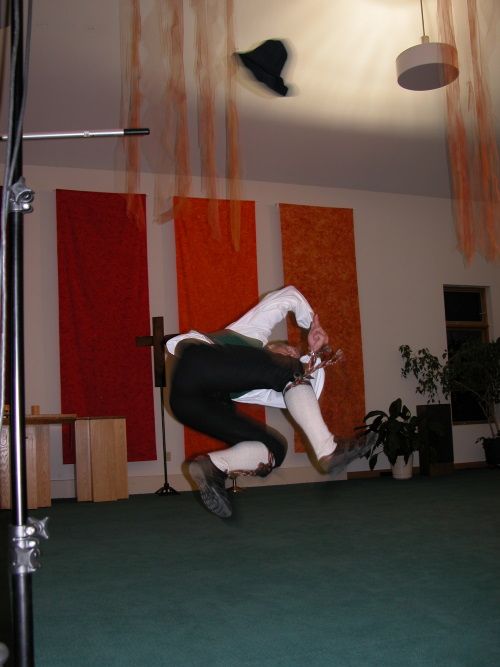
And Sigbjørn Rua:


Rua began learning the dance at the age of 7 and Brennesvik was his teacher. As you can see, they were decked out in traditional Norwegian garb. While some would say that I'm haberasherily-challenged, I want to say that Buen's vest and shirt with the funky collar and poofy sleeves was really neat. After a brief intermission, the show resumed.

As Buen played, Brennesvik stood on a chair and held out a pole which had a hat dangling from the end. Rua would dance in a circle a few times and then do a flip and kick the hat off of the pole. He missed the first time but nailed it on the second.

When the dancers were introduced, it was remarked that Brennesvik comes from a family who danced constantly. Every family gathering involved dancing - from birthdays to funerals and all holidays in between. I can't help but get a weird feeling when watching traditional dance such as I saw last night. It is just so unlike the dancing that permeates our mass culture today. There was the lack of eroticism, the difference in age between the dancers, the costumes - just the whole ball of wax.