Showing posts with label Kellerbier. Show all posts

12 June, 2025

Late spring brews

As the weather has gotten warmer, my beer choices have gotten heller.

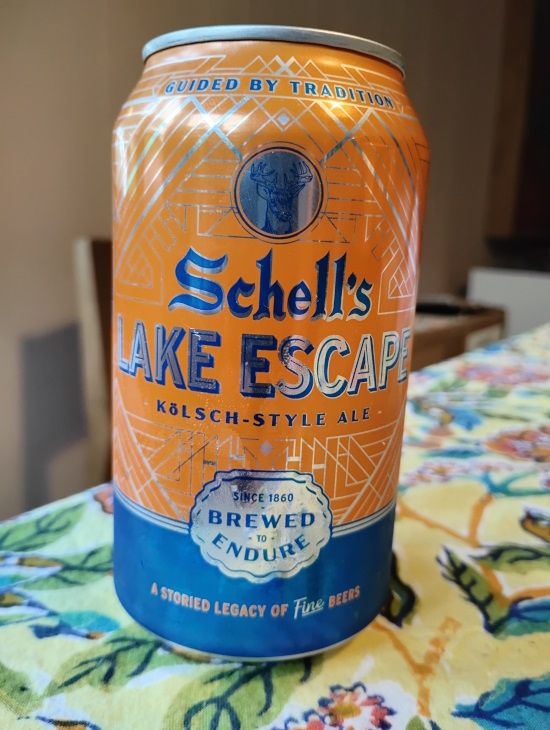
It's been a long time since I've had Schell's. It seems like there are only a couple varieties on shelves here in Madison these days, unfortunately. But I'll take what I can get.

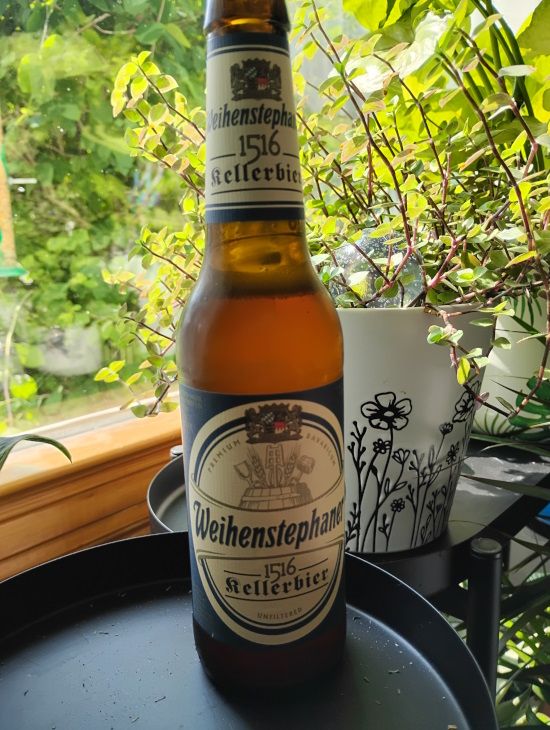
The folks at Weihenstephaner must decoct this stuff 3 or 4 times because it is Maillard Himmel. Simply delicious! I can only image how much more tasty it must be fresh from the Keller. 

10 August, 2022

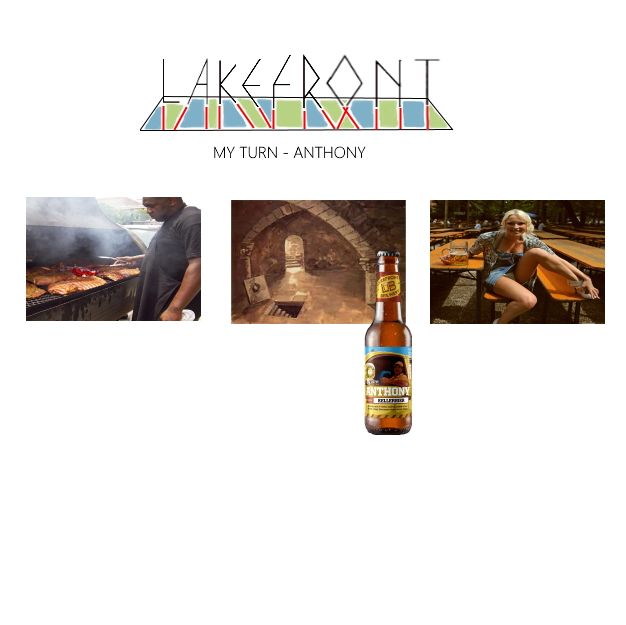
The Grand Parade of Shipping and Packaging: My Turn - Anthony by Lakefront Brewery

I don’t know who this Anthony fellow is, but I like the cut of his jib.

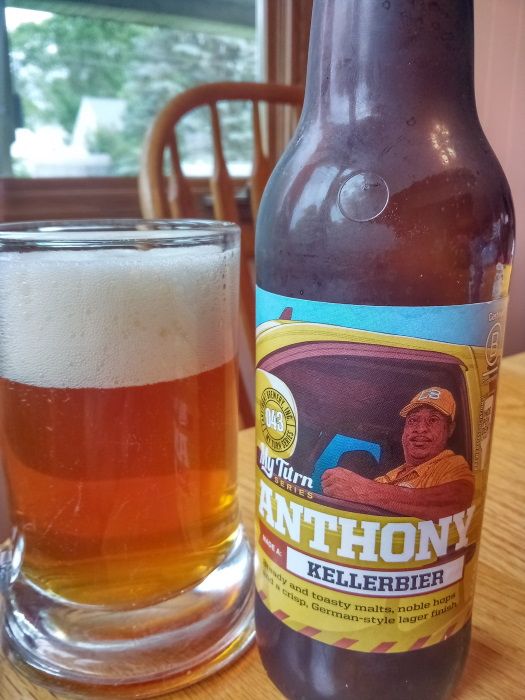
Wait. I do know who this Anthony fellow is because it says right here on the six-pack carrier: he’s a Shipping and Packing Technician. At Lakefront Brewery in Milwaukee, that is. Anthony chose a Kellerbier for the 43rd iteration of My Turn, Lakefront’s series of beers with the styles selected by employees. If I lived in Milwaukee, I would get a job there and then start using those Mission: Impossible masks to impersonate my co-workers so that every My Turn brew would be a Rauchbier. As it is, though, I can’t really complain about a Kellerbier.

Not long after trying their new Kölsch, Bierzeit, I discovered that Lakefront now had a Kellerbier on offer. It was a welcome 1-2 punch of German-style lagerbiers. I think that the Kellerbier is fairly obscure in its homeland and is even more so here in the U.S., although a few years ago it seemed that the Keller Pils was poised to go from being completely unknown to just mostly unknown with a few breweries offering the style. Summit kept brewing the stuff even after the pico-trend had passed but it too is now gone. But, with new IPA variants in demand, surely a Keller IPA is on the horizon. (Maybe even a Keller Cold IPA.) Heck, most breweries wouldn’t have to do anything beyond tweaking labels and ad copy.

These days Weihenstephaner 1516 Kellerbier is not totally impossible to find while I don’t know of any domestic Kellerbiers to be found in Madison area beer coolers. Well, none that aren’t Anthony.

To the best of my knowledge, Kellerbier is simply beer that is unfiltered, usually a Helles or Märzen or, at least, something in that ballpark. The word means “cellar beer” and I think it refers to the beer being served right from the lagering cellar, i.e. – no intermediate filtering anything. I also read here that, traditionally, the cask that the beer is aged in has the bung left unplugged so Kellerbier has very little fizz.

The packaging includes the rather telic description “a German-style lager meant for summertime biergarten enjoyment.” Truth be known, I performed my thorough and highly scientific testing in my dining room and not at a biergarten. However, if someone from The Biergarten at Olbrich Park is reading this, please know that having Anthony on tap at your fine establishment would be most agreeable.


Anthony’s Kellerbier is a gold-tinged amber hue. There was the requisite haze beneath a nice, frothy head of off-white foam that had staying power. Bubbles could be seen inside. Apparently this Kellerbier was not lagered with an open bung. Or fizz got added later, perhaps. The aroma was a wonderful mix of grassy hops and bready malt with a touch of honey thrown in.

The first sip was heavenly as my tongue was caressed by delectable waves of malty goodness that tasted like bread that had been lightly toasted. A good fizz lurked underneath which helped make the beer’s medium body seem a bit lighter. In addition to bread, there was a little honey and some spicy hop flavors that kept things in balance.

On the finish, some of that luscious malt flavor lingers for short spell before ceding to a moderately spicy hop taste that adds healthy doses of bitterness and dryness.

I can certainly imagine this beer would be a fine companion down at the Biergarten. The fizz seems to be non-traditional feature here but with the great bready flavor, it is but a minor glitch.

Junk food pairing: The packaging says Anthony loves to cook BBQ so sit out on your porch or deck for that faux-Biergarten feel and serve Jay’s Barbecue potato chips with his Kellerbier.

08 April, 2017

Welcome To St. Louis, Son: Noble Lager by Schlafly Beer


A friend of mine who swears that Pappy's Smokehouse in St. Louis has the best ribs and pulled pork in the known universe had been talking about making a trek south to enjoy some of their admittedly very fine ribs and whatever other meat trips his trigger that day. Well, that day happened a few weeks ago.

As I discovered less than a mile from Pappy's lies The Schlafly Tap Room. And it was our first stop after we rolled into town. My experience with the brewery's beer is not extensive which is probably due to a combination of my parochial tastes and the limited selection of their brews I am presented with at the bottle shops I frequent in Chicagoland. Amongst the brews I sampled was their hefeweizen which was excellent. It featured fine phenolic banana with a touch of estery clove – just the way I like it. A light body and a citrusy edge made it perfect for a nice sunny day.

Upon returning home I was reminded that I had started a review of their Noble Lager but had never finished it. And so I thought it was the right time to do so.

Noble Lager is a late summer seasonal and I found some in Chicago last autumn. Schlafly bills it as a "traditional lager" without saying whose traditions in which it was steeped. The ingredients are all European or European varieties but it's not being sold as a Helles. An American lager with European ingredients, perhaps?

The beer was a medium yellow hue and, curiously enough, hazy. Not muddled like the new trend in eyepahs – just a tad cloudy. (May St. Gambrinus save us from totally turbid lagers!) I managed only a small head on my pour which was loose and white and lasted about an average time while inside was a surfeit of bubbles. While clarity would have perhaps made for a prettier beer, it still looked good to me.

My notes indicate that the aroma was "awesome!". This was mainly due to a wonderful bready scent that was accompanied by a tad of malty sweetness. Although moderate, the hops greeted my nose with a fantastic mix of grass and floral scents. I presume the latter came from Lublin hops which are commonly thought to be a Polish variety but in fact are Czech. (They are, however, apparently quite popular in Poland.)

If the label "traditional lager" had me worried that this was going to be what I see called an "American pale lager" – often times a moniker for micros that are macro+ - then my fears were dispelled quickly because Noble Lager tasted like a Zwickel/Kellerbier. The heavenly trifecta of biscuit, bread, and yeast were like manna to my tongue. A bit of honeyed sweetness followed before those Noble hops imparted a nice grassiness. Just enough to add balance along with a firm fizziness.

The finish was a bit surprising. As the malt faded a bold spicy hop taste took over. Think black pepper. This made things fairly dry and bitter and gave a nice crisp snap to the finale. My glass had Schaumhaftvermoegen everywhere and thick webs of it too. It was a beauty, eh.

Whatever a "traditional lager" is, count me in because this is a fantastic beer. It was as if a melanoidin bomb went off in the kettle triggering countless Maillard reactions to give Noble Lager its great toasty-bready aroma and flavor. And the yeast was a bonus. I wish some of that floral scent has been in the taste but that's a minor quibble. The Saaz-like finish was a lovely surprise and added a nice contrast to the clean bready flavor. I'd love a return trip to Schlafly to taste this stuff fresh from the teat.

Junk food pairing: Pair Noble Lager with a heaping plate of potato chips topped with melted Provel.

07 August, 2016

Lager! Lager! Erik Jensen Shed His Grace on Thee: Sea to Sea Lager by Green Flash Brewing Company


While it would be madness for me to say that the zwickel/kellerbier is a trend in microbrewing, I have run across a trio of them this summer courtesy of New Glarus, Weihenstephan, and Summit. A picotrend, perhaps? An unfiltered pale lager, I am quite partial to the style and its Maillard reacted malt goodness which gives a wonderful yeasty bread flavor.

San Diego's Green Flash Brewing is well-known for its eyepahs and so I did a double and almost triple take when I saw Sea to Sea Lager, a zwickel, from them in the cooler of a local purveyor of fine brews. Not only was I amazed that they had a lager on offer, I was also surprised that it wasn't an eyepah masquerading as a pilsner.

Truth be told, I've never had a Green Flash beer before. I see their bottles on the shelf and am under the distinct impression they simply want to pummel me with hops all day, every day. Ergo I avoid their brews. Could an eyepah brewery brew a good zwickel with its emphasis on gentle malt flavor instead of a West Coast wave of fruits and pine? I was suspicious at first that they had merely brewed an India Pale Zwickel, all of the tasty toasty malt flavor having been washed away by a cascade of citrus. My fears were allayed when I saw the words "Hallertau Mittelfreüh and Czech Saaz" emblazoned on the side of a can.

The name of the brew comes from the fact that Green Flash will soon be opening a brewery in Virginia and will then have facilities on either coast.

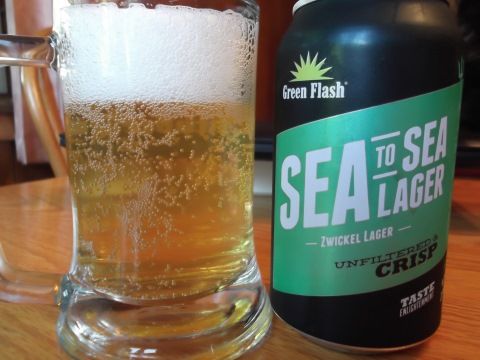
Sea to Sea pours a nice darkish straw color that borders on yellow. It has a slight haziness to it. A big, frothy, white head adorned my glass for a minute or so. It was rather an effervescent brew with lots of bubbles inside.

I smelled a bit of cracker as well as a fairly faint bit of pepper which I presume came from the Saaz hops. But the primary scent was a more grassy dose of hops that was a bit like hay. All in all, the bier had a fresh, pungent smell about it.

The taste was similar but, if I may channel John Madden for a moment, different. The malt, which was like restrained cracker on the nose, was transformed into a fuller flavor. "Biscuity" is a fair descriptor. However, the hops haven't faded into the background. There a nice grassy/herbal taste with perhaps a touch of citrus which surely the Hallertau Mittelfreüh and the Saaz have, in the immortal words of Emeril Lagasse, kicked it up a notch with an even spicier and more pungent flavor.

Unsurprisingly, the Saaz shine on the finish. The malt fades and a sharp pepper flavor is ushered in that is vaguely redolent of mint and it brings the dryness with it. (You hear me?! Dryness comes with it!) Don't get me wrong, we're not talking Bohemian pilsener levels of Saaz hoppiness here but a fair amount nonetheless. There was a goodly amount of Schaumhaftvermoegen with a some thick streaks of foam lining my glass.

I needn't have worried about Green Flash's ability to brew a lager because Sea to Sea was quite tasty. It had a good, clean lager taste with plenty of malt goodness. While I tend towards something a little more like bread, I really cannot complain here. And I loved the grassy hop flavor here. It was fresh and piquant and every bit as toothsome as trendier hops that taste like passion fruit. With its light body and sessionable 4% A.B.V., Sea to Sea is a great brew for these dog days of summer.

Junk food pairing: Try lighter fair such as Lay's Brazilian Picanha chips with their pungent simulacrum of chimichurri sauce or some White Cheddar Cheetos Puffs.

20 July, 2016

Out of the Keller: Keller Pils by Summit Brewing Company


While Surly over in Minneapolis is perhaps the trendiest brewery in the Twin Cities, Summit Brewing in neighboring St. Paul is the stalwart veteran of the scene. Having been formed in 1986 the brewery is celebrating its 30th anniversary this year with a quartet of special beers. The first, a double eyepah, was released late last winter. Then, just before the heat of summer, they unleashed Keller Pils, an unfiltered German-style pils.

Despite my perception of them being the unfashionable old-timer of the Twin Cities (though not as old as fellow Minnesotans August Schell which is 155+ years old), I just looked them up and Summit brews somewhere on the order of 120,000-130,000 barrels a year so someone is drinking their brews. It's just not usually me, I guess.

It's not that I'm anti-Summit. I suppose it's because stores tend to display their Sága Eyepah most prominently and then there's another eyepah and another and I then begin to get eyepah fatigue and my eyes wander to the Schell section. The truth is that they brew a fine pilsener and it's on store shelves year round. My parochial taste in beer no doubt also plays a role. Their year-round line-up looks to be mostly pale ales and so I tend to turn away. Finally there's Summit's Maibock and Oktoberfest. While I enjoy both, they tend to get lost in a sea of such beers every spring and autumn.

That I have failed to adequately support this neighbor to the west in the past is beyond a doubt. In my defense, however, I did purchase a six pack of their anniversary Keller Pils last weekend and have gone a long way towards guilt tripping myself with my writing thus far.

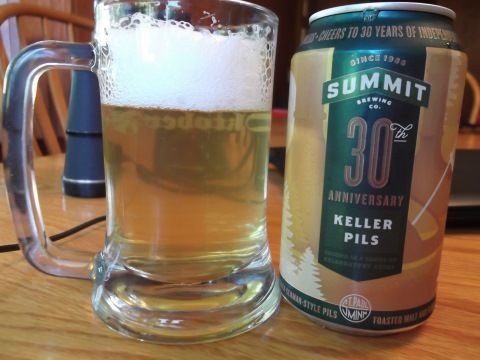
Keller Pils pours a hazy straw color. This being an anniversary brew, it put its best foot forward with a large, fluffy yet firm, white head that remained for quite a while until I greedily slurped it down. The bier was highly effervescent with bubbles aplenty inside going upwards.

"Keller" is German for cellar and implies a couple things to me. First is that the bier is unfiltered which I saw with the haze. But I also associate keller biers with freshness. It's fresh from the lager tanks downstairs. So fresh, the brewery didn't even bother to filter it. My can of Keller Pils had "10/10/16" printed on the bottom. Do they give consumers six months to quaff it?

Regardless of the fact that the bier in my glass was not pumped fresh from Summit's lagering tanks promptly upon hitting peak tastiness, it did have a really nice, pungent hop aroma that was floral and herbal just like spring itself when the flora once again comes to life. I can just imagine how it would have smelled earlier in the year. There was also a great cracker graininess here too.

Summit states that their Pilsener is brewed using a decoction mash and although I don't know if the process was utilized in brewing Keller Pils, it has those wonderfully rich malty flavors associated with decoction mashing. The bier is awash in seas of biscuit, toasted grain, and yeasty bread. The hops are no slouches either with a herbal taste above a floral one like I smelled earlier. Summit declares Keller Pils to be a German pilsner. And so while the hops give a fairly strong taste they are not as assertive as the Saaz you'd find in a Czech pilsener. Bitterness was moderate.

Keller Pils finishes with a spicy, almost minty, hop flavor overtaking the melanoidin maltiness. The bitterness is bumped up a couple notches making for a dry conclusion.

Decoction or not, Keller Pils is chock full of wonderful toasted grain and bread flavors and being a nice, clean lager, they really shine. A light body and a healthy level of carbonation means the bier isn't cloying and instead has a fairly bracing crispness. The hops are wonderful as well and I just love the floral freshness. But the greens aren't overpowering.

For anyone keen on taxonomic correctness, I'd bet that Keller Pils should lose the "Pils" and be happy being a kellerbier. I mean, can a pils not be clear? Regardless, Keller Pils ist ausgezeichnet!

Junk food pairing: As long as you're drinking bier from St. Paul, you should pair it with junk food from St. Paul. While quaffing your Keller Pils, snack on some Old Dutch Ripples Onion Blossom potato chips.

03 April, 2016

Decoction Madness: Zwickel and 1516 by New Glarus Brewing and Weihenstephan


It's like I died went to heaven this spring. The good news came like a 1-2 punch. First came the left jab that the venerable Bavarian brewery Weihenstephan had brewed a limited edition kellerbier called 1516 in honor of the 500th anniversary of the Reinheitsgebot and that it would receive U.S. distribution. This was quickly followed by the right hook of New Glarus resurrecting Zwickel with a new formula (when was the last time it was brewed?) and in limited quantities.

Personally, I think kellerbiers/zwickels should be produced in mass quantities and widely distributed, displacing IPAs from taps across the globe. But, sadly, I am in a minority on this issue. So I'll take what I can get. I really enjoy because, in my (limited) experience, they have that wonderful malt flavor that combines fresh and lightly toasted bread. It's that Maillard reactiony/melanoidin taste that German brewers seem to make with ease while American brewers often struggle to create or don't even try to. I think the contrast is most stark with Oktoberfests. German varieties are usually very bready while American ones often have a lot of sweetness.

I've heard two opposing explanations for why German biers have more of that bready flavor. First is that German brewers use decoction mashing. This involves taking part of the wort (the grain-water mixture), boiling it, and then returning it from whence it came. I'm not sure how this is supposed to produce the desired flavors; just some kind of latent heat voodoo, I guess. The opposing view is that German brewers use different malts than American brewers.

Personally I am agnostic on this issue. All I know is that A) I love the Maillard reactiony/melanoidin taste and that B) German biers have it more often and in greater quantities than American beers.

I have undertaken a completely half-assed amateur investigation into zwickels and kellerbiers and it has revealed that they are, for all intents and purposes, the same style. Unfortunately, my inquiry never took me to Germany so I wouldn't be at all surprised if there are slight variations in practice such as one being a bit hoppier than the other or more carbonated.

Kellerbier means "cellar beer" while a zwickel is a sampling valve on a cask and each is an unfiltered lager. They're pale, turbid, and have a solid malty base along with generous helping of hops. That's my take, anyway.

Weihenstephan claims to be the oldest brewery in the world with records showing a brewery having been licensed on its site in 1040. New Glarus Brewing, meanwhile, was founded slightly more recently in 1993 in the eponymous Wisconsin town just south of here. Its brewmaster, Dan Carey, served as an apprentice brewer in Bavaria and is no stranger to German bier.

Each brew has some novelty in its hop selection. 1516 features Hallertauer Record hops, an heirloom variety that appears to be hanging on by a thread. Only 1 hectare was grown last year - that's about 2.5 acres or, as my calculator helpfully informs me, .92 soccer fields. What do Hallertauer Record hops taste like? I dunno. Zwickel features not only German and Czech hops, but also French ones. I've encountered the French Strisselspalt hop on a couple of occasions but am unsure if that is what was used here. The label notes it was brewed with six hop additions and warns drinkers that it is "assertively hoppy". In addition, pursuant to my blathering above on decoction, Zwickel's label also says that it was brewed using a decoction mash.

Zwickel poured a burnished yellow and was clear. 1516 was a little bit darker and appeared light gold in the center of the glass although it was much lighter at the narrower bottom. Unlike the its cousin, 1516 was a touch turbid. Both biers ended up with creamy, white heads that lasted what I consider to be an average amount of time – about 30 seconds. While both biers had bubbles inside, 1516 was noticeably more effervescent.

Beginning with the home team again, Zwickel smelled of bread along with a fresh, zesty hop aroma that was grassy and spicy. 1516 had a similar smell but it was a richer, more yeasty kind of bread aroma and the hops were more like grass or hay without the spiciness. Oh mama! That smell, that bready smell. We were getting into Platonic ideal territory here.

1516 kept the melanoidin melody humming along with a big yeasty, bready taste that reminded me of walking into a bakery. As the bier warmed a touch just the slightest hint of malty sweetness crept in but mostly it was Maillard madness. The hops remained grassy tasting but highlighted with a bit of lemon or citrus. Some carbonation rounded things out with a little dryness. Zwickel's carbonation was more up front but I could taste that wonderful bready flavor. Not as strong as in 1516 but it was still delicious. There was also a little roasted grain taste as well. The German and/or Czech hops offered more fresh grassy goodness but I also caught some floral hop in there which I presumed to be from the French greens.

Both biers finished with lingering grain/bread flavors and a swelling of grassy/peppery hops which added both flavor and some dryness. Zwickel's carbonation was felt here too and it had a more pronounced hoppiness but I didn't feel it was assertive.

In each case my glass was left with some nice Schaumhaftvermoegen. Zwickel gave a few nice streaks along with numerous spots of foam while 1516 left a couple large patches along with several spots.

Ausgezeichnet! These are two great biers. Light in both body and color yet they each are full of flavor. While both had fantastic clean lager profiles, 1516 has more of that yeasty, fresh bread taste which I crave. And each had a goodly amount of hoppiness that fell somewhere between a German and a Czech pils, but it was Zwickel that had a broader and fresher hop palette which delivered on the Noble flavors but also added a little floral to the mix which I loved. I didn't find Carey's creation to be "assertively hopped" as the label admonished and it was certainly much hoppier than a helles, but, at the same time, this was not an IPZ. 1516 is 5.6% A.B.V. and I cannot find the alcohol content of Zwickel but it is surely 5-5.5%.

Dan Carey declares the zwickel to be his favorite bier style. I cannot be so confident as to label a single style as my favorite, but it is certainly a favorite. The zwickel/kellerbier has a wonderful simplicity to it. There is the delicate bready side which is like manna but the hops stand on their own instead of just adding a little balance as they do in a helles. The leafy greens are a distinct set of flavors to savor in addition to lending dryness and balance. This less-is-more ethos must surely make demands on the brewer. Bereft of any bursts of tropical fruit, with no time spent in a bourbon barrel, and no lacing with Lactobacillus, any mistakes or just the fickleness of the brewing gods will be evident in a kellerbier. To have two fine examples at once is a real treat indeed.

Each of these biers have limited availability. I bought my 1516 out at Steve's on Junction Road and was told there was not much left. Zwickel has been available exclusively at the brewery since the middle of last month. It is nearly $18/six-pack so savor each sip.

Junk food pairing: Complement the relative austerity of Zwickel and 1516 by pairing them with soft pretzels dipped in a mild cheese food product sauce.
27 December, 2015

Lilywhite Lager, She Gonna Lead You Right: White Lager by Schalfly Beer


My first encounter with a Schlafly beer was quite impressive. It was a very tasty Kölsch and gave me my first hint that there's more to St. Louis' beer scene than foreign conglomerates making watery garbage. In addition it demonstrated that Schlafly was adept at brewing Germany styles of bier. This autumn the brewery announced a new winter seasonal - White Lager(PDF) - a zwickelbier. The idea was to offer something lighter than the more typical winter fare of doppelbocks, imperials stouts, and the like.

The German zwickelbier, a.k.a. - kellerbier, is an unfiltered pale lager. I think of it as an unfiltered helles with more hops. "Keller" means cellar while a "zwickel" is a little valve on a fermentation tank used to sample the brew. The idea behind the style is that you are drinking very fresh bier from a fermentation tank still sitting in the cellar. Thusly drinking a zwickelbier from a bottle seems to be a bit contradictory to the premise behind the style. And so the treat here is the yeast that remains in the bier as opposed to the freshness. For the record, my White Lager has a date of 13 October 2015 on it. I purchased the six-pack in late November and had my tasting a couple weeks or so later in mid-December.


White Lager pours a dark yellow color. With the yeast not having been removed, the bier is hazy, though just slightly. My understanding is that while zwickelbiers and kellerbiers are essentially two words for the same bier, the zwickel usually has more carbonation. In this case I got a small white crown in my glass that dissipated quickly. However, inside the bier itself were many a bubble.

The aroma was equally fresh bread and grassy hops. Test batches of the brew contained orange peel but I didn't smell any citrus which leads me to believe that this ingredient was left out of the batch or batches that were bottled. While White Lager doesn't have the most complex aroma you'll ever wrap your nostrils around, the breadiness here was rich and inviting.

As it was in the taste. It had that wonderful melanoidin/Maillard reaction toasty bread goodness in spades as well as some yeasty dough flavor as well. I personally love the helles/zwickelbier/kellerbier because it's those toasted grain tastes that are most prominent. White Lager didn't rock the boat with malt sweetness being minimal. The hops were grassy to the tongue but took on a floral side as well which was quite tasty though there was little bitterness. Carbonation added a little dryness in lieu of bitterness.

As the malt fades on the finish, the hops come to the fore. They lose the floral notes and take on Noble spicy ones along with a liberal dose of bitterness making for a rather dry conclusion.

THIS. This was a very tasty bier. I applaud the paucity of sweetness which allows the clean toasted grain flavor to really shine. And it is these melanoidin/Maillard reaction flavors that I crave in bier. The hops give their all and manage to offer a nice balance. I appreciated how they changed through the tasting process taking on floral and spicy qualities at different stages. White Lager is 5.5% A.B.V. and has a rather light body so it's not going to warm you up this winter. On the other hand, I can certainly imagine it as being a crisp, refreshing drink for quaffing after snow shoveling or other outdoor activities.

Junk food pairing: I like potato chips with my zwickelbier. For a traditional take, try some kind of dill-flavored chips. But don't be fooled. White Lager can handle something a bit spicier such as Jay's Hot Stuff chips too.

23 August, 2015

This is not a kellerbier. I repeat, this is not a kellerbier: Zwickel by Urban Chestnut


I used to think that zwickel was just another name for kellerbier and the zwickel/kellerbier was simply helles that was unfiltered and unpasteurized. Now I believe this view to be wrong and am not really sure what a zwickel is. It seems that it's a light kellerbier, with a bit less alcohol and less hoppiness. Oh, it also features more carbonation because, unlike the kellerbier, the bung is firmly in place on the tanks so the precious carbon dioxide does not escape. It also seems that kellerbiers and zeickels are lagered for differing lengths of time but I cannot confirm this. Oh, and a kellerbier seems to be, in extreme shorthand, a hoppy, still Märzen. Which I guess means that the zwickel is, in extreme shorthand, an unfiltered, unpasteurized helles. It would seem that a trip to Franconia is in order to clarify matters.

Unfortunately I won't be stepping foot in Germany any time soon but luckily Urban Chestnut's brewmaster, Florian Kuplent, hails from Munich and began to learn his craft there. And I am also fortunate that he brews Zwickel.

Kuplent's zwickel pours a lovely deep yellow and has the requisite turbidity with all that tasty yeast still in there. This was quite an effervescent brew as I got a nice fluffy white head which was in no hurry to go anywhere. In addition there were lots of bubbles forming at the bottom of my glass only to make their way upwards.

The aroma was a little bit of heaven. It smelled like bread - full of yeasty, grainy goodness. There was also a note of spicy hoppiness from the Hallertau Perle und Mittelfrueh varieties. Zwickel tastes like fresh bread. There was a bit of mild doughy sweetness (which veered towards apricot as the beer warmed) but Zwickel had a lot more of that superior bread crust-melanoidin flavor. The yeast also added to the impression that one was drinking liquid bread. More beers ought to remain unfiltered, in my humble opinion. Finally, the plentiful carbonation lent a little dryness to this decidedly malt-focused brew.

There wasn't much to taste of hops until the finish where the Noble Hallertaus exerted some peppery bitterness and helped Zwickel finish on a dry note. My glass ended up with a couple moderately sized patches of Schaumhaftvermoegen.

While I can imagine that Zwickel tastes exceptional coming right from the tap at Urban Chestnut, St. Louis is much closer than Franconia and it still tasted fantastic to me. Just as hopheads are going ga-ga over Citra hops these days, I get my thrills with that bread crust kind of flavor that European malts seem to provide. And there's no shortage in Zwickel. At 5.2% A.B.V. it is perhaps a bit stronger than is traditional and the bready flavors are at the fore here but this is not a very hearty brew. It has a nice medium-light body, is not very sweet, and is bubbly making it quite suitable for warmer weather.

I'd love to taste Zwickel fresh down in St. Louis. I have friends who swear that Pappy's Smokehouse is the best BBQ on the planet and there's an Urban Chestnut outpost less than half a mile from Pappy's. But, since there's no trek to St. Louis in the near future…

Junk food pairing: Pair Zwickel with Pepper Jack Cheese Nut Thins. Both are relatively light fare but the chili makes for a nice contrast to the mellow, bready flavors of the beer.