Showing posts with label Potosi Brewery. Show all posts

24 February, 2021

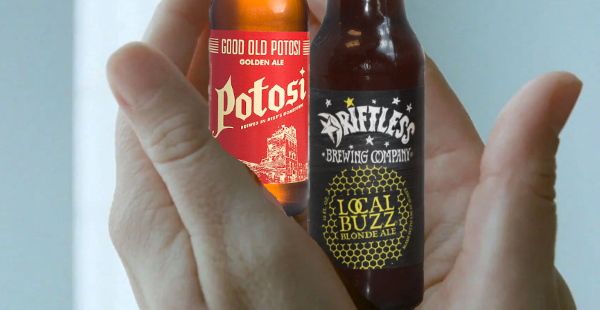
A Brace of Blondes: Local Buzz by Driftless Brewing Co. & Golden Ale by Potosi Brewing Co.


After tasting a golden ale from the Wisconsin brewing company that has "Hillsboro" in the name, I found myself in the mood for the style. Something tasty to drink after shoveling as opposed to a big, heady brew to fend off the cold. I proceeded to stumble across Potosi's Golden Ale and Local Buzz, a blonde ale made honey from Driftless Brewing Company. Both breweries are in Wisconsin's Driftless Area in the southwest part of the state. "Driftless Area" refers to how the region was left unscathed by glaciation during the last ice age and so we're left with a beautiful landscape full of valleys, ridges, and streams full of trout.

I recently had one of those heady brews from Potosi – their doppelbock – and have enjoyed their beers for years. Despite having been around since 2013, Driftless is still a newcomer to me. A couple months or so ago I had their Driftless Lager and was disappointed to find that it was an American pilsner/macro lager or whatever you call the style that is Miller, Bud, and Coors. Does this happen in any other sector of the food industry?

Microbrews emerged to some degree or another as a response to macrobrews, i.e. - Miller, Bud, and Coors. They were made (crafted, even!) in small batches with less or no automation and didn't cut corners with adjuncts. These beers had more flavor than Miller and associates. Microbrewers became craft brewers and changed the beer landscape in not only this country but worldwide. And now some of them are making the equivalent of High Life.

I went shopping yesterday and realized that coffee seems to have undergone a similar transformation, at least here in the States. It used to be that coffee was coffee. Packaging didn't tell you anything about how it was prepared. Juan Valdez did his magic behind the scenes and you just bought a tin of a ground brown powder. But Starbucks and small roasters have changed things so that Folgers now offers gourmet coffees. Folgers even now admits that you can roast beans to varying degrees instead of having just one generic product that is ground coffee.

Do small, independent coffee roasters offer bags just labeled "Coffee"? And when you go home and brew some, do you find it tastes just like Maxwell House or Sanka? Do "craft" coffee roasters try to mimic the mass-produced stuff their coffees exist in opposition to in the same way "craft" brewers brew Bud-like swill?

Huh. I had meant to discourse on the tastiness of a relatively simple un-barrel aged, non-double dry hopped blonde ale but ended up with a mini screed. Ooops. Let's get to the beers.
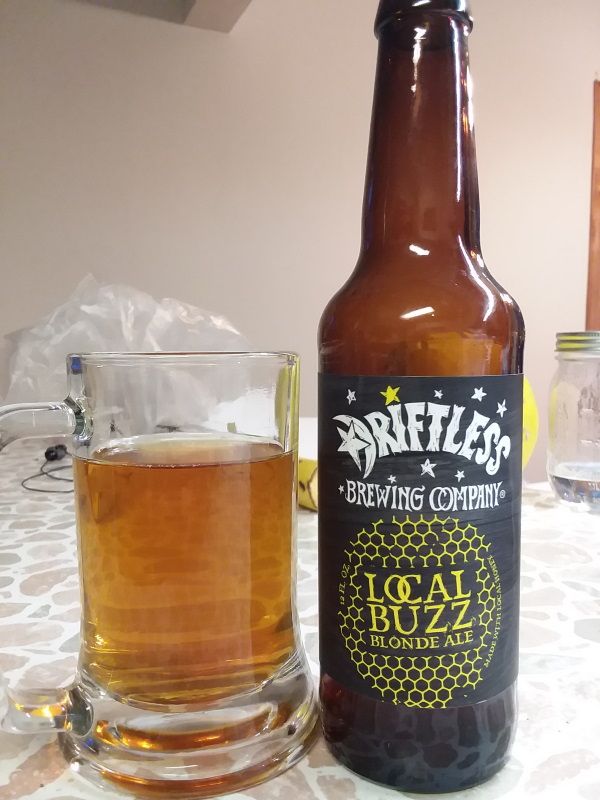

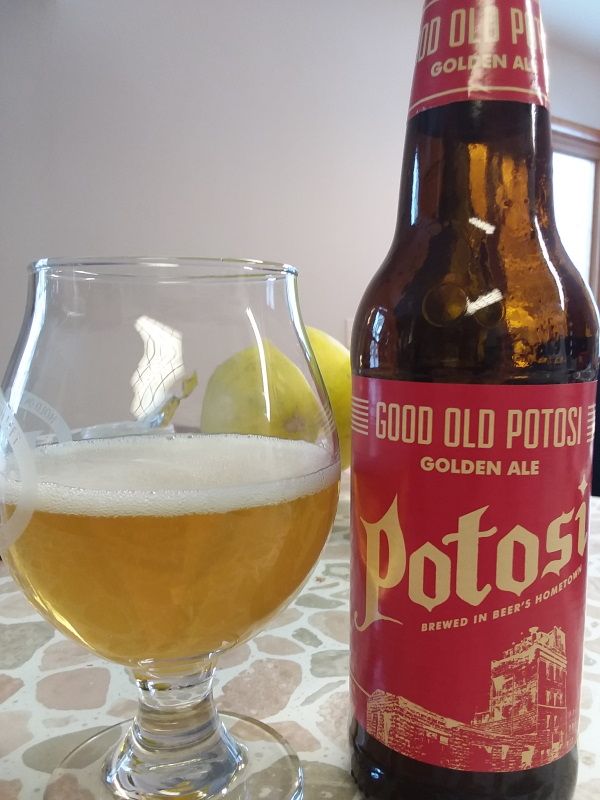
Driftless' Local Buzz describes itself as a blonde ale while Potosi refers to their Golden Ale as a golden ale. I am not sure if "golden ale" is a marketing term or a distinct style recognized by the brewing clerisy. I took it to be a synonym for blonde ale. Whatever the case, it was funny to see that Local Buzz was a clear gold color while Golden Ale was more yellow and quite hazy. When I raised the latter to a light, I saw a little vortex of what I presumed were proteins doing a slow swirl. It was oddly mesmerizing and reminded me of the creation of the universe scene in The Tree of Life. All I needed then was a sylphlike woman to stroll through a field of barley, her lithe hands brushing the tops of the plants.


Neither beer produced much of a head, at first, anyway, so they didn't look great. But a second and more rigorous pour of Potosi yielded a lovely white bit of foam that improved the visuals immensely.

The Buzz had a honey smell to it along with caramel. I'd also swear there was just a hint of banana. GA smelled like cracker, a little bit of grass, and corn. Honestly, it smelled like Miller High Life.

The honey served Local Buzz well. It had a nice earthy honey taste to it along with a little bread. While there was some fizz, it was quite smooth and medium-bodied. The finish was slightly bitter and just a tad dry. GA, on the other hand, had a really nice finish which started on a creamy note before ending with more bitterness than Local Buzz that tasted grassy and spicy. Prior to that I tasted a fairly light-bodied brew with a little cracker flavor along with a touch of sweetness. Plus, it tasted like corn to me. Honestly, this stuff was a lot like Miller in flavor in addition to aroma.

Golden Ale impressed me with how well it mimicked an American macro lager and a Terrence Malick film. Otherwise, it is not a beer for me. Local Buzz fared better in my mouth. Although I feel it needs a little more grain flavor (and more fizz too), I really liked the honey here, both in strength and quality, with its earthy, floral qualities.

Junk food pairing: Lighter beers fare well with lighter fare so grab yourself a bag of Honey Mustard & Onion Pretzel Crisps.

30 January, 2021

Great Taste, More Filling: Northern Method by Potosi Brewing Company


Whenever I see the word "doppelbock" on a label my mind immediately pictures a Falstaffian monk, cheeks flushed red clutching a tankard as he takes a break from his monastic duties to have a little earthly fun. I am not sure why this is the case but it likely has something to do with the tale that the origin of the style lies with monks who brewed a heartier bock for sustenance during their fasting for Lent. (And, now that I look, it also probably has to do with Paulaner's label.)

Upon closer inspection, this doesn't seem to really have been the case although there are monks involved in the beer's history and they did do stuff like drinking beer during Lententide.

The genesis of the doppelbock dates back to 1651 and the friars of an order founded by Saint Francis of Paola. Their monastery was in suburban Munich and for the feast day in Frank's honor on 2 April they brewed a special beer which they called Sankt-Vaters-Bier (Sacred Father's Beer or something like that). This was the ur-doppelbock. The beer would be brewed for this day every year. While 2 April fell during Lent most years, sometimes it was after Easter. So there were indeed friars drinking this stuff during Lent.

As the years went by this special feast day brew became known as Salvatorbier and the brewery became Paulaner. And Paulaner exists today and their doppelbock is called Salvator. From what I've read, doppelbocks have gotten less sweet but more potent over the years. A little less liquid bread for lent and more booze to ward off the chill of late winter/spring. Regardless, doppelbocks today are generally about the malt and very sweet.

In addition to associating them with monks, I also think of doppelbocks as something consumed around Lent. But I recently spied one by Potosi called Northern Method and figured I'd give it a shot even though it was only January and Catholics were still whoopin' it up to celebrate the conversion of St. Paul.

The Potosi Brewing Company has, to the best of my knowledge, absolutely nothing to do with monasteries, ascetic lifestyles, or celibacy. Located in the southwest corner of the state within spitting distance of the Mighty Mississippi, it opened in 1852 and closed 80 years later after becoming Wisconsin's fifth largest brewery. A few decades later a non-profit group, the Potosi Foundation, raised the necessary funds to resurrect the brewery which had been donated to them. Potosi Brewing opened once again in 2008 and today the facility is also home to the National Brewery Museum which is pretty slick if you're into old beer cans, signs, and whatnot.


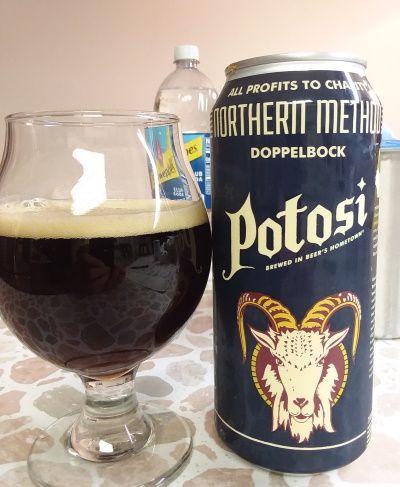
Northern Method, the name being a nod to the origin of the bock, is really a nice, clear reddish brown color but sitting there in that glass on the counter it had a tenebrous tint. With a creamy tan head, the beer looked, well, not imposing but like a rather heady concoction. It was ready to fortify me against the winter weather.

It smelled more or less like I thought it would – sweet like raisins and caramel but also a bit boozy and astringent. It's 8.5% A.B.V., by the way.

Raisin and caramel were also to be tasted along with a more plum-like/stone fruit flavor. I discerned a little dark chocolate as well. And, in keeping with its reputation as liquid bread, there was a bready flavor too. Some sweetness lingered on the swallow as the hops finally decided to make themselves known with a touch of spicy bitterness.

Despite being a big beer, I found Northern Method to be rather easy drinking. Malt sweetness was the order of the day but my palate never got bogged down in a cloying sludge. The beer had a medium body and I think the sweetness was prevented from running roughshod over my tongue by judicious hopping and just the right amount of carbonation.

Northern Method is a "Fall / Winter Seasonal Limited Release" and so, oddly enough, it will be leaving store shelves in February just as folks are really getting into the swing of Lent.

Junk food pairing: Christians refrained from eating meat during Lent in the Middle Ages but "meat" referred to land animals with hooves. And so, for example, beaver was perfectly acceptable. As was fish. So, head down to your local Asian grocer and buy a pack of unagipai, which are essentially eel cookies. You'll be in the clear as far as those pesky Lenten dietary restrictions go.

06 October, 2016

What Have the Germans Ever Done For Us?: Oktoberfest by Potosi Brewery


Good ol' Potosi. Whenever I hear the name, I think of how a friend of mine still holds it against me that I unwittingly drank his last Potosi Czech Style Pilsner one day in the dim and distant past. He still speaks of the incident in tones of thinly veiled anger. He's like liberals who still piss and moan about Ralph Nader forgetting all the while that it was the Supreme Court who crowned Dubya president. In addition to a very tasty Czech pils – there was a reason I chose it amongst the others on offer - they have a fine brewery and museum out there on the Mighty Mississip.

With the vast majority of Wisconsin Oktoberfests that I've had this season ranging from almost medicore to awful, I had a goodly amount of confidence that Potosi could be different. Their Oktoberfest could be like the Battle of Guadalcanal or the Battle of Stalingrad. Just as those campaigns proved to be turning points in World War II, so too could Potosi's bier be the critical juncture in the search for a good Oktoberfest brewed in the Land of Cheese.

I mean today's Wisconsin microbrewers are ostensibly the successors to generations of German immigrants who settled in our fair state - and their descendants too. The earliest waves of Forty-Eighters brought socialist ideas which most famously shaped Milwaukee along with other things like kindergarten. And immigrants regardless of political orientation gave us their love of sausages, strudel, and of course bier. Germans had a very large impact not only on culture here in Wisconsin but also the United States at large.

Ergo it's been frustrating as a Wisconsonian of some German extraction to witness breweries of my state flounder attempting to brew on Oktoberfest that tastes as good as one that has made the trip all the way from Munich. Hell, we've even let California eat our lunch.

Potosi's Oktoberfest poured a gorgeous clear copper hue. My initial pour managed only a small head that was off-white and left me wishing is Auf wiedersehen all too soon. This was my inability to pour correctly, however, as my second and more vigorous pour gave a much larger and much prettier crown of foam. There wasn't much effervescence on display.

Moderately sweet caramel was first to hit my nose followed by a smidgen of roasted grain while some faint grassy hops lingered in the background. I wasn't surprised by the bouquet since the bier's color lacked the pale complexion of Oktoberfests: The Next Generation.

Considering the lack of bubbles, Oktoberfest was well-carbonated by which I mean it had just the right amount of carbonation. Not particularly acidic, but just enough push back against the malt. And that malt was mostly caramel tasting with attendant sweetness. Not cloying though. It was joined by a little roasted grain and some hops which had taken on a spicy tint. Overall it had a nice medium body and a clean lager taste that was fairly crisp.

The malt faded on the finish allowing the spicy hop taste to really come through. While rather bitter and a fair bit dryer than I'm used to for the style, it was still rather pleasant. My first pour of the small head produced no Schaumhaftvermoegen but my second let loose some really nice, thick streaks of foam.

This was not a bad Oktoberfest but nor was it great. I liked the level of caramel sweetness here but felt it needed more roasted grain flavor to bolster the larger malt taste. This has been a common refrain here this Oktoberfest season. Most of the one's that I've had have had a very one dimensional malt taste – caramel and little else. Potosi, to its credit, adds more non-caramel malt flavor than your average bear but this bier just didn't find that Golden Malty Mean.

Junk food pairing: I paired my Potosi Oktoberfest with Snyder's Zesty Ranch Pretzel Pieces to good effect.