Back around 1997 or thereabouts, I ran into an essay by a gentleman named Judson Caswell called "Minstrel in the Gallery: History in the Music of Jethro Tull" that I believe he wrote for a college class back in circa 1993. At least that's when he posted it to a Jethro Tull mailing list. In it he wrote:
Still, Ian owed much to the black blues and jazz traditions. His flute playing was a stylistic derivative of Roland Kirk, a famous jazz saxophonist. Perhaps he also derived aspects of his later stage persona from Kirk as well. Kirk is described by Lipsitz in his book Time Passages. Lipsitz speaks of Kirk's unusual stage attire and behavior as subversive and unconventional. He also makes note of Kirk's aggressive sense of humor, citing his satirical rendition of hymns and his "mischievous wordplay". Lipsitz calls attention to these characteristics to identify Kirk as a performer who is deriving his power from a sense of history. He explains that Roland Kirk presents an art that can be interpreted at many levels--an art that makes reference to the past through oblique and coded messages. These messages arise as eccentricities in Roland Kirk's music and stage presence.
I knew of Roland Kirk as Tull had done a version of his "Serenade to a Cuckoo" on their first album. Although I've since learned differently, I accepted that he was the model for Ian Anderson's style of flute playing. But I didn't really know much about Kirk himself and found myself intrigued.
And so I sought out Time Passages. Not hard to find. Lipsitz got his PhD. in history at my alma mater and was, at the time the book was published, a professor just to the west at the University of Minnesota.
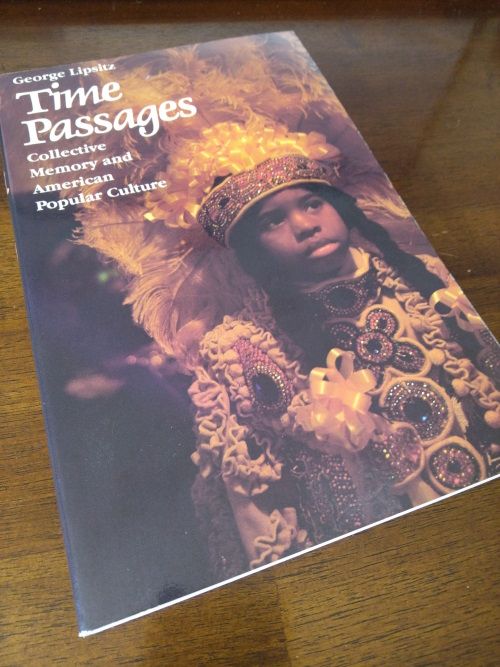
Lipsitz opens the book with a discussion of Kirk.
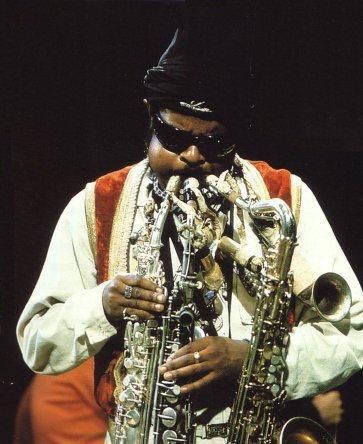
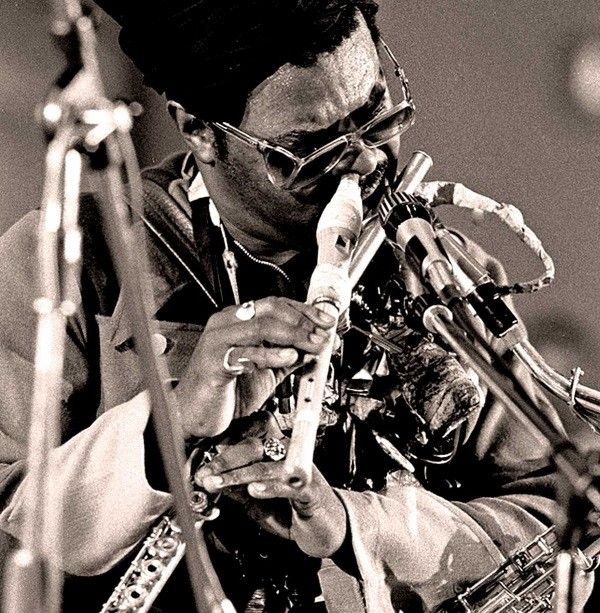
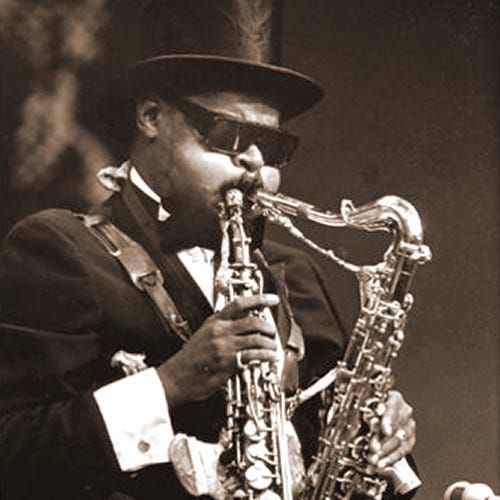
The late jazz musician Rahsaan Roland Kirk used to preface his performances with an unusual word of advice for the audience. A burly black man who often wore a stovepipe hat with a feather in it, and who frequently carried two saxophones (which he sometimes played simultaneously), Kirk would peer out at the crowd through dark sunglasses and growl, "This ain't no sideshow."
He proceeds to portray Kirk as Caswell described. His music, stage persona, and stage banter all "called attention to his role as a black musician in a society controlled by whites." Lipsitz claimed that Kirk "called attention to his identity as a historical subject, a descendant of slaves and a victim of white racism, a human being forced to disguise his pain and anger within the outward appearances of a sideshow."
Personally, I think Lipsitz is overly hyperbolic here and leaves little to no room for Kirk to dress or speak out of pure merriment or to play a song for the sheer joy of it. But I guess that's neither here nor there.
After reading the section on Kirk, I wanted to hear the man himself say those words: "This ain't no sideshow." I wanted to hear this little bit of musical history instead of it simply existing as words on a page.
Life got in the way back in the late 90s but my desire was rekindled during the Covid lockdown. Lipsitz doesn't list any notes for his comments on Kirk. John Kruth's biography, Bright Moments: The Life and Legacy of Rahsaan Roland Kirk, wasn't published until a decade after Time Passages so that wasn't a source. Wikipedia showed that some live material came out during Kirk's lifetime but 3 posthumous lives albums post-date Time Passages' publication thusly they were out. And so, as someone who collects bootlegs, I then sought out every Kirk show I could find.
Boots can be a good way to experience musical history. After all, Dylan aficionados actually heard that guy call him "Judas" long before the show was officially released in 1998.
I came away with Kirk shows from 1963, 1964, 1967, 1970, and 1972-76.
Where to start? Lipzig's phrasing gives one the impression that Kirk began all of his shows with the desired word of advice.
Some help came at the same time I was downloading the concert recordings when I stumbled upon a dissertation by a gentleman named Benjamin Tress called "The Jazz & People’s Movement: Rahsaan Roland Kirk’s Struggle to Open the American Media to Black Classical Music". The paper's first section is a brief biography of Kirk and notes, "...Kirk also gradually changed his image, moving away from the conservative style of dress he had sported in the Fifties and early Sixties...In 1967, he was back on the cover of Down Beat, though this time with thicker sunglasses, a large knit hat, and facial hair that was reminiscent of a Black Bohemian style."
Furthermore, Tress says "Kirk’s recorded statements from the late Sixties and early Seventies also indicate a trend towards greater racial awareness."
My guess was that I'd find my prized word of advice in recordings from this time period.
Thinking that it would be fun to listen to a bunch of Roland Kirk and Rahsaan Roland Kirk music, I just started with the earliest show and made my way forward. Since it was quite possible that Kirk had said "This ain't no sideshow" at some point other than the outset of a show, I listened to each of the recordings in their entirety.
Here they are:
10/24/1963 Club Montmartre, Copenhagen, Denmark
9/26/1964 Philharmonie, Jazztage 1964, Berlin, East Germany
9/27/1964 Prälaten, Jazztage 1964, Berlin, East Germany
10/2/1964 Paris, France
10/6/1964 Messuhalli, Helsinki, Finland
10/10/1964 Teatro dell'Arte al Parco, Milano, Italy
10/14/1967 Sala Kongresowa, Warsaw, Poland
10/19/1967 Prague, Czechoslovakia
2/26/1970 Stuttgart, Germany
3/3/1972 Studio NDR, Hamburg, West Germany 34min(set 2)
4/2/1972 Village Vanguard, New York City, NY
9/22/1972 “SOUL!” TV show
10/29/1972 Jazz Workshop, Boston, MA
12/31/1973 Village Vanguard, New York, NY-
4/4/1974 Village Vanguard, New York City, NY (early show)
4/4/1974 Village Vanguard, New York City, NY (late show)
4/14/1974 Village Vanguard, New York City, NY
6/30/1974 Glen Island Casino, New Rochelle, NY
1/3/1975 Village Vanguard, New York City, NY
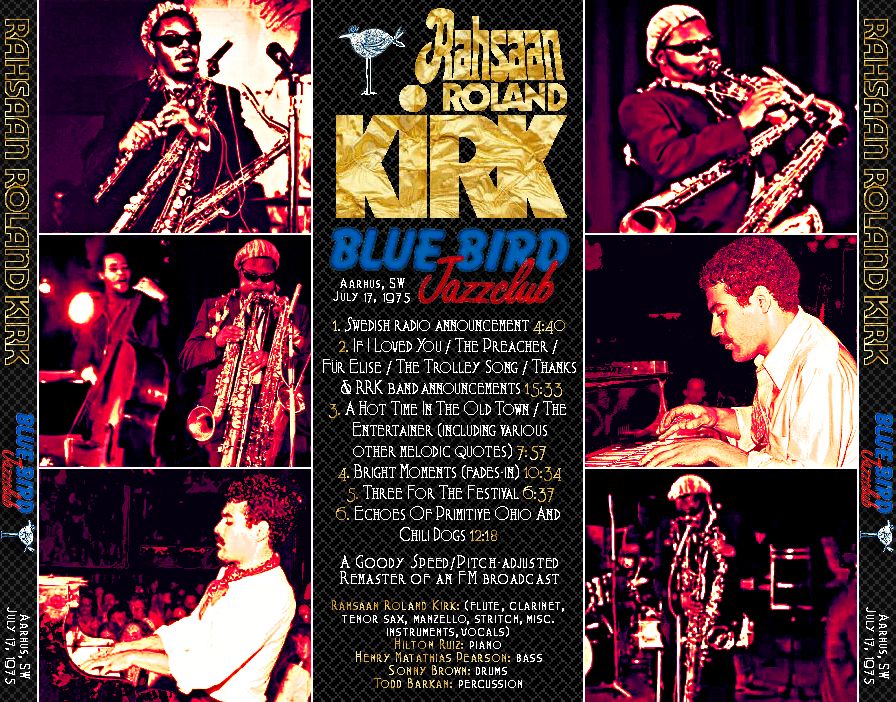
7/17/1975 Blue Bird Jazzclub, Aarhus, Sweden 58min
11/14/1976 Studio 104, Maison de la Radio, Paris, France
There is a country ton of absolutely mind-blowingly fantastic music here.
Kirk was a master of circular breathing and there are times when he holds a note for a full minute, maybe more. As noted above, he played multiple saxes at once. Sometime they play in harmony, giving a rich, full melody; at others he's busting out different parts on each sax.
On one of the earlier shows, he threw in a bit of "Let It Snow", which took me by surprise. Kirk and his bands perform originals and a wide variety of covers that range from New Orleans jazz, Duke Ellington, John Coltrane, Stevie Wonder, and more. He definitely celebrates all manner of black American music and implores the audience to do the same. In later shows, they even do a bit of "Hey Jude".
Some random notes from my listening:
The February 1970 show has a song with some parts that brought "Low Spark of High Heeled Boys" by Traffic to mind. Similarly, there were a few piano solos that brought some Keith Emerson parts to mind. These moments drove home the fact that progressive rock leaned on jazz heavily at times and not always by people in the Canterbury scene.
"Fingers in the Wind" from 3 March 1972 is simply gorgeous.
At the Boston '72 show he gripes about Jethro Tull's version of "Serenade to a Cuckoo" getting a lot of radio airplay while his original does not.
Racial awareness came to fore at the September '72 show. He bemoans the paucity of black classical (i.e. - jazz) musicians on TV - Kirk helped found the Jazz & People’s Movement to address just this issue. He also says "plantation Earth" instead of "planet Earth".
"Fly Town Nose Blues" is a great song. On the 4 May 1974 shows he's got a guy named Kenny Rogers on baritone sax and he plays this wonderful struttin' melody as Kirk wails on flute. Just fantastic.
The late show from that date features the proto-rap "Clickety Clack". Influenced by The Last Poets? Gil Scott-Heron? Kirk says The Beatles came to American and took all the money while a black man went to a Rolling Stones concert and got killed. He proceeds to diss Lawrence Welk and say that Redd Foxx got screwed over.
That last show from 1976 was performed after Kirk's first stroke which left one side of his body paralyzed. That he continued playing was miraculous. Here, though, the band sounds smoother, the rough edges have been polished and the simultaneous saxes are missing. Everything seems more conventional, less eccentric, less Kirk.
So, which shows featured Kirk saying "This ain't no sideshow."?
None.
Not a single one.
I grant you, not all of these recordings are complete so it's entirely possible that he made that comments at some or all of these shows and the recorder in the audience, the radio station, or the TV station either didn't record it or left it out of the recording that has made it out into the world of bootlegs.
Having listened to all of my boots, I went to Youtube and listened to:
Jun-73 Kongsberg Jazz Festival, Kongsberg, Norway
7/18/1975 Montreux Jazz Festival
6/24/1972 Montreux Jazz Festival
Again, no sideshow comment.
As stated above, Lipsitz provides no notes or the slightest clue where he got the notion that Kirk said "This ain't no sideshow" even once, much less at every show, as he implies. I don't think that my little round of listening to Kirk shows is iron clad, rock solid, definitive proof that Lipsitz is wrong, but I find it very suspicious.
I didn't expect to hear Kirk utter those words until shows from the late 60s so I wasn't surprised that I came up empty on the earlier ones. But I was surprised that I never heard them at all. I was also more than a little bewildered to find no mention of Kirk's sideshow comment beyond Lipsitz when I did general internet searches. Maybe I need to search the Down Beat archives or some such thing. Perhaps it was mentioned in an article and Lipsitz simply forgot to give credit.
While "This ain't no sideshow" certainly sounds like something Kirk would say and I don't doubt that Kirk said that at some point, I just don't believe Lipsitz that it was a very common, much less ubiquitous, occurrence. Either he got something wrong or pursued Herzog's ecstatic truth for his text.
Whatever the case, it was pure joy listening to all of that music by Kirk and I recommend you check him out if you haven't already done so.