25 October, 2011

Beer Notes, 25 October 2011

Well, it looks like Carl Nolen's bid to take over Capital Brewery will not come to pass. But the real news in the article comes from the brewery's president, Scott Wiener:

Wiener wrote that the brewery has formed a board of advisers to help set long-term strategy, which could include expansion.

Lakefront has released Local Acre Wet Hop.


Local Acre lager is brewed with 100% Wisconsin ingredients. "This is the limited-edition, single batch, wet hop addition." Not sure if this is available in Madison or not. Anyone seen it on store shelves?

Before I move on I want to say "WTF, Lakefront?". I can find no mention of the brew on their webpage, only their Facebook page. Why do you guys insist on having people go to multiple sites to find out about your brews? The idea behind the Internet is to make the search for information easier, not more difficult.

Beer Street Journal has some news about Leinenkugel including this:


Leines is getting into barrel aging beer with some aged Big Eddy Russian Imperial Stout due in a couple years. Next year sees the release of a couple new brews - a Wee Heavy Scotch Ale and an IPA. I had the Big Eddy IIPA back in 2007 and thought it was a tasty West Coast version of the style.

I wonder what's up with Leine's. The Big Eddy series debuted 4+ years ago yet they seem to avoid actually releasing the stuff with any regularity. It's like they keep dipping their toes in the craft beer waters but never dive in.

A hearty thanks to Jeff Glazer at Madison Beer Review for choosing the right person - my lady, The Dulcinea - to win a free pair of tickets to the Octoberfest extravaganza up in Kohler over this past weekend.

It was a good time. I ate too much and she drank too much. (And if I weren't driving, I would have too.) Founder's Nemesis black barley wine was incredibly tasty and incredibly potent. The Great Dane's pilsner was skunky. It tasted like I'd imagine a piece of cardboard that's been hanging in my shower for a couple years would. The two reps should have had some on the drive up before foisting it on us. The D laughed at me for telling the Big Bay rep that I really like Wavehopper. "You're such a beer geek," she taunted.

I sampled their Long Weekend IPA, which, coincidentally, isn't featured on their website. It was good stuff and distinctly non-West Coasty. Little to no citrus hoppiness and instead you get the more herby/grassy flavor. While a good beer, it would have been better if it hadn't been 35 degrees outside.

While I'm on the subject of Big Bay, the guy said that their porter is due next month but will be on draught only. While he didn't have a comprehensive list, he did say that it would make its way here to Madison and that the Coliseum Bar will probably get first dibs as they've been asking for it. This I did not expect. Do they sell a lot of Boatilla and Wavehopper there or do they just have a hard-on for porters?

Another beer that was good but would have tasted better about three months ago was Potosi's Wee Stein Wit. Nice balance of spice and orange. With this brew, their "shandy", and Czech pilsener, Potosi had a mighty impressive year, IMHO. Some of the best summer brews in the state. Plus I'm told their Tangerine IPA is excellent as well.

Lastly, Valkyrie Brewing Co. is looking to distribute in Madison but no date has been lined up. Brewmaster Randy Lee says he's been getting a lot of requests for Viking's Hot Chocolate to return so it seems likely he'll be brewing it again. Probably no Morketid (Viking's dunkel), though.

First 3D Hindi Film, RA.One, Coming to Madison

RA.One looks like a blast and it's screening here in Madison tomorrow, Thursday, and Saturday. It is a big budget CGI blockbuster with a guy in a superhero suit, chase scenes on trains, lots of cars flying around, and a whole lot of broken glass. The Movie Mahal website is promoting it as the first Hindi film in 3D. Unfortunately, it doesn't seem that it'll have English subtitles as the site has stated as much in the past for other films.

The 3D presentation is on Thursday and Saturday only.

Eating in Chicago Eclair to Chile Relleno

While in Chicago over the weekend, The Dulcinea and I dined at a couple fine establishments.

The first was Sensational Bites, a dessert café. The D got a slice of carrot cake while I went with an eclair the size of my head.


I had a sliver of the cake and it was mmm-mmm good. Very moist and flavorful. With all the shredded carrot visible, The D said it was like there was a whole carrot in just this piece.

My eclair was great as well. Great in taste and in size. It was the equivalent of a burrito from La Bamba - the size of my head. The custard filling was among the best I've had with specks of vanilla bean in it. Much to my delight, it wasn't overly sweet. The custard was rich and creamy but not cloyingly sugary. For its part, the frosting was made from dark chocolate so it retained a goodly amount of bitterness along with that earthy chocolate flavor instead of simply being a brown-colored layer of sugar.


The other noteworthy eatery was Tuxpan Mexican Grill. It's owned and run by Jaime and Mary Cianca. It's basically a whole in the wall kind of place and the food was great. Things started out with chips and three varieties of salsa plus a pitcher of water full of lime slices. My mom order a taco plate which was a tamale and a taco, The D had enchiladas suizas, and I got chile rellenos. My dish came with two chilies - one stuffed with cheese and the other beef. All orders had beans, rice, and salad.

Mary was our server and it turned out she and her family used to live a couple doors down from my mother. And so a conversation ensued. Everything is made from scratch. Jaime does most of the cooking but Mary does a couple dishes including the chile rellenos. The tamales are are a hit with their family and I can attest that they are tasty. There were no complaints at our table and we left with full bellies. Plus the prices were very reasonable.

If you're ever in the Jefferson Park neighborhood, check Tuxpan out.

24 October, 2011

WI Book Festival 2011: The Katyn Order by Douglas Jacobson

I had a busy weekend and was able to attend only one event at the Wisconsin Book Festival - Douglas Jacobson and his latest novel The Katyn Order. Here's the synopsis from his website:

The German War Machine is in retreat as the Russians advance. In Warsaw, Resistance fighters rise up against their Nazi occupiers, but the Germans retaliate, ruthlessly leveling the city. American Adam Nowak has been dropped into Poland by British intelligence as an assassin and Resistance fighter. During the Warsaw Rising he meets Natalia, a covert operative who has lost everything—just as he has. Amid the Allied power struggle left by Germany’s defeat, Adam and Natalia join in a desperate hunt for the 1940 Soviet order authorizing the murders of 20,000 Polish army officers and civilians. If they can find the Katyn Order before the Russians do, they just might change the fate of Poland.


Mr. Jacobson has some Polish blood from his mother and, although he's an engineer by trade, he likes to study overlooked episodes of World War II. He explained that his recent studies led him to the point where he had two major events that he wanted to write about. First was the Warsaw Uprising of 1944 and the other was the Katyń Massacre. He managed to delve into both in his latest book. The Polish Heritage Club of WI-Madison was a sponsor of the event on Saturday and there were more than a few people from Poland in attendance. Jacobson said that when he gives his presentation on The Katyn Order most audience members are unfamiliar with the Katyń Massacre. I think that most of us there on Saturday were familiar with it, one person too familiar, perhaps.

In a nutshell, the Katyń Massacre was carried out in the spring of 1940 by the Soviet Union's NKVD or People's Commissariat for Internal Affairs. Some 20,000 Poles were slaughtered, most of them military officers but also members of the intelligentsia, i.e. – lawyers, doctors, and the like. Recall that the USSR invaded and captured eastern Poland in 1939. 200,000+ soldiers were captured and eventually freed with many conscripted to fight the Nazis. However, the officers remained detained and in 1940 Stalin signed the orders to have them killed. The victims were shot in the head and their bodies dumped into mass graves.

In 1943 as the Germans advanced through the USSR, they stumbled upon the graves in the Katyń forest and they attempted to use their discovery as a propaganda tool against the Soviets who denied everything. It wasn't until 1989 that the Soviets admitted what had been done and their government's role in it.

Mr. Jacobson gave a summary of the history and noted that, in general, Polish contributions during World War II tend to be ignored. Polish soldiers fought in every theater of the war. They fought in Poland but also in the deserts of Africa and in the skies with the RAF, for example. He read a couple passages from the book and it sounds like a very good read. Things got even better after his presentation. In the audience on Saturday was Dr. Waclaw Szybalski. A native of Poland, he immigrated to the United States in 1950. I attended a birthday celebration for him this past summer and learned about the many contributions he has made to the field of genetics. The list at the link above sounds impressive but when someone explained what all the meant to me in layman's terms at the party, it was even more so.

So, while I knew about Dr. Szybalski's contributions to science, I didn't know until Saturday that he was a Polish military officer and escaped being murdered in the Katyń Forest in 1940. He explained how the Soviet Army occupied his hometown of Lwów but that they were very disorganized and he basically slipped through the cracks after discarding his uniform. He also noted that he heard about the massacre a few weeks after it had happened and that the American and English governments knew all about it during the war but they didn't press the issue with the Soviets as they were allies and didn't want to upset Stalin. This attitude carried on after the war was over. It was fascinating to hear some of the history mentioned in Jacobson's book told by someone who witnessed it first-hand.

An audience member also from Poland noted that, prior to the Solidarity Movement, just mentioning the word "Katyń" would get one arrested and imprisoned.

As you can imagine, it was a very interesting Q&A session. Cheers to Mr. Jacobson who was generous enough to allow the focus to be moved from his book to the larger history behind it and to someone who was alive and there when it happened. I think he was as grateful to hear other people's stories as was the rest of the audience.

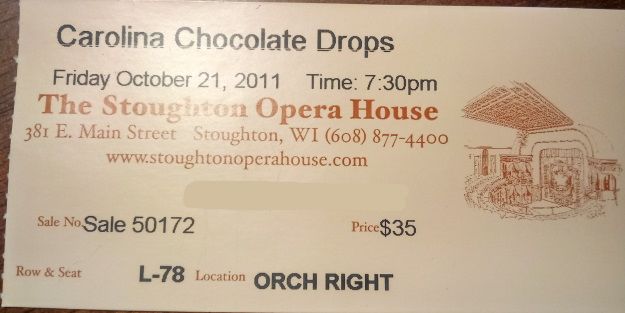
Carolina Chocolate Drops @ Stoughton Opera House, 21 October 2011


The Carolina Chocolate Drops cruised into Stoughton last Friday night and played to a sold out Opera House. It was their third stop here in the Madison area in the past year and a half and they put on another great show as they plundered their way through various American songbooks.

I’d seen them last year at the Orton Park Festival but missed their appearance this past spring at the Barrymore Theatre. (Luckily that show is available on YouTube.) Since that day last year, the band has experienced some line-up changes. Justin Robinson left and was replaced by Hubby Jenkins. Beatboxer Adam Matta joined on what I presume to have been an informal basis. He’s gone missing and was replaced by cellist Leyla McCalla.

The CCD earned their reputation by reviving nearly-forgotten black fiddle music and reminding listeners that the banjo started life in Africa with a gourd as its body. They paid homage to their mentor, fiddler Joe Thompson, with songs of his such as “Riro’s House” that showcased Rhiannon Giddens prowess on the instrument. Dom Flemons introduced another song as having been culled from a mid-19th century songbook aimed at white players at a time when the banjo was gaining in popularity in areas not associated with slavery.

But, while they love to plunder age-old songbooks, their tastes aren’t as parochial as it might seem. Giddens plays a mean fiddle but she also has a tremendous set of pipes. This shouldn’t be surprising as she is a trained opera singer. Here she stepped up to the mic and belted out “The Divorce Song”, a jazz tune by Ethel Waters from 1927. She also took on contemporary R&B with “Hit ‘em Up Style (Oops!)”, a positively new song originally done by Blu Cantrell in 2001. Also from the other side of the tracks was the proto-country of “I Truly Understand (That You Love Another Man)”.

Wherever their muses take them, these folks have not only the chops but also the talent to play any instrument required. In addition to her fiddle and other stringed instruments duties, Giddens played a kazoo solo with gusto while Flemons was happy to augment his guitar with pan flute or to bust out a snare drum and some brushes. Jenkins seemed equally at home clawhammering away on a banjo as he did playing rhythm bones and McCalla swapped her cello for what looked like a bodhrán for “Riro’s House”.

Beyond the history lessons and the virtuosity is the fact that CCD shows are just fun. Songs at breakneck tempos like “Sourwood Mountain” are sheer joy that will get your toes tapping while the audience was pulled in to sing along with “Don’t Get Trouble In Your Mind” and “Hi Ho Fiddle I Day”. “Cornbread and Butterbeans” was the encore. Giddens introduced it by saying that they had requests for it. I had no idea it was so popular but I shouldn’t be surprised considering just how blatantly catchy it is.

Jenkins may be new but he fits right in. Like Giddens and Flemons, he is a multi-instrumentalist and he effortlessly juggled banjo, mandolin, rhythm bones, and probably others that I cannot recall. Plus he sang lead on a couple songs that were formerly sung by Robinson. McCalla stayed in the background for the most part alternately plucking the strings of her cello like an upright bass and bowing them. Her parts were not flashy but they filled out the songs and I was especially impressed how well her bowed playing complemented the arrangements.

Madison’s Boo Bradley opened the evening with 25 minutes or so of their jugband attack. I’d heard of them previously but never heard them. Once I became acclimated to Scott Kiker’s voice, it was easy to love their music, a blend of various strains of blues from the first half of the 20th century done on guitar, upright bass, and washboard. Good stuff, Maynard.

21 October, 2011

The Peril of Not Living in a Major City

Roland Emmerich's first non-CGI disaster fest in over a decade, Anonymous, was to have opened today at Sundance.


Yet the Elizabethan potboiler is not playing according to their Showtimes pages. Why is that? Sony Pictures has changed the release schedule at the last minute.

Instead, in an unusual change so close to a planned launch, the studio will open the picture, about a British earl who some claim was the true author of William Shakespeare's plays, in only 250 theaters next weekend. Sony had originally planned to launch the movie in thousands of theaters.

Tracking surveys indicated that audiences were not that interested in seeing the film and it was likely headed for a very soft opening of less than $5 million. Sony is now hoping to generate buzz and positive reviews to boost audience excitement by opening the movie only in major cities Oct. 28. The studio then plans to expand its run to more locations throughout November.


Think about that. Only a few million - just not good enough. Uff da! While Anonymous' story and Emmerich's films generally don't interest me all that much, I read at IMDB that the movie is "The first major full-length motion picture to be shot with the Arri ALEXA high-definition digital-video camera." Now, that interests me. I'd go see it on this basis alone. Hopefully it'll end up here next month.

20 October, 2011

Scalia Issues Originalist Verdict on Pizza


Supreme Court Justice Antonin Scalia was in Chicago earlier this week and he issued a characteristically originalist ruling on pizza:

“I do indeed like so-called ‘deep dish pizza.’ It’s very tasty,” the high court’s most outspoken conservative said after a moment’s hesitation. “But it should not be called ‘pizza.’ It should be called ‘a tomato pie.’ Real pizza is Neapolitan. [from Naples, Italy] It is thin. It is chewy and crispy, OK?”

More "real pizza" is coming to Madison. Naples 15 will soon be opening at the graveyard of restaurants, Butler Plaza.

Salvatore Di Scala, who plans to open Naples 15 at 15 N. Butler St. in December, called from the island of Ischia near Naples, Italy, where he said he is importing flour for his pizza dough.

Di Scala reports that his wife is pregnant, due around the time the restaurant is expected to open.

The restaurant will replace Las Cazuelas Mexican restaurant in Butler Plaza. It was the original location of Cafe Porta Alba, where Di Scala did some consulting work.

Di Scala intends to serve authentic Neapolitan pizza and eventually get certification from the Associazione Vera Pizza Napoletana, an international nonprofit organization founded in the mid-1990s by a group of Neapolitan pizza makers, who instituted strict pizza-making requirements.

Born in Naples, Di Scala was raised 20 miles away on the island of Ischia. He considers Madison his "second home."

19 October, 2011

Is Walker Getting Ready to Drop the Hammer?

Rumor has it that Capitol Police have had their shifts changed to hours, including 12-hour stints, resembling those from earlier this year when there were some protests going on there.

Is he going to announce the end of PTO for state employees?

Dispatch from the Food Carts

Back when it was hot outside I ate lunch with the Eating in Madison A to Z gang. We dined on the comestibles from Thai-riffic. Head over there for an account of our dining adventure.


About Those iPads...

Earlier this month it was announced that the Wisconsin Economic Development Corp., the public/private hybrid agency that replaced the Department of Commerce, purchased 73 iPads for a total of about $60,000, which includes activation fees and monthly data plans. Not sure if that includes anything else like Bluetooth keyboards or not.

A couple days ago Ryan Waal editorialized against the move over at The Daily Cardinal saying, essentially, that surely the state could have gotten a better deal on some laptops. He rightly points out that one of Governor Walker's mantra's is "We're broke."

Waal is angry that the taxpayer footed the bill for the devices but he misses a crucial point. The issue really isn't how much we paid upfront for those iPads, but rather what the Total Cost of Ownership or TCO is going to be on them. In other words, how much is the taxpayer going to pay for those devices over their lifespans? For example, you can buy an inkjet printer dirt cheap but that doesn't represent the TCO because you're going to be buying ink for years at $30+ a pop. The TCO of that printer is going to be the purchase price, the cost of ink refills as well as paper, and any money you spend maintaining it. Do you have to call HP and pay to get some tech support for the device? Well, that's part of the TCO too.

As far as these iPads go, I will admit up front that I have never touched one and have never spoken to anyone who deals with them in the enterprise. That caveat aside, taxpayers should be weary. I presume that money will be spent to deploy the iPads. Money would have also been expended to deploy laptops but is going to a new device and new OS going to increase those costs? Do all the users now have to have iTunes in order to get their device going? Will the WEDC infrastructure inherited from DOC have to be modified? Will new applications have to be written to work with Safari? (Is Safari on an iPad a mobile version?) Will new apps have to be purchased so that WEDC users can read and manipulate PDFs and MS Office files? Are they going to have to pay new license fees to Microsoft? What happens if a user loses the device? Does the iPad have some native system for WEDC IT to wipe it remotely or will a third party app have to be purchased to ensure that all those secret documents about luring mom and pop stores from Rockford to Beloit aren't compromised? To the best of my knowledge, iPads cannot join domains so how are they going to be managed? Do new IT people have to be hired? Or will the current staff be trained? Will iPads affect any long-term IT plans for the agency?

Tom Thieding, WEDC's spokesman, is quoted in the above article as saying, "There was a need for a technology upgrade…The old Department of Commerce - it was just lumbering along." OK, fine, but that doesn't mean that iPads are the solution. They may be or they may not be. What I get out of Thieding's comments is that the iPads were the cheapest solution in upfront costs but not necessarily the best solution in terms of either total cost or of fitting into the current IT environment.

IT staffs should keep an eye on this. According to one vendor, while various WI state agencies have bought the occasional iPad for executive staff, no agency has done a rollout like this one.

So the issue for the people of the great broke state of Wisconsin isn't whether WEDC could have gotten 73 laptops for less than $60,000, it's whether the TCO of 73 iPads is less than that of 73 laptops, tablets, or some combination thereof and, because, quite frankly, this whole thing just doesn't sound right, whether or not WEDC employees will be able to do their jobs effectively with the iPads.

18 October, 2011

Nothing Like a Refreshing Arctic Ale

Having recently read The Terror, a fictional account of Sir John Franklin's doomed 1845 expedition to discover the Northwest Passage, I was interested to find out about the existence of this stuff:


Allsopp's Arctic Ale was brewed in 1852 for Captain Sir Edward Belcher and his crew who were to set out in search of Franklin's expedition. Belcher was not successful but, to his credit, one of his ships survived along with his crew. This bottle is infamous because of the Ebay incident where the original owner misspelled Allsopp as "Allsop" and sold the bottle for only a few hundred dollars. The winner of that auction turned around and reposted it there with correct spelling and more info. He/she got much better bids.

I guess this stuff was 10%+ ABV and was a barley wine. In Belcher's book, The Last of the Arctic Voyages, he says on page 21: "...Allsopp. That name will live for ages in the recollection of all Polars."

Belcher equipped at least one of his ships with brewing equipment and on page 339, he describes the results as being "much esteemed". Fuck, if I were north of the Arctic Circle with pack ice closing in, any beer would be highly esteemed by me. Still, they don't do adventures like that anymore. When did you ever hear about a space shuttle crew bringing a homebrew kit with them?

Some gentlemen are making a movie wherein the cycle up nort to the Arctic and recreate the brew. Seems like an awful lot of trouble to go through just to brew a beer which leads me to believe its more of a publicity stunt than anything. If the pretty awful Brew Masters show is anything to go by, I can just imagine what this movie will be like. Camera must be moving at all times and use lots of canted angles because otherwise producers will assume viewers will just get bored. No shot can last more than 1 second - ibid. It'll have a cheesy metal soundtrack - ibid. It must have danger for repeats on Fox so they'll pull a Robert Flaherty and hire handlers to plant polar bears near the set. It'll be like Scott of the Antarctic!


Cast from John Carpenter's THE THING Watching Footage from the New Prequel

Madison Metro's Windfalls

Madison Metro received some good news: it is receiving a bit over $5 million in federal grant money.

Madison Metro spokesperson Mick Rusch said the grant would allow Metro to continue running at its current rate despite the economy while also allowing for improvements to the transit system.

“Before this grant, we saw a decrease in funding,” Rusch said. “This grant allows us to continue replacing our buses at our current rate of about ten a year, or 100 over ten years.”

The grant also includes funds to purchase new wireless fare boxes, which Rusch said would allow Metro to better track passengers and fare usage. Data will be automatically downloaded to Metro’s computer systems, allowing the company to easily keep track of passenger traffic.

Alder Scott Resnick, District 8, said the money would also allow the city to update several unsafe or decrepit bus shelters.


As I said, this is surely good news and I'd like to make a recommendation for the next time Metro gets a windfall. I have bitched in the past about how useless bus stop signs are here in Madison. They tell you where a stop is and what routes serve it but absolutely nothing about the routes themselves. What's the frequency of the routes? Where do they go? What hours do they run? None of this handy information is available on the signs. So allow me to suggest upgrading to something like this:


These are the new signs for Seattle Metro riders. Notice how they actually give the information riders need. In addition to the routes that serve the stop, you are told where the routes go and when you can expect them to be at the stop. Handy.

TV shows you saw as a kid...

...that took on new meanings when you watched them as an adult.

Exhibit A: The Gong Show

17 October, 2011

Autumn Means...

...pan de muerto!

I picked up a loaf at Pan Y Pan over the weekend. Mighty tasty.


The Revolution's Soundtrack Will Be Polka

At least in Cleveland.

Randy Hopper Busted for DUI

I guess Randy Hopper is still hurting after that recall election. He was arrested yesterday for suspicion of drunk driving.

Police said that they've cited a former state senator for drunken driving.

Fond du Lac County Sheriff's Department Chief Deputy Mark Strand said his agency got a cell phone call from a driver who reported Randy Hopper was all over the road on U.S. Highway 151 late Sunday afternoon.

Strand said Hopper pulled into a grocery store parking lot, where a deputy arrested him. He was released early Monday. Strand declined to release Hopper's blood alcohol levels.

Lock and Load

Here in Madison, we're wondering whether people will be able to bring their concealed weapons to various digs around town once the new law goes into effect. Can I pack heat in the Capitol? Will I be able to take my sawed off blunderbuss into the Co-op? After talking with a couple stateys and a Capitol Police officer over the past few months about this issue, I am convinced that the Republicans who drew up this legislation are a bunch of fucking nimrods who don't have enough sense to pour piss out of a boot if the directions were written on the heel. None of them could tell me who would be able to carry in various buildings. Plus there are all the exceptions. You can't CC on bus, but you can carry on the UW campus, just not inside facilities. But that excludes faculty.

The legislation was apparently not a model of clarity.

One thing I learned a couple weeks ago is that it's not just people in Madison who don't want to go shopping with Bill Hickok or wait for hours at the DMV with Ike Clanton. I stopped at a gas station a little east of Fond du Lac and lo and behold there was a sign on the door saying no handguns allowed in the store. When you walk inside, there's a little ledge with newspapers and such. Well, there was a handbill for a venison processing plant so we're talking about an area where people own and use guns. This was rural Wisconsin, after all. It makes me think that, when the Dems regain control of Wisconsin state government, it might not be that hard to repeal the CC law, pressure from the NRA not withstanding.

I now read that the Willy Street Co-op is going to ban guns in their stores. While a taste for organic food and the proclivity to carry a pistol are not mutually exclusive, I highly doubt this policy will be problematic. Still, I really want to see one of the hippies there confront a shopper packing heat, especially a shopper that drives an SUV and uses the Jenifer Street driveway for in- and egress.


R.I.P. Motion Picture Film Cameras

Sad news. ARRI, Panavision and Aaton have all stopped manufacturing motion picture film cameras.

While the debate has raged over whether or not film is dead, ARRI, Panavision and Aaton have quietly ceased production of film cameras within the last year to focus exclusively on design and manufacture of digital cameras. That's right: someone, somewhere in the world is now holding the last film camera ever to roll off the line.

"The demand for film cameras on a global basis has all but disappeared," says ARRI VP of Cameras, Bill Russell, who notes that the company has only built film cameras on demand since 2009. "There are still some markets--not in the U.S.--where film cameras are still sold, but those numbers are far fewer than they used to be. If you talk to the people in camera rentals, the amount of film camera utilization in the overall schedule is probably between 30 to 40 percent."


How good are digital motion picture cameras these days? Can they match the resolution of film? Color reproduction? Do they really look as good as a nice 70mm print?


Eating in Madison with JM & Nichole

Read what happened when The Dulcinea and I joined JM & Nichole at Stalzy's Deli. I recall JM inhaling a triple decker and being happier than a pig in shit at the root beer selection. And there was something about pyramids or pharaohs or ancient Egypt which was funny. Maybe Nichole or The D remembers what it was.


14 October, 2011

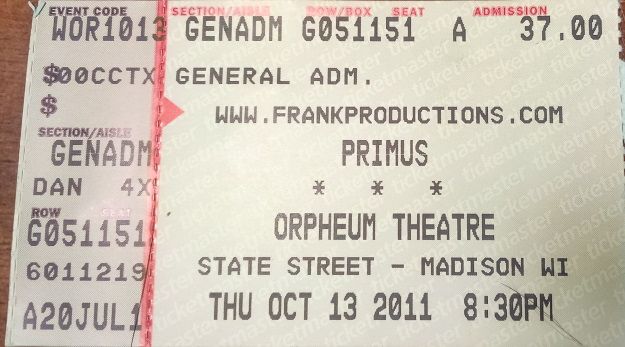
Primus @ the Orpheum Theatre, 13 October 2011


I believe the last time Primus were here in Madison was back in 1998 and Les Claypool’s fingers had barely gotten a workout on last night’s opening number, “Here Come the Bastards”, before clouds of pot smoke wafted into my face. Thirteen years on and everything seemed normal.

Primus are back. Instead of doing a nostalgia tour as they had been doing over the past 10 years, they have returned supporting a new album, Green Naugahyde, released last month, and with a new drummer, who is actually an old one. Jay Lane was last with the band in 1988 just prior to Primus to recording their first album.

The crowd was definitely on the younger side with few silver heads to be seen. And it seemed that a goodly chunk of them were barely out of diapers back when I first became a fan in 1991. A lot of the younger folks crowded into the standing area in front of the stage and there was plenty of jumping and dancing. The first set leaned heavily on Sailing the Seas of Cheese, which drew an enthusiastic response. When Claypool’s percussive bass, Ler’s slashing chords, and Lane’s thundering drums kicked in for the first time during “Those Damned Blue-Collar Tweekers” (“…they’re running this here town…”), the crowd went apeshit. You could feel the electricity in the air as cheers went up and bodies starting moving. I am shocked that no mosh pit started down on the floor. Whether this was because of the security or because they were too stoned, I don’t know.

“Fisticuffs” was heartily welcomed by my friend Buke because Brown Album is one of his favorite Primus albums. A huge smile broke out on his face when that bass line started. I’d last seen the band in 1994 so I was excited to hear any post-Pork Soda material. I’d been secretly pining for “Mrs. Blaileen” and they delivered. Tales From the Punchbowl is an underrated album, in my opinion. “Wynona’s Big Brown Beaver” gets the attention but Tales is full of gems. The other song from it that they played was “Over the Electric Grapevine”. Claypool did a bass solo every song and, while some featured a bit too much noodling dissonance, the one here was fantastic. It was fuzzy and noisy yet it kept that melodic riff going that seems to trail behind the drums, never quite catching up.

The show was full of surprises for me. One happened when that farty bass line got “My Name is Mud” started. Again the crowd roared and bodies flailed. I guess I just saw too many Pantera shirts because I figured most people wanted to hear the harder, faster material from the first couple albums yet this song that basically plods along while Ler does some of his most pointed and dissonant guitar work drove the crowd into an ecstatic frenzy. Another surprise was the paucity of material from Frizzle Fry. Considering that Lane demoed most of the album before he left the band, I thought they’d play more than the title track.

Having heard the band’s 1988 “Sausage” demo, I was not totally unfamiliar with Jay Lane’s drumming style. Herb basically copied his parts for much of Frizzle Fry. Their drumming styles aren’t dramatically different and I appreciate how they each get the most out of their hi-hats. Lane seemed right at home doing “Mrs. Blaileen”. But I think he’s funkier than Herb. A little more emphasis on the bass drum. Something like Bill Bruford vs. Alan White.

After a break during which the audience was treated to some very early Popeye cartoons on the big screen, the band returned and proceeded to play all of Green Naugahyde excepting the short coda, “Salmon Men”, which closes it out. It was yet another surprise that the crowd really responded to the new material. About halfway through the set Claypool said as much. I have to question the wisdom of confining the new material to its own set. While I take it that the band is confident enough about their new songs to play all but one, I think the material is generally strong enough to hold its own against the old stuff. “Tragedy’s a’ Comin’” is probably one of the funkiest things the band has ever done, lyrics excepted. And “The Last Salmon Man” is a latter day classic with its insistent, throbbing bass and some almost Pete Townshend-like soloing. “Lee Van Cleef” is another favorite of mine off the new album and I have to say that these songs can hold their own when paired with the old classics.

Encores were “Golden Boy” and a killer “American Life” which was 10+ minutes. It was nice to hear another song from Brown Album and the closer just rocked the house.

13 October, 2011

Detective Dee Makes It to Madison

Detective Dee and the Mystery of the Phantom Flame starts here in Madison tomorrow. Kudos to Sundance for bringing it to town. I saw it 2+ weeks ago and my review is here. I thought it was a blast. Highly recommended.

The Daily Page 86s Blog Post About Madison Bars & Racism

I have noticed that Jack Craver's blog post entitled "Nothing new: Madison bars don't like blacks" has been removed. Luckily Google Cache has it.

Editors will let David Blaska fill his Daily Page-sponsored blog with lies, defamation, &c. but letting another blogging relate his personal experience is just too much. Sad.

Corner Store Closing?

I drove by The Corner Store on Willy Street the other day and saw a big sign in the window saying the building was for sale or for lease. Is The Corner Store R.I.P. or are the building owners just looking move on? Anyone heard?

12 October, 2011

Marine Corp Vets Have Words For Sean Hannity

Weekend at Wyalusing


Nothing says camping like a face full of smores.

Last month I packed my gear and went to Wyalusing State Park with my friend Dogger and Miss Regan. I'd never been there before so it was great fun seeing everything for the first time.

We did a lot of hiking. The first trail we hit was the Sugar Maple. It was a really nice hike with ravines everywhere.


(This is an ex-tree!)


The trail led us to Pictured Rock Cave. You can't see it from the trail, however. Instead you walk down a winding path…


…and then all at once it comes into view.


Here it is from another angle.


The layers of sandstone were gorgeous. Unfortunately The Dulcinea's new camera had a hard time with the subtle maize yellow of the rock when I took photos close-up and I had no idea how to adjust the white balance. Still, you can still see the gradation.


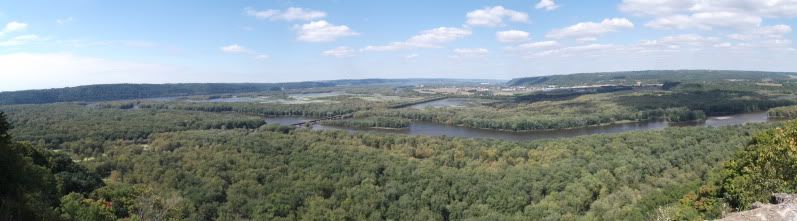
However, I discovered that it does have a panorama feature which stitches three photos together and it worked nicely. Click on the photo for a larger version.


There was water dripping down from above us and vines dangling - it was just beautiful. Very peaceful. Regan enjoyed the sand and spent a lot of time digging. She didn't want to leave but leave we did. Next stop was Point Lookout on the north side of the park. The view was amazing. You face north, towards the Wisconsin River and looking west you can see where it dumps into the Mighty Mississip.


Not only was the view spectacular, but we were also looking down at the route taken by Marquette and Joliet. They canoed this way back in the summer of 1673. An eagle was gliding out in front of us but too far out for my small camera to get a good shot. I could have stood there and watched for hours.

Next stop was Treasure Cave. Getting there involved going down the bluff quite a ways on an often narrow and always highly perilous trail. But our almost preternatural skills at walking down steps made the trek uneventful. To get into the cave, you have to walk up a flight of those steps like they have in submarines that are basically just ladders. Here's Regan doing a little spelunking in an opening off of the main chamber.


And behind some rocks at the entrance is a narrow crawl space that isn't visible unless you wander behind them.


Despite being mildly claustrophobic, I crawled in followed by Regan. We didn't get too far because my mind kept postulating that it would collapse on us if we went any farther or we'd get to the end only to discover a Silurian outpost and then we'd really be in trouble.

After making the long haul back up the side of the bluff, we returned to camp. I think we had planned to go back out and do some more exploring after refreshing ourselves but those silos of Flaming Damsel just went down a little too smoothly. Ergo resumption of hiking would have to wait until the next day.

This was the first time camping for me in a long time prior to this and it was so nice to be cooking flesh over an open flame and having the time to just sit and stare at the fire. I did a lot of hunting for wood and didn't notice until the morning that my clothes had a lot of burdocks in them. It was also rather cute to hear the fear in Regan's voice when our lantern was no longer visible from the campsite.

The next day we went back to the north side of the park. I believe this is Council Point.


Hitting the Sand Cave Trail we came upon Sand Cave.


Again, very pretty sandstone layers. There were other kids there Regan's age so it was next to impossible to get her moving down the trail once again. There are a brace Sand Caves and the above is the bigger of the two. Unfortunately the second is guarded by a fence and inaccessible to people.

Our last hiking venture was on the Sentinel Ridge Trail which follows the Mississippi River from above. There is a series of Indian effigy mounds along the path.


There is also a Passenger Pigeon Monument with a plaque that reads something like "Here's to the Passenger Pigeon, victim of man's avarice and stupidity." Quite fitting.


Off in the distance we could see a barge hauling freight south on the river. Sentinel Ridge is covered in oak trees and, when we were tired of acorns hitting us in the head, we went down to the boat landing. And there it was, Old Man River.


I'd never seen the Mississippi River up close before, only driven over it at several points. Well, perhaps I saw it in the Twin Cities but that would have been when I was a kid and have no memory of it. But I finally got to see the storied river. Mark Twain wrote about it as did William Faulkner. Floods have inspired songs from "When the Levee Breaks" to "Tear-Stained Eye". There wasn't much out on the river except for a couple fishing boats out in the distance. Very serene.

There are railroad tracks near the shore and Regan was excited because we had two trains pass by at once.


The Mississippi River and trains – two of the greatest metaphors in the American lexicon all in one spot.

We were there before the leaves started turning in earnest and I can only imagine just how beautiful Wyalusing must be in the autumn. Perhaps I'll find out next year.

Paying for Civilized Society

Towns and cities across America are in a financial bind these days and Madison is no exception. But while we argue about funding for our city's performing arts center, other municipalities are going a step farther.

Take Highland Park, Michigan, a suburb of Detroit. It's behind on its electric bill so DTE Energy repossessed most of their street lights.

Most of the city's street lights have been repossessed because officials failed to pay a multimillion-dollar utility bill, giving rise to concerns about safety and crime in darkened neighborhoods.

DTE Energy crews have removed about 1,400 light poles from Highland Park as part of a settlement that allowed the city to avoid paying $4 million in unpaid bills going back several years. DTE, which says the work will be completed by Oct. 31, has replaced 200 lights with newer models on street corners, but most neighborhoods remain in the dark.


Unsurprisingly, some have used the darkness as cover for theft.

"After they took the street light from in front of my business, someone climbed onto my roof and stole an air conditioning unit," said Bobby Hargrove, owner of Hargrove Machinery Sales on Oakland Avenue, who also claims a police officer asked him for money to beef up his protection.


Even worse is the news that the Topeka City Council is tossing around the idea of decriminalizing domestic violence to save money.

Last month, the Shawnee County District Attorney’s office, facing a 10% budget cut, announced that the county would no longer be prosecuting misdemeanors, including domestic violence cases, at the county level. Finding those cases suddenly dumped on the city and lacking resources of their own, the Topeka City Council is now considering repealing the part of the city code that bans domestic battery. The thinking here is that the county won’t let domestic violence go unpunished in Topeka and so will be forced to step in and start prosecuting it again if the city won’t. Basically, it’s a big game of chicken–where the “chicken” is, I suppose, the chump who won’t allow domestic abusers to walk free?

"Collateral Damage" = People

Here's a video from a group called No More Victims "that connects American communities with war-injured children and their families. Community participants band together to learn how the child was injured, assess the child’s current situation, and work to meet the most pressing needs of the child and family."

This Iraqi girl is 6 years-old and was shot in the head by a member of the U.S. forces in her homeland. (Not sure if that means a soldier or a Blackwater contractor.) She was brought over here for medical treatment. It's amazing that she is all smiles and so winsome. I had to stop watching when she says that, if she could meet the person who shot her, she'd simply ask "Why?"

11 October, 2011

Im Dumpling Haus

The Dulcinea and I had brunch at Dumpling Haus on Sunday along with a couple friends who were eating their way across two counties. (They broke their fasts at a pancake breakfast somewhere in Jefferson County.) Here's what the table looked like when we were finished.


Three of the four of us ordered a noodle dish along with dumplings or buns and passed everything around so that we could all get a taste. The first dish that made its way to our table was The D's Sesame Noodle Kick.


The noodles were done perfectly. It had enough hotness for The D to label it hot while I found it to be on the mild side. I think she liked it because sesame is her weakness at Asian restaurants. Nothing fancy here, just a basic bowl of noodles but tasty nonetheless. Here are the shrimp dumplings.


Again, very tasty. The shrimp were nice and firm and, while not caught that morning, they didn't taste like they had been in cryogenic suspension. The diaphanous dough wasn't all glutinous so it had a nice smooth texture. I can't recall what kind of sauce was ladled over the top but it was surely soy sauce gussied up a bit. I must have grabbed a couple that had escaped the flood.

Here are the Barbecue Bao. Someone also got an order of the Haus Bao Zi.


Alas, the buns were hit-or-miss here. The dough itself was fine – light and fluffy – but the filling's the thing wherein lies the tastiness of the bao zi. In the case of the barbecue variety, there was a paucity of it and what was there just tasted generic. Not badly or off, just more of an adumbration of BBQ as opposed to something well-seasoned; too sweet and lacking flavors to complement the meat. The Haus Bao fared much better with its savory pork mini-patty tucked neatly inside.

I think that these are the Haus Jiao Zi.


Same kind of pork filling as in the Haus Bao but I don't care. I love the mixture of pork, minced vegetables, garlic, soy, sesame, and ginger and can eat that stuff until the second coming of Christ.

My last photo is of the Black Bean & Pork Noodle.


It was slightly disappointing because the black bean wasn't seasoned very much. Basically you had a nice bed of noodles with a big glob of gelatinous black bean that had some bits of pork in it. I found this very odd considering everything else was seasoned, whether it was to my liking or not. The julienned cucumber made a nice contrast to the rest of the dish, though.

The last dish I recall was an order of the Haus Lo Mein with chicken. Nothing grand about it; a simple combination of noodles and chicken tossed in a light, basic, soy sauce. Some pukka comfort food. I hope Samara Kalk Derby doesn't try it because, if memory serves, the chicken was (gasp!) dark meat and not her precious "choice" white meat.

There is still a lot on the menu that we left untouched and I would certainly return. However, I felt that the noodle dishes were a bit overpriced considering the portion size. But I suppose one must pay for freshly rolled noodles.

Don't Call Us, We'll Call You

So much for Obama's pledge for a more transparent federal government.

The Department of Homeland Security won't even make the phone numbers of their PR people public.

Some federal agencies post the office phone numbers of public affairs staff on their websites.

Not the Department of Homeland Security, which believes their release poses "a clearly unwarranted invasion" of employee privacy.

That was the department's response when it denied a Federal Times Freedom of Information Act request for the office phone numbers of its official spokesman. Personal privacy exemptions to FOIA are more commonly used to block disclosure of personnel or medical files.

DHS' response typifies what many see as the Obama administration's unfulfilled promise to shed more light on government operations through FOIA, the key federal open records law.

The day after President Obama took office in January 2009, he directed agencies to "adopt a presumption in favor of disclosure" when responding to Freedom of Information Act requests.

In the case of DHS, a Federal Times reporter sought the phone numbers of individual public affairs staffers after having difficulty reaching them through a central email address for media inquiries. The agency eventually released a 58-page directory of public affairs staff, but redacted every phone number under the privacy exemption.

Beer News: Ale Asylum, Capital, and House of Brews

Ale Asylum will soon be moving into this:


As Mike Ivey of The Capital Times reported, AA is going to building a shiny new brewery over by the airport.

The makers of Hopalicious and other styles of full-flavored ales and lagers are seeking city approval for a 46,000-square-foot building at 2102 Pankratz St., just west of the airport off International Lane. Plans include a 36,000-square-foot warehouse along with a restaurant and rooftop patio.

The brewery currently has about 20 employees but expects to grow to 40 or 50 employees over the next two years. Plans include 208 surface parking spaces. Solar hot water panels would be incorporated on the roof.


"The makers of Hopalicious and other styles of full-flavored ales and lagers" - sounds like a press release.

I heard about this 2 or 3 weeks ago from an AA employee but wasn't sure when it was to be announced. Good on AA. It's nice to see them A) stay in Madison and B) stay on the north side.

So is it going to be a real full-service restaurant? When I first read that there are going to be 208 parking spaces I thought that they are really going out of their way to accommodate drunk drivers. It makes sense, however, if they're going to expand the food side of things. I guess. How many restaurants have that many spaces? At least the new site is a hop, skip, and a jump away from Packers Avenue and buses.

Joe - what's the skinny?

In other local beer business news, Capital has hired a new general manager, Tom Stitgen.

Jeff Glazer over at Madison Beer Review poured on the snark. First he notes that Carl Nolen, Capital's former President, is still figuring his plans (for buying out the brewery?) and then Capital hires an accountant.

Look, I don't run Capital. They didn't ask my opinion, but like most of you, I have an asshole, so I'm going to use it: Capital's problem isn't an accounting one. The problem at Capital Brewery is not that they aren't selling enough t-shirts and are losing money on the Gift ("Geschenk", thank you very much) Haus.

I found his post confusing because I didn't get the idea that Stitgen was replacing Nolen from the piece. Nolen was president while Stitgen is GM. Maybe Capital eliminated the president position and consolidated various duties in the GM position, I don't know.

So what does Glazer think Capital's problem is? Based on some of his previous posts, one of his biggest gripes about Wisconsin craft brewers is that they don't collaborate. Well, Kirby has collaborated with Rob LoBreglio of The Great Dane. That's how we got Supper Club and a barley wine the name of which I don't know. This being the case, I'd guess that Glazer's problem is that Capital is not moving into other states aggressively enough. The article says, "Capital says it has come up with a plan to create three separate profit centers: brewing; the Bier Garten, it's seasonal outdoor entertainment venue; and the Gift Haus, which sells beer, clothing and accessories." This sounds like internal restructuring and doesn't preclude trying to distribute in California.

Lastly I see that House of Brews is slowly finding its way to taps here in Madison. A list is here. In addition to his rye Kölsch, page now has Cellar Dark ale and Full House which is a pale ale, I do believe.

Still Life: Katze With Paperwork On Dish

The Dulcinea's katze has moved on from curling up in the fruit bowl to curling up on the serving plate and using the bowl as a pillow.


Getting Into the Swing of Fall Cooking Polish Style

With the weather changing I've started using the oven again. And my tastes have been leaning towards heartier fare. To get into the autumnal spirit of things I recently made kasza jęczmienna po staropolsku - Old Polish Barley, Bean & Sausage Casserole. (I guess capitalization is pretty sparse in Polish.) It turned out pretty well.


It's made by layering the ingredients just like lasagna. Instead of sheets of pasta, you lay down barley. Here's the barley cooking while my diced onion is sautéing.


After the onion was nice'n'tender and the kielbasa heated, I mixed them with some white beans, a little tomato sauce, and a heaping tablespoon of plum preserves. As far as seasoning goes, it's pretty simple. Just salt, pepper, and marjoram.


The recipe calls for a greased casserole dish with bread crumbs sprinkled about. I had no bread crumbs so it was lined with matzo meal. Start with a layer of barley then filling and continue until you have a final layer of barley on top. In my case, I had enough for only one stratum of filling. Poles love to put sour cream on everything and the situation is no different here. Smooth some on the final barley layer and then throw it in the oven.


While not a fancy dish, I thought it turned out pretty well. The 15 year-old registered no complaints. I liked how the plum sweetness melded with the smoky flavor of the kielbasa with the marjoram lingering in the background of both. And I also enjoyed the way the filling contrasted against the barley. It has the sweet vs. savory element going but there was also a contrast in texture as well. Each bite had the firm pearls of barley mixing with the easily mushed beans.

I am planning on making this again. Some variations might include using another type of fruit in the filling, higher quality kielbasa like a fine jalowcowa which has juniper berry, or mixing something in with the sour cream for another flavor. Perhaps some garlic. I use pearl barley but there are other varieties as well. It might look interesting if you use the black variety.


10 October, 2011

The Terror


Dan Simmons' The Terror is a fictional account of Sir John Franklin's lost expedition of 1845 to find the Northwest Passage which had no survivors. With all of the action taking place north of the Arctic Circle, this book is the coldest one I've ever read. I'd get chills just looking at the cover. And, when scurvy really starts taking a toll, I began to subconsciously choose orange juice as my preferred beverage.

As best as researchers can piece things together, the expedition's two ships, the HMSes Terror and Erebus, got stuck in the ice somewhere off the northwest coast of King William Island in September 1846. The pack ice never thawed enough to allow the ships to sail and the crews spent nearly a year and a half trying to survive aboard the immobile vessels and on the nearby island. A note found several years later indicates that they had planned to attempt to make their way to the Canadian mainland in April of 1848 and hopefully sail the Back River to Great Slave Lake and civilization.

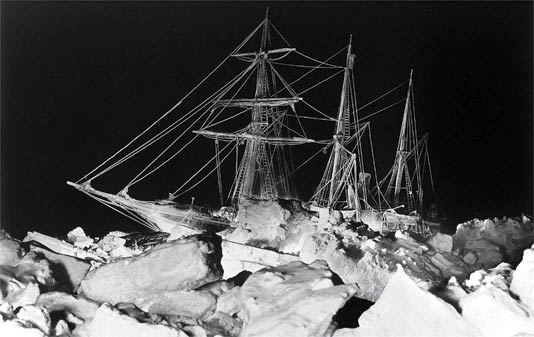
The novel begins in October 1847 with the ships held fast by the ice. Captain Francis Crozier walks the decks of the Terror checking on the guards who struggle to generate even a modicum of warmth while out on the deck. Simmons wastes no time in giving a chill to the reader by noting in the second paragraph that it's -50F with the temperature dropping. When I was reading the very first few paragraphs, I immediately thought about the Endurance stuck in the ice some 60 years later. (See this photo, for an example.) I sat there imagining the sheer, well, terror of being several hundred miles away from anything approaching civilization when you know the overnight low is probably going to be in the triple digits below zero and you've got to stand out in that for an hour or two on guard duty. And the reason they're on guard duty is because there's a "thing" lurking out there which may or may not be a particularly vicious polar bear. It reminded me of Smoky from LOST. It's lurking and seemingly attacks indiscriminately while remaining enigmatic until the end.

Having gone into the novel not knowing anything about the real expedition, I appreciated how Simmons just drops the reader off in media res. The ships are stuck in ice, Sir John Franklin is dead and you don't know what happened, there's an Inuit woman called Lady Silence by the crew who cannot talk because she has no tongue, and there's that thing outside. Plus there's a noisy pack of rats chowing down in the Dead Room where corpses are stored. Basically Simmons puts the reader underneath a Stygian gloom from the first few words.

Crozier is the main character here. He begins as second in-command but becomes the head honcho upon Franklin's death with Captain James Fitzjames of the Erebus assuming the role of his second in-command. Franklin is portrayed as fairly incompetent in addition to being a snobby Brit – the kind who takes fine china on a voyage to the Arctic. He is also a prude to boot as he allowed no profanity and was a teetotaler. While Fitzjames essentially fades away over the course of the book, Crozier steps up and delivers. He is Irish and thusly has always been something of an outcast in the RN. He has a genuine concern for his men and is willing do to whatever need be done. He is more pragmatic than is predecessor. No fine china and, instead of reading from the Bible during sermons, he reads from Thomas Hobbes' Leviathan.

While there are flashbacks to the lives of some of the characters prior to the expedition, the book mostly keeps you out on the ice. The thing out there is an ever-present threat and there are some vicious attacks but it's generally in the background, a terror looming over the proceedings. At 760+ pages, that means that a large part of the story is devoted to the quotidian rituals of the ships' crews. They try to stay warm but there's only so much coal. How much to devote to heating the ships and how much to save for the steam engines once the ice has broken? Food isn't an immediate problem at first but more and more cans are found to be putrid. It seems the Royal Navy took the lowest bid from a shady victualler who did a less than stellar job. It doesn't help that the sailors are less than adequate hunters which means precious little fresh meat. That and there are curiously few animals around. Plus there's sickness. Scurvy and consumption. And everyone has frostbite. Over the course of the book characters decay from illness and lack of nourishment. Clothes become too small, eyes and cheeks become sunken. Periods outside mean that frostbitten toes are amputated on a regular basis. And, perhaps worst of all, the rum is being depleted.

There isn't a lot of character development here. Crozier is the most fully-realized of the bunch with perhaps Dr. Goodsir coming in second. We learn a fair amount about him through entries in his diary. He becomes Crozier's confidant and a fairly substantial player. But the emphasis is firmly placed on life out in the cold, barren, and mostly lifeless Arctic. That's because this is a story of survival and decay as parable than it is of personal development. These guys are out in the middle of nowhere trying to hang on while all around things them falls apart. Despite having state of the art steam engines and utilizing the then new technology of canned comestibles, food decays, morale decays, order decays, and people decay. The Terror is a slow-burning tale of agony on every front. But the whole thing is a metaphor for America or for Western civilization more generally.

About halfway through the book, the officers have a meeting in which they decide to abandon the ships. When it is done, an old, wise codger named John Bridgens asks to have a word with Crozier. Bridgens implores Crozier to peruse a couple large volumes from the ship's library which detail an expedition made by Sir John Ross and his nephew James to the same general area where the Terror and Erebus are locked in ice. The Rosses utilized survival techniques they gleaned from the native Inuits and Bridgens urges Crozier to adopt them. He refuses and puts the books back on the shelf not even having cracked the spines.

This act, along with the revelation that Crozier has the gift of second sight, takes on its significance about 300 pages later.

***Spoilers ahead! Turn back now!***

Crozier is the only member of the expedition left alive but he is rescued by Lady Silence. Simmons gives us a chapter on Inuit folklore which explains the nature of the creature that preyed on the expedition and relates it to the encroachment of white people into Inuit lands. The main idea here is that, as more white people come, a balance is upset which throws the Inuit into turmoil. They will forget their culture, become drunks, and despair.

Lady Silence heals Crozier and they become intimate. Under her aegis, he becomes part of her culture in addition to a part of her life. There an echo here of 2001: A Space Odyssey with Crozier becoming something vaguely like the Star Child in that story. His transformation involves not only adopting another culture but also becoming part of a cosmic balancing act involving the Inuit and the creature.

***End of spoilers.***

It's important to note here that this ending is not some jejune epilogue tagged on for a happy ending. On the contrary, it is lengthy and involved. It makes for a fitting coda in that it is remarkably peaceful and lets the reader come down from 700 pages of terror and agony. But it also parallels that which preceded it in that it involves survival on the ice. Finally, it explains things. It explains the fate of the Franklin Expedition – why the ships were trapped in ice which never melted, why the creature attacked the crew, and what the nature of the creature was.

Don't let The Terror's imposing length deter you. While brutal with its narrative of men in a totale krieg with the worst Mother Nature can throw at them as well as inanition, it is also an enthralling Gothic horror story that keeps you guessing and savagely appeals to your sense of morbid fascination.

The Evolution of the Medieval World: Society, Government & Thought in Europe, 312-1500


No matter how much I wish there was a book that gave a panoptic discourse on the Middle Ages, I just don't think there is one out there. However, David Nicholas' The Evolution of the Medieval World: Society, Government & Thought in Europe, 312-1500 comes pretty close.

The topic of medieval Europe is a huge one. This book weighs in at around 500 pages and gives a good overview of some 1200 years of history of a whole continent – no mean feat. But when you think about the task Nicholas set for himself, 500 pages is not a lot space - just think how many thousands of pages Will Durant wrote on the same topic – but he uses his pen economically.

There are four parts to the book. The first chronicles the waning days and fall of the Western Roman Empire and the rise of Christianity. It also covers people that, from my experience, get short shrift from historians when they write general histories for laypeople like me, namely the Celts and German tribes in the north and the Byzantines and Muslims in the east. All too often histories of medieval Europe forget these groups and make it out that the only things of note that were done by Anglo-Saxons and the French. France and England all the way.

I think that, to the popular mind, darkness descended on Europe after Rome fell. It was like one minute you had civilization and the next it was some kind of Hobbesian milieu. One thing I learned recently was that, if you went to Constantinople between 476 and 1453, the year it fell to the Ottoman Empire, and talked to its citizens, they'd tell describe themselves as Romans. They thought of themselves as citizens of the Roman Empire long after Rome succumbed to barbarians. Of the fall of Western half of the Roman Empire, Nicholas says, "The fall of Rome is legend; the reality was mutation."

This is probably the first book I've read which really lays out how Roman culture, institutions, etc. survived after 476 in Western Europe. People still used Latin, for instance. Roman roads, aqueducts, and other infrastructure continued to be used. Many of those vias became major trade routes. Roman law also held prominence for a long, long time. Germanic peoples had the concept of "personality of the law" which meant that defendants were judged by the laws of their ethnic group. And so Romans continued to be dealt with under Roman law even though their ruler was some Teutonic fella.

Nicholas divides medieval times into three phases: Early (700-920), High (920-1270), and Late (1270-1500). He does a good job of alternating chapters that have those seemingly never-ending lists of kings and popes that most people hate with chapters that deal with how people lived their lives during that time and institutions other than monarchies and the Church. For example, in high school I was taught about the feudal system but it wasn't this monolithic entity to be found everywhere in Europe and was not the same at different periods in time. Vassalage was hereditary at some place and points in time but not others. Some owed their lords crops or money while others owed military service. Or some combination. There were vassals who couldn't leave the land without the lord's permission but others didn't have this restriction. And the Germanic people didn't really have a feudal system as we think of it in, say, France.

In the chapter entitled "The Intellectual Awakening of Medieval Europe", we learn about the arts. There are the epics like The Song of Roland and Arthurian romances, but we also discover that Duke William IX of Aquitaine "wrote some of the most sexually explicit poetry in any language before the twentieth century." Who'd a-thunk it? Plus poetry from a bisexual knight named Marcabru survives. And how about this stanza from "Monk of Montaudon" by an anonymous author:

And I like to stretch out in summertime
Along the banks of a river or brook
When the fields are green and the flowers ripe
And the birds are piping their little peeps
And my girls friends sneaks up on the sly
And gives it to me one time quick.


A section on music shows the development of genres such as the organum style and the motet. I always associated the lute with the Middle Ages but apparently it was never used outside of Muslim Spain until the Renaissance. I found the the short section on drama very interesting. Most plays involved reenacting scenes from the Bible but, according to Nicholas, the English were ahead of the folks on the continent. I thought this method of staging the plays was really neat: "They were performed in processions of carts, each of which contained a separate scene, and the carts were then arranged in the order appropriate for the drama." The idea of using carts instead of a stage rang a bell with me. Someone here in Madison ought to revive this dramaturgical device.

At the risk of continuing for a few more pages of the neat stuff I learned by reading this book, I'll stop here and leave you with a few notes that have to do with the writing and organization of the book. First there's the issue of maps. There are many of them included at the end of the book but there were times when Nicholas mentioned a city that appeared on none of them. This usually happened when I was reading sections on commerce and trade and those on battles. Some port city would be noted as a major hub for wool or spices or whatever yet none of the maps included had it on them. Or there would be a decisive battle just outside of a town but I found that I had no clue where this town was and the maps were of no help. And so I usually had to settle for knowing in what region these places were.

One thing that would have been nice is if the book had illustrations. Yeah, I suppose this would have made the already lengthy tome even longer and much more expensive but I'd have like to have had some pictures showing the parts of churches, for instance, when Nicholas discussed the changes in the architecture of them over the years. And I think it just helps to understand the period if you have illustrations of what buildings looked like, the clothing of the time, the tools, et al. If so-and-so was a famous painter, it'd be nice to see an example of his work. But this book seems to me to be more of a concise general reference work aimed at college students as opposed to a colorful, eye-catching volume for the layreader. Nicholas gets bonus points from me for including a suggested list of books for further reading at the end of each chapter.

Lastly I want to say that I really appreciated how Nicholas punctuated the book with short asides as to how historians know things. In addition to things like poems and the works of chroniclers that have survived the years, medieval bureaucracies are a gold mine for historians as they have bequeathed us tax records. How many people lived in an area? What were their vocations? Check the tax rolls. Where did cities import goods from? Check the tax rolls. Tax collectors were despised then just as the IRS is now. However, they probably experience a lot more violence that IRS agents do. Yet we should be thankful for the medieval tax man for much of the knowledge we have about life back in those times.

As I said above, I think that The Evolution of the Medieval Worldwas probably meant as a one-stop shop for students of medieval history. However, regular schmoes like me with an interest in the subject will also get a lot out of it.

08 October, 2011

Farewell Bub's

Bub's Burger Joint is no more. I hardly knew ya and I mean that as I ate there but once. Someplace called (roughly) Happy Grill Mexican Restaurant is moving in.

07 October, 2011

There's Always Money For Arms

If you think the Occupy Wall Street folks have it bad with the pepper spray, then check out Greece. The cash-strapped government there busted out its Visa card and is buying some tanks - from us.

According to information of the “Hellenic Defence & Technology” magazine, the U.S. authorities approved to grant 400 M1A1 Abrams tanks to the Greek Army, which will include options between simple refurbishment – worth tens of millions dollars for all the tanks- and upgrading to a higher level of operational capability, with a higher corresponding cost.

Now, I don't know what they're for, exactly, but I wouldn't be surprised if crowd control was among their uses.

You Know You're Rich When...

...you can ignore your children and then, when you're on your deathbed, you hire an author to write your biography so the kids will know their father. Like Steve Jobs.

"I wanted my kids to know me," Jobs was quoted as saying by Pulitzer Prize nominee Walter Isaacson, when he asked the Apple Inc co-founder why he authorized a tell-all biography after living a private, almost ascetic life.

"I wasn't always there for them, and I wanted them to know why and to understand what I did," Jobs told Isaacson in their final interview at Jobs' home in Palo Alto, California.


"Almost ascetic"?! What a joke. Simeon Stylites lived an ascetic lifestyle so an "almost ascetic" lifestyle is one where you at least live in a hovel and do your godly contemplation. Asceticism is about renouncing worldly things such as those that begin with a lower-case "i", not designing the fucking things and living in a mansion.

I presume Jobs' kids will read the biography as an e-book on iPads. Just the way dad would have wanted.

06 October, 2011

Venus

An erotic comedy done in claymation. Those crazy Danes.

Caroline and Rasmus are in a mess. They have not had sex for four months. To Caroline's great dismay Rasmus beleives the answer is to be found at the local swingers club, and Caroline relucatantly agrees to go with him to the club in an attempt to save their relationship. Rasmus regards the club as a cornucopia of opportunities but Caroline is unsure of herself, of the situation, and of Rasmus.

Venus is an erotic comedy about rediscovering one another and finding the spark where you least expect it.


05 October, 2011

Lots of Americans Living Paycheck to Paycheck

I knew we Americans didn't save very much but this is ridiculous. First came this: Almost two-thirds of Americans don't have a grand in the bank to handle an emergency expense.

A majority, or 64%, of Americans don’t have enough cash on hand to handle a $1,000 emergency expense, according to a survey by the National Foundation for Credit Counseling, or NFCC, released on Wednesday.

That was from a survey over the summer. More recently there's this one that notes that a third of Americans couldn't pay their rent or mortgage for more than one month if they lost their job.

One in three Americans would be unable to make their mortgage or rent payment beyond one month if they lost their job, according to the results of a national survey taken in mid-September.

Despite being more affluent, the poll found that even those with higher annual household incomes indicate they are not guaranteed to make their next housing payment if they lost their source of income.

Ten percent of survey respondents earning $100K or more a year say they would immediately miss a payment.


Now if we would only cut taxes on the rich, then this would all go away, right?

New Wiseman Doc & Herzog Plays the Villain

Frederick Wiseman has a new film ready for release called Crazy Horse:

“Crazy Horse” documents the inner workings of the famed Parisian cabaret club The Crazy Horse. The documentary follows the rehearsals and performances for a new show called “Désirs,” staged by celebrated French choreographer Philippe Decouflé.

Wiseman has been preoccupied with dance lately. The film hits theaters in January. Check out this interview with him at the Toronto International Film Festival. He talks about choosing his subject, financing, distribution - all the good film geek stuff.


And Lord help us all: Werner Herzog is going to be starring in One Shot opposite Tom Cruise and he'll be playing the bad guy. Director/writer Christopher McQuarrie wrote The Usual Suspects so there's hope. We just need some good scenery-chewing dialogue that utilizes a Bavarian accent well and some non-linear/unreliable narrator action involving Rosamund Pike's clothing mysteriously falling off.

Point Joins Ranks of Pumpkin Brew Brewers

Point's latest entry in its Whole Hog series of limited edition beers is going to be a pumpkin ale. I'm not a huge fan of this type of brew. Sometimes it seems that some brewer adds cinnamon and nutmeg and says, "Hey! We've got a fall seasonal!" without every adding pumpkin or worrying about whether the beer is actually any good. They seem more worried about replicating the taste of pumpkin pie in a bottle rather than creating a good-tasting beer.

We'll see how Point does it.


03 October, 2011

Wisconsin Brewers Bring Home the Gold at GABF

The winners at the 2011 Great American Beer Festival have been announded (PDF) and six medals were awarded to Wisconsin brewers.

Fruit Beer
Gold: Raspberry Tart, New Glarus Brewing Co.

Gluten-Free Beer
Silver: New Grist, Lakefront Brewery, Milwaukee, WI

German-Style Doppelbock or Eisbock
Gold: Autumnal Fire, Capital Brewery Co.
Bronze: Eisphyre, Capital Brewery Co.

American-Style Black Ale
Gold: Blacktop IPA, New Glarus Brewing Co.

Scotch Ale
Silver: Wee Heavy, Vintage Brewing Co.

Moving over to the macro side:

American-Style Lager or Cream Ale or Lager
Gold: Red Dog, Miller Brewing Co.

What is Red Dog? I've never heard of it. New Glarus always seems to get the gold in the fruit beer category. Raspberry Tart and Belgian Red just seem to alternate. On the other hand, I was very surprised to see them get the gold for Blacktop. I am highly unsurprised that Capital kicked ass in the doppelbock category. And congrats to my friend Scotty for Wee Heavy's silver medal.

It was also nice to see 5 Rabbit Cerveceria's 5 Lizard get a gold for best Fruit Wheat beer. I had the stuff at the Great Taste this year and liked it a lot. A great summer brew. 5 Rabbit hasn't been open that long and I think this is their first year in competition so to bring home the gold is quite an accomplishment.

Four Star Video Moves

Four Star Video Heaven has moved to 449 State Street. The space is a bit smaller than their old one on Henry, apparently. I sure hope this isn't a prelude to its going out of business.