My, oh my, what a wonderful day!
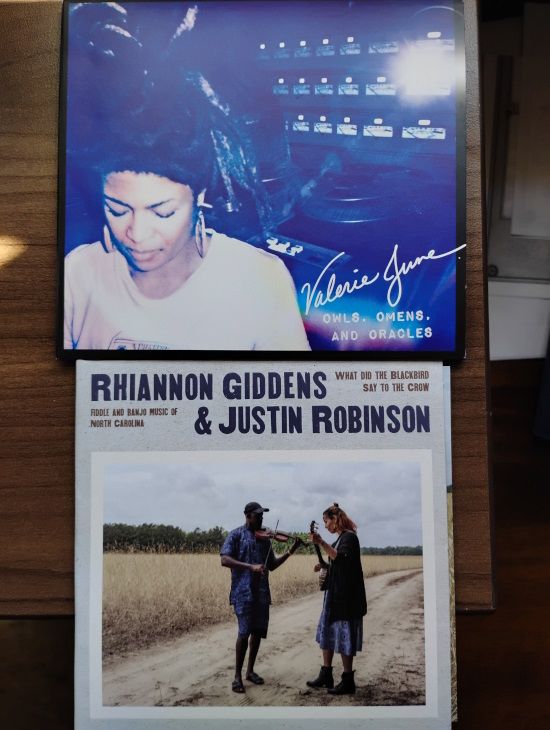
I got not one, but two new albums courtesy of MadCity Music - the latest by Rhiannon Giddens and Son Volt. What would it sound like if Giddens and Son Volt teamed up and made some tunes together?

My, oh my, what a wonderful day!
I got not one, but two new albums courtesy of MadCity Music - the latest by Rhiannon Giddens and Son Volt. What would it sound like if Giddens and Son Volt teamed up and made some tunes together?
Rhiannon Giddens has released another track from her upcoming album, Hope Is the Thing with Feathers, which comes out next month. It's her take on "Freight Train" by the great Elizabeth Cotten.
Since there's a new (newish, anyway) documentary on the Carolina Chocolate Drops, here they are here in Madison at the Orton Park Festival back in the day.
Recently I put a CD shelf together and got all of my music CD's unpacked. Well, most of them. Bootlegs remain in a box. Since then I have bought even more and now have to rejigger things to make room for them on the proper shelves.
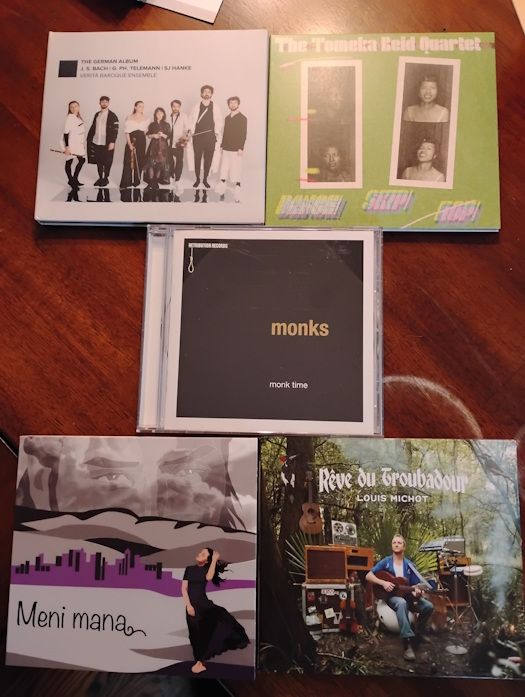
The Louis Michot and Alash albums were bought at their shows here earlier this month while the one by Verità Baroque was purchased online after seeing one of their performances at the Madison Early Music Festival back in January. Tomeka Reid - come back to Madison, please!
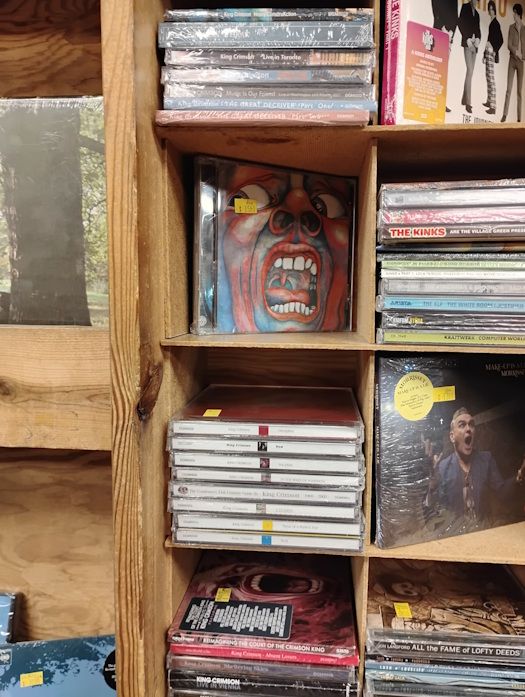
I bought The Monks album just yesterday at B-Side. It was neat because I hadn't been there in ages and had never been to their new digs which, I suppose, aren't all that new anymore. The general layout is the same as the old space and the presence of Steve Manley behind the counter gave a familiar and welcoming feeling. But it was really odd to be able to browse without having to squeeze between shelves. All that space is so odd. Ha!
I was happy to see that the King Crimson selection remains strong there.
A month or so ago I noticed that Faun Fables was scheduled to play here in Madison. While I was completely unfamiliar with their music, I had heard of them as Nils Frykdahl of Sleepytime Gorilla Museum is a member. As his significant other Dawn McCarthy. For this tour two of their daughters would be joining them.
And then just a few days before the show I saw that H.R. Britton and Bucky Pope would be opening. I know Bucky a little but had never heard of Britton. The description at the venue's site included that he is "a storyteller, actor, educator, and musician" and that "He creates full-length solo storytelling shows". Interesting. Maybe we'd get an abbreviated half hour storytelling opening set.
Before showtime I went to the bar for a refill and met Bucky who was chatting with local drummer extraordinaire, Dan Hobson. I said hello and turned around to find Nils Frykdahl at the bar next to me. I was surrounded by musos.
Britton began the show with a solo acoustic performance.
He announced that he would be doing a set of Pink Floyd songs from 1967-1970. Now that I did not expect. Furthermore, it would be an anti-storytelling set as he said that he'd refrain from any banter between the songs. Let the music prevail.
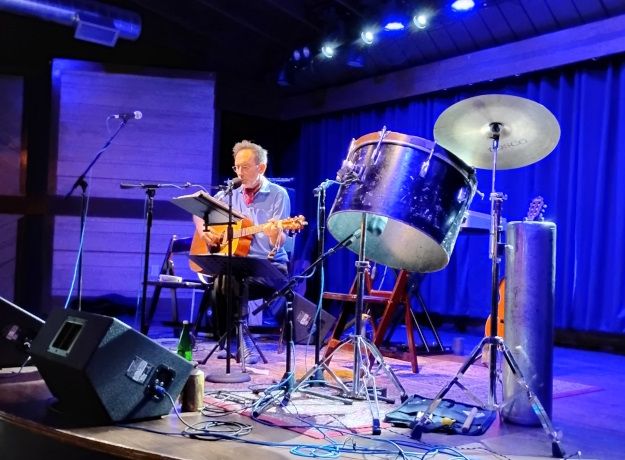
"Set the Controls for the Heart of the Sun" worked really well even without percussion. I thoroughly enjoyed the set but was slightly disappointed that there was no storytelling to be had. I mean, it seemed to be his raison d'être, after all.
Bucky was up next and took to the stage wielding his guitar while his pal Saul grabbed an acoustic bass. (He would later wield an acoustic guitar.) Apologies to Saul for capturing only a sliver of his face.
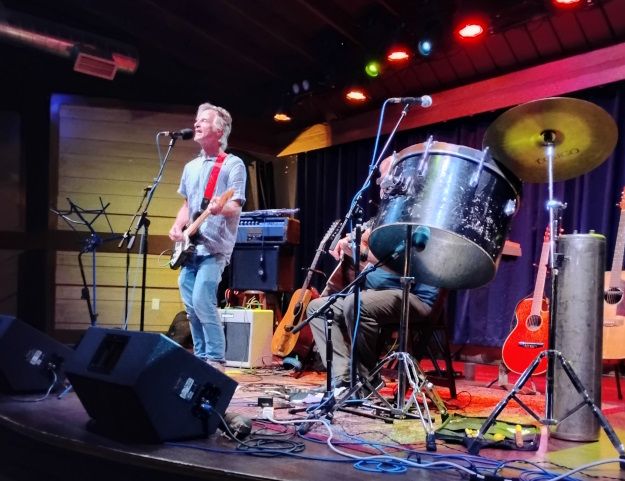
I didn't recognize any of his songs but I enjoyed them, especially one called "Jaunty Larkabout" or something like that. Before leaving the stage he mentioned that he would be performing with Mothballs the following weekend.
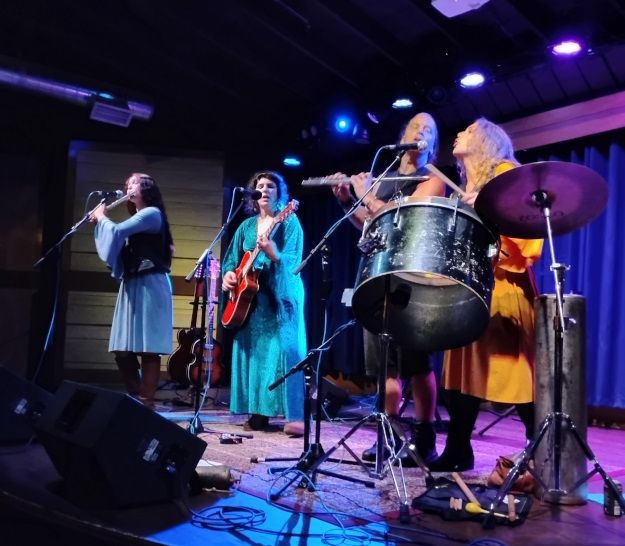
Faun Fables took the stage. Frykdahl was clad in 90s era cargo shorts while McCarthy and their daughters - I never did catch their names - wore what I guess you'd call peasant dresses.
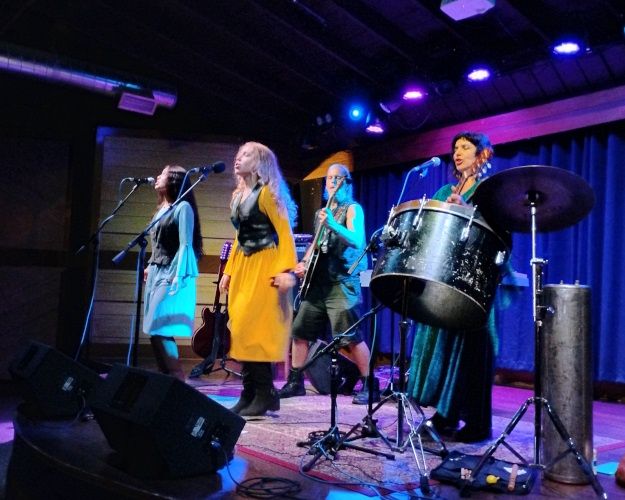
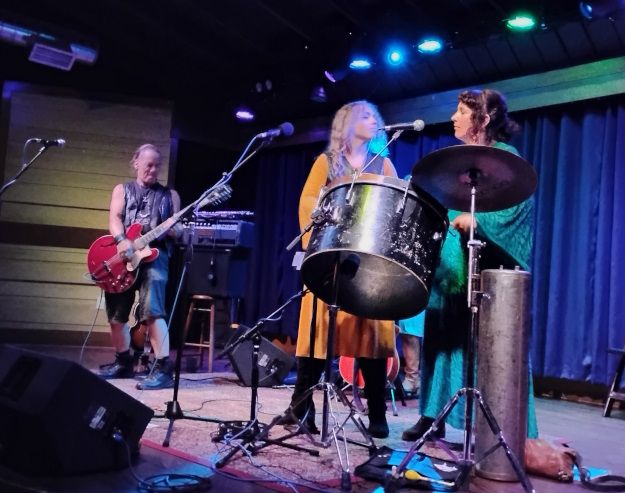
Some of the songs had a very ethereal feel that reminded me of some newer Celtic folk music while other songs were more straightforward in their folkiness. The daughters did a little performance for one song. Or was it two?
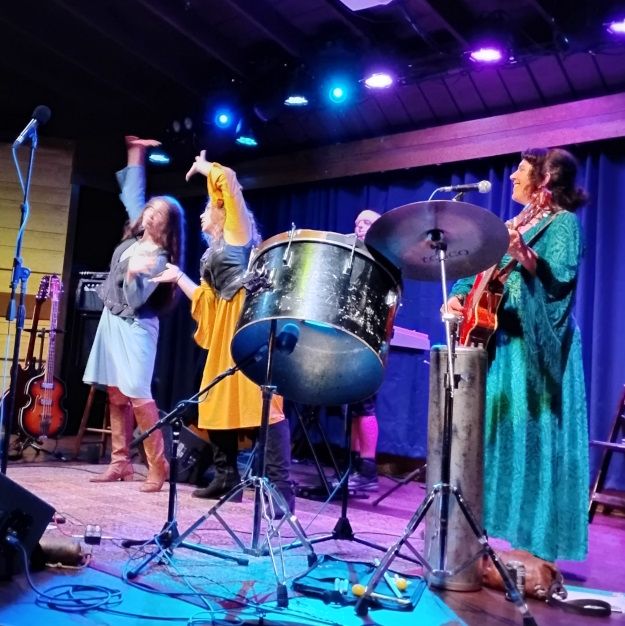
An excellent show! I really enjoyed Faun Fables with all of their folky, pagan vibes. But the songs should not be shortchanged. They were great. Wonderful melodies and some gorgeous singing.
Thanks for the new tunes, MadCity Music. Also thanks to Rhiannon Giddens, Justin Robinson, and Valerie June.
Last weekend I went to see the Alash Ensemble down at The Bur Oak. It was a wonderful show with lots of songs about horses and mountain ranges. Someone captured a bit of it on their phone and has posted it.
Another new tune from Rhiannon Giddens & Justin Robinson. I am really looking forward to their album What Did the Blackbird Say to the Crow which is to be released on 18 April.
Another tune from Rhiannon Giddens & Justin Robinson has been released: "Marching Jaybird". I am really looking forward to their What Did the Blackbird Say to the Crow album which comes out next month.
Rhiannon Giddens has reunited with former Carolina Chocolate Drops bandmate Justin Robinson for a new album called What Did the Blackbird Say to the Crow that comes out in April. Giddens' website describes it as "an album of North Carolina fiddle and banjo music" and one of the album's songs, "Hook and Line" is out now.
Sounds mighty fine to my ears.
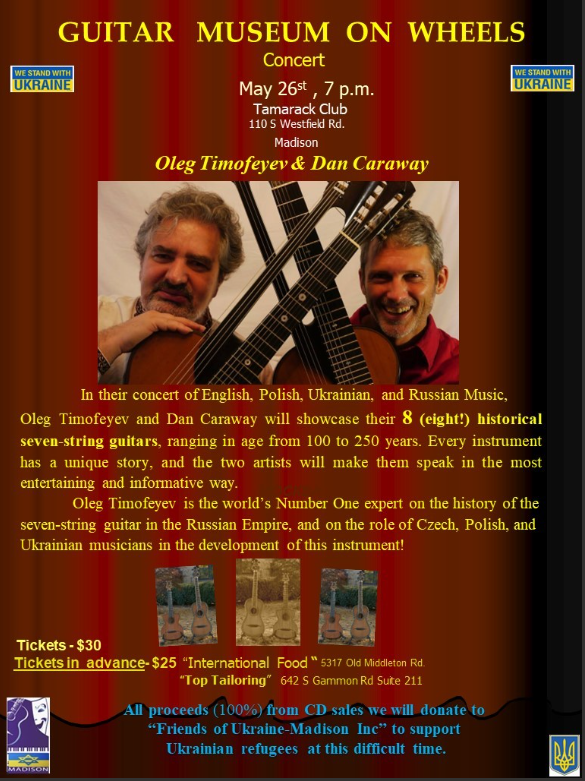
Oleg Timofeyev, the world's foremost authority on the history of the Russian 7-string guitar is going to be performing here in Madison. It's a doubleneck!
I found a live version of "Feast of the Green Corn" by Sacred Harp, a.k.a. - Daniel Bachman. I simply adore this song. Love his vocalizing here. It adds a very ethereal touch.
Sacred Harp - Feast of the Green Corn - Salem, Oregon from Paul Murray on Vimeo.
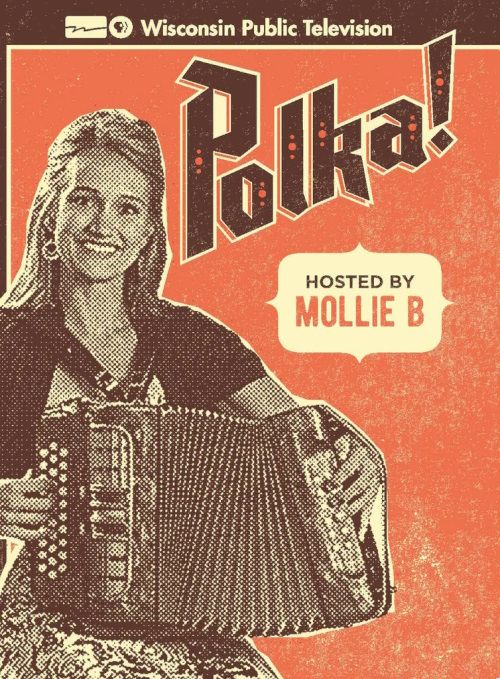
The polka became the official dance of Wisconsin 30 years ago this month. This article notes that the push to make it the state dance "started as a class project by local educator Violet Bergum and her second-grade class at Lindbergh Elementary School in Madison. The class approached a state senator, who drafted the bill."
That was news to me. I was under the impression that Wisconsin folklorist Prof. Jim Leary was the impetus for it. Still, he did testify before the state Legislature in favor of it. You learn something new everyday.
It is nice to see Bruce Triggs celebrating the anniversary on his radio show, Accordion Noir, this week. Check it out here.
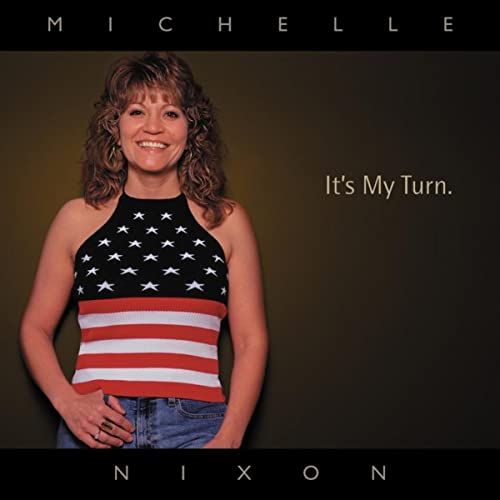
Native Virginians Michelle Nixon and Vernon Hughes both came from musical families and made their first forays into performance at young ages. Nixon developed her singing skills in church while Hughes spent his childhood learning mandolin. At 14, each of them joined their first bands. A chance meeting at a recording session in 1992 led to a musical partnership which has lasted 11 years. In the late 1990s, Nixon and Hughes were together in regional favorites Local Exchange. After its dissolution, the the partnership emerged unscathed. After adding four new members, they adopted their new name and recorded It’s My Turn, their first album for Pinecastle.
Just a brief look at the cover of It’s My Turn will let the listener know what they’re in for. Nixon stands against a plaintive backdrop wearing blue jeans and a tank top with the Stars and Stripes. Locks of hair lazily sit on her shoulders and she has a large caliber smile on her face. With a mix of originals and well-chosen covers of traditional and newer songs, the album tackles bluegrass in the time-honored ways of Bill Monroe with a few contemporary twists.
A cover of Tom T. Hall’s “Harlan” kicks things off. Jason Davis’ banjo and Justen Haynes’ fiddle get the song moving from the get-go and it never lets up. It’s a paean to Harlan County, Kentucky and the people who live there. Personally, when I think of Harlan, I think of the miners and their strike in the early 1970s as documented in Barbara Kopple’s documentary, Harlan County, USA. This explains why I heard a bit of irony in the lyrics but you can’t deny the celebratory mood of the song. The bouncy bass and Nixon’s enthusiastic delivery make this song infectious.
“One Small Miracle” is a woman’s lament as she watches her husband walk out the door and out of her life. While the tone is melancholic, it’s a showcase for Nixon’s fantastic voice which is warm yet full of pleading. Hughes steps up to the mic and croons the traditional “Bees in the Hive” with Nixon adding some great harmony. “Couch Potato,” an instrumental, betrays its name with some blazingly fast banjo picking from its 15 year-old(!) composer Davis who leads the charge. Along the way Haynes and Hughes strut their stuff on fiddle and mandolin, respectively. This song really smokes!
Bassist Jim Green rearranged the gospel “Step Into the Water” and the result is a fantastic bluegrass song. He sings lead here but Nixon and Hughes contribute as well. In fact, the three of them harmonize superbly. A version of “Hello Operator” gets your feet moving once again and is followed by another Tom T. Hall song, “Joan Henry.” Hall wrote this gender-bending take on the traditional “John Henry” with Nixon in mind and she belts it out with confidence.
Michelle Nixon has a great voice and she’s surrounded herself with a clutch of musicians whose talents equal her own. The playing is tight and the vocal harmonizing tighter. And they’re no slouches at penning songs either. The older songs are rendered anew with spirited performances while the newer tunes are respectful of the rich traditions of bluegrass.
(This was originally published at The Green Man Review back in 2003-08.)
A couple months ago I saw Daniel Levitin speak about his new book The World in Six Songs: How the Musical Brain Created Human Nature. A question & answer session followed his talk. The final person given the chance to ask Levitin a question opted instead to make the observation that music a less participatory activity here in the 21st century. Levitin agreed and noted that instead of performing songs with family and friends, most people today are merely listeners who encounter music on the radio, at a venue, or take musical succor from an iPod. To counter this state of affairs, the evening ended with both speaker and audience singing a verse or two of Pete Seeger's "If I Had a Hammer."
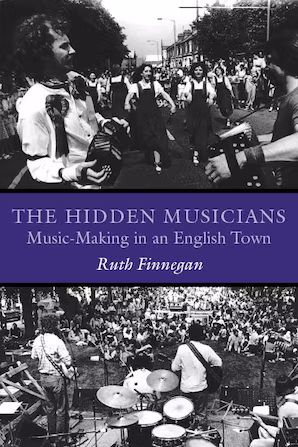
This impromptu bit of sing-along served as a nice coda to the book which I had recently finished, Ruth Finnegan's The Hidden Musicians: Music-Making in an English Town. Nearly thirty years ago Finnegan began surveying the musical landscape of Milton Keynes, a suburb of London. Last year her seminal book was republished and it provides a fascinating glimpse into a world of music-making that remains relevant today in the age of the Internet and the MP3.
The musicians that Finnegan refers to in the title of her book are amateurs of all stripes whose activities she studied and documented in the first half of the 1980s. Her focus was on music as a commitment and activity which enriched the performers and audiences alike, as opposed to a vocation which satisfied pecuniary needs. Music as a text was also ignored so music theory and examinations of how pieces came to be were strictly avoided.
After a couple introductory chapters, Finnegan describes a broad scene populated by amateur musicians practicing a panoply of styles. There were classical orchestras, choirs, jazz bands, folkies, rock groups, and even people playing country & western. They performed at pubs, churches, public halls, schools, and at festivals. Music seemed to permeate almost every aspect of urban life in Milton Keynes. Children learned to play at school and via private lessons, there were concerts where music was the main attraction and there were events where music was a secondary attraction or provided a backdrop to other activities.
While being a work of ethnomusicology, The Hidden Musicians is also part oral history as it details why thousands of people in her town dedicated countless hours to the pursuit of music. For example, some outfits, especially choirs and brass bands, had histories going back decades and many performers said that embracing traditions and making them their own held great meaning for them. It was common for people to note how their musical activities were intricately bound with friendships and socializing as well as the inherent joys of creating and playing music.
Meticulously, Finnegan examines each genre and looks at who participates in the associated scenes. She investigates who the musicians are, their motivations, and where they perform. Also noted are the audiences and their various expectations. The great virtue of the book is that it never strays far from the proposition "that music whether in Milton Keynes or elsewhere has many non-musical implications." Music itself may be romantically endowed with abstraction and universality but, for amateur musicians, their avocation requires time, commitment, and a juggling act to balance performance with work and family.
Much of The Hidden Musicians is devoted to what most people already know, namely, that amateur musicians work very hard for little or no pay. However, what makes this a particularly important and engaging work is how Finnegan documents the ways in which music is part of the tapestry of life for urban dwellers who, the prevailing wisdom tell us, are strangers to each other in a sea of humanity. What The Hidden Musicians reveals is that music is much more than a distraction or simply entertainment. It is a fundamental avenue for creating and strengthening social ties and a path for people to express themselves in a myriad of ways.
(This was originally published at The Green Man Review back in 2003-08.)
It was a rainy Saturday when I caught Christine Costanzo at a local café. Amidst the chatter and the roar of the espresso machine, Costanzo delivered an intimate performance armed with just her guitar, voice and a set of mostly original material culled from her EP and new album.
It was hard not to find a parallel between the dark skies and seemingly pervasive melancholy of her music. Starting with the opening strains of "New York Song," Costanzo laid bare a view of love propped up by, in her words, "loss and longing."
Her playing and singing have the starkness of Gillian Welch. Most of the songs featured hushed, gentle melodies but the pace picked up as the terrain became rougher. Costanzo has a beautiful voice that exudes a sense of weariness with a touch of hope. Considering the sparse instrumentation, it was her voice that really carried the songs. Sometimes she has a tender, pleading voice. This is exemplified in "Send Me Back to Ohio" which reminded me of "Oh, Bury Me Not." It's a somber story of a woman from California who meets the love of her life; he takes her to east to Ohio where they begin a family. Upon her husband's death, she finds herself once again in California mourning: "When I go, send me back to Ohio/Bury me where my first love lay."
At other times, her voice is an aching whisper as in "Lay Your Love Down" when she asks, "Do you think I'm afraid to lay my love down?" Costanzo's view on love is rather akin to Richard Thompson's. In "Appalachian Sky" she sings of "the landscape of my love for you" but it seems barren. In "Big Sky," the singer reaches out for her lover but is left with "a hand full of dreams and a/hand full of air." "Used To Be So Free" is more upbeat musically but the lyrics are a lament over days gone by.
Changing the scenery to add a hint of the political was the scornful "Reap What You Sow" in which a farmer loses his farm. Needless to say, he had no kind words for those who forced his hand. A cover of Steve Earle's "Ft. Worth Blues" late in the show was the only non-original. Costanzo ended her set with "All the Songs Unfinished," which also closes her new album Big Sky.
My only complaint was that she didn't try to engage the audience more. There were the obligatory "thank-you"s and pitches for her new album but she refused to tell us about the songs or herself. But I suppose this is part of her style. With an introspective streak a mile wide, she lets her music invite you into her world rather try to drag you into it.
(This was originally published at The Green Man Review back in 2003-08.)
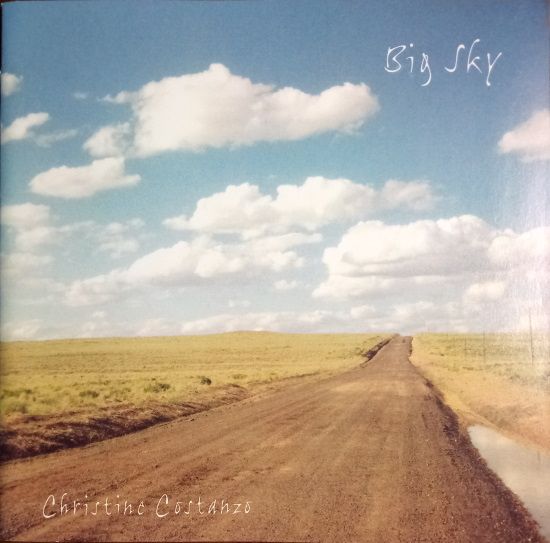
Originally from rural Ohio, Christine Costanzo moved to Madison, WI in 1994 and has been part of the folk scene for three years. Last year saw the release of her first recording while her debut album is fresh off of the presses.
Christine Costanzo is a 3-song EP featuring only her smooth, Joan Baez-like voice and acoustic guitar. The lead track, "Huck Finn," lazily moves along not unlike the river and carefree characters in its lyrics. A quietly picked guitar introduces "Lay Your Love Down." With her beautiful voice full of longing, Costanzo contemplates a lover and solemnly pleads: "don't you think it's time/we laid our love down?" The mood shifts once again for the last song, "Reap What You Sow." Musically, the song has a bluesy feel but the lyrics are of defiance. A farmer is forced to sell his farm and pours his contempt on the banker, presumably, who is buying the land: "But I'm gonna die a wealthy man/the knowledge in these hands/you'll never understand."
Costanzo's guitar playing is not slick but it doesn't need to be. It suits the songs fine and allows her highly expressive voice to shine.
For her first full-length album, Costanzo enlisted the help of various musicians to flesh out her sound. In addition to her guitar and voice, Big Sky features bass, fiddle, banjo, etc.
"Appalachian Sky" starts things off and it encapsulates what Costanzo's songs are all about. Musically, the lonely banjo of Doug Brown hovers in the background, leaving her voice and guitar in the fore. Lyrically, the first stanza says it all: "The landscape of my love for you/lay all along a county road/Winding through the Appalachian foothills and the sky." Her lyrics are steeped in bucolic imagery and chart a landscape of love that is littered with loss and resignation. She continues: "One day admit defeat, melt and take their/place in that sky."
"Nothing Left to Say" finds the narrator of "Lay Your Love Down" throwing up with white flag while the dolorous harmonica of Catfish Stephenson lingers in the background like a fading memory. Chris Wagoner's lilting fiddle weaves its way around the narrator's maudlin pleas in the beautiful "Send Me Back to Ohio." The metaphor of the sky returns in the title track. But instead of an Elysian Field for failed lovers, it is now the chasm between them: "I reached out my hand for you/I saw your eyes fading out of view/Left me with a hand full of air, the sky came between us."
Costanzo dons the protest singer hat and tackles racism on "Sylvia Plath" and "Minor Litterings." While they have catchy melodies, I like my political songs to have more fire and brimstone. I wished she had gotten a bit angrier, a bit more gritty. Still, the musicianship is solid with the understated percussion on the latter particularly effective.
Moving back to the personal realm, Costanzo laments days gone by in "Used To Be So Free." "Darling a north wind's blowing in/And the autumn's all around/Falling." A newly recorded version of "Huck Finn" featuring Wagoner's fiddle lifts the mood a little before leading to the album's closing tune, "All the Songs Unfinished." Costanzo is alone with her guitar again and she plucks out a lonesome melody. But she betrays it by curling her lips around a ray of hope at last: "Silent raindrops meeting still water/There, I know you and I rest/Complete."
Despite the added instruments, the album feels very warm and intimate. It's not a showcase for instrumental virtuosity but rather it's about abetting Costanzo's wonderfully emotive voice as it traverses a landscape that perhaps has a few peaks after all.
(This was originally published at The Green Man Review back in 2003-08.)

