Seen before Once Upon a Time in Harlem at Point.
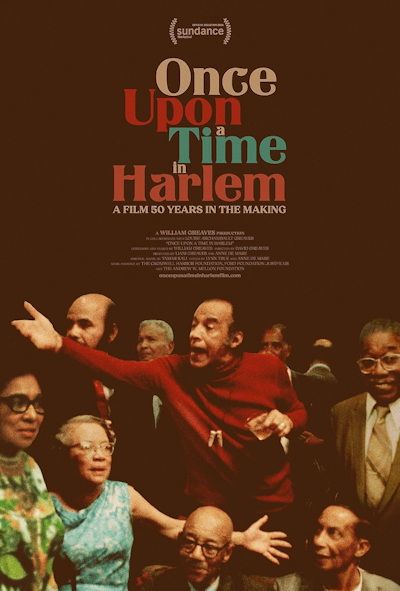
When I think of the Harlem Renaissance, I think of Langston Hughes thanks to a high school English teacher. Once Upon a Time in Harlem did a fine job of expanding my definition of the marvelous cultural movement from the 1920s. My understanding is that the gathering of the HR luminaries was called by William Greaves, he who directed Symbiopsychotaxiplasm. Greaves assembled a crew to shoot the footage which went unused and put into cold storage until his son David put it all together after his death.
Among the attendees were photographer James Van Der Zee, Harlem librarian Regina Anderson, painter Aaron Douglas, actor Leigh Whipper, and on and on. They all gathered at Duke Ellington's home in Harlem in August of 1972 along with Greaves' cameras.
The film begins with everyone arriving and people who hadn't seen one another in decades renewing acquaintances (friendships?). For the first half, or perhaps more, of the film the camera captures the attendees reminiscing about their youths and giving we in the audience a feel for what the Harlem Renaissance was. Not only was Langston Hughes writing poetry, but Douglas painted and another fellow produced theater, etc. I'd never heard of sculptor Augusta Savage before but we got a good dose of memories of her.
Of course Hughes came up but so did Marcus Garvey. I recall Paul Robeson being discussed as well as Zora Neale Hurston. I was really pleased to see a cutaway to a photo of Hubert Henry Harrison known as "the father of Harlem radicalism". That guy was not only incredibly thoughtful and smart but also principled and brave. Jeffrey Perry has written a two-part biography of Harrison though I've only read the first, Hubert Harrison: The Voice of Harlem Radicalism, 1883–1918.
The roughly second half of the film features the attendees discussing and arguing over the meaning of the Harlem Renaissance. The guy in the red sweater, I cannot recall the gentleman's name, seemed particularly keen to disappear up his own arse when talking about the movement's meaning. And, being a bunch of old farts, there is some lamentation, especially by a woman there, that the youth of the early 70s were woefully ignorant of the Harlem Renaissance and the past more generally. The whole "How can you know where you're going if you don't know where you've come from?" kind of thing.
I really enjoyed Once Upon a Time in Harlem as it illuminated something that, for me, was only slightly visible and mostly obscured by shadows. There is much more to the HR than Langston Hughes and all manner of people participated. The librarians may not have written poems or novels but they provided a space for black creativity to flourish.
I'll also note that the movie reminded me of times when my father-in-law got together with other black men his age and they reminisced about the civil rights movement of the 1960s and those turbulent times. Perhaps somebody ought to get a bunch of folks who were part of that movement together for cocktails in front of cameras.
Onto the trailers.
Whenever I see the trailer for Behemoth, I feel like I should be more interested in seeing it than I am.
A screening of this got added to Cinematheque's calendar next month so, if you cannot make that one, you'll theoretically be able to catch it at Point.


No comments:
Post a Comment