Showing posts with label Berliner Weisse. Show all posts

24 January, 2021

Let Me Bring You Tips From the Wood: Want a Fresh Cut? by 1840 Brewing Company


Most of my last few beer reviews have been of beers by newer breweries from Milwaukee. This holds true for today's post despite the name 1840 Brewing Company which appears to have sold its first beers in 2017. The "1840" part comes from the year that Milwaukee's first commercial brewery opened. That was the Milwaukee Brewery sometimes called "Owens' Brewery" after Richard Owens, one of the three founders.

1840 bills itself as an "urban farmhouse brewery" and I am not sure what that means. Perhaps my Googling skills have gone soft. When I try to get a definition of this, I just get articles from Milwaukee outlets that note it is an urban farmhouse brewery as if the definition was self-evident and would mean something to the vast majority of humanity. Oh well.

My understanding is that 1840's brews have only recently begun appearing in Madison. I found them recently and decided to give one a try after seeing that they had a Berliner Weisse on offer in which spruce tips were involved. The beers come in these neat brown half liter bottles with some vaguely old-timey labels making them look like Samuel Taylor Coleridge's laudanum vials.

The spruce made me think of the spruce Goses I'd had. Bayerischer Bahnhof, one of the few German breweries that makes Gose, had a spruce variant and some of it ended up Madison. I had a pour at the Hop Cat which used to be downtown. And then there was a spruce Gose by Freigeist Bierkultur. I rather enjoyed both of these biers so I was looking forward to a Berliner Weisse imbued with some coniferous goodness.

When I was putting the bottle into the refrigerator, I read the rest of the label and saw that it was dry hopped with NZ Kohatu® hops that impart tropical fruit flavors.

D'oh!

I felt like Homer Simpson in the flying pig episode, "It's just a little fruity. It's still good, it's still good!"

Caveat emptor.

Despite not - how shall I say it? – being a proponent of trendy hops that taste like tropical fruit, I plowed on.
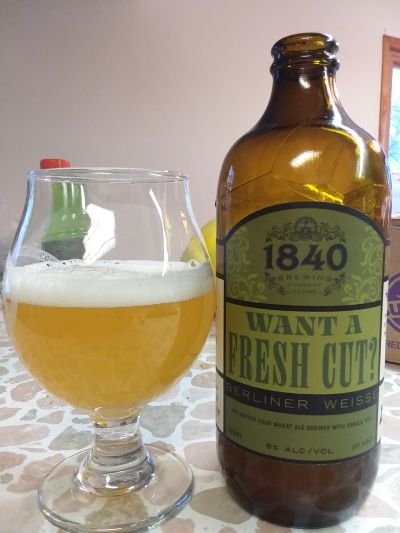

Want a Fresh Cut? poured a lovely hazy yellow with a nice, loose white head that didn't stick around too long. It had the requisite lemon/citrus smell of a Berliner Weisse along with pine and tropical fruit. The latter reminded me of mango. Or was it passion fruit?

I tasted that lemon in the assertive sourness. Carbonation seemed a little on the low side for a style with the moniker "Champagne of the north" but it was by no means flat. There was still plenty of fizz to tickle the tongue and add some dryness to complement the tang. The piney taste remained in the background, behind all the sour and made a nice counter flavor.

And then came the hops.

The fruit flavor was, um, assertive, and almost makes you forget you are drinking a Berliner Weisse, for a split second. And the piney taste was laid low by mango. In addition to tropical fruit, Kohatu® hops are also supposed to taste like pine needles. To my taste, fruit overwhelmed any pine taste and, honestly, I assumed the sharp, resiny taste came from the spruce tips but, never having tasted these hops previously, some of that could have come from the Kohatu®.

The mango/tropical fruit taste lasted into the finish as did a hint of pine that lingered well after the beer was down the hatch.

Want a Fresh Cut? is just not my thing. I think there was a tasty kettle soured Berliner Weisse in that bottle but it was overrun by tropical fruit hops. It had just the perfect level of sourness for my taste and was optimally carbonated for me as well. And I very much enjoyed the pine flavor. It was fairly mellow but was still worked well against the lemony bite. But the tropical fruit was too much. Not only that, I also don't particularly care for strong fruit flavors from hops. I've had mango syrup in a Berliner Weisse and it was fine. I've also had many a Berliner Weisse aged on fruit and they were very tasty. So why would I object here?

I think the answer is partly how my tongue works and partly psychology. I am not inclined to drinking Berliner Weisse with mango syrup all day long. One is fine. But the sugar adds body and the sweetness plays off of the sour in a way that seems naturally pleasing. They are good sparring partners. Yeah, the mango flavor isn't real but the drinker knows it's artifice and it works for a glass.

Schell has a whole program devoted to Berliner Weisse and they usually age the beers on fruit. Real fruit. So you get the sugars. In addition, the fruit flavor is real. Adding that flavor via hops violates what former UW professor Noël Carroll might call a category violation. You're tasting fruit with no fruit in sight. My primitive ape brain is programmed to look askance at such things.

I think I'd have liked Want a Fresh Cut? if the fruitiness were still there but much less prominent. Let the spruce and the sour do their pas de deux and the hop-spawned tropical fruit can be an accent. However, if fruity tasting hops are your thing, Want a Fresh Cut? may just be right up your Strasse.

Junk food pairing: Pair your Want a Fresh Cut? with the tropical goodness of Jay's Krunchers® Sweet Hawaiian Style Onion Kettle Chips.

11 December, 2016

Last Gasp of Summer: Cherry Hallo Ich Bin Berliner Weisse by Mikkeller


While my previous review was of a bier getting a little long in the tooth, this one is of a brew that is definitely, well, younger. Cherry Hallo Ich Bin Berliner Weisse was released sometime this past summer though, if memory serves, I didn't find a 500ml can of it around Madison until the autumn.

It was brewed by Mikkeller, a Danish gypsy brewer. I think the can indicated where the bier was actually brewed but it's long gone and I didn't note it down. Mikkeller reminds me of Wisconsin's own MobCraft in that store shelves are always filled with a myriad of their brews but the selection is constantly changing. Don't like what you see at your local bottle shop? Just come back next week and you'll be confronted with a whole new collection of their brews. Does Mikkeller even have an annual beer?

My exposure to their libations is quite limited. I suppose this is a combination of most of their beers just not appealing to me and price. I saw a $25 bottle yesterday which is out of my price range except under certain circumstances. But the stuff does have to travel across the ocean and is presumably not brewed in mass quantities so it can't be cheap.

It seems odd to be writing about a Berliner Weisse as snow falls outside my window. I am quite behind in my reviews.

Hallo Ich Bin Berliner Weisse poured a gorgeous red hue with a purple tint. It was, as expected, rather cloudy. I managed to top my glass with a large, firm pink head that stuck around for quite a while. Also present was the customary surge of bubbles inside. Champagne of the North indeed. This was one pretty brew.

The lactobacillus gave a wonderful lemony scent which was accented by that of the cherries. Tucked in the aroma was also some grain/wheat.

On the first sip my tongue was treated to a healthy dose of fizz to start things off. This was followed by a large tart blast that was only mildly citrusy/lemony. The cherries brought up the rear and, as with the aroma, had to be content with aiding and abetting the sourness. Unlike a lot of Berliner Weisses I've had, I could taste the wheat. Not strong, mind you, but easily discernible amongst the other flavors.

The finish was really nice as some tartness and the cherry lingered until the next sip. There was no lack of Schaumhaftvermoegen as my glass was lined with foamy streaks and spots aplenty. It looked good going out just like it did coming in.

This was a very fine bier. The tartness was firm but not deadly although the carbonation was plentiful enough to boost the acidity towards Destihl levels but it never got that intense. The cherry added a tasty, if subtle, layer of flavor that contrasted nicely with the sour. It was light, fizzy, and refreshing and writing those words makes think of warmer days as yet more snow falls.

Junk food pairing: I prefer lighter accompaniment with my Berliner Weisse. Try a bowlful of Bugles. However, I can also see trying to capitalize on the cherry here and so it would not be out of place to have a Hallo Ich Bin Berliner Weisse in one hand and a Hostess Cherry Pie in the other.

29 August, 2016

A Berliner in Verona: Berliner Weisse by Wisconsin Brewing Company


This past Wednesday the Wisconsin Brewing Company loosed a small batch of Berliner Weisse into the wild as part of their Forward! series. My understanding is that these brews are released and then feedback is solicited with the possibility that one of these test brews may make it to the big time and hit store shelves and tavern taps.

I am not sure who brews these beers and wouldn't be at all surprised if they are made by brewmaster Kirby Nelson's minions. Just look at WBC's partnershipwith the UW-Madison's College of Agricultural and Life Sciences and the fact that Blister in the Sun was concocted by the minion known as Clint Lohman. The brewery has a reputation for working with people new to the trade and allowing them to show off their chops.

The Forward! series has come up with a few beers these past two or three months that have interested me and this trend looks to continue into over the coming weeks. And so once more unto the breach…

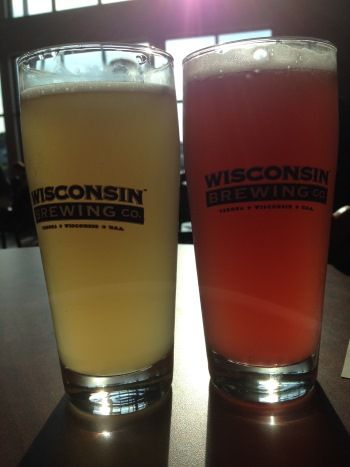
Berliner Weisse poured a light yellow hue and was quite cloudy. There was about an inch of loose, white foam atop the glass that lasted just shy of a minute. There was a fair number of bubbles in the bier but not exactly what one would expect from the "Champagne of the North".

The aroma was puzzling because there wasn't much of one beyond a very faint citrus smell from the lactic sour. I encountered this same phenomenon last month with WBC's Czech pils that was devoid of scent just like Jean-Baptiste Grenouille. Perhaps there is some kind of olfactory quirk at play here. Breweries smell like, well, breweries – they smell like malt in hot water. Maybe one's nose becomes desensitized to certain beer smells if you are standing in a room with the aromas of the brewing process swirling and eddying around you. Still, I would think that hops and lactic acid smells would still be discernible even if more delicate malty ones were not. Do the Germans have a lengthy word for this kind of thing?

Upon tasting I noticed that there wasn't a whole lot of carbonation. Not too surprising given the relative paucity of bubbles. The tartness was middle of the road, although I don't mean that in a pejorative sense as when discussing rock music. There was some lemony citrus taste to the sour and I was surprised at how full the wheat flavor was.

At the finish the taste of the wheat lingered along with a mild lactic tartness. There was no Schaumhaftvermoegen.

While it may not rank with the greatest Berliner Weisses ever made, this bier was pretty tasty. It wasn't mega-knock-your-socks-off tart but neither was the sour so faint as to approach homeopathic strength. My preference is for a tad more tartness but I cannot complain as it had a nice, mildly acidic taste. However I will complain that the bier was short on citrus. I wish it had a little more of that lacto-lemon flavor. Oh, and more carbonation too. On the other hand, I enjoyed the wheat flavor quite a bit.

Whatever the flaws, it still made for a tasty and refreshing on a hot summer day. It comes in at 3.8% A.B.V., by the way, and the brewery has raspberry and woodruff syrups available for those wanting a shot of sweetness.

Junk food pairing: I thoroughly enjoyed the jalapeño white cheddar popcorn we had while quaffing our Berliner Weisses. The salt enhanced the sour which was complemented by the mild chili flavor.

25 July, 2016

It's All Greek to Me: Westporter Weisse by Parched Eagle Brewpub


Last month when I stopped in at the Parched Eagle Brewpub to try out their ESB, proprietor Jim Goronson was putting the finishing touches on a Berliner Weisse. It took me a few weeks but I eventually made a return trek to try out the bier which had been christened Westporter Weisse.

Little did I know that day in June that Goronson was back in his brewhouse wielding Greek yoghurt. I guess this makes Westporter Weisse probiotic or some such thing. Apparently yoghurt is blessed with multiple strains of lactobacillus, the bacteria that gives the Berliner Weisse (and other sour brews), their distinct citrusy tartness. With Athens Gyros next door to his building, Greek yoghurt must have been a no-brainer for Jim.

While I neglected to ask him exactly how he soured his bier, my understanding is that you put a dash of yoghurt into some warm wort which is the lacto equivalent of the back seat of a car - an ideal breeding ground for little critters. After a honeymoon of a few days at the right temperature, you have a colony of lactobacillus ready and waiting for the right kettle souring opportunity.

When I received my pint of Westporter, I was surprised at how turbid it was. The brew looked like one of those New England eyepahs that I hear are taking the world by storm. This is stuff looked like a whiteout in a glass. Well, except it was light yellow. The small white head didn't stick around very long and I was unable to see through the lemon haze to check on effervescence.

Things returned to normality as my nose hovered over the glass taking in wheat and sourness. The sour smell was lacking the usual lemon bit at first but it became more citrusy as the bier warmed. While the mildewy, wet blanket aroma of brettanomyces yeast has a long history with the Berliner Weisse, none was introduced here. And so some strain of lactobacillus was responsible for the faint, yet very pleasant, funky smell here.

While Destihl's Berliner Weisse has a lock on the Best Beer for Making Voltaic Piles category, Westporter has a good, firm tartness. Cold, the tartness flies solo but is joined by the expected lemon-citrus taste as the bier warms. The wheat poked through a little bit as did a mineral water flavor but I didn't taste much carbonation.

The tartness slowly faded on the finish and left my mouth with a slight citrus tang and the aforementioned mineral tastes. Schaumhaftvermoegen consisted of a few scattered spots of foam.

Key to enjoying a Westerporter Weisse is letting the bier warm up a tad so that the lemon scent and taste from the bacteria comes through to really bring the tartness to life. It falls in the middle of the pack as far as the acidic taste and sourness goes. It won't dissolve metal but it may be something of a challenge for those new to sour brews. (This can be remediated with the strawberry syrup on offer at the bar.) Westporter has a light body perfect for this heatwave – it's only; 3.5% A.B.V. - but I wish it had more carbonation. There's also a mineral aftertaste that, although not strong, challenged my tastebuds to figure out what to make of it. It seemed more out of place than bad tasting.

All in all, not bad. Westporter Weisse was, to the best of my knowledge, the first beer I've had soured using yoghurt and it'll take more tasting to figure out if the process lends anything unique to a brew.

Junk food tasting: Keep the Greek theme going. With a Westporter Weisse in one hand, put a pile of Shearer's Rosemary and Feta Kettle Chips in the other. For dessert, pair Westporter with a Hostess Greek Yogurt Swirl cake.

22 July, 2016

Your Brewer Was a Hamster: Berliner Weisse with Elderflower by Victory Brewing Company


I'd bet a dollar to a doughnut that most people who laughed at the scene in Monty Python and the Holy Grail where the French guard insults King Arthur by saying, "Your mother was a hamster and your father smelt of elderberries!" hadn't the faintest notion of what elderberries smell like. We laughed anyway not because of any inherent quality of the elderberry but because of the sheer absurdity of the scene.

I'd also wager that most people who see a bottle of Victory's Berliner Weisse with Elderflower will have never tasted elderflowers and that a sizable chunk of drinkers will, like me, have Monty Python and the Holy Grail spring to mind.

Late last year Victory announced its Blackboard series, an annual run of four limited edition brews. The beers are alternately draft-only and bottled. Berliner Weisse with Elderflower is the third entry this year having been preceded by an Agave Eyepah with Grapefruit and a Dry-Hopped Brett Pils. (Oatmeal Porter with Hazelnut will close out 2016.) Thankfully the Berliner Weisse was bottled because there's no way I'd be able to make it out to sub(ex?)urban Philadelphia to try it.

Now that we're firmly entrenched in the dog days of summer, the Berliner Weisse is a fine style to indulge in with its light body, abundance of carbonation, and tangy tartness. And hell, who knows what additional delectations the elderflower may bring to repulse the positively plutonian heat.

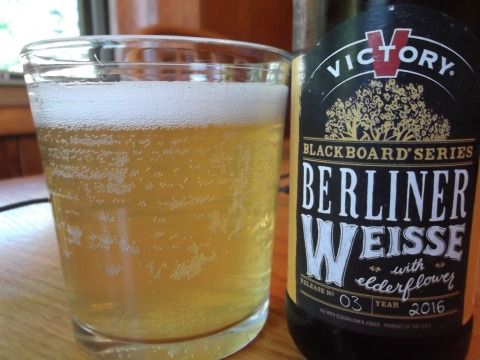
Berliner Weisse with Elderflower pours a pale yellow with the characteristic haze that wheat brings to beer from its proteins. (I wonder when we'll have Kristall Berliner Weisses.) I got a half inch or so of frothy, white foamy goodness that lasted about half a minute. As expected, this is an effervescent brew with bubbles aplenty inside.

There was a big lacto-lemony sour scent along with a floral/herbal aroma that leant towards the sweet. This was my first encounter with the elderflower in the beer and quite pleasant it was. New Belgium's Gruit also had elderflowers and it too had a nice floral smell.

That lemon did double duty and made for a bracing, sour salutation for my tongue. The lactic acidity along with the firm carbonation gave the bier a really nice bite. Wheat was hinted at while the elderflower added a floral touch that was on the earthy side and another layer of tartness. I presume this latter taste was the elderflower, anyway. It was a bit like the child of a tart, baking variety of apple and a quince.

This may not be the most tart Berliner Weisse I've ever had but it has a good, sturdy sour taste and it should not be surprising that it lingers well after the liquid has left my mouth. Oddly enough, the wheat then comes on strongly followed by a little berry fruitiness and a hint of sweetness. A most unexpected, though welcome, finish. Alas, my glass was left with no Schaumhaftvermoegen.

Fantastisch! Even ohne the elderflower this is a great Berliner Weisse. The tartness is strong but not deadly as you with a Destihl brew and it has the requisite light body and plentiful carbonation. At 5.2% A.B.V., it's a bit more potent than usual. Adding in the elderflower laces an already wonderful brew with shades of sweet botanical joy.

Junk food pairing: The Berliner Weisse pairs well with lighter fare such as thinly cut potato chips. Plain ones will allow you tease out the elderflower accents. On the other hand, you may want to play up the lemony-citrus flavors of Berliner Weisse with Elderflower and so get your hands on a bag of Lemon Oreos.

10 April, 2016

She Comes in Colors Everywhere: Berliner Weisse from Next Door Brewing Company (With Bonus Content!)


The wife and I made a trek over to Next Door Brewing over the weekend. I needed a beer after agreeing to bid rather more than I had wanted on a house. Id' heard tell that there was a Berliner Weisse available along with a trio of flavored syrups. It was barely above freezing outside so it was not exactly optimal weather for a light, low-alcohol, high-quaffability brew but occasio praeceps.

At its most popular, there were reputed to be several hundred breweries making Berliner Weisse. But the ever-increasing popularity of lagers, the spread of the formerly Bavarian-only Reinheitsgebot, and various wars led to the style's decline. Today I believe there are only one or two larger breweries still making the bier along with a smattering of microbreweries doing their level best to revive the indigenous style.

I have read that the practice of adding a shot of syrup ("mit Schuss") originated sometime during the bier's heyday, the 19th century, and was common by 1900. Traditionally drinkers are given the choice between raspberry (Himbeere) or woodruff (Waldmeister). Next Door, however, offers raspberry, mango, and Blue Curaçao. While there, we looked up just what the heck Blue Curaçao was and discovered that it was the flavor of the peel of the laraha, a citrus fruit found on the island of Curaçao. Why the liqueur is colored blue remains a mystery.

I ordered a flight of four samples: the straight Berliner Weisse and one each of every syrup.

The unadulterated bier was a hazy light yellow. There was no head but I could see a goodly number of bubbles inside the glass. Taking a whiff, I caught the expected citrus sourness characteristic of the Lactobacillus-laced style. Unexpected, however, was a rather strong floral scent that was slightly sweet. I was reminded of rose hip jelly. The beer menu noted that the bier was dry-hopped with Huell Melon hops, a newer German variety, and I presume that was what I was smelling.

That sweet floral scent was also found in the flavor along with a strong lactic tartness which gave a nice acidulousness. Despite a big hop flavor, the bier was not bitter and I could discern little grain flavor. (I'm not sure how much wheat Next Door used.) But it had a nice light body that made me yearn for a summer day.

Mit Schuss: Raspberry. A nice light red color and the bier tasted like fresh raspberry juice. The syrup definitely added a touch of sweetness but it also lent a really nice tart flavor as well. All in all, it didn't dull the bier's natural tartness very much and instead added more. Well played, Next Door. That floral hop flavor lingered in the background and complemented the fruitiness very well.

Mit Schuss: Mango. Hard to tell that it had any syrup in it by sight as it looked very similar to the unadulterated bier. Again, it had a nice fresh, fruity flavor but this was sweeter than the raspberry. But it had a somewhat restrained sweetness; this did not taste like sugar water by any means. The mango worked really well with the floral hop flavor again.

Mit Schuss: Blue Curaçao. It had that turquoise hue that made it look like mouthwash. This syrup was much more subdued than the other two. The bitter orange flavor was really mellow while the syrup generally was not very sweet. I really enjoyed the gentle bitterness here. This one seemed to dull the floral hop flavor more than the others but it was still delightfully present.

The addition of Huell Melon was a stroke of genius. I thoroughly enjoyed the sweet floral aroma and flavor it provided. It added another dimension to the traditionally light, tart, and fizzy bier. (It comes in at 3.8% A.B.V.) I adored the fresh fruit flavors of the syrups as well as their restrained sweetness. Each added something different to the mix – tartness, a heightened (yet still fairly restrained) sweetness, and bitterness. I am really looking forward to the warmer weather as Next Door promises a rotating selection of syrups. Personally I am keen on tasting their take on woodruff syrup.

Junk food pairing: I recommend a hearty plate of poutine with your Berliner Weisse from Next Door. It's tartness and acidity make for a nice contrast to the food's smooth fattiness as will any fruit syrup you choose.

BONUS CONTENT!!

Next Door gets credit from me for serving half-pints. This allows for more sampling and accommodates those times when a full beer is too much. Less waste. And so, in addition to my Berliner Weisse flight, I also got to check out Pilot Pils #2.

It featured New Zealand Moteuka hops which lent a rather nice citrus flavor and bitterness. I felt it had the hoppiness more like a Czech pils than a German one but it was not as hoppy as a full-on version of the former. It had a nice bready flavor but felt that it should have been more like cracker. It just tasted heavier than I expect from a pils. And it needed more carbonation. Not many bubbles to be found and precious little of the fizzy taste. It should have been a bit drier, to my taste. On the other hand, I really liked the hops and the level of hoppiness here.


EVEN MORE BONUS CONTENT!!

My wife ordered a pint of the Märzen and I had a sip. It was tasty. Very tasty indeed. I really liked the malt flavor which was nice'n'toasty, full of Maillard reactiony goodness.


09 March, 2016

Hello Daddy, Hello Mom: Black Forest Cherry by August Schell Brewing Co.


I'm your Black Forest Cherry bomb

The fourth Noble Star Berliner Weisse is Black Forest Cherry. Just as Framboise Du Nord used 5,000 pounds of raspberries, so does this one use 5,000 pounds of the eponymous fruit. And just like I did with Framboise Du Nord, I thought of a New Glarus beer as I opened my Black Forest Cherry – Belgian Red. Two sour cherry beers, sure, but two rather different beers nonetheless.

A Schell's press release said the inspiration for this bier was the old German tradition of putting some cherry liquor into a Berliner Weisse. (I think they may have meant liqueur but that's not a big issue.) I'd never heard of this practice (no surprise there) and thought that the addition of cherry was simply to produce another bier flavored with traditional German fruits as opposed to kumquats or other tropical ones. On the other had, I wasn't surprised. I've read of Germans putting caraway flavored liquor into their bier (perhaps Schell will brew a caraway Noble Star) as well as northern Germans drinking bier with a shot of Korn which is basically vodka made from rye.

As the fourth release we've come to the summer of 2014, about a year after the first Noble Star. My bottle was filled in July 2014.

Black Forest Cherry pours an auburn hue with a little extra red in there. Unlike the last Noble Star, this bier was downright hazy. Again I was unable to generate any more than a small tan head that dissipated quickly. As expected, there were plenty of bubbles inside the bier moving on up.

I recently read a wine review in which the author claimed that a particular vino smelled like smoked quartz and slate to her. I'd never encountered such a fusion of olfactory prowess and geology previously. In addition there was washed rind cheese, fennel or perhaps celery, tarragon, apple, and white flowers. All of this in a single wine – and that's just the aroma.

This Sokal-eque review comes to mind because, when I took a sniff of my Black Forest Cherry, I didn't get a laundry list of aromas. Just two, in fact – lemony lacto and tart cherry. Regardless, it smelled wonderful despite lacking any igneous, sedimentary, or metamorphic scents.

My previous Noble Star went easy on the carbonation but that was not the case here. Black Forest Cherry is quite fizzy. The lactic acid sourness was big and bright and complemented well by the more blunt tartness of the cherries. In addition to their tartness, the cherries themselves were quite tasty with their almondy-clovey taste providing a nice counterpoint to the citrus flavor of the lactic acid. There was a mild woodiness from the aging tanks here too which went really nicely with the stone fruit.

Black Forest Cherry finished with the lactic sour and cherry tart lingering on the tongue.

Despite being rather tart and sour, the bier didn't come across as being very acidulous. Perhaps this is because of the large dose of cherry. My glass was left ohne Schaumhaftvermoegen.

What a lovely bier. It was dry overall with a goodly amount of sour and tart. I really enjoyed how the bacteria and fruit came together here. Again Schell has brewed a bier that isn't too anything – they really know how to give your tongue a good dose of sour without going overboard and how to add fruit without having it smother the bier. This is Jace Marti and company in the zone, at the top of their game, and whatever other sports phrase trips your trigger.

Junk food pairing: Wash down a Hostess Cherry Pie with your Black Forest Cherry. For a savory treat, grab a handful of Kettle Maple Bacon potato chips.

08 March, 2016

Please See If Her Green Neck Is Long: North Country Brünette by August Schell Brewing Co.


While I cannot recall exactly when and where I was introduced to the Berliner Weisse, it was certainly presented as a light, fizzy, sour wheat bier. A Berliner Weisse was yellow and somewhere from 3-4% A.B.V. or so the stylistic piety went. However, back in Germany in the 19th century you'd find breweries making them to various strengths including Märzen which was about 5.5%. I'd never heard of such a thing until a couple years ago when Schell introduced the third in its Noble Star series of Berliner Weisses, North Country Brünette.

As the name implies, the bier is not a bright, hazy yellow and it is 5.4% A.B.V. instead of 3.7% as the first couple Noble Stars were. My bottle was filled in March of 2014. I've had good luck with aging Berliner Weisses, intentional or not. I won't claim letting one sit in your basement for a couple years will yield a bier superior to one uncorked fresh from the store soon after release, but I've never been assaulted by bad flavors.

North Country Brünette pours a fairly dark auburn. It appeared to be clear which I took as a sign that there's less wheat in this bier. Maybe I need to learn to pour but I never seem to get a big head with these Noble Star brews. Here I got a small one that was off-white and, just like others, dissipated rather quickly. However, there was plenty of bubbles inside the bier going up the glass.

Taking a whiff, I got the usual lemony/citrusy lactic acid smell along with some subtle barnyard brettanomyces funk and some even more subtle hints of leather and perhaps cherry. I think the latter two scents were from the malt. Never having had a Märzen Berliner Weisse, I wasn't sure exactly what was typical for the aroma. Add to that the bier's age and I was clearly in terra incognita. Well, for me, anyway.

An insistent lemony lacto sour was first in the taste and its potency didn't diminish very much as I went along. Schell has, for my taste, really hit the sweet spot as far as making the Noble Stars sour. So far they've had a consistent level of sourness which is perfect for me. The Noble Star biers are aged in reconditioned cypress lagering tanks and I could really taste that here. It seems that the woody flavor gets lost when there's fruit involved. There was also a little brett funk which grew as the bier warmed. North Country Brünette tasted less fizzy than previous Noble Stars but I suspect that's due to its slightly heavier body.

I couldn't taste anything typically malty, if you will. The heavier body betrayed more grain but I didn't discern any caramel or roasted grain flavors. I thought it tasted fairly dry but not particularly acidic. The bier also had vinous flavor to it which reminded me of vermouth. I highly suspect this to be an off flavor due to age but it wasn't an unpleasant one as it went well with the woody notes.

North Country Brünette finished dry with some lingering lactic sourness and a touch of brett. Not a trace of Schaumhaftvermoegen.

This was quite a departure from the Berliner Weisse that I was used to and was akin to a sour brown ale. By the time I got to the bottom of the bottle I was tasting a lot more funk than I did in my first glass but still not a great amount. Schell hit another sweet spot for me. Moving away from light and light & fruity, North Country Brünette is replete with darker, earthier flavors than the previous Noble Stars I've had. I could have done with a bit less woody flavor but this is a minor quibble. As the third release in the series, it's a great diversion out into left field.

Junk food pairing: North Country Brünette goes well with blue cheese. Sadly, we are going to have to wait for the day when junk food makers will offer something that lets blue cheese stand alone instead of the mandatory mingling with Buffalo wing sauce dust. Until then try some Doritos Collisions Hot Wings and Blue Cheese where you can segregate the blue cheese chips from the spicy ones.

07 March, 2016

She drank a raspberry Berliner Weisse: Framboise Du Nord by August Schell Brewing Co.


The kind you find in a liquor store

Today I am going continue drinking my way through the Noble Star series of Berliner Weisses from Minnesota's venerable Schell Brewery. I began with Apparent Horizon the latest in the series as I type. Framboise Du Nord or "Raspberry of the North", is the second in the series but I'm getting all timey-wimey so it is next on the docket. My bottle was filled back in October 2013 and I am hoping it survived the past couple years in my cellar more or less intact.

Framboise Du Nord is 3.7% A.B.V. which I believe was the same strength as the initial brew in the series, a plain Berliner Weisse, and now considered average for the style although the bier has been historically brewed to a variety of strengths. The use of raspberries is an inspired choice. Not only are they very tasty but they are also one of the two common flavors of syrup traditionally put into Berliner Weisse with the other being woodruff. Schell boasts that 5,000 pounds of raspberries were used while the bier aged in the heritage cypress lagering tanks for a few months.

Framboise Du Nord comes in a lovely, well, raspberry red that has a slight brown tint to it. It was just a touch hazy. My initial pour produced a rather small pink head that went away quite quickly. As befitting a "champagne of the north", however, there were lots of bubbles in the bier making their way up.

As I was trying to take a decent enough photograph for this post I could smell the raspberries. Framboise Du Nord positively emanated clouds of fresh raspberry goodness. Underneath this was the expected lemony lacto tartness. The bier smelled like summer in a glass – it was absolutely wonderful.

For better or for worse, I've developed a habit of holding my first sip in my mouth so that it sits on my tongue as well as keeps at least part of the roof of my mouth covered. I think this really brings out the carbonation and made the first sip of Framboise Du Nord a big, bubbly, tart, in-your-face fruity explosion. I could feel the carbonation tingle while that lemony lacto sour melded with the tartness from the raspberries. The fruit here tasted fresh and juicy despite the bier's age and the lacto sour did not let up very much as I worked my way through the bottle.

As a Cheesehead it's difficult not to think of New Glarus' Raspberry Tart here. It too comes in a big green bottle, has a similar color to Framboise Du Nord, and they are both sour brews. But Raspberry Tart has a bit of sweetness that Framboise Du Nord does not. It's also a bit heavier than its neighbor from Minnesota too.

Framboise Du Nord finishes with raspberry tartness and lactic acid sourness lingering long after the your sip has found its home in your belly. As per usual with the Berliner Weisse, there was no Schaumhaftvermoegen to be had.

I drank this bier after coming in from shoveling snow and made fairly quick work of the bottle. Admittedly, there were a few sips that turned into thirst quenching gulps but I think I gave this bier a fair shot. And I loved it. It was light, fizzy, and bursted with the taste and smell of fresh raspberry. Plus it had a great mix of berry tartness and lacto sour which was big yet not overwhelming. It was dry and acidic but, again, not to an extreme. As it warmed, the bier revealed a little bit of that rode hard and put away wet brett funk but it accented rather than dominated the flavor.

Junk food pairing: If you have some Framboise Du Nord squirreled away, I recommend busting it open and eating some Crunchy Flamin' Hot Limón Cheetos.

29 February, 2016

A Singularity of Tastiness: Apparent Horizon by August Schell Brewing Company


Schell, whose motto is "German craft beer", is well-known for its selection of German bier styles that are familiar to craft beer drinkers – hefeweizen, pilsners, bocks, et al. Back in 2013 the venerable brewery jumped headlong into the sour trend with the Noble Star series, its take on the Berliner Weisse, a light, bubbly, tart wheat bier. The Berliner Weisse was extremely popular in its native city in the early 19th century but its popularity was on the wane a hundred years later as lagers were ascendant. A couple world wars, economic hardship, and Germany being riven in twain all led to the near extinction of the Berliner Weisse in the latter half of the 20th century.

As a couple German brewers kept the flame alive, American microbrewers discovered the style and have slowly but steadily resurrected the Berliner Weisse on these shores. Schell brewmaster Jace Marti has also resurrected a couple of cypress lagering tanks dating back to the mid-1930s for fermenting his takes on the style.

Although I have described the Berliner Weisse as being a light, bubbly, and tart – the "champagne of the North" according to Napoleon and/his soldiers – the style has changed over the centuries. The proportion of wheat to barley has changed over time, for example, and smoked wheat used to be standard. And the bier has been brewed to various strengths over the years. Today in Germany it is not uncommon for a Berliner Weisse to be served mit Schuss, a.k.a. - with a shot of fruit syrup, Himbeere (raspberry) or Waldmeister (woodruff). I've read that this practice started in the early 20th century but cannot find that website at the moment.

Today we have Schell's Apparent Horizon, a Berliner Weisse brewed with 35% of the grain bill given over to rye as well as lactobacillus bacteria and brettanomyces yeast, the latter known for the funky, "barnyard" aroma and flavors it produces. At 5.1% A.B.V. it is known as a vollbier or full beer in German, quite a bit higher than the more common 3.5-4%. The label says it was bottled in August 2015 and is, to best of knowledge, the latest bier in the Noble Star line.

Hopefully as the days grow longer and warmer my photographs will get better but, for now, all I can do is apologize. Apparent Horizon poured a lovely yellow gold and was slightly hazy. However, the bier got cloudier with each pour and it was quite turbid by the time I got to the bottom of the bottle. My initial pour produced a small white head but a second more aggressive one gave a larger one. It dissipated quickly just like champagne. And just like champagne there were veritable armies of bubbles inside the glass going upwards.

The bier's aroma had a fairly potent dose of that lemony lactic acid tartness. But there were also earthy, woody smells as well which came from the cypress tanks and the not insignificant amount of rye in the bier. Oddly enough, my nose also caught some sweetness which was more like honey than fruit.

My tongue could not help but notice all those bubbles that caught my eyes attention. Light and bubbly are two wholly appropriate words here. The wheat stood out as did the lemony lacto tartness. While some Berliner Weisses present the drinker with enough sourness to strip paint, Apparent Horizon was more temperate. You couldn't miss the tartness but was also moderate enough to allow a host of other flavors to come through including more subtle ones like the woodiness from those cypress tanks. There was some rye spiciness as well as a semi-sweet floral taste. Topping things off was a moderate wet blanket funk from the brettanomyces.

The finish had some lingering lemony tartness which, when it finally gave way, left my palate to enjoy a woody/floral afterglow. My glass was left ohne Schaumhaftvermoegen.

Apparent Horizon is the eighth entry in Schell's Noble Star series and Jace Marti is at the top of his game. This is a complex bier yet every flavor was in its place with none being overpowering. As a lover of rye in beer I was excited to drink this brew and was not disappointed. The rye was quite tasty and lent a little dryness. While the bier was tart, it was not overly so which meant that it was only mildly acidic. Again there's that moderation and balance at work. Besides the rye, I especially like the woody notes from the cypress tanks and that mysterious floral taste. They really pushed an already wonderful blend of grains, yeast, and bacteria over the top and made the bier even more complex yet retained a wholly approachable character.

Junk food pairing: I highly recommend pairing Apparent Horizon with some dill pickle potato chips.

11 February, 2016

Taking the Hopfentea Plunge: Hopfentea by Perennial Artisan Ales


As I mentioned previously, I have a trio of brews by Perennial Artisan Ales to review. First came Pineapple Kumquat Berliner Weisse and now we have Hopfentea (or "hops tea", I guess. Not sure if that's grammatically correct Deutsch or not. At least they ran the words together.) Hopfentea is a Berliner Weisse that had tropical fruit flavored tea steeped in it. Or so I gather.

I've actually had this bier before – at the Great Taste of the Midwest in 2013. I enjoyed it then although I had no recollection of doing so when I sampled it again last week. This bier was bottled in 4/2015 and it's likely I bought my bottle last summer. It was brought home and placed in my cellar away from the light.

Hopfentea pours a light gold hue while the bier was turbid. Somehow I managed to pour some "Champagne of the North" without producing a big head. **face palm** And so I ended up with a rather small, white head that went away quite quickly. But there were plenty of bubbles inside the bier so my glass at least had a bit of that bubbly, effervescent look.

Perennial sure loves tropical fruit flavors in their Berliner Weisses. Sadly, I am not exactly the most experienced consumer of tropical fruits. The label appears to have a papaya on it but it doesn't betray the flavors of the teas that were used in making the bier. And so I can only tell you that the aroma is rife with tropical fruit. Papaya? Maybe. I can say that I didn't catch pineapple or kiwi or banana. Imagine papaya, mangoes, star, and passion fruits blended together. Along with that nebulous aroma there was the distinctive lemony tartness from the lactic acid bacteria.

As I expected, Hopfentea didn't skimp on the tartness in the flavor. It was a big, lemony blast of the stuff. The tropical fruit flavors were in the background here and added a pleasing mellow sweetness. And I could taste the non-fruity bits of the tea too. There was a very pronounced herbal flavor that was also quite dry. To me it tasted of black tea but I cannot say exactly what kind of tea was steeped in the bier taste. Lastly I can say that there was plenty of carbonation to be tasted which gave the bier a nice, bubbly, champagne-like quality.

The finish was pretty clean and dry as the tartness lingered as did the herbal/tea, though not the fruit, flavor. There was no Schaumhaftvermoegen to be had.

As with the Pineapple Kumquat, the fruit flavor here is pretty mild. Then again, it is provided by flavored tea. Hopfentea had a really nice tartness to it which mellowed only slightly as I drank more. Sadly, the acidulousness combined with the astringency of the tea to make something which I didn't find particularly pleasing. It was just too sour and bitter with too little fruitiness for counterpoint. I am curious as to whether Perennial changed the recipe or if my tastes have changed.

Junk food pairing: I would recommend something sweet to counter the astringent tea flavor of the bier. Try some Honey Nut Chex Mix or Lemon Crème Oreos.

10 February, 2016

Just Like the Beach at Waikiki: Pineapple Kumquat Berliner Weiße by Perennial Artisan Ales


I was a bit surprised to discover that I have never reviewed a beer from Perennial Artisan Ales. While I've tasted their beer previously I've never sat down with a bottle and written an account of what happened next. Well, that's about to change. Indeed, this will be the first of a trio of reviews featuring brews from the St. Louis brewery.

To be honest, it wasn't until last year that I paid much attention to Perennial. This is not intended as a slight because I've had their beer at the Great Taste of the Midwest and was never suitably unimpressed. I suppose that my eyes just wandered elsewhere when confronted with the sinfully sizable selection of beers to be had on store shelves. I don't think the human brain evolved to handle quite so many options. It is keen on two at a time – fight or flight, hot or cold, ale or beer, and so on. Anyway, I noticed a Perennial Berliner Weiße appear on the shelf at some point last year. And then another one did a couple months later. And then yet another one.

First up is Pineapple Kumquat Berliner Weiße. The label says it was bottled in 8/2015 which means the bier was about six months old when it was poured into my maw. Despite being a style with relatively low alcohol, I've had Berliner Weißes older than this which were fine. Kept away from light and cool, I think a Berliner Weiße will keep for a while. Perhaps it's the acidity that keeps them it good shape.

Pineapple Kumquat poured a light yellow. It was cloudy, as was expected, and topped with a big, firm white head that dissipated rather quickly. As befitting a "Champagne of the North", it was quite effervescent with lots of bubbles inside the beer moving on up.

The aroma brought images of women bearing leis and libations garnished with small umbrellas to mind with its rather pungent tropical fruit smell. It was easy to discern the pineapple but it had been ages since I'd been confronted with a kumquat which is a small orange-like citrus fruit. There was a big lemony tartness from the lactic acid bacteria which was joined to a non-lemon citrus component which I presume to have been the kumquat.

Despite the ability of the beer's smell to conjure images of a luau, the tropical fruits were rather mild in the taste. Again I was able to discern the pineapple and there was an overall tropical fruitiness but the bier had to warm up a bit before the fruit really tasted anywhere near as prominent as the aroma suggested. I was also able to taste a little grain after the bier had its chilly edge taken off. The lemony lacto tartness was quite big on first sip and it retained a pronounced sourness throughout my session. (I do believe that I drank the whole bottle.)

For the finish, the tropical fruit flavors faded which allowed the lacto tartness to linger. This combined with the carbonation made for a rather clean and dry ending. Schaumhaftvermoegen was minimal with just a few small spots of foam.

This was a rather well-carbonated bier. With its light body and fizzy taste, it made me wish that it was summer instead of the bowels of winter. I thoroughly enjoyed the combination of pineapple and kumquat but felt that the tropical fruit flavor was too subdued. While I wasn't looking for huge fruit flavor as if I had drank it mit Schuss, I was rather hoping for something more than a pineapple/kumquat accent. There was a hint of sweetness from the fruits which rounded off the lactic tartness just a little bit. And that tartness was big and it stayed that way more or less the whole time. Perennial really nailed the sour here, in my humble opinion. Despite my desire for a more substantial tropical fruit flavor, this is still a very tasty brew.

Junk food pairing: Pineapple Kumquat is a light, fizzy bier. (It rolls in at 4.2% A.B.V.) This being the case, keep your food pairings on the light side as well. I prefer plain potato chips or some lime-chili tortilla chips.

01 February, 2016

The Bier That Makes Your Tongue Approve...It's: Infectious Groove by O'so Brewing Company


I recall back in 2008 or so drinking my first beer by a shiny new brewery up in Plover (that's in central Wisconsin, for any non-Cheeseheads) called O'so Brewing. It was a Duzy Piwo, tasty blonde ale that seemingly disappeared from shelves as quickly as it had arrived. Hoppier pastures beckoned, I guess.

O'so has been around for about eight years now and recently introduced a couple of new beers. Liquid Soul, an imperial stout, is the brewery's latest winter seasonal. Infectious Groove, a Berliner Weisse and polar opposite of the big, black stout, has been added to their year-round line-up. The Berliner Weisse is a sour wheat bier and, while Wisconsin breweries have had sour brews available all year long, I think Infectious Groove may be the first native one in six packs. It would appear that sour beers have truly gone microbrewing mainstream here in Wisconsin.

Infectious Groove is made by what's known as kettle souring. Instead of the bier becoming infused with bacteria from the air or some kind of storage vessel as it ages, lactobacillus bacteria are added to the boil kettle – the kettle in which grains and water are boiled – without the heat and allowed to sit for anywhere from one to several days. During this time the bacteria, like their brewing yeast brethren, eat some of the sugars from the grain. But instead of pooping out alcohol and carbon dioxide, the bacteria give us lactic acid which gives the Berliner Weisse its trademark tartness. With their job being done, heat is applied once more and the bacteria are killed.

This method of souring beer is relatively quick, easy, and easy to control. I'm sure any brewer out there will also tell you that this is a vastly oversimplified description or at least a very incomplete one of how brewers sour their beers without resorting to lengthy aging processes. While I am certainly no expert nor a particularly experienced consumer of sour beers, I think the big takeaway from this is that when you sour a beer by adding a particular bacteria from a packet purchased from a lab, you get a clean kind of sour. You're limiting things to a single strain of bacteria instead of the being at the mercy of what the wind blows your way or what lurks the pores of wood in a barrel. It's a trade-off, I guess. Ease, quickness, controllability, and a narrower band of flavors vs. the lengthier time, more difficulty, and the wider band of flavors of stochasticity.

OK, let's get back to Infectious Groove.

It pours a dark yellow and is quite turbid. No filtering here. I got a medium white head that dissipated rather quickly and I noticed only a few bubbles going up my glass. It didn't look like a champagne of the North.

The aroma had a really nice lemony tartness which I'd expect from a Berliner Weisse. But I also caught an unexpected berry sweetness which was quite pleasant. Would I taste this fruitiness? Not initially, at least. Infectious Groove proved to be a very sour bier with a big lemony/citrusy tartness. I find that most sour brews taste extremely tart at first but that my tongue acclimates itself to the acidity and so the beer tastes less sour as the session goes on. The same is true here but Infectious Groove lost less tartness than most sour beers I've had. As my sipping continued I noticed a sort of vegetable-like funkiness reveal itself. It was not fruity and it was not a moldy, barnyard, wet blanket kind of thing either. I'd never tasted anything like it in a bier. It was pleasant, pretty mellow, and complemented the familiar lemon tartness well.

Behind all of the tartness I caught a rather pronounced bit of wheat/grain. A welcome surprise as the grains are usually quite subdued in my experience with this style. Lastly there was some carbonation that added to the general acidulousness of the bier.

The finish was lemony and funky with the tanginess lingering. There wasn't much in the way of Schaumhaftvermoegen to be had aside from a few small spots of foam.

If we here in Wisconsin are to have a year-round Berliner Weisse for the first time (or at least the first time in 100+ years) then we are lucky to have Infectious Groove. It has a nice light body and, although it may not look like a champagne of the North, it has a nice fizziness to it which will no doubt be welcome in the dog days of summer. It does come in at 4.8% A.B.V. which is a bit higher than traditional dictates, though. What really makes it stand out to me is that the graininess is not buried underneath all the tartness (really couldn't taste hops, however) and that it maintains a good, solid sour throughout. The initial blast of sourness lessens but not greatly. And I should mention the other funky tart flavor which, although unidentified, added some depth to the overall flavor as well as a nice complement to the citrus sour.

I also want to mention that I also drank some Infectious Groove mit Schuss – some waldmeister (woodruff) syrup in my case. The tartness held up really well as I was able to produce an admixture that was both tart and slightly sweet with a pronounced waldmeister flavor. Most impressive.

I've read that Infectious Groove is replacing Memory Lane, a pilsner, in O'so's line-up. As a lager lover I am saddened to hear this. But Infectious Groove is a worthy and very tasty bier and it eases my sadness. Greatly.

Junk food pairing: I personally like potato chips with my Berliner Weisse. Plain works fine but lemon & pepper or lemon & rosemary ones are great as they complement the bier's tartness well.

17 January, 2016

Goodbye Sister Deesko: Deesko! by 3 Floyds Brewing Co.


3 Floyds bills their Deesko! as a "Munster-style Berliner Weiss". Not being familiar with the brewery's hometown, I'm not quite sure what makes this a Munster-style brew. I tend to think of 3 Floyds ethos as being about high octane and very hoppy beers. So perhaps it's the high amount of alcohol – 6.5% A.B.V. – in Deesko! The Berliner Weisse is traditionally a very low alcohol brew with about half that. Heaven forfend the Berliner Weisse from an IPA hopping regimen!

Although described as being "perfect for summer", I bought this bottle back in October which, if this tweet is any indication, means that it was fresh at that time. Since then the bomber has been in my cellar out of the light and keeping relatively cool. Opening the bottle I wasn't expecting its age to be a problem as the Berliner Weisse style is about the tartness from lactic acid instead of more delicate hoppiness which degrades with age.

Perfect for summer. Then why was this bier released in the autumn and why did I drink it during a cold snap in January? Uff da! Truth be told, I have more Berliner Weisses in the cellar that will be consumed soon.

Deesko! pours a light gold/deep yellow color. It was quite cloudy - so much so that it was almost opaque. As befitting a Champagne of the North, my glass ended up with a large slightly off-white head that dissipated at a moderate pace. There was a fair amount of bubbles in the bier going up the glass. While not pristine like a pilsner, I thought it looked rather good with its light color and generous foam radiating tasty refreshment.

The aroma was quite potent with a splendid tartness that was both lemony/citrusy along with sharp green apple. It was a big, zesty blast to the nose and I expected something similar for my tongue. Lo and behold the bier had a massive lemony sour taste that made my lips pucker. Although there was a goodly amount of carbonation, it couldn't really compete with all of that lactic tartness. Underneath all of this was a bit more malt than you normally find in the style but Dessko! still had a fairly light body and wasn't very sweet.

Sadly, there was also a herbal/medicinal flavor as well that veered into Band Aid™-like territory. While not pronounced, there was just enough of it that the tartness wasn't able to conceal it. Various sites on the Interwebs say these kinds of off flavors are the result of chlorophenols, produced when phenols made by the yeast come into contact with chlorine.

On the finish the tartness lingered for quite a while along with that off flavor, which was milder than it was earlier. There was no Schaumhaftvermoegen to be found as it all had slid down into the bier.

I think I would have really enjoyed Deesko! had there not been that off flavor. I didn't pour it down the drain, however, and instead applied some Waldmeister (woodruff) syrup and polished off the bottle. I tried to add just enough to disguise the medicinal flavor yet not to make it taste overly sweet. Having accomplished this, I found it quite tasty with a nice tartness. The body was still light enough to retain that easy drinking quality. This was after work and I quaffed the bottle fairly quickly.

Junk food pairing: Dessko!, off flavors or not, pairs well with pretzels, preferably soft ones, adorned with a nice, sharp cheese food product.

07 January, 2016

You Got Beer in My Cocktail: Old Fashioned Berliner Weisse by MobCraft Brewing


Madison’s (soon to be Milwaukee’s) MobCraft Brewing is famous for pioneering the crowdsourcing of beer recipes. My experiences with their brews have been very hit or miss but I don't mind trying out one of their brews every so often that sounds interesting.

And of one their brews that sounded interesting was Old Fashioned Berline Weisse. Just as the name indicates, it's a Berliner Weisse flavored with various spices and aged in either bourbon or brandy barrels in order to turn an unsuspecting bier into a simulacrum of Wisconsin's unofficial cocktail, the Old Fashioned.

In addition to not knowing much about beer, I also don't know much about cocktails. So I've gleaned from the Interwebs that the ur-Old Fashioned was made by muddling sugar and bitters and then adding whiskey. The concoction was then garnished with an orange slice. Cheeseheads, however, tweaked the recipe at some point lost in the mists of time to use brandy instead of whiskey and added a splash of soda or sour mix. It also gained a maraschino cherry for additional garnish. This article by Rachel Fell seems as good an introduction to Wisconsin's version of the drink as any. And it comports with what I've always heard about the state's love affair with brandy, namely, that it began at the 1893 World's Fair in Chicago after some visitors from north of the border fell in love with Korbel and returned home to spread the gospel.

I recently tasted the brandy barrel aged variation of Old Fashioned Berline Weisse. The brew was released back in July 2014. While not fresh, my bottle has been stowed away in my cellar so it's been kept relatively cool and out of light.

Old Fashioned Berliner Weisse pours a gold hue which was rather darker than I expected. While my initial pour was clear, my last one was totally turbid. This was an extremely effervescent bier as befitting a "champagne of the north". Foam rushed out of the bottle upon de-capping. In my haste to put the cap into my bottle cap recycling can, I didn't notice the frothy ejaculate and, like Onan, some of it ended up on the floor. Once decanted, my glass had a large off-white head that proved to be in no hurry to depart as well as a country ton of bubbles in the bier itself moving on up.

As I noted above, Old Fashioned is brewed with various spices and they are meant to mimic bitters. On the nose I could smell the cardamom and star anise, but not the juniper. There was also the scent of the oranges. Everything on the aroma reappeared in the taste. And again, I could not taste juniper. Joining those spices and the fruit was brandy. The barrel aging was done with a relatively light touch so, while you cannot miss its flavor, it doesn't overpower the other components. Being a Berliner Weisse, this is a sour beer courtesy of lactic acid. And Old Fashioned has an assertive sour flavor, though it isn't particularly lemony or citrus-tasting as is usually the case.

This is something I've wondered about since I've started drinking sour beers. Why is it that some lactic acid sour beers have that lemon flavor whereas others do not? Does that taste fade with age, perhaps? Something to investigate.

Lastly, I shall note that the carbonation is prominent. Not only is the Berliner Weisse a fizzy and vivacious style, but all those bubbles help imitate the soda or sour that is used in the Wisconsin iteration of the cocktail.

For the finish those spices lingered a bit until finally fading which allowed the lactic acid to prevail for a sour, dry finale. Schaumhaftvermoegen was sparse as the vast majority slid down into the bier. However, there were a few spots of foam to be had.

While I don't indulge in Old Fashioneds and it's been several months since I stole a sip from one, MobCraft's tribute to my state's favorite cocktail tasted very much like how I remembered its namesake tasting. My frau, who indulges in an Old Fashioned much more frequently than me, gave it the thumbs up saying that it tasted just like the cocktail. It was as if our dining room had been transformed into a supper club.

Beyond the whole mimicry element, Old Fashioned is a tasty brew. It has a light body and is all fizzy and bubbly yet it also boasts a plethora of flavors from spices, fruit, barrel aging, and bold bacteria. I was quite impressed with just how much I could taste the brandy considering the bier is only 5% A.B.V.

Junk food pairing: If you should have any Old Fashioned left, begin by pairing it with the fried equivalent of a relish tray. Grab some dill pickle potato chips and some vegetable chips. Once you've polished those off, go for Meijer Prime Rib & Horseradish Wavy Potato Chips.

15 September, 2015

The Pinot Grigio of Beers: Festina Peche from Dogfish Head


Dogfish Head's summer seasonal is Festina Peche, a "neo-Berliner Wiesse" made with peach. To demonstrate just how beloved craft beer is here in Madison, I can tell you that this beer was on sale at the BP on the 2800 block of Atwood Avenue. Even our little neighborhood gas stations have relatively generous selections of good beer. At least those gas stations in nice, hip middle class neighborhoods.

Dogfish Head is well known for its IPAs with temporal names as well as more extreme beers, amongst which is 120 Minute IPA, a brew that is 15-20% A.B.V. and 120 I.B.U.s. World Wide Stout and Olde School Barleywine, Fort, and perhaps others are also quite potent being in the 15-20% A.B.V. range. The brewery is not afraid to use ingredients not normally involved in brewing, such as raisins and granola, including ones little-known to the modern American palate like wattleseed and gesho root. Their Ancient Ales series is a bit of beer archaeology in which the brewery recreates the brews of yore using as their guide the residues left on millennia old pottery.

Considering that I genuinely appreciate their often off-centered approach and their willingness to unleash beers completely out of left field, I would think that I'd drink their beer more often than once every several years. Truth be told, when DH pulled out of Wisconsin back in 2011, I couldn't have cared less. For one thing, I have no interest in IPAs made by the brewing equivalents of Vestal virgins would do nothing but add hops to an eternally boiling batch of beer. Secondly, DH's beer tends to be expensive. By no means are all of their brews abhorrently priced to a parsimonious person such as myself, but I tend to notice 12 oz bottles priced at $9-10 most often and recoil in penurious horror.

Lastly, Dogfish Head are one of the primary offenders of portraying craft beer as the domain of a bunch of petite bourgeoisie lotus-eaters. Witness how their American Beauty beer "captures the spirits of the band's (the Grateful Dead) 30 years of touring and recording." At first I wondered if there was LSD in the beer. Also note how DH lists a comparable wine for their beers. Piercing Pils isn't just comparable to a Riesling, it's comparable to a "Late-harvest Riesling". It is this kind of stuff that explains why Budweiser hits so close to home when they poke fun at the craft brew scene with commercials that say, "Let them sip their pumpkin peach ale. We'll be brewing some golden suds" and tweets that read "Nobody cheers for the guy who brings a watermelon wheat beer."

Craft beer was formerly microbrew and microbrew was about drinking beer that had flavor instead of being some kind of homeopathic preparation which may have been a part of beer at one time but was left with only malty memories of it. Today craft beer drinkers are expected to pair their brew of choice with French cheeses and understand the difference between early- and late-harvest Rielsings.

Rant over. Is Festina Peche any good?

Sorry about the lousy photo. I just cannot take a decent photograph unless it's near the summer solstice and the sun is shining high in the sky. Festina Peche is a lovely straw color and is slightly hazy. My pour produced only a small, fizzy head that dissipated rather quickly. You can kinda sorta see in the photograph how there was a modicum of bubbles in the beer going up. Not exactly "Champagne of the North" in appearance but still quite inviting.

The aroma was inviting as well with the lactic lemony/citrus tartness being the first thing I managed to smell as well as being the most prominent scent. Beneath it was a bit of peach as well as crackery notes. That wonderful citrusy lactic tartness comes shining through upon tasting the beer. The sourness here is what I'd describe as moderate and much, much more subdued than my near death experience drinking Destihl's Counter Clockweisse. On the other hand, the tartness here is prominent yet it allows other flavors, such as a hint of bread/grain, to come through. It is said that appearances can be deceiving and so it is here. Festina Peche may not look to be the most effervescent beer ever brewed, but the carbonation comes through to your tongue and so there's a bit of dryness to counter the sour.

And what of the peach? I found the fruit's flavor to have been rather faint. I put the beer all over my tongue and let it rest on the roof of my mouth and against my cheeks but the peach flavor remained distant. It was present and easily discernible but I was disappointed, at first. Then again, Dogfish Head never promised a wave of peach would come bursting through my door like the Kool-Aid guy. After a while I came to rather appreciate the level of peach in the beer.

Festina Peche finished with a lingering lactic tartness along with some dryness from the carbonation. Alas and alack, my glass was left with no Schaumhaftvermoegen.
To answer the question I posed above: Yes, Festina Peche is good. Very good indeed. The tartness was not overbearing which meant that it played well with the other flavors. While I would have liked to have tasted more peach, this is no hanging offense. I found Festina Peche to be quite sessionable. It is 4.5% A.B.V. which is perhaps just a smidge high for the style but, more importantly, it has the requisite light body and flavors that never overpower. Instead it offers a tasty blend of flavors that find a nice balance with one another.

Junk food pairing: Pair Festina Peche with some Walkers Crispy Duck and Hoisin potato chips for the main course. When dessert rolls around try FP with a waffle cone of Cherry Amaretto Fudge ice cream from the Chocolate Shoppe.

08 September, 2015

The Curiously Sour Brew: Counter ClockWeisse by Destihl Brewery


Yet another Berliner Weisse. They just keep-a comin' and I can tell you there are still more in my basement. I am going to have to hurry because the time for light, fizzy, tart wheat beers is slowly coming to a close. In just a few days we're looking at lows in the 50's – that's 10-12°C, for you metric folks – which means it's almost time to switch to stouter brews in anticipation of the leaves turning and the onset of winter.

This time we have Counter ClockWeisse from Destihl, an installment in their Wild Sour series. Destihl hails from Bloomington, Illinois and I am fairly certain that I'd managed to avoid their beer until this summer when some of their cans caught my eye. This shouldn't be taken as discourtesy towards the brewery but rather it's the case that it has just flown under my radar. I suppose they don't have a reputation one way or another other that has really grabbed my attention. But now Destihl has it.

Counter ClockWeisse pours a moderate deep yellow and is surprisingly clear. Destihl took the appellation for the style, "Champagne of the North", to heart. My pour produced a big, pillowy white head that stuck around for a while. And there were bubbles galore going up the beer. A lovely brew, bright and sparkling – the complete opposite of the cloudy day I drank it.

As expected, a lemony tartness took pride of place on the nose with its attendant acidity. There was also some bread to be had and what I took to be saltiness. It was very odd to smell this last aroma. Not bad, by any means, but quite unexpected. Taking my first sip I was reminded of the first time I'd ever tasted a Berliner Weisse. This stuff was sour. Not just sour, but eye-closing, lip-puckering, sour. I thought that this is probably how a Pan Galactic Gargle Blaster tastes. This was likely the most sour Berliner Weisse I've ever tasted. The tartness was a bit less lemony on the tongue than on the nose with the flavor being more generically citrus than a specific fruit. After a couple of sips the sour remained potent but my palate recovered a bit and was able to discern the fizziness and dryness from the carbonation as well as salinity and some grain.

Neck and neck with the salinity for the title of most curious flavor was a sweetness that was vaguely fruity but also a bit malty. This is a light-bodied beer and only 3% A.B.V. so the sweetness was surely a product of bacteria. Destihl says that it the beer undergoes "unique, spontaneous wild yeast and lactic fermentation". It was very peculiar. Tasty, but peculiar. This sweet flavor carried into the finish which also had some dryness from the carbonation plus a lingering citrus tartness. My glass was left with no Schaumhaftvermoegen.

Counter ClockWeisse has much that helps it stand out in the crowd. It's highly intense tartness, a curious salinity, and an unexpected sweetness all render it a unique entry in the world of the Berliner Weisse. I would also add the lack of hops in the finish. Normally a bit of spicy hop goodness can be had in the finish but I could discern none here. Overall I enjoyed Counter ClockWeisse. I really liked the sweet'n'salty thing against a backdrop of massive tartness. I do offer the caveat that this beer was basically my upper limit of sourness. With most Berliner Weisses I've had, you get an initial blast of sour that mellows as you drink to nicely tart. Here you get a sour flood of Biblical proportions which mellows to mere Three Mile Island overload.

Junk food pairing: Pair Counter ClockWeisse with cracklin. If you cannot get your hands on any, go for a big bag of pork rinds. Sit back and let the beer fight it out with the porky fat goodness on your tongue.

01 September, 2015

A Sour, Boozy Blitzkrieg: Yuzu by New Belgium Brewing


I now go from imperial pilsner to imperial Berliner Weisse.

My bottle of New Belgium's Yuzu was packaged in June 2013. However, New Belgium also tells me that Yuzu is "Delicious now and differently delicious later." I'm not sure that they were thinking two years later but I feel better now for having let the bottle sit in my basement for a stretch.

Perhaps like me when I first saw the bottle in the store you are asking, "What is a yuzu?" The yuzu is a Japanese citrus fruit that has a tart flavor. New Belgium describes the taste as being a cross between grapefruit and orange. This was, as best as I can recall, my initial encounter with yuzu. On paper it sounds like pairing the venerable Japanese fruit with Germany's renowned sour wheat beer is a match made im Himmel.

Yuzu pours a light gold and is cloudy. This "Champagne of the North" from Colorado is as effervescent as all get out. My pour produced a big, foamy white head which was slow to dissipate. Furthermore there were bubbles galore forming at the bottom of my glass and then making their way upwards. With its light color and all those bubbles, Yuzu just looked like summer in a glass.

My nose first caught a lemony tartness from the Lactobacillus followed by a tropical fruit aroma. I can't really assign a specific fruit to it but it was sweet and rather sharp as opposed to being mellow and earthy. The aroma was just a generic tropical fruit smell kind of in the same way that Blue Moon ice cream is a generic fruit smell. You know it when you smell it. There was also a hint of grain in there, likely the wheat.

When I dared take a swig, I immediately tasted bread – the wheat – which was odd. A fruity tartness came next which I take to have been my introduction to the yuzu. It was moderately strong and not as sharp as the tartness one associates with Lactobacillius. Speaking of which, there was also some lemony tartness from the lacto. The carbonation was generous and full here lending a bit of dryness and, I would imagine, added to the overall tartness of the beer. A malty sweetness became more apparent as the beer warmed. Lastly I caught what I think of as medicinal flavor which is usually caused by a phenol of some ilk. I suppose I'd label this as an off flavor but it wasn't overpowering and it certainly didn't ruin the beer.

Yuzu finishes with some of that omnipresent tartness as well as an alcohol burn. There was just a smidgeon of some herbal/grassy hops there as well to dry it out.

At the end I was left with some fine Schaumhaftvermoegen on my glass and a bit of a buzz. Yuzu's light body belies its 8% A.B.V. Part of what made this beer so easy to drink was that it wasn't very sour. The Lactobacillus' flavor was rather restrained and I caught no funkiness from the brettanomyces that New Belgium notes as being in the brew. Not having drunk any Yuzu back in 2013 I am unsure if the restrained sourness here was simply the beer being differently delicious later or whether this was situation from the beginning. Either way I really enjoyed the tart citrus flavors that the yuzu brought to the table. I think they commingled with the malt to produce something a bit sweeter than the lacto sour and added a nice layer to the already complex elixir.

Junk food pairing: Yuzu is a big beer with some bold flavors so you'll need some equally complex junk food to go with it. I heartily recommend Flamin Hot Limón Cheetos dipped in guacamole. This will provide a hint of complementary citrus flavor but mostly you get a Maginot Line of mellow, creamy tasting fat, cheese, and fried cornmeal that dares Yuzu to penetrate it with its sour, boozy blitzkrieg.

31 August, 2015

Dan Carey's Thumbprint Is All Over This Beer: Berliner Weisse by New Glarus Brewing


The grand parade of Berliner Weisses continues today with Dan Carey's take on the style from New Glarus.

This is the fourth or fifth Berliner Weisse that I've reviewed this summer. If you'd have told me back in, say, 2008 that I wouldn't have to wait too long before I had this many to choose from, I'd probably have called you crazy. I just couldn't see sour beers having that great of an audience. Hence why I tend not to prognosticate. This light, bubbly, sour wheat beer, this "Champagne of the North", is readily available here from multiple breweries throughout the summer and probably throughout the year.

As best I can tell either Carey first brewed Berliner Weisse for the limited-release Unplugged series back in 2008 or that year was the last time it was brewed before going into hiatus. Either way it returned in 2013 and has been a Thumbprint (i.e. - the new name for Unplugged, MTV references having become passé a long time ago.) release ever since.

Berliner Weisse pours a yellow/light gold color and is hazy. As you'd expect from a beer called the "Champagne of the North", it was quite effervescent. My glass was adorned with a big, pillowy white head with lots of bubbles going up the glass. I do believe that last year's batch was criticized for being overly carbonated.

Brewmaster Dan Carey puts his own touch on his Berliner Weisse by adding grape juice to the beer. Prior to the beer's resurrection in 2013, Pinot Grigio and Riesling grape juice was added to the beer although it seems that only the latter has been used since the reintroduction. I caught that grape in the nose as well as the lemony sour aroma from the lactic acid bacteria. Faint but still present was a bit of graininess from the Wisconsin white wheat. I wonder why white wheat was used here instead of red wheat. What's the difference in wheat varieties for brewing?

The taste mimics the aroma. At first I discerned the mellow grape and then the lemony sourness. The grape flavor was not very strong but one can certainly taste it. I suppose it counters the tartness a little bit with a touch of sweetness. A surfeit of carbonation adds some dryness and that fine alliterative Wisconsin white wheat is present as well with a bit of grainy flavor lingering in the background.

Berliner Weisse finished with some of the lemony tartness hanging around as well as that dry, fizzy carbonic acid bite. My glass was left with some good Schaumhaftvermoegen.

This year's batch seems to be less tart than in years past. I don't write that to imply that this Berliner Weisse isn't tart or is in some way compromised, but rather that it seems just a bit less pucker-inducing than previous batches. This batch also tastes lighter to me; there is less body here. Previous iterations just seemed to be fuller tasting all around – more sour, more grape, more grain. Not that they were imperial or doppel versions of the style, mind you, but they tasted bigger to my palate.

Is this new diminutive version a problem? No, not really. All of the requisite flavors are still there and Dan Carey still sets his Berliner Weisse apart by his use of grape juice. It's probably an even better summer thirst quencher now. On the other hand, the fuller tasting version had its virtues as well. It was more of a sipping beer whereas the lighter iteration is more for quaffing. Plus I think the heartier version fared better with heartier fare. This one pairs better with lighter foods such as…

Junk food pairing: Pair New Glarus' Berliner Weisse with lighter junk foods such as Cheddar Cheese Almond Nut-Thins or a nice, greasy plain Kartoffelchip.

24 August, 2015

The Biggest Berliner Weisse I've Ever Had: Snarling Badger by Grand Teton Brewing


Looking back, I've had a lot more Berliner Weisses in the past few months than I thought possible and now it's time for yet another one. It doesn't seem so long ago that the style was considered exotic and strange. I recall sharing one several years ago with a friend who was repulsed by the beer's foetid vapors and hideous tartness. My first encounter with a Berliner Weisse wasn't quite so horrible but it did take me a little time to become accustomed to the style. While there are far, far fewer Berliner Weisses than there are, say, IPAs, fans of the former are luxuriating in a bounty of beers these days. This time around we have one from Grand Teton Brewing which is, I just learned, in Idaho.

Snarling Badger is the brewery's summer seasonal but was originally intended to be a one-off brew back in 2012. The ur-Snarling Badger was unique in my Berliner Weisse experience in having been a blended take on the style. A batch was brewed and fermented entirely with lactic acid bacteria and then blended with another batch that had been fermented with hefeweizen yeast to produce banana and clove esters/phenols which contrast with the citrus sour produced by the Lactobacillus. I'd never heard of fermenting exclusively with Lactobacillus and found this rather intriguing. I wonder how the product of lacto fermentation differs from one fermented with brewer's yeast and then lacto-soured. Unfortunately I can find no evidence to indicate that the blending process was ever used beyond the initial batch in 2012.

Also, Snarling Badger is what might be termed an imperial Berliner Weisse as it is 7.5% A.B.V., more than twice the strength of a traditional Berliner Weisse. I use "traditional" cautiously here because the style dates back to the 16th or 17th century and has changed much over the years. The notion that a Berliner Weisse is strictly about 3% A.B.V. seems to be a 20th century one that developed as the style was rapidly disappearing. I don't doubt for a minute that there was a starkbier ("strong beer") version of Berliner Weisse over in Germany at some point over the past few hundred years.

Snarling Badger pours a yellowy gold that is hazy from the wheat in the grain bill. My glass got only a small head that was soon to be gone. Still the beer was quite effervescent with lots of bubbles moving up my glass and a fair number of them clinging to the side. It is the "Champagne of the North", after all. (Which makes me wonder about reports of last year's batch of Berliner Weisse by New Glarus which rated it as over-carbonated.)

As was expected, the beer had a pronounced lemony aroma but there was another citrus smell to be had – tangerine. It reminded me of the new (and inferior) Tangerine IPA by Potosi in cans which I find to be syrupy, though Snarling Badger was by no means as cloying. Also present was another sweet fruity aroma, namely a stone fruit smell that, in combination with the tangerine, made for an almost treacly nose. This was not going to be the Berliner Weisse that Napoleon encountered. Notably absent were any banana or clove aromas as one would expect if some hefeweizen had been blended in.

Snarling Badger's taste was much like the mix of aromas that my nose caught. The lemony tartness from the lactic acid bacteria was there but so were a couple of sweet flavors. First was a doughy, grainy sweetness while second was peach-like. The sweetness was prominent but it never crossed that threshold into cloying. I think that the carbonation really helped the Lactobacillus in keeping the sugary hordes in check by adding some dryness to the flavor.

At the finish the tartness ebbed away allowing a slight grassy hop bitterness to come through.

This was my first time drinking a Berliner Weisse that was this potent. While there was a goodly amount of sweetness, it didn't suppress the sourness. However, if you really want lip-puckering tartness that will kill your tastebuds, then Snarling Badger isn't the beer you're looking for. For a beer that is this big and sweet, it had a lighter body than you'd expect and the surfeit of carbonation no doubt gives it a lighter mouthfeel. While the sweet and sour were more or less in balance here, this beer is too big to be a summer thirst quencher. However, it made for a nice summer nightcap.

Junk food pairing: Pair this big beer with heartier junk foods such as thick cut potato chips or Snyder's Hot Buffalo Wing Pretzel Pieces.