Showing posts with label Doctor Who Decalogs. Show all posts

25 June, 2025

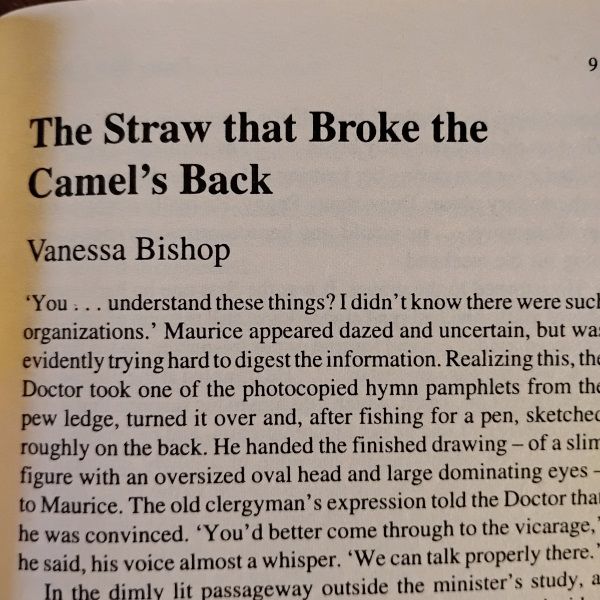
Stranger in a Strange Land: The Straw That Broke the Camel's Back


Vanessa Bishop did a lot of writing for Doctor Who Magazine in addition to penning some short stories, none of which I've ever read. Until now.

"The Straw that Broke the Camel's Back" appeared in the first Decalog so we are looking at a tale from c.1994. The Reference Guide places it immediately after Doctor Who and the Silurians while the Complete Adventures shunts it forward a bit to follow The Ambassadors of Death instead. The Reference Guide adds explanations for chronological placement of the stories whereas I can find nothing similar at The Complete Adventures site. I am going with the former here as the Brigadier is still pissed at the Doctor for what he sees as his willingness to betray UNIT in favor of the Silurians.

Lethbridge-Stewart is indeed very angry with the Doctor. He is suspicious of that two hearts thing and not happy that his scientific advisor has been slipping out without telling his (ostensible) superior where he's going. And so the Brigadier is having the Doctor followed.

I should note that the story begins with a bit of Reverend Maurice Burridge. First, the beginning of an encounter with the Doctor followed by some reckless driving out on the country lane that shakes him out of prayer mode.

As noted above, the Brigadier is suspicious of the Doctor and even Liz isn't quite sure where he's been going when he suddenly goes absent from the lab. It turns out that the Doctor has been trying to track down an alien who has been stranded here on Earth. Sounds like something right up UNIT's alley but the Brig and Co. have been left out of the loop, presumably because of the jiggery-pokery that the Brigadier pulled off with the Silurians. It turns out that Burridge has been harboring the creature.

With the Doctor having been tailed, the Brig and a crack UNIT squad show up as the Doctor is closing in on the alien. It turns out that, when people make eye contact with the visitor from another world, this alien gaze induces seizures followed by death. Of the humans, that is. The Brigadier refuses to let the Doctor follow through on his plan to have the alien captured and cared for while he repairs its ship.

The alien, an Eriscent, is running for its life but encounters a group of UNIT red shirts as it attempts to re-enter the church. The soldiers suffer from the telepathic contact the alien tries to make. In order to prevent death on a wider scale, the Doctor lets off a shot and the alien falls to the ground dead. He bitterly whispers to himself, "There. I'm sure that's made everything a lot tidier for you, Brigadier." before telling Liz that his shot didn't even hit the alien, that it has simply died of fear.

This is one dark, bleak tale. It's hard to believe that the Doctor and the Brigadier would become such good friends after they fight here. I mean, they don't just do the old couple bickering routine, they really go at it. Recriminations follow accusations and poor Liz gets stuck in the middle. The Brig reprimands her and good, at one point. And that poor alien. For once the Doctor is unable to help someone who really needed his assistance.

Bishop does a great job here of telling a fine tale in under 30 pages but also taking the relationship between the Doctor and the Brigadier to an extreme - for Doctor Who. I am used to this pair being at loggerheads occasionally but ultimately working together for a common cause. Here these two alpha males show a lot of contempt for one another. A very different feel than anything I've seen on the TV show.

As I was writing, it occurred to me that this dark twist on the Doctor Who formula may have been part of a larger trend in the mid-90s. Then I struggled to find another example of a TV show/movie franchise/whatever which usually had happy endings take a turn to the dark side. I thought about Batman but I don't read comics so I didn't know when he turned into The Dark Knight. So my hypothesis remains just that.

Anyone out there more familiar with pop culture out there that can comment on existing properties becoming darker and grittier in the 90s?

28 June, 2023

Another Ark in Space

As you can see from the excerpt above, there's this giant spaceship called Hope and it is an ark carrying the remains of humanity, both cultural artifacts and literal remains in the form of DNA samples. It's trying to go home again, essentially, with a course set for Earth which they hope is habitable once again so that the extinct human race can be resurrected. Six androids run the ship and are responsible for getting it to its destination.

However, for years they've been plagued by a group of mutants simply called the Others. The Hope's automated defense systems have been successful in repelling the Others' attacks until now. A small group of them manage to penetrate the ship's hull and gain entrance. They attempt to get to the DNA samples but are killed by three of the androids - a.k.a. - Guardians - who also die in the defense of the ship.

With such a close call, the remaining Guardians decide to kill any other intruders on sight and to destroy the Hope rather than have their precious cargo fall into the wrong hands. Enter the TARDIS.

The Doctor wanders out on his own but Jamie and Zoe can see on the scanner that 2 of the Guardians are on their way to intercept him. In a bit of levity, Brake notes that the TARDIS has "a near-magical ability to amend the scanner’s view to show the occupants exactly what they wanted to see." Seeing the Doctor about to encounter some peril, they spring into action, the upshot of which is that the 2 androids are destroyed and this triggers the auto-destruct sequence. The remaining Guardian is amenable to the Doctor's entreaties and our time traveling hero manages to put the auto-destruct countdown on hold.

However, it wasn't completely disabled and so the ship's automatic defense systems are not working as they're still laboring under the theory they're not needed as the ship is going to explode soon so why bother. As the Doctor does an autopsy on the remains of one of the Others and finds out that they're mutated humans, the indefatigable foes realize their opponents are defenseless and spring into action.

With the Others set to breach the hull again at any moment, the remaining Guardian insists that the Hope be scuttled. But it gives the Doctor a piece of art so that something of the human race survives. It's a picture of a man and a woman called "The Faces of Humanity". The Doctor, Jamie, and Zoe depart and the Hope self-destructs.

This story is one that I think would benefit from being a fully-fledged novel. It's a fine short story with a premise that casts a pall over things. Humanity exists only in packing crates and then our heroes' intervention does more harm than good. The Others remain enigmatic and I thought of them as being like Reavers from Firefly. Now, what did they want the DNA for?

I felt it was really neat to have them be descendants of humanity. A novel could have explored human nature using the Others as representative of our base animal instincts while the ark and its contents could stand in for the better, less warlike aspects of our nature.

There is perhaps a hint of this dichotomy on display when the author, Colin Brake, references 2001: A Space Odyssey. The Doctor is running around the TARDIS console hitting buttons and activating switches in a manner "like a prehistoric chimp confronted with a big black alien obelisk". Brake hints at a comparison between our primitive ancestors and a species that can create big spaceships.

Random thought: The Hope has at least one dome and this brought the ships from Silent Running to mind.

I enjoyed the rather solemn tone as it was so different from most Doctor Who stories. It wasn't a simple good vs. evil setup with good proving triumphant. Just as the Guardians misunderstood the intentions of the TARDIS crew, might the Others also have less than malicious motivations? Some real food for thought in this story that would benefit with some more breathing space.

As he wanders outside the TARDIS, we are told "the Doctor’s face was once again both grave and dark" and this is an apt take on the tone here. A nice departure.