Showing posts with label Gruit. Show all posts

20 May, 2016

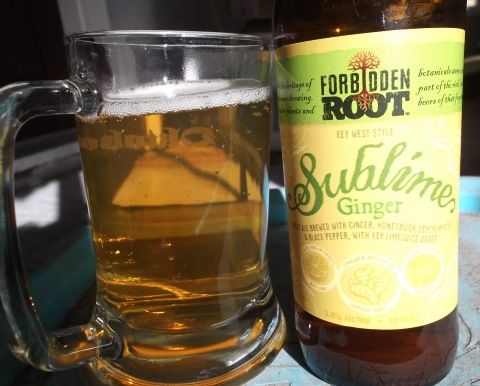
The Shandy Sublimated: Sublime Ginger by Forbidden Root Brewery


Chicago's Forbidden Root continues to brew against the grain by making beers that decidedly deemphasize hops and instead forage through herbs, spice, berries, nuts, and so on to find unique flavors to add to their brews. And since I last sampled one of their beers they have gone and opened a restaurant that serves food as inventive and off the beaten path as their beers.

Back in December I had Shady Character, a porter brewed with black walnuts, licorice, roasted chestnuts, star anise, and tellicherry pepper. On a recent venture to Chicagoland I grabbed 4-pack of Sublime Ginger as it looked to be a light thirst quencher and it seemed that warm weather was just right around the corner. Ha! Rain and cool temperatures moved in not long after I bought this beer.

Sublime Ginger is brewed with fresh key lime juice, ginger, honeybush, lemon myrtle. Like most people in my position, I had no idea what honeybush and lemon myrtle were as I pulled the 4-pack out of the cooler. I find it alternatingly intriguing and frustrating to drink gruits and so-called "botanical beers" such as Sublime Ginger. Trying new foods is a fine thing. Broaden your palate, I say. One might begin cooking with a new ingredient after having become enamored with the taste. But is also slightly vexatious because, not having tasted these botanicals before, I don't know if I can even taste them much less what they might add to the brew's overall aroma and flavor. How do you relate to someone else what an ingredient adds to a beer if you don't know what it smells and tastes like?

This is a minor gripe, to be sure, and the pleasure of drinking the beer and trying something new outweighs any frustration. But such reviews tend to be inferior for my tastes.

I sampled Sublime Ginger on a rather nice and sunny day. Out on my porch the sun highlighted the beer's lovely light gold color as well as its clarity. I need to become a little more aggressive with my pours because I think my last 20 reviews all mention a "small [insert color here] head" and this was no different. What's a guy got to do? Just turn the bottle upside down and put it in the glass? Anyway, the poor excuse for a head dissipated quickly while there was a smattering of bubbles in the beer.

This is one of those beers that reeks – but in a good way. I love being able to smell a beer's aroma even if my glass is several inches away from my proboscis. It's a sly bit of seduction that heightens your senses and builds anticipation. In this case, I caught a prominent bit of citrus. A proper sniff revealed more depth to that scent than my initial impression. Sure, I could smell the Key lime juice but was that lemon myrtle in there as well? The ginger was also happy to let your nose know it was an ingredient. It smelled rather fresh yet mellow at the same time. Not as pungent as, say, some Jamaican ginger beers I've had which have a sharp ginger aroma. There was also a little bit of pepper too. Not strong, mind you, but it was there.

While the citrus was bigger than the ginger in the aroma, the lime juice (and the lemon myrtle?) stepped aside on the taste. There is a reason for ginger be mentioned in the beer's name. While up front, the ginger flavor itself wasn't very sharp. It mixed well with a hint of pepper. The lime/citrus came next followed closely by a nice, vaguely sweet floral taste which I suppose could be the honeybush. In the background was a light grain/wheat flavor but there was also some malty sweetness.

The finish saw the ginger linger and offer a little bite in concert with the carbonation making for a rather dry ending. Alas and alack, there was no lacing left on my glass.

Sublime Ginger was incredibly tasty. While the ginger did not have a very sharp taste, it did retain a little zestiness which mixed well with the tangy citrus flavors. Both of these played against the malt sweetness which highlighted the floral taste that may or may not have come from the honeybush. To top things off, the carbonation put a fizzy spin on all of the above. With its light body (and 3.8% A.B.V.) this botanical alternative to the ubiquitous shandy makes a fine brew for enjoying in the summer heat.

Junk food pairing: Sublime Ginger is a light-bodied brew with brighter, more airy flavors and so it requires a food pairing on the lighter side. El Rey tortilla chips are made in Milwaukee and they are thin, light, and crisp – perfect for dipping in some kind of pre-made queso processed cheese food product kind of sauce. Just keep both the heat level and the cheesy sharpness at a low level.

27 December, 2015

Roots to Branches: Shady Character by Forbodden Root


Forbidden Root describes itself as being "Chicago's first botanic brewery". I interpret this to mean that they're taxonomic dilettantes who have casually tinkered with hop's status in the plant kingdom without informing any devotees of Linnaeus such as practicing botanists. Oh, and they consider any remaining plant life fair game for flavoring their brews.

There must be something in the water in Illinois because Scratch Brewing Company at the other end of the state takes a very similar approach. Like Forbidden root, Scratch does use some hops but, from what I can tell, mostly flavors its brews with other ingredients foraged or grown locally.

Forbidden Root was founded by Robert Finkel, a refugee from the world of venture capital. B.J. Pichman is brewmaster and operations manager. Brewer, author, and brewing consultant Randy Mosher is a partner in the venture financially and creatively. I take it that he helps formulate the beers as well as designs the labels, packaging, etc.

The team takes inspiration from history – those days of yore when brewers did not have sacks of Citra hop pellets dropped off on their doorsteps by the postperson. Tellingly, neither "grut" nor "gruit" appear on the brewery's webpage. "Botanic" has more cachet these days. Or the former words have medieval European connotations, perhaps. But even when hops are used, Forbidden Roots' beers still contain generous amounts of alternative botanicals.

I recently purchased a four-pack of Shady Character, a porter laced with licorice, black walnuts, roasted chestnuts, star anise, and tellicherry pepper.


It pours a very deep brown which appears black in the glass. While I was pouring I noticed that the beer looked a bit muddy – like there was sediment in it. Not a problem and understandable considering the beer was flavored with the fruit of the forest floor. I got about ½" of tan head that was neither in a hurry to dissipate nor desperately keen to stick around. I couldn't see inside the glass so I'm not sure if there were bubbles shooting up or not.

The first thing I thought of after taking a whiff was Chinese plum wafers. These are about the size of a quarter and slightly thinner and I ate many as a kid. Check out your local Chinese/Asian grocery store. The typical deeply roasted grain porter smell came next followed by more botanicals – licorice and nuttiness, though I couldn't tell you if it was the black walnut or the chestnuts or both.

The black malts came through well in the taste as primarily coffee but also some bitter chocolate. I could taste the licorice as well as that Chinese plum wafer. I am curious as to what gave that flavor and aroma. Despite the fruity taste, this isn't a very sweet beer. There is some sweetness, presumably from the dark caramel malts, but it is balanced by a fair amount of bitterness. Forbidden Roots says Shady Character has 33 I.B.U.s but lists no hops which comports with my tastebuds who thought that the bitterness was from the black malts. Rounding things out was some nuttiness in the background of unknown origin.

The beer finished with that plum wafer flavor and the malty sweetness took their leave while the black malt bitterness and the licorice/star anise lingered. There wasn't much in the way of lacing as most of the foam slid down into the beer leaving only a few random spots.

If this is "botanical brewing" then I say bring it on. I have reviewed a few gruits here and I've come to really enjoy them, especially those that use flowers. Shady Character, on the other hand, makes a good case for the forest floor as source of flavorings for beer instead of verdant fields. There are few sharp flavors here and instead we have earthier, more rounded ones. I like how the nutty flavors meld with the darker malts as the licorice and star anise provide a brighter flavor to give contrast as hops would. Shady Character is 6.7% A.B.V. and has a medium body which make for a hearty bulwark against the cold. On the other hand, it's not that big of a beer and it's unique, rich flavor isn't cloying. Thusly it makes for a nice of change of pace from the season's sweeter bocks and boozy imperials stouts.

Junk food pairing: Shady Character has a lot of flavor on its own so pair it with something complementary and unobtrusive. Try some pumpernickel pretzels if you crave the savory. If you have a sweet tooth go with some dark chocolate covered pretzels.

26 October, 2015

Now let's show them what our Spectra beer can really do!: Spectra Trifecta by Founders Brewing Co.


I don't believe I've ever reviewed a beer by Founders before. This is probably because I don't drink much of their beer although Red's Rye is probably my favorite IPA. Sadly, that beer went draft only back in the spring of 2013.

At about the same time that Red's Rye bottles began to go unfilled, Founders became a sponsor of ArtPrize, an annual art competition in Grand Rapids, MI, Founders' hometown. Each year the brewery brews a special beer in honor of ArtPrize with proceeds from sales going to the competition. This year the brewery gives up Spectra Trifecta, a Kölsch brewed with chamomile, lemongrass, and ginger.

The Kölsch is a rather underutilized brewing canvas, if you will. The style is not about big, domineering flavors wrecking your palate; it's about trying to find some kind of balance amongst a bit of cracker flavor from the malt, some fruitiness from the yeast, and hops. It just has a certain simplicity that lends itself well to running roughshod over Reinheitsgebot. In theory, anyway. Flat 12 Bierwerks has a Cucumber Kölsch (which I rather liked) and didn't Vintage Brewing here in Madison add some sumac to Sister Golden Ale a year or two ago?

Spectra Trifecta is a bit darker than your average Kölsch being a slightly deeper yellow than most I've come across. It was hazy and, curiously enough, had an abundance of particulate matter – lots of small white flecks. Up top it had a nice, foamy white head that lasted only a short time. However, there were many a bubble making its way up the glass.

The beer had a potent aroma as I could smell it when the glass was nowhere near my nose. I caught the pleasing mélange of sweet, floral chamomile and spicy ginger. The botanicals were also quite prominent in the taste. The chamomile tasted less sweet than it smelled and so its floral flavor was highlighted. The ginger tasted raw and pungent while the lemongrass played a more supporting role with its sharp, citrus taste being rather subdued. Carbonation added a little bite. Underneath all of that I could discern some cracker-like malt flavor along with a hint of the fruitiness from the yeast. Not much in the way of hops to be had. It was crisp and clean, having been fermented at cold temperatures and had a nice light body.

At the finish the lemongrass came out from behind the shadow of its botanical brethren to take a much more prominent place while the ginger and chamomile slowly faded. There was also some bitterness here that was reminiscent of strong black tea. It was like mix of herbal hops and chamomile. There was just a minimal amount of Schaumhaftvermoegen left on the sides of my glass.

Where was this beer over the summer? At 5.9% A.B.V. it's not a session beer but the piquant botanicals here add a rich, zestiness to the beer that would have been perfect in the sun. Chamomile adds wonderful floral taste while ginger and lemongrass add sharper, citrusy flavors. Spectra Trifecta is more gruit than Kölsch, I suppose, as the malt, hops, and yeast flavors are all rather subdued. Having been lagered, the botanicals are a bit more distinctive here than in more traditional-minded gruits I've had.

Junk food pairing: Spectra Trifecta goes well with guacamole, especially if you scoop it up with lime flavored tortilla chips.


09 September, 2015

a spicy, hopless concoction from up nort: groot by oliphant brewing


Oliphant Brewing is one of Wisconsin's newest microbreweries. It lies in downtown Somerset - up nort in St. Croix County, within spitting distance of the Mississippi River, and not far from the Twin Cities. Proprietors Matt Wallace and Trevor Wirtanen caught the homebrewing bug and decided to open a brewery back in 2011. Their dream was realized last year when their 3 bbl brewhouse opened.

I found some crowlers of Oliphant at Riley's last month. Since I'd not seen them before nor have I since, it seems likely that they did a bit of self-distribution when they were here for The Great Taste of the Midwest. There were three flavors, if I recall correctly, and I went for their gruit/grut, groot.

groot pours a lovely, deep mahogany – a nice break in the line of yellow beers that I've been drinking lately. My initial glass was clear but there was sediment at the bottom of the crowler which ended up in the terminal pour. I got a nice, big tan head which lasted for a while and there were some bubbles making their way upwards from the bottom of the glass.

The aroma had a doughy sweetness but I also smelled clove, vanilla, and cinnamon. I couldn't help but think of gingerbread cookies with this completely – in a good way - unexpected scent. The taste was very similar with a bready malt sweetness and clove being the most prominent flavors. There was a sense of drinking gingerbread cookies here but ones that were from Jamaica. This was not liquid cookies as there was also bit of an earthy, woody flavor present too. I later emailed the brewery to ask what botanicals were in groot and was told that there were clove, caraway, juniper, and rainbow peppercorns. I couldn't detect the caraway so it must have become part of the gruit's botanical gestalt but I can see that the juniper and peppercorns were likely the primary contributors to that earthy flavor I tasted underneath the gingerbread.

groot was rather dry on the finish owing to the carbonation with the clove lingering until the next sip. My glass was, sadly, left without any lacing.

This was a most surprising beer. The usual gruit botanicals like bog myrtle, yarrow, and mugwort are nowhere to be seen so Oliphant gets points from me for taking the path less traveled. I also appreciate that they brewed a gruit that didn't attempt use a bitter tasting plant to as a hop substitute. There is no bitterness here at all. The spices are really about complementing the malt rather than playing against it. It should also be noted that I am not the biggest fan of clove. I don't dislike it but I prefer it be part of a larger seasoning regimen. It's a prominent flavor here but I drank a couple glasses or more of groot. The Dulcinea and my medieval Fretourys of Applys batter got the rest.

Aside from the spices, groot had an easy-going medium-light body and was very smooth. It's 6% A.B.V. so you'll want to share your crowler and/or, like me, use some in a historical recipe. Hopheads will likely avoid groot and I am sure many others will as well with a crowler costing $8.99. Not cheap, although cheaper by the ounce than most bombers but more expensive than growlers. Plus the can is not reusable. Crowlers are the craft beer equivalent of the vortex bottle.

Junk food pairing: Pair groot with a bag of Lay's Greektown Gyro potato chips. These chips have some kind of magical lamb dust on them which will go well with the earthy, woody spices in groot.

25 June, 2015

Several Species of Small Flowery Botanicals Gathered Together in a Vat and Brewing with a Pict: Fraoch Heather Ale by Williams Bros. Brewing


After drinking my trifecta of gruits I figured that was it. Where else was I to get a gruit in these parts? Well, a trip to my local purveyor of adult beverages induced anamnesis. Fraoch Heather Ale from Scotland's Williams Bros. Brewing Company must surely qualify as a gruit. It's not uncommon in Madison stores and I'd had it before. How could I have forgotten?

Williams Bros. likes to portray themselves as the keeper of an ancient Gaelic beer recipe and, while it makes for good copy, I'm a bit skeptical that Fraoch tastes much like the heather ales that Picts drank while groovin' in a cave back in the day. Still, I give them credit for brewing this beer regardless of how close it hews to tradition and for getting good distribution so that Fraoch didn't languish in the High Street specialty stores of Edinburgh and Glasgow. If I can get it at my grocery store down the street, they've surely done something right.

Fraoch is brewed with wheat in addition to barley malt. Aside from the titular flower, there's bog myrtle and ginger here as well as some First Gold hops which must be more prevalent in the UK than here in the States. Yeah, there's hops but they're outnumbered here by other botanicals so I see no reason to disqualify Fraoch from my gruit pursuit.

As you can see from my not-too-shabby photo Fraoch pours a beautiful light gold. It was clear and I got a pillowy white head that dissipated rather quickly. The beer wasn't particularly effervescent as there were only a few bubbles to be seen making their way up the glass. Ooh, that aroma! It was positively luscious with a wonderful floral scent along with bread and a malt sweetness that was akin to stone fruit.

Unfortunately Fraoch didn't taste as good as it looked or smelled. It began rather tastily with a brisk, slightly minty attack followed by the wonderful taste of heather. As someone whose experience with heather is confined to this beer, I am rather flummoxed as the Internet purports that heather is rather low in floral qualities. But I tasted a taste that was floral in the way people tend to think "floral" tastes. Perhaps another ingredient highlighted the floral bit or it depends on what parts of the heather plant you use. Regardless, this flavor segued into a spicy bitterness which I took to be the bog myrtle and hops in combination. There were hints of bread and malt sweetness underneath but the beer has a rather light body to the point of tasting a bit watery. This is not a cardinal sin in and of itself but the heather flavor was rather weak. I had to let the beer sit on my tongue in order to get a good dose of it. Now this is a problem. While it's admittedly been a while since I've had Fraoch, I recall the heather taste being much more prominent then than now. Since I've been on this gruit pursuit, I've come to adore floral flavors in beer and this was rather disappointing.

The beer finished a bit on the dry side with moderate spicy bitterness. My glass was adorned with just a little bit of lacing that clung to its side.

Fraoch needs more heather. The bog myrtle/hop bitterness dominated here instead of providing balance to the malt and the heather. It was as if there was a pause on my tongue where the heather should have been before the bitterness kicked in. I will also note that I couldn't taste the ginger but it may have been responsible for that bite at the beginning of my sip.

Junk food pairing: Froach pairs well with sharp cheese-food products such as Easy Cheese as well as Haggis & Black Pepper Potato Chips.

23 June, 2015

What Frederick II Drank After a Hard Day of Crusading: Prof. Briem's Grut Bier


Next on the gruit docket is Professor Fritz Briem's 13th Century Grut Bier. Who is Prof. Fritz Briem? From what I can gather, he is a big wig at the Doemens Institute in Germany which appears to be a sister organization to the Siebel Institute in Chicago where he also held a position. (The Sielbel Institute in Chicago is where one can learn to brew professionally.) Matthias Neidhart of importer/distributor B. United International approached Herr Briem about historical beer styles and the result was the Historic Signature Series. Briem developed the recipes while the beers themselves are, according to Beer Advocate, brewed at the Weihenstephan brewery. In addition to the gruit at hand, two other beers have been brewed in the series under Briem's auspices: 1809 Berliner Weisse and Grodziskie.

Unlike the other two gruits I've had recently, Briem uses neither bog myrtle nor mugwort in his brew. Instead we have bay, ginger, caraway, anise, rosemary, and gentian. Oh, and there's also pollinated wild hops. Quite an interesting mix. (I'd never heard of gentian and had to look it up. It's a flower that is used in many beverages in Alpine areas.) Can there be hops in gruit? Sure, why not? One can imagine a brewer in the High Middle Ages having hops as but one among a vast array of botanicals to flavor his or her beer before the lupulin devil took pride of place.

Briem's brew poured a light gold color and was slightly hazy which is not surprising considering that there is wheat in the grain bill in addition to barley. I got a paltry head which dissipated rather quickly. The beer was not particularly effervescent either as there was only a periodic bubble to be seen. And what did this concoction smell like? I definitely caught the ginger. There was also a floral scent in there which I presume was the gentian. A hint of pine and some malt sweetness rounded out the aroma.

The ginger returned on the tongue while the rosemary and anise were also quite discernible in moderate amounts. The beer was light-bodied with just a bit of carbonation evident on the palate. I was a bit surprised to find that the brew was slightly tart like a Berliner Weisse with a bit of that lemony/citrusy tartness. It was really the botanicals that shone through here with the malt and wheat in the background. As the beer made its way back the bay and caraway came out and wasn't bitter at all.

As I drank my glass was left with little Schaumhaftvermoegen.

Of the three gruits I've tried so far, this one has the lightest body which has the effect of emphasizing the botanicals. There's no bog myrtle or wormwood here for bittering which makes for a very different taste – he's not trying to emulate the role of hops here. In addition, Vintage and New Belgium's brews had much more prominent floral tastes than Briem's gruit. Instead he utilizes spices and herbs with sharper flavors that contrast more with the grainy flavors and sweetness.

My gruit trifecta has been a flavorful journey but I must admit that Briem's take enthused me the least. This is partly because I really like floral flavors which are absent here and I am not a fan of anise while I can take or leave caraway most of the time. (Unseeded rye for me, thanks.) However, neither the caraway nor anise was very prominent here. I could taste them but there was a lot happening on my tongue at the time. Don't like the anise? Then don't worry because there's ginger and rosemary around the corner to help. This gruit is a bit of a roller coaster ride in that new flavors are always appearing. You get some this on the front and then some of that on the middle of your tongue and yet even more new flavors appear in the finish. It gets high marks from me for a having just the right amount of tartness and a high refreshment factor for warmer weather with a moderate alcohol content of 4.6% A.B.V.

Junk food pairing: Prof. Briem's Grut Bier pairs well with Snyder's Bacon Cheddar Pretzel Pieces. You've got the two main German culinary staples: beer und pork.

04 June, 2015

And Your Beer Smells of Elderflowers!: New Belgium's Gruit


Next up on my quest for hopless beer is New Belgium's Gruit.

New Belgium is in Fort Collins, Colorado and they've been around since 1991 which makes them craft brew veterans. I find their Fat Tire amber ale in coolers at most summer shindigs I attend at friend's homes. Fat Tire is fine by my palate although I don't go out of my way to buy it. Indeed, I rarely give New Belgium's annuals and seasonals a glance although I do enjoy 1554 dark lager. However, I do always check out their Lips of Faith line which features more experimental brews. The Coconut Curry Hefeweizen went well with the Thai food I and my fellow RPGers ate at various gaming sessions last winter. And so when I saw that New Belgium had brewed a gruit, I just had to grab a bottle.

I must admit to being quite surprised when I poured myself a glass and found that, unlike my local gruit from Vintage, this stuff was so pale in color. My chromatic confusion must surely be because I associate gruit with being the stuff people in 1350 quaffed after a hard day of setting the bodies of plague victims alight which would have been dark and smoky. Instead New Belgium's iteration is a nice dark straw hue that's a big hazy from the wheat in the grain bill. I got a nice white head while a modicum of bubbles were found below.

With an herb/spice mix containing ingredients that I was unfamiliar with, I was keen on taking a whiff to find out what these exotic botanicals smelled like. It's just extra fun knowing that you're to get something different instead of more fucking grapefruit hop aroma. My nose caught plum, a bit of sweet, doughy malt, orange, and a floral scent which I presumed to be the elderflowers.

The first thing my tongue noticed was that tingling from carbonation. The beer didn't look particularly effervescent but it tasted so. Beyond that the elderflowers returned from the aroma and there was more of the stone fruit malt sweetness. The beer also had earthy, almost musky, overtones. I'm not sure if these came from a particular botanical or if it was the product of multiple herbs/spices. Whatever the case, they complemented the floral taste really well and made a nice contrast to the sweetness of the malt. The gruit had a medium-light body which was smooth as it was brewed with oats. As the beer warmed, the malt became more prominent yet the balance of flavors remained.

The bitterness came at the finish. All that bog myrtle, horehound, yarrow, and wormwood really did the job and it was a lasting bitterness. Just like with the Vintage gruit, there was a subtle minty burn here as well which I take to the bog myrtle. My glass was left with some nice lacing.

I am beginning to get the hang of the new-fangled gruits. You use a few herbs/spices that are bitter and then something floral for aroma and to add to the flavor. As it stands, New Belgium's gruit is mighty tasty. My palate has really taken to floral flavors in beer. There's a pleasing détente here between the sweet and the bitter, the earthy and the floral. While I'm sure an India Pale Gruit with 100 I.B.U.s of mouth-puckering wormwood astringency can't be too long in coming, I enjoy the gentle bitterness of the gruit. I also really appreciate how this brew's body had one foot each in the medium and light. The beer is easy-drinking yet it does not venture into the lawnmower beer realm. It is, ominously enough, 6.66% A.B.V. yet it doesn't taste that big.

Junk food pairing: New Belgium's Gruit pairs well with rosemary potato chips. Even better if there's garlic on 'em too.

26 May, 2015

Hops? We Don't Need No Stinking Hops! - Snowflake 2015 Gruit by Vintage Brewing


A recent column by the Wisconsin State Journal's Chris Drosner reviewed Small Town Brewery's Not Your Father's Root Beer, a beer, unsurprisingly, flavored to taste like root beer. Drosner wrote:

But beer purists — and they are a vocal lot — will say that Not Your Father’s Root Beer is not a beer because it lacks one ingredient considered essential to beer: hops.

Who are these "beer purists"? It's funny. Do beer bottles say "malt beverage" on them or "hop beverage"? Here's how Wikipedia defines beer: "Beer is an alcoholic beverage produced by the saccharification of starch and fermentation of the resulting sugar." Now, do you boil grains to get fermentable sugars or do you boil hops? People were consuming beer long before the use of hops came along.

I didn't know this until I looked it up but the ancestral home of the beloved hop is China. The plant made its way west and found a home in the gardens of ancient Romans who ate the shoots. As far as Western civilization and brewing is concerned, the first record of hops used in brewing comes from 822 C.E. in a list of rules written by Abbot Adalhard documenting how his abbey was to have been run. Tenants of the abbey were to collect hops and a tithe of malt and hops were given to the porter to brew beer.

Hops were growing in the wild in Europe during this time and it wasn't until the 11th or 12th century that hops were first cultivated commercially by some enterprising folks in Northern Germany. From here, their use spread although there was resistance that took decades, if not centuries to overcome.

So, if medieval brewers weren't brewing with hops, then with what did they flavor their brews?

Various and sundry divers botanicals. "Gruit" or "grut" refers to not only hopless beer but also to the botanicals used to flavor beer. It seems that the most common ones were bog myrtle, yarrow, and rosemary. However, many other herbs, spices, barks, etc. were used including juniper, mugwort, heather, sage, caraway, ginger, et al.

As someone who is not a hophead and who grows tired of liquor store clerks only being able to suggest some kind of hoppy pale ale or apologize for not having Pseudo Sue in stock, I decided to try all of the gruits I could this year. Granted, there are few but I gave it my best shot.

Every year Scott Manning at Vintage brews "a new and unique 'snow flake' beer- always a fresh new recipe and never the same brew twice." This year he brewed a gruit which he described as a brown ale with mugwort, licorice root, sweet gale, chicory, chamomile, and orange peel. Not a hop in sight. (Praise be to St. Gambrinus!) I got to taste this year's gruit while it was still in the tank and I was really looking forward to the finished product.

As befitting a brown ale, the beer is a deep reddish brown and is also clear. My pour produced a small head that disappeared fairly quickly. Some bubbles could be seen in the glass. Considering that Scott basically threw the whole spice rack into this brew, I was surprised that all my nose could pick up was roasted grains and an unidentified floral scent. Heck, maybe it's just my nose. Despite my proboscis not being overwhelmed, the aroma was very fine.

As for the taste, the brew was very smooth but had a fairly thin body. I first noticed roasted malt sweetness that was bread-like. On top of this there was a nutty flavor that I presumed was the chicory. Where I would normally expect to taste some sprightly hop bitterness, I found myself pleasantly surprised by a floral flavor along with a hint of licorice. Mind you the beer didn't taste like you were digging into a plate of begonias but rather a more subdued flavor similar to how rose hip jelly doesn't have a sharp, pungent floral flavor. At the finish, I could taste something minty and a bit of bitterness as well that was akin to that of a Noble hop. I believe that the mugwort provided the former while the sweet gale gave the latter.

If you had any ancestors in medieval Europe, you don't have to contract the Black Death to feel a connection to them. Instead you can quaff this fine gruit. I'm not a malt expert but I believe that the invention of malts that didn't taste like the smoke of whatever was fueling the fire that kilned them wasn't until the 17th or 18th century. And so I'd guess that, if you were to invite your ancestors to dinner (which humans don't seem keen on doing), they'd probably wonder just what the hell they were drinking. Having said this, I thoroughly enjoyed Scotty's vintage 2015 gruit.

With a body on the thin side and an A.B.V. of about 5%, this is certainly a brew for the warmer months. The floral taste and minty finish also contribute to the sense of this being a beer for nice spring days and the summer months. I really like how the floral flavor contrasts with the earthy malt/chicory base. These are all mellow flavors with the malt segueing into the botanticals seamlessly. Honestly, I didn't miss the hops at all.

Junk food pairing: Eat Cheddar Cheese Cracker Combos along with your Snowflake gruit. The salt accents the botanicals while the cheese provides a vaguely sharp and creamy contrast to the malty sweetness.