I finished reading The Bright Ages: A New History of Medieval Europe yesterday and so this song came to mind.
Showing posts with label Marillion. Show all posts
Showing posts with label Marillion. Show all posts
24 June, 2026


05 January, 2026
A lavender loaf
Lavenders blue, dilly dilly, lavenders green
When I am baking, dilly dilly
You will be eating
I baked more bread yesterday. With a mostly full bottle of buttermilk in my refrigerator, I opted for a loaf of buttermilk lavender bread. It turned out well.
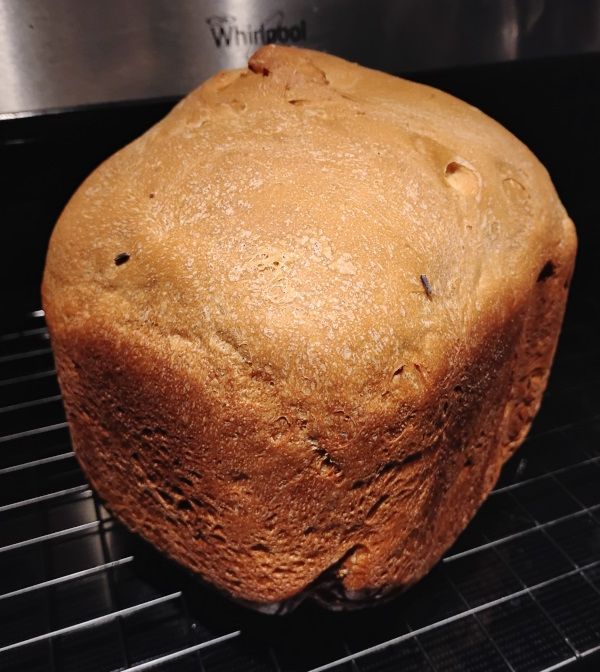
I ate a bit simply with butter but think that honey would be very tasty as would making French toast with it. That bread machine cookbook I took out from the library explained the various types of yeast so I went out and bought some of the instant stuff. My hope is that this will help my next loaf of rye to rise correctly.
Addendum: this bread goes very well with tuna salad.
12 August, 2025
Today's addition to the divorce playlist
My wife wrote to me shortly before filing for divorce, "Eventually you will have to...learn to love yourself."
I don't feel this is/was a problem at the time she wrote it. In fact, I'd say that we are divorcing because I do love myself. This song reminds of me just how wrong she was.
22 December, 2023
A Proggy Christmas 2023
Some new holiday prog.
First is Marillion's cover of "I Believe in Father Christmas" by Greg Lake. I wonder if this song is more well-known these days than "Lucky Man". It has transcended the "classic rock" tag, I think.
Lovely version here by the Marillos.
Also, we have Steve Wilson's first Christmas song that features lyrics written by AI:
Challenged by a friend last week on why I’d never done a Christmas song, I protested it wasn't really me, and besides I didn’t think I had it in me to write suitably Christmassy lyrics. "No problem”, he said, "we’ll get ChatGPT to do it for you!", upon which he instructed the AI to generate Christmas lyrics in the style of Steven Wilson. Which it proceeded to do so. By the yard, in fact, I was shocked at how instantaneous and easy it was to guide it ("don’t actually mention Christmas" we said to it, "make it feel more lonely”…etc)
I think it did a good SW impression. "Make it feel cold and lonely" - ha!
05 May, 2023
This beer is totally...

Where are the Maibocks, where are the altbiers, where are the Kölsches
To breach the dawn of the sentimental brewmaster
To breach the dawn of the sentimental brewmaster
27 September, 2022
Watch the Old World Melt Away
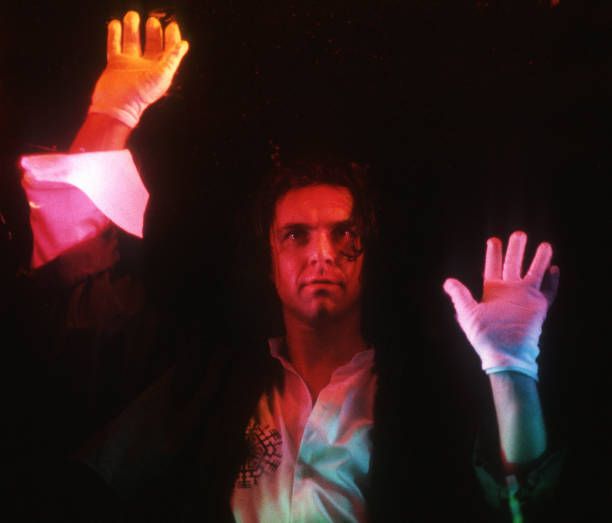
I remember the moment I found out that Marillion had lost their singer, Fish, very well. It was, I think, the spring of 1988 and the sad news came in a letter – the handwritten type sent via the U.S. Post Office – from a woman with whom I traded bootlegs. The teenage me was in shock, at first, as I read the words while seated at the kitchen table. Shock then led to me feeling devastated. How would I get my fix of prolix, poetic lyrics about personal struggles and the achingly beautiful guitar solos that brought them to life musically? What would happen to the band? Was it really the end?
Not by a long shot.
Marillion smartly brought in a new singer who was much shorter than Fish, had a completely different voice than the Scotsman, and wrote very different lyrics. I didn’t envy Steve Hogarth having to fill Fish’s shoes but history has proven he was more than capable of being the band’s front man.
I recall well buying the first album of this new incarnation of Marillion, Seasons End, in the fall of 1989. Although the cover featured the old logo, it did not sport the very colorful imagery of Mark Wilkinson who had painted the artwork for the band’s previous album covers which were dense tableaus of Fish's lyrical world. Instead it was more spartan, featuring a series of small photographs that represented the four elements set on a larger backdrop of ocean waves. Each of the smaller pictures had a reference to the band’s previous era with Fish.
The one representing earth has a feather which may be a magpie feather; in the air panel we see the tip of a jester cap not unlike the one seen on the Clutching at Straws cover; a chameleon sits on a branch while in the background a fire roars; and lastly the picture of a clown seen on the Fugazi album cover is seen sinking into a pond or lake.
I couldn’t wait to get home and listen to it.
I suspect the band decided to play a trick on fans with the lead-off song, “The King of Sunset Town”. Here we all were, eager to hear the new singer in action. We hit play or drop the needle and are forced to wait two and half minutes before Hogarth sings a note. But a glorious two and a half minutes they are.
Mark Kelly conjures a wash of synths that slowly builds. He adorns the swirling mix of string-like and chorus sounds with some other bits that, along with Steve Rothery’s guitar, add mood to the gently churning aural wave. Pete Trawavas’ bass eventually joins and some subtle cymbals from Ian Mosely are thrown in for good measure. Then a glassy whoosh of those cymbals ushers in the drums which skip along as Rothery gives us a gorgeous solo full of his trademark sustained notes. I love this solo’s cadence which starts with high notes and then descends. Then it’s back to the higher ones and down low once more.
Things slow down with a few plucked guitar notes and a wandering bass providing the backdrop for Hogarth’s entry. He has a kindler, gentler voice than Fish. “The King of Sunset Town” is about the poor and the rich, the powerful and the weak, filtered through the lens of the events of the Tiananmen Square protests of that summer. Had Fish tackled this topic, he surely would have made the lyrics a screed angrily denouncing the Chinese authorities and bitterly lamenting the deaths of those killed by the army.
But Hogarth (and lyrical co-writer John Helmer) write a broader, more humanistic tale. One that perhaps focuses less on the violence and deaths, and more on the power of that nameless man who stood in front of a line of tanks causing them to halt. Hogarth’s voice is no less powerful or emotive than Fish’s, but he tacks the seas of human experience via a different course than his predecessor.
The music sounds fresh and dynamic here and on the rest of Seasons End. Instead of another round of plumbing the depths of despair and marshaling anger, Marillion seek out the good in the world, however well-hidden, and tease out hope even if the situation seems hopeless. The balance between opening one’s heart and venting one’s spleen tips decisively towards the former.
23 September, 2022
Raised in the jungles I quickly learned to read the trees
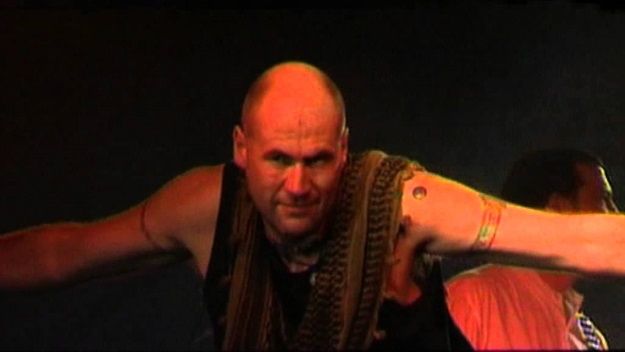
Back in the spring/summer of 1987 a friend of my older brother caught wind that I was a Genesis fan of epic proportions and, as good elders do, gave me the "If you like Genesis, you should check out..." speech familiar to many a proghead. A tape was also included. While I cannot recall the whole spiel, Marillion was on the list as the accompanying tape, which I still have, contained the 12" single for the band's "Market Square Heroes". The b-sides were "Three Boats Down from the Candy" and "Grendel", the 17 minute epic that lovingly borrowed a bit from Genesis' own epic, "Supper's Ready".
A friend of mine whom I'd suckered into being a Genesis/prog fan a couple years earlier and I went out on a mission to find more Marillion. While I'm not sure, I'd bet we made our way to the Rolling Stones music store out by the HIP (Harlem Irving Plaza). Chicago music lovers know where I am talking about. I don't recall what Marillion album my friend bought but I went home with their fourth album, Clutching at Straws. The anguish and melancholy of Fish's lyrics (along with some angry and sorrowful music) were perfect for a disconsolate teenager who had just a couple months previously been uprooted from Chicago to the backwoods of Wisconsin.
Roughly a year later I was shocked to hear that Fish had left the band. And so my proggy path had been riven in twain. I still had Marillion to follow with their new singer, Steve Hogarth, but also Fish's solo career.
A few years ago Fish announced that he was to retire from music after a final solo album and a farewell tour. The album, Weltschmerz, was released in 2020 while the tour was, like most things, delayed by Covid. Endings invariably give way to reminiscence and reflection and with 30+ years of fandom under my belt, I joyously looked back at his career.
One thing that has made his solo work so interesting is that Fish is not much of a composer so he collaborates with others who can devise musical accompaniment to his lyrical musings. Some collaborators stuck around for multiple albums while others worked on one before moving on. This means that there is some continuity but also plenty of variation in his solo work.
I am loathe to label any of Fish's albums as my favorite although I do feel some are better than others but find that each has its place. Listening to a YouTube playlist recently, a live version of "Jungle Ride" came on and I was reminded again what a fantastic song it is.
The song appears on his fifth solo album, Sunsets on Empire, from 1997 which is famous in proggy circles for being the one where Fish collaborated with Steve Wilson of Porcupine Tree. Wilson produced it, played on it, and co-wrote 6 of the 10 songs. "Jungle Ride", however, was co-written with guitarist Robin Boult who had been one of Fish's co-conspirators since his second album, Internal Exile.
As with a lot of music in my collection, Sunsets on Empire is inexorably intertwined with a period in my life, in this case it's my misbegotten mid-20s. My friendship with my roommate had become frayed to the point of being irreconcilable and there was, unsurprisingly, a woman involved. Fish was having marital problems when he wrote the lyrics for Sunsets on Empire and it was hard not to feel a sense of connection.
But "Jungle Ride" is more concerned with one of the other themes of the album, manhood. Sunsets on Empire isn't a concept album focusing on all things masculine but it is a motif that appears every so often.
The theme is most overtly expressed in the song "Brother 52", about an American biker and Fish fanatic who felt that the collapse of society was nigh and so he started stockpiling weapons. This drew the attention of the federal government and ended in a shootout with ATF agents. The refrain of "We are lover, warrior, magician kings" is a reference to the book King, Warrior, Magician, Lover: Rediscovering the Archetypes of the Mature Masculine by Robert Moore and Douglas Gillette. The authors use Jungian theory to explore masculinity via the four titular roles/archetypes. It's been ages since I've read the book but I think the gist of it is that healthy masculinity involves balancing "mature" expressions of these impulses, which are the primary ones in men.
Elsewhere on the album Fish is a loving and protective father to his daughter Tara on the song bearing her name. "Goldfish and Clowns" chronicles an incident in which Fish had a tryst, of sorts, with a woman who wasn't his wife that he met at a party. And so we get a song about being a husband and the things that go along with that role - love, fidelity, etc.
"Jungle Ride" takes the listener back to the fairs of the singer's youth and the ride that gives us the title. Therein we find men-in-training awkwardly jockeying for the attention of pretty girls as gangs of boys/young men prowl the midway looking to stir up trouble and get into fights. This was an era
Where men don't cry and husbands lie and you never have to justify a kickin'
When mates jump in to save your skin if a chib is ever pulled out in a square go
It's a song about immaturity/boyishness on various fronts. It is also a stunning song musically. After Fish's spoken word intro, Robin Boult's melodic acoustic guitar sits atop a tom-heavy beat from drummer Dave Stewart that is joined by the extra percussion of Dave Haswell. (Conga? Djembe?) The air is thick in the dream-like atmosphere here. Just shy of the halfway mark, the band fall into a hypnotic groove while a violin solos and sultry, wordless vocals weave from left to right like a beautiful woman tempting and teasing.
A true highlight of a career with many.
12 May, 2007
Review: Marillion - Somewhere Else
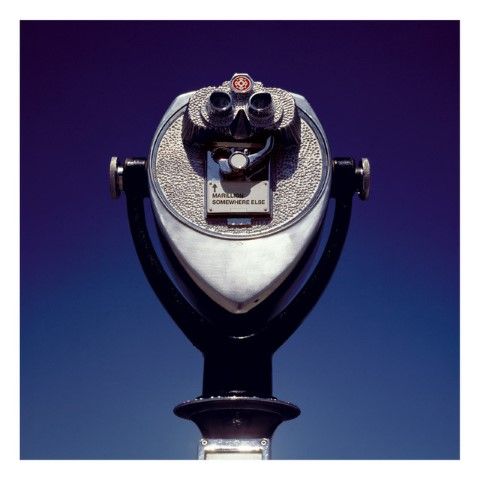
The whole Fish vs. H thing is, I think, mostly a dead issue for Marillion fans. Just as Steve Hogarth could never pull off the Beat poetry of "Bitter Suite", Fish could never handle the gentle "Brave". I've always credited the band with finding a replacement for Fish that sounded nothing like the big Scotsman. Along with a change in singer, the band's music had to move on as well. They couldn't continue in the neo-prog vein forever and everyone knew it. The first album with H, Seasons End, was largely comprised of songs written while Fish was still in the band but the new frontman made his mark. The lyrics mostly moved away from the personal and when they did address relationships, they approached them positively or at least not in the dire terms Fish was known for.
The band moved away from prog in fits and starts during the early and mid-1990s. The last album of theirs I bought on the day of its release was 1995's Afraid of Sunlight. It wasn't bad and I found that the best song was the least Marillion-like – "Cannibal Surf Babe". Much more a nod to The Tubes than early Genesis, it proved that the band could tack non-proggy seas and still create great music. But I found the album to be wildly inconsistent and I had discovered other musical paths to tread. I still kept up with them and found out that they basically severed all ties to their past with Radiation from 1998. With it, they'd chosen to make intelligent, well-crafted rock music instead of prog. While this is a gross oversimplification, the new direction was undeniably different. I thought that the next few albums suffered from the same problem as Afraid of Sunlight - they were too inconsistent. Two or three great songs and the rest sounded like either filler or good ideas that weren't able to be fleshed out well enough. 2004's Marbles offered hope. A trio of lengthier songs which stitched together various contrasting bits generally worked well. In between were pure pop songs, jazzy bits, and ballads all with a nice modern sheen that was current but not out of place on an album by a bunch of geezers. The guys are exceptionally talented musicians with guitarist Steve Rothery being able to say more with just a few notes than most guitarists can with a few dozen. (His solos on "Sugar Mice" and "Easter" are spine-tingling.) Despite this, I approached their latest effort, Somewhere Else, expecting more of the same hit-or-miss stuff and prepared to just have it linger on my shelf along with their last several albums.
It was quite a surprise to find that the album was very good and much more consistent than anything they've done lately. They're out of the gate with "The Other Half" with its skipping beat that's almost surf. Rothery's hurdy gurdy guitar grinds out something like a riff while these fluttering keyboards sound like they're from The Beatles' Revolver and the song as a whole has that same driving intensity of "Tomorrow Never Knows". Hogarth is in fine form with his voice as emotive as ever and I just love how Pete Trawavas' bass slithers in and out of the other instruments. While the song lays no claim to being prog, Rothery's solo here is classic. "See It Like a Baby" is another mid-tempo rock song with an uplifting chorus and more great work on the bass. The rim shots during the verses are vaguely reminiscent of a certain tune done while Fish was still in the band. Rothery scratches out a rather gritty solo while Mark Kelly fills in the picture with his keyboards. Again, this is a rock song as opposed to a prog song but the fine melody and catchy chorus are irresistible.
"Thankyou Whoever You Are" opens with some piano which leads into a tender pop song. Unfortunately, it all seems a bit by the numbers. Start out slow, speed up a bit, and then have a big guitar solo. Hackneyed but at least it's sincere and not overwrought. "Most Toys" is perkier and a bit grittier as it rejects today's hip nihilistic cynicism. Hogarth is nothing if not being honest when he sings "He who dies with the most toys/is still dead". The song has another strong melody and a straight-ahead rock feel with the guitar lending a loose, ragged feel to it.
The album's title track follows and it's the longest song here clocking in as it does at 7:51. It's a slow burner with H pondering "this rock-star trip" and illustrates the stripped-down aesthetic of the album. In days past, Mark Kelly would have added layers of keyboards to evoke a mood but here he is content with just some understated piano. The guitar here is classic Rothery – lots of sustained notes echoing through the rhythm. Somewhere Else as a whole has this rather bare feel.
"A Voice From the Past" follows quickly on the heels of the title track but doesn't change the mood much at all with its slow tempo led by a waltzy piano. As the lyrics get angrier, the music follows suit during an interlude which is really Marillion at its best. The band have never really been about virtuosity. Sure, there were moments but their music has always been strongest when the ensemble is playing behind and under-girding some great, expressive singing. They never needed a big guitar up in your face because they got angry as a group. The same holds true here. Guitar adds muscle but it's really H's voice that holds centerstage.
"No Such Thing" reminds one of Black Sabbath's "Planet Caravan" with the processed vocals. A simple guitar figure is plucked out and repeated while drummer Ian Mosley finds occasion to actually use his toms. And that Beach Boys theramin sound from "Cannibal Surf Babe" rears its head again. This is a nice change of pace for the album. And, when a rap of the snare gets the song moving, Rothery's playing takes on a familiar guise. I recall being in high school when a friend of mine who was also into Marillion had taken up the drums and was in a band. He was trying to get their guitarist to stop playing big chords all the time and he said to me he wanted something more like the ending of "Incubus". As that song comes to a big finish, Rothery is just playing this simple figure of like four clean notes. It's a real testament to what the guy can do. No loud chords, no distortion yet what he played (or didn't play) added so much drama to the music and that's what is happening here.
"The Wound" begins a bit like "Out of This World" with its faux R&B; beat. Again, Rothery's minimal playing serves the song well. In addition, there's some good organ work from Kelly. It eventually finds a groove, of sorts, which reminded me of Ozric Tentacles' "The Throbbe" with its pulsing bass line. "The Last Century For Man" just meanders aimlessly too long. They've gone to the start-slow-and-build-up well just too many times. Instead of essentially bifurcating the song into a slow part and a faster part with a coda, I'd rather they'd have interspersed the dynamics throughout. "Faith", which closes the proceedings, was originally from the Marbles sessions and a live version escaped as a b-side back then. This is a studio re-recording that begins with some gentle acoustic guitar as H gives a lovely, tender vocal performance that shows his affinity for Romanticism. This version lacks the slide guitar embellishments of the live rendition but, when it gets going with some drums, it takes on a breezy late-60s vibe which works well.
Somewhere Else gains strength from having shed much of the gloss of previous albums. Some recent material suffers from the band's inability to integrate the shiny and new with their traditional strengths. For instance, the slick "contemporary" drum machine of "You're Gone" just doesn't sit well beside Rothery's waves of sustained guitar notes. In 2007 the band have stripped down the arrangements and I think the music benefits from this tremendously. My first complaint is that Mark Kelly doesn't get enough time to shine. He adds subtle colors to the songs most of the time and never really steps out. The other weakness of the album is that they start too many songs off slowly. With the sparser arrangements, this eventually gets stale and the inevitable moments when things pick up are all-too predictable. At least the group doesn't get bogged down by attempting to distance themselves from their past here as they have been doing for several years. This is especially true for Rothery. One of the great things about his playing style is that it's rarely ostentatious. Marillion has never been about the big riffs and the guitar charging ahead. Rothery has always added muscle when needed but, as demonstrated here, he says more with less.
Somewhere Else isn't going to draft a whole new legion of followers for the band. Neither will it draw Fish-era fans back into the fold. Perhaps the best thing about this album is simply that the songs are their best in years. They just went out and crafted good melodies.
Subscribe to:
Posts (Atom)