Showing posts with label Medieval. Show all posts

25 June, 2026

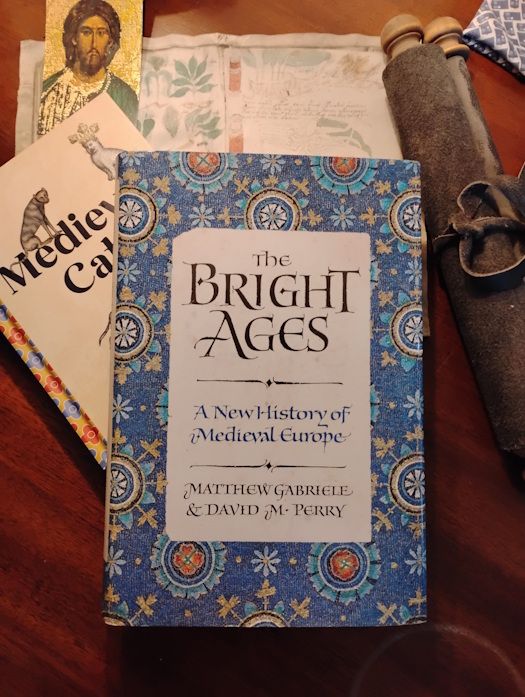
Petrarch Had It All Wrong: The Bright Ages: A New History of Medieval Europe


I'd heard of The Bright Ages a few years back in 2021 when the authors appeared on a podcast that I listen to. Then earlier this year I found a copy at a used bookstore and snatched it up.

While it is aimed at the lay reader and I am one, I think I've read enough books on medieval history and listened to enough podcasts to say that I have moved just beyond being a typical lay reader. And so nothing here surprised me. I may have not read a particular fabliaux or about the life of a particular empress but I've learned enough about these and other subjects that they're not new to me nor are they greatly revelatory, by and large.

Authors Matthew Gabriele and David M. Perry have, I think, a couple goals here. One is to dispel myths about the so-called Dark Ages, a concept given to us by Petrarch, and to show that they were, in fact, bright. The second follows from the first and is to counter the evildoers of our time who justify their views and actions by placing themselves in a line that extends back to the Middle Ages, to cast their words and deed as a continuation of those medieval figures that they deem righteous.

The book is a series of tableaux that counter one or more widely held misconceptions about the Middle Ages and present a truth more complicated. The first chapter looks at the role of women in medieval Europe. They were not simply these meek creatures ruled over by and beholden to the men in their lives. And so we learn about Galla Placida who ruled the Western Roman Empire on behalf of her minor son from 425 to 437 until he turned 18. Women may not have been 100% equal to men but they did wield power.

In one chapter we learn about Vikings and the myriad of trading routes and partners they had. In the popular imagination they cruised around northern Europe in their longboats and, upon landing, immediately began raping and pillaging. And so it was really neat to learn about Viking in the Caspian Sea region where they traded their ships for camels to haul goods. Since Islamic states charged higher taxes to pagan northerners, these Viking pretended to be Christian.

Of course, in my head I envisioned these blond warriors with horned helmets trucking through the desert on camels. But Viking helmets didn't have horns. D'oh! This section of the book is emblematic of many others which illustrate that Europe wasn't an all white place in the Middle Ages and that people moved around and intermingled all the time. Vikings went to the Caspian Sea and to North America; Muslims made their way into Spain where they preserved many an ancient text; the Mongols went west and extended their empire into Europe, knocking on the gates of Vienna; monks from France went to the steppes with bare feet to convert the Mongols to Christianity. Humanity mingled throughout the Middle Ages.

I really enjoyed the final chapter on medieval cities. We non-historians have this notion that people lived out in rural areas under the feudal system. But many medieval Europeans lived in cities. City air was free and urbanites were sometimes granted freedoms and privileges that their country cousins were not. The book states "Voting was a prominent part of medieval urban life" yet most common conceptions of that time exclude voting and view it as a habit of ancient Greeks that we moderns picked up after a long period of kings issuing orders to their vassals and popes pronouncing ex cathedra.

One of the disturbing things in the book that I felt had relevance to today was the all-too often terrible plight of the Jews. The Christians of the First Crusade killed Jews on their way to Jerusalem and in the city once it was taken; Jews were run out of France in the early 14th century; piles of manuscripts of the Talmud were burned in Paris in 1241; they were forced to convert at the tip of sword or else. And on and on.

I think the book's discussion of horrible treatment of the Jews (the book discussed Jews in more terms than their persecution, it should be noted) resonated with me as I heard last month that, Francesca Hong, a candidate for governor of my fair state, was gleefully looking forward to chatting with Hasan Piker, an internet celebrity or commentator or something internet, who has said some terrible things such as:

"...any 'Zionist entity' should be 'treated in the same way as a rabid neo-Nazi, and you shouldn’t even let someone be the local dog catcher if they’ve ever exhibited any positive feelings about the State of Israel.'"

Last year Kanye West was seen in public wearing a Swastika shirt. And I recall the numerous reports of Jewish students being harassed on American college campuses in the wake of the events of 7 October. And on and on. When I was young virulent anti-Semitism was largely practiced by assholes who lived out in the boonies and accumulated large caches of guns or marched in Skokie and now it has a certain, albeit limited, mainstream acceptance.

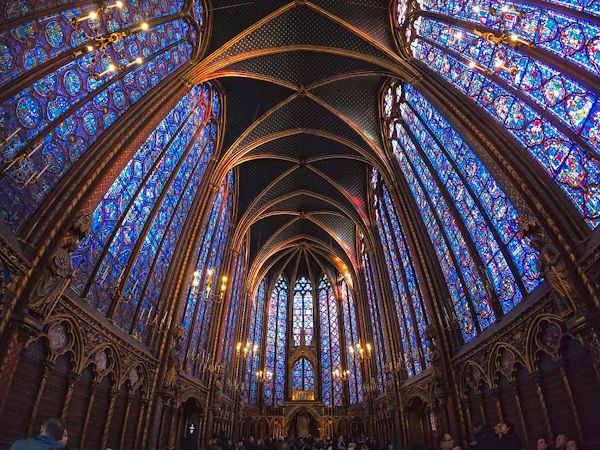
Lastly I want to mention that the book delves into how the Middle Ages were, well, bright. Just look at the 13th century stained glass of Sainte-Chapelle!


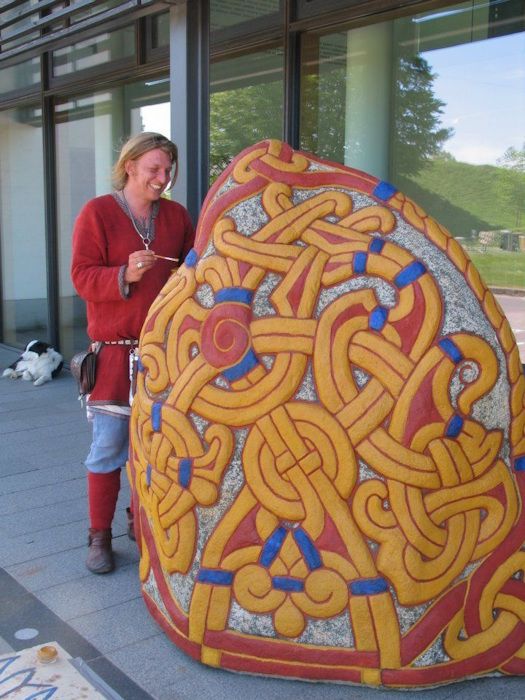
And here's a reconstruction of a standing stone from the tenth century with carvings. The stones were painted back in the day.


We see surviving medieval objects in cold brown and grey but they were bright and colorful back in the so-called Dark Ages. Medieval churches were often colorfully painted and brilliant mosaics were not uncommon.

The Bright Ages dispels common myths and implores readers to take the Middle Ages on its own terms and see commonalities with our own time, to view the people of that time as being much like us despite their foibles and failings. They may have had weird beliefs and held to superstitions we have discarded but they loved their children, enjoyed a good meal, and their leaders were just as conniving and corrupt as our own. This is not an exhaustive retelling of history but a sampler that will hopefully impel readers to investigate this fascinating period further.

02 April, 2026

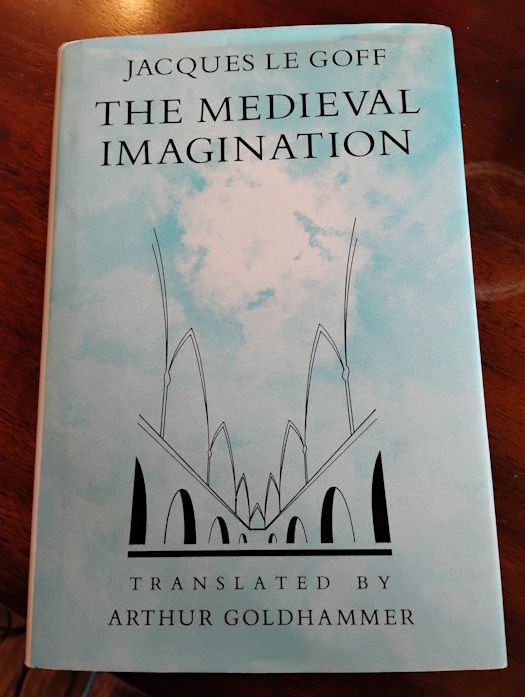
Just Jacques' imagination

Upon starting to read this book I discovered that it is not directed at the layreader, at least not very much. Instead it seems to be a collection of essays by Le Goff culled from various journals aimed at professional historians. And I so came upon many terms that I wasn't familiar with. For example, in "Vestimentary and Alimentary Codes" I came across "vair" as being used on the haute couture in the 12th century romance Erec and Enide along with squirrel, sable, etc. The interwebs say vair refers to the fur of a type of squirrel and so I find that the difference between vair and squirrel fur is lost on me.

This is a minor example, I grant you. But he refers to other writers without offering much in the way of qualifications and will occasionally throw something out there for you and just leave it without definition or much context. For example in the essay "The Repudiation of Pleasure" Le Goff looks at the notion that Western civilization was, as we say these days, sex positive prior to the spread of Christianity and that the Church fathers threw a yoke around the libido. But he notes that Paul Veyne and Michel Foucault maintain that a shift towards the prudish took place before Christianity arrived on the scene and that among pagan Romans existed a notion of "virile puritanism". What was that? I dunno as Le Goff just moves on. And, since Le Goff is French, perhaps he felt no need to introduce a couple fellow French intellectuals to his French audience.

Just as the book is a compendium of essays with no attempt to connect everything together, what I got out of reading it is just as random and disparate.

In 1274 the Pope is organizing the Second Council of Lyon and the preparation is done in units of 6 months - travel times, time to fill out and return questionairres, and so on. Le Goff notes, "Six-month intervals were clearly an important spatial and temporal unit in the contemporary minds." I find this interesting in and of itself but would love to know why. Is there a Biblical justification? Something to do with average travel times between cities?

The writings on Purgatory were quite intriguing and showed how conceptions of it appeared and changed over time. We are told that in the days and weeks after death, God granted permission to some souls to leave Purgatory and return to Earth to "solicit aid from relatives in a brief apparition". Le Goff then notes that it was believed that the color of apparitions of condemned souls indicated how much penance they had done. If the spectral figure is a third to a half white then that means more suffrage is needed.

At least twice Le Goff contrasts an antithesis in the minds of Romans vs. medieval clerics. The Roman imagination, he says, was concerned with urbs vs. rus, that is, the city vs. the countryside. But in the minds of medieval clerics the important contrast was nature vs. culture which is to say that which is wild (e.g. - the ocean and the forests) vs. that which was built, cultivated, and inhabited (cities, villages, etc.)

It took me a bit to grok the distinction. For the Romans both the city and the country were places populated by people but they had their own modes of living. By contrast the minds of medieval clerics saw humanity in one place but not the other. I will note that an early essay explained how the forest took the place of the desert in the European Christian imagination.

But this distinction is tossed out more as trivia and never really justified or fully integrated into much of anything. 

There was a lot of interesting stuff here but the book simply has this scattershot feel to it instead of offering a throughline. I would love to read more about each of the individual topics here at greater length with more examples from the Middle Ages and, because I am not a historian of that time, perhaps analogies to my own era. Some good food for thought but I need something more.

12 August, 2025

Crop rotation in the 14th century was much more widespread...

I found this on a recent trek to the bookstore.

I look forward to learning about how the stirrup, crop rotation, mechanical power, et al changed things in medieval times.

08 August, 2025

Gifted

I was given some fine microfiber wipe hoolies.

Doctor Who, gaming, medieval manuscript - the giver knows me all too well. Just look at this hoopy Voynich Manuscript wipe. 

 
I am very grateful for the gifts. My glasses will be spotless. Well, sometimes.

06 September, 2023

"Making a Medieval Book"

This looks really neat - a video demonstrating the late medieval process of making a book.

26 June, 2023

The Corona Diaries Vol. 87: Got Medieval?

(Listen to the handy and informative prelude.)

(late March 2023)

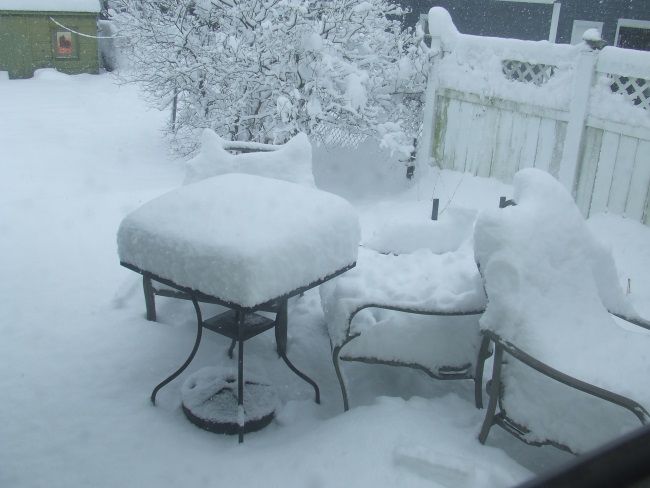
I know it’s going to surprise you, but we had a blizzard recently. It dumped a little over a foot of the white stuff on us. I mean it just kept snowing and snowing and…

Thankfully I was at home that day and so was able to shovel 3 or 4 times over the course of the day instead of coming home from work in the evening and having to shovel it all at once and pull a back muscle or 4.

Here are some house sparrows eyeing up the bird feeder as the snow falls on them.

The reason they were waiting in the bush is because the feeder was occupied by Ms. Cardinal.

The snow did not stop the squirrels. They had no problems finding traction on the power poles and were zipping all around.

Spring may have been a few days old but Old Man Winter wasn't ready to give up quite yet.

The snow put a damper on progress over at our neighbor’s house. You may recall that a tree fell on it last summer and that, after a few months, it was finally demolished except for 2 walls. Well, the construction finally started this month. It didn’t take long to do the framing and get a roof on it. It seemed like major progress had been made every day.

The red is gone and now we have greyish blue.

The exterior looks more or less done so I assume they’re plumbing it now and running electricity. We are very happy to not have a wreck in the neighborhood anymore and for our neighbor to be closer to having a habitable house again.

********

I recently took a trip to Chicago to visit with my mother and we went on a trek to the Art Institute. I hadn’t been there in ages and was keen on seeing their new(ish) exhibit, The Deering Family Galleries of Medieval and Renaissance Art, Arms, and Armor.

Since it was a fairly nice day, we walked down to the Jefferson Park El stop. I hadn’t taken the El in a while and it was neat to once again see that old North Avenue Baths building by the Damen stop. 

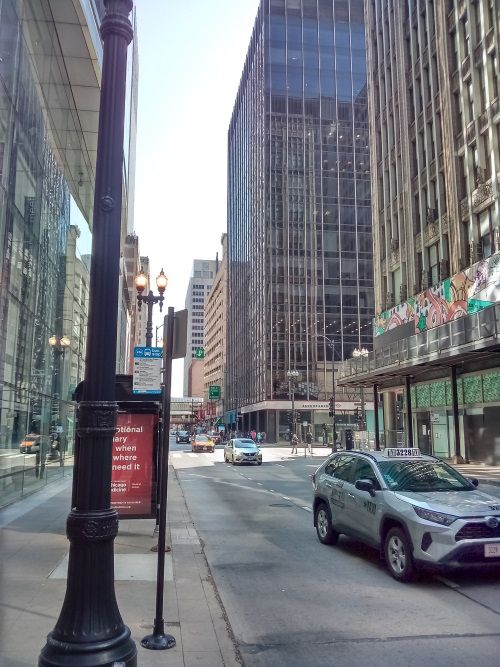
Although it was a bit – quelle surprise! – windy downtown, it was lovely.

As we were waiting to cross at Adams and Michigan, we heard a car honk then CRASH! Someone tried to turn left but timed it poorly and their car got t-boned right in front of us. An exciting start to our visit.

We went inside and got into a fairly lengthy line. Although my mother had plenty of cash on her intending to treat me to a day out, we discovered that cash is no longer accepted at the Art Institute. It's an annoying practice that is spreading like the Creeping Charlie in my backyard. Summerfest in Milwaukee has gone cashless as have the music venues here in Madison owned by the corporate behemoth that is Live Nation. So I pulled out my credit card. It was my lucky day as the guy gave me the Chicago resident discount since I was with mom.

Honestly, I had forgotten just how ginormous the Art Institute is. Making a bee line to the Medieval/Renaissance exhibit was not possible. It took us little while and more than a few ganders at the map but we eventually got to the section with all of the Renaissance paintings and strolled through.

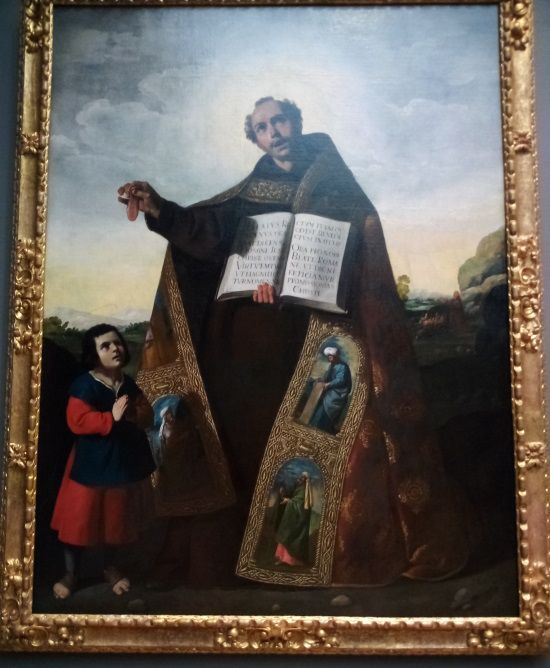
While I prefer medieval art over that from the Renaissance, generally speaking, I must admit they did some interesting work in the 17th century such as this painting of Saint Romanus of Antioch holding his own tongue. I presume it was cut out when he was martyred. He is the patron saint of those stricken with logorrhea. 

But the gallery has too many paintings of aristocrats, i.e. – the people who could afford to commission their own portraits. Plus, I think there are a million depictions of magi adoring the baby Christ.

“What’s this one called?”
“Adoration of the Magi.”
“Huh. And this one?”
“Adoration of the Magi.”
“Wait! Wait! Don’t tell me. This one is Adoration of the Magi too.”
“Correct.”

One thing I like about medieval art is that it doesn’t have a realistic sense of perspective like much Renaissance art. Before that Italian guy rediscovered the mathematical elements of perspective, medieval art was more interested in relaying a moral lesson or making sure all of the right symbols were in the frame, realism be damned. Everything looks off-kilter but in a fun and interesting way.

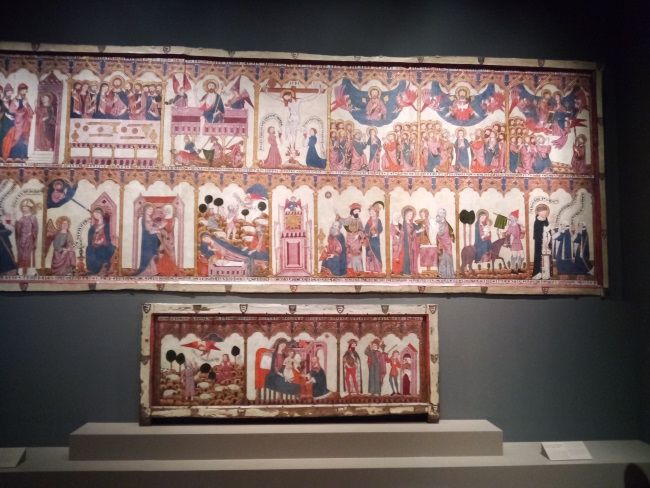
We finally arrived at the Medieval/Renaissance exhibit and I began to feel giddy. I felt genuine excitement and awe upon seeing the gigantic altarpiece on one wall.

Did I set off the alarm by getting too close to inspect what appeared to be gold leaf? You bet I did!

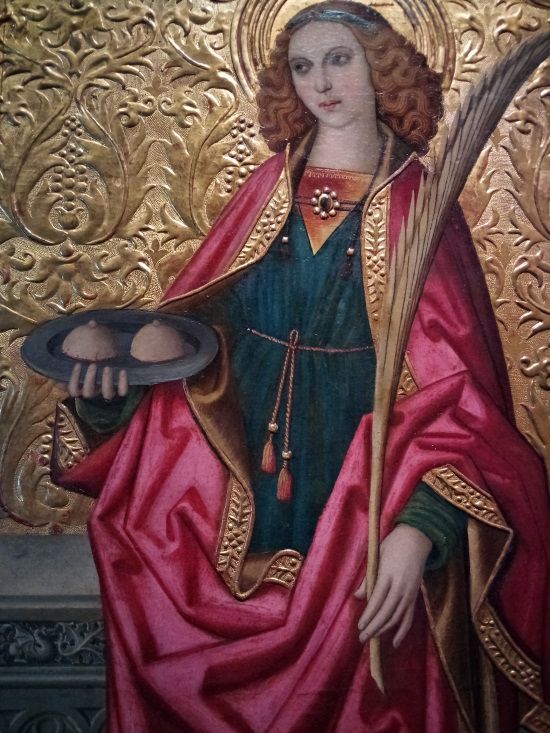
Fewer secular portraits of aristocrats here and more paintings of saints and martyrs. This is someone who had her breasts cut off when she was martyred.

She doesn’t appear the least bit distraught at holding a tray with her boobs on it. I guess that’s what grace does for you.

Now, having recently listened to a medieval podcast which was a guide to the most popular saints, I knew this to be Saint Agatha.

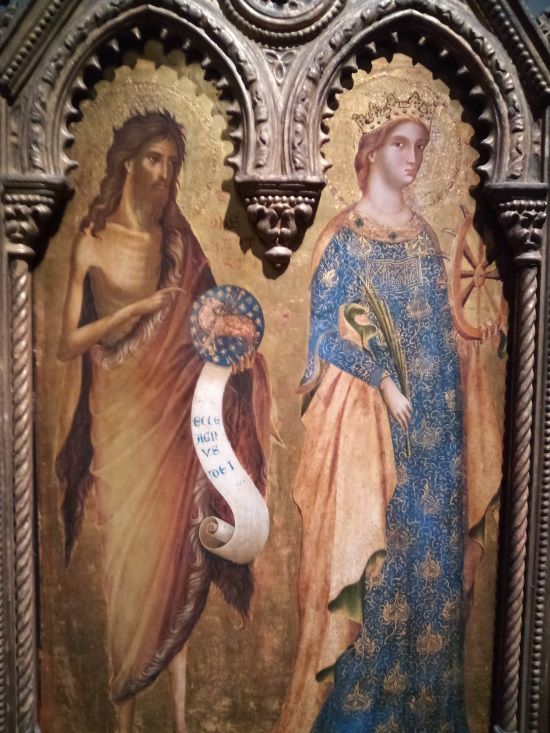
Here’s another:

That same podcast informed me that a female saint with a book was St. Anne and a female saint with a wheel was St. Catherine who, legend has it, was to have been killed on a breaking wheel, a very nasty torture device which involved lots of broken bones and general mutilation. However, she touched it and the wheel fell apart so her tormentors went to Plan B, a simple, direct route, and beheaded her instead.

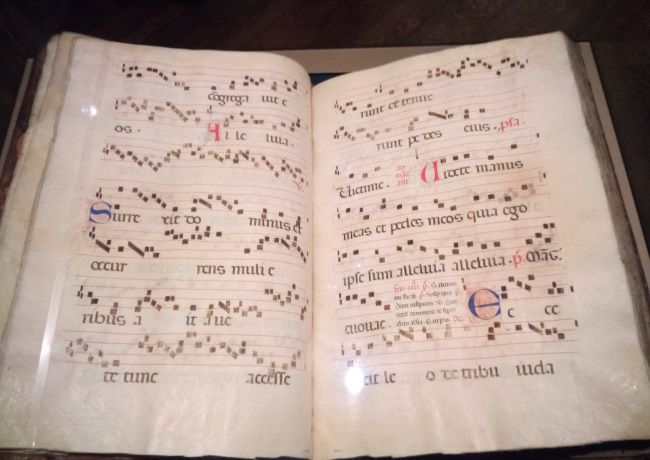
Not far from this painting was a 13th century antiphonary.

This contained the music to be sung or chanted by monks during the liturgical rites for the canonical hours of the day. I’m not sure if every monk would have had access to one of these or if they shared or perhaps a monk led the chanting with one of these before him. Regardless, it was really neat to think that hundreds of years ago some fellow squinted at these notations in the fading light of dusk to sing at vespers.

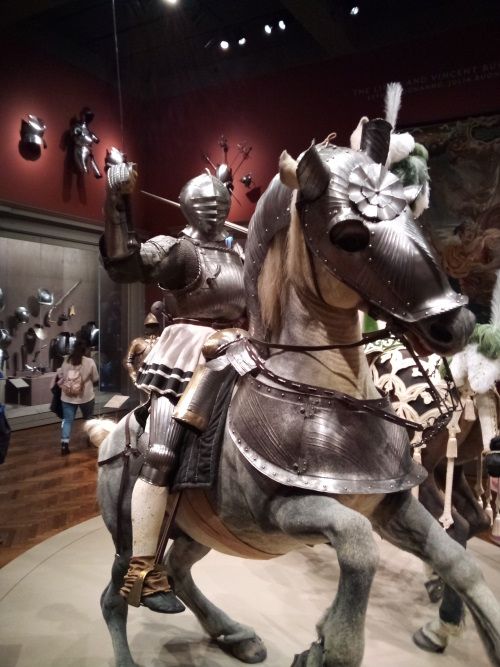
After displays of jewelry, plates, glassware, and other household items, you get to the big room with most of the military gear - arms and armor aplenty.

I think that most of the armor was ceremonial with just a handful of suits meant for use and most of those were for jousting instead of battle. Still, they were impressive and my back ached just thinking about wearing one of them. Men seemed to be rather smaller back then than now. Say what you will about our modern diet, but I doubt I nor most of my friends could fit into most of the armor on display. We grow 'em big these days. We're taller, broader chests - just bigger all around.

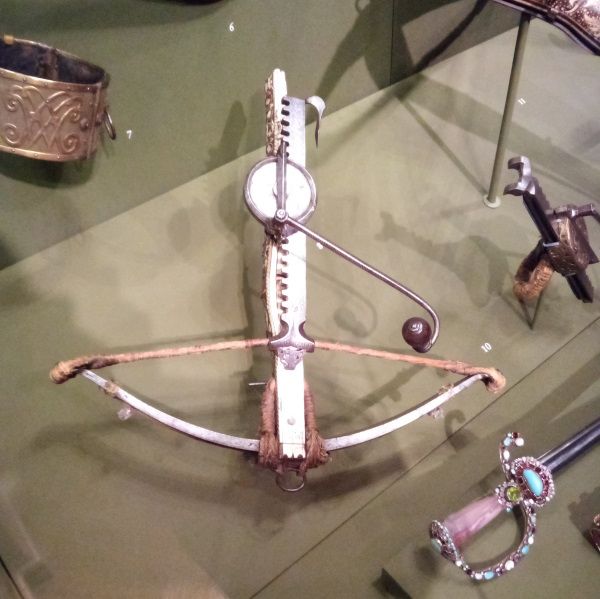
On the arms front, there were a lot of halberds, glaives, maces, and swords. One display case held a two-handed sword that was about as long as I am tall. I cannot imagine having to wield one of those. I'd probably cut my own head off on accident. Plus, there were lots of bows.

I’m thinking that, if you need a crank to pull the bowstring back, then I’d bet that bow will launch an arrow with many a pound of force. It must have been able to pierce even the best armor.

I could have spent all day in that exhibit but, alas, we had to move on if we were to be able to check out some other art.

One piece I really wanted to see was The Rock by Peter Blume.

I don’t know why but I adore this painting. The colors, the storm clouds portending doom…There’s the ruins of a building on the right and a new one being built on the left with the rock in the middle. I believe it was painted in the mid-1940s so perhaps it’s about World War II and the hope for something better once it is over.

In an area nearby were works by African-Americans. I took a picture of Nightlife by Archibald John Motley, depicting a night club in Bronzeville, but it wasn’t in focus. So I bought a print of it for my Frau.

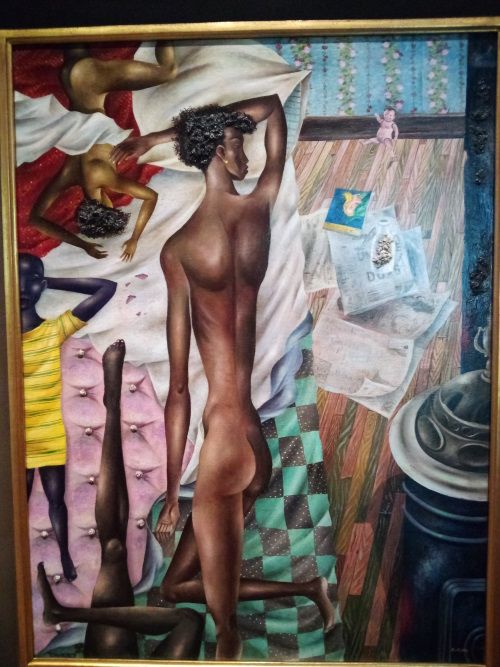
However, my shot of Eldzier Cortor’s The Room No. VI did turn out in focus.

I like the colors a lot and the very unreal sense of perspective that reminded me of medieval art.

Wandering around the modern gallery, it seemed like my favorite room had had its contents changed. The last time I was there, there was a room that held The Awakening of the Forest by Paul Delvaux, a couple works by Magritte - Time Transfixed and On the Threshold of Liberty, and Girl with Cat by Balthus. Or was it Solitaire? I just loved sitting in that room for a long time taking everything in. The Awakening of the Forest and On the Threshold of Liberty are both rather large works and it was easy to get absorbed by them.

We went to grab a snack before going to see the special Dalí exhibit called "Salvador Dalí: The Image Disappears". To get into the exhibit, I had to scan a QR code with my phone to get into a virtual line and then wait for a text to tell us that we could enter. I wonder if we could have been issued paper tickets or been assigned a time. It's a shame to make ownership of a smartphone a prerequisite to seeing an exhibit.

I find it interesting that we are at a point now where one must bank a certain way in order to gain entrance to the Art Institute and you apparently need a smartphone to get into a certain exhibit. It seems that a credit card and smartphone are becoming the bare minimum to be able to participate in more and more cultural activities.

A brave new world.

I had a blast at the museum and need to set aside a few more days to see the rest of it sometime. We went and had dinner at Miller’s Pub before catching the El back to Jefferson Park.

I’d read that CTA ridership was down significantly but our train was packed to the gills with commuters on their way home and a smattering of people heading out to O’Hare with suitcases in tow.

It was a grand day out in the big city.

********

I go through periods where I try to catch up on things I missed in the 1990s or go in-depth into something from that time that I can recall but don’t know a whole lot about.

For instance, back in c.2006 I read a few books and watched a couple documentaries about the Rwandan genocide that took place in 1994. I remember hearing about it on the news back then but I only recall talking heads on the evening news. Going in-depth and then seeing footage from Rwanda depicting events from the genocide was a whole different ball of wax. A few years back I listened to a podcast about P.J. Harvey’s debut album from 1992 and wondered how it was that it took me nearly 20 years to investigate it because I really enjoyed it.

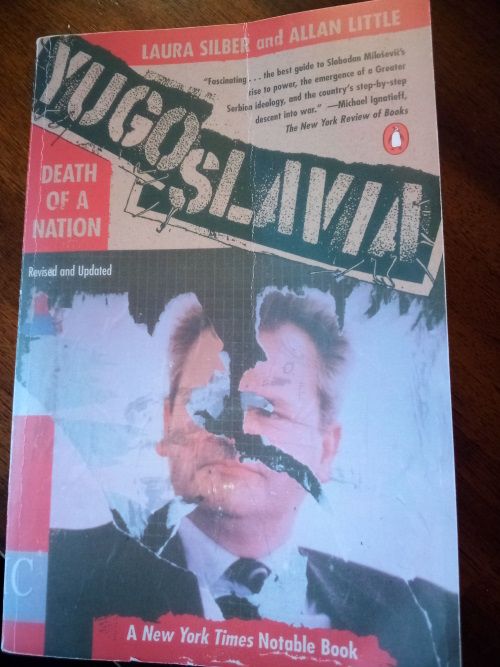
My latest investigation into that time involved reading this book, Yugoslavia: Death of a Nation by Laura Silber and Allan Little which recounts the history of the Yugoslav Wars from 1991-96. I recall hearing about it in the news, with the siege of Sarajevo, which lasted nearly 4 years, being especially prominent in my memory.

Right off the bat I learned that Yugoslavia consisted of 6 republics and 2 autonomous provinces. I just figured it was a single, united country but no. This made things confusing as each republic/province had its own internal government but also representatives to the federal one. Another thing that made the read complicated was how most people’s surnames ended in -ić. There was Kadijević, Adžić, quite infamously MiloÅ¡ević, et al. All of those diacritical marks meant that I consulted the Cast of Characters at the beginning of the book quite often. That in addition to all of the maps.

The book tells a really sad story that has been repeated throughout human history. A demagogue whips people into an us vs. them frenzy and the killing begins. Here it’s Slobodan MiloÅ¡ević who stirred up Serbian nationalism. He followed this up by getting other republics to send representatives to the Yugoslav federal government who were subservient to him or were at least sympathetic to Serbia.

Slovenia and Croatia see MiloÅ¡ević’s gambit and declare their independence from a puppet Yugoslavia that is having its strings pulled by Serbia. Bosnia eventually declares independence too.

Milošević would claim that Serbian minorities in the other (former) republics were being prosecuted and use this as a pretext for war. The Muslims in Bosnia and Herzegovina became scapegoats and suffered terrible atrocities.

In addition to the Serbians run amok and all of the death and atrocities they caused, the book also tells of the mainly impotent responses of NATO and the UN. After having read about the UN efforts during the Rwandan genocide, I was hardly surprised.

As with every war, the Yugoslav ones had their share of absurdities. One tale that sticks in my mind happened in May 1992 when the president of Bosnia-Herzegovina, Alija Izetbegović, is flying back from failed peace negotiations in Lisbon. He threw caution to the wind and decided that the plane should land in Sarajevo despite the city having descended into chaos and conflict. He was captured by the Yugoslav federal army which by this point was controlled by Serbia.

He asked his captors to be allowed to call his staff to let them know what had happened but was told the phones were down. Shortly after this, a phone in the room he was being held in rang. It was a woman who was calling to find out if her daughter’s plane had left earlier in the day. Izetbegović told her that he was the president and asked her to call his office to tell them that he was a captive at the airport. If she couldn’t get through, she was to call a radio or TV station and tell them instead to get the word out. 

As it happened, she ended up speaking with a Sarajevo TV station. The conversation was broadcast live and captured for posterity on video tape and can be seen in the 6-part documentary based on the book with the same title and which I recommend highly.

While a very sad tale, I was glad to learn more about some history that I lived through, even though I didn’t experience it first-hand.

I’m not sure what my next 90s throwback venture will be. I’ve been meaning to read The Quincunx since around 1995 so perhaps that should get taken care of.

********

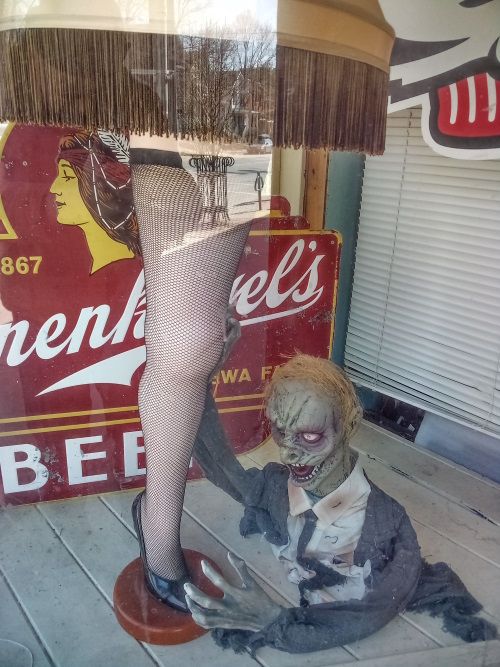
Bonus photo time. I recently met a friend for lunch at a nice older tavern. Next door to it was a storefront that had this display in it. It’s a homemade leg lamp as seen in A Christmas Story that’s being accosted by a zombie.(?!)
(Listen to the postlude.)

26 January, 2023

Today I'm gonna ponder like it's 1199

My latest music purchase thanks to the helpful and friendly folks at MadCity Music:

 
 (Candle by Mr. Bill's Workshop.)

My years of Latin in my younger days paid off as I was able to translate the title as "Today Christ Is Born". I was completely unfamiliar with The Boston Camerata, an early music ensemble, when I listened to a CBC radio show about the winter solstice last month. The show featured "Uterus hodie Virginis floruit" from this album (I think it translates as "Today the womb of the virgin flowers/blooms".) and I found the piece to be simply beautiful.

The liner notes say that it dates back to the 12th century Aquitaine. I don't know how it would have been performed back in Eleanor's day, but here it has a rather simple, sparse arrangement with just voice and what I think is a rebec, a medieval proto-violin. The song is gorgeous, if not sublime, and perfect for some quiet contemplation looking at the snow that covers the trees outside my window.


22 July, 2021

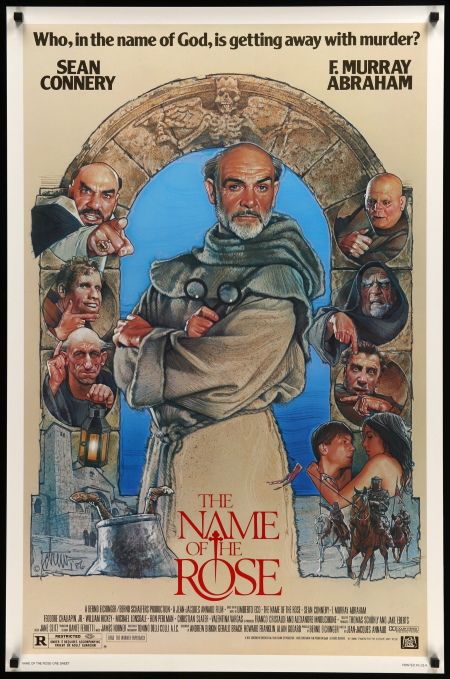
Penitenziagite!: Rewatching The Name of the Rose


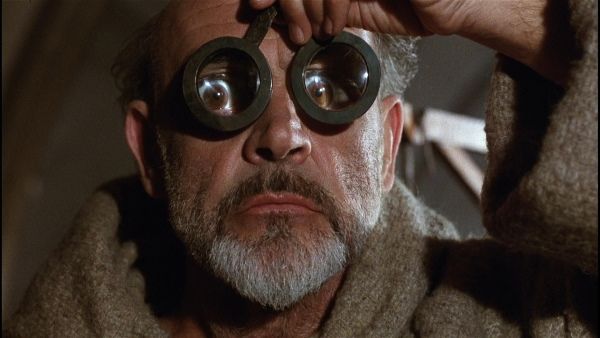
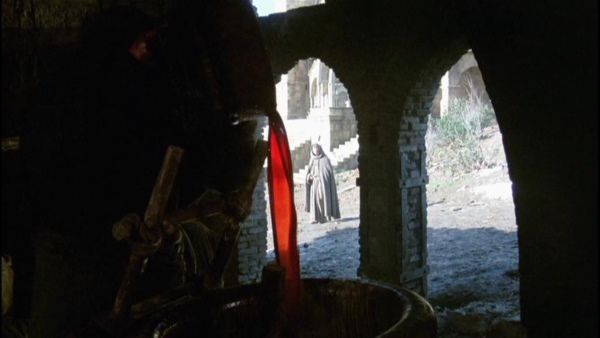
set the Blu-ray player in motion at dusk. Inside was my as-yet unplayed Blu-ray disc of The Name of the Rose, Jean-Jacques Annaud's 1986 "palimpsest of Umberto Eco's novel", i.e. – film. The idea was that it would be dark outside by the point the film's heroes, William of Baskerville and Adso of Melk, were plunged into the mysteries of the abbey. My timing was pretty good as the light was all but gone from the sky as the pair was wandering the snowy hill where the body of Adelmo of Otranto had been found.

If memory serves, I first saw The Name of the Rose back in 1990 or '91 when my roommate went on a mini Sean Connery marathon and rented it on VHS from Four Star Video. I fell in love with it instantly. The DVD was certainly an upgrade from videotape but the movie portrays a world lit by fire and the old NTSC television standard just wasn’t up to the task of accurately reproducing all of the film's textures of light and shade. While nothing will match a fine 35mm print of The Name of the Rose, I figured the Blu-ray would at least be leaps and bounds ahead of previous home viewing methods. And so it was.


As expected, the picture was much sharper and more detailed. While the film was intentionally made with an emphasis on drab colors and has a kind of grainy, dingy look befitting the time and place, lighter colors seemed a little more brilliant while the shadows were darker and contrasted more with the candlelight. I didn't notice any digital artifacts, though I wasn't actively scanning my TV screen for them. In short, I've never seen the movie look so beautiful. But I still want to see it on the big screen on film!

A large part of why I adore this movie so is that I am enamored of the European Middle Ages. Here it is the Late Middle Ages – 1327 – and you've got a bunch of monks venerating books with the passion of Barry in High Fidelity, just less ostentatiously. But, instead of revering Led Zeppelin and Echo and the Bunnymen, these monks cherish their St. Thomas Aquinas and Aristotle. Especially Aristotle. I suspect I enjoy medieval history in large measure because I can see my world underneath all of the superstition and behind the Christianity. Yet it is also foreign and exotic. And that tension is something I find fascinating and addictive.

Another thing I enjoy immensely is a good mystery and there are multiple ones here. Who killed whom? What are the various characters hiding? To describe the film as a Sherlock Holmes tale set in the Middle Ages is an oversimplification but not wholly inaccurate. Umberto Eco's novel also has the whodunnit elements but also much, much more.

The skeletal plot is thus: A Franciscan friar named William of Baskerville, played by Sean Connery, and his novice, Adso of Melk, a young Christian Slater, arrive at a Benedictine abbey where a group of their fellow Franciscans are to debate a Papal delegation on the matter of Christ's poverty. This was a real bone of contention in the 14th century and Wikipedia says it was known as the "theoretical poverty controversy". Shortly after they arrive, William notices a fresh grave in the abbey's cemetery and he is told that an illuminator, Adlemo, recently died under mysterious circumstances. And so William investigates his death and concludes it was a suicide. But another monk, a translator of Greek named Venantius, is found dead, his corpse in a vat of pig's blood. William is now investigating murder.

The movie hews to the murder investigation much more closely than the novel which gives many pages to the debate surrounding Christ's poverty and matters of the Church more generally. Eco was a semiotician so the book dedicates many a page to signs and symbols. One scene that I loved when I reread the book last year was when Adso stands before a doorway and ponders the arch and the art and the inscription for 4 or 5 pages. Still, while the movie doesn't go into the history in depth and can only dedicate so much time to the themes the book elaborates upon at length, I think Annaud elevates them above being mere baubles.

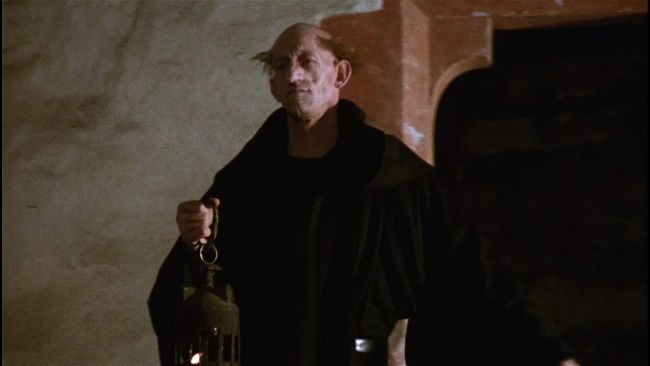
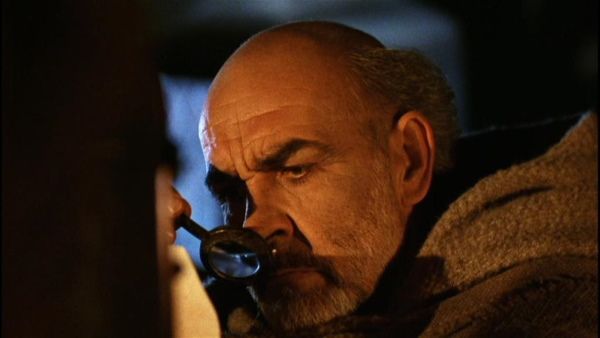
As movies go, The Name of the Rose probably portrays the early 14th century more realistically than any other. Or, at least as realistically. As noted in the October 1986 article about the film in American Cinematographer magazine, "Every prop, every piece of furniture, every book in the film was handmade in Italy." When William uses his glasses to inspect an illustration on the desk of one of the scribes, that gold leaf is the real deal. And the monks who inhabit the monastery are a genuine grotesquerie with their tonsures, moles, missing teeth, cataract-ridden eyes, exceedingly pale complexions, and so on. Most of them are vulgar in one way or another. Add in a few dwarves/little people and you get this weird Fellini-esque vibe.

As would likely have been the case in 1327, the abbey is populated by men from various part of Europe and beyond. Malachi, the head librarian, is played by the German actor Volker Prechtel. Here Prechtel's chiseled features, his large nose, and a thin, U-shaped bit of unkept hair all conspire to give him a stern countenance. So, when William tries to gain access to the library, his curt replies consisting solely of "No" in a German accent just come across as extra sinister. It's a little thing but just so effective and memorable.


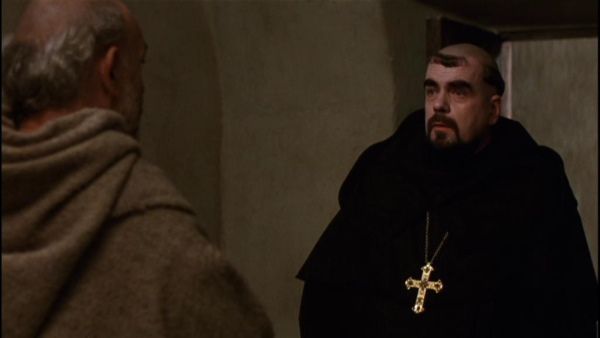
Home video releases have no deleted scenes and I have heard nothing about material being excised from the shooting script but I had to wonder if there is material on the cutting room floor. Early on when the Abbot goes to William's cell to greet his new guests, we see him fiddle or clutch the rather ostentatious gold cross he wears around his neck. And Annaud makes sure cinematographer Tonino Delli Colli gives us a close-up of the large ring he wears as Adso kisses it. I think the book makes more of the wealth the Abbot displays – he's hosting a debate on Christ's poverty, don't forget – and I am curious if this scene is just a brief nod to the debate or if scenes involving the Abbot and his valuables were edited out or perhaps scripted but never filmed.


In my latest viewing I finally noticed a flub. At one point William and Adso are in the scriptorium looking at the desk of Venantius, I believe. William finds a scrap of paper with some Greek text and notices an odd smell about it. He deduces that something was written on it in lemon juice so he places the paper above a candle or lamp flame so the heat induces a chemical reaction and makes the citrus symbols visible. Later in the film, William presents this scrap of paper to the Abbot as evidence to show motive for the murders. But William exposes the hidden text again by placing the paper near the flame when it should already be there.


I've been listening to the film's soundtrack by James Horner recently and it is wonderful. I love the choral voices, the pulsing bass notes, the chime-like sounds, and the drone of what I suspect is a hurdy gurdy. So I paid special attention to the audio portion of the movie on my recent viewing. It is notable how often there is no music and we are left with only diagetic sounds. When someone tries to drop a large stone on William as he and Adso stroll the abbey grounds, the novice catches site of the threat and pushes William out of harm's way. They then give chase. But there is no music attempting to heighten the action, just the sounds of footfalls on wood and grunts. The audio portion here is spartan and realistic as well as wholly appropriate and effective.

At times the volume goes up to jolt the viewer such as when a sotto voce conversation between William and the Abbot concludes and we immediately get the loud squeals of a pig being slaughtered. Sacred sounds tend to be in hushed tones while the profane blare like Gabriel's horn. But the audio dynamics are also used to illustrate the difference between the abbey's inhabitants and outsiders. For example, there is William's joyous outburst when he and Adso steal their way into the library. Not only is it loud, but it is a laugh, something that we know Jorge would disapprove of immensely.


Foley artists were kept busy because most scenes have creaky wooden floors or just some part of the environment making noise. Add in voices speaking Latin and/or people speaking English with an accent and it just creates a wonderfully rich, evocative, and polyglot atmosphere.

And the characters here are so very fun. The monks and friars that are the least bit significant all have distinct personalities, countenances, ways of speaking, and so on. For instance, there's William's fellow Franciscan, Ubertino of Casale, with a deep, slightly raspy voice who draws out syllables so that most of what he says has a melodramatic quality to it. Berengar is overweight, unnaturally pale, and I think the only time we hear his voice is when he screams in a very feminine manner. I just love how the film makes the monastery out to be this menagerie of humanity.

One thing that didn't occur to me until my recent viewing was just how densely packed the film is with information. I was reminded of JFK and how Oliver Stone was constantly throwing evidence and conspiracy theories at the viewer. Here several characters and their motivations have to be presented even if just to make them a suspect. We see Berengar lustfully gaze at the young Adso while Malachi's steely eyes throw shade at William. Annaud has William explain some things to Adso while brief cutaways show us people's facial expressions that impart even more information. And because so many monks are not leading the pious life prescribed for them, there is much indeed to tell the viewer.

While it doesn't have the glacial pace of a Tarkovsky film (I mean no offense to the Russian auteur), The Name of the Rose moves slowly as did life in a medieval abbey, I suppose. The murder mystery takes centerstage but there's also Adso's young lust for the girl who lives in the village outside the abbey. Yes, it presents an opportunity for a salacious scene but her character also provides motiviation for Adso and helps illustrate that the clergy don't always view the laity with vos estis sal terrae in mind. And there's the debate about Christ's poverty. In addition, we have William's rationality competing against his faith. Yes, these topics yield to the mystery but there is a lot to be had here.

Watching The Name of the Rose should be an annual rite for me although it is currently more of a biennial thing. And, having read the book last year, methinks I must now rewatch the mini-series from a couple years back. But first I shall listen to the BBC audio drama adaptation.

16 June, 2021

The Corona Diaries Vol. 12b: How to Recognize Different Types of Flowers from Quite a Long Way Away

No. 1

The trillium.


The trillium.

Mid-May 2021

Back in another entry earlier this year, I noted that I had taken a walk at the Heritage Sanctuary (just a bit east of my house) back when there was still snow on the ground and that it was noted for the trilliums (or is it "trillia"?) that bloom in May. Well, I went back there recently to see these storied flowers.


In addition to being all verdant, it smelled wonderful. There were a couple spots that had that tang of pine but mostly it was simply plant scented. It smelled "green", I guess you'd say. There were 2 varieties of flowers everywhere: the white ones above and a those of a light purple hue.


I had to ask a fellow walker which was which and was told that the white ones were the trillia. Now I know how to recognize different types of flowers from quite a long way away.

********

Since my last entry I've been to the movies again. This time it was Final Account.


It's a documentary concerning some of the folks who propped up the banality of the evil that was inherent in the Third Reich. While we meet a former member of the SS and someone who was a guard at a concentration camp, most of the people were just average folks who talk of getting swept up in the fervor of the time. They join the Hitler Youth as it was expected of them. Others talk of how they got used to the smoke from the ovens used to burn bodies at a nearby camp. It became almost unexceptional.

I'm not sure how people can live with such things but I suppose we humans can put up with a lot of horror and inhumanity if it's out of sight or doing so is what allows us to get on with our lives.


********

I found a blog post called "photo-documenting a chicago two-story brick cottage unoccupied since 1939" which was really neat.


Given recent events, the first thought that came to my mind was, "Holy Christ! Look at all that asbestos! And lead paint too!" Secondly, I had to wonder why it's been unoccupied for so long yet the owners do minimal upkeep to prevent it from falling down instead of just demolishing it.

I can imagine the place in better days and that it might have looked something like the apartments my grandparents and great aunts and uncles lived in at that time. The men would be seated around a table playing pinochle and drinking beer while the ladies were gathered in the kitchen.

Check out the rest of the blog as it has lots of stuff about bygone buildings in Chicago. I guess the company salvages old architectural ornaments, furniture, and whatnot and resells them. Lots of neat bits about architecture and photos of lovely old buildings.

********

I've been doing some medieval reading lately.


Life in Medieval Europe was good. It's a short book directed at the lay reader that gives a high-level overview of, well, life in medieval Europe – western Europe, mainly. It was a fun read even if most of the material was already known to me. But if you're unfamiliar with the period, it's a nice intro that busts a lot of myths such as that people didn't drink water during this time and that spices were generously applied to cover up the taste of rotten meat. The Victorians sure started a lot of pernicious rumors.

If you have any interest in the Middle Ages but don't know where to start, you could do much worse than Ms. Cybulskie. In addition to her books, she hosts a podcast for Medievalists.net which is perfect for neophytes.

Another book I read recently:


This too is for the lay reader. It's a series of excerpts from primary sources (in modern translations) about a variety of topics illustrated with period art and illumination. It's very pretty.

I adore medieval illumination. Perspective is all goofy and people usually have a rachitic look about them. Things look surreal and I just love it.


With a new film based on the tale Sir Gawain and the Green Knight coming out in July, I wonder if moviegoers will attempt to read the source material. I am sure medievalists the world round are hoping for a renewed interest in their field of study.

********

Bonus photo: The Frau is apparently now into garden gnomes. She bought this one recently. Very Zen.

05 December, 2020

The Corona Diaries 1: The Best Laid Plans

Back in August I started my Corona Diaries - a series of missives sent to family & friends who live out of state. I am adapting and expanding them for the blog.

Late August 2020

2020 started off well enough.

I have been hoping to visit Germany for a while so I enrolled in a non-credit adult enrichment German language course thinking the time was nigh. The Frau and I were looking forward to drinking Rauchbier in Bamberg and seeing what else Germany had to offer a couple of American tourists. Perhaps the Altstadt in Heidelberg as well. Or Berlin. How can you go wrong with Berlin? I could see the sights I've only read about in the Gereon Rath novels. Ever since learning that my German ancestry goes back to my great-great-great grandfather Heinrich who hailed from Hannover, I've had a desire to drink a Breyhan (a beer style native to Hannover and very popular from the 16th-19th century) and to visit the city from which I get my German blood. The first ur-drops, anyway.

I took German in college and actually became fairly proficient for a short time. One of my roommates had taken German in high school and was majoring in German literature so I was able to come home and practice with him. It got to the point that I started to dream in German. The next year my friend went to study in Germany for a year and so there went my tutor and conversation partner. (Accompanying him was Scott Manning of Vintage Brewing. I believe that Scottie's Schwarzbier, Schwarzfahren, was named in honor of one of their adventures.)

It wasn't long before I found that I recalled much more than I thought I would. Over the years I've always used a bit of German here and there, e.g. – yelling "Achtung!" at the kids when they were little.

Speaking of my stepsons, they are doing well overall. The oldest turns 25(?!) in the autumn. He lives very close to where we lived before buying our house – on the isthmus not too far from downtown. His girlfriend moved in with him when the stay at home orders came down in March. He was doing some acting as well as teaching when the pandemic struck. I am very proud of him as he has gotten his stuff together and become quite responsible. It's as if he's an adult or something.

The youngest turned 21 this summer. Instead of volunteering to buy beer for his stepfather so he doesn't have to venture out to the Covid-laced liquor store, he is moving to Eau Claire at the end of this month or early September. As young men often do, he is following a woman - his girlfriend is returning to school there.

Having an interest in medieval history, I took another class last winter called "The Art of the Medieval Book." I learned the difference between parchment and vellum and how they're made, about medieval inks, and so on. Plus, I was excited to handle a codex for the very first time!


Being a big fan of The Name of the Rose – the novel, film, and TV series – it was thrilling to actually touch and leaf through some codices. To be able to feel the parchment, look at the detail in the illuminations with my own eyes, and whatnot was really neat. Luckily my fingers and tongue did not turn black.

2020 was also supposed to have included other travel plans beyond a potential trip to the Fatherland. I had carried a week of vacation time over from last year and had plans aplenty. The spring was to have involved a trip to New Orleans to visit The National WWII Museum with friends, a couple of whom I got to know through my brother and were, like him, big World War II history buffs.

My father was a huge WWII history buff and passed this down to my brother. I couldn't help but develop some interest in the subject and recall writing a paper on the day that will live in infamy at Pearl Harbor when I was in 4th or 5th grade. But I never came close to the devotion to the subject that they had. For instance, they'd be able to watch a WWII movie and point out that the Panzer Mk III onscreen was not yet in service at the time of the events the movie is portraying. I can still picture my father sitting before our TV in back of the house with mentholated smoke streaming from his nose and curling around his head as he gleefully watched Kelly's Heroes or Tora! Tora! Tora! for the 40th time.

After my brother died, I felt strangely obligated to keep the family interest in WWII alive so I started reading about it. I inherited some of their books but I've also been buying my own. Rather than retreading the well-worn, I've been trying to avoid the battles and aspects of the war that the likes of Steven Spielberg have made into blockbuster movies so that means no D-Day, no Pearl Harbor, no Holocaust, and no Battle of the Bulge. Instead I've read about the Rape of Nanking, the Battle of Stalingrad, the North African theater, and about Europe in the immediate aftermath of the war's end. 

Here are my latest purchases:


I've not yet read the book on the invasion of Poland but reading about The Battle of Okinawa sure makes life during the pandemic look like a cakewalk, I can tell you.

I had hoped to visit The National WWII Museum with my brother at some point – perhaps also head over to the National Museum of the Pacific War outside of San Antonio with him since we'd be down south. We'd check out the exhibits, he could lecture me about the war, and we'd reminisce about the old man. Much to my dismay, that never happened. So, I had a crew of friends lined up to board an Amtrak train for a spring trek to New Orleans…

Those plans fell through when The Frau announced she needed surgery. I moved the New Orleans trip to the autumn so I could be around for her recovery. (All went well and she has recovered fully.) In addition, she wanted to go to London for her X0th birthday in the summer. I had applied for my passport in December and it arrived in February.

And then came COVID-19. All these plans were shelved along with my annual trek to Indianapolis for the Gencon gaming convention; the gaming convention here in Madison, Gamehole Con, was soon canceled too and, most recently, so was the Doctor Who convention held out in Lombard, IL on Thanksgiving weekend, Chicago TARDIS. It's depressing to see my virgin passport and be reminded of all the plans I had. I really need to stow that somewhere out of sight.

Instead of venturing far and wide, I have spent the past five months working on short trips. Yesterday the Frau and I visited our favorite dairy, Sassy Cow. The farm and creamery are only about 20 miles north of Madison. We were there several years ago when the creamery opened but haven't been back since. That trip is notable in our minds for the cow who was in labor.


I had recently read an article about the plight of dairy farmers here in Wisconsin and thought visiting a farm would be a fun, if short, getaway.

Sassy Cow is not an industrial farm – more like a large family farm. The tour is only about 30 minutes but it's always nice to get out to the country. The smell of a cow barn never fails to take me back to living up north by Eau Claire while in high school. We left after having spent more money than I had hoped and are now very well stocked with ice cream, half & half, cheese, and yoghurt.


01 April, 2015

Medieval Salve Kills Antibiotic Bacteria


Perhaps the Dark Ages aren't as dark as generally thought.

Researchers have discovered that a medieval salve for eye infections is very effective against some nasty strains of bacteria which laugh at futile attempts to kill them with antibiotics. The recipe was taken from the above "Bald's Leechbook". I presume that none of the researchers knew Old English which means that a medievalist of some stripe at some point had to translate. Score one for liberal arts majors!

But researchers recently found that a thousand-year-old Anglo-Saxon treatment for eye infections works as an antibiotic against one of today’s most notorious bacteria, Methicillin-resistant Staphylococcus aureus (MRSA). The British researchers will present their findings this week at an annual microbiology conference held in the United Kingdom.

Christina Lee, a professor in Viking studies at the University of Nottingham, translated the recipe from the Old English in Bald’s Leechbook, which was written in the 9th century and is one of the earliest known medical textbooks. The researchers prepared four batches of the recipe, which called for two species of garlic and onions, wine, and bile from a cow’s stomach brewed in a brass cauldron and let sit for nine days before use.

take cropleek and garlic, of both equal quantities, pound them well together, take wine and bullocks’ gall, of both equal quantities, mix with the leek, put this then into a brazen vessel, let it stand nine days in the brass vessel, wring out through a cloth and clear it well, put it into a horn, and about night time apply it with a feather to the eye; the best leechdom.

The researchers tested the concoction on cultures of MRSA bacteria in synthetic wounds as well as in rats. No individual ingredient had no effect on the cultures, but the combined liquid killed almost all the cells; only about one in 1,000 bacteria survived. At more dilute concentrations, the salve didn’t kill the bacteria, but still interrupted their communication, preventing them from damaging tissues.

06 October, 2014

Those Poor Navarrese

Bill Maher recently stirred up a shitstorm by suggesting there was something wrong with the Muslim world when books, movies, and cartoons incite riots and provoke Muslims to threaten the authors' lives (and in the case of Theo van Gogh, threats became murder.) and that Muslim countries generally treat women poorly. Maher was called all manner of things including Islamophobic, racist, and a bigot.

Well, Maher's got nothing on the medieval author of The Pilgrim's Guide to Santiago de Compostela. I've been reading about medieval Iberia and the book includes some excerpts from this work which was written around 1140. As the title indicates, it's a guide for people making a pilgrimage to Santiago de Compostela in northwestern Spain. According to the text, it was nearly as popular a destination for pilgrims as Rome or The Holy Land which makes one wonder why there's this myth that medieval folks didn't travel far from their homes.

The author is an anonymous Frenchman who informs travelers of which rivers are safe to drink, what towns are to be found on the route, and about the natives as well. Whoever the author is, he really didn't like the Navarrese. (Navarre is or was a region in north-central Spain.) I mean he really, really didn't like the Navarrese. He begins by noting that "These people, in truth, are repulsively dressed and they eat and drink repulsively." It gets worse.

...when the Navarrese are warming themselves, a man will show a woman and woman a man their private parts. The Navarrese even practice unchaste fornication with animals...He even offers libidinous kisses to the vulva of woman and mule.

A Frenchman decrying oral sex?! Forsooth! Up to this point in the book, at least, not even the Jews are described so harshly. Sure, they are said to be greedy and untrustworthy but at least they didn't practice cunnilingus.

Oh, but here's the best bit:

This is a barbarous race unlike all other races in customs and in character, full of malice, swarthy in color, evil of face, depraved, perverse, perfidious, empty of faith and corrupt, libidinous, drunken, experienced in all violence, ferocious and wild, dishonest and reprobate, impious and harsh, cruel and contentious, unversed in anything good, well-trained in all vices and iniquities, like the Geats and Saracens in malice, in everything inimical to our French people.

The author does concede that the Navarrese are good warriors on the battlefield so they're not all bad.

07 March, 2014

Rocket cat, burning out its fuse up there alone

Leave it to the Germans to turn Katzen into medieval siege weapons.


You're a 16th century German prince plotting to crush a peasant rebellion, or perhaps you're leading an army against the Ottoman Empire or looking to settle the score with a rival nobleman. What's a guy looking for a tactical edge to do?

Bring on the rocket cats!

Fanciful illustrations from a circa-1530 manual on artillery and siege warfare seem to show jet packs strapped to the backs of cats and doves, with the German-language text helpfully advising military commanders to use them to "set fire to a castle or city which you can't get at otherwise."

"Create a small sack like a fire-arrow .Iif you would like to get at a town or castle, seek to obtain a cat from that place. And bind the sack to the back of the cat, ignite it, let it glow well and thereafter let the cat go, so it runs to the nearest castle or town, and out of fear it thinks to hide itself where it ends up in barn hay or straw it will be ignited."


Sounds pretty ridiculous but according to Wikipedia, the Russians used anti-tank dogs in World War II and the U.S. military even trained some of their own.