14 August, 2026
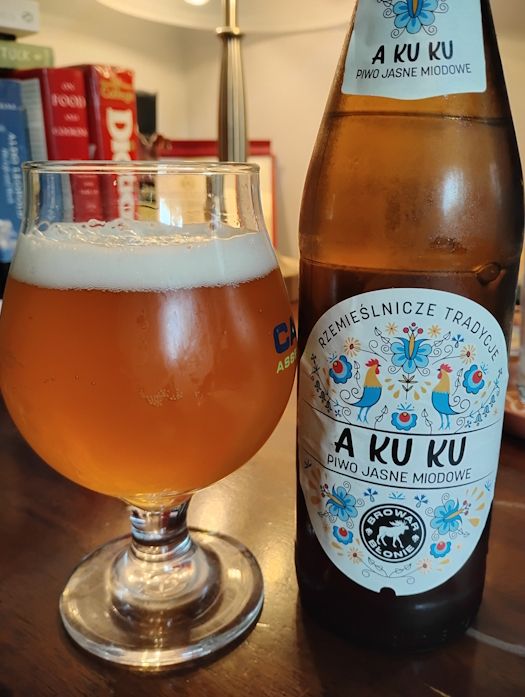
Loude drink ku ku!: A Ku Ku by Browar Błonie
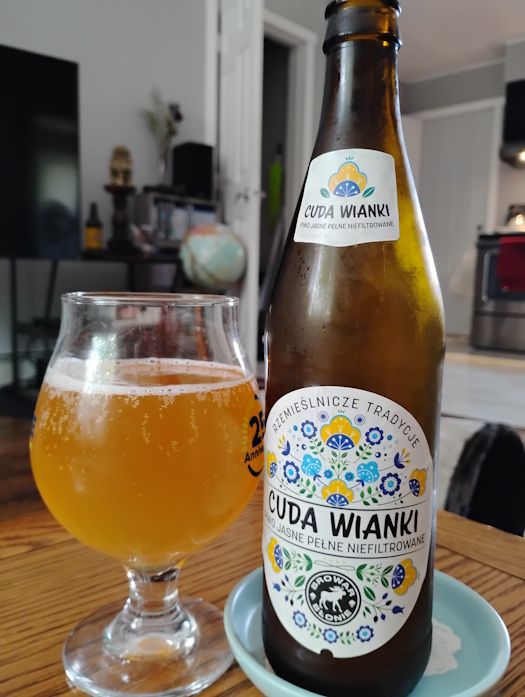
An ironic name?: Cuda Wianki by Browar Błonie
25 June, 2026
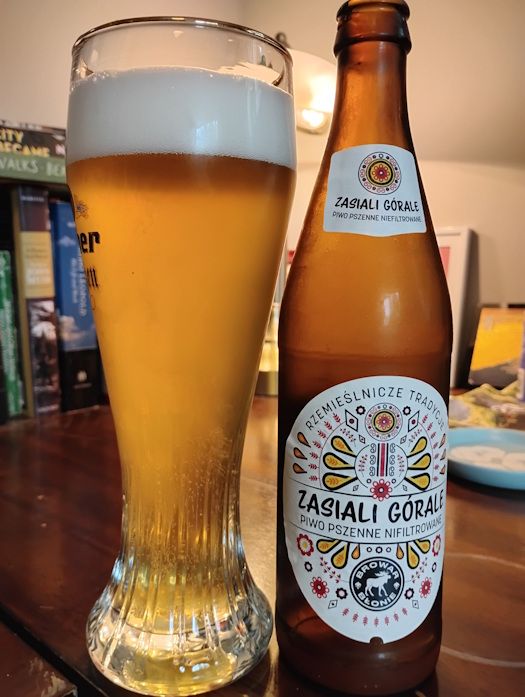
The Highlanders sowed their seeds where exactly?: Zasiali Górale by Browar Błonie
14 April, 2026
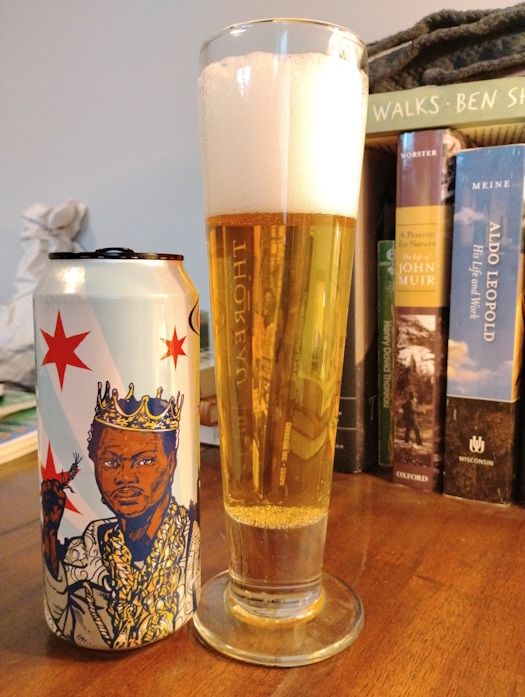
A floral state of mine: Moorvolution by Revolution Brewing & Moor's Brewing
04 April, 2026
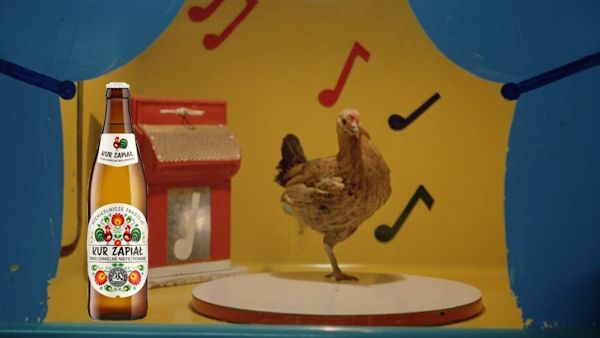
Can't stop the singing chicken: Kur Zapiał by Browar Błonie
My luck with Polish beers has not been good lately if the piwo isn't a pale lager from Okocim or Żywiec or another of the bigger Polish breweries. Binny's seems to keep beers from Poland on their shelves long past their lifespans until they are these musty, skunky pale imitations of their former selves. And so when I came across this brew I was a bit gun shy.
I didn't find it at Binny's, however, but rather at Deli 4 You in Schaumburg back in December when I was returning to Madison from having spent some time in Chicago at the Christkindlmarkt. And the date on the label read 30.06.2026. Well within freshness tolerance. The Polish craft beer selection there was small but how many Polish craft beers actually get exported to the U.S.? I think they stocked the full complement of Browar Błonie's Polish Folklore series. Why did I buy this one? That is lost to the ages. It could simply have been that I was in the mood for a pilsner that day. (There was, if I recall correctly, a label in English on the back.)
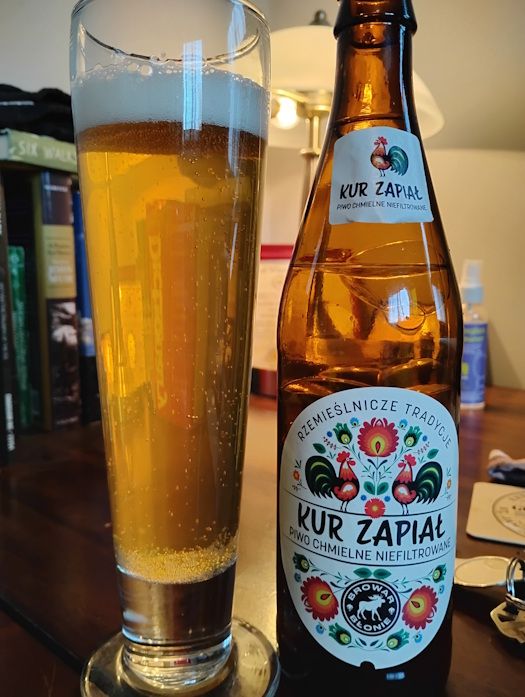
The description at the brewery's website as translated by Google reads, "Light, unfiltered, dry-hopped beer. Refreshing taste and floral-herbal aroma." Oh, the name translated to "The Hen Sang".
For tasting, I busted out my new pilsner glass which I got at Goodwill when shopping for things for my new apartment. A couple years back I gave away most of my beer glasses but wanted a couple two tree for my new life.
The piwo was yellow and had a slight haze - it's unfiltered, remember? There were lots and lots of bubbles which is something I associated with the pils. My pour produced a small head of lovely white foam which lasted an average amount of time. It appeared to be a very pretty pils, to my eyes. The aroma was just as nice with the Polish hops - variety unknown - giving off straw and floral smells. A nice, cracker-like maltiness was to be had as well.
All of those bubbles portended the piwo's big fizz. A delicate biscuity malt flavor was joined by hops that gave a lovely floral taste along with a mild dose of herbal and some straw notes. The maltiness lingered a couple seconds on the finish before the hops rushed in with their floral/straw combo and some attendant bitterness. My tongue tasted smoothness which I figured came from the malt even though there wasn't much grain flavor to be had - some kind of malty-carbo-palimpsest? Just enough bitterness for a slight zip at the end to go with the moderate dryness.
Oh mama, this was a great piwo! It had the delicate pilsner malt flavor down perfectly and I simply adored the floral aroma and taste that the hops gave. The piwo was light and delicate and had just the right floral everything. Just fantastic stuff.
Junk food pairing: The lovely, tasty, delicate floral taste here deserves not to be overshadowed so stick with something on the mellower side such as Simply White Cheddar Cheetos Puffs.
07 November, 2025
15 August, 2025
06 June, 2025
My sincerest desire has come true here: Grodziskie by Dovetail Brewery
Tales of a Grodziskie by Chicago's Dovetail have long been told in these parts but I had never encountered it face to face until last month. I am guessing it's been my poor timing. Either I'd never make it down to Chicagoland when it was in season or the Binny's website proclaiming its availability had not been updated to reflect its absence. I also suspect that part of the problem is that Dovetail takes a very, um, European approach to seasonality. While most American microbrewers adhere to a strict release schedule for their seasonals, e.g. - their Oktoberfests hit shelves in late June, Dovetail seems to be the opposite and release their seasonals whenever they get around to it - within reason, of course.
Or maybe that's just my view from Madison.
Anyway, I was excited, perhaps a bit too excited, to find this Grodziskie. Being made with 100% smoked wheat, it was right up my uliczka as smoked beers are like manna from heaven for me. It is also perhaps the only native Polish beer style left these days and having some Polish blood in me means it's like drinking for the home team. Doubly so since Chicago is my hometown.
The Platonic ideal of Grodziskie was passed down to me from Ron Pattinson, if memory serves. It is to be light, smoky, hoppy, and fizzy. And I judge every Grodziskie style ale based on his description. Can one interpretation that doesn't exactly conform to this ideal still be tasty? You betcha! Tis but a starting point.
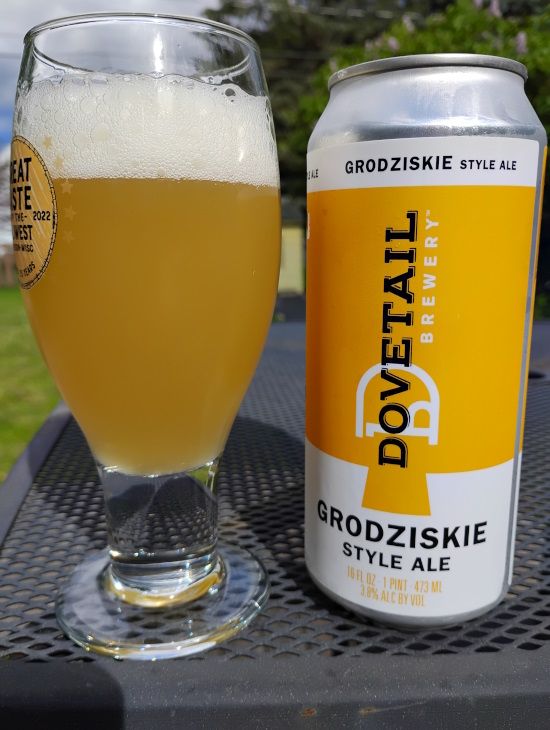
With a hazy yellow color and a very modest 3.8% A.B.V., this brew fit the light bill. A big, firm layer of foam rested atop the tantalizing liquid and, not being in a hurry to go anywhere, I was able to get a decent photograph. The aroma was of smoke along with a little bit of citrus.
My tongue was not surprised at the beer's light body which also had a very pleasant smoothness to it underneath a fairly mellow dose of fizz. The smokiness was delicious and not overwhelming which allowed for a tad of a grainy taste to come through. For their part, the hops tasted herbal-spicy and complemented the smoke well without overpowering it.
The smoky taste held fast for a bit on the finish before the herbal-spicy hop flavor came in to deliver moderate dryness and slightly more bitterness.
Since I don't know how to say "Oh mama, this stuff was good!" in Polish I'll just say oh mama, this stuff was good! While I am not sure, I do believe that the wheat used in the Grodziskie was traditionally smoked with oak. However, I am not sure what wood was used to smoke the wheat here. I don't think it was applewood or cherry, though. But, oh mama, it tastes great! And the smokiness is not particularly strong despite the whole grain bill having been given the treatment.
I'll never know how this stuff compares to the brew the inhabitants of Grodzisk Wielkopolski drank back in the day but I love Dovetail's take on the style. Maybe a touch more fizz but that's a very minor quibble. This is a fine brew and made the perfect companion on a few spring evenings.
Junk food pairing: Pair your Grodziskie with a bag of Old Dutch Onion 'N Garlic potato chips. They provide a nice contrast to the smoke taste yet somehow also complement the beer perfectly.
22 December, 2024
How do you say "bummer" in Polish?
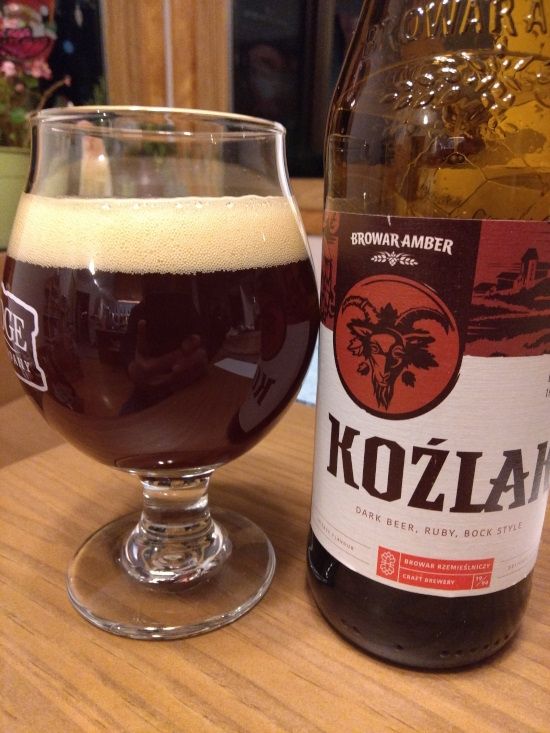
I had a Polish bock beer and was all excited to find succor in it after wandering in the cold and write a review of it as a companion piece to the one of Giant Jones' version and then I find that the beer was bad. Long past its life expectancy with that worty-vermouthy taste. Bummer.
But I remain undeterred. As Douglas MacArthur once said, I shall return with a fresh bottle...
25 November, 2024
Biały Filip: Koźlak by Giant Jones Brewing Co.
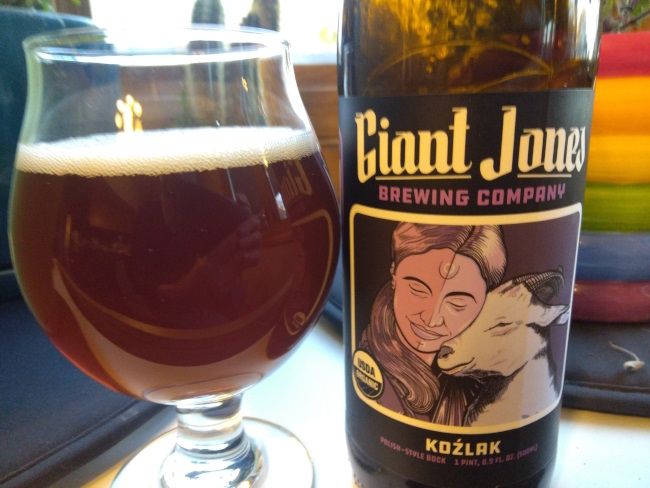
After seeing Black Philip on a can of hard apple cider leading us into dark temptation, we now have a label featuring a white goat snuggling contentedly with a young Polish gal beckoning us into inter-species conviviality. This comes courtesy of Giant Jones Brewing here in Madison.
The beer is called Koźlak and it conjures in my mind images of a detective, likely because it is close to Kolchak and Kojak. While "Koźlak" may look mysterious with its exotic diacritical mark, it is, as I have just discovered, a rather mundane word and simply means bock. Giant Jones calls it a Polish-style bock as it was brewed with Marynka hops.
I don't know if Polish brewers actually brew their bocks with Marynka hops or not. Since Giant Jones' brews are organic, this variety must be fairly common, at least in Poland, if there's an organic version. My knowledge of Polish hops extends no further than Lublin/Lubelska.
My assumption here is that, since my bottle was filled back in April, that this was meant to be a spring bock. I am not sure how long it was lagered but it sat around for 6+ months after bottling. Hopefully it was taken good care of during this time.
My pour produced a rather nice loose, tan head but it went away quickly and I fumbled with my camera so I wasn't able to get a decent photo of it. And, as you can see, I wasn't able to get a decent photograph of even just a tad of foam. The brew was a lovely amber color, which seems only fitting for a Polish beer, and was quite clear allowing me to spy a goodly number of bubbles inside. My initial sniff caught caramel and a fruitiness that I can best describe as a generic berry scent - something akin to Boo Berry cereal. My mind may have caught this latter smell because there was a box of that very cereal atop the refrigerator when I pulled the bottle out. Beneath all that was a hint of lemon and a dash of hay. That green aroma grew as the beer warmed.
Seeing all of those bubbles made me think my mouth was in for some nice fizz and indeed it was. Good thing too as the body was medium-heavy. I was surprised that it wasn't very sweet, though caramel and stone fruit were prominent flavors. The hops added something herbal. On the swallow, those malty flavors faded allowing a moderately potent hoppiness to emerge. Marynka must be a bittering hop as the finish was quite brisk with hefty doses of both bitterness and dryness.
Koźlak was a fine brew. Those hops surely added the lemon and hay scents, which I really liked, and their bitterness made for a very nice contrast to the big malt flavors. I am left to wonder what this beer tasted like fresh. As it was, Koźlak's 7.9% A.B.V. left me feeling nice'n'warm on a chilly fall evening. Maybe I can try it again next spring.
Junk food pairing: Pair your Koźlak with a bag of potato chips. I find that Jays Hot Stuff with its bold paprika heat stands up to the big bock. Plus Old Dutch Dill Pickle chips provide a nice contrast to the mega-maltiness.
Put this Polish music in your ear holes
29 October, 2024
2024 Madison Polish Film Festival
The Madison Polish Film Festival dates have been announced: 10 & 17 November. Screenings are at Union South and are free and open to the public. No Union membership required. Here's the line-up.
01 December, 2023
Who is Number One? You are Number Three.: Polish Pils #3 by Goldfinger Brewing Co.
Last year I stopped in at Goldfinger Brewing Co. on a chilly night looking for a palate cleanser after a chance encounter with some pickle beer. We found that their House and Vienna lagers were superlative and wonderful showcases for the power of a fully armed and operational decoction brewhouse.
While Downers Grove, Illinois is a long way from Poland, the brewery's owner and brewmaster, Thomas Beckmann, is a descendant of one Markus Goldfinger who started a mini-brewing empire in Krakow, Poland back in the 19th century so the fellow has the art/business in his veins. Beckmann looks to pay tribute to his ancestors by crafting lagers using time-honored methods such as decoction. He may also use horizontal lagering tanks (I thought so but cannot recall), which are apparently the bee's knees when it comes to vessels where your beer can slumber at 30 some-odd degrees for a while.
Polish beer seems to largely consist of an array of pale lagers dotted with some Baltic porters. However, I do see some of their brews that are made with honey for a local touch and have also heard tell of Baltic Porters brewed with smoked plums which sounds simply delightful. Plus, there's the grodziskie, which is absolutely delicious.
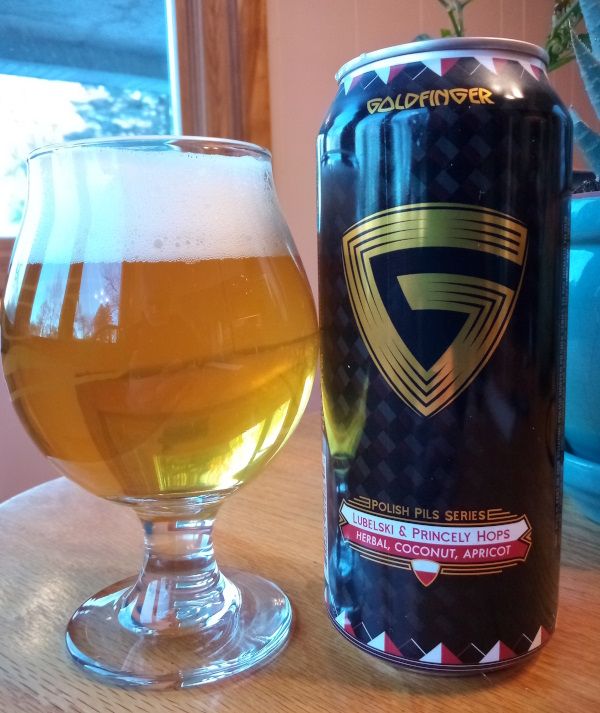
Into this cozy, shall we say, milieu of Polish brews Beckmann has made his own contribution - a series of Polish pilsners that showcase blends of Polish hops. I snagged a pack of the latest entry last month during my annual autumn pilgrimage to Binny's. This is #3 in the series and features Lubelski and Princely (Ksiażęcy) hops. I've heard of Lubelski before as I think that's the most common Polish hop variety, at least to Americans. Princely was new to me and it is apparently new to the scene as well. For better or for worse, it was bred to provide fruity flavors a la most American varieties these days. The can advertises coconut and apricot and I assume they come from the Princely as Lubelski, I do believe, is more herbal - more Noble and less fruity.
Honestly, I went in hoping that the fruit flavors were subdued and that this wasn't one of those Hawaiian Punch beers. I didn't think that Goldfinger, a brewery that adheres to tradition otherwise fairly rigidly, as far as I can tell, would make one of those but maybe the novelty factor was just too great for Beckmann to overcome. That and my trips to the liquor store have got me seeing tropical fruit overload everywhere.
The beer poured a lovely yellow color that veered to light gold at the right angle which set off the categorization cogs in the beer enjoyment part of my brain and I thought, "Kinda more on the German side of things." I would expect a German pils to be perhaps a touch lighter but Pilsner Urquell is definitely darker. So, it's in that liminal pilsner SRM space...woooo...A big dollop of white foam sat atop the aureate liquid and it had staying power. There was a modicum of bubbles inside. I don't know what aromas to expect from Princely hops but I assume the fresh herbal-grassy scent here was courtesy of the Lebelski ones. There was also something fruity but it was indistinct to my nose. It was more stonefruit than tropical, though.
My first sip revealed a nice medium-light body which seemed to fit in the middle of my German-Czech pils dichotomy just like the color. Fizziness was middling, i.e. - I'd have been happy with a touch more but the beer still had a pleasant bite. A great cracker taste was accompanied by a nice touch of herbal hoppiness and this allayed my misbegotten fears of an overly fruity brew. There was something fruity in there, however, but it was like Winston in Ghostbusters and stayed in the background by-and-large.
The power of suggestion is, um, powerful and I'm not sure if I was tasting a fruit flavor that kinda sorta tasted like coconut because the label said so or not. It was more like apricot on the finish when the cracker taste yielded to a firm dose of herbal hoppiness which, in turn, faded slightly andlet that fruity taste seep through more.
Polish Pils #3 was excellent! For the most part, it tasted like a traditional pils of some stripe with the fruity tastes never taking over. Instead, they were a really nice accent. I loved the fresh grassy hop scent and the light, cracker malt taste. Really delicate flavors handled adroitly by Beckmann and Co.
Junk food pairing: Get some of Goldfinger's Polish Pils quick because I believe it's a limited edition brew. It will pair well with onion and sour cream potato chips but I highly recommend going with a dill snack and your babcia would no doubt approve of Herr's Creamy Dill Pickle chips where every bite is full of mizeria goodness.
29 March, 2022
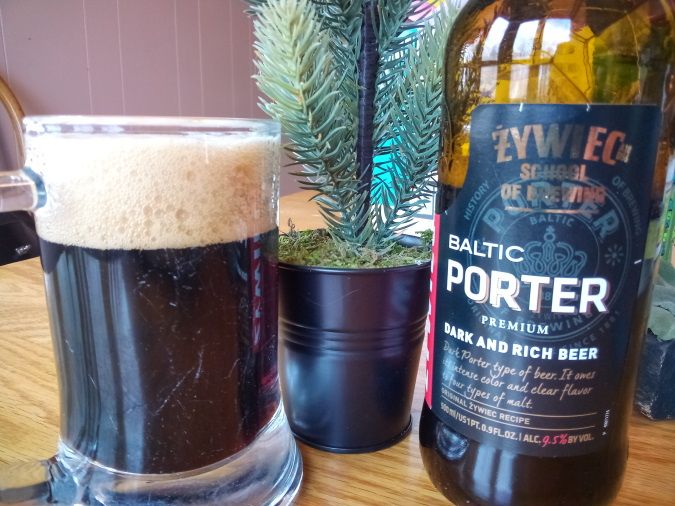
How zaftig! How Żywiec!: Baltic Porter by Żywiec Brewery
It wasn't all that long ago that winter had just given way to spring and I was reviewing a different Baltic porter. That one was made right here in Madison. It had a strong stone fruit flavor, too much, in fact, for my taste. Well, today we have another big, dark lager, one that you will likely find in the all the taverns and inns from Międzylesie to Lubin. Or Lublin, for that matter.
My previous encounter with this style was with one brewed in collaboration by Giant Jones Brewing Company and Working Draft Beer Company. While it had all of the requisite flavors, they were out of balance for my palate, with a taste akin to plum leading the charge while coffee and dark chocolate, my favored Baltic porter flavors, came in much smaller doses. These tastes are provided by dark malts and add bitterness which, in combination with hops, acts as a nice counterpoint to the sweeter aspects of the beer from the paler malts. I rather doubt that the Giant Jones/Working Draft brew was extraordinarily sweet, as in I don't think it had more sugars in it than the imported Baltic porters that I recalled. But having a fruitiness as the primary flavor tricks my brain into tasting more sweetness than is actually present.
Hoping that my memory wasn't failing me, I figured I ought to trust but verify.
It having been quite some time since I'd last had a Baltic porter brewed somewhere near the Baltic Sea and having had a couple domestic versions that didn't appeal to me all that much, I sought out an imported version. I think Madison's eastern European population lives mainly on the west side so it was off to Woodman's West. I noticed that there wasn't any Baltika like I remembered being there previously with "previously" likely meaning 10+ years ago. Plus, they used to carry 2 liter plastic bottles of Russian beer, as I recall, as well but I saw none of those. Was this a boycott of Russian beer because Putin invaded Ukraine? Or the result of making more room for craft beer? Perhaps Russian beer is simply imported less and harder to get a hold of. Regardless, I was able to find Żywiec Porter, the only imported Baltic porter they had on hand. It is Polish so points for going back to the motherland on this one.
According to the vast repository of all human knowledge, Wikipedia, the Żywiec Brewery dates back to 1856 and the town of – quelle surprise - Żywiec which currently resides in far southern Poland. There was no state of Poland in 1856 and instead the town was part of the Kingdom of Galicia and Lodomeria. Today the brewery is owned largely by a corporation, holding company, or some other legal entity that has the word "Heineken" in it and, also according to Wikipedia, has a capacity of 5 million hectoliters which apparently comes out to a little over 4 million barrels.
Besides being a brewery that still uses green glass bottles, Heineken is a brewing leviathan. It's a multinational company that makes a gagillion barrels a year in facilities around the globe. I get the impression that Żywiec is to Heineken as Leinenkugel is to MillerCoors or AB-InBev or whatever conglomerate owns them these days. And just as Leine's corporate overlords have ensured that Summer Shandy is found in every state in the Union, Żywiec's have willed that their beer be available in Madison, Wisconsin.
I am getting better at pouring and was able to get a big head of tan foam in my glass. It was moderately firm stuff. The liquid was a deep, deep mahogany and of fine clarity as I was able to see a fair number of bubbles inside. The aroma was heavenly! Full of cherry and chocolate, it smelled like it had been brewed in collaboration with CocoVaa as it was as if I had just taken a deep whiff over a box of chocolate truffles. There were also hints of coffee and tobacco.
So far, so good.
One drop was all it took to know that this was a big, rich beer. It had a heavy body like the proverbial motor oil. My tongue got a goodly dose of malty sweetness that was a little caramel, but more like honey. Cherry lingered in the background as other, non-fruity flavors kept the sweetness at bay. Coffee flavors lent bitterness while some fizz and spicy hops did their part. Much to my delight, it was also faintly smokey. The cherry and sweetness slowly faded after swallowing which allowed notes of coffee and a hint of bitter chocolate to take centerstage. Those spicy hops returned as well, adding bitterness to make for a rather dry finish. A healthy alcohol burn also aided this effort.
Oh, it left a lovely bit of lacing in my glass.
This is an archetypal Baltic porter. For me, anyway. There was a lovely cherry taste to be had here but it never overpowered the other, more savory, malt flavors. The coffee taste was great and I really enjoyed how it, the fizz, etc. worked together to keep the beer from being a cloying mess. This stuff is a heady brew at 9.5% A.B.V. and it tastes like it. My whole body began to feel warm after half a glass, which was rather nice on a chilly spring evening.
Free of vanilla and with subdued stone fruit flavor, this is the Baltic porter I remember, that I prefer.
Junk food pairing: Żywiec Porter is a big, rich brew with a complex
mix of flavors and so deserves to be paired with something endowed with an equally intricate
set of gustatory components. Start with a plateful of Super Pretzel Mini Pretzel Dogs and
smother them with warm Cheez Whiz.
16 February, 2022
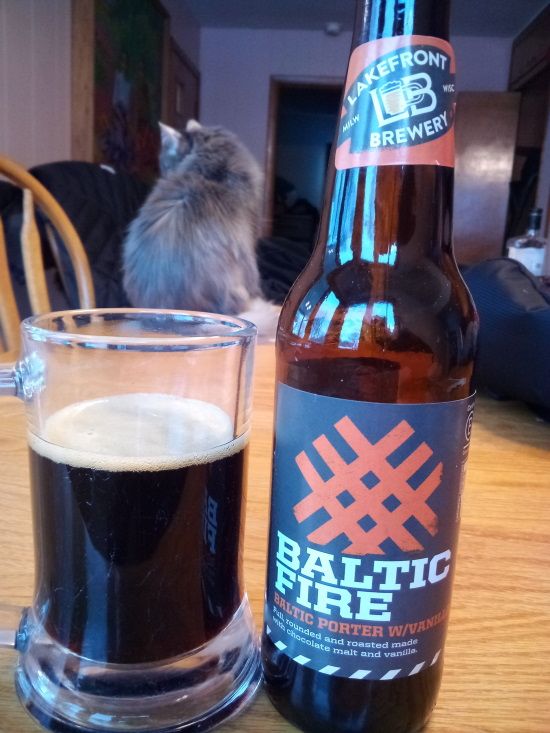
Did you know "vanilla" comes from "vagina"? No, really.: Baltic Fire by Lakefront Brewery
Yesterday I wrote about the advent of coffee beer in 1994 just 25 miles to my south in New Glarus. And today I have read that the term "Baltic porter" was first used that very same year by Bill Yenne in his book Beers of the World although it was über beer geek Michael Jackson that seems to have popularized the term 4 years later. There truly was more to the 90's than grunge, cargo pants, despair, and indifference.
While Slavic food is severely underrepresented in the Madison dining scene today, a restaurant called Russia House spent much of the 1990s evoking images of Sean Connery romancing Michelle Pfeiffer and dishing out borscht and vodka to folks downtown. I was sad to see it go but was very happy to see the opening of Arbat Russian Restaurant in nearby Fitchburg sometime the following decade. I have fond memories of chasing away the winter chill there with hearty platefuls of pelmeni and stuffed pork loin. And to wash it all down I was able to choose from a full array of Baltika beers with my favorite being #6, their Baltic porter.
English beer historian Martyn Cornell has written about the history of this style so credit is due to him for what follows.
The short story is that the Poles developed a taste for English porter in the 18th century with a particular fondness for something called the "double brown stout" which sounds like it was a much, um, stouter porter than its more workaday cousin. I suppose it isn't surprising that the Poles had a taste for a stronger brew considering their hostile neighbors. You too would seek out a more potent potable if the Prussians, Russians and Austrians invaded your country and wiped it off of the map as happened in 1795 when the state of Poland was terminated and would not reappear for 120+ years.
Fast forward to the 19th century when lager brewing was all the rage and some entrepreneuring Polish brewers applied it to their beloved porters. And voila! The Baltic porter was born.
Until an international standards committee comes up with a mutually agreeable definition of what exactly constitutes a Baltic porter, I will continue to labor under the characterization of a beer that is a dark lager around 8% A.B.V. that is otherwise a porter.
It's a fairly uncommon style here in Madison, as far as I can tell. When I am at a liquor store in Chicago, the shelves have Baltic porters from various large Polish brands such as Okacim, Zywiec, and Perła in addition to Baltika, which is a Russian brewery. Unlike Chicago, Madison does not have a large Polish/Polish-American population and so those beers don't show up on our shelves. Thankfully some craft brewers are happy to help fill the gap. Last winter I tasted a Baltic porter from Milwaukee's Third Space Brewing called Ice Bear. And late last autumn another Milwaukee brewery, Lakefront, gave us Baltic Fire, a Baltic porter with vanilla.
Lakefront is one of the progenitors of the Wisconsin craft
beer industry having opened in 1987. Their Riverwest Stein is not only tasty,
but also a stalwart of the beer scene here. It's one of those brews that does a
yeoman's job in places that don't have menus that are printed in a typeface so
small you need a magnifying glass to read because they need to fit in all the
trendy IPAs and hard seltzers they serve on a single sheet.
While I am inclined favorably towards Lakefront, my Spidey senses tingled when I saw that their new Baltic porter was made with vanilla. Additives in beer can have some tasty results but American brewers tend to use them with all the subtlety of Donald Trump at a beauty pageant. So, I was a bit leery about this Baltic fire stuff yet I tried it anyway because a Baltic porter with vanilla sounds delicious.
Baltic Fire looked dark brown with a slight reddish tint. Its clarity allowed me to see lots of bubbles bopping around inside. My photo, as usual, doesn't capture the beer in all of its glory as the big tan head exited stage right hastily. As someone who enjoys dark beers, I can say she was a looker and had me chomping at the bit to take a sip. Taking a whiff, I caught vanilla. Lots of it. "This must be what it's like working at the McCormick vanilla extract factory," I thought to myself. Subsequent sniffs revealed some stone fruit and coffee smells.
My first sips revealed a good fizziness – recall all of those bubbles – and a medium bodied dark lager with a hint of coffee and a large dose of vanilla. As in, had I just fallen into a vanilla extract vat at that McCormick factory? Heavens to Murgatroyd, that was some potent vanilla! Not surprisingly, that taste lingered after I swallowed though a little fruitiness emerged along with a hint of dark chocolate. Then I tasted some hoppy bitterness and a rather unpleasant extracty astringency.
Sadly, my additive-induced wariness proved correct. This
beer was not for me. The vanilla was just too much and suffocated the wonderful
porter flavors. Those coffee and chocolate bits need to breathe! I hope that Lakefront
tries again and uses a lighter touch when it comes to the vanilla because I think
there are some complementary flavors here that are simply out of balance.
Junk food pairing: Pair Baltic Fire with something that will replace some of the lost porter flavors. Go with a bowl of Brownie Supreme Chex Mix Muddy Buddies.