Showing posts with label Politics. Show all posts

13 November, 2024

Ugly progressive

It's been about a week since Donald Trump won the popular vote to become president once again. I didn't vote for the man and I believe that his call to Georgia Secretary of State Brad Raffensperger asking for him to "find 11,780 votes" and his attempt to intimidate the Georgia official by saying, "You know, that's a criminal offense. And you know, you can't let that happen. That's a big risk to you." should have disqualified Trump for running for president again, if not subjecting him to charges of treason. But such are our laws.

Just as the election season is done so too am I with the post mortems. If I never have to hear Rachel Maddow bloviate again it will be too soon. Sadly, the election has revealed that the ugliness which infects Madison progressives goes deeper than a trio of moviegoers.

Take Paul Fanlund, publisher of The Capital Times. In an opinion piece called "Face it, Donald Trump’s ‘cult’ is now an American majority", he writes:

The country today is on strong economic footing, whatever the distortions. That an overwhelming majority of Wisconsin voters did not understand or appreciate those facts represents the ultimate triumph of propaganda.

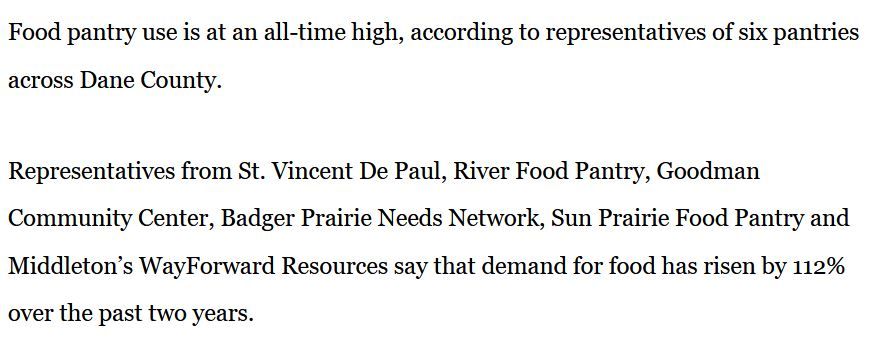
The very next day Isthmus noted "Times are tight at Madison food pantries".


This echoes what Fanlund's own paper noted earlier this year in a piece called "Dane County food pantries say demand surged to record highs":


I guess these area folks who don't have a lot of money left to buy food after paying rent are actually flush with cash from the booming economy and just don't understand or appreciate how pecunious they truly are because of propaganda. Perhaps it's how you slice it, which statistics you cite but there just seems to be a disconnect between the wonderful economy heralded by this well-heeled blowhard and a growing number of Wisconsonians who are in the bread line.

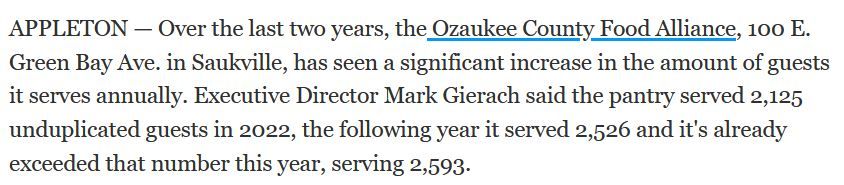
"Propaganda" from Appleton's Post-Crescent dated barely a month ago indicates that the same holds true in the northeastern part of Wisconsin.

What a bunch of fools! How can they not appreciate the great economy?!

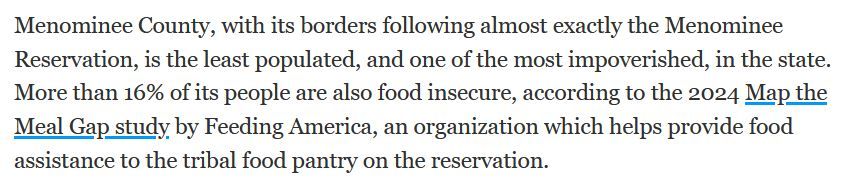
Look! Even more victims of propaganda in Menominee County:

and the Coulee Region.

Later in his screed, the querulous Fanlund claims that all Trump voters are white.

Trump voters are willing to tell young women and people of color they should continue to know their place as second-class citizens.

Trump voters are willing to tell immigrants who — like their own northern European ancestors — are simply seeking the American dream, that that door is now closed.

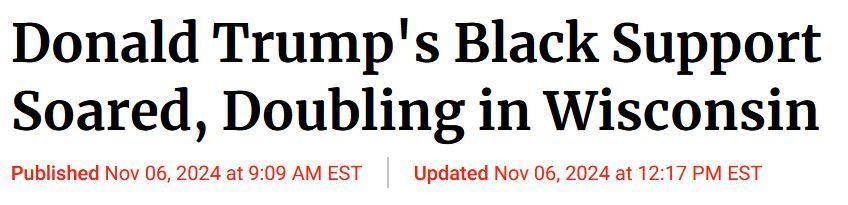
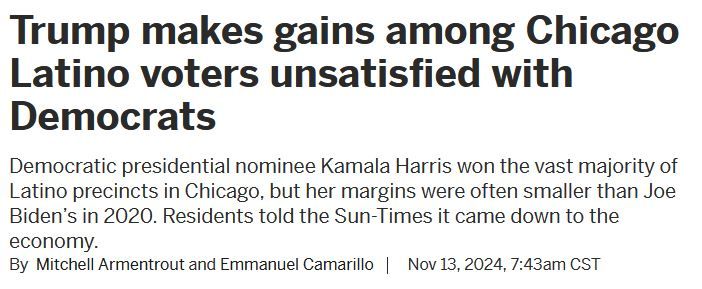
These comments elide the rest of the story, as Paul Harvey used to say, i.e. - the news that people without northern European ancestry voted in larger numbers for Trump than previously thought possible by the progressive clerisy. Trump made gains with Black and Hispanic voters in large part because of the economy. Support for Trump from Blacks here in Wisconsin soared dramatically.

Oh look! Latinos saying it was the economy.

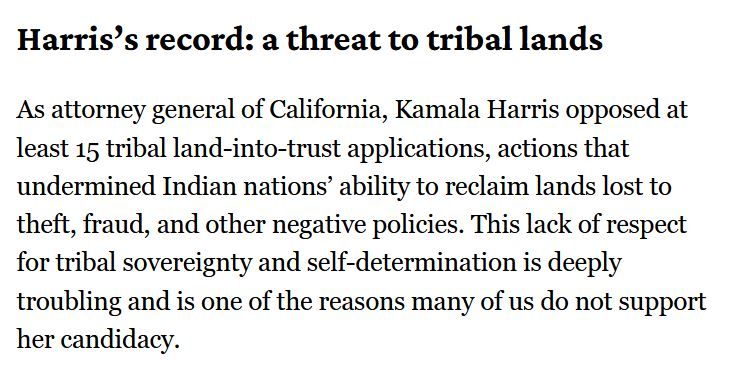
And Native Americans also moved right. Here's a bit from "A Navajo perspective: why many of us support Trump over Harris":

But for Fanlund, there are no Trump voters of color and the Orange Man's lily-white supporters are all too stupid to see how great the economy is, their pocketbooks be damned. The Cap Times' grumbletonian just cannot even imagine that people unlike him might have different priorities, that their finances might not correspond to macroeconomic statistics in the ways he thinks they should.

"It's inconceivable!" he blurts out to no one in particular from the porch of his not inexpensive home, sounding like Vizzini but with the gentle humor leeched out in favor of red hot sanctimony. What a jagoff.

Being disgusted with such naked condescension, I have stopped contributing to the Cap Times.

01 January, 2014

Immigration Laws Affect Madison

Last month Juliana Kerr from The Chicago Council on Global Affairs was in town to discuss immigration. She met with Mayor Soglin who "convened a roundtable with city council members, Hispanic and Somali immigrant community leaders, and several youth" in addition to the Madison Committee on Foreign Relations, a group of "civic, business, and academic leaders" who meet once a month to hear presentations and discuss global issues. Sadly I could find no mention of Kerr's meetings in Madison newspapers. Luckily Ms. Kerr blogged about her day in Madison.

When most people discuss Wisconsin’s stake in the immigration debate, they think of the migrant workers in the dairy industry. And with reason: forty percent of Wisconsin’s dairy farm workers are immigrants, and yet, the current U.S. immigration system doesn’t offer a low-skilled year-round visa to legally employ them long-term. Add to this the fact that some policymakers want to focus on enforcement-only bills first—including mandatory e-verify—and the entire dairy industry could be threatened.

What may be more surprising, however, is that the lack of immigration reform is also affecting Wisconsin’s urban areas, not just rural ones. During my recent visit to Madison, Mayor Paul Soglin convened a roundtable with city council members, Hispanic and Somali immigrant community leaders, and several youth. They immediately asked when the DREAMers (young unauthorized immigrants brought to the U.S. as children) would be able to go to college and pay in-state tuition. Or have the right to apply for citizenship. Or stop fearing deportation at every turn. One boy pleaded to learn more about rumored tracking devices being placed on the ankles of unauthorized immigrants facing deportation. Brought to the United States as young children, they know of no other home than Wisconsin. Why are they being punished? Do we not want them to be educated and successful members of our society?, they asked.

The Mayor is compassionate for their situation and mindful of the changing demographics of his city, noting that while Madison’s overall population has grown from 170,000 in 1980 to 233,000 in 2010, the minority population grew by over 57 percent from 2000-2010 alone. In 2010, minorities made up 18 percent of the total population compared to 13 percent in 2000. The Hispanic population almost doubled from 13,400 to 26,400 during the same period.

But he is also at a loss of what he can do from his office in the absence of federal immigration reform. Even offering driver’s licenses or in-state tuition for unauthorized immigrants are decisions that can be made at the state level, but not municipal. (Ironically, I had also reached out to the governor’s office for a meeting with any willing body but was told that since immigration is a federal issue, no one in the office dealt with it.) The Mayor does what he can, such as supporting grants that go to social service organizations for immigrant communities and welcomes guidance from other cities that are developing creative immigrant integration policies while waiting for Congress to act.


I found this very interesting as, although I was familiar with the large number of immigrants working on dairy farms here in Wisconsin, I really didn't know much about how our immigration laws affect the ever-growing number of minorities here in Madison. While Madison is not a large metropolis by any means, what people think of as "urban" problems are no longer relegated to Milwaukee alone anymore.

In addition to being unable to find any example of Madison's newspapers reporting on Kerr's visit, it is also disappointing that Mayor Soglin didn't mention it on either his personal blog or his mayoral one. What the mayor says and does is news simply by virtue of his office. Madison mayors, like all politicos, are happy to point out their attendance at ribbon cuttings and to announce the formation of committees to study problems but they rarely maintain a vocal presence to keep issues of importance in the public eye. Soglin should be blogging, holding press conferences, etc. much more often to keep important topics on the front burner. Instead of waiting for Congress to act, he could publicize his meeting with Kerr and community members to start the process of taking immigration off the back burner. Perhaps he can do something with Milwaukee mayor Tom Barrett to further publicize the issue. Simply by being mayor every word Soglin utters and every word he types is de facto newsworthy. He has the power to begin and foster civic conversations yet he seem fairly reluctant to do so, which is a shame.

12 November, 2013

Soglin Looks To Get Tough on Poverty

Finally! It was good to read this morning that Mayor Soglin has started advocating for a new economic plan for Madison to address the growing poverty and racial disparities here in Madison (and Dane County at large). This is why I voted for him. Mayor Cieslewicz really turned me off with the vast amount of political capital he spent on pushing the Edgewater Hotel remodeling plus the fact that he drank the Richard Florida Kool-Aid on a near daily basis. Urban analyst Aaron Renn once noted that "the creative class doesn’t have much in the way of coattails" yet it seemed that the only things in Cieslewicz's arsenal to combat rising poverty in Madison were tech startups and amenities for the vaunted "creative class".

Recently a group called Race for Equity released a report detailing vast economic and educational disparities between whites and blacks in Dane County. Amongst the findings:

-- In 2011, the unemployment rate was 25.2 percent for Blacks compared to just 4.8 percent for whites. Nationally, the unemployment rate was 18 percent for Blacks and 8 percent for whites.

-- In the same year, "over 54 percent of African American Dane County residents lived below the federal poverty line, compared to 8.7 percent of whites, meaning Dane County Blacks were over six times more likely to be poor than whites."

-- More than 74 percent of Black children live under the poverty level as opposed to just 5.5 percent of white children. The report suggested "that this 13 to 1 disparity ratio may constitute one of the widest Black/white child poverty gaps that the Census Surveys reported for any jurisdiction in the nation."

-- "In 2011, African American youth in the Madison Public School District had about a 50 percent on-time high school graduation rate, compared to 85 percent for white students."

-- "African American adolescents, while constituting less than 9 percent of the county's youth population, made up almost 80 percent of all the local kids sentenced to the state's juvenile correctional facility in 2011."


To address these issues

Soglin released a 15-page Madison Employment Plan that will focus on five areas over the next year: housing, quality child care, transportation, health and education/employment.

He said a team of government, community and business leaders needs to work together quickly in three areas:

Youth internships

Building trades apprenticeships

The creation of more full-time — not just part-time — jobs for adults

...

Increasing the number of full-time jobs overall is “as big as the universe itself,” Soglin said. “It is simply creating more jobs in locally based companies.”


There's much to like here although I am skeptical of the notion that existing companies can provide all the work that is needed. A recent blog post by Pete Saunders remarked upon a report from last year on the Chicago mega-region, i.e. - the area from Milwaukee south along the Lake Michigan shore to northwest Indiana. This region has the same racial disparities as Madison and what caught my attention was this part of the report: "Skills mismatch lies at the heart of these challenges. Low-skilled workers are not finding jobs, while manufacturers can’t fill medium-skilled job vacancies." If creating full-time jobs that pay well enough to support families is the goal, Madison needs to look for new blood, in my humble opinion. One would think that existing companies would already be creating more jobs if the demand was there.

A few things that come to mind in light of all this:

1) Money is tight. Every drop of utility will have to be wrung from the money available.

2) Governor Walker has declared Wisconsin to be open for business. Can Madison/Dane County have him put his money where his mouth is? Can the WEDC be of help in increasing/diversifying the range of employment opportunities here?

3) Partnerships. Can Madison/Dane County partner with neighboring municipalities?

4) Can we better leverage our existing strengths? Take, for instance, Dane County's agricultural sector. Can we leverage it into something more than a public market?

5) We've got Jennifer Cheatham, Nancy Hanks and a whole cabal of former Chicago Public School system administrators running the Madison public schools right now. They bring a wealth of experience from a system struggling with large numbers of poor minority students. Let's listen to them. We should also be open-minded about revisiting Kaleem Caire's Madison Prep Academy. I was certainly ambivalent about it and thought tweaking was necessary but, as my political science professor Charles Anderson described his philosophy of pragmatic liberalism, if something isn't working, try something else.

In the years 2000-2005, the top two counties that people moved to Madison from were Cook and Milwaukee - Chicago and Milwaukee. It seems likely that a fairly significant number of these people were poor minorities. If Lisa Bullock's story is any indication, that trend hasn't stopped.

Bringing together "government, community and business leaders" is a good idea. Prof. Anderson would call this a community of inquiry. But Soglin needs to keep this issue front and center. He cannot keep quiet about it for a Friedman unit or two. Instead, he must keep talking about it, keep explaining how investing in children mired in poverty and their unemployed parents will benefit Madison and Dane county as a whole. Soglin, et al need to make a case to the business community that his plan will benefit them; they need to make a case to the "creative class" explaining how his plan will benefit them; they need to explain to the very people they seek to help what the plan is and how it will help them. Make sure these people have some control over their lives instead of it just being Big Daddy Soglin dictating everything.

It's going to be a long row to hoe which is why the mayor needs to advocate for his plan loudly, publicly, and often.

07 November, 2013

Quis custodiet ipsos custodes?


There is a petition up at Change.org encouraging people to contact their Wisconsin state representatives and Attorney General J.B. Van Hollen to show support for Assembly Bill 409 which would establish an independent review board to investigate incidents civilian deaths at the hands of the police.

KEY POINTS of AB 409:

1.) Requires a three-member team of investigators (two from agencies that do not employ an officer involved in the death) to prepare a report and provide it to the district attorney of the county in which the death occurred.

2.) Then, a Review Board, which the bill creates and attaches to the Department of Justice, must review the report to ensure it addresses all aspects of the death and may request further information from the investigative team.

3.) The five-member Review Board (appointed by the Attorney General) would consist of:

•A retired or reserve judge.
•A former sheriff, chief of police, chief deputy sheriff or asst. chief of police.
•An assistant attorney general.
•A professor or researcher affiliated with a Wisconsin university or college, who has expertise in the field of criminal law or criminal justice.
•A former district attorney or assistant DA, who served in that capacity for at least 10 years.

4.) Any officer involved in a death would be required to submit a blood sample subject to testing with either the officer's permission or a search warrant.


I think this is a good idea but I would imagine that police unions are going to fight this tooth and nail. But I have some reservations. That review board is stacked with former officials of the legal/law enforcement professions and I'd like to see more people from outside of those areas. Aside from the blue code of silence, when I read articles such as this one about a Chicago police officer who drank "multiple" beers before reporting to duty, ends up standing over a bleeding suspect and putting three rounds in his back killing him, and then gets off basically scot-free, I just have very little faith that attorneys general, former AGs, and current/former district attorneys are particularly impartial.

There is something at the site that is particularly striking:

Cops can be heroes, but since 1890 every Wisconsin officer who took a life was cleared of any wrongdoing. Every single one.

I can't find a citation so I don't know that it's true but, if so, it's outrageous. This shows that the people who are ostensibly "on the same side" as the police should not be charged with overseeing the men and women in blue.

As an aside, I recognize Paul Heenan on the right in the photos above. Does anyone know who the other two gentlemen are?

12 September, 2013

Dirty Wars Starring Jeremy Scahill


I wish I had been at either of the screenings of Dirty Wars that Jeremy Scahill had attended here in Madison because I would have loved to have asked him who he felt the movie's audience was. On a substantive level, the film followed Scahill, an investigative reporter, from Afghanistan to Somalia and points in between as he looks at the covert wars carried out by the U.S. government. Stylistically, however, Dirty Wars made me feel like I was watching Tony Scott's Enemy of the State. Was this thing aimed at aging anti-war lefties or younger apolitical folks who might be drawn into examining American foreign policy a bit closer?

Scahill is no stranger to war zones. He eschews military escorts, green zones, etc. and instead heads out onto the battlefield where the news is. He reported from Iraq both before and after the U.S. invasion in 2003 as well as from Serbia as NATO bombs fell and the movie begins in Afghanistan with the aftermath of an assault by U.S. forces on the home of an Afghan family. Scahill takes a journey into a part of the country that is not under the control of NATO forces and is especially unsafe after dark.

There he meets the family who was the victim of US aggression. As they sang and danced at a family gathering, American troops raided the home. The family's patriarch, a local police chief who had worked with American forces, was dead as were others including three women, two of whom were pregnant. Scahill talks with survivors of that deadly night and watches cell phone footage of the party and the aftermath. A man claims that American soldiers dug their bullets out of the men and women they shot. Anti-American sentiment was running high along side the pain of lost loved ones. But who exactly raided their home?

Scahill found the beginning of his answer with the work done by an English war correspondent named Jerome Starkey. Starkey took photos of one General McRaven at a ceremony in apology for the raid which involved presenting the family with a sheep. McRaven, it turns out, worked for JSOC – Joint Special Operations Command. Scahill doesn't recognize the group and redirects his search to find out more about them.

There are many scenes showing Scahill at home scouring Internet results and shuffling through paperwork as he traces the origins of JSOC and their ever-expanding role in the projection of American power around the globe. He eventually continues his travels to see how our “war on terror” proceeds out of the limelight.

In an all-too brief sequence in Somalia, our intrepid reporter meets a warlord named Mohamed Afrah Qanyare who is happy to take our tax dollars to be an American proxy in fighting terrorists. He chillingly says of we Americans, “They are the war masters.” Scahill also travels to Yemen where he meets with Anwar al-Awlaki's father. Al-Awlaki, you may recall, was an American citizen killed by drone sans due process. The same fate befell his teenaged son. Immediately after 9/11 al-Awlaki preached peace and was a minor media figure. But, as Bush II's wars dragged on, he witnessed his fellow Muslims suffering and dying at the hands of America. The anti-American sentiment expressed by the Afghani man early in the movie returns as we learn that al-Awlaki became vehemently anti-American and promoted attacks on Americans.

Dirty Wars left me feeling ambivalent. On the plus side, Scahill and director Rick Rowley do a great service here by illuminating how the United States fights terrorism now that we've left Iraq, are winding down operations in Afghanistan, and have generally pushed the War on Terror out of our minds. It seems that Breaking Bad garners more public attention than does the fact that America is still at war with soldiers killing and dying. Dirty Wars is also important for showing us the victims of American aggression. In the wake of 9/11 President Bush asked no shared sacrifice from the American public. The rich got tax breaks and the middle class was asked to keep going to Disneyland. The mainstream media and government made sure that we never got to see dead American soldiers; all we saw were caskets with American flags draped over them. Ever further from view were the dead innocents who perished at American hands. Apparently we cannot have the American sense of moral superiority challenged.

While Dirty Wars is important for not letting the War on Terror slip down the memory hole and for giving a faces and names to people that we kill, much of the impact is dulled by aesthetic choices that turn the movie into a half-baked spy thriller. For instance, people are introduced by freezing the frame as if it were a surveillance photo. Plus there's too much focus given to Scahill as the tireless seeker of truth and, furthermore, he comes across almost as a parody. In Blade Runner Harrison Ford's voiceover narration sounds incredibly disinterested. Here, the opposite holds. Scahill comes across as being overly earnest. When I've heard interviews with him, he sounds like a normal guy who is sincere and very passionate about his job. His narration comes across as being so fake that it's melodramatic. In real life he seems humble which is in stark contrast to the braggadocio that comes across in his description of his decent into that dangerous region in Afghanistan.

The focus on Scahill and his quest to uncover JSOC gets in the way of presenting a broad picture of the nefarious methods our government employs to carry out its foreign policy objectives. Dirty Wars comes across as being a series of portraits rather than an overview. Scahill's interviews are revealing but the focus remains on individuals at the expense of showing large-scale patterns of dirty wars. I think it would have been more effective to reveal more raids resulting in the deaths of civilians, for example, to establish a pattern of behavior. The movie makes it feel that the incident in Afghanistan at the beginning was unique instead of being part and parcel of our policy. It's not uncommon to hear reports of terrorists being killed and then to hear that many civilians also died. NATO and the US deny the civilian deaths until the likes of Scahill and Starkey reveal the truth. This is an established pattern. We are told as much but this is a visual medium we're dealing with. An anonymous man saying so just doesn't cut it. Similarly, the fact that American policy and actions generates anti-American sentiment is something that got lost in the shuffle.

Dirty Wars has an important message to tell but it gets muddled along the way by a weird desire to emulate Tony Scott.

Help Kickstart World War III!

This one goes out to Gregory Humphrey because, well, because Obama!


29 August, 2013

Will America Ever Break the Habit?


After our invasion of Iraq turned up no weapons of mass destruction in that country, President Bush did a little bait and switch with bringing freedom to the Iraqis brought out as the prime motivation for our Middle Eastern incursion. "The survival of liberty in our land increasingly depends on the success of liberty in other lands," he said in 2005. This notion of bringing liberty from the barrel of a gun was nothing new. Walter Nugent points this out straight away in his Habits of Empire: A History of American Expansion when he notes that Thomas Jefferson, well-known advocate of individual freedom, envisioned the United States as an "empire for liberty". "But imperialist he was," Nugent says of the Founding Father.

Nugent splits American imperial ambitions into three phases. The first is the acquisition of the lower 48, the second is the empire building done in the Pacific Ocean as well as the Caribbean & South America, and the last is the post-WWII era which utilizes more indirect methods of control. Each of these phases, Nugent opines, are undergirded by a sense of American moral pureness and superiority. American expansion is always accompanied by proclamations that we are committing a moral right and never justified on selfish grounds such as economic gain or for strategic concerns.

The bulk of the text is devoted to how the original Americans expanded their 13 colonies into what is today the continental United States. I recall a fair amount of high school American history class – everyone knows the Louisiana Purchase and “Fifty-Four Forty or Fight!”, for instance, but Nugent goes into some depth here. He begins with Transappalachia. America was able to play the English, French, and Spanish off of one another and gain favorable borders after winning its freedom. The desire to expand had to do with a lust for land and profit-making but there was also a strong sentiment that would later be known as “manifest destiny”. Even the earliest Americans felt that they had a divine mandate to exercise dominion over the land.

One of the great things about the book is how Nugent provides a fairly detailed political and historical context for events. For example, rather than simply saying that the Treaty of Paris was signed in 1793, we learn about the pressures facing everyone at the bargaining table. The English colonial secretary, the Earl of Shelburne, was facing empty coffers and a need to split the Americans from the French. Meanwhile in Paris the French foreign minister was desperate to have the Americans honor their treaties with his country. Over in Spain, King Carlos III was attempting to get on the good side of the Americans as their newly formed country now abutted the Spanish Empire.

Subsequent chapters deal with the Louisiana Purchase, the disastrous War of 1812, the acquisition of Florida, Texas, Oregon, etc. The treatment of Indians is well-known and Nugent doesn't cut America any slack in this regard. But he doesn't dwell on this topic either. Much more emphasis is placed on the stratagems and subterfuges used by the men who have run this country. For example, the ink was barely dry on the Louisiana Purchase when future president James Monroe and diplomat Robert Livingston started claiming that the deal included West Florida when they knew damn well it didn't. Soon Jefferson and Madison were spouting the same nonsense. That autumn insurgents took the French fort in Baton Rouge and Madison seized the moment to declare West Florida as belonging to the United States - much the chagrin of our erstwhile allies who had played such a significant role in helping the colonists gain their freedom.

One of things that drew me to reading Habits of Empire was watching John Sayles' Amigo, a film about America's venture in the Philippines at the tail end of the 19th century. I realized that I knew precious little about how my country ended up with all those islands in the Pacific.

It started with a search for islands that could act as the maritime equivalents of rest stops for trade ships. Then the military, in the form of the Navy, and the guano industry aligned interests and in 1856 uninhabited guano-rich islands were declared fair game by the Guano Islands Act at the behest of the American Guano Company. The Midway Islands followed in 1859. Samoa involved chicanery. The natives didn't have a monarch who had authority to cut deals in a manner that Westerners were accustomed. So the United States basically went out and found one.

Hawaii is a very sad tale. Americans moved in and initiated reforms which would benefit themselves. Whites established industries such as sugar and soon Hawaii was home to a wealthy white elite that owned most of the land. In the late 1880s King David Kalakaua's policies weren't rigged in favor of the upper classes so they fomented an uprising and forced Kalakaua to the real power over to them and the government cabinet they populated and controlled. Voting was restricted to landowners, most of whom were white. Pearl Harbor came under American control, laws were passed that mandated all schools to teach in English only, et al.

We gained the Philippines after defeating the Spanish. Many American politicians viewed the Filipinos as savages, unable to rule themselves. And so the American mission there was one of “benevolent assimilation” backed by “the strong arm of authority”. Unsurprisingly, the same people who didn't want the Spanish in their homeland also didn't want Americans there. A tense occupation collapsed into war when an American soldier killed two Filipino soldiers and then yelled, “Line up, fellows. The niggers are in here all through these lines.” A day later 59 Americans and some 3,000 Filipinos were dead and a war was on.

Nugent gives scant attention to his third phase of American expansion as he considers it to be ongoing but this does invite the reader to look at how phases one and two resonate today.

One of the most obvious continuities is the use of questionable assertions or outright lies to enter into war. The sinking of the U.S.S. Maine in 1899 as a pretext for war echoes in the Gulf of Tonkin incident and the claim that Iraq had weapons of mass destruction. In the Philippines Americans tortured Filipinos. The most notorious form of torture was the so-called “water cure” which we call water boarding today. In that same war the American military gathered civilians and placed them into areas around various villages with the warning that, if they left this zone, they were putting their lives at risk. Nugent notes that this “tactic also prefigured the 'strategic hamlet' policy that the Americans would use decades later in Vietnam.”

The episode in the Philippines also demonstrates how America has traditionally viewed itself as being superior to other nations. The notion that the “savages” couldn't rule themselves was tweaked a little for our Iraqi incursion. Bush did not describe the Iraqis as unfit for democracy, but instead claimed that America was doing God's work in bringing democracy to an oppressed people. Despite the change, the American paternalism remains the same.

Finding the man named La Mamea to act on behalf of the Samoans doesn't seem all that different from America propping up friendly dictator the past several decades. And on and on it goes. This country has lied, stolen, cheated, betrayed allies, and killed in the name of expansion and exerting its influence. And nearly every time it has been done under the guise of moral rightness and with the supposed approval of the Judeo-Christian deity.

Habits of Empire is a real eye-opener. It provides overwhelming evidence that we Americans should be highly skeptical of the foreign policy claims of our politicians and to ignore their grandiose claims of American exceptionalism. Underneath all the moral rhetoric, America has proven to be motivated by greed just as much as any other empire.

22 February, 2013

Goin' Mobile

It looks like the state couldn't put the kibosh on BadgerCare soon enough for Dennis Smith because he has now resigned his position as the Secretary of the Department of Health Services to become a lobbyist.

This isn't surprising. DWD is now on their - what? third secretary under Walker.

And then there's the WEDC, a Frankenstein-like entity devised by Walker. Our Dear Leader got to hand pick the leaders of the organization which would be the standard bearer of his "Open for Business" mantra yet it was a complete clusterfuck. It's CEO and CFO resigned. And let's not forget that Walker was the chairman of the WEDC's board.

Many of Walker's cronies whom he puts in charge of state agencies just refuse to finish out his term for one reason or another. Smith, at least, stayed for a couple years. DWD secretaries, on the other hand, are appointed and then bail faster than a deacon in a whorehouse. Do these people just take these secretary gigs as favors? "Yeah, sure, I'll run your agency for a bit. I'm between lobbying/think tank jobs right now."

Look at the press release announcing Smith's new job:

Previously, Secretary Smith served as Director of the Center for Medicaid and State Operations at the Centers for Medicare and Medicaid Services (CMS) under Secretaries Tommy Thompson and Michael Leavitt. He also served as Acting Administrator of CMS from December 2003 to March 2004. In addition, Smith also held positions as Medicaid Director for the Commonwealth of Virginia and as Chief of Planning for the California Department of Developmental Services.

He's leveraging experience gained at the taxpayer expense to hang out with Howard Dean and to advise "clients on long-term market opportunities and business strategies related to health system and health insurance reform". It seems like his stint at the DHS was just a resume builder.

I read an article recently but cannot find it now which addressed this kind of situation. This particular piece was about taking on the revolving door at the S.E.C. specifically, if memory serves, but can perhaps be applied to anyone who uses their civil service merely as a way to gain contacts to use in a more lucrative position in the private sector. The idea was to take a percentage of their salary for five years once they leave the government.

In this case, Smith appears to have cut his teeth at the taxpayers' expense and now he has landed a plum job in D.C. for a private firm (he also did a stint with the Heritage Foundation) where he will, no doubt, make what appears to be the riches of Croesus in contrast to the incomes of those folks whom he would deny Medicaid. Perhaps he can give we the taxpayers a cut of his new salary in exchange for the education and a list of like-minded "reformers" upon whom he can rely that he received at our expense.

11 February, 2013

Do Parking Laws Promote Drinking and Driving?

Over at The Daily Page, Linda Falkenstein has look at the agenda of the next ALRC meeting. It includes this:

One Barrel Brewing is asking for an increase in capacity from 65 to 80, which hinges on a reduction of the rules for available parking stalls.

What are those rules? The way I read it, there are laws on the books that, in practice, ensure that taverns have enough parking spaces for people who want to consume alcohol and get back in their cars and drive away. I thought that we are in the process of discouraging drunk driving and here it sounds like the law mandates more parking spaces for people who drink and drive.

One Barrel is in a walkable neighborhood so I should think that Herr Gentry could get an exemption.

07 February, 2013

Taibbi on Too Big to Jail

Matt Taibbi on why our government considers some bankers too big to jail. Infuriating stuff. Taibbi makes a good point here by noting out that the government sent CEOs to jail for the savings & loan scandal so why not now?


06 February, 2013

Citizen Dave Gets Transit Wrong (Well, Part of It)

In his latest post at The Daily Page Dave Cieslewicz writes about the recent report by the Wisconsin Transportation Finance and Policy Commission concerning transportation in our state. Cieslewicz was on the commission and he laments that most of its recommendations are going to be ignored by the Republicans in control of state government.

While I agree with most of what he writes, I think he does a disservice with this:

Finally, it's a bad idea to move state support for transit out of the transportation fund to the general fund. That makes it easy to start thinking of transit as more of a discretionary program and not what it is, which is part of the transportation network that helps move people to and from their jobs.

Emphasis mine.

I am inclined to agree with Jarrett Walker who thinks the heart of public transit is "personal mobility" which he defined as "the freedom to move beyond walking range without a personal vehicle". Cieslewicz's words here probably do not fully express his view on transit but, regardless, it is disheartening to have a member of the Wisconsin Transportation Finance and Policy Commission explicitly label public transit as being for getting to and from work to the exclusion of all else. The truth is that all kinds of people use public transit to go to and from various places. People use public transit to go to school, go shopping, to the homes of friends and family members, to head somewhere to grab a bite to eat, to seek out arts and entertainment, to get to doctors' offices, etc. While I don't know what the state's transit fund is used for specifically, Amtrak is public transit as far as I'm concerned which means you can add going on vacation to the list.

Labeling transit as only having to do with getting to and from work may sound good to conservative trickle down job creator wannabes but it elides the broader function of public transit.

As I was writing this Governor Walker's State of the State address came to mind, specifically, "...I am committed to a healthy transportation system that includes roads, bridges, freight rail, ports, and airports. Whether it is traveling to a tourism destination or taking product to and from market..." What about passenger rail?

The two Amtrak routes that serve Wisconsin posted ridership gains in FY 2012 and Walker has said that "he always had supported improvements to the Hiawatha". (The state's treatment of Talgo notwithstanding.)

Rather than celebrating a degree of passenger rail success in Wisconsin, Walker ignores it. I was hardly surprised considering that the DOT's Connector newsletter now seems to avoid the subject. When Doyle was governor, the newsletter touted the rising number of rail passengers almost every month. After Walker took office Connector disappeared for a stretch and returned in a new form, avoiding all mention of passenger rail as far as I can recall. Considering that the Hiawatha Line broke a ridership record in Amtrak's FY 2012 with 838,000+ passengers, you'd think that would be something to cheer.

14 March, 2012

Cold Comfort in the Battle Against the Vampire Squids

The vile filth coming out of Wall Street lately has my mind reeling. Both in the sheer amount of it and in the utter depravity that falls under the aegis of banking and investment. Today Greg Smith became the former executive director and head of Goldman Sachs' United States equity derivatives business in Europe, the Middle East and Africa. He explained his departure in the New York Times, of all places. He seems to be the lone big wig in the industry to have tired of the drive for short-term profits and the exaltation of greed as a cardinal virtue. Smith laments how the ethos of Goldman Sachs has deteriorated from serving the customer to screwing the customer.

I attend derivatives sales meetings where not one single minute is spent asking questions about how we can help clients. It’s purely about how we can make the most possible money off of them.

It makes me ill how callously people talk about ripping their clients off. Over the last 12 months I have seen five different managing directors refer to their own clients as “muppets,” sometimes over internal e-mail. Even after the S.E.C., Fabulous Fab, Abacus, God’s work, Carl Levin, Vampire Squids? No humility? I mean, come on. Integrity? It is eroding. I don’t know of any illegal behavior, but will people push the envelope and pitch lucrative and complicated products to clients even if they are not the simplest investments or the ones most directly aligned with the client’s goals? Absolutely. Every day, in fact.


Matt Taibbi's take on Smith's jeremiad just made it more depressing. According to him, no regulations, no lawsuits, and no Occupy protests could ever change what he calls the "screw-your-clients, screw-everybody, grab-what-you-can culture of the modern financial services industry". Instead, he says, "Real change was always going to have to come from within Wall Street itself." If true, then millions of people and their families are at the mercy of Wall Street even more so than they are now. Hell, billions. It means that We the People are powerless. It means that we live in a plutocracy and, if we are lucky, we may be the beneficiaries of a little noblesse oblige. If we're lucky.

I don't know what effect Smith's resignation will have. Maybe his former employer will take heed and change. Then again, maybe it won't. Perhaps other Wall Street firms will act on his admonition but, then again, maybe not. There are a lot of angry guys out there who are pissed because they're doing dishes by hand and Goddess knows we can't have investment banker types doing that. It's why Rome fell. (Where's Madge when you need her?) So, short of nuking Wall Street from orbit, there's not much we can do.

And what have they been up to? With the Attorney General foreclosure settlement terms having been made public as well as at least some of the results of the HUD Inspector General's investigation, we now know more of just what those pecunious gundyguts have done, continue to do, and will be able to do in the future.

Let's start with how "the mortgage settlement lets banks systematically overcharge you and wrongly take your home. According to Abigail Field, there is a threshold for error in loans so any fuck-ups on the part of the banks up to that threshold don't count and don't have to be reported. Furthermore only "reportable" errors get tallied.

Imagine your household income is $80,000. Imagine that at $80k the bank’s formula says you get a modification and thus you can keep your house. But the bank doesn’t use $80k in its math; it uses $77,000. So the computer rejects you, and you lose your home to foreclosure. Does law enforcement care about the bankers wrecking-your-life error? No, because the $3,000 error, while enough to deny you the mod, isn’t 5% of your income. So the error was too small to count.

It’s not enough for the B.O.B.s to make such a big mistake when they rejected you for a mod and foreclosed that the error is “reportable”. They have to make 5 reportable errors in every hundred files reviewed before they get in trouble! Since the B.O.B.s
(Bailed Out Bankers)are dealing with millions of people seeking mods, that’s a lot of A-OK big mistakes–50,000 for every million mod applications.

She notes many more ways banks can screw over customers before suggesting that "maybe we should start asking if the banks as too big to be competent." The lesson here is that banks can overcharge and illegally foreclose on homes up to a certain point before our government will do anything about it.

Isaac Gradman, a lawyer, reviewed the settlement. He notes that it lays out the misconduct of the banks: providing false or misleading information to borrowers, overcharging borrowers and investors for services of dubious value, lying to borrowers about the reasons for denying their loan mods, signing affidavits without personal knowledge and under false identities, and so on. Yet banks don't have to admit guilt.

It also looks like very few homeowners will receive relief out of the $17 billion dedicated to that cause:

The first problem is that, as the Wall Street Journal recently noted, the actual amount of loan forgiveness isn’t large relative to the problem of underwater debt. The WSJ attributes to Ted Gayer, co-director of economic studies at the Brookings Institution, the estimate that the settlement’s complex set of requirements mean that about 500,000 borrowers, or 5% of those who are underwater, may be eligible for help.

He also mentioned how banks can get credit towards that $17 billion by modifying loans and a potentially unintended consequence.

It would be one thing if banks shared in the cost of modifying a loan in securitization, and the credit was proportionate to the cost they paid. But aside from transaction costs, banks absorb not one cent of a reduction of principal or interest on a loan held by investors. Thus, by giving banks the opportunity to pay their settlement amount with investors’ money, regulators may be encouraging banks to modify twice as many loans, but they are also encouraging banks to impose the costs of those loan mods on the investors who had absolutely nothing to do with these servicing atrocities. (Emphasis his.)

Matt Stoller reports that Wells Fargo continues to robosign. And worse:

But I think the most interesting parts of the document release were the HUD Inspector General reports on the five banks and the DOJ complaint. What these prove is what we’ve always known – the law enforcement community knew exactly what these banks were doing. DOJ simply chose not to prosecute.

I guess Eric Holder was too busy figuring out how Obama and the Cigarette Smoking man from X-Files chatting in a dark room counts as due process.

Stoller also says that "Bank of America would not comply with subpoenas."

Indeed, David Doyen wrote a post called ”Obstruction of Justice a Feature of Bank Interaction with Foreclosure Fraud Investigators” in which he details some of the ways the banks impeded the HUD investigation. He notes like Stoller that the DOJ sat on info of crimes and preferred, in his words, “to use it to negotiate a settlement than in a criminal inquiry.”

Wasn't it Obama who said, “What Wall Street did was immoral, but it wasn’t illegal”?

Dayen points out this doozy from the investigation:

We reviewed 36 affidavits for foreclosures in judicial States to determine whether the amounts of borrowers’ indebtedness were supported. Chase was unable to provide documentation for the amounts of borrowers’ indebtedness listed on the affidavits for all except four. When we reviewed the four affidavits, three were inaccurate. Specifically, the amounts of the borrowers’ late charges and accumulated interest did not reconcile with the information in Chase’s mortgage servicing system.

A 97.22% fuck up rate. And we bailed these douchbags out?

Lastly, American Banker began a multi-part series on Tuesday delving into how the Office of the Comptroller of the Currency is investigating JP Morgan Chase for issues in their credit card unit. The first part of the series is here and you can read blog posts about it from Matt Taibbi, Yves Smith, and David Dayen.

The upshot is thus. A whistleblower named Linda Almonte came forth accusing JP Morgan Chase of

1. Chase Bank sold to third party debt buyers hundreds of millions of dollars worth of credit card accounts. . .when in fact Chase Bank executives knew that many of those accounts had incorrect and overstated balances.

2. Chase Bank executives routinely destroyed information and communications from consumers rather than incorporate that information into the consumer’s credit card file, including bankruptcy notices, powers of attorney, notice of cancellation of auto-pay, proof of payments and letters from debt settlement companies.

3. Chase Bank executives mass-executed thousands of affidavits in support of Chase Banks collection efforts and those Chase Bank executives did not have personal knowledge of the facts set forth in the affidavits.

After a couple years or so it appears a regulatory agency is finally looking into the matter and, furthermore, it seems that these practices continue.

What chance do lower and middle class people have if Wall Street entities can basically make shit up and pass it off on someone else for a profit and only get a slap on the wrist from the Feds? We are fucked six ways til Sunday and sitting around hoping for more Greg Smiths to have an effect is the coldest of comforts.

The Ladies Just Don't Get No Respect

Considering that Julaine Appling and her ilk scored a victory yesterday when the Assembly passed a bill "that would ban abortion coverage from policies obtained through a health insurance exchange to be set up under the federal health care reform law".

But I suppose it could be worse. Take Kansas where legislators want to excuse doctors who refuse to tell women that their foetuses will be born with congenital birth defects.

This Get Out of Jail Free For Being an Asshole card is tucked away in in what is apparently called the No Taxpayer Money for Abortions Act. So taxpayer money can't be spent on abortions but can be spent on dropping bombs on children. I get it. Wait, no I don't.

Now I read that Arizona not only wants to make sure that employers of all stripes can deny insurance coverage for birth control to employees but is also looking to give employers the right to fire women who use birth control.

Arizona legislators know that whether or not her insurance covers it, a woman may get the prescription she needs to prevent an unintended pregnancy. They want to give her boss the right to control that too. The bill they are pushing would not only allow employers to take the insurance coverage away, but it would also make it easier for an employer who finds out that his employee uses birth control to fire her.

Apparently only women get to have this hanging over their heads. The article isn't totally clear on this point but I'm thinking that men who have a condom fall out of their pocket (unused, that is) in front of their bosses don't have to worry.

It can't be long before some state mandates that women view their foetus via an IMAX 3D camera used intravaginally before obtaining an abortion. And no taxpayer money for the camera either.

20 December, 2003

Ragin' Cajun

Oh man! James Carville is goin' off on the Republicans AND the Democrats on CSPAN2 right now. Awesome!

19 December, 2003

News

Well, a judge finally told the RIAA where to stick their subpoenas. According to the AP:

"WASHINGTON - A federal appeals court on Friday rejected efforts by the recording industry to compel the nation's Internet providers to turn over names of subscribers suspected of illegally swapping music online.

The ruling from a three-judge panel from the U.S. Court of Appeals for the District of Columbia was a dramatic setback for the industry's controversial anti-piracy campaign. It overturned the trial judge's decision to enforce a type of copyright subpoena from a law that predates the music downloading trend." I wonder if Kazaa traffic is gonna increase because of this.


Also newsworthy is Ralph Nader's decision to run for Prez again next year. This will, no doubt, engender more argument between my landlord and I as he is dead certain that Nader cost Gore the election. hehe

26 November, 2003

Good News!

The "Honorable" Herr Scalia has recused himself from the Supreme Court's hearing of a case seeking to ban the recitation of the Pledge of Allegiance in public schools.

Click here for more.