30 June, 2019

Summertime Perambulations Part II

Previous perambulation

Heading down Atwood Avenue the air is sweetly scented as I pass homes with front yards adorned with flowers. Once you get west of Starkweather Creek (which always makes me think of the great Starkweather-Moore expedition of 1933 - and are in the Schenk-Atwood neighborhood, the houses become pre-war with smaller lots and the cookie cutter designs of my own Eastmorland dissolve into an array of styles.

I take a detour to the north and head to Wirth Court Park where another Sid Boyum sculpture lives. Curiously enough, I walked by a gentleman who looked an awful lot like Brian Standing, the president of the Friends of Sid Boyum, a group dedicated to preserving his art and legacy.

60

I am not sure if the artist himself entitled this work "Hippopotamus" or if that is simply how it is referred to today. The inlaid tile border is really beautiful.

Heading back south I discover that the Madison-Kipp Corporation has some new, well new-ish, murals.

65

Plus the Goodman Community Center has revitalized the Madison Brass Works ghost sign on their shiny new expansion.

64

It had been a while since I ambled down Waubesa Street and I found that the Goodman Center had a really need yard with a large water hoolie for people to cool down under, seating, and one of those ubiquitous cow statues.

Whilst trekking back to Atwood Avenue, I find myself walking by Boyum's home.
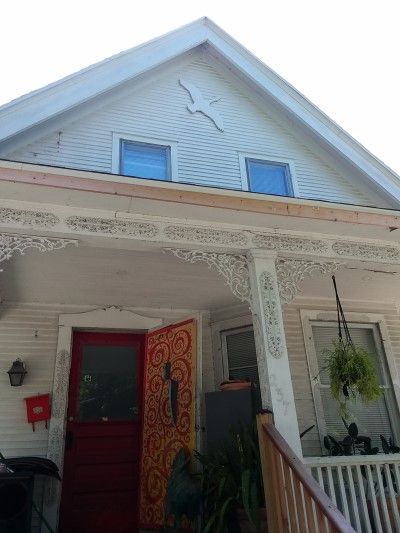
61

A sculpture (or was it two?) was sitting in the long grass alongside the driveway.

Continuing south I end up at my next destination which was Elmside Circle Park, home to Boyum's "Polar Bear Chair".

57

Sadly, it resides on the south side of the park away from the swings and slides. I hope the neighborhood kids give it some love and attention.

Back on Atwood Ave., I walk by the metallic statuary on the perimeter of Daisy Café & Cupcakery's parking lot.

05

Across the street I spot the first of several ghost signs that I'd encounter on my walk.

07

The Thorson Store Fixture Co. was in business from 1935-1970 and this ghost sign is a relatively new find. More for a bit more history of the business, check out this post at the East Side History Madison's Blog. While I'm at it, check out the Facebook page of Ghost Signs of Madison, Wisconsin which is run by Maureen Janson Heintz.

I stopped in at the BP on Atwood and Miller for some refreshment and saw this holiday/memento mori decoration on the door.

06

On the interior was an Easter drawing. Nice dichotomy of the sacred and profane – circle of life and all that. You know, that Jungian thing.

I spied these on the facade of Atwood Studios.

58
59

The heads are new additions but the light fixtures are surely old. I had never noticed these before despite having driven by and ridden by on the bus countless times. Plus I've even frequented a business in the building yet they never drew my attention. That, I suppose, is the joy of perambulating. Being cognizant of your surroundings as opposed to focusing on your destination. It's a shame that the newer buildings here in Madison have no such detail.

Next door to Atwood Studios is The Victory, coffeehouse. It has a funkadelic mural on the Corry Street side of the building.

68

Sadly, I've never been to The Victory but they have (had?) a sign on their windows proudly announcing that they lacked wireless and so patrons would have to socialize with one another.

Across the street at Next Door Brewing Co. they have a mural for their outdoor seating area.

67

It's been a while since I've stepped inside. They have good food, including some items that use their beer/spent grains as an ingredient, and a decent beer selection, as far as my taste goes. Like most breweries and brewpubs, they have more their fair share of IPAs but they also find time to throw a Czech dark lager into the rotation. Plus they brew a fine Berliner Weisse, even if it is kettle soured, during the summer. In years past an array of Schlüsse have been on offer from the traditional raspberry and woodruff to mango and other tropical fruit flavors. (Because pretty much everything in craft beer these days revolves around tasting like fruit punch.)

Continuing down Atwood I pass the lovely St. Bernard church. My assumption is that it is named after Bernard of Clairvaux, one of the big dogs of 12th century Catholicism.

09

Not being Catholic I must admit I don't know much about the church beyond their brat stands which are a fixture of weekends during the summer. Does anyone know what you call that kind of exterior? I am assuming it's not actual pieces of slate or whatever kind of rock it may be stacked atop one another. Must be something that comes in sheets that you can just slap on the walls. This is not the only church I encountered on this walk to look like this. Plus it seems that at least a few of Madison's wells have this same kind of exterior.

Down the street I find this little ditty.

10

It's a box that holds those little flags you wave when you want to cross the street which were apparently all across the street in its sister box.

My first stop in search of music – the ostensible purpose of my journey - would be at Sugar Shack Records…

Ensuing perambulation

29 June, 2019

Summertime Perambulations

Recently I found myself in a peripatetic frame of mind and took a little walk. I had it in mind to accomplish a couple of things that I'd been meaning to do for a while: 1) do some music shopping and 2) head over to Tangent and try their gruit. Since it was a nice day, I decided to hoof it down to my local purveyors of CDs and then over to Tangent for a drink.

WARNING! Tangent (no pun intended) ahead.

There were three albums that I was keen on adding to my collection. First there was Adrian Belew's Pop-Sided which I'd only heard of the day before. I am falling behind on new stuff by proggy legends. 3 Feet High and Rising by De La Soul came next in line because I had heard a bit of "Jenifa Taught Me (Derwin's Revenge)" the week before and realized I should probably have that album in my collection. Lastly and most covetously was Terry Riley's A Rainbow in Curved Air.

I'm sure that I first heard of A Rainbow in Curved Air, like many fans of The Who, in reference to its influence on Pete Townshend in 1970 when he was composing the tunes for Who's Next. After all, the "Riley" in "Baba O'Riley" is Terry. I've known about the influence of the avant-garde composer/musician and his electronic minimalist album for years, decades really. But having read about it while in high school, I assumed it was an obscure bit of experimentalism known only to the select few initiates of the Cult of Riley. Presumably Pete Townshend had found a rare copy while on tour at a Brigadoon-like record store in New York or Chicago that only appeared to customers on nights when the moon was full between the summer and winter solstices. I mentally filed it away as an album to listen to someday, if it could ever be found.

That was some time in the second half of the 1980s. Along comes the Internet making much obscure music available and even for free in most cases. But it didn't occur to me to scour YouTube for it until a few months ago while I was in media res of a The Who binge. I was listening to some of Pete Townshend's demos, specifically the one for "Baba O'Riley", when it suddenly occurred to me to seek out A Rainbow in Curved Air. And so I did and holy Christ was it good.

You can listen to it here. Once you've done that, check out Townshend's demo for "Baba O'Riley" to hear the influence. I learned fairly recently that the keyboard parts to "Baba O'Riley" and "Won't Get Fooled Again", which I've always assumed to be synthesizers, were, in fact, Lowrey organs. For the former a repeat setting was used while the organ was run through a synthesizer for the latter. To top things off, I have also discovered that bits from A Rainbow in Curved Air were used in The Hitchhiker's Guide to the Galaxy radio show. I believe they are to be heard during the entries to the Guide itself.

Tangent over.

So, with my goals set, I struck out on foot.

I live in the Eastmorland neighborhood. It's a fairly sleepy bedroom community. The kind of place that realtors would tell prospective buyers is close to urban amenities to elide over the fact that it doesn't actually have many of them within its boundaries. One thing it does have, however, is Olbrich Park, an expanse of green on both sides of Atwood Avenue with a goodly amount of shoreline on Lake Monona. So I began by traipsing by the new park shelter still under construction.

01

Crossing Starkweather Creek meant that I was outside Olbrich Gardens. Evergreens line the fence that borders the sidewalk.

02

03

This stretch along the sidewalk not only looks wonderful with all of the trees and flowers decorating the perimeter of the gardens but smells magnificent as well. Indeed, this was the first of a few times that my nose caught a floral scent while I was walking that day. I'd look over at the nearest bed of flowers only to not recognize them and be saddened that our lilacs were not particularly fragrant this year.

At the corner of Atwood and Oakridge is a sign announcing that I was entering the Schenk-Atwood neighborhood and a short distance away was this:

04

Just as the Poles have their kapliczka, Schenk-Atwood has its sculptures announcing that you are entering Sid Boyum territory. Boyum was a Madison artist who resided in the neighborhood. He died in 1991 and his concrete sculptuary now dots the landscape of the Schenk-Atwood and Marquette neighborhoods. His departure from this world left a house full of art and a backyard full of sculptures. With efforts underway to preserve his legacy, I presume we'll be seeing more of his work put on public display.

Subsequent perambulation

17 February, 2018

A Smoked Lager by Any Other Name: Smoked Lager by Sam Adams


A couple months ago I wandered lonely as a cloud through my local grocer's liquor store and came upon Sam Adams' American Craft Lagers Variety Pack. As a lover of lagers it was quite refreshing to see an assemblage of beers that had been given a generous amount of time to age, weren't barrel aged, nor described as "juicy" yet had a plethora of flavors on offer. Many breweries whose stock-in-trade is the IPA throw in a pils or unleash an Oktoberfest in the autumn seemingly to demonstrate that they are not some one trick pony but lagers generally don't get a lot of love. And, truth be told, a lot of these black sheep of the brewery lagers are just not very good.

The variety pack was lead by Sam Adams' flagship Boston Lager. Filling in the ranks were Noble Pils, Fresh as Helles (a helles with orange blossom), Coffee Black Lager, Kellerbier, and Smoked Lager. The last one was especially pleasing to find as smoke beers are close to my liver and like the Brigadoon of the brewing world. Not only was I blessed with a plethora of lagers but my purchase entitled me to a free ham. You don't get porcine lagniappes with those trendy hazy eyepahs.

One notable aspect of the variety pack that didn't occur to me until I got it home was how utilitarian the names are. (Did Peter Singer do the labels and marketing?) "Smoked Lager", "Coffee Black Lager" – not even "Al's Smoked Lager". If someone ever remakes Repo Man for the craft beer age, they will surely hire whoever came up with these names as production designer.

And the labels. They are moderately spartan with an image against a mostly solid background. Other beers get a scantily clad woman who adheres to conventional conceptions of beauty or a pistol-wielding cat riding a unicorn. Here the Kellerbier label has a rendering of what appears to be Delicate Arch out in Utah. Huh? On the other hand, the Fresh as Helles label has an appropriate Pantone shade of orange and I must admit to liking the absurdity of a bear holding a coffee cup on the Coffee Black Lager label. If only it was extending it ursine equivalent of a pinkie finger. Overall, though, the look of this variety pack just feels thrown together.

But what's truly important is what lies beneath the label and behind the glass when the lip of the bottle is between my lips.

Smoked Lager is a lovely deep amber hue and quite clear. My initial pour produced a rather small tan head although my subsequent attempt at getting the beer in my glass provided a much more generous topping of foam which was more befitting of a fine lager. Inside there was a lot of bubbles which, again, pleased the aesthete in me.

I was surprised by just how sweet the beer smelled. Some caramel, some stone fruit. The smoky scent registered as medium on my highly unscientific syringolic scale but was oh so nice. To round things out was a touch of grassy hops.

Thankfully Smoked Lager proved to not actually taste particularly sweet and the honeyed aroma belied a light-medium body. While there was some sweetness there, the rich smokiness stepped forward. It was paired with a gentle bread flavor as toasty and earthy tastes hovered in the background. A dash of peppery hops and generous fizz added to the crisp lagery goodness.

The finish was dryer than I expected and more bitter as well. Again, it was the fizz and spicy hops. But some smoke lingered as well. Schaumhaftvermoegen levels were at Defcon 3 with several streaks of foam lining my mug.

This is a very good beer. Bamberg, Germany's Schlekerla is the standard bearer for smoked lagers even if only because theirs are most commonly found on store shelves here with the other brewers in Bamberg choosing to keep things local, generally speaking. Sam Adams' take on the style isn't as smoky as Schlenkerla's but by no means is it merely an accent. To the fore yet still something that an open-minded non-rauchbier drinker wouldn't immediately flee from in terror. The smoked malt was done so using beech wood. This variety is very common though I am not sure why. Perhaps an Old World legacy?

The one thing that didn't thrill me about Smoked Lager was the carbonation. A tad too much fizz. It gave the brew a sharpness that detracted from the smoke whose mellow richness should be allowed to shine. But this isn't a fatal blow.

Junk food pairing: Presumably the free ham deal is over and has moved on to pretzels or cheese. So pair your Smoked Lager with some Lay's Barbecue Ham or Kettle Brand's Maple Bacon potato chips.

And remember, smoke is the new haze in 2018!

04 February, 2018

You might say the secret ingredient is salt: Lulu Peach Gose


Like many countries around the world Poland has jumped onto the craft brewing bandwagon. Or so I've read. Here in Madison it's easy to find Okocim's pale lager and I see Żywiec's lager on the odd occasion but, by and large, Polish piwo doesn't demand much shelf space here in Madison. Chicago, on the other hand, is a different story. With its large Polish and Polish-American population, there is much more Polish beer to be had. Warka and Tyskie are a couple other brands that come to mind that are commonly seen down there. Plus you find porters and bocks instead of simply pale lagers.

My guess is that most of the brands I see on Chicago shelves are owned by larger breweries and likely ones that are owned by a multi-national conglomerate. But I've seen increasingly more Polish piwo in Chicagoland stores that aren't pale lagers labeled with familiar names. It's entirely possible that some/most/all of actually brands owned by bigger players but it seems like at least some would pass muster with the Polskie Brewers Association as being "craft" or "independent".

I am interested in Polish piwo not least because I am part Polish. But there's also the fact, or so I've read, that Poles smoke beer in a way that Americans generally do not. Alas, I've not yet found any Polish smoke beers but did recently come across a some goses from Poland and came home with one - Lulu Peach Gose.

When it comes to goses, I've become pretty snobbish about the salt. On one hand you've got those where it acts like the shake or two that one would put on a meal: it enhances the flavor of whatever you put it on or in. Over at the other side there are goses that taste salty or, rather, where you taste salt. I've not encountered one that, if left out, would attract deer, but it tastes salty. In between is my sweet spot. I like a fairly prominent mineral flavor. If you were to add just a pico-mole more of NaCl molecules it would actually taste salty. A sub-saline kind of taste, I guess you could say.

Owing to recent controversy about sexist beer labels and sexism within the craft brewing industry, I took especial notice of Lulu's labels. They all feature women but manage to portray them in a way that doesn't give you the impression that their underwear is at their ankles. I saw no words that could lead the drinker to think that, by consuming the piwo in hand, they would get laid by a comely Polish maiden. However, I can neither confirm nor deny the existence of a Lulu Boyz Instagram page.

Well, onto piwo.


Lulu pours a hazy light gold. Although my poor photography doesn't really get it across very well, a nice white head atop the honeyed liquid made for a very pretty sight. There were lots of bubbles inside while the head was alive with activity. I could hear the white noise of the fizz as bubbles burst. I rather like an aural component to my beer.

Moving on in the panoply of senses, the aroma was replete with fresh peach. (Peach pulp is used here.) It smelled really nice. Some lemony lacto and a touch of salinity were also present.

The taste was pleasantly peachy – juicy even, as is the new parlance. I was surprised at how mild the tartness was. A little citrusy with a mild tang. Nothing like many American versions which can also be used to remove calcium deposits from tile. Coriander lurked in the background along with a hint of graininess. On the saline scale, it was right where it should be with a good mineral taste but not really salty.

This is a 3.5% A.B.V. beer and was very light-bodied. But the recipe includes oats and so Lulu had a smoothness to it I've never tasted in a gose. It contrasted nicely with the tartness as well as the generous fizz.

Lulu tartens up at the end as the peach fades, though never entirely goes away. I even caught a little spicy hoppiness here too. Overall, a fairly dry ending.

A few spots and a couple short streaks were all my glass was left with.

While I grant you that this was a beer better suited for summer, it was very tasty nonetheless on an evening in the depths of winter. It was light and fizzy with a gentle tartness and plenty of fresh-tasting peach flavor. And they got the salt just right too. It made for a wonderful sweet and sour taste. The standard bearer for fruited goses, in my humble opinion.

Junk food pairing: Pair your Lulu Peach Gose with some salt & vinegar potato chips for an intense gustatory experience.

30 January, 2018

Haze means nothing, while smoke, acquired from beechwood, means everything: Nathan by Lakefront Brewery


I have been waging a highly unsuccessful campaign on Twitter to get drinkers to make 2018 the year when smoke beers overtake New England IPAs as the trendy, hip brew. OK, by "campaign" I really mean putting "#SmokeIsTheNewHaze" in the odd tweet but I labor on nonetheless. This is an old review which I am only now finishing but it fits my tilting at windmills Twitter endeavor nicely.

It was a sad day when I noticed Schell's Chimney Sweep was no longer gracing store shelves. Being a rauch dunkel, it was one of my favorite biers combining two of the best flavors: dark and smoked malts. A quick check of Schell's website confirmed my worst fears – it had been retired.

Having a rauch dunkel at my disposal for a good chunk of the year was such a blessing but the ride was over. Thankfully Lakefront stepped in to fill the void, albeit for a short time, with Nathan, a smoked dark lager that was the 22nd entry in their limited My Turn series which features styles chosen by employees of the esteemed Milwaukee brewery.

Lakefront was founded in 1987 making it one of the oldest microbreweries in Wisconsin. Indeed, it's one of the godfathers of the American microbrew scene. They offer a great brewery tour and brew a wide variety of beers. They've been tweaking their offerings as of late, though, with a distinct turn towards the hoppy. Not being a hophead, I haven't sampled their plethora of lupulin-heavy ales (including a Single Hop series which consists of nothing but IPAs and a Double IPA series) and I miss Cherry Lager. But there's always Riverwest Stein, a fixture at the High Noon Saloon, a new German pils, and My Turn produces something appealing relatively frequently.

Such are the times we live in.

And so I was quite happy to see Nathan on the shelf. Dunkels are something of a rarity themselves and a rauch dunkel trebly so. Considering the brewery's track record with lagers and rauchbiers I was expecting a fine brew.


It poured a dark amber and was unfashionably clear. The small tan head proved short-lived but I spied many a bubble inside the glass. That precious smoky scent caught my nose immediately and my notes say it was of that classic German beechwood variety but I cannot recall if that was my amateur rauchbier opinion, it was noted on the label, or if I had actually asked the brewery. For some reason I suspect I availed myself of the Twitters and asked. Beneath, between, and behind the beechwood goodness was a wee bit of grassy hop as well as a hint of doughy, sweet malt.

The proof of the bier is in the drinking, though. A nice slab of smoke pleased my palate immensely. Not so much of a bacon taste as it was, well, smoke. There was also a tasty mild bit of stone fruit malty sweetness balanced by some spicy hops. A generous dose of fizz kept the malty milieu from whelming my tongue.

Nathan's body (ahem) was medium-light which made the beer go down easily in the hot summer months. The smoke lingered on the finish and the hops became more prominent which made for a fairly dry, clean denouement. My glass was left with no Schaumhaftvermoegen as it has slid down into the bier.

My notes say "Good'n'smoky" and indeed it was. Lakefront certainly delivered as I expected them to. Rather than blather on about how much I loved the smoke taste, I shall instead add that I appreciated the bier's qualities which made it a delightful seasonal: the lightish body, the fizz, and the hops which added some balance to the malt. Nathan proved to be a fine brew both for the cool spring as well as the heat of early summer. The smoke provided a heartiness which went well as I waited for the aestival weather while the body and the fizz made Nathan equally drinkable as the summer kicked in.

I am sorry that this brew is no longer with us. R.I.P. Nathan.

Junk food pairing: I paired Nathan with Bacon Habanero Pretzel Crisps and didn't spare the horseradish dip.

04 July, 2017

It Wears the Color of the Summer Soldier: Grandes Lagos by Great Lakes Brewing Company


It wasn't that long ago that I was enjoying a hibiscus beer and now here comes along another one.

Beers made with the tropical flower aren't exactly ubiquitous but they're not rarities that come around as often as Halley's Comet either. Here in the Madison area we've got Vintage's Hibiscus Saison that heralds the arrival of warmer weather every spring; starting this year Revolution's Rosa now also heralds that meteorological change for we Cheeseheads. 5 Rabbit's Huitzi features the flower as does Milwaukee Brewing's Weekend @ Louie's. And surely there are other examples from breweries farther afield some of which surely distribute here. Ooh! Widmer Brothers' Marionberry Hibiscus Gose. Can't forget that.

The latest hibiscus brew to come to my attention is Great Lakes Brewing's Grandes Lagos, a Mexican lager that spent some quality time with the tasty flower. It's a spring seasonal that I believe was introduced last year but only on draught so now folks farther afield can enjoy it.

To be honest, I don't know what a Mexican lager is. Lakefront introduced one this year called El Wisco so perhaps this is something of a trend. With novelty being so highly coveted by the American microbrewing scene, every style will surely get 15 minutes of fame. After some limited investigation, my hypothesis is that a Mexican lager from an American microbrewer is a pale lager made with maize and generally given a name that begins with "El" or ends in "-ito" for that extra touch of authenticity.


Grandes Lagos (i.e. - Great Lakes), like the last hibiscus beer I had defied my expectations and wasn't pink. Rather it was more of a pinkish orange and quite clear. Nothing much to report as far as the head goes. Small, white, and off like a prom dress. However, the brew was fairly effervescent with a decent number of bubbles inside. All in all, a pretty beer.

My nose caught some popcorn, biscuit, and of course that lovely floral scent of the hibiscus.

I suppose the point of a craft Mexican lager is that it helps you beat the heat by being light and refreshing. Grandes Lagos certainly is that with its light body, firm fizz, and solid crispness. None of the flavor here were particularly strong – there was a little corn to be tasted alongside a mild maltiness The hibiscus was complementary and not overpowering. It had a bright floral taste plus some tartness which went well with a mild grassy hop flavor.

The floral tartness remained after the beer had gone down my gullet and it was joined by a little spicy hoppiness which was moderately bitter. Just enough to conjure a pleasant dryness. Not much lacing – just an occasional spot or two.

Endowed with that essential aestival trifecta of being light, fizzy, and crisp, Grandes Lagos is made for the dogs days of summer. The corn and malt are pretty mild (but not too weak) so, while they are always there in the background, it's the tasty hibiscus that shines. I love their floral flavor and the gentle tartness they bring.

Junk food pairing: Stick with lighter fare for Grandes Lagos. Try a bag of guacamole flavored potato chips or some white cheddar popcorn.

02 July, 2017

Allegory of the Kölsch: Pear(?) Kölsch by Capital Brewery


This was something of an oddity I found at Growlers To Go-Go recently - a pear Kölsch. I say odd not because Capital is a stranger to German bier styles because they're not; and not because pear Kölsch is some heretofore unknown exotic brew. Indeed, Capital brewed it a few years ago for a pre-Great Taste of the Midwest party and again last year. The Kölsch is apparently something of a fixation for the brewery's director of operations, Zach Faber, who has been honing his Kölsch for a few years now. 

No, what's got me flummoxed is that Capital released a non-pear Kölsch this past spring so either Growlers To Go-Go got things mixed up or Faber is continuing his search for the Platonic ideal of a pear Kölsch.

Personally, I love the idea of adding some pear to the rather humble Kölsch. It's not that you're adding something novel because the style has native pomaceous flavors owing to its yeast. Instead you'd be bolstering the bier's built-in fruitiness to make it stand out. Well, that's my Platonic ideal, anyway.

While I've never strolled the Straßes of Cologne and tasted the freshest Kölsches in their hometown, I am rather picky when it comes to the style. I prefer it to have a distinct, clean cracker taste along with a nice fruitiness that is part pomaceous, part berry-like. The ale yeast provides the fruitiness while ample lagering gives the crisp malty/wheaty taste. (Though I am told that the lagering process for a Kölsch differs from that of, say, a pils.) And for me the gold standard is Reissdorf. They balance these flavors perfectly like a well-mixed album where each instrument and voice has its own space yet blend together in a harmony.

Capital is no stranger to German bier styles or lagering so I was quite looking forward to this brew.


It lit my glass* up with its brilliant light yellow hue which, along with its clarity, made for a very attractive brew. My only complaint is that my pour managed only a small crown of white foam which dissipated quickly. Though there was a fair number of bubbles inside the glass.

My nose got all excited taking in the requisite fruitiness, including pear. Not too strong, mind you. There was also some biscuit and a tad of grassy hops.

The truth about whether this was a pear Kölsch or not would be revealed by my tongue. It discerned a light fruitiness which definitely had some pear as well as apple and that nebulous "berry-like" taste. Having said this, it didn't taste like there was any added pear; just the normal flavor you get from the yeast. There was also a little fizz and the wheat/malt. Unfortunately it was not the crisp, crackery flavor I crave in my Kölsch. Instead it was mushy, dough-like kind of grain taste.

I liked how the fruitiness lingered on the finish as a mild herbal hoppiness made its presence known. Not particularly bitter but just enough to lend a little dryness. After emptying my pseudo-stange it was left with some Schaumhaftvermoegen - lots of spots and a few patches of webbing.

I am no supertaster but will go out on a limb and say that this is not a pear Kölsch. The fruitiness just didn't seem stronger than I'd expected from a non-fruited brew. Regardless, I really enjoyed the fruit flavors here which included pear. My gripe is that the grains tasted doughy instead of crisp and crackery which muddles the overall flavor instead of giving everything room to stand on its own yet harmonize with each other. This tasted more like Gaffel or Sünner as opposed to Reissdorf which is not a hanging offense. Capital Kölsch is still very tasty. It's light and goes down easily. Plus the modicum of hops on the finish make for a nice contrast.

Junk food pairing: A little salt helps bring out the fruity flavor here, makes it more distinct. But don't overwhelm your palate. Try some plain potato chips or regular Cheez Its.

*My stangen are still packed away in the basement but my wife saved a mole jar and it proved an adequate substitute.

01 July, 2017

Beltane's Flower: Hibiscus Gose by Boulevard Brewing Company


Kansas City's Boulevard Brewing Company began distributing to Wisconsin back in the spring. I must admit that when I first heard the news, I wasn't excited. But this wasn't due to Boulevard, whose beers I was not familiar with; rather it was because of Pavlovian conditioning. I mean, it seems that the other breweries who have begun distributing here all brought an arsenal of eyepahs. (I'm thinking particularly of Golden Road.) Strolling down the beer aisle at Woodman's I'd see stacks of eyepahs by breweries new to the state – session, double, juicy, New England – the whole lot. And so when I heard about Boulevard's immanent arrival I couldn't help but think "Do these people not realize we already have dozens of native eyepahs that are just as bitter/juicy/fruity/cloudy as something imported from distant lands?"

Then I did a little reading and discovered that Boulevard brews a hibiscus gose and a little excitement began to well within. Suddenly I recalled having had a hibiscus goes Dexter's one time but soon realized that it was Marionberry Hibiscus Gose by Widmer Brothers.

Hibiscus is, perhaps not exactly trendy, but certainly much more common than when I first had a beer infused with the flower. This was back in 2009 or thereabouts which means I was oddly on the bleeding edge of beer trends for what is likely the first and only time. This was at the home of Joe Walts (he of Ale Asylum fame) when he introduced me to a hibiscus saison that he had created with Robyn Klinge (she of Madison Craft Beer Week fame). It was an extremely tasty brew and, though Joe never opened his brewpub, the recipe found a home at Vintage Brewing when Robyn was their beer ambassador (or whatever her title was.)


While I expected Boulevard's Hibiscus Gose to be pink it was more orange – almost amber. Not sure how to explain that. Also curious was the fact that the bier was clear. Being a wheat brew it's normally a touch hazy but I suppose filtering highlights the color. I got a medium-sized white head which stuck around for a little while. Inside there was a modicum of bubbles.

The aroma had that lovely floral scent of the hibiscus as well as some citrus from the lactobacillus.

My tongue was greeted with a fairly big dose of sour that was moderately lemony. Then the hibiscus kicked in with a firm bit of the floral. The flowers also lent a tangy bitterness. I'd swear I caught just a hint of coriander, an ingredient I wish was generally more prominent in goses. Similarly, there was a tad of cracker underneath. The lacto and carbonation gave the beer a pleasantly acidic patina.

The finish was wonderful with a hint of the hibiscus accompanied by a lingering tartness from the flower. It was here that the salinity became noticeable and it helped bring the coriander out of the botanic malaise and to the fore. Sadly there was no Schaumhaftvermoegen to be had.

Delicious! I appreciated that the bier didn't have a lethal sourness. The lacto and hibiscus kept things nice and tart, though. Aside from adding some tartness, the hibiscus adds a tasty floral accent to the gose. I know some folks who are turned off by flowers in their food and drink. Unlike say, rose hips, hibiscus, at least in the beers I've had, has a taste that is brighter and less richly aromatic. The sour along with a light body and low alcohol – 4.2% - made it extremely refreshing on a hot day. This is a great bier and it was quite fortuitous that Boulevard began distributing here when they did as Hibiscus Gose is a spring seasonal. I look forward to next year's batch already.

Junk food pairing: Pair Hibiscus Gose with something that tastes of warmer climes such as lime flavored tortilla chips or guacamole Takis.

29 June, 2017

Smoke from South of the Border: 15 Feet by Off Color Brewing


I am returning to my hometown of Chicago and Off Color Brewing here after having had a fine pilsner of theirs. Chicago has a large Polish/Polish-American population which once included my babcia. I have fond memories of eating her Polish cooking as well as other gustatory memories such as making a stop at a pierogi restaurant before seeing Son Volt at The Vic and nearly falling asleep behind the wheel after eating at a Polish all you can eat joint. It is only fitting then that Chicago's Off Color brews a Grodziskie. Native to Poland, the Grodziskie (a.k.a. - Grätzer) is a piwo that's light, smoky, and hoppy made from 100% smoked wheat. Or so the theory goes, anyway. Quite a ways away from the pilsners and Baltic porters that the country is known for.

15 Feet is one of Off Color's seasonal piwos and I bought a six pack back in the spring after stopping at a pierogi wholesaler in Portage Park. It has one foot in tradition with the other in today. While brewed with 100% applewood smoked wheat, the brewers either couldn't get their hands on any Polish hops or were keen on tweaking things to reflect the current microbrew ethos. Regardless, 15 Feet features Sorachi Ace hops, a Japanese variety that boasts lemon and lime scents and flavors. An odd-sounding pairing on paper, to be sure. But smoked beer is a passion of mine and I couldn't resist no matter how incongruent the ingredients.


Grodziskies as conceived today are not big beers – the Poles leave that to Baltic porters – and 15 Feet comes in at a mild 3.5% A.B.V. which, I have read, was standard, for at time at least. And so 15 Feet is a very light yellow color. It's got that wheat haze which made it only slightly difficult to see a fair number of bubbles inside. My glass was adorned only with a small white head and it didn't stick around very long.

The aroma was succulently smoky with a touch of fruity sweetness. It was applewood smoked, after all. I will admit to not being intimately familiar with Sorachi Ace hops but I found that they gave a pleasant citrus scent here.

I was in heaven as the first wave of smoke wafted over my tongue. It had that same fruity sweetness to it as I had smelled. Not mega-potent but rather a glorious golden mean. Those hops gave a definite lemon-lime flavor which, I have to say, reminded me of 7-Up but not in a sickly sweet cloying kind of way. A little wheat came through and the carbonation gave a little bite that made the piwo a tad dry.

On the finish the smoke lingered as did some citrus. But then a dash of Nugget hops brought forth a moderate dose of resiny bitterness which elevated the dryness.

My glass was left with lots of foamy spots.

This is really effin' good. As a lover of smoke I was entranced by the luscious smoke wrapped in its semi-sweet fruitiness. Kilometers away from the hackneyed "bacon" descriptor. The citrus taste went splendidly with the smoke which, if you think about it, isn't all that odd considering we put citrus juice on grilled meats. On top of all this was a gentle earthiness. Light, refreshing, and with just the right amount of smoke. Perfect refreshment for a summer day.

Junk food pairing: Root vegetables are a staple of the Polish diet and so I heartily recommend busting open a bag of potato chips to go along with your 15 Feet. Smoked gouda are highly recommended but Kettle Chips' Backyard BBQ variety go well too.

25 June, 2017

A Brew for Sue: Tooth & Claw by Off Color Brewing


When I think of Chicago's Field Museum, I usually think of the final scene of Damien: Omen II. That's where Damien is on the museum's stairs looking down at his chauffeur as a ride beckons and his aunt Ann's corpse burns inside. Now, when that scene doesn't come to mind then I envision what everyone else does: Sue the T-Rex. Back when I was a kid visiting the museum it didn't have a fancy bistro nor a house beer. Things have changed since then.

The story goes that when Off Color's John Leffler was at Goose Island, he sought advice on honey and befriended melittologist Megan Beckert in the process. Flash forward a few years and you find Leffler getting Off Color, well, off the ground while Beckert was at the Field Museum looking to revamp its food offerings. She approached Off Color about brewing a special beer for the museum and the result was Tooth & Claw which debuted in 2013.

Tooth & Claw is billed as a dry hopped lager/pils and as per the museum's requirements for a broad audience, there's nothing extreme or out of left field here which is sort of odd considering Off Color's reputation. My experience with their brews is devoid of lagers, as I recall, so I was keen to find out how well they could brew one. From what I've read, the beer began to be bottled and distributed outside of the museum not long after its debut. If so, I find it odd that I never ran into it until recently. I found it at a store in the city so perhaps it's not found so readily out in the suburbs.

Since I was to enjoy some Chicago beer I figured I'd also put on some Chicago music for the occasion - The Polkaholics! This was keeping with family tradition of drinking beer and dancing the polka.

Tooth & Claw pours a lovely light gold. Like a good pils it is clear and had a brilliant white head. However, I didn't get that much foam and what there was didn't last long. As expected it was plenty fizzy.

The aroma was what I expected – some biscuity malt and hoppy vapors that were grassy in the main but with a touch of spiciness. I can't find anything to indicate exactly what variety of hops was or were used in the dry hopping process (all German varieties were used) but I take it that the Hersbrucker were behind the grassy scent while the Tettnang added that peppery spiciness.

Truth be told, the taste was more or less what I figured it would be as well. The malt had a nice mellow cracker taste to it but also a slight honeyed sweetness which I presume came from the Carapils. This combo gave it a medium-light body. I could taste all that effervescence I saw in the glass and it gave the brew a bracing crispness. Overall the hops were at what I'd describe as a medium level (35 I.B.U.s) although I am sure eyepah drinkers would brush it off as being on the mild side. My notes say the hops tasted "herbal-grassy" and this is a combo I really enjoyed here. I guess the Hersbrucker and Tettnang provided these flavors while the Herkules ramped up the bitterness more generally.

The finish was rather dry with all those bubbles and the hop taste became spicier taking on more of a black pepper thing. That fizz also lent a mild acidity. Schaumhaftvermoegen was light on the ground with only a handful of spots lining my glass.

I hope that my saying that the beer turned out large to be what I expected isn't taken as a slight because this is a damn good beer. The malt was perfectly restrained yet didn't lead to a watery brew. Just enough there to aid and abet the hops. I also thoroughly enjoyed the resurgent hop spiciness at the end; it added a nice tang. But I must also say that I am really loving grassy/herbal hop flavors these days and Tooth & Claw has them in spades. There's just something about the more vegetal/green flavor that I enjoy. They can give a beer a vibrant, fresh immediacy that is simply wonderful. You almost expect to taste dirt next.

Tooth & Claw is 5% A.B.V. so you shouldn't find your museum going experience impaired at lunch.

Junk food pairing: Grab a bag of The Daily Crave's Smoked Gouda Lentil chips. They're light and crispy so they don't get in the way yet the cheese adds a nice smoothness on the tongue. And smoked foods are simply great and go well in all situations.

24 June, 2017

Scenes from Eastmorland

Here are some other sights around Eastmorland.

A very noticeable one is the giant chicken in the front yard of a house on Johns Street just off of Walter.


There's also a Marlboro Man-like figure leaning against a tree.


Another one with a white handkerchief and a pipe resides just down the street.


Over at the corner of Richard and Schenk is a house with faux log siding.


Eastmorland has its share of Little Free Libraries such as this one which I think is on Ontario Street.


In addition we have a Little Free Pantry by Lansing and Milwaukee.


Poor hippies.


On one walk The Dulcinea and I came across a drake standing in the middle of the sidewalk. His Frau was relaxing on the lawn.


In the backyard of the old home at Johns and Margaret stands this lunar table with sidereal stools.


I've noticed a couple corners lacking houses and instead have wide expanses of grass. Here's one at Richard Street and Starkweather Drive.


I am unsure if there were homes at the corners that perhaps burned down or if these plots were intentionally kept open. This one is at Harding and Hargrove. The owner has recently been planting and laying decorative stones.


I must admit that I don't know what this concrete monolith is. Whatever it may be, it sits in the middle of the retaining pond that runs along the Capital City Trial. I believe it's over by the baseball diamonds/Thai Pavilion.


My guess is that it has something to do with the water utility. There's a pumping station or some such thing just down the trail at Olbrich Park. Or maybe it was once a support for a foot bridge…?

Like the lakes that feed it, Starkweather Creek can get pretty gross during the summer but the city and DNR are trying to remediate the pollution.


I went down to the creek's shore by the bridge at Milwaukee and Fair Oaks and found that it wasn't as bad as I had expected. Much less garbage, for instance. More info can be found here at the city's website.

Meanwhile at the Royster Corners development at Dempsey and Cottage Grove Road the retention pond thingy has been extended and a part of it has become a native Wisconsin plant farm. This is by Royster Oaks Drive and the Capital City Trail. I don't know what exactly this entails as I've never seen anyone there to ask but there was a tent for the green-thumbed to ply their trade in there.


The plant farm is home to geese. Lots of them.


So many that the sidewalk is cover in shit.


On one walk we spied a fox on the (ballast) rocks. It was coming down from the railroad tracks along an access path when it saw us. Presumably it was looking to break its fast with a nice goose. Upon seeing us, though, it headed back up to the tracks and jogged alongside them before eventually disappearing.

Lastly here's the Voit Farm.


I have wondered about it ever since I began shopping at Woodman's back in the early 90s. It's owned by the same family that owns the concrete plant next door and has been there for ages – somewhere on the order of 160 years. The Wisconsin State Journal ran an article about the Voits back in 2006 which gives the details.

A friend used to live in the neighborhood and recalls the carnival rides the family hosted for the big East Side Business Men's Association summer shindig. Today the home is unoccupied and the barns are deteriorating. From what I can tell they alternate corn and soy – this year it's corn – but don't seem to harvest it. There was still soy on the vine last November. I presume they need to plant crops for property tax reasons.

On the one hand an old family farm is pretty neat but on the other it seems a waste. I believe that the Voit's property is in the Town of Blooming Grove and not the City of Madison although the town is set to be annexed within the next 10 years. Perhaps the city will incentivize the land's sale/development if the Voits do nothing during the interim. A family farm museum type thingy would be pretty neat but I'd also like to have more businesses within walking distance. Land east of Starkweather Park next door is now for sale with the Swiss Colony facility going away so change is afoot.

11 June, 2017

In the Pines, In the Pines: Pacific Wonderland by Deschutes Brewery


This may very well be my first review of a Deschutes brew. I've certainly had beers from the Portland brewery – their porter and stout – but, for the most part, it's been simply a brewery from Portland that brews a lot of eyepahs for me. To paraphrase Bob Dylan, they go their way and I go mine.

But a few months ago I noticed Pacific Wonderland Lager at Woodman's and I figured I'd give it a try. The brewery apparently decided to do something a little out of left field by brewing a lager and making it a year-round offering. At first I figured it for an eyepul but, upon closer inspection, I noticed that the hops were all German. Granted, one of them, Tettnang Mandarina is citrus flavored so there is a nod to the American hopping regime.

This whole fascination with citrus-flavored hops and very hoppy beers is kind of like Apple products for me. Despite owning Windows computers, I recognize that Apple makes fine equipment. So it's not that I dislike Apple computers, it's more that the people who use them are often times assholes who feel the need to be dismissive of Windows, talk up the usually chimeric advantages of Macs, and make sure you are aware of just how conspicuous their consumption is.

On a recent episode of a beer-related podcast one of the hosts talked about having spent some time in Europe. If I recall, this personal said that he became pilsnered-out to which his co-host remarked something akin to it must have been a relief to return to the States and have a beer with flavor. Right. Because malt and Noble hops are tasteless and beer never had flavor until about ten years ago. What a jagoff. I have no problem with fruit-flavored hops; it's the people who fetishize them and say that without them a beer has no flavor.

So back to Pacific Wonderland. Would it be a lager hopped like an eyepah? Adhere to European tradition? Was something wonderful going to happen?


The beer had a lovely straw color but was oddly hazy. Not exceedingly so, mind you, just unexpected. My pour gave me a medium head of frothy, white foam that, pleasingly, lasted a good amount of time. It was nice and bubbly.

Taking a whiff, I found it to be a little Old World and some New. Some biscuity malt was joined by a variety of hoppy scents including herbal, a dash of pine, and faint lemon/citrus. Not a bad start at all.

I found the taste to be similar with a nice, light cracker maltiness. From the Old World I tasted some herbal and spicy – almost Saaz-like – hoppiness and from the New there was some pine with a dash of citrus for good measure. I will reiterate that all of the hops are German - Hallertau Herkules, Hallertau Mittelfruh, and Tettnang Mandarina.

The finish was crisp and quite dry as that piney hop flavor prevailed although there was a touch of citrus in the background. It was also rather bitter with black pepper and herbal flavors lurking beneath the pine. Schaumhaftvermoegen was everywhere with webs of white lining my mug.

I have to give Deschutes credit for trying to bridge the traditional and the new by brewing a pils that uses all German hops yet including newer ones that have trendy, fruity flavors. However, this beer just did not appeal to me. There was too much pine taste to it. (They likely came from the Herkules hops.) The beer's light body and restrained maltiness seemed defeated by the rather cloying resiny taste. I've had other pine-tasting/spruce tip beers which I enjoyed but here it was almost overwhelming. On the plus side I liked the fruity hop flavor which was more of an accent but nevertheless contrasted deliciously with the herbal and spicy hop tastes and complemented the biscuity malt well too.

Junk food pairing: Pair your Pacific Wonderland with a bag of Jays Garlic and Onion potato chips and a brick of pepper jack processed cheese food product.