05 February, 2021

The Corona Diaries Vol 9: Riding the Green Dragon. Er, Circle.

December 2020

I want to take this opportunity to extend an offer to everyone: if you have any questions about your fecal matter (or anyone else's, I suppose), please don't hesitate to ask me as I recently came across this handy little tome:


I will soon be wise in all things feces^ and be able to answer all of your pressing poo-related questions.

^This reminds me of a story told to me by a friend of mine. He was in an intro to biology class up at UW-Eau Claire and "feces", well, digestion, was the topic du jour. A woman in the class read a section from the textbook and pronounced it "feck-us".

********


hile I am on the subject of books, you may recall that I took a class on medieval manuscripts last winter. I have returned to the subject with my latest read, Meetings with Remarkable Manuscripts: Twelve Journeys into the Medieval World, by Christopher de Hamel. de Hamel is a librarian and expert on medieval manuscripts. While working at Sotheby’s, he was in their manuscript department, or whatever group there deals with codices, and is reputed to have touched more medieval books than any other human being on earth.

It's a very interesting read. He gives an account of the library that holds each text, the books' histories, and a look at the contents, both the words and images. It was really neat to see photos of and learn about the Carmina Burana manuscript. There on the page were the opening lines of "O Fortuna". Did you know those famous lines are not original to the text and were instead added later? I had no idea. Plus I agree with de Hamel: much of the art in the Book of Kells is really pretty awful.


Highly recommended if you want to learn more about medieval manuscripts.

********


We got snow yesterday – a little over 6 inches. After shoveling for the first time, I went for a walk and it was just gorgeous outside. Just below freezing and the snow was coming down at a good clip. My wanderings took me over to Starkweather Creek. I walked along the shore for a stretch before I came to a small hill that kids use for launching themselves off of on their bikes. My attempt at scaling it was an epic failure and I ended up falling and sliding down once I'd gotten about halfway there. It made me feel like that guy in Jack London's "To Build a Fire". Well, except that it wasn't quite that cold out. And civilization was just a block away. But, aside from those two things, it was just like that story.

Ahem.

********

(Now to finish off my account of my trek up north.)

It was yet another lovely morning when I departed Mountain for Stevens Point. On my way there I found myself driving through a town called Wittenberg which sounded familiar but I couldn't place it. Then I saw an old delivery truck that must have been from the 1950s with "NUESKE'S" in big friendly letters on the side. Nueske's makes some of the best bacon I've ever stuffed into my piehole. They smoke the meat to perfection over either applewood or cherrywood. Just great bacon.

After about 100 miles I arrived at the home of my friends on the northeast side of Stevens Point just before noon. It was a gorgeous, sunny day and I figured that they'd be at work while the kids would be schooling somehow, somewhere so I parked in their driveway and promptly removed my bicycle from the rack. The day's ride would be the Green Circle, a bike/walking trail of 25-30 miles that goes around the north, east, and west sides of the city and the town of Whiting to the south. While some of the trail uses streets, it's mostly crushed and compacted rock.

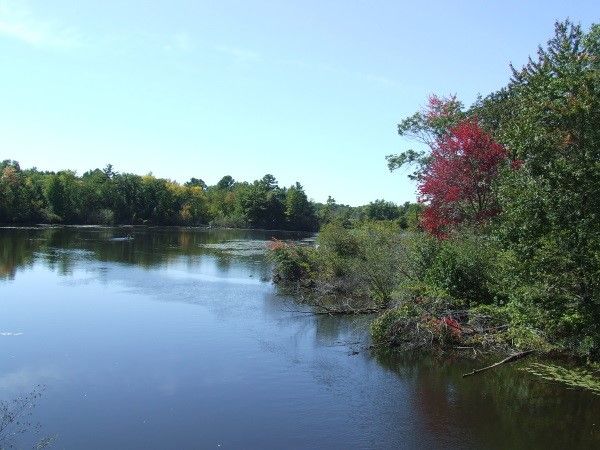
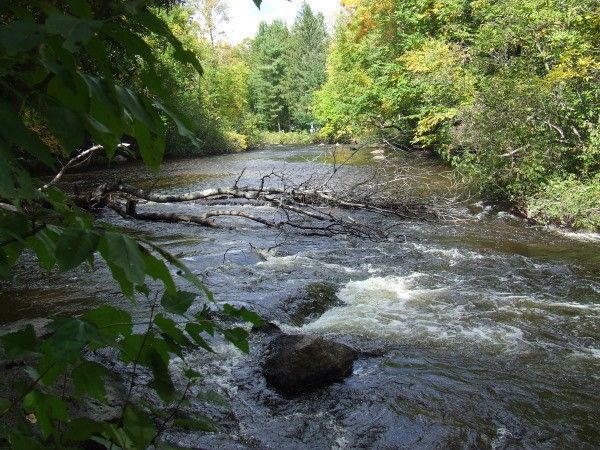
The Moses Creek Trail section runs about 4 blocks away from my friends' home so it wasn't long before I was on the Green Circle. The next section of the route had a stretch that ran alongside the Plover River which made for some really nice scenery.


Stevens Point is up in the pinery and the outpost of the University of Wisconsin there is known for its forestry and paper science schools.

The paper industry in Wisconsin has fallen on hard times as of late. A mill in Wisconsin Rapids – about 20 miles from Point – closed over the summer putting around 900 people out of work. From what I've read, it sounds like venture capital groups buy these companies and then shut down the mills rather than updating them for the 21st century paper market. More on that mill's closure here.

On the other hand, the mill way up north in Park Falls reopened this year.

Anyway, it is hardly surprising that the bike trail went through some nice pine stands.
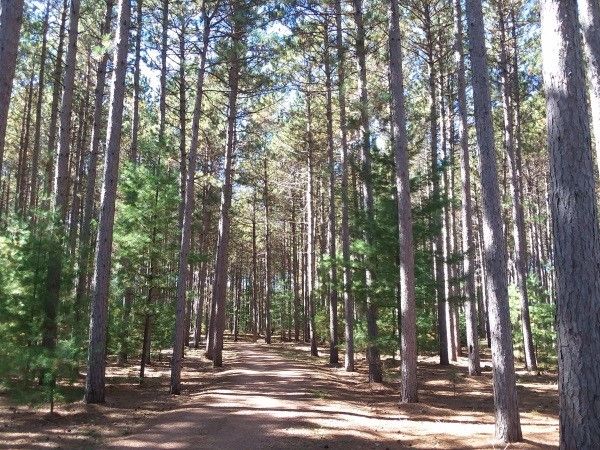

I am big fan of the pine/fir/spruce and the smell in these stands was just wonderful. I believe we have a mixture of white and jack pines in this photograph but I'm no arborist. It was white pines like these (?) from the Wisconsin pinery (and Michigan's) that rebuilt Chicago after the Great Fire. Tangentially, it is also my understanding that Milwaukee brewers - especially Miller - shipped their beer down to Chicago in mass quantities after the Fire to quench the thirst of those cleaning up and rebuilding.

The Green Circle goes through many parks including the Schmeeckle Reserve which is a wildlife preserve belonging to the UW-Stevens Point. There's marshland therein and the trail goes from gravel to boardwalks.


In addition to the Plover, the trail runs along the mighty Wisconsin River which starts up north by the Upper Peninsula, methinks, and flows to the Mississippi.


Over on the west side, the Green Circle goes near downtown and – quelle surprise! – there is a mural.


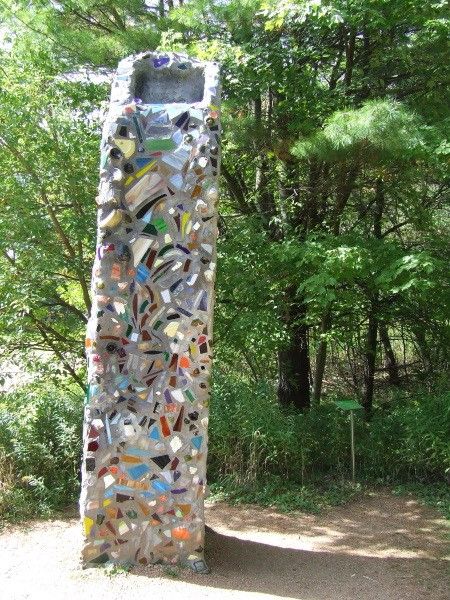
On the northwest side of town, the trail runs by the Stevens Point Sculpture Park.


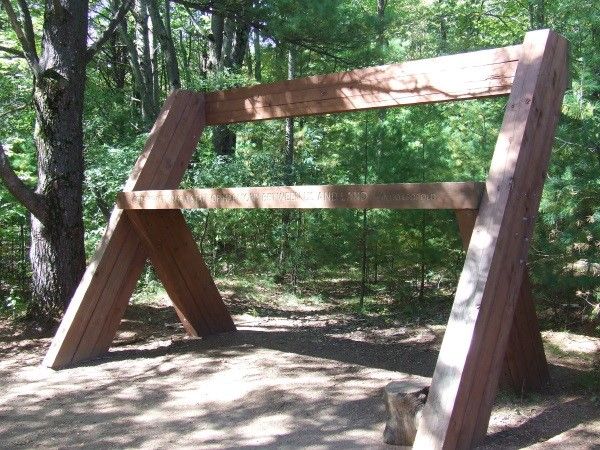
It is really nice with sculptures of all sorts littering a path that runs through the larger Zenoff Park. In addition to deer centaurs, there was a giant Leopold bench.


The shadow of Aldo Leopold looms large over Wisconsin.

If memory serves, this tower/obelisk was built in such a way as to be a home for a particular variety of bird that I cannot recall in addition to its aesthetic duties.

My ride also took my down a stretch of the route used by stagecoaches to go from Stevens Point to Wausau, about 35 miles to the north. So that was a nice bit of local history.

I was thoroughly impressed with the Green Circle and hope to ride it again. In addition to the wonderful scenery, most of it is pretty level with just a few uphill climbs. Plus, I got lost only once so it has easy navigation going for it. Next time I'd like to detour from the trail into the city more. Hopefully I can do so and there will be more shops, cafes, and whatnot open.

Upon returning to my friends' house, I rang the doorbell and was greeted by my friend Wendy. She had been home all along and was wondering where I had been. I spent a couple days with her and husband Matt. During this time we caught up on each other's lives as we hadn't seen one another in several years. Their kids had grown considerably and two were now teenagers. I was happy to see that Matt survived teaching one of them to drive.

We spent some time touring the area's breweries and ended up at Central Waters Brewing Company, O'sO Brewing Company, and McZ's Brew Pub. McZ's is in nearby Rosholt, population 500 or so. A resident had gotten married that day and the town was all but deserted as basically everyone was at the reception. Nice and quiet and no wait for a table.

Matt lived in Germany and England after graduation where he learned the brewing trade. Upon returning to the States, he started work at a brewpub out west and made beer for a living for a few years. So, if I taste an off flavor in a brew, I get the chemical formula of the culprit from him. If there's no off flavor, I get a lecture about how well or how poorly the beer at hand conforms to traditional style guidelines.

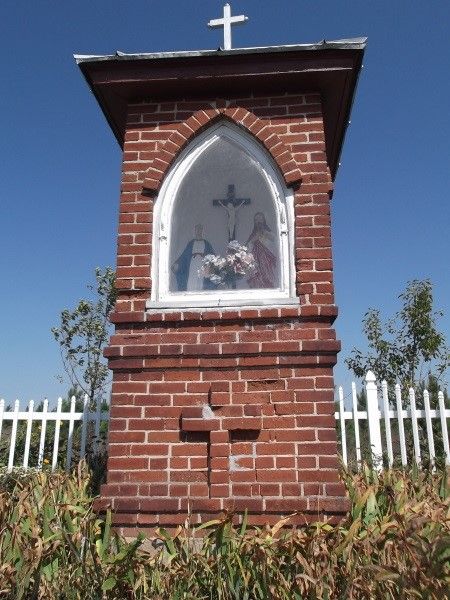
Stevens Point is in Portage County which has had a large Polish-American population for ages. This being the case, the county has various roadside shrines and crosses. I saw one I hadn't seen before on my trip. I wasn’t driving and we didn't stop for a photo opportunity but I recalled where it was and found it on Google Maps.
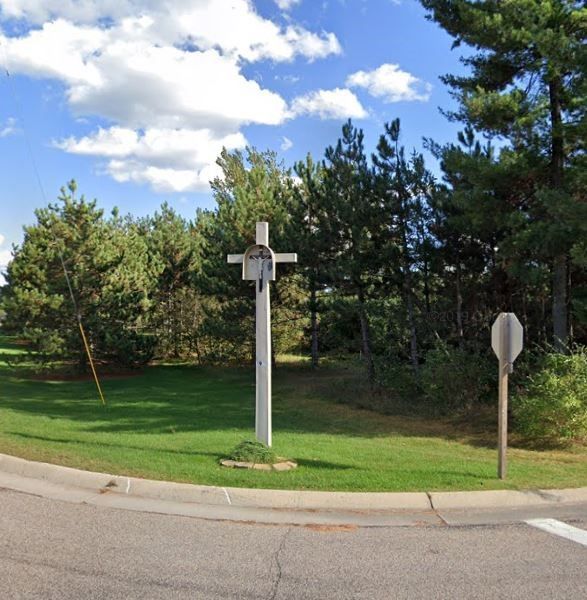

However, I was able to get a photo of this roadside shrine which I'd encountered on another venture.


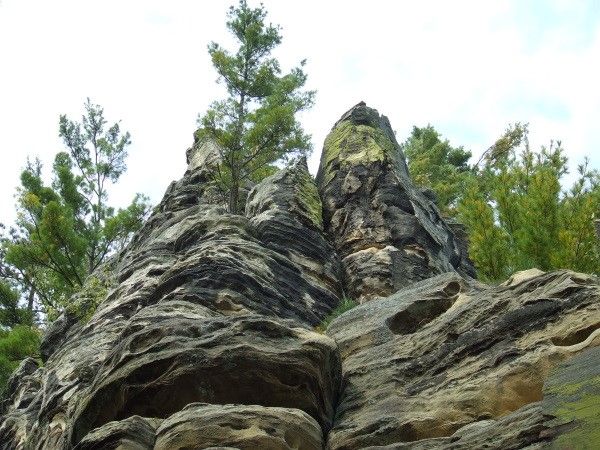
I bid my friends auf wiedersehen after a couple days and journeyed south to the Nekoosa area. My first stop was Roche-A-Cri State Park where I parked and then immediately hit the trails. I ended up hiking a few miles. The park is notable for a butte/rock outcrop thingy which features Native American petroglyphs. I believe these are the only ones in the state. Well, the only ones that are hundreds of years old.


Because of Covid, I wasn't able to go to the top nor get close to the petroglyphs. Still, the weather was rain-free and temperate so it was a nice walk.

My final stop was at the pièce de resistance of Wisconsin gustatory culture: a supper club.
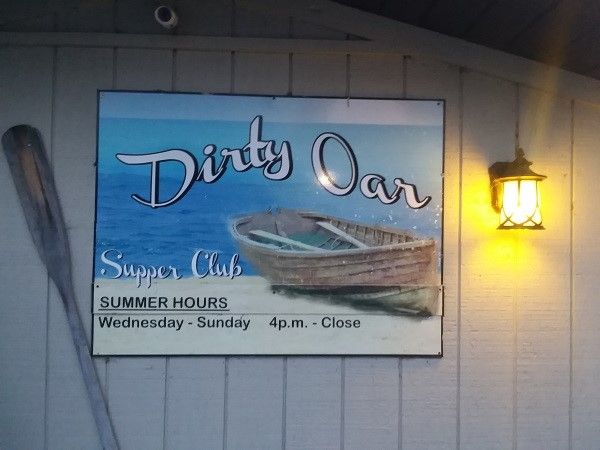

This one happened to be owned by an old friend's ladyfriend while he was the head chef. She grew up in the area and had gone there many a time as a kid. When the place came up for sale, she jumped at the chance to keep it open so another generation can enjoy Old Fashioneds and prime rib.

The last time I saw either of them was in, oh, 2004 or 2005. I hadn't announced my intent to stop by ahead of time so, after being seated, I asked the waitress to relay a message to Chef Ed. Since he was known to some of us as The Polock (he being a product of Milwaukee's south side back in the day), I asked her to tell him that a customer was asking what he had to do to get a decent pierogi in this town.

It was really fun to be able to chat with them again. The place was fairly busy despite the capacity restrictions and they were short on staff so we didn't have a long time to talk. I enjoyed my pine nut encrusted walleye and the wonderful view. The building is on the east side of Petenwell Lake and so diners are treated to beautiful vistas of the setting sun.
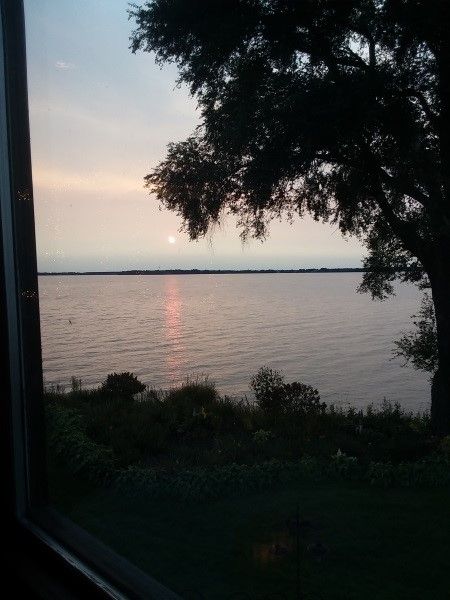

The next day I headed home to Madison. I was not enthusiastic about returning to work the following day, I can tell you.

Bonus photo – food delivery robots. These deliver food from UW-Madison cafeterias to students in the dorms.

03 February, 2021

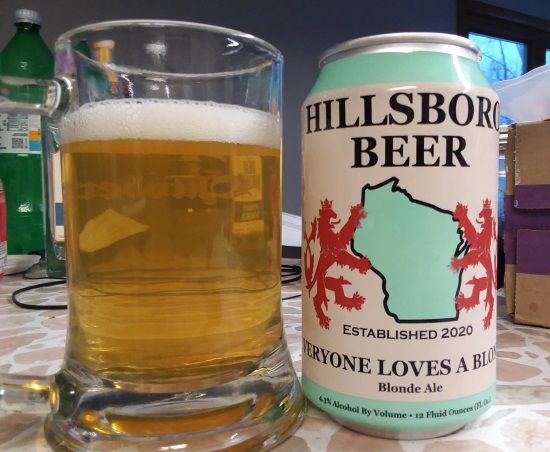
Just Goes Without Saying: Everybody Loves A Blonde by Hillsboro Beer


I've been seeing beer from the Hillsboro Brewing Company around Madison for a while now. And I've always meant to try it. But I kept saying to myself, "Oh, it's that newish brewery out by Waterloo. I want a lager this time. Next time I'll give them a try." And I'd buy some lager and return to the liquor store the next week, see Hillsboro beer and say to myself, "Oh, it's that newish brewery out by Waterloo. I want a lager this time. Next time I'll give them a try." The sheer predictability of my time at the liquor store was like Groundhogs Day.

Well, I finally burst the chains of my beer buying rut and went out and bought some beer by Hillsboro Brewing Company. When I got it home, I inspected the label and realized that the Hillsboro Brewing Company is, in fact, located in – quelle surprise! – Hillsboro, Wisconsin. For months I had been confusing it with Hubbleton Brewing Company which lies 20 some odd miles east-northeast of Madison. Hillsboro, on the other hand, is on the east side of Vernon County about 80 miles northwest of Madison. D'oh! I seem to be having tremendous difficulty with my brewery names. Just one little H and I was totally confused.

Now that I am confident that I am writing about the right brewery, I can say that Hubbleton Hillsboro opened in 2014 and then moved down the street to larger and fancier digs and reopened in 2018. And now just to put a Phildickian spin on things, I look at the can and see that it has "Hillsboro Beer" on it, not "Hillsboro Brewing Company". Plus it has "Established 2020" in friendly letters there on the front. Brewed by Potosi. So does Potosi own the Hillsboro brand? What happened to the brewpub? I'm beginning to feel like Time Out of Joint's Ragle Gumm as everything I thought I knew about a brewery in Hillsboro is turning out to be an illusion.

Everybody Loves A Blonde is, not surprisingly, a blonde ale. The style is the bastard child of the craft brewing scene. It is often referred to as being "light" and "approachable" – beers for macro lager drinkers or those who aren't out to have their palates wrecked. This reputation is a real shame because the restraint of the blonde ale is virtuous and tasty in its own way.


While I wasn't surprised to see that Everybody Loves A Blonde had a lovely straw color, I was not expecting it to be slightly hazy. It seems more beers are a tad cloudy these than in years past. Is this a trend I've just not picked up on? Is haze the new craze even when it's not an NEIPA? Or am I doing something wrong? Atop the yellow liquid was a creamy white head that last a minute or so.

The beer had a very nice crackery aroma with a little berry mixed in.

Taking a sip, I noticed the carbonation right away. Not of champagne magnitude, but a good, firm fizz. There was some fruitiness that tasted like grapefruit and pineapple to me. Restrained and not juicy. There was also cracker to be had as well. It was light-bodied and a little on the watery side. I thought I caught a hint of corn too. The finish was moderately dry with a little hoppy bitterness.

Either it needed a bit more of grain taste or it needs to be warmer outside. On the other hand, I really enjoyed the fruitiness which was tasty yet not ostentatious. By and large, everything came in moderation and was in its proper place as I'd expect from the style.

Junk food pairing: Get yourself a bag of ghost pepper tortilla chips. Everybody Loves A Blonde will go down easy as you try to extinguish the flames.

30 January, 2021

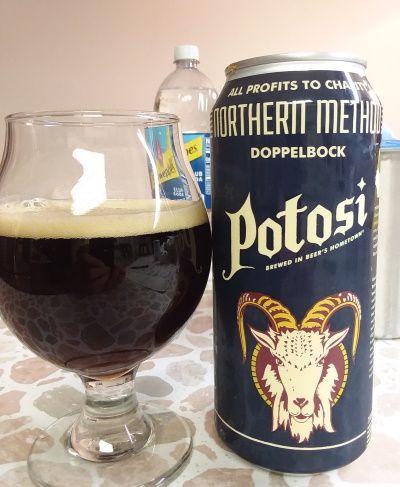
Great Taste, More Filling: Northern Method by Potosi Brewing Company


Whenever I see the word "doppelbock" on a label my mind immediately pictures a Falstaffian monk, cheeks flushed red clutching a tankard as he takes a break from his monastic duties to have a little earthly fun. I am not sure why this is the case but it likely has something to do with the tale that the origin of the style lies with monks who brewed a heartier bock for sustenance during their fasting for Lent. (And, now that I look, it also probably has to do with Paulaner's label.)

Upon closer inspection, this doesn't seem to really have been the case although there are monks involved in the beer's history and they did do stuff like drinking beer during Lententide.

The genesis of the doppelbock dates back to 1651 and the friars of an order founded by Saint Francis of Paola. Their monastery was in suburban Munich and for the feast day in Frank's honor on 2 April they brewed a special beer which they called Sankt-Vaters-Bier (Sacred Father's Beer or something like that). This was the ur-doppelbock. The beer would be brewed for this day every year. While 2 April fell during Lent most years, sometimes it was after Easter. So there were indeed friars drinking this stuff during Lent.

As the years went by this special feast day brew became known as Salvatorbier and the brewery became Paulaner. And Paulaner exists today and their doppelbock is called Salvator. From what I've read, doppelbocks have gotten less sweet but more potent over the years. A little less liquid bread for lent and more booze to ward off the chill of late winter/spring. Regardless, doppelbocks today are generally about the malt and very sweet.

In addition to associating them with monks, I also think of doppelbocks as something consumed around Lent. But I recently spied one by Potosi called Northern Method and figured I'd give it a shot even though it was only January and Catholics were still whoopin' it up to celebrate the conversion of St. Paul.

The Potosi Brewing Company has, to the best of my knowledge, absolutely nothing to do with monasteries, ascetic lifestyles, or celibacy. Located in the southwest corner of the state within spitting distance of the Mighty Mississippi, it opened in 1852 and closed 80 years later after becoming Wisconsin's fifth largest brewery. A few decades later a non-profit group, the Potosi Foundation, raised the necessary funds to resurrect the brewery which had been donated to them. Potosi Brewing opened once again in 2008 and today the facility is also home to the National Brewery Museum which is pretty slick if you're into old beer cans, signs, and whatnot.


Northern Method, the name being a nod to the origin of the bock, is really a nice, clear reddish brown color but sitting there in that glass on the counter it had a tenebrous tint. With a creamy tan head, the beer looked, well, not imposing but like a rather heady concoction. It was ready to fortify me against the winter weather.

It smelled more or less like I thought it would – sweet like raisins and caramel but also a bit boozy and astringent. It's 8.5% A.B.V., by the way.

Raisin and caramel were also to be tasted along with a more plum-like/stone fruit flavor. I discerned a little dark chocolate as well. And, in keeping with its reputation as liquid bread, there was a bready flavor too. Some sweetness lingered on the swallow as the hops finally decided to make themselves known with a touch of spicy bitterness.

Despite being a big beer, I found Northern Method to be rather easy drinking. Malt sweetness was the order of the day but my palate never got bogged down in a cloying sludge. The beer had a medium body and I think the sweetness was prevented from running roughshod over my tongue by judicious hopping and just the right amount of carbonation.

Northern Method is a "Fall / Winter Seasonal Limited Release" and so, oddly enough, it will be leaving store shelves in February just as folks are really getting into the swing of Lent.

Junk food pairing: Christians refrained from eating meat during Lent in the Middle Ages but "meat" referred to land animals with hooves. And so, for example, beaver was perfectly acceptable. As was fish. So, head down to your local Asian grocer and buy a pack of unagipai, which are essentially eel cookies. You'll be in the clear as far as those pesky Lenten dietary restrictions go.

27 January, 2021

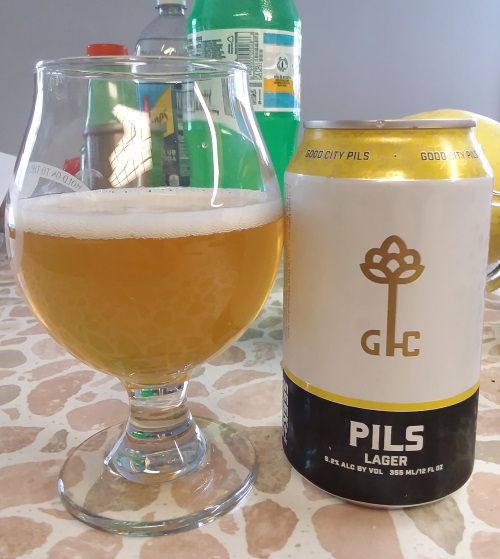
I'm drinkin' up Good City libations: Pils by Good City Brewing Company


Yet again I am drinking beer from a Milwaukee brewery that is fairly new. This time we have Good City Brewing Company which opened its doors in 2016. Presumably they are doing well as they have two locations in Milwaukee and are opening a taproom in out in the burbs during a pandemic. I'm a bit late in sampling one of their brews mainly because I kept seeing their Mosaic pale ale and IPAs and, not having much interest in those styles, I just got into the habit of ignoring them. Life is too short to peruse shelves that are overwhelmingly stocked with trendy IPAs, pastry stouts, and other beers I don't care to drink.

There is the fear factor as well. I've spent good money on lagers from breweries that make ales 99% of the time and usually I am left highly unimpressed. They cannot dry hop or barrel age the malt flavor out of existence and you are left with crap. There may very well be a haze factory out there that makes an Oktoberfest that is so good, it would make the most discerning beer enthusiasts out on the Wiesn cream their Lederhosen. But I am not going to dedicate a lot of time and effort to sifting and winnowing in order to find a hymen in a whorehouse.

It's a real shame that the single beer coolers are often times where old beers are sent out to pasture. I like being able to get a bottle/can or two for sampling purposes instead of committing to a 4- or 6-pack. This is especially nice for breweries with which I am nearly or totally unfamiliar. But there are still fresh or relatively fresh singles to be had in some coolers.

And so it was on a trip to the singles coolers at my local grocery store. Good City's Pale and India Pale Ales were there flanking a row of their Pils. So I snagged one of those so I could finally give them a try. It was canned on 18 November which meant it was less than 2 months old. Not super ultra mega maxi fresh but still plenty fine.


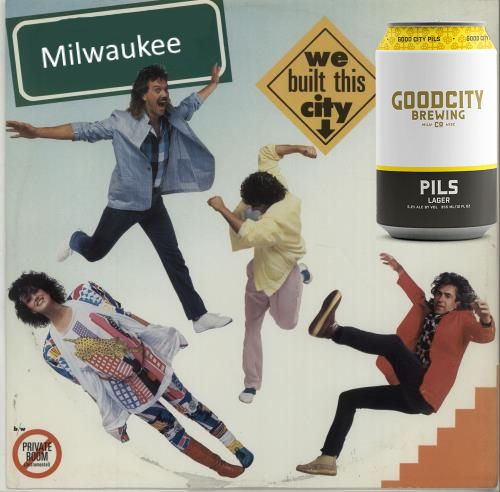
Good City describes Pils as "A fresh take on a style that Milwaukee was built on." Bohemian lager yeast, pilsner malt, and "assertively hopped" with Tettnang & Saphir hops, German varieties both. At some point, using hops that taste like fruit will stop being a "fresh take", and hopefully soon. My experience with Saphir hops has been rather limited but positive overall. The beers I've had that used them didn't taste like Froot Loops. Indeed, the fruitiness was on the subdued side.

Pils was surprisingly hazy. With the proliferation of the Kellerpils, pilsners that aren't crystal clear are no longer novel. I must have looked silly holding my glass to the light and I felt like the kind of person Pantone marketers laugh at. Is it a light gold, or more of a darkish yellow? One of those. My pour didn't produce a big head but the white foam I did get looked nice while it lasted. While I spied some bubbles inside, I expected more.

Although I was not exactly bowled over by the beer's appearance, the smells emanating from my glass were wonderful. A strong biscuit scent was followed by some berry and pear and a faint hint of grass.

Not only did I smell biscuit but my tongue tasted it and the flavor was very, well, tasty. Perhaps a bit stronger than I'd expect from a pils but delicious nonetheless. Not surprisingly it had a body that wasn't as light as your normal pils but it was by no means a particular heavy beer. There was a good level of carbonation though, as with the bubbles, I'd expect a little more fizz.

For being "assertively hopped", I didn't find it particularly hoppy. I caught a little berry fruitiness from the Saphir along with a grassy/straw taste. The expected pepper-like bitterness came on the finish which, with some fizzy help, made for a decidedly dry experience.

Pils genuinely defied most of my expectations. I expected clarity and I got haze; I figured there's be a light, crackery malt flavor and I was given something more like a Helles; I read "assertively hopped" and found it to be more moderate to my taste. Despite this, I rather enjoyed Pils. While I would have liked a bit more Noble hop flavor, I felt it had just the right level of fruitiness. And I really liked the biscuit flavor here.

Think of it in REM terms. With a pils I would expect the jangly guitars of "Pretty Persuasion" and I instead got the distortion and chords of "Oddfellows Local 151". Great songs both of them. Pils may not be what I was expecting but it was still delicious.
Junk food pairing: A fresh take it may be, but it's still a pils from Milwaukee. This being the case, pair it with some Prime Rib flavored potato chips. For a real treat, dip them in horseradish sauce.
26 January, 2021

The Corona Diaries Vol.8: Guess I'll see you dancin' in the ruins

November 2020

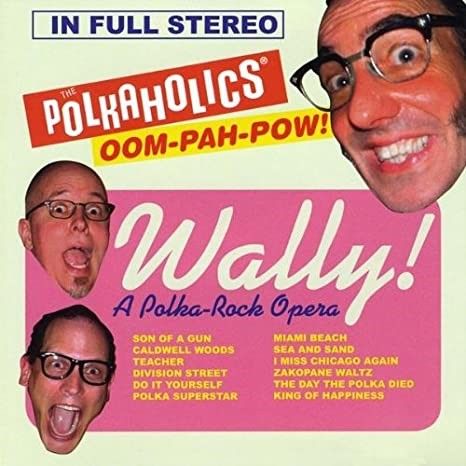
As I type, polka music is blaring from my computer's speakers. Curiously enough, the cat doesn't seem to mind. The music is by Chicago's own Polkaholics, who merge polka with rock music. Back in old times before Covid they played every so often at the Independence Tap at Irving Park and Harding, not far from my old stomping grounds. The album of choice today is Wally!, a polka-rock opera about the life of the Chicago polka icon "Li'l Wally" Jagiello.


Over the course of an hour or so it chronicles Li'l Wally's life from growing up in Chicago to retiring to Florida and all polka points in between. Listeners are treated to some Chicago history along the way. "Division Street" celebrates life on Chicago's Polish Broadway (mainly the taverns) while "Caldwell Woods" is about family trips on Sundays to the north side for polka music, food, and fun at the titular forest preserve.

I brought up the subject of polka-laced picnics at Caldwell Woods to my mother and she told me that she used to go there on Sundays as a girl. Perhaps she heard Li'l Wally in person back in the day.

Wally! can be heard here:

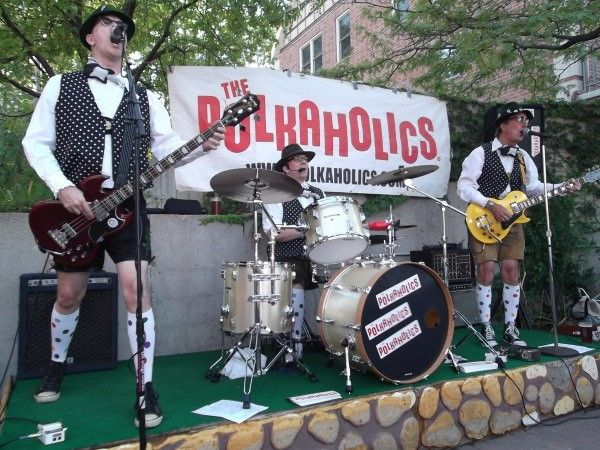
This is the band here in Madison at the Essen Haus in honor of the Great Taste of the Midwest beer festival several years back.

*****

A friend of mine recently pawned some Criterion Collection blu-ray discs off on me that were duplicates in his collection. One of them was Kiss Me Deadly and the Frau and I watched it that same night. It was the first viewing for both of us although we both knew it was referenced in Repo Man and Pulp Fiction. I adored it! I loved the sound design for the ending. It complemented Detour, the 1945 Edgar G. Ulmer film that we had watched a week previously very well.


*****

In addition to fresh air, exercise, and letting me indulge a desire to simply cruise around town, my bike rides earlier this year also afforded me the opportunity to investigate things that I'd heard of or read about but had never seen with my own eyes.

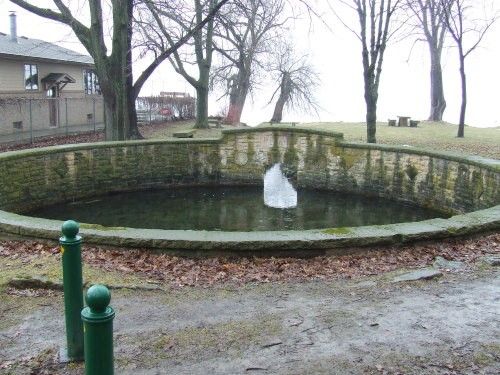
Take, for instance, this cistern on the shore of Lake Mendota.


Built in 1934 by the Wisconsin Emergency Relief Administration, it captures the waters of Merrill Springs before they run out into the lake. It's in a nice little park on the west side in a rather upscale neighborhood at the dead end of a street. I don't happen to know many upscale people so I've never really had cause to go to that area previously. And so the cistern was something that I'd heard about but had never seen until this year.

In a similar vein is the Annie C. Stewart Memorial Fountain.


Like the cistern, the fountain is in an upscale neighborhood but this neighborhood isn't in some hidden corner tucked away on the far west side at the dead end of a street. Rather it is just south of campus. Perhaps I saw the fountain at some point back in the 1990s but I don't recall doing so. This spot was the entrance to the zoo back in the day and today it's a small part of a much larger park with a Native American effigy mound nearby.

Built in 1925, it is in pretty rough shape today although I have read that a non-profit group is looking to restore it back to its former undinal glory. More or less, anyway.

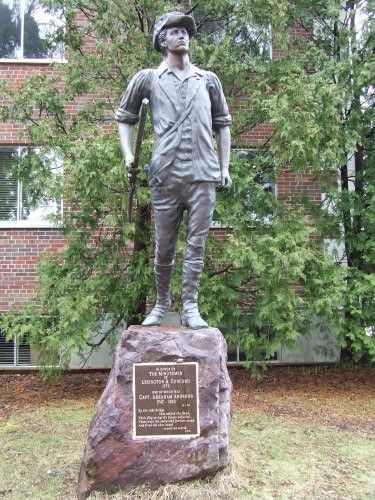
I must admit that I never thought of Wisconsin as prime Revolutionary War memorial territory. Yet just a block or two down from a popular mall stands this statue.


It is dedicated "In Honor of the Minutemen of Lexington & Concord 1775 – One of whom was Capt. Abraham Andrews." A cursory search of the Internet didn't reveal any connection between Capt. Andrews and Madison. Presumably there is or was one with a distant ancestor who lived here. It's in front of a building that I suppose is neo-colonial in style and is home to various offices.

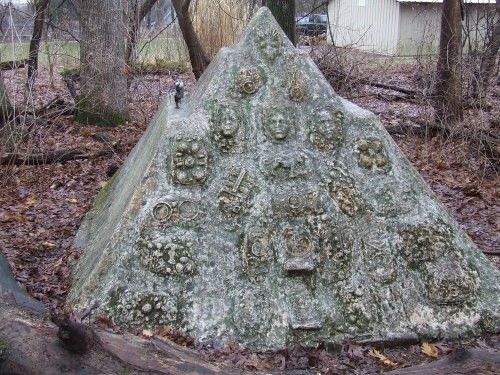
Even more enigmatic than a Revolutionary War memorial here in Madison is this concrete pyramid.


I first heard about it last year and was intrigued as its genesis remains shrouded in mystery. The pyramid sits in the woods of a park behind an elementary school and it is generally thought that it was made by a teacher and their students back in the 1970s. Apparently, however, no one knows exactly who it was, when it was built, or what, if anything, the symbols on it are supposed to mean. At least no one is stepping up and taking credit for it. Either that or I haven't searched the Internet long enough to find out more.

My hypothesis is that a teacher had read some Carlos Castaneda, taken some peyote, and came up with the idea to build a pyramid. It was the 70s, after all.

Madison is home to the 115th Fighter Wing of the Wisconsin Air National Guard. Any friends or family from Chicago reading this may have heard and/or seen some of its F-16s on 11 September 2001 as it's my understanding that they were dispatched to guard the skies over the Windy City on that day. They are stationed out at Truax Field Air National Guard Base. I've known that Truax has been open, more or less, since World War II. What I didn't know until this year is that it used to be much larger than it is today.

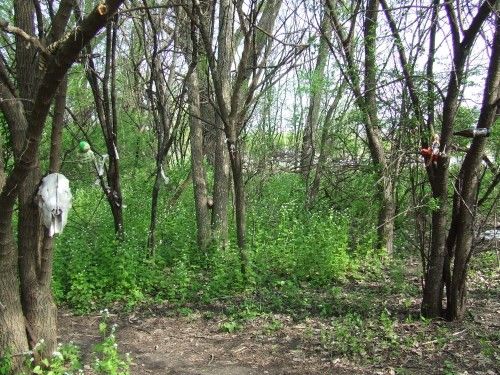
I was riding my bike to the north side – near the airport/Truax Field – when I noticed some dirt paths off of the bike path in the woods. I decided to investigate. They turned out to be trails for folks who like to do some off-road biking. I followed one to an area that I call Blair Witch Alley. It's a small clearing on the path with dolls, stuffed animals, bones, et al adorning the tree branches.


The place had a creepy vibe that brought to mind those scenes from The Blair Witch Project which feature stick figurines hanging from branches.

Continuing down the trail I noticed Barbie dolls on branches about every 50 feet or so.


It was all rather eerie.

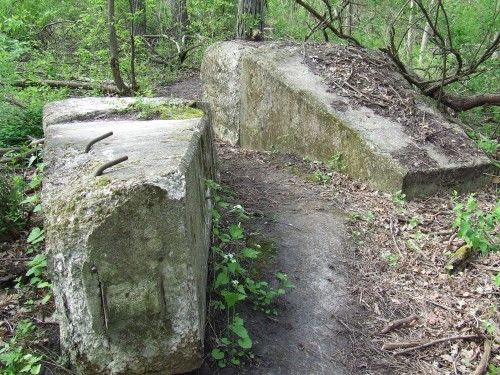
In addition to dolls, there were cement blocks with the rebar hammered flat lining some stretches of the path and hiding in the overgrown areas at others. Eventually I came upon spots that had much larger concrete bits.


Having seen these and recalling the patches of blacktop sticking out of the grass I'd seen to the south, I figured that these must the ruins of the Truax Air Force Base of yore, leftover when its mission was scaled down in the late 1960s/early 1970s and the base apparently downsized.

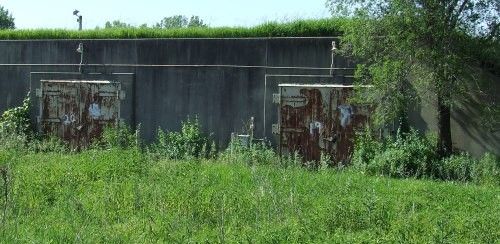
I'd heard tell of bunkers used by the Air Force to store rockets and other munitions that were long abandoned. One of my co-workers moderates a historic Madison Facebook group and he proved helpful in finding some old posts about the bunkers. With an idea of where they were, I set off to find them.

I found them just west of the concrete ruins down a small ravine in the middle of a golf course. To get at them you have to traverse one of the holes and I irritated a couple golfers the morning I went in search of the bunkers.


Approaching the fence, I was startled by movement. I spied a deer on the other side. It was staring at me and, because I relate everything in my life to movies, I suddenly had this weird, uncanny feeling that reminded me of the scene in Annihilation when our heroines come upon two deer that are in the process of transmogrifying into plants. Things went eerily quiet and I felt oddly alone as a chill ran down my spine.


For its part, the deer quickly tired of the intruding human and bounded away into the woods.

As for the bunkers, an Air Force vet had this to say:

Truax stored the Douglas AIR-2 Genie rockets in those bunkers (along with a lot of other types of munitions) from about 1958 when we started flying the Northrop F-89 Scorpions as a part of the Air Defense Command mission and then the supersonic Convair F-102 Delta Dagger (which carried the GAR-11/AIM-26A Nuclear Falcon missiles) up to 1974. As we know the Genie was an unguided air-to-air rocket with a 1.5 kt W25 nuclear warhead and the GAR-11/AIM-26A Nuclear Falcon missile was a semi-guided W54 nuclear, explosive with a yield 250 t TNT equivalent. So contrary to what Gene Rankin mentioned, Truax harbored 24 plus (2 squadrons) and two types of aircraft that carried nukes for a period of about 16 years and let’s not forget the Active Duty Air Force was also there during that time as well.

24 January, 2021

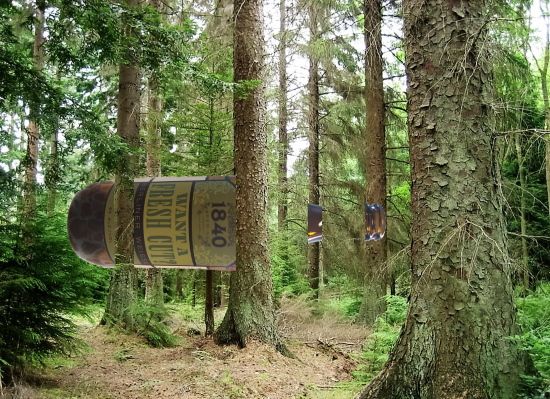
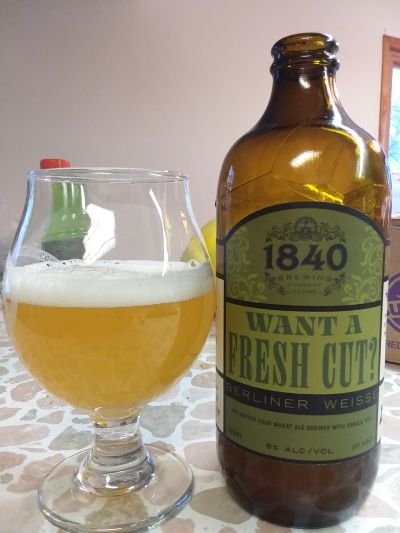
Let Me Bring You Tips From the Wood: Want a Fresh Cut? by 1840 Brewing Company


Most of my last few beer reviews have been of beers by newer breweries from Milwaukee. This holds true for today's post despite the name 1840 Brewing Company which appears to have sold its first beers in 2017. The "1840" part comes from the year that Milwaukee's first commercial brewery opened. That was the Milwaukee Brewery sometimes called "Owens' Brewery" after Richard Owens, one of the three founders.

1840 bills itself as an "urban farmhouse brewery" and I am not sure what that means. Perhaps my Googling skills have gone soft. When I try to get a definition of this, I just get articles from Milwaukee outlets that note it is an urban farmhouse brewery as if the definition was self-evident and would mean something to the vast majority of humanity. Oh well.

My understanding is that 1840's brews have only recently begun appearing in Madison. I found them recently and decided to give one a try after seeing that they had a Berliner Weisse on offer in which spruce tips were involved. The beers come in these neat brown half liter bottles with some vaguely old-timey labels making them look like Samuel Taylor Coleridge's laudanum vials.

The spruce made me think of the spruce Goses I'd had. Bayerischer Bahnhof, one of the few German breweries that makes Gose, had a spruce variant and some of it ended up Madison. I had a pour at the Hop Cat which used to be downtown. And then there was a spruce Gose by Freigeist Bierkultur. I rather enjoyed both of these biers so I was looking forward to a Berliner Weisse imbued with some coniferous goodness.

When I was putting the bottle into the refrigerator, I read the rest of the label and saw that it was dry hopped with NZ Kohatu® hops that impart tropical fruit flavors.

D'oh!

I felt like Homer Simpson in the flying pig episode, "It's just a little fruity. It's still good, it's still good!"

Caveat emptor.

Despite not - how shall I say it? – being a proponent of trendy hops that taste like tropical fruit, I plowed on.


Want a Fresh Cut? poured a lovely hazy yellow with a nice, loose white head that didn't stick around too long. It had the requisite lemon/citrus smell of a Berliner Weisse along with pine and tropical fruit. The latter reminded me of mango. Or was it passion fruit?

I tasted that lemon in the assertive sourness. Carbonation seemed a little on the low side for a style with the moniker "Champagne of the north" but it was by no means flat. There was still plenty of fizz to tickle the tongue and add some dryness to complement the tang. The piney taste remained in the background, behind all the sour and made a nice counter flavor.

And then came the hops.

The fruit flavor was, um, assertive, and almost makes you forget you are drinking a Berliner Weisse, for a split second. And the piney taste was laid low by mango. In addition to tropical fruit, Kohatu® hops are also supposed to taste like pine needles. To my taste, fruit overwhelmed any pine taste and, honestly, I assumed the sharp, resiny taste came from the spruce tips but, never having tasted these hops previously, some of that could have come from the Kohatu®.

The mango/tropical fruit taste lasted into the finish as did a hint of pine that lingered well after the beer was down the hatch.

Want a Fresh Cut? is just not my thing. I think there was a tasty kettle soured Berliner Weisse in that bottle but it was overrun by tropical fruit hops. It had just the perfect level of sourness for my taste and was optimally carbonated for me as well. And I very much enjoyed the pine flavor. It was fairly mellow but was still worked well against the lemony bite. But the tropical fruit was too much. Not only that, I also don't particularly care for strong fruit flavors from hops. I've had mango syrup in a Berliner Weisse and it was fine. I've also had many a Berliner Weisse aged on fruit and they were very tasty. So why would I object here?

I think the answer is partly how my tongue works and partly psychology. I am not inclined to drinking Berliner Weisse with mango syrup all day long. One is fine. But the sugar adds body and the sweetness plays off of the sour in a way that seems naturally pleasing. They are good sparring partners. Yeah, the mango flavor isn't real but the drinker knows it's artifice and it works for a glass.

Schell has a whole program devoted to Berliner Weisse and they usually age the beers on fruit. Real fruit. So you get the sugars. In addition, the fruit flavor is real. Adding that flavor via hops violates what former UW professor Noël Carroll might call a category violation. You're tasting fruit with no fruit in sight. My primitive ape brain is programmed to look askance at such things.

I think I'd have liked Want a Fresh Cut? if the fruitiness were still there but much less prominent. Let the spruce and the sour do their pas de deux and the hop-spawned tropical fruit can be an accent. However, if fruity tasting hops are your thing, Want a Fresh Cut? may just be right up your Strasse.

Junk food pairing: Pair your Want a Fresh Cut? with the tropical goodness of Jay's Krunchers® Sweet Hawaiian Style Onion Kettle Chips.

22 January, 2021

The Further Adventures of Gereon Rath


The March Fallen provided one of the odder experiences I've had with regards to reading a book. On the morning of 6 January I read the chapter in which the Reichstag was torched in 1933 only to see later that day that rioters/insurrectionists stormed the Capitol in Washington D.C. I had to wonder if those who took the Capitol to stop the election certification would attempt to burn the place down. Luckily they did not.

This is the fifth book in the Gereon Rath series by German author Volker Kutscher. The first two books, Babylon Berlin and The Silent Death, have been adapted for TV as Babylon Berlin and is available on Netflix for those of us in the States. The books take place in Weimar Germany beginning in the spring of 1929 and my understanding is that the series will continue until the start of World War II in September 1939 when Germany invades Poland.

Rath is a police detective who has fled his native Cologne for Berlin after he accidentally kills a man. He is given a ribbing by his new co-workers for being a country bumpkin in the big city. Berlin was and still is, from what I gather, the hedonistic capital of Germany. Perhaps even of Europe more generally. You can really let your freak flag fly there. During the 1920s there was cabaret, various erotic clubs where transvestitism was often not frowned upon, drugs, prostitution – a place of decadence and transgression. Rath is a good Catholic boy in a den of sin.

This time around Rath is investigating the death of a World War I veteran whose body is found underneath a rail overpass. It being February 1933, he now he has to contend with a police department that is becoming ever more politicized as the police chief is a Nazi.

The Nazi presence/menace has been around since the first book and gotten more prominent with each succeeding one. With The March Fallen they have stepped out of the background and into the light. It's early 1933 so Hitler is chancellor, not dictator, but he is a polarizing figure for the characters. Swastikas are to be found hanging in public and the SA, a Nazi paramilitary organization, roams the streets having basically been deputized in service of the police. Some are dyed in the wool believers in the Nazi cause while others, like Rath's fiancé Charlotte Ritter who is trying to break the police gender barrier, are adamantly opposed. Others join the Nazis out of sheer self-interest or just to stay out of their crosshairs. Germany has begun dancing on the edge of the volcano. We the readers know how things pan out and so the political backdrop adds more layers of tension beyond the murder mystery at the heart of the story.

While Rath is an angel in contrast to the Nazis, he is far from perfect. Earlier in the series he was addicted to morphine as a result of his experiences in the war. Here, he continues his relationship with the Berlin mafia, the Ringvereine, and, in one scene, he and Charlotte dispose of some evidence, shall we say. Plus he engages in a little blackmail.

One of the neat elements of these books is how Berlin itself is almost a character akin to London in Ben Aaronovitch's Rivers of London series. It's quite the milieu of rich and poor, exotic dancers and construction workers, communists and democrats, and so on. Rath's work takes him all around Berlin and Kutscher rattles off all kinds of places that would have been or are familiar to Berliners – Alexanderplatz, the Ku'damm (think State Street, my fellow Madisonians), the ginormous KaDeWe department store (I thought of the Marshall Fields on State Street in Chicago), and so on. The variety of locations makes the city come alive on the page which makes for wonderful reading even if I have to look up many of the locations.

While there are eight books in the series thus far, only the first five have been translated into English. And, sadly, only the first three have been published in the States so you may need to find an independent bookseller abroad to get volumes 4 and 5. But do take the plunge.


21 January, 2021

Pink Floyd's Animals is 44 today


Today is the 44th anniversary of the release of Pink Floyd's Animals. This is one of my favorite Floyd albums and, to my taste, their best after Meddle. It's got the proggy twists and turns but also a drive - an anger and perhaps even a bit of menace that not only fits in with the punk ethos of the time, but also was something new for their music.

Most of the album actually dates back to 1974 as the band were trying to figure out how to follow-up Dark Side of the Moon. A short tour of France in June '74 saw the debut of a song called "Raving and Drooling" which the world would come to know as "Sheep" two and a half years later. (An early version of "Shine On You Crazy Diamond" was also performed on these dates.) Later that year Floyd toured England and "You've Got to Be Crazy", eventually to become "Dogs", joined the set.

For ages the only way to hear these early versions of the songs was via bootlegs. I'd heard them on recordings from the mid-November shows at Empire Pool (Wembley Arena) that, although taped from the audience, were of excellent quality. But in 2011 recordings of these songs were officially released by the band.


I really like "Raving and Drooling" with its persistent percussion and the soloing by Wright. It has a raw feel that harkens back to the pre-DSotM days and would certainly have been the black sheep of Wish You Were Here had it been included. On the other hand, "You've Got to Be Crazy" sounds like it would have fit on Wish You Were Here quite well. Less mayhem and anger plus the keyboards sound like other songs on that album.


In 2014, I believe it was, a bootleg started making the rounds called The Extraction Tapes, Vol. 1. Supposedly from Britannia Row Studios and recorded in June 1976, it contains in-progress versions of all the songs on Animals. (Also included are field recordings of sheep baaa-ing and some blues improvisation from their 6 July 1977 show in Montreal.) Sometimes a vocal is just a bit different than the album version while "Sheep" still has the lyrics from "Raving and Drooling" and some of the music which would later be excised. "Pigs on the Wing" hasn't been riven in twain yet and has an electric guitar solo, although I'm not sure if it's the same one that's on the 8 track version of the song.


To the best of my knowledge, Pink Floyd never played any songs from Animals after the In the Flesh tour of 1977. But Roger Waters has so here is "Pigs (Three Different Ones)" live from Milwaukee, WI on 29 July 2017.

20 January, 2021

Hey Braggot!: Paint It Black by Giant Jones Brewing & Bos Meadery


With a pandemic raging, people afflicted with Trumpian madness storming the Capitol in Washington D.C., and a polar vortex set to swoop down upon us, these are the days that not only try men's souls, but also give them a thirst that can only be slaked by something a bit more pantagruelian than the average beer.

Thankfully here in Madison we have Giant Jones Brewing Company. Proprietors Jessica and Erika Jones figured they'd start a brewery. A very niche brewery. It opened in 2018 and offers only the headiest of beers brewed exclusively with organic ingredients. Everything is a barleywine or an imperial or a double or bock strength or a triple or what have you. While they offer a double IPA, they also brew styles that are much less common in these parts including weizenbocks (pale und dark) and a rotating selection of barleywines all the year long.

Just two blocks from Giant Jones is Bos Meadery where Colleen Bos, a "former" medievalist, transmogrifies honey, water, and yeast into mead. The meadery opened in 2012 and has been producing meads made with various varieties of honey, fruit, herbs, and spices ever since. Mead is a cousin of wine and most of Bos' are of similar strength to their vinous relatives.

And now, just like the gustatory congress of chocolate and peanut butter, Giant Jones got their beer into Bos mead. Or did Bos get their mead into Giant Jones' beer? Either way, they now give us Paint It Black braggot.

Braggot is like a cross between mead and beer and does not seem to be made particularly frequently, at least not here in Wisconsin. Paint It Black may be a first for Giant Jones but Bos has offered at least one braggot previously - during Madison Craft Beer Week in 2018 and it was excellent. They produced it in collaboration with St. Francis Brewery (R.I.P.) and it featured a rye stout, if memory serves, given the meady treatment.

Honey is one of those foods that I never thought about much until, quite frankly, I began to drink mead. Unless you grew up on a bee farm, I'd bet honey was just this golden, treacly stuff to you as it was for me. Then I drank mead made with single nectars and discovered that there is more to honey than meets the eye. Go to the Bos Mead Hall and sample the their Wildflower, Buckwheat, and Cranberry Blossom meads and you shall taste what I mean.


Paint It Black merges Giant Jones' winter seasonal, Extra Stout, with Bos' Wildflower Mead. My bottle was filled on 8 December 2020 so it was fairly fresh when I consumed it. As the name indicates, the braggot appears to be black. And, as usual, if you contort yourself just right, you can tell that it is a deep reddish brown. The tan head was soft & pillowy and hung around for an average amount of time. You know, a minute or so. It looked lovely.

In addition to its good looks, the brew smelled wonderful. (My notes say "awesome!") Coffee and bitter chocolate dominate here but the mead's floral-vanilla sweetness was certainly no slouch even if it wasn't as prominent. I was reminded of a box of fancy truffles, such as you'd get from CocoVaa, that use flowers as an ingredient. It smelled lovely.

At first, I tasted dark chocolate and honey sweetness but then came a touch of wildflower (which grew a tad as the braggot warmed) and a moderate bit of carbonation. Coffee and herbal hop bitterness came through on the swallow. A fizzy dryness and some boozy heat rounded my sips out. It tasted…lovely.

Really. I simply adored this stuff. It had all the roasty/coffee/chocolate flavors that are why I love dark beers so much plus some floral ones as well which are, to my taste, woefully underused in beer. At 9.4% A.B.V. it will take your cares away and warm you up but it doesn't taste heavy. Instead, it goes down smooth and easy.

Junk food pairing: Paint It Black is best enjoyed with a bag of dark chocolate covered pretzel thins. The chocolate complements the stout well while the pretzel adds more grain flavors plus salt which further heightens the meady goodness of the braggot.

18 January, 2021

The Corona Diaries Vol.7: Down On the Banks of the Oconto

November 2020

Our local supermarket has started carrying more "exotic" fruits. My guess is that it's in response to a growing number of customers who are either Hispanic or of Southeast Asian descent. And so there are now Dragon fruit, persimmons, and hitherto unknown to me varieties of mango now available for our delectation. Previously we'd have to take a trek to a smaller ethnic grocery store to find such fruits. (Not that I mind doing so, mind you.)

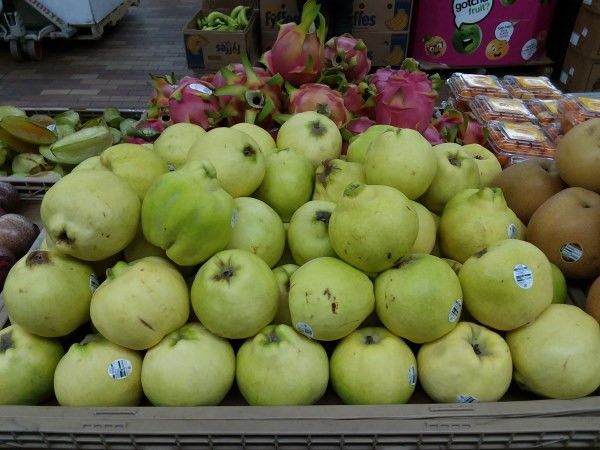
On a recent visit I noticed that quinces are now on offer.


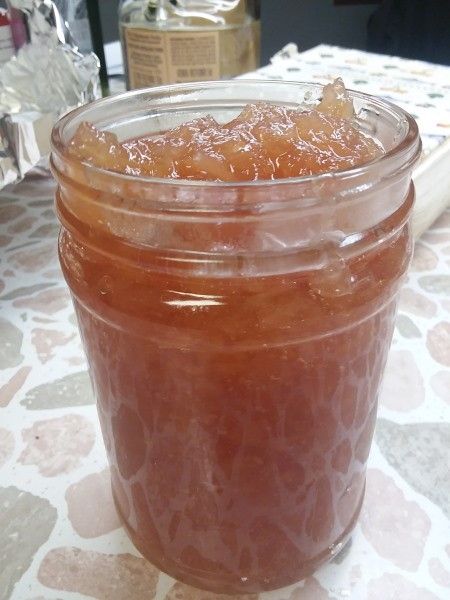
I bought a couple of them and proceeded to make some quince marmalade.


I made it according to an adapted 17th century recipe:

To make rough red marmelade of Quinces. Take Quinces and pare them, cut them in small peces from the coare, then take as much sugar as the peces doe waye, and put the Quinces beinge cutt into an erthen pott and put halfe the sugar that you waied into the pott and as much water as will couer them, then sett them into an ouen with howsholde breade. then when they are paked poore them into a postnett or preseruinge pan and put the rest of the sugar to it, then bruse them with the back of a spoone, then boyle them with sturringe till it will come cleane from the bottome of the pan then boxe it.

I got caught the itch for historical cooking many years ago when I attended a seminar on medieval cookery. Since then I've occasionally taken pleasure trying to cook like it's 1399. One's tastebuds are often challenged when all of the foodstuffs of the New World are absent. However, there are plenty of familiar things such as cryspes, which we know as funnel cakes. (Probably the only period food you'll find at a Renaissance Faire.) I found a recipe for frutours – fritters – that are apple slices dipped in beer batter and fried.

While most of the ingredients in medieval cooking are in everyone's kitchen, some are not. I mean, who uses verjuice (the juice of unripe grapes) these days? I had to mail order a bottle of it. Grains of Paradise were found at Milwaukee's public market. The cubebs for my medieval meatballs, pumpes, also had to be shipped in, this time from the west coast. Cubebs are Javanese peppercorns. Similar to the black pepper we enjoy everyday, it tastes a bit more sprightly, more citrusy to me.

Pumpes are beef meatballs seasoned with mace, clove, cinnamon, and saffron in addition to cubeb. They are served in an almond milk-based sauce flavored with mace and cinnamon.


It's funny to see "pumpkin spice" everywhere during the autumn because cinnamon, clove, ginger, and nutmeg were all basic spices for the medieval chef and used year-round. The basic seasoning blends – powder douce & powder fort – were based around them and often used on meats, not just sweets. I blame Starbucks.

********

After I'd gotten home from my trip, someone asked if I'd seen the marker of the Sputnik 4 debris crash site while I was in Manitowoc. Alas, I had not. D'oh! While I'd heard about it previously, it slipped my mind when I was there and I never encountered any signs imploring me to go see it. The silly part is that I was only a block away from it when I was making my trek north of downtown in search of baked goods.

Next time.

********

About a hundred miles northwest of Manitowoc is Mountain and that was the second destination on my vacation itinerary. A couple friends of mine from Chicagoland have a cabin just outside of town and gave me free use of it. O
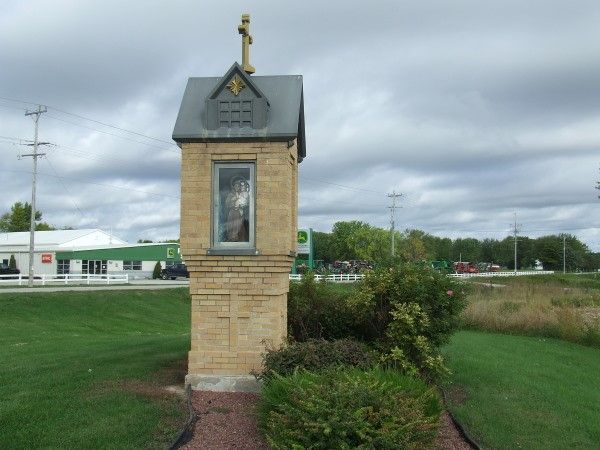
n the way there I passed by a roadside shrine.


I'd never seen one outside of Portage County to the west and had always taken a different route to the cabin. I shouldn't have been surprised, however, as I was just north of a town called Pulaski and just south of a little unincorporated village named Krakow. These shrines are a Polish(-American) phenomenon and are found at crossroads. (Sometimes you'll find a cross but no shrine.) I suppose they announce you're in a Polish/Catholic area but I wonder if their placement has historical roots in the supernatural lore of crossroads.

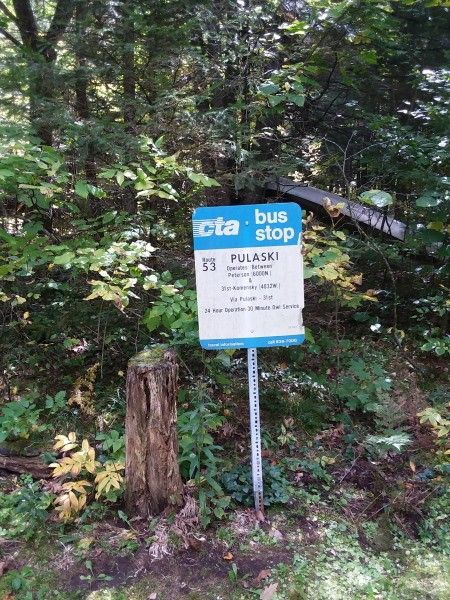
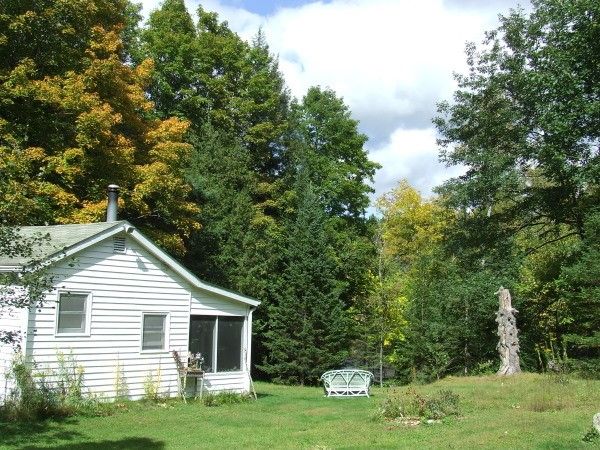
My friends' cabin is on the bank of the north branch of the Oconto River. I know I've gone down the right driveway when I see a familiar sign.


It was a beautiful morning with some fall colors coming in.


The cabin has no electricity nor running water but no expense was spared with the dual seat outhouse.


The river was high and flowing quickly.


It was wonderful to be out in the country away from computers and cars in a spot where the loudest noise was the river flowing. No masks, no news, and the lovely outdoors instead of being ensconced upstairs at my desk in my office at home.

Across the road lies the Nicolet National Forest so I took a stroll. At one point I heard a woodpecker and tried to find it. As I was gazing upwards, an acorn fell and missed my head by about a foot. I never spotted the bird so I continued hiking down the road and found a trailhead at the end of it. So down the path I went.


The trail was about a mile long and ended at a national forest road. There was some wonderful scenery along the route with even more fall color than there was to be found by the cabin. As I wandered near a small pine stand, I could smell the coniferous goodness. The smell of the country is wonderful. Well, as long as you're not downwind of a farm.

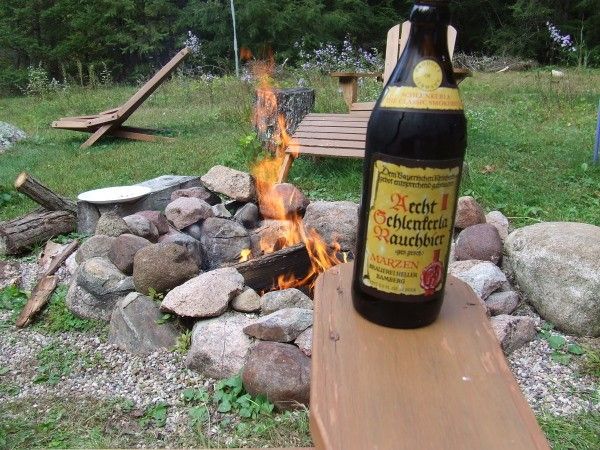
After my little hike, I wandered back to the cabin and lit a fire. With dinner I had one of my favorite potent potables, a Schlenkerla Rauchbier.


Rauchbier = smoke beer. That is, the malt is dried with direct heat from burning beechwood so the grain is kissed by the smoke imparting guaiacol and syringol and whatever other chemicals make smoked foods taste so delicious.

The Schlenkerla brewery was established in 1405 in Bamberg, Germany where Rauchbier is the town's specialty. Back then most beer was smoke beer as I believe the use of indirect heat/use of coke instead of wood to dry malt is a 17th century invention. Bamberg is also home to another Rauchbier brewery, Spezial, but, sadly, they do not export their beer to the States. This being the case, the Frau and I are determined to visit Bamberg someday to sample their brews. Plus, the town has retained some medieval buildings so I can indulge my love of the Middle Ages while there.

I also had a bottle of Becherovka, a Czech digestiv with me. It was given to me by an uncle when he was clearing out his liquor cabinet on a recent visit. A couple swigs made a fine post-prandial treat but it was too sweet to drink a lot of. Perhaps if had been colder or diluted. Just a bit cloying for me. I left it in the cabin's liquor cabinet for future guests to indulge themselves.

I stayed at the cabin for only one night as my next stop was Stevens Point, home of a couple friends from college whom I hadn't seen in several years. As I was packing up, I heard a woodpecker nearby. I was able to find this one and even got a snap of it.


Bonus photo: some fine chainsaw totem art from Madison.