Showing posts with label Stanley Kubrick. Show all posts

20 August, 2025

The Green Man now has company

I got my divorce tattoo - a dryad!


Isn't she lovely? A fine complement to the Green Man on my other arm. I adore the twig and the berries in her hair.

I recall the day back in June when I looked at my Green Man tattoo and remembered why I got it 20+ years ago. It is an argus keeping watch over me. I need only listen. When I listened to him in June, I understood that my wife was no longer my partner and hadn't been for some time. It was clear that she is, as they say these days, toxic.

Sitting in the chair as the ink was being applied, I thought about the myriad of things that the new image stood for and why I was there getting it painted onto my arm. Tears came to my eyes. When I look at my new tattoo today, I see that it symbolizes a repudiation of my marriage/wife or, at least, some elements/aspects of them. But that is only a small part of it. Much more prominent are things sacred: nature and the feminine but, perhaps most importantly, it holds the promise of a new beginning. My old life is on its last legs and a new one beckons.

Thanks to whomever did the artwork that I found on the internet and formed the basis of the image and my eternal gratitude to Jon at Forward Tattoo who devised the final design and helped me more than he will ever know by putting the ink on my skin.

Forward Tattoo is filled with artwork and this Ralph Steadmaneque tribute to 2001 caught my eye.

22 May, 2025

A distant performance

As a boy, I was entranced by György Ligeti's music that was featured in the films of Stanley Kubrick. I got the itch to hear any and all of these pieces performed live. Back in 2004 I jumped at the chance to hear the Milwaukee Symphony Orchestra perform Atmospheres which was featured in 2001: A Space Odyssey. It was glorious!

It took nearly 21 years but I finally saw that another of Ligeti's pieces, Lontano, was going to be performed by the Elgin Symphony Orchestra. Again, I jumped at the chance and bought a ticket.

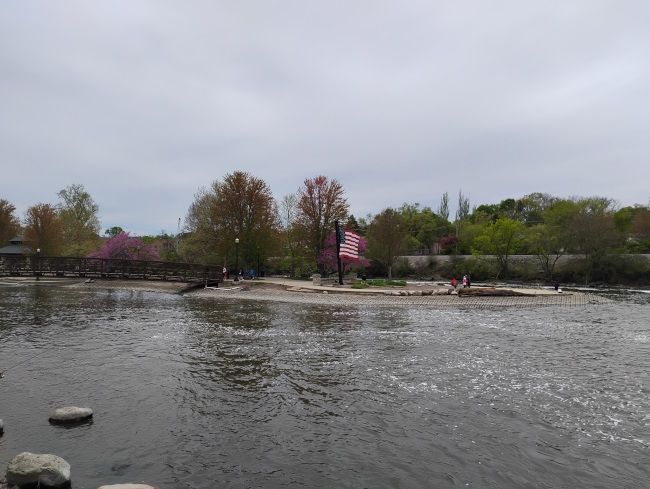
I swung into town a little before showtime and took the opportunity to wander the Fox River shore. The performance was to take place at the Hemmens Cultural Center so I strolled around a bit north of where I did the same last year.

There is an island that has been all gussied up for some lovely scenery on your stroll.

You can get right up to the water and there were several people, including a couple families, taking advantage of the opportunity to take in the scenery or do some fishing.

Canada geese were everywhere. This family were not impressed by the human and I ended up with a photo of all of their butts.

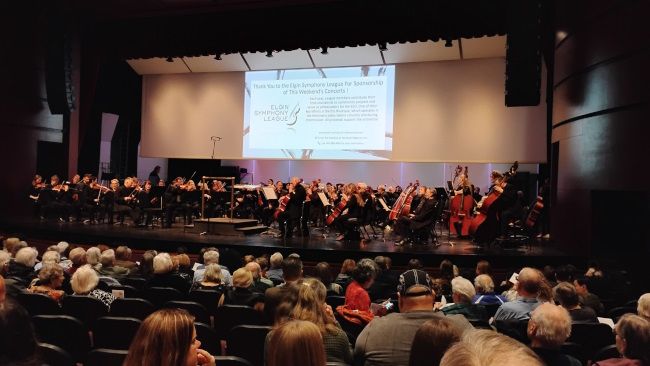
Showtime neared and so I headed to the hall where the great and the good of Kane County and beyond were filing in.

The performance was the ESO's season finale and was sold out.

The Music Director, Chad Goodman, is a young fellow and he introduced the pieces with exuberance and humor.

Lontano was sublime. It's eerie shimmering entranced me and would have been perfect for the soundtrack of Annihilation. I closed my eyes and let the music wash over me and take me somewhere else.

Mozart's "Paris" symphony, which followed, was a total 180 with its allegro movements standing in stark contrast to the ethereal moodiness of Lontano. Holst's The Planets closed out the program. I'd never heard it performed live so it was a real treat. "Mars, the Bringer of War" was just spectacular! The way it builds with such force was just fantastic to behold in-person.

Now onto finding performances of Lux Aeterna, Aventures, and Requiem for Soprano, Mezzo-Soprano, Two Mixed Choirs and Orchestra.

06 February, 2024

The Corona Diaries Vol. 105: Sawdust City

(Watch the prelude.)

(late-August 2023)

Earlier this month my Frau and I made a trek up north to Eau Claire to visit my youngest stepson who lives up there in sin with his girlfriend. The visit was made possible by the fact that the Frau has been feeling much better lately with her weird allergic reactions having subsided greatly. She reached the point where she felt comfortable being hours away from the safety of a Madison-area emergency room, the likes of which she has visited a couple times this summer after having an adverse reaction and putting her epi pen to good use.

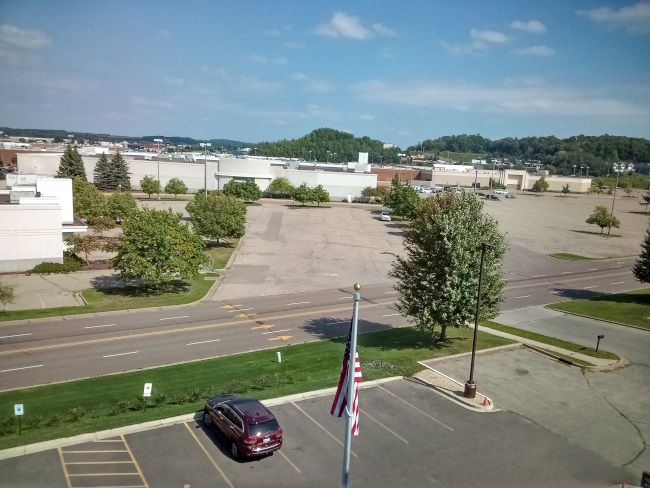
The drive north was rather uneventful and we checked into our hotel which was in the Oakwood Mall complex. The mall itself was dead. It appeared that there was a smattering of cars parked in front of JC Penney but that was about it. Vast acres of parking lot sat empty and some buildings had small trees growing in the cracks of their sidewalks. I expected to see some tumbleweeds blow through the lot.

It was rather creepy, to be honest, and made me think of Dawn of the Dead, George Romero's second zombie movie where uninfected survivors of a plague seek refuge in a mall from the insalubrious and quite undead hordes. Instead of being turned into mindless flesh eaters with pallid complexions, they become symbols of mindless consumers who obey our capitalist overlords.

When I moved to the area in 1987, Oakwood Mall was still shiny and new and I am told that it eventually put the nearby London Square Mall out of business. It had this "Mall of the Future" reputation. Or was big and expensive, anyway. I have a memory of going to Oakwood shortly after my family moved up there and watching the white locals just stare at a lone black family walking around the mall as if they were aliens from outer space. We felt bad for the family and very uncomfortable watching the scene unfold. Welcome to northern Wisconsin.

My Frau had gotten us a suite with a kitchenette and a couch and it was all fancy. So we picked up the kids and went out in search of dinner. We settled on a Hmong/Thai place called Noodle Wrap which was located in the area that was formerly London Square Mall. The mall that I had known had been demolished and replaced with a supermarket and a few mini-malls. We got takeout and retreated to our hotel suite where the air conditioning was in perfect running order.

I got a dish called Hot & Spicy or some such thing.

Not super hot, but it did have a pleasant zing to it. I’d have been happier if there had been a little less meat and more onion. The sauce had a slight tang to it which was just perfect. Everyone seemed to enjoy their food and we spent the night chatting away and enjoying the fine company.

The next morning I was up and at them. My Frau wanted to relax and so I went out to wander around downtown on my own. We were down there maybe 10 years ago for a wedding but didn’t get to see much of it.

I parked my car in front of the Masonic Temple.

I'd been there maybe a dozen years before to attend a memorial function/celebration of life for a friend's mother who had passed. His father was a Mason and the celebration was held at the temple. I have no idea how well membership in the Eau Claire area is doing, but I'd bet it's on the decline. As sad as it is to admit, whenever I see buildings that are (or were) home to a fraternal organization, I almost immediately think about our fraying social fabric a la Bowling Alone by Robert Putnam. OK, I've never read it but have read about it.

Last time I spoke to a friend who is a Mason about the organization, he said that they're struggling to attract new members. The temple here in Madison seems to be rented out for events more often than it's used by the Masons themselves to hold meetings where they plot getting the Eye of Providence placed on more corporate logos, run the numbers on purchasing more black helicopters, plan control of the government, and so on. A VFW here was recently torn down to make way for luxury apartments.

On the plus side, the American Legion post in our neighborhood is still up and running. They have brat fries on Saturdays during the summer and I have been known to stop there for lunch after a bike ride.

Is Putnam right? Is social capital on the decline? I'm not sure but I do think fraternal organizations are struggling, in general.

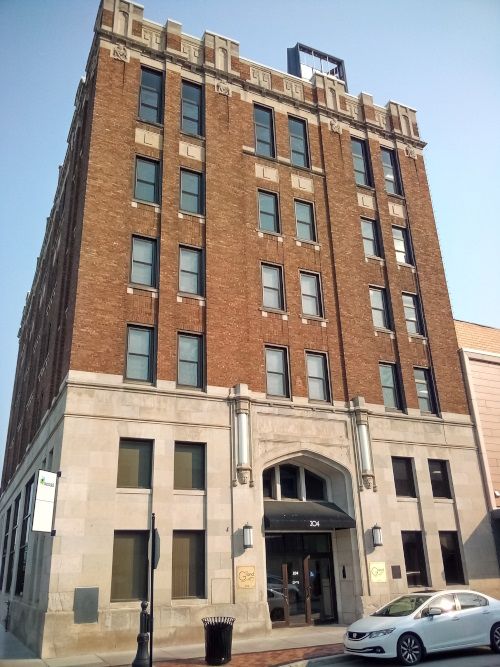
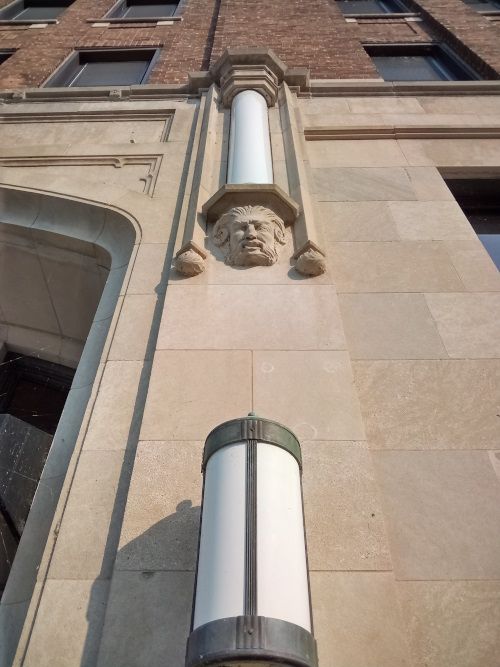
Next I wandered down Graham Avenue and came upon the old Scandinavian American Fraternity Building which was erected in 1930.

It’s a neat building outfitted with lots of figures and faces.

 
I have no idea when the Scandinavian American Fraternity actually used the building. This reminds me that Madison's Sons of Norway Idun Lodge 74 sold its space on Winnebago Street a few years back and the building is now a club with a restaurant. Another example of a fraternal organization on the decline.
 
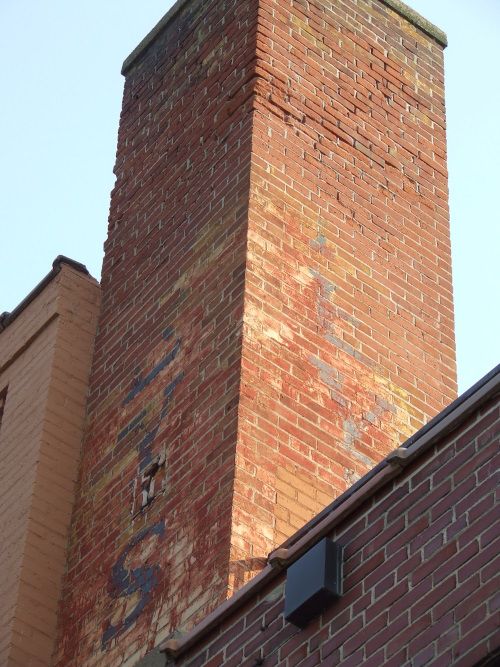
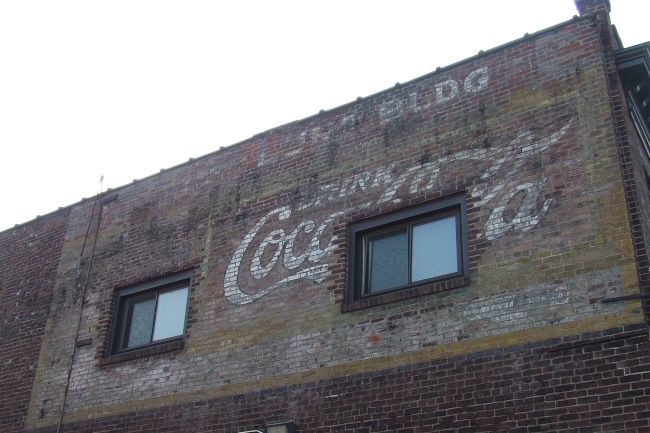
I also encountered some nice ghost signs on my stroll.

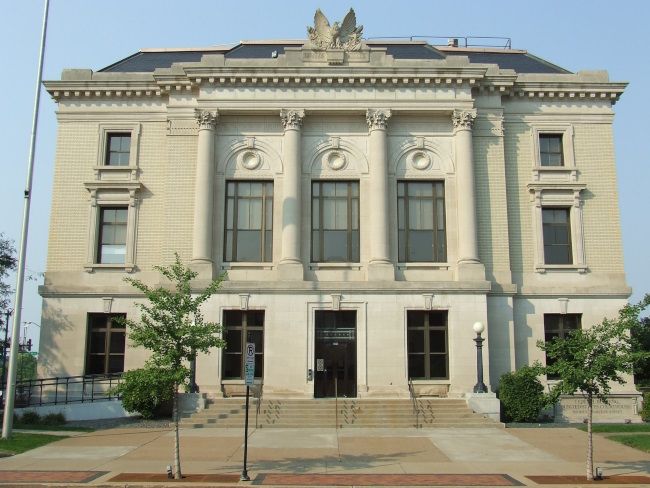
I forgot that there was a federal courthouse in Eau Claire. It was built in a neoclassical style and has a lovely eagle frieze. At least I think that’s a frieze.

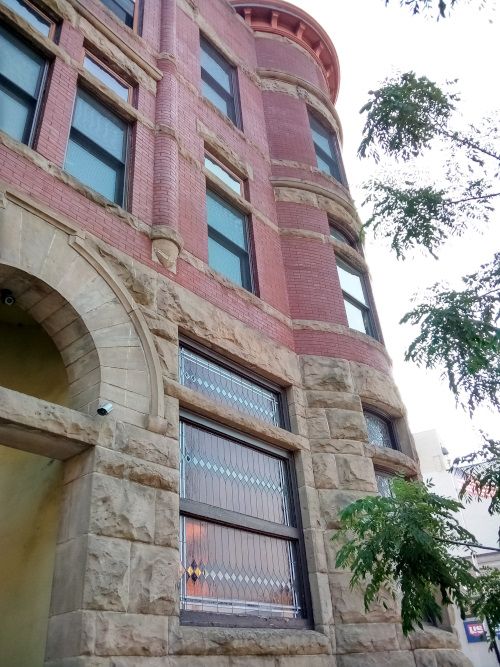
I ran into a beautiful old building that didn’t seem to have a name but a plaque noted it was on the National Register of Historic Places. Lovely stained glass. This place was surely around back in the 19th century when Eau Claire had just earned its nickname of "Sawdust City" because of all the lumber mills that called it home.

Something new to me was all of the statues that littered the downtown streets. Here is “Rachel Weeping”.


From my height, the whole weeping thing wasn’t apparent. However, when I looked at the face, I could see the despair in her eyes.

Was this a representation of the Biblical Rachel, wife of Jacob?

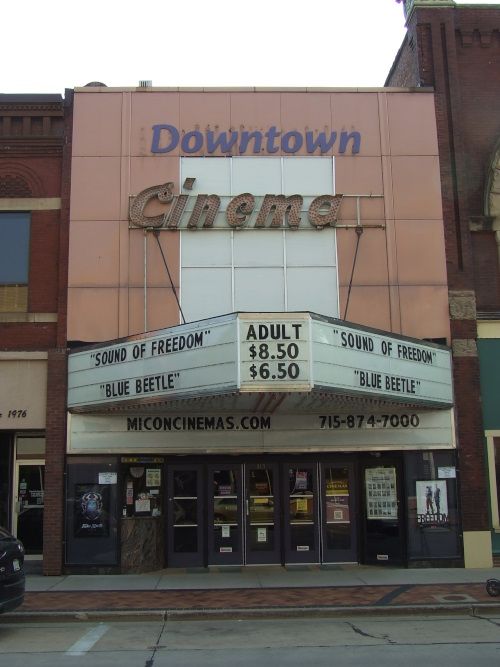
I walked by this cinema and recalled going to see Stanley Kubrick's Full Metal Jacket there shortly after it came out in June 1987.

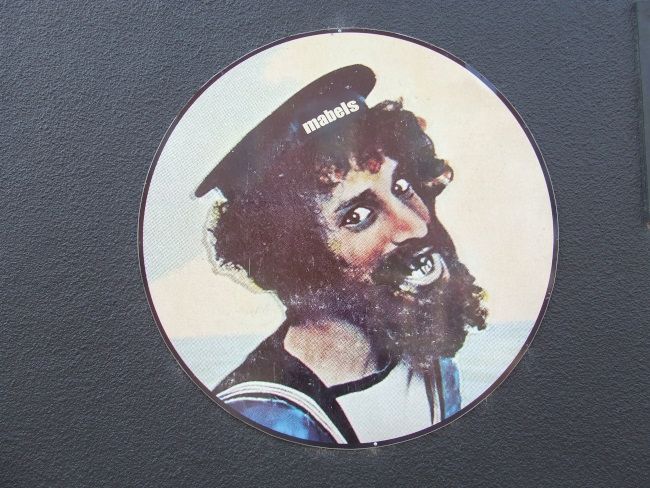
I saw this picture on the side of Mabels which appeared to be an antique store. 

It looks like Elliot Gould as a maniacal merchant marine who's been at sea just a bit too long and has been touched by Neptune himself.

Eau Claire seems to be doing well. It's probably not too much of an exaggeration to say it's the Madison of the northern part of the state. Unlike most cities here in Wisconsin, it is experiencing population growth. A small, but thriving, tech sector and lots of medical jobs means there's some good money around. Fields are becoming housing developments and the usual signs of gentrification, such as coffeeshops and public art, abound.

It's home to a state university, an indie pop band of some renown - Bon Iver, and I would guess that its relatively close proximity to the Twin Cities means an influx of Minnesotans looking for a smaller urban environment. It was nice to see Hmong culture out in the open. As an immigrant group in the late 80s, they mainly kept to themselves and were viewed with suspicion. Large families crowded into small apartments and locals cracked jokes about having their family pets become a meal for some Hmong family. Now they seem part of the city's fabric along with the Yankee and Scandinavian types.

I cannot claim that Eau Claire came across as being very cosmopolitan, though it certainly felt more so than when I lived in the area. To my mind, it had shed some of that big small town vibe. For example, there were taverns and restaurants that seemed to appeal more to city dwellers of some means instead of good ol' boys seeking excitement in the "big" city. These places were apt to serve trendy craft brews from the local IPA mill, The Brewing Projekt, or Minneapolis' Surly Brewing for a premium instead of Bud Light.

Overall, Eau Claire feels less like a last bastion of nondescript civilization before you are truly "up north" and more of a destination in its own right with its own character.

********

Bonus photo. Here’s our Kentucky coffee tree which the city planted a year or 2 ago. It’s got some dead limbs but also some live ones and I am confident it will survive to adulthood. It is nice to see a tree poking up above our hedgerow once again.

06 March, 2023

The Songs Remain the Same


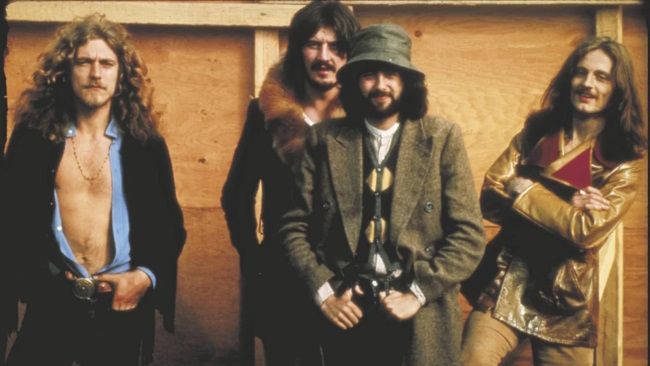
I listened to Led Zeppelin quite a lot when I was a teenager and into my 20s. Nothing unusual here, nothing that countless other young men didn't indulge in as well. At some point, though, I moved on. It wasn't a falling out so much as me just finding lots of other musical rabbit holes to go down. As the years wore on Zeppelin would occasionally return to my musical diet after long periods of absence. A song of theirs might come on the radio or I would just get a hankering to hear one of their tunes.

One sad day I unceremoniously disposed of most of my tapes and records and found myself having to rebuild my music collection. I was in no hurry to buy any Led Zeppelin. At some point or other, I decided it was time to buy some of their albums but found that, in my 30s, I had become less enamored of Robert Plant's wailing and keener on listening to the blues artists that Zep had covered and been influenced by than their interpretations.

But I never lost sight of the fact that the guys were extremely talented and had a body of work that was much more eclectic than riffs and orgasmic moans. Some of their songs remain classics for me and have aged very well. Just like your humble narrator.

One Led Zeppelin song that I still love is "When the Levee Breaks". Yeah, it's a blues cover but it's really a re-working of a country blues song and not just a traditional blues tune put into overdrive with heavier guitars and a faster tempo. This is something altogether different.

I first heard this song when I was about 10 years old and loved it immediately, as I recall. I also remember thinking of it as being quite different from the rest of that album, Led Zeppelin's untitled 4th, a.k.a. - Led Zeppelin IV, a.k.a. - Zoso, a.k.a. - Four Symbols. "When the Levee Breaks" wasn't riff rock and it wasn't acoustic balladry. It was...just hypnotizing.


It opens with what is probably the most famous drum line in all of rock history. John Bonham's bass drum is drenched in reverb and right up front pounding away while his snare has a that great woody pop to it. The drums echo just enough to be readily noticeable and give the listener a sense that there's simply something different about them but not done with too heavy a hand to make them sound thoroughly unnatural.

Then harmonica, bass, and guitar come in. The guitar has a rather clean sound - no big fuzzy chords. It churns away in the background instead of being the main melodic component that your ears grasp onto immediately. The original version of the song by Memphis Minnie and Kansas Joe McCoy is a rather bouncy country blues. But Led Zeppelin transform it into a sludgy, raga-like epic.

There are no typical Jimmy Page guitar solos. In their stead we get breaks of distorted slide guitar that pay homage to the blues but don't really sound like it. The song just sounds dark and slightly surreal. If Jimi Hendrix took the blues into outer space and gave them a crazy, psychedelic sheen, then Zeppelin take them underground here, rolling them in the raw earth. That catchy drum beat and the jangly, churning guitar just don't stop and draw you in until you're lost in their rhythm.

Sometimes the guitar is clean, other times it has a wooshy effect - tape flanging, apparently. I've also heard that the tape was slowed down just a bit so the whole song steps down in key and, if you compare the released version to versions of the song that are more works-in-progress and not so adulturated, the instruments kind of meld into one another as in an alchemical blending of base elements.

No one element sticks out here with the others playing support roles like in other Zep songs where things seem to built around a guitar riff. This song feel orchestrated with everyone's contributions making a whole greater than its parts.


When I finally did buy a Led Zeppelin CD, it was Led Zeppelin III.

While the album has some classic riffing and more traditional takes on the blues, it's known for being the acoustic album in their catalog. They decamped from the big city (I think) and settled into a cottage in the Welsh countryside and returned to the city with several more acoustic, folky-flavored songs. That's the rock lore, anyway.

Of that bunch of softer songs, "That's the Way" stands out for me.

The gentle strum of an acoustic guitar opens the song but is quickly joined by mandolin to provide a sprightly rhythm that goes up and down with the first part ending on a high note followed by a decent into lower ones. Steel guitar adorns the acoustic instrumentation and adds a dreamy quality to the bucolic scene. Towards the end of the song as it meanders to a close, there's a little bit of a sound played backwards as you can hear delicate whooshes, as if the wind is gently lifting something up into the air. It's subtle, though and doesn't drag you off into some psychedelic landscape like the Stargate sequence in 2001: A Space Odyssey. Rather it's more like when Jessica Chastain's Mrs. O'Brien floats and glides around that big old tree in that scene from The Tree of Life.

Robert Plant eschews the wailing here, for the most part, as he takes a mellower approach to singing some rather impressionistic lyrics that only give glimpses of various scenes. The first verse begins with what appears to be the end of a childhood friendship before quickly zooming out and then in on a young man being ridiculed for having long hair, as one did in 1970. Later there are what seem to be more environmentally conscious lyrics where someone concerned with the state of environment has their concerns shrugged off - "all that lives is born to die".

The song feels like you're sitting by a window as the sun streams in and you look out at the tall grass bending in the wind as the leaves rustle and you let your mind wander, wander down the years to childhood and back up to the present with anxiety over the future. "That's the Way" is just a very pretty song with a hint of the wistful that floats along like a daydream.

Also check out the rough mix. The steel guitar is missing but it has some lovely dulcimer runs that the finished version lacks.

04 January, 2023

A Life in Pictures


Stanley Kubrick is one of my favorite directors and 2001: A Space Odyssey is one of my favorite films of all-time. Seeing it on an UltraScreen wasn't just watching a movie - it was a true cinema experience. I was genuinely filled with awe. It was experiencing the sublime.

Sure, this documentary is brimming with hagiography but there were some good interviews, interesting anecdotes, and I learned about the man and his films. It's always a joy to hear another Kubrick fan talk about his films and get glimpses behind the scenes.

07 March, 2014

Remembering Stanley Kubrick

It's been fifteen years since Stanley Kubrick died. (Where does the time go?) Here's a tribute by one Alexandre Gasulla.


21 April, 2013

WFF '13: Room 237


Being a big Stanley Kubrick fan, I was eager to catch Room 237. As a bonus, director Rodney Ascher was in attendance.

The movie's title refers to one of the rooms in the Overlook Hotel in The Shining which “shines” particularly brightly. It is where Jack and his son Danny both have eldritch paranormal experiences. Room 237 looks at the theories of five fans of the film who find within it supposed “hidden” subtexts and meanings beneath the façade of a story of an author going mad. Jay Weidner sees The Shining as proof that Kubrick shot the footage of the moon landing which given to the public; Bill Blakemore insists that the film's subtext is about the Native American genocide; Geoffrey Cocks agrees that there is a hidden meaning about genocide here but that it's about the Holocaust; and Juli Kearns and John Fell Ryan espouse numerology, subliminal messages, and a lack of veracity in the sets.

For 100+ minutes these people are allowed to expound upon their oddball theories. Weidner sees proof in Apollo 11 sweaters worn by Danny whereas Blakemore describes seeing #10 cans of Calumet baking powder on the shelves of the kitchen's dry goods storeroom and having a revelation about Kubrick's “true” thematic intentions. Fell Ryan sees an inbox taking on phallic meaning. A German typewriter indicates the Holocaust. And on and on and on. Kearns points out inconsistencies in how Kubrick presents the layout of the Overlook – the relative positions of hallways and rooms to one another change in the course of the film. OK, fine. Insignificant but fine. But from these observations she tacks a course into La La Land when she sees a minotaur in a poster of a downhill skier.

Did I mention that this inanity goes on for over 100 minutes? None of these people seem capable of incorporating things like coincidence or the human tendency to see patterns where there are none into their worldview. The exigencies of a film shoot seem to elude them as does the simple notion of human error. Why are cans of baking powder significant whereas cans of ketchup are not? Is that really a minotaur or does a poster at a hotel nestled in snowy mountains which says “SKI” on it actually show someone skiing? Was Stanley Kubrick superhuman or was he fallible like the rest of us and prone to the odd continuity error here and there like basically every other director on the whole planet ever since motion picture film was invented?

That people who hold crazy beliefs is neither new nor extraordinary - witness the white European version of Jesus appearing on toast – but can be enlightening. And so the blame for Room 237 being a bad movie belongs to Ascher and company.

He and his fellow moviemakers decided that we should never see our theorists. They exist solely as disembodied voices who talk over footage from The Shining and are identified by their names appearing on the screen. We learn very little about them as their monologues consist mainly about their ideas and how they came to them. With no voice of reason to contradict these people, they are essentially arguing amongst themselves. The patients are in control of the asylum and hearing one ludicrous exegesis after another is tedious if not painful.

Another point against the movie is that, for parts where footage from The Shining is not appropriate, Ascher and Co. fill them in with footage from other movies or TV shows. It's a nice nod to these media but, unfortunately, all these shots do is literally illustrate the comments of subjects. There's nothing wrong with putting in a clip from Barry Lyndon when one speaker is discussing it but are more akin to the scene where we are hearing from Blakemore and we see one of those anti-littering commercials from the 1970s with a tear trailing down the Indian man's face. I guess one can say using scenes from other movies is some kind of commentary on the power of the movies but here it feels more like Ascher had nothing to say and needed to fill screentime.

I guess that's the main problem with Room 237 - Ascher didn't really have much to say. What does the fact that people hold such crazy ideas have to say about human psychology? Not interested. That finding “clues” in The Shining and having anyone but the friends of Blackmore, etc. know about these crackpot ideas are largely a function of DVD players and the Internet could be a jumping off point for looking at the role of technology in our world but, again, Ascher isn't interested. What about the relationship between filmmakers & their films and fandom? Ascher need not give any definitive answers but all he did here was create a movie that is the webpages of these people writ large when one can do that on the Internet. Room 237 is more freak show than documentary.