04 June, 2013

Goodbye Sixie: Spiral Scratch by Gary Russell


Being a big fan of the Sixth Doctor I approached Spiral Scratch with some anxiety. Yes, Sixie deserved to have a proper regeneration story but this was the end of the road for the Sixth Doctor PDAs. How would this farewell story hold up?

As with Instruments of Darkness Gary Russell devotes the opening chapters of the book to introducing a bevy of characters. First there are two alien children who find themselves in the medieval village of Wulpit. Then in Cold War Bucharest Prof. Joseph Tungard and his wife find themselves exiled to England after Joseph dares to go against the Romanian government. Over in England Sir Bertrand Lamprey loses his home and wife to a fire while in a different England two parents visit their daughter's grave.

For his part The Doctor gets it in his head to go visit his old friend Prof. Rummus who runs the Library of Carsus. But he and Mel both have surreal moments. Mel is in the console room when it plays host to various alternate Doctors and Mels including one incarnation of our hero clad in all black with a scar across one eye. This coterie of Time Lords act a bit like The Doctors in "The Five Doctors" as they try to put their heads together to puzzle things out but the new ones disappear before any answers are arrived at. The "real" Mel is left wondering who or what the Lamprey the other Doctors mentioned is. The "real" Doctor also had a strange encounter and is convinced that they must go to Carsus.

There they meet Rummus and experience more timey-wimey events including, disturbingly, the dead bodies of Rummus and The Doctor. With people's timelines running amok, Rummus and The Doctor postulate that the Vortex Spiral has been scratched and that something needs to be done pronto.

At this point I was completely enthralled with Spiral Scratch. Several characters have been introduced and time has gone all non-linear with alternate versions of the characters wandering into scenes, offering tantalizing clues, and then disappearing. Unfortunately, Russell can't keep the momentum going.

It turns out that Rummus stole an ancient Gallifreyan device called the Spiral Chamber and has used it to study the Lamprey, an inhabitant of the Vortex endowed with a voracious appetite for time. Rummus unknowingly allowed the Lamprey to cross from the Vortex into our reality and it is now running roughshod over everything and everyone, merrily eating timelines as it goes. This in itself is a fine story idea but the Lamprey – this eldritch creature from the Vortex which threatens the whole of reality – actually looks like a lamprey. Furthermore, while it's genuinely fun to read about The Doctor, Mel, and their various alternate incarnations running around in different time streams, the subsidiary characters just never quite gel for me. There's too much going on for the story to give them their due and they're just not that interesting.

It's not that they're horrible characters, but rather that Rummus and his relationship to The Doctor would have been more interesting to explore. He's not just some scientist meddling in areas which he shouldn't, he's a friend of The Doctor's who sets in motions events which could destroy everything. I'd much rather have had a more intimate story exploring the dynamic between these two as well as the Library on Carsus. It is billed as the largest repository of knowledge in the universe – what an interesting place! - and certainly could have been a wonderful jumping off point for investigation but instead is used sparingly.

I wish that Russell had narrowed the scope of the story a bit to include less characters and less worlds. There are some amusing moments but a bit here and a bit there in alternate timelines and other worlds just feels unsatisfying. It's like Russell dragged these places into the story more to broaden it and give it an epic feel than anything else. The alternate versions of The Doctor and Mel are a clever device here and I think it would have been more interesting to have them appearing leaving behind a tantalizing clue before disappearing throughout the story rather than being more fully-realized as they are here.

The setup in Spiral Scratch was great but the execution gets bogged down with too many people that aren't particularly interesting. To give Russell his due, the regeneration scene at the end was done well and leads directly into "Time and the Rani" with the Rani saying, “Leave the girl, it’s the man I want...”

Revenge of the Smythe: Instruments of Darkness by Gary Russell


Instruments of Darkness is the final book of a trilogy that began with The Scales of Injustice, which I haven't read, and continued with Business Unusual, the story which introduced Mel. I found the latter to be fun but it was a pretty standard DW story. Thusly I was rather surprised by this one which veered into territory that the New Series treads.

Russell opens his tale with a series of vignettes introducing us to various characters. We begin with a rather mysteriously with an albino and a blue light appearing at various points in the past with women being abducted each time. Finally in 1972 a "shadow man" steals away with a woman named Lori who, he proclaims, is his Ini-Ma. We also meet the aging Vice-Marshal Dickinson whose son disappeared while working for UNIT. Plus there's Captain Therese Gavalle whose mind is taken over by an alien.

The story moves into the present. Over in the village of Halcham the reclusive Sebastian Malvern provides shelter for the infamous Irish twins, Cellian and Ciara as well as a trio of teens who survived the nightmare of SenéNet in Business Unusual. Meanwhile in Park Gavalle responds to an anonymous invitation and finds herself in the employ of the Network, a secret organization that is a front for another secret organization bent on perpetrating evil and harnesses the power of psychics to do so. Trey Korte also returns here. He's been using his psychic abilities on behalf of UNIT and its doppelgänger C19. DI Bob Lines also makes an appearance here. He uses a beacon to signal The Doctor after Trey is abducted from a hospital.

Whew! That's a lot of characters and plot strands.

Luckily Russell is up to the task of bringing them all together. But what surprised me was that he brought Evelyn Smythe into the fold. She was a companion from the Doctor Who audio dramas from Big Finish. The Doctor and Mel meet up with her and it is revealed that The Doctor dropped Evelyn off on Earth to keep an eye out for the Irish Twins but that he did so without giving her any material support and left her there several earlier than he intended to. Unsurprisingly, Evelyn is angry. This leads to some wonderful prose delving into the relationship between The Doctor and his companions. Of her The Doctor says:

"But Evelyn... Evelyn was different. For the first time in some years, I met someone who was, well, an equal. Evelyn didn’t need rescuing too often – I can remember one or two ferocious creatures that needed rescuing from her. She used her brains, her wit and experience to get out of any real trouble and we faced things together. She’d had a lot of life experience you see – she was divorced, she had spent most of her life dealing with younger people, her students. Nothing fazed her.’ He laughed. ‘She even held her own against an entire Dalek army once. We read the same books, laughed at the same jokes. There was an unspoken respect and equality between us, I suppose."

Upon hearing this Mel begins to see The Doctor in a new light, one in which his bluster covers over "a very basic sadness". Perhaps The Doctor not only cared for Evelyn but cared about her as well.

The new series episode "School Reunion" comes to mind and I suppose that basic sadness is really a general theme of the New Series – last of the Time Lords and all that. Russell worked on the New Series although I'm not sure how much of this was his doing. What I like here is that this look into The Doctor's psyche comes courtesy of Sixie with all his outrage instead of the younger, hipper David Tennant. Moral indignation was such a defining characteristic of Colin Baker's Doctor that a look underneath the bluster and the chance that he had done wrong by Evelyn has more impact for me than what the New Series did. (Of course, I say this despite Sixie admitting to having misjudged Lytton in "Attack of the Cybermen".) That the Irish Twins are seeking redemption here adds another layer to the emotional core of the story and perhaps parallels The Doctor's movitivations.

All in all Instruments of Darkness was a fine PDA. The highlight is surely The Doctor and Evelyn's relationship laid bare but it's a fine adventure tale as well.

23 May, 2013

New Glarus Turns 20 and Auf Wiedersehen Joe

Has it really been almost 20 years since I started drinking New Glarus? I recall buying a six-pack of Edel Pils as soon as it was available in Madison.

Robin Shepard has a lengthy piece on New Glarus Brewing. He reviews the brewery's history and notes the release of its 20th Anniversary Ale, a take on the Belgian Dubbel.

New Glarus 20th Anniversary Ale is a robust and flavorful beer made with a combination of American, English and Belgian malts; American and German Hops; and a touch of Belgian candi sugar. Single 20-ounce bottles go for around $9 each. "This is a strong beer, one you'll want to share," adds Dan. It's also a beer that's best served warmer than refrigerator temperatures to bring out its rich sweet plumb and chocolate-y flavors.

Some new labels from Leinenkugel:


The Big Eddy Über Oktoberfest will be a hefty 8.5% ABV and also dry-hopped. Release date is late August. The Big Eddy Ryewine (photo grabbed from this page) sounds very tasty as I love rye. It will be 10% ABV. I am hoping that it is being released next month so that it can age in the cellar and that Leinenkugel isn't actually expecting anyone to drink this stuff during the summer. Lastly, that Bernie's Barrelman Ale is a new beer to be available only at Miller Park. Sounds like a pale ale. Hopheads will be happy to hear that it has Cascade hops in it.

Kirby has brewed an American IPA.


It's available at all four Madison-area Great Dane locations. The Wisconsin Brewing Company is looking for comments on it and, if I ever get around to trying it, I will be happy to give commentary.

Scott Manning of Vintage Brewing was on TV recently sporting his fancy brewing overalls and hogging the camera as his assistant toiled in the background. He brewed his Rhine Heights Kölsch earlier this week and I am looking forward to it.


Lastly, a fond farewell to Joe Walts who is leaving Ale Asylum – indeed, leaving Wisconsin – to become brewmaster at Narrows Brewing in Tacoma, Washington. I am purposely keeping the DVDs he lent me so I have an excuse to go west and barge into the brewhouse once it's up and running. No one has ever taught me more about water softness than Joe. Best of luck to him and his family. Now who will I homebrew a dunkles with?

Hitting the Books: Well Read Temptress from Pipeworks


Well, we had a brief spell of warm weather before spring asserted itself again. Luckily I managed to get in some more Berliner Weisse drinking before the chill and rain took over. Earlier this month it was Blue Lady. This time we have Well Read Temptress, another Berliner Weisse from Chicago's Pipeworks. Often times folks add Waldmeister (woodruff) or Himbeere (raspberry) syrup to Berliner Weisse but here the beer has been aged on fresh raspberries which adds a nice twist.

Temptress pours cloudy just like its blue sister and is a pretty light pinkish red. I got some nice foam atop it all but the stuff dissipated fairly quickly. There weren't a lot of bubbles visible in the glass which is very deceiving. The beer smells like summer. Its heavenly aroma has fresh raspberries first and foremost followed by a bit of the sourness.

Like the aroma, raspberries are the first thing you taste. My big complaint with Blue Lady was that the blueberry flavor wasn't prominent enough and I'm happy to report that Well Read Temptress doesn't suffer this same fate. The raspberry is more plentiful here though not overpowering. It shares your tongue with the lemony tartness well. The lactic acid provides just the right amount of tartness for me. You can't miss it but it is also not going to make you pucker so much that you permanently distort your face. And as with Blue Lady, breathing in while drinking enhances the berry flavor. The mouthfeel is light and, while you can't see much in the way of bubbles, you can certainly taste the carbonation. It finishes with a smooth, lingering sourness.

I adore Well Read Temptress. It was nice to taste that Pipeworks got the perfect amount of raspberry into this beer to balance the tartness. It is 4% ABV which is quite sessionable and is wonderfully refreshing.

Junk food pairing: Go with sour cream and cheddar kartoffelchips.

16 May, 2013

Willkommen in Madison Sushi Express

I see that Sushi Express has opened where Big Red's used to be on the 600 block of University Avenue. They even deliver.

As I walked by I thought about how prevalent sushi is. At what point does does a non-American "ethnic" food become American? At some point hot dogs, being of Germanic origin, became standard American fare. I stopped at a Freiderick's Family Restaurant in Fennimore earlier this week and there was an all you can eat taco bar. Tacos are American now too.

I suspect that sushi has some time yet before it becomes as American as hot dogs and tacos but it's getting there. It is no longer considered to be some exotic Japanese dish. Grocery stores sell sushi and I suspect it won't be long before PDQ and 7-Eleven start doing so if they haven't already.

Slate Publishes Screed Against American Hop Fetish

Adrienne So critiques hopheads up at Slate with an article called "Against Hoppy Beer". The thrust of the article is thus:

That’s when I realized that I had a problem. In fact, everyone I know in the craft beer industry has a problem: We’re so addicted to hops that we don’t even notice them anymore.

...

Craft brewers’ obsession with hops has overshadowed so many other wonderful aspects of beer.

No doubt hopheads at Beer Advocate have their knickers in a twist now. While not the perfect plea for more/different diversity in the craft beer world, I am happy to see overly hoppy beers get knocked in the press.

Cultural Conformity in Madison?

Is Madison a bastion of cultural conformity?

On the surface, Madison has many progressive aspects. Sustainability and the “greening of the city” stand front and foremost as two easily recognized. Curbside recycling and composting, increasing investment in bicycle transportation, native gardening, and urban farming. There is an intense concentration of a wide range of alternative health practitioners. Artisan craftspeople abound, creating specialty foods and other handcrafted products. “Shop local” is the resounding cry to support small businesses, and farmers markets adorn every neighborhood in the summertime.

Idyllic as this sounds, there is a less appealing aspect to this picture. As Madison concentrates is cultural practices into a few baskets, the proliferation of other ideas diminishes. Ten years ago I would have characterized Madison as a place that had progressive perspectives. Now I would characterize Madison as a place with few ideas, all perpetually reinforced and more deeply ingrained every day. People regurgitate a handful of versions of the same thoughts in ever narrowing expressions. Everywhere you look it is repetition of the same ideas, whether it be on politics, design, or social culture. People strive to look the same, to dress the same, and to have the same lifestyle. It is so pervasive, that women within a 30 to 40 year age range may display similar choices in hair, dress, and accessories. What began as a city with progressive and forward looking ideas to develop a new urban course has become a closed container of cultural conformity. There is a new cookie cutter in Madison, and it is young, alterna-hip, and white.

Truth be told, this is a quote from an article called "Leaving Portlandia" and I swapped out every instance of "Portland" and replaced it with "Madison". But does it still apply here?

I've never been to Portland so I cannot vouch for the accuracy of the article but I do think there is a sense of homogeneity here in Madison. Words like white, middle-class, locally sourced, Democratic, and indie rock seem applicable to Madison whereas words such as multiracial, blue-collar, diverse, and hip-hop seem less so.

Rolling Out the Summer Brews - 5 Lizard by 5 Rabbit


With the weather finally moving into summer territory I thought the time was right for some 5 Lizard, a Latin-style witbier by Chicago's 5 Rabbit. I first time I had it was at The Great Taste of the Midwest a year or two ago and loved it on that 80+ degree day. A fantastic summer brew. The witbier is a Belgian wheat beer commonly spiced with coriander and bitter orange peel. Here the folks at 5 Rabbit replace the orange with lime and give it a tropical twist with the addition of passion fruit.

5 Lizard poured a hazy yellow and had a nice, frothy white head. (I believe both of these characteristics are due to the wheat.) The glass really glowed in the sun on my porch. It was well carbonated too. Upon smelling it, my nose was struck by the passion fruit first and foremost but there was also a slight bit of herbal hoppiness in there.

The beer has a light and bubbly mouthfeel along with a lovely creaminess on the tongue which I think it owes to the oats in the grain bill. The passion fruit is prominent here with its succulent sweet and sour flavor cozying up to your tastebuds. The tanginess of the lime was also present making this a very fruit forward beer with the carbonation accenting these flavors. While fainter, the coriander was unmistakable. To top things off there was also some graininess present that was vaguely sweet. That's a lot of flavors to juggle and 5 Lizard pulls it off well. The fruitiness dominates, to be sure, but the other flavors don't let it run away with the show. Everything balances out in the end.

The brewery states that 5 Lizard has Motueka hops in it which I discovered to be a variety from New Zealand that has a citrus/tropical fruit flavor and a Noble hop aroma. While I caught the aroma, I'm not sure about the flavor. I didn't find it hoppy; then again, this is probably the first and only beer using Motueka that I've ever had and was expecting more of the Noble flavor since it was in the aroma. More fool me.

The finish is smooth with the lime zestiness and more passion fruit goodness that lingers for a short time.

I have to admit that I liked 5 Lizard even more than when I had it at The Great Taste. My tongue hadn't been battered with a dozen other brews when I had it this go round like it had been at the festival. It is light and smooth plus it has a delightful myriad of flavors that balance well. At 4.3% ABV this beer is quite sessionable and incredibly refreshing.

Junk food pairing: 5 Lizard pairs well with friend plantain chips.

15 May, 2013

Crafting a Nation One Beer at a Time Coming to Madison

Another trailer but this time it's about beer. Crafting a Nation One Beer at a Time is a new documentary that profiles various craft brewers. I recognize Jim Koch and Sam Calagione here but I'm not sure who the others are. The moviemakers really seem to be pushing the notion of craft brewers as blue collar artisans who sacrifice everything for the love of beer with the music here that is some of the most cloying, saccharine stuff ever. Sounds like second rate Townes van Zandt.

It'll be playing at the Barrymore here in Madison next Wednesday night. Tickets are $10

The Congress Trailer

This is the trailer for The Congress, a movie about an aging actress or model who sells her image and then things get all Phildickian. Looks interesting at the very least. It's based (loosely by the sounds of it) on a book by Polish sci-fi author Stanislaw Lem.


Doctor Who: Business Unusual by Gary Russell


I made the mistake of reading Business Unusual at the same time as I was listening to The Wrong Doctors by Big Finish which meant that I was consuming two stories at the same time both of which attempted to explain how Mel ended up traveling with The Doctor. It was confusing for a stretch as I kept thinking about Mel going to a play rehearsal while reading the book and wondering when The Doctor was going to head to SenéNet whilst listening to the audio drama.

Business Unusual begins with the rather gruesome death of Robert McLaughlin at the maw of a mutant dog of some kind which drools green saliva and has green eyes. McLaughlin was a member of C19, a Torchwood-like outfit, and his assignment was to investigate the technology company SenéNet. Next thing we know The Brigadier is doing the same thing. While spared the fate of being eaten by a mutant dog, he is taken prisoner.

Meanwhile The Doctor is helping out the Brighton constabulary by mopping up a mess that The Master had made in their computer system. While out and about he sees Mel from afar and does all he can to avoid her lest she become his traveling companion. If this is allowed to happen, he would move ever closer towards his own fate as The Valeyard. Time has a way of smoothing out changes made to it and of course our hero ends up meeting Mel. The Doctor runs into Trey Korte, an exchange student staying with Mel's family. Trey has some latent psychic powers which are discovered by the villains and this catches the attention of The Doctor. He is unable to avoid Mel at this point.

Together they take on SenéNet which is headed by a man named Townsend. He has stolen various bits of alien technology from C19 and appropriating them for his own ends. He had previously augmented his body with that technology but it is now showing its age and he seeks to upgrade his mortal coil. In Townsend's employ are the Irish twins Cellian and Ciara. I read afterwards that all three appeared in Russell's The Scales of Injustice, a Third Doctor novel but, not having read it, I cannot judge how well or interesting these characters develop.

The story here is reminiscent of The Green Death with the mysterious corporation and its equally mysterious CEO. But what makes Business Unusual different is how Russell gets into the heads of the supporting cast. Erskine is a former member of UNIT under Lethbridge-Stewart who was left for dead in one of the group's battles with invading aliens. As he seeks revenge against those who abandoned him and took his life away, The Brigadier contemplates the responsibilities of his job as well as the drastic consequences his decisions have at the human level. Cellian and Ciara had their minds manipulated by Townsend and are ruthless killers for most of the book but they eventually find what's left of their humanity.

In the books introduction Russell notes that he wanted to write a story that he "thought Colin Baker would have liked to be in". To this end I think he was mostly successful. While Mel and The Doctor bicker at first, they do settle in fairly quickly and develop a warm relationship. This is the kinder, gentler Doctor we saw in The Mysterious Planet and later in the Big Finish audios. His gaudy attire is remarked upon more than once plus it is revealed that he's a Pink Floyd fan:

Alan switched on the car stereo system, which included a CD player, and Mel automatically selected her father’s favourite Pink Floyd album.
‘Ah, Piper,’ murmured the Doctor. ‘Syd’s greatest hour.’

There is, however, a scene out of character for The Doctor. Part of Townsend's plan has a couple dozen or so kids turned into zombies attached to computers. In one scene as his scheme is being foiled by The Doctor, our hero seems to care little about their horrible fate. Indeed, other children also have horrendous things happen to them which Russell describes in heartbreaking detail.

A lot of Business Unusual is boilerplate Doctor Who but it is a very fun story. The Doctor-Brigadier combination was nice but it they are separated for most of the book so it was a bit of a letdown. What sets it apart is the way Russell treats the minor characters and gets into their heads and fleshes out their motivations and has them gradually change.

Ayn Rand Would Be Proud

Rich folks hire handicapped people so their rich kids can get into Disney World rides sooner.

They are 1 percenters who are 100 percent despicable.

Some wealthy Manhattan moms have figured out a way to cut the long lines at Disney World — by hiring disabled people to pose as family members so they and their kids can jump to the front, The Post has learned.

Rich moms shamelessly hire disabled tour guides so their kids can cut long lines.

The “black-market Disney guides” run $130 an hour, or $1,040 for an eight-hour day.

“My daughter waited one minute to get on ‘It’s a Small World’ — the other kids had to wait 2 1/2 hours,” crowed one mom, who hired a disabled guide through Dream Tours Florida.
Dr. Wednesday Martin, social anthropologist who discovered scheme.

“You can’t go to Disney without a tour concierge,’’ she sniffed. “This is how the 1 percent does Disney.”

The woman said she hired a Dream Tours guide to escort her, her husband and their 1-year-old son and 5-year-old daughter through the park in a motorized scooter with a “handicapped” sign on it. The group was sent straight to an auxiliary entrance at the front of each attraction.

13 May, 2013

Gravity Trailer

Alfonso Cuarón finally returns with Gravity. Sandra Bullock and George Clooney star as two astronauts who survive the destruction of their space shuttle and are trapped in orbit. Presumably gravity gets a hold of them and they are slowly pulled towards the Earth. Emmanuel Lubezki is the DP here. He shot Children of Men for Cuarón and he's been Terrence Malick's cinematographer since 2005 so it should be pretty.

I am not sure I can watch this much less on 3D IMAX. I'd probably get vertigo.


Brat und Brau Returns to Madison

Brat und Brau opened in Madison in 1969 moved to Mazomanie at some point but is now returning to Madison. It will be in the Northside TownCenter on north Sherman Avenue in the spot former occupied by Hamann Charcuterie.

Here's what Nichole and JM had to say about their former iteration.

07 May, 2013

To the Wonder Delayed

A few weeks ago Terrence Malick's latest movie, To the Wonder was scheduled to open here in Madison at Sundance this month. The film's website now lists a 22 August date at the UW Cinematheque. What happened?

Not to demean Cinematheque, because they are a great organization, but a week-long run would be really nice. Contra Rob Thomas, not everyone who wants to see it will be able to make it. Plus it's a Malick film. The bigger the screen, the better.

03 May, 2013

Introducing a New Hop Variety. Sort of. Beck's Sapphire

I had a Beck's for the first time in ages a few months ago. It was my first since the conglomerate formerly known as Budweiser started brewing it in St. Louis. (Was the stuff for the U.S. market brewed in Germany prior to this?) I thought that it, like pretty much everything the conglomerate formerly known as Budweiser brews was watery. It certainly had more flavor than Bud but less than I remembered it having.

I thought about this when I heard that Beck's was introducing a beer brewed with a new(ish) variety of German hops called Saphir. I read that it was released in 2002 and is related to Hallertau but has more of a sweet, fruity, citrus-tangerine thing going for it. The hops sounded interesting so I thought I'd brave the waters of Beck's and give it a try.


Things started out promisingly enough as it poured a dark straw color which was a stark contrast to the sleek black bottle. It was clear and filled with bubbles running up. The aroma was good too. It had that nice biscuity smell that's common to pale lagers but there was also a very sweet scent which was partly bready and partly fruity. To my nose the latter was like strawberries. Lurking in the background was a spicy hops scent – what I'd expect from Noble hop, Saphir's ancestors.

The taste had some of the elements you'd expect from a lager like this; it was light on the tongue and had the aforementioned biscuit flavor. But it wasn't crisp and clean. There was this dull, mellow sweetness present that kind of tasted like the strawberries in the aroma. Very odd. Even odder was that, considering this beer was supposed to be featuring a new variety of hops, I really couldn't taste them. Unless, of course, that whole strawberry thing was Saphir fooling me. I certainly could not taste anything akin to tangerine or citrus generally.

Sapphire finished moderately dry and with some mild hop bitterness of the spicy kind.

This isn't an ungodly awful beer but it's certainly not good. I am left wondering where the crisp, clean lager qualities went and why I still have no idea what Saphir hops taste like. I thought the German Hüll melon hop variety was supposed to have strawberry nuances, not Saphir.

Junk food pairing: Japanese rice cracker snack mix but the stuff that has wasabi peas in it.

01 May, 2013

"Madison is a reality distortion field"

So says Joe the Planner. He was here a couple years ago when the Congress for New Urbanism had their annual soiree and wrote about what he found. His post is a couple of years old but interesting. In it he writes about the Capitol Square as a place of civic and commercial engagement.

So, finally, here is the disclaimer: Madison is a reality distortion field. Yes, the conditions that undergird much of that city's success can't be duplicated in most other places. However, that success wasn't divinely ordained, either. Their reality is simply the cumulative product of the choices and sustained efforts of Madison's leaders and citizens. They've intentionally created a city for people, not cars. This is clearly reflected in the design of their streets and public spaces, which is the focus of this piece—and why Madison was an obvious choice of venue for the CNU.

Blue Lady, A Berliner Weisse from Pipeworks


I bought this bottle last autumn and have been saving it for a warm day. Little did I know that it would take until the last day of April for the appropriate weather. (And we'll be reverting back to bock weather shortly.) Chicago's Pipeworks Brewing Company has been gaining a good reputation with IPAs that have "ninja" and "unicorn" in the name but what attracted me is the fact that they have brewed four varieties of Berliner Weisse. In this case, we have one that was aged on fresh blueberries.

Berliner Weisse is a sour wheat bier that is top-fermented and seems to come from a family of Northern German beers which also includes Gose, the grätzer/grodziskie, and Lichtenhainer. As lagering became trendy and Bavaria's Reinheitsgebot became the law of the new country called Germany, these styles either died out or hung onto their dear lives by a thread. Berliner Weisse, then, is something of a relic of the days before the pils became ubiquitous and I've read that there were hundreds of breweries making Berliner Weisse in Berlin at one time.

Blue Lady is a very pretty beer. It's a light purple with a distinct reddish tint and is hazy. She is well-carbonated with lots of big bubbles giving a large head that dissipates quickly. Pouring it sounded like pouring soda or champagne with that loud fizzy sound. And the aroma was marvelous as well. The bright sourness came first but found some balance with sweet blueberries.

As you would expect, the lactic acid really comes through on the palate. It is very sour at first but mellows a bit to a lemony tartness. The Berliner Weisse used to naturally pick up brettanymyces back in the day but there's no hint of a wet blanket here. Disappointingly, the blueberry is very much in the background where it mixes with a floral flavor. I wasn't expecting Blue Lady to be sweet as when you serve a Berliner Weisse mit Schuss - with a now-traditional shot of Himbeere (raspberry) or Waldmeister (woodruff) syrup, but I was hoping for the berry flavor to be a bit more prominent. I found that it helped to breathe in the aroma while drinking as this brought out the blueberry.

Before having drunk enough of it to neutralize most of my tastebuds, I caught some clove as well as a bit of herbal hoppiness and the beer was moderately dry overall. Blue Lady is 4% ABV which I believe is a bit higher than the Berliner Weisses being brewed in Germany today but it still has a light bubbly mouthfeel. It finishes dry and tangy.

Despite the paucity of blueberry, I very much liked Blue Lady. It has a nice tartness which was augmented by the berry flavor just enough to make things interesting. Plus it was extremely refreshing in yesterday's 85 degree heat. It's too bad that Wisconsin brewers don't brew this style. At least they don't bottle it if they do. The last time a local Berliner Weisse was on store shelves here must have been back in 2008 with New Glarus' take on the style. I thought Blue Lady was just a touch less tart than Dan Carey's brew.

Junk food pairing: Provolone Cheez-Its. The creamy cheese flavor will sit well against the tartness of the beer and the subtle smoke flavor will fool your tongue into thinking you're drinking a Lichtenhainer.

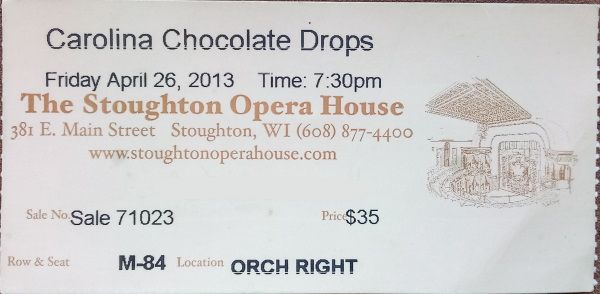
Carolina Chocolate Drops Return to the Stoughton Opera House


It’s basically a given that the Carolina Chocolate Drops will swing through the Madison area at least once a year. Last weekend the band had a two night stand at the Stoughton Opera House and both shows were sold out. They were in fine form when I caught them on Friday night.

What started as an attempt to keep the Piedmont musical legacy of fiddler Joe Thompson alive has turned into a musical outfit of great prowess extolling the joy of whatever music catches the band’s fancy. The line-up has solidified with founding members Rhiannon Giddens and Dom Flemons joined by newcomers Hubby Jenkins and Leyla McCalla, although the latter pair have been part of the band for a couple years or thereabouts.

The night began with a spirited performance of “Black Annie”, a piece learned from Thompson, and continued with the old bluegrass tune “Don’t Get Trouble in Your Mind”, one of the band’s signature songs, which invited audience participation. The members of CCD all excavate the histories of folk music so you don’t have to and they love to report on what they’ve found. For instance, Giddens brought out a replica of a 19th century banjo for the medley of “Briggs’ Corn Shucking Jig/Camptown Hornpipe” and launched into a mini-lecture about how the banjo was originally an African-American instrument, black face minstrel shows, etc.

Much of the set was familiar, having been performed in their Madison-area shows previously. In addition to “Don’t Get Trouble in Your Mind”, songs like “Goin’ Down the Road Feeling Bad”, Johnny Cash’s “Jackson”, and “Sourwood Mountain” proved their mettle as reliable crowd pleasers. On the other hand, former stalwarts “Cornbread and Butterbeans” and “Hit ‘em Up Style” were absent. But in their place were some tunes that were new to Madison audiences. Flemons stepped out on Gus Cannon’s “My Money Never Runs Out” and Tampa Red’s “Got It Fixed” while Giddens once again demonstrated her tremendous voice with the doleful “Julie”, a song she wrote after having read a true tale from the Civil War. And Hubby Jenkins added “Buck Creek Girl” to the mix.

McCalla stepped out from behind the cello to do “Rose Marie”, a Haitian song which, like Giddens medley of tunes sung in Gaelic, helped broaden the band’s scope to include more than old-timey Southern folk song. The Chocolate Drops aren’t touring behind a new album but they did include a few songs from their last effort Leaving Eden. “No Man’s Mama” and the title track once again showcased Giddens’ pipes with the latter bringing tears to the eyes of my significant other.

While there were a few genuinely tender moments, CCD shows are mostly light-hearted affairs and Friday night was no different. The audience was invited to dance and sing, Giddens cut a rug, Flemons twirled his guitar, and Jenkins played the bones behind his back. Foot-stompin’ fun and most of the audience left the Opera House knowing more about the history of the banjo than they did coming in.

30 April, 2013

Good Luck With a Schornsteinfeger: Schell's Chimney Sweep

I tend to think of Schell's as the Leinenkugel's or Point of Minnesota. A regional brewery that's been around since the mid-19th century and produces craft-lite brews. When I say "craft-lite" I mean they brew much less beer than Miller-Coors and styles beyond American pale lagers which are, to my taste, watery. It's like they try to sit on the fence by brewing something that has a good flavor but not a whole lot of it lest they offend the palates of people who think Grain Belt full-on gustatory assault. I think that this impression was fostered by having read reviews and by sampling the odd beer of theirs at the Great Taste of the Midwest. But recently I've read more about them and became intrigued. So I thought I'd give some of their beers a try and give Schell's a chance to set things right with my palate. The Gose-inspired Goosetown was disappointing in that it deviated from style greatly but was eminently drinkable. Next up is Chimney Sweep.


Chimney Sweep, the brewery's winter seasonal, is a dunkles rauch (or is it a schwarzbier?) - a dark lager with some smoked malt in the grain bill. I love dark lagers. I love rauchbiers. I had to try this stuff.

It's a lovely beer with a deep reddish brown color. If you look at it in the narrow part of a glass, it appears clear and you can see that the carbonation is high. My glass got a big head but some of that is surely due to my hasty pour. (I was thirsty.) I also got some nice Schaumhaftvermoegen.

When I took a whiff I immediately smelled a honey-like sweetness. Considering that caramel popcorn was being made at the time, I am unsure how much of the aroma was from the beer and how much came from the oven. There was also that wonderful, magical smell of roasted grain which makes the dunkles the beer style of champions.

The taste of Chimney Sweep is the aroma inverted. With a medium mouthfeel, the roasted barley's coffee overtones were highlighted, though the lighter malts were present as well and, to my delight, this was no watered-down dunkles. The flavor was full and clean as a good lager should be. Underneath this was some smokiness as promised. It complemented the malt very well instead of competing for domination. If you're familiar with Karben4's Nightcall porter, then I'd say the smoke flavor here is about 50% more than in that brew. While more distinctive in Chimney Sweep, we are still nowhere near Schlenkerla territory. It simply added a little smoky sweetness to balance the slightly bitter roasted goodness. As the end of my sip neared, I could taste a hint of a plum sweetness which I find to be more prominent in Hofbräu Dunkel and, I find, makes that bier highly distinctive (and incredibly tasty). The finish is on the dry side and some mild hop bitterness comes through here as well.

I was really taken by surprise by how good Chimney Sweep was. It is a clean balancing act of darker malts, lighter bread-like malts, smoke, some fruity sweetness, and hop bitterness. It's 5.2% ABV which means you can enjoy a few at a session. A great beer.

Junk food pairing: Chimney Sweep goes well with Old Dutch Onion & Garlic potato chips.

29 April, 2013

Alive in the Superunknown: Upstream Color


I recall having a very fun conversation with my friend Aaron in which we tried to make sense of Shane Carruth's time travel parable Primer and thusly I was happy to hear that Carruth had final come up with a follow-up, Upstream Color. Here he has a larger budget but hasn't moved towards the mainstream or made a film which is in any way easy to decipher.

The film's first act follows a character only known as Thief. He cultivates plants which have a certain worm or grub that lives in the soil with their roots. A couple teenagers experiment with a hastily prepared tincture of the worm and find that it has a weird effect, namely, that it allows for a low-level form of mind control. Thief, on the other hand, goes for bigger prey. He forces a whole worm down the throat of an unsuspecting victim named Kris that he spies at a club. This allows him to have full control over her.

Before getting her to give up her life savings to him, Thief has Kris do seemingly inane activities like transcribing Moby Dick and convinces her that he has a condition which causes his head to be as bright as the sun so that she looks away from him. Once Thief has gotten the money and run, Kris wakes up under his spell no longer, though with no memory of what happened to her. She finds that the worm inside her has grown as it writhes around under her skin and that surgery with a chef's knife is not particularly effective. The cure for this is offered by The Sampler. He has setup shop out in a field with speakers that play a low, rumbling beat which mysteriously draws Kris. He draws the worm out and into a pig.

Kris begins the process of getting her life back together when she meets Jeff on the train. She is understandably cautious about letting Jeff into her life at first. But she takes the plunge and we discover that he too has had an encounter with Thief. Their romance is oddly compelling as these two lost souls try to find themselves as well as courage to find someone else to have in their lives. Scenes consisting of jump cuts where the pair try to sort out their memories, unsure which ones belong to whom are sad and romantic at the same time.

The Sampler, meanwhile, understands the power of the worms. Once removed from a person's body, they take with them memories from their former host or, perhaps, allow him to peer into the recess of the former hosts' minds, places they themselves may not be able to look into. Although this porcine Rube Goldberg contraption of a mind reading system is never fully explained, it seems that the worms respond to sound as he uses various field recordings that he has made to somehow stimulate the worms and allows him to experience the memories of others.

Upstream Color is reminiscent of Eternal Sunshine of the Spotless Mind but is much more abstruse with the Phildickian aspects turned up to eleven. The sci-fi aspects of the plot are never grounded in any kind of internal logic. Thief and The Sampler are not fleshed out with them remaining a thief and a voyeur, respectively. And so the focus is on Kris and Jeff. They see through a glass darkly with their relationship moving in fits and starts. I think that the movie portrayed the nervousness, the fun, and also the sadness of getting to know someone intimately very well. It felt realistic at the face-to-face level while being mired in absurdity when you step back. Perhaps what makes their relationship interesting is that Carruth cuts between Kris & Jeff and scenes of The Sampler & his pig farm. I felt that the mystery of The Sampler and his porcine friends contrasted nicely with the more tender story of two lovers and their search.

While I don't think there is a definitive reading of Upstream Color except in Carruth's head, I do think there are clues I missed which could fill in some holes in my understanding of the plot. For instance, at one point Kris thinks she is pregnant and at the same time the sow that received the worm from her body is revealed to be so. There is some kind of link between former and current hosts. The Sampler kills the piglets by tucking them in a sack and throwing it into a river. He explicitly shows a blue liquid – the worm "essence" - drifting out of their corpses on the bottom of the river. Does The Sampler kill them just because he doesn't want any more pigs? Does this act exert control or influence over Kris? Or is he feeding the eldritch blue orchids which grow along the river and among whose roots the strange worms live? On a second viewing I would also be cognizant of match on action cuts. There were a few and I suspect they aren't there for purely aesthetic reasons.

Upstream Color has a goodly amount of thematic material to chew on. It's about tragedy and finding control over our lives. In the spirit of Blade Runner, I'd say it's also about memories and their role in being human. These are heady topics to be sure but Carruth couches them in a friendly, albeit odd, way which proves to be perfectly suited for pondering.


Berghoff Gets a Makeover, &c

The making of Summit Pilsener. I'm not sure if I've had this stuff or not but will have to try it. I've been drinking Schell lately so it looks like I'm in a Minnesota phase.


I see that Leinenkugel will be releasing an "imperial" - 10% ABV - Oktoberfest this year under the Big Eddy imprimatur.

The most interesting Wisconsin beer news I've heard lately is that the Berghoff brand is getting a makeover. It sounds like they're becoming more craft-like and are moving production from Minhas to Point. Apparently batches at Point will be smaller and so allow more flexibility. I never thought of Berghoff as great beer but I usually have it a few times a year at various summer festivals around Madison when the craft selections are Fat Tire and/or Capital's Island Wheat and Supper Club.

Berghoff will launch seven new brews, led by the seasonal Solstice Wit Beer (5.2% ABV), made with Calamansi juice, an Asian citrus fruit, and spices, it is a refreshing summery beer from a long tradition of unfiltered wheat beers. Perfect for warm weather drinking, Solstice Wit joins Berghoff’s other major year-round labels: Straight Up Hefeweizen (5.2% ABV), a Bavarian hefe-weizen, with the creamy goodness of wheat, plus a fruity and spicy nose; Dortwunder Lager (5.5% ABV), a classic and evenly balanced pale lager in the Dortmunder tradition; Reppin’ Red Ale, Malt & Rye (6.2% ABV), a serious red ale that mixes tangy rye and crisp toasted malts with plenty of American hop character; Sir Dunkle Crispy Dark Lager (5.5% ABV), smooth and malty, with a bright crispness, making a drinkable and very satisfying beer. Berghoff will also introduce the first beer in its Überbier Series, Germaniac Extra Pale Ale (6.3% ABV), brewed with honey and molasses, it will be a briskly hopped extra pale ale patterned after the old “outlaw” beer style, Kottbüsser.

While I applaud them for the change in direction, their marketing division ought to be fired. "Sir Dunkle"? What the fuck kind of a name is that? Did someone's 5-year old kid devise that one? The Überbier Series sounds interesting.

Minkoff and his sales team have put together an aggressive marketing plan to introduce Berghoff to new consumers, which will include: street teams; extensive samplings and promotions at targeted bars, restaurants and beer stores; and a smart social media outreach, largely centered in Chicago, IL; Milwaukee, WI; and Madison, WI to start.

Does this mean there will be Berghoff Frauleins in short dirndls at The Malt House offering samples?

Scooby Doo Meets David Lynch

Back in the early 1990s The Onion had a funny article about David Lynch directing a Scooby Doo movie. I recall that Kyle MacLachlan would be Shaggy and I think Velma was going to be played by Isabella Rossellini . Well, folks behind Scooby-Doo! Mystery Incorporated seem to have taken the idea to heart.


24 April, 2013

Goosetown: The Gose That Isn't


I was excited to hear that Schell was going to be brewing a Gose called Goosetown as a summer seasonal. The Gose is a top-fermenting sour wheat bier flavored with coriander and salt. It was first brewed nearly 300 years ago in the northern German town of Goslar. The bier became quite popular in Leipzig and it became a center of Gose brewing. The style went into decline after World War I and the next great conflict put an end to Gose production. Its revival went in fits and spurts until the 1990s when it was again pulled back from the edge of extinction. There are a handful of German brewers who brew Gose so it's not exactly a popular style but since even I can get my hands on a Gose brewed in Germany, it seems to be doing OK. For a more detailed history of Gose check out Ron Pattinson's blog entry on the subject from which I cribbed this information.

My experience with the style is limited. In addition to the above Leipziger Gose, I've had a couple versions at the Great Taste (I believe one was from Gordon Biersch) which were unimpressive, Sam Adams' Verloren, which I hope to review soon, and Widmer Brothers' Marionberry Hibiscus Gose which I had on tap last summer at Dexter's. That stuff was very good, in my humble opinion. Sadly, its presence here in Madison went virtually unnoticed. So how did the folks at Schell do?

My photo this time is slightly better. Goosetown pours a brilliant straw color and is very clear. I got a nice foamy head but it disappeared fairly quickly. There were bubbles galore in my glass but little in the way of Schaumhaftvermoegen. My stuffy nose caught the coriander in the aroma and a hint of malt sweetness.

I have to admit my surprise when I took a sip and tasted a fine cracker-like grain flavor which was crisp and smooth. The stuff was lagered?! It didn't take long for a mild but very pleasing wave of coriander to appear along with a similar sortie of salt. On top of all this was a vague lemony zing. The mouthfeel is light and pleasant. Some herbal/spicy hops were apparent in the finish which, along with the carbonation, made it moderately dry. As the bier got warmer, the salt noticeably carried into the finish.

Very odd. Very odd indeed. They lagered it. That's the first deviation from tradition. The second was that Goosetown wasn't very tart. I don't know what units are used to measure tartness but Goosetown probably has a few micro bits of it. Historically speaking, the Gose is supposed to be a mouth-puckeringly tart bier from lactic acid but Goosetown is not. Leipziger Gose is not particularly tart yet it exceeds Goosetown in this department by orders of magnitude. I wasn't expecting to look like Homer Simpson after he ate the 77X42 at the Springfield Candy Convention, but I was rather hoping for a bier that at least tasted like there was some lactic acid within a few miles of the brewery when it was made. Instead, Goosetown tastes like a good pale lager or Kölsch that has had coriander and salt added to it.

Schell describes Goosetown as being their "interpretation of a traditional, German-style Gose" and they are arguably pushing the definition of the word "interpretation" to its limit. It's not so much an interpretation, in my book, as it is a hybrid which borrows liberally from the Gose but left out one of the best parts.

So Goosetown bears only a vague resemblance to the Gose but I really like this stuff and will be drinking more of it if summer ever arrives. It is very refreshing, not too big at 5.2% ABV, and it simply tastes good. The coriander and salt are subdued but have enough presence to make for a unique and very pleasing flavor.

Junk food pairing: Pair Goosetown with SuperPretzel SoftStix.

23 April, 2013

New BBQ on South Side (New to me, anyway)

On my way back into Madison today I stopped for gas at the 7-Eleven at Park and Buick. With my gas pumping I noticed JB's Eat-A-Bite BBQ tucked next to the mini-mall housing the 7-Eleven. They advertise "Authentic Louisiana Home Cookin'". The menu is a real hodge-podge with BBQ, Cajun, and Chicago sitting along side generic staples like hamburgers and hot wings. The BBQ is self-evident while the Cajun aspect is represented by catfish, red beans & rice, jambalaya, shrimp etouffee, frog legs, and "Alligator Bites". I like frog legs and, while I have had alligator sausage, it was nothing special to my palate. On the Chicago side there Italian beef (a tentative joy on my part), Italian sausage, Maxwell Street Polish sausage, and a Maxwell Street pork chop. There are also Southern sides such as okra and greens.

Anyone tried this place yet? (I'm looking at you, JM and Nichole.)

While I'm on the subject of food, I'd like to mention El Patron in Fort Atkinson. It's my new lunch spot when I have to travel east for work. Their lunch menu is cheap and their lunch specials are a steal. Today I had a grilled chicken breast topped with about 5 pounds of grilled onions, rice, salad, and tortillas for $6.50. And this included chips and salsa for starters. There's nothing nouveau or fusiony here, just plain comfort food. At least that's my impression from the meals I've had. Strangely, they give you ranch dressing along with the salsa that comes with your chips and they have this weird predilection for putting a white sauce on various burritos but these can be avoided. Back on the plus side, they have red and green habanero sauce at the table. I have only been there after the lunch hour so my experience with the service is limited but has been great. The food is served quickly and the staff are friendly. I can always look forward to the gentleman asking, "More iced tea, amigo?"

Lastly, go get some pan de fiesta from El Bolillo. The stuff is heaven. Fluffy, yet with substance, it has sesame seed and a light glaze along with raisins tucked into its folds. I get mine at Super Tienda Latina along with the tamales there on Saturdays. Perfect gaming chow for trying to solve The Skinsaw Murders.

Chatoe Rogue's Roguenbier Rye Ale


Chatoe Rogue is a series of beers from Oregon's Rogue Ales which feature ingredients grown by the brewery itself on land that it leases from local farmers. Here, Roguenbier Rye Ale is brewed with barley, rye, and hops that Rogue grew themselves. Considering just how much this much this endeavor must cost, I am surprised that bombers of Chatoe Rogue beers are only $7 at Jenifer Street Market. Contrast this with the $15 bombers of The Great Dane's barleywine this past winter.

Roguenbier is a roggenbier, a German rye ale. A cousin of the hefeweizen, the roggenbier replaces the wheat with rye but uses the same type of yeast. Although Germans have been brewing with rye for ages, my understanding is that the roggenbier as we know it today is a very modern invention, dating back to the 1980s. I suppose that in a nation so steeped/mired in tradition the roggenbier is the black sheep of the deutsche bier familie but I think it's a wonderful idea.

Rogue's take on the style begins with its deep reddish brown color that borders on the opaque. It looks like a heady elixir that means business. The stuff is bubbly and I got a decent head but it didn't stick around long. It certainly had one of the odder aromas my nose has taken in for some time. The smell was toffee-like but a musty, smoky toffee. But there was also that banana-tinged ester aroma lurking in there.

On the tongue, Roguenbier has a medium body. The first thing you taste is the sharp, black peppery rye flavor. Soon enough, however, the spicy hops appear and join the show. While not at IPA levels, the hops here are much stronger than I thought they'd be and compete with the rye for your tastebuds in a spicy-bitter showdown. Sadly, the mellow banana flavors of the esters produced by the Weissbier yeast are quite subdued and only make an appearance near the finish which is slightly bitter and dry.

Vintage's Tippy Toboggan (Full disclosure: I know Scotty the brewmaster.) takes a different tack by letting the rye give a firm accent to the beer without overpowering the yeast or the other grain. And the hops contribute to the balance instead of competing for dominance. Truth be told, I could barely taste the malt here. TT is a bountiful medley of grainy, spicy, and fruity flavors that is quite sessionable at 4.7% ABV while Roguenbier is TT's older, wilder brother that emphasizes the bolder flavors and packs a bit more punch at 5.5% ABV.

I personally prefer Tippy Toboggan but Roguenbier is a good brew. The former I can drink all night while splitting a bomber of the latter with The Dulcinea proved to be just the right amount.

Junk food pairing: Let the moldy, spicy goodness of the creamy cheese food product filling of Buffalo Blue Cheese Combos melt over your tongue while drinking Roguenbier.

21 April, 2013

IPA Ascendant

A couple new labels:


I think I had St. Thomas last year at the Potosi Brew Fest. I found it rather bland. But, if it is the same brew, perhaps it's been reformulated. The Lakefront beer seems to have been brewed for a two-location restaurant chain out in New York/New Jersey. A fernet is a post-prandial bitter and this stout appears to be a custom digestif. Sounds tasty.

Lew Bryson notes data showing that the IPA is selling like gangbusters.

It should come to a surprise to no one, but sales tracking company GuestMetrics has released a report showing that IPA kicked ass and took names last year. According to their database (from POS systems in restaurants and bars), IPA showed stronger growth than any other type of beer last year: an amazing 39% year on year. And it's accelerating going into the second quarter of 2013; 1Q 2013 showed 40% growth.

This comports with the shelf at Jenifer Street Market this morning which had an empty row where six packs of Capital's Mutiny IPA should have been. The shelves at Woodman's generally haven't been full of Mutiny either. While I am not sure if this is just hopheads trying it out or if they're getting repeat business, good for Capital. I am not a big fan of IPAs but I did have a couple yesterday. Geneva Lakes' No Wake IPA was pretty good. Big in citrus/grapefruit hoppiness. Rhinelander's Thumper American IPA was less successful. It had a dull sweetness to it that I didn't care for. This is a Rhinelander product brewed by Minhas so it's not surprising that Thumper was pretty bad. I will say in their defense, however, that their Chocolate Bunny stout is actually good stuff.

Since I mentioned Capital I should note that Doug at Over Served has a review of their new summer seasonal, Lake House. He describes it as a lawnmower beer. I will certainly try it and am hoping it's more of a helles than an American pale lager. But I am also disappointed that there will be no hefeweizen or wild rice or Fest this summer. (Hey Dan Carey - put Laughing Fox out in the summer and Dancing Man in the autumn.)

Looking westward, I noticed that Schell's gose, Goosetown, is now on store shelves. I had one yesterday and it was good. It tasted like it was lagered to me, which is not traditional. Still I liked the salt, coriander, and sourness. My initial impression of Schell was not positive (FireBrick) but I am now warming to them. They have a gose, an alt, a Kölsch, a rye lager, and a rauch dunkles. Now these are beers that interest my palate.

WFF '13: Beyond the Hills

Roughly 10 years ago film critics decided that there was such a thing as the Romanian New Wave and Madison even had a Romanian Film Festival for a while. A few years ago it was subsumed by the Wisconsin Film Festival and, as far as I can tell, is now a thing of the past. However the WFF does seem to make it a point to include Romanian films. This year the festival screened Beyond the Hills by Cristian Mungiu whose 4 Months, 3 Weeks and 2 Days what shown five or six years ago.

Beyond the Hills allows the audience to watch as Voichita and Alina sift through the remains of their relationship which has withered over time and distance. As the film opens, Voichita is walking along a rail platform looking for someone. She eventually sees Alina on a different platform across a set of tracks and yells out for her to stay there. While Voichita says this because a train is coming, it also summarizes neatly her feelings for her former friend and lover.

The pair grew up together in an orphanage. At first they were friends but, as maturity neared, they also became lovers. Alina eventually left Romania to seek her fortunes in Germany while Voichita stayed behind and joined a small rural convent. Some time has passed and Alina has returned to seek solace in Voichita and also to bring her back to Germany. The problem is that Voichita is happy or at least content with her life. She is desperate to comfort her former lover but realizes that they have grown into different people and that their fates are to be separate.

Alina doesn't take the rejection well. Having lost her faith, she doesn't understand why Vaichita would want to remain cloistered away in a place with no electricity or running water while taking orders from an overbearing priest who preaches that the West is decadent and corrupt. And she reacts like a child. Disbelief at first followed by vain attempts to change Alina's mind. Finally she starts lashing out.

Father Nusu is concerned that Alina's presence is distracting his flock from God and decrees that she must leave. She does but returns to the monastery. It becomes increasingly evident to the audience that Alina has mental health issues and she is bound and gagged so as not to hurt anyone, including herself, and to prevent her from disturbing the routine at the monastery. The Father and his nuns come to believe that she has become possessed by Satan and decides to perform an exorcism. Things don't go well at first but Nusu perseveres. Eventually it seems as if Alina is cured but she suddenly collapses and is DOA at the hospital. As the film nears its end, the secular authorities become involved.

As is the case with the other two Romanian New Wave films I've seen, Beyond the Hills is a slow, tempered affair. André Bazin would have been in hog heaven here as Mungiu and his cinematographer Oleg Mutu opt for long takes, a fair amount of depth of field, and widescreen so that everyone can fit in the frame at the same time obviating the need for shot-reverse shot. It has a natural feeling here as our eyes dart around to catch multiple facial expressions instead of an editor cutting to a close-up to give primacy to one or another. For instance, at the dinner table Father Nusu holds court and denounces the West while extolling the virtue of his religious path. Alina wears an expression of distaste while Voichita looks nervous and the rest of the nuns look on in timid agreement.

Beyond the Hills is a very fluid film. Mungui changes the focus of the story and shifts the audience's sympathies towards characters around. It begins with the relationship between Alina and Voichita at the fore but shifts towards Father Nusu and his followers. At first Alina comes across as an immature, self-centered teenager but we come to feel sorry for her as we realize that she is ill and is bound against her will by Nusu. Father Nusu also transforms. He is pompous and overbearing but his sincerity and concern for Alina eventually come through. And as the film ends, he is pitiful and seemingly broken as he is lectured by the police and taken away to be charged in Alina's death.

I highly suspect there's more than a dash of social commentary here. But being an ignorant American, I can't tell you what it is. I wish I knew more about the role of the Eastern Orthodox Church in Romania, for instance. It takes a while but Nusu does gain some audience sympathy. And the nuns come across as a bunch of lemmings who see Satan everywhere and react with hysterics. On the secular side of things, orphanages come out looking OK but the hospital is portrayed as having given up on its obligations. Does the Romanian medical system have a reputation? And is there a general attitude towards Western Europe?

My ignorance aside, there is a lot to chew on here. The changing nature of friendship, obedience to authority, and religious duty are some of the ideas Mungui throws out for us to consider. What obligations do we have to one another? How should one deal with conflicting obligations? The film doesn't seem eager to give much in the way of definitive answers. The final scene appears to reject clarity. As Nusu and some of the nuns are in the back of an idling police van waiting for the prosecutor to arrive. A vehicle drives by and splashes mud all over the van's window. The movie ends with the wipers struggling to clear the mess.

WFF '13: Room 237


Being a big Stanley Kubrick fan, I was eager to catch Room 237. As a bonus, director Rodney Ascher was in attendance.

The movie's title refers to one of the rooms in the Overlook Hotel in The Shining which “shines” particularly brightly. It is where Jack and his son Danny both have eldritch paranormal experiences. Room 237 looks at the theories of five fans of the film who find within it supposed “hidden” subtexts and meanings beneath the façade of a story of an author going mad. Jay Weidner sees The Shining as proof that Kubrick shot the footage of the moon landing which given to the public; Bill Blakemore insists that the film's subtext is about the Native American genocide; Geoffrey Cocks agrees that there is a hidden meaning about genocide here but that it's about the Holocaust; and Juli Kearns and John Fell Ryan espouse numerology, subliminal messages, and a lack of veracity in the sets.

For 100+ minutes these people are allowed to expound upon their oddball theories. Weidner sees proof in Apollo 11 sweaters worn by Danny whereas Blakemore describes seeing #10 cans of Calumet baking powder on the shelves of the kitchen's dry goods storeroom and having a revelation about Kubrick's “true” thematic intentions. Fell Ryan sees an inbox taking on phallic meaning. A German typewriter indicates the Holocaust. And on and on and on. Kearns points out inconsistencies in how Kubrick presents the layout of the Overlook – the relative positions of hallways and rooms to one another change in the course of the film. OK, fine. Insignificant but fine. But from these observations she tacks a course into La La Land when she sees a minotaur in a poster of a downhill skier.

Did I mention that this inanity goes on for over 100 minutes? None of these people seem capable of incorporating things like coincidence or the human tendency to see patterns where there are none into their worldview. The exigencies of a film shoot seem to elude them as does the simple notion of human error. Why are cans of baking powder significant whereas cans of ketchup are not? Is that really a minotaur or does a poster at a hotel nestled in snowy mountains which says “SKI” on it actually show someone skiing? Was Stanley Kubrick superhuman or was he fallible like the rest of us and prone to the odd continuity error here and there like basically every other director on the whole planet ever since motion picture film was invented?

That people who hold crazy beliefs is neither new nor extraordinary - witness the white European version of Jesus appearing on toast – but can be enlightening. And so the blame for Room 237 being a bad movie belongs to Ascher and company.

He and his fellow moviemakers decided that we should never see our theorists. They exist solely as disembodied voices who talk over footage from The Shining and are identified by their names appearing on the screen. We learn very little about them as their monologues consist mainly about their ideas and how they came to them. With no voice of reason to contradict these people, they are essentially arguing amongst themselves. The patients are in control of the asylum and hearing one ludicrous exegesis after another is tedious if not painful.

Another point against the movie is that, for parts where footage from The Shining is not appropriate, Ascher and Co. fill them in with footage from other movies or TV shows. It's a nice nod to these media but, unfortunately, all these shots do is literally illustrate the comments of subjects. There's nothing wrong with putting in a clip from Barry Lyndon when one speaker is discussing it but are more akin to the scene where we are hearing from Blakemore and we see one of those anti-littering commercials from the 1970s with a tear trailing down the Indian man's face. I guess one can say using scenes from other movies is some kind of commentary on the power of the movies but here it feels more like Ascher had nothing to say and needed to fill screentime.

I guess that's the main problem with Room 237 - Ascher didn't really have much to say. What does the fact that people hold such crazy ideas have to say about human psychology? Not interested. That finding “clues” in The Shining and having anyone but the friends of Blackmore, etc. know about these crackpot ideas are largely a function of DVD players and the Internet could be a jumping off point for looking at the role of technology in our world but, again, Ascher isn't interested. What about the relationship between filmmakers & their films and fandom? Ascher need not give any definitive answers but all he did here was create a movie that is the webpages of these people writ large when one can do that on the Internet. Room 237 is more freak show than documentary.


17 April, 2013

Holsteiner Lager from Argus Brewery


It seems that Goose Island, Revolution, and Half Acre get all the attention in the Chicago brewing scene. This means that various Belgian style brews, pale ales, and stouts tend to be most closely associated with Chicago's craft beer scene. So I was pleasantly surprised to find that another craft brewery down there, Argus, brews Holsteiner Lager. I discovered that, in addition to this beer, a Märzen, Argus also brews a California Common beer and an IPA. (Of course they brew an IPA.) A bit of an odd portfolio but I like it.

The Märzen is also known as the Oktoberfest. "Märzen" means March in German and that's because this style was originally brewed in that month. The lore I've heard is that the style came about during the Middle Ages when brewers would brew a slightly stronger, hoppier beer in the spring to be consumed over the summer months when the making beer was particularly problematic. It was only in the 19th century that the beer became associated with autumnal festivals.

As my photo more or less shows, Holsteiner poured a copper color which was clear. I didn't get much of a head but there was a goodly amount of bubbles making their way up. This beer looked very nice in my pilsener glass.

With the chilly, rainy weather we've been having this spring I wasn't at all surprised to find that I had a stuffy noise after I poured this beer. I guess I just didn't notice that I'd spent my day being a mouth-breather. This perhaps explains why my nose detected a berry smell from this stuff. It was just weird. But there was also was a honey aroma as well which seemed more in line with a Märzen.

Traditionally Märzens are about the malt and Holsteiner begins with malt sweetness that has hints of bread dough and peach. Mouthfeel is a bit on the light side of medium. The hops are easily discernible, though, and probably stronger than the style usually affords, American tweaks like Hoptoberfest aside. The hops here don't dominate like they do in an IPA but there was certainly more Noble goodness present than you find in local favorites like Capital Oktoberfest or New Glarus Staghorn. Holsteiner has a nice clean taste as lagers should. It finished on a fairly dry note.

Truth be told, I didn't care for my first Holsteiner but I came to appreciate it more as my six pack dwindled. It's basic failing is that the malt presence has very little depth. The Märzens I really enjoy reveal various shades of maltiness as they flow over my tongue. Holsteiner, however, peters out quickly and gives way to the hops. While not a great Märzen, this is still a decent, quaffable lager. It is 6% ABV so be sure to quaff responsibly.

Junk food pairing: Warm soft pretzels with a spicy brown mustard.

WFF '13: Post Tenebras Lux


Post Tenebras Lux, Latin for “After darkness, light”, will surely go down as the most divisive, if not most loathed, film of this year's Wisconsin Film Festival. Director Carlos Reygadas has constructed a surreal story that plays out like random scenes from a life rather than a linear tale that will surely alienate viewers looking for a linear tale.

The film opens with a small girl wandering a rain-soaked field with mountains in the background as dogs shepherd cows and horses around her. The scene plays out slowly with the sky darkening as night approaches and a thunderstorm rolls in. It was beautifully shot with a Steadicam (not unlike many scenes in Terrence Malick's The Tree of Life) with flowing pans and constant movement of camera and subjects. We then cut to a dimly lit door inside a modern house in a scene that resembles something from Paranormal Activitywith artificial lighting and a static camera. The door opens and a red glow enfolds the room as a tall, thin CGI figure enters the room. It has the head of a goat, cloven feet, and is naked with its male genitalia dangling between its legs. The figure carries a toolbox and wanders down a hall where a small boy sees it from his room before it disappears through a door across the hall.

We soon find out that the girl in the opening is the daughter of Juan and Natalia and that it was her dream. It is a lovely morning and she awakens her parents with her cries. Natalia rises from bed and we glimpse her beautiful before she dons a robe and attends to her daughter. We also find out that the boy who witnessed the spectral figure is their son. Juan is an architect and he has moved his family into a picturesque rural area of Mexico. In the scene their lives seem idyllic. Natalia plays with her daughter while Juan tickles his son and there is laughter all around. But soon a dark side of Juan is revealed when he mercilessly beats one of his dogs for a transgression which remains unknown and offscreen.

Juan and his relationship with Natalia ostensibly form the core of Post Tenebras Lux. We witness scenes from their lives that jump around in time and space. For instance, we see them when the kids are older at a fancy home where the family matriarch is holding court. In another scene the children are young again and the couple argues over sex. Natalia may have curves in all the right places but their sex life is apparently in shambles. Juan is passive-aggressive here moving from apology to more conflict in a split second. Later we suddenly find them at an anonymous bath house in Paris traversing rooms full of naked and wet (and mostly older) couples looking for the Duchamp room. Once they find it, Natalia disrobes and enjoys being fucked by a strange man while she is cradled in the arms of an older woman who is, again, a stranger.

When Juan and Natalia's dysfunctional marriage is not on display, we get glimpses of the other folks in the area. We see Juan admitting to a porn addiction at an AA meeting after others tell their own more tragic tales, for instance. At the meeting a man known as Seven gives a laundry list of the work he has done on Juan's house which highlights Juan's relative wealth. A tension is built here between Juan, who is lighter skinned, and the townspeople who are darker skinned. Later Juan catches Seven and a friend robbing his house and Seven ends up shooting him. This dose of social commentary gets lost, however, as we return to Juan and Natalia or other diversions such as the scenes of boys at an English school playing rugby and trees falling in the woods.

Post Tenebras Lux plays out in a dreamy expressionist way. The various scenes don't really tell a story in as much as they show human passions alight and suggest things about the characters. Some shots have their edges blurred lending a dream-like quality to them. We are told that the opening scene is a dream and perhaps the whole film is. It is surely fractured enough to be. While Juan is not a particularly likeable protagonist, the scenes with him and Natalia have a raw, brutal honesty to them. It is weird suddenly being transported to a sex club but there is also something tender about the pleasure Natalia takes in having sex with a stranger.

There is a scene where one of the men from town auto-decapitates which no doubt leaves audiences puzzled but it's the scene with the red goat-man figure that sticks with me. Is he a demon or Satan? Or perhaps he is Pan, the Greek god of wilderness and spring fertility, taking his tools into the marital bedroom to fix a broken relationship? Either view will work. Reygadas is not interested in presenting a definitive story with its own rules of cause and effect. Instead he is concerned here with giving his audience the raw material – shots of nature, human drama, passion, dreams, and the supernatural - to form its own story and its own interpretations.


16 April, 2013

WFF '13: Lore


Lore is a semi-Bildungsroman set in the final days of World War II and features the title character, a girl settling into her teenage years. She is the dutiful eldest daughter of an SS officer and as the film opens Lore greets her father only to be told to start packing. Unbeknownst to the girl, the Battle of Berlin is lost. Lore's parents try to keep a good face on for their children but Lore begins to see the cracks in their story when her father shoots the family dog.

With Allied troops encroaching the family leaves their stately manor and take up residence in a farmhouse nestled in the Black Forest. Further cracks appear to Lore when she witnesses her parents' deteriorating relationship. Lore's world is already on a shaky foundation but gets totally turned upside down when her father is arrested by the Allies and her mother decides to turn herself in. Before doing so she instructs Lore to take her siblings to her grandmother who lives near Hamburg. In a wrenching scene, the woman can't honestly answer Lore's question about whether she will return and rejects her own infant son and thrusts him back into Lore's arms before regaining composure and saying her final farewells to her eldest daughter.

Until this point Lore seems dutiful yet sheltered. She knows how to be a good German girl but seems remarkably ignorant of what is happening in the world. But with her parents gone, Lore begins to understand that her life of comfort is over and that she must protect her siblings from a world which is not as nice as she was led to believe. She decides to adopt the facade of her parents and remain at the farmhouse with her sister and three brothers. But, when one of her brothers is caught stealing milk, the antagonism of the neighbors which had previously stayed just below the surface rises above. Lore gathers her brothers and sister together and they head for grandma's house.

They travel on foot across fields and down country roads. Brother Peter is but a toddler and cries almost constantly. At first the people they meet are not unfriendly but the horror of their situation begins to manifest itself at an abandoned farmhouse where Lore discovers the bloodied corpse of a woman. But she also encounters a young man resting upstairs. She apologizes and leaves him. They make their way to a refugee camp where they stop and rest.

Lore's innocence further retreats when she witnesses a man raping a woman. On a kiosk are photographs of Holocaust victims with messages from the Allies. Lore is transfixed by them and begins to realize that her country was not all that she was told. Pointedly, other onlookers decry the posters as propaganda. Also there is Thomas, the man Lore found previously in the farmhouse. He forces himself on her but she flees. Still, he follows them and helps out when the kids are stopped by U.S. forces. If the film hinted at Lore's views about Jews, they come to the fore as Thomas offers his identity papers to a G.I. and she sees that he is Jewish. She allows him to be their protector for the rest of the journey but doesn't want to be touched by this Jew.

Before Lore's mother leaves her, she tells her daughter to remember who she is and the film does a nice job of portraying Lore remembering that then forgetting as she is transformed from a child to a young woman. Necessity is the mother of invention. Seeing her family and her society dissolve before her eyes quickly teaches her that adults lie. Death was something of an abstraction to her until she came across that body at the farm. She also becomes a sexual creature in the course of her journey. Upon seeing the rape, she watches briefly with disgust but also fascination. Later, when she no longer has jewelry to offer in barter, she offers her body to a man with a boat that could ferry her group across a river. Lore had come a long way from daddy's little girl and she would go on to offer it to Thomas as well.

Thomas is a mysterious figure. He's in early 20s with dark hair and dark eyes both of which contrast with the blonde hair and blue eyes of Lore and her siblings. Although he tries to force himself on Lore at the camp, he eventually becomes an indispensable companion who protects the children, gathers food, and helps them navigate their newly-occupied country. Clinging to the beliefs with which she was raised, Lore is repulsed and stand-offish yet Thomas persists. However, seeing the photos of death camp prisoners, learning the anti-Semitic views of an old woman they encounter, and being the beneficiary of Thomas' tenderness and protectiveness which came out of nowhere, her views change. No longer a naïve girl who mimics her parents' views, Lore becomes a young woman who gains her own ideas forged from tribulation and experience.

Lore beautifully captures the German countryside but director Cate Shortland and cinematographer Adam Arkapaw like to keep the camera close. Shots of the characters walking always begin with close-ups of feet that wander in and out of focus. The same holds true when it comes to revealing inner states. Much of the time this involves people's faces but also simple human contact such as when hands reach for other hands or in bathing scenes where arms and legs dominate the screen. When Lore offers herself to Thomas, everything is in close-up with her hand taking his and placing it inside her dress between her legs. This style draws Lore away from the larger tragedies of the war and the Holocaust and makes it an intimate portrait of a girl becoming a woman.


15 April, 2013

The Benedict Arnold of Beer: Double Agent IPL by Sam Adams


Sam Adams has taken the plunge into hop-fordwardness with their Hopology Collection, a series of beers that emphasize humulus lupulus. Double Agent is an India Pale Lager, a style which aims to mimic an IPA while retaining some lager characteristics, i.e. – very hoppy yet lean and crisp.

Double Agent pours a light amber and is very clear. I got a nice head which settled but still left a luscious bed of foam to get caught in my moustache. As the beer made its way from the glass to my gut, it left some nice Schaumhaftvermoegen. The aroma was a nice combination of the malt which had a plum-like sweetness and the hops which contributed grapefruit/citrus tones as well as a nice pine scent.

The taste was a lot like the aroma. There was a definite malt backbone to be had that had a peach-like sweetness. But the story here is the hops and Sam Adams used seven here: Zeus, Simcoe, Citra, Ahtanum, Cascade, Centennial, and Nelson Sauvin. You can taste grapefruit flavors first, which I presume is the Citra coming through, followed by a piney hop flavor which I believe is the Columbus hops. Mouthfeel is medium light which confounded my expectation considering the beer's color but it was just right considering the flavor. The resiny hop flavor gives way to a nice dry finish.

I was disappointed that, unlike the other IPL I've had, Coney Island's Sword Swallower, Double Agent didn't balance flavors well. It is certainly not a bad beer and hopheads should enjoy its medley of hops but I thought Sword Swallower hit the right notes in terms of melding hops and malt. Double Agent tasted more like a concession to the IPA trend than a unique riff on the well-known style. Still, I'd rather drink one of these than most IPAs when I find myself needing to overdose on American hops. And at 5% ABV, it is still quite sessionable unlike its ale cousins.

My guess is that most hopheads couldn't tell this IPL from an IPA. The differences are subtle. Since hops are the raison d'être of an IP-whatever, the lack of fruity esters may escape notice. Double Agent has a clean taste in this respect. The sweetness is of grain and not of yeast. As far as I know, the IPL isn't its own style in beer judging manuals. Whether it gains the honor or not remains to be seen but, to oversimplify on the basis of two beers, it really comes across to me as a pilsener brewed with American hops instead of Noble ones. Double Agent has 43 IBUs which is the high end for pilseners from Europe. In large measure, it's just the hop flavors which differ.

Junk food pairing: Quaff your Double Agent with some lime chili tortilla chips. Guacamole is highly recommended.

11 April, 2013

Snowdrift Vanilla Porter by Leinenkugel

Last year Leinenkugel decided to replace its winter seasonal Fireside Nut Brown with Snowdrift Vanilla Porter. I shuddered upon hearing the news because Leines generally over does flavoring in beer. Berry Weiss, Sunset Wheat, and their dreadful shandies all are more akin to a Boone's Farm product than a beer enhanced by fruit. I figured that the vanilla would simply replace the fruit in the fateful scheme of fruit flavoring. Were my fears justified?


Snowdrift is a nice looking beer, I'll give it that. It's a very deep brown to the point of being nearly opaque although there were plenty of tiny bubbles making their way up. My pour had a nice head which lasted a fair while. As I was trying to get a decent photograph, Snowdrift's splendiferous odor emanating from its frothy head hit my nose. The roasted grain was most prominent but there was also a toffee aroma there along with a sweet raisin scent. Oddly enough, the vanilla was very faint.

I should have stopped there but no. In the interest of all that is good and holy about beer I actually drank it. It was medium-bodied, which was pleasant, but lacking in actual porter taste. What it did taste like was vanilla extract. This flavor was front and center along with an astringent taste akin to the flavor of alcohol in a very big beer. Snowdrift is only 6% ABV but my tongue wasn't convinced that it wasn't an imperial something or other with so much alcohol that no amount of malt could cover up the taste. I actually took multiple sips to try and taste the grains. A nice roasted flavor was there but buried underneath a sea of vanilla that was a bit too sweet for my palate.

The hops came though at the end and teamed with the carbonation for a fairly dry finish which was a nice contrast to that which came before.

I thought Snowdrift was bad. To its credit, it is not cloyingly sweet like Leinenkugel's fruit concoctions. I feared this beer would be like a milkshake so at least Leines avoided that. But there's too little roasted grain. I mean, porters are supposed to have some burnt grain in the grain bill, right? The vanilla and that astringent flavor dominated and that was not pleasant at all.

Junk food pairing: Don't bother to drink this beer and save your comestibles for something else.

08 April, 2013

Eating Like a Medici

I bought me some of this recently:


While I'd read a lot about verjuice I'd never actually tasted any so I bought a bottle. Verjuice is the juice of unripened grapes or apples and was popular during the Middle Ages. Eventually it lost favor with cooks as lemons became more common and vinegar became cheaper. This stuff is made from grapes and it tastes a bit like tart wine. It has less of an acidic bite than either vinegar or lemon juice.

Thinking that we'd turned the corner on winter, I decided to make a 15th century Italian blue summer sauce from Martino de Rossi's 1465 book on cookery, Libro de arte Coquinaria. Unfortunately I found no blackberries at Woodman's over the weekend so I made a red sauce instead.

The sauce is very easy to make. It's berries with some ground almond, ginger, sugar, and verjuice. I then served it over a poached chicken breast. Being in the spirit of the 15th century, I prepared it more or less the old fashioned way.


I really need a larger mortar & pestle. The recipe has you crush the berries and then mix in the rest of the ingredients. That being done, the cook then presses the mixture through a sieve so you get a puree. In my case, I pressed it through a conical colander with a spoon. One of those mega pestles would have been perfect. Well, either that or a food processor.


My pictures don't really do the sauce justice because it looked really nice - a beautiful creamy red. It also was very tasty. The berries and ginger were at the front but the verjuice added a nice mellow tartness which couldn't be missed.

The dish is served cold. I'd like to make this again when it actually is summer as it would make a fine light lunch on a hot day. Probably go well with a Kölsch.


04 April, 2013

The Balcony Has Closed

Roger Ebert has died. I am bummed. Watched him and Gene Siskel battle it out on TV as a lad. Sad to see another figure from my childhood go. But it isn't just that. I enjoyed reading his reviews and his blog. He was a great film critic and a great champion of movies.


02 April, 2013

The Silence


The Silence begins with Timo looking at himself in the mirror as he shaves. It's an apt image for this German semi-murder mystery which draws comparisons to The Killing and Twin Peaks. While this film has elements of those TVs shows, The Silence puts the mystery aspect into the background for the most part and instead brings to the fore the struggles of an anonymous German town's inhabitants as they deal with loss, grief, and obsession.

On a beautiful summer day in 1986, an 11-year old girl is out riding her bicycle in the bucolic German countryside. Timo and his friend Peer are out driving after having watched some child pornography. They follow the girl in their car down a lane. Peer jumps out, catches the girl, and proceeds to rape her before ending her life. All the while Timo sits in the car looking horrified yet he remains silent. His guilt doesn't exactly get the better of him but he does leave town. (I haven't divulged any spoilers here because we see exactly who does what in this brutal opening.)

Twenty three years later the case hasn't been solved. The girl's body was eventually found in a lake but Peer was never brought to justice. Meanwhile Timo got married became a father and, generally speaking, leads a nice middle class life while the detective on the case, Krischan Mittich, celebrates his retirement. Amidst life going on seemingly normally, another 11-year old girl goes missing with her belongings found at the same site where the first victim was killed back in 1986.

Old wounds are reopened and we see that the guilt and sadness from the events in 1986 still haunt many people in the town while others have their own newly-minted problems. Krischan is convinced that it's the same killer and, despite having retired, he begins to investigate on his own. In one scene, he holds a stack of case files and notes that the first investigation ended his marriage. Elena, the mother of the first victim, has seemingly never even started to lift herself from the depths of perdition. She is a doleful figure who has constructed a shrine to her grief by keeping her daughter's room the same as it was in 1986. The detective in charge of the case is David who became a widower just months previously. At one point he asks Elena when the pain begins to go away and she replies, "Never."

With the second murder, the question becomes whether Peer has struck again or if there is a copycat killer on the loose. Guilt gets the better of Timo and he returns to the town in order to confront Peer. Their reunion is absolutely chilling. The onscreen tension is so thick you could cut it with the wrong side of a knife. Timo's face is full of desperation as the life he carefully built up falls apart while Peer wears a smile that may or may not be hiding something. In the end, David is the only person who seems to be able to break through his anguish as he is able to get to the bottom of the case.

The Silence is based upon a novel by Jan Costin Wagner and is Baran bo Odar's directorial debut. Odar and his crew deserve a lot of credit for creating an extremely creepy film that takes place in the glaring sunlight of summer. The mise en scène is very warm yet the characters and events are so unsettling. On the outside everything is bathed by the sun but on the inside the characters are swallowed by shadows. Their abilities to move beyond the past and to struggle with the ineffable while still going forward are obscured, perhaps forever.