15 April, 2017

St. Louis: The Tourist Stuff

Sunday was the day for doing the tourist thing. I arose and ate the Long John I bought at Strange Doughnuts which was quite tasty. We headed downtown with our first destination being the Old Courthouse.


It had a really hoopy dome.


No longer used to mete out justice, it is now a museum free and open to the public. I had no idea of the building's storied history which included these folks:


That would be Dred and Harriet Scott who filed separate lawsuits in their collective bid for freedom and to simply be treated as people as opposed to mere human chattel.


It was rather humbling and awe-inspiring to be in the very room that the Scotts were as they began their legal quest.

In addition to that hallowed room, there were a couple other courtrooms preserved in their 19th century glory such as this one.


Aside from legal history, the museum also had exhibits depicting the history of St. Louis and its role as the Gateway to the West. The area is rich in Native American history with the site of the Mississippian metropolis, Cahokia, right across the river. Then came explorers, trappers, and traders. I have to say that the depiction of a couple trappers hunched over a fire in a small shelter during the winter made me quite thankful for modern amenities.

The city was the terminal stop for aspiring pioneers who would take on food, wagons, supplies, and whatever else they required before heeding Horace Greeley's plea. And so one exhibit had a wagon and all the kit used by those seeking their fortune out west. Again, I was thankful for being a denizen of the 21st century.

Outside was a statue of the Scotts.


And across the street was The Arch. Unfortunately it was undergoing renovations both to the museum underneath and to area around the base so we couldn't get particularly close.


It was truly a spectacle to behold and warrants a return trip to take the tram ride up to the top. There was a tram in the Courthouse and either the Arch's design didn't warrant anything larger or people were considerably smaller back in the 1960s.

Since Madison does a poor job of opening its lakefronts to the public, I was curious as to what St. Louis did with its riverfront but the construction prevented me from checking that out.

Here's the Courthouse looking west from the Arch.


St. Louis' downtown is setup rather neatly. West of the Arch is the Old Courthouse. Extending five or six blocks behind it are a series of parks each taking up a block. Some really nice greenspaces with modern sculpture aplenty including a couple rabbits and a heading lying on its side. At 11th Street where the parks end there are a couple courthouses done up in Greek Revival featuring wonderful colonnades.

Downtown was really nice with some gorgeous buildings. Many of them are fairly tall but the wide streets and open spaces kept away that canyon feel like you get in Chicago. I wish we'd had more time because it was eminently walkable and I'd have loved to have wander around. The sad part was that there were very few people around – at least for what I'd think a downtown would have. A few families dotted the parks while the Arch and Courthouse hosted a fair number of tourists including a school group or perhaps Girl Scout troop. Granted, it was a Sunday morning but I still thought there'd be more folks milling about.

This is apparently par for the course. I found an article about the decline of St. Loius which notes "Downtown St. Louis sits eerily quiet on most days, despite millions of taxpayer dollars spent on upgrades." I should give the caveat that we did not look around all of downtown. But the parts we did seemed to lack draws. While I'm sure downtown is overflowing with humanity when there's a baseball or football game – both stadiums are near the riverfront – but I didn't see many stores or other attractions to keep people coming.

Soon enough it was time to head out for some barbecue. On our way we drove by the City Museum with its funky outdoor playground.


The ostensible purpose of the trip was to indulge in smoked meat at Pappy's Smokehouse in Midtown which is a little west of downtown. We arrived around opening time and the line was almost, but not quite, out the door. I had discovered the reason that downtown was so bereft of people.


As we neared the counter, I noticed a couple of St. Louis' finest making their way out having had an early lunch. The place was hoppin'. We placed our orders and found a table. My friend Charles swears that Pappy's has the best ribs in all of Christendom so I got a half slab along with a chicken quarter. (Plus some pulled pork and brisket to take home.) Also on tap were Fitz's sodas, St. Louis' own. I did not try them, alas.


The ribs were quite excellent. To my taste, Pappy's sauces are merely OK, offering too little beyond sweetness. And so I dug into my ribs – dry. They were cooked perfectly, tender but not falling off the bone. The rub was slightly sweet with a peppery tang and a hint of thyme. My chicken was also very tasty. (I later found the pork to be good while the brisket was excellent.)

Here are the smokers taking a rest out on the sidewalk.


There mere sight of this is Madison would send neighborhood association presidents into immediate cardiac arrest.

With lunch done, we packed our coolers and hit the road home.

10 April, 2017

Beer Me in St. Louis: First Impression Part Two

Our hotel was way out west, next to an I270 off ramp. I don't think it was actually in the city of St. Louis proper. Before making the trek out there for check-in, we decided to stop for one more beer. This time it would be Side Project Brewing's The Cellar out in Maplewood.

Stepping out of our vehicle we saw this in one direction.


And in the other…


We had to stop in at Strange Donuts. Each of us bought a pastry for breakfast the following morning. (They were tasty.) There were also t-shirts on offer such as this hoopy one.


Donuts safely stowed in the car, it was off to The Cellar.


Side Project brews "Belgian-inspired" beers. Although I am not unfamiliar with Belgian styles, I really don't know a whole lot about them beyond some basics. The menu wasn't exactly Greek to me but it sure highlighted my ignorance. I ordered a grisette and when my friend asked what I was drinking, the conversation went thusly:

Friend: What did you get?
Me: A grisette.
Friend: What's that?
Me (looking at menu): A brett-fermented farmhouse ale aged in oak.

I'd heard of the grisette but had no idea what it was. And nobody else really knows either as descriptions of it prior to its recent revival here in the States have apparently all been lost. There is general agreement that it was a low-alcohol brew made for miners in the Hainaut region of Belgium at some point in the dim and distant past. Having had some, I can imagine those miners quaffing this stuff by the gallon.


It was light, slightly funky-tart, a little oaky, and just all-around tasty. However, the irony of me drinking a less than 12oz pour of a beer originally made for working stiffs costing about as much as the minimum wage in this country was not lost on me.

The Cellar was definitely a place for craft beer aficionados and fairly well-heeled ones at that. Look at the menu. Notice the serving temperatures listed as well as the level of toasting of the foedre used for aging the Foedre Fermier. Not quite the place for hoi polloi like myself.

Still, I really enjoyed my grisette as well as the rye my friend James ordered. There were two ice cubes in the glass and they were nearly flawless. You'd need some kind of laser to detect the imperfections.

The room itself was bright and had some nice rustic charm to it. The Cellar was also the second place in a row whose men's room had but one single solitary toilet.


We made it to the hotel, which was located in a light industrial area, only to find that not enough rooms had been booked and that most of those that were were not yet ready. A real charley foxtrot but also not really that big of a deal. The food, drink, and company more than made up for it.

Once things were sorted, we hit the road back into the city for dinner at Iron Barley Eating Establishment. We had a short wait for a table and so we settled at the bar. I ordered a Zwickel from Urban Chestnut although I was impressed that there was a beer engine back there and it foreshadowed our last stop of the night. Someone else who was waiting struck up a conversation with my friend Randy. He told the gentleman that we were from out of town and looking forward to hitting Pappy's Smokehouse the next day. Randy's interlocutor remarked that there was a new barbecue place in town, a pretender to Pappy's throne, and that their smoked salmon was fantastic.


For dinner I had about an entire pig's worth of ribs perched atop a bed of braised sauerkraut. Quite tasty. I noticed that the menu also offered smoked salmon. A pattern was developing here. Smoked salmon was seemingly quite common. I sampled some toasted barley and it too was delicious. The place reminded me of The Weary Traveler here in Madison though the tavern side of things was smaller. And it was more ragged but not in a forced or kitschy way. I will add that the waitress was wonderful and managed to rattle off a list of what seemed like a dozen specials with ease. Very impressive. The water closet had but one commode. I don't know how much a "Jethro sized" vessel holds, but you could get one of soup.


The neighborhood that Iron Barley is located in was...distressed? It wasn't bad in the sense of there being drug dealers and prostitutes on every corner but there were a lot of vacant buildings in the area. The street was lined with these two-story apartments and just about every other one was boarded up. I didn't see any broken windows nor graffiti, though.

For a nightcap it was off to Civil Life Brewing. It was tucked away off of an arterial street and had a nice old-time tavern look about it.


My comrade Charles was especially keen on Civil Life as they specialize in beers of the British Isles. He had lived in England for a spell where he acquired a taste for milds and ESBs and has a hard time finding versions of these beers here in the States that match the taste of those he had in their homeland. According to him Civil Life gets as close as you can this side of the Atlantic.

Full English pints were available but also half pints for $2.50. It was a steal especially considering how tasty the beer was. I had a British Bitter.


Cracker and caramel on the malt side with herbal, almost medicinal, hoppiness. Simply tasty. I sampled Charles' ESB and it to was great.

And, yes, the restroom had but a lone toilet. St. Louis regulations must stipulate 1 toilet per 300 people because Civil Life is not small. There's the main bar area with a dart area in back and more room upstairs. Plus there's seating outside to boot. There must be long lines during the summer.

Civil Life closed at 11:00 and we were on the road back to the hotel by then.

09 April, 2017

Beer Me in St. Louis: First Impression Part One


A few weekends ago a few friends and I engaged in the great American tradition of jumping in a car and hitting the road. Our destination: the Gateway City. While I'd driven through it previously I had never actually spent any time outside of my car there. My cohorts all agreed that Pappy's Smokehouse had some of the best barbecue in all of Christendom with their ribs being singularly tasty. A weekend of beer, barbecue, and good company was just the way to help usher in spring.

We had reserved a minivan but ended up with a giant black Suburban featuring tinted back windows. It was luxurious. The middle bench where I sat had its own climate control with vents on the ceiling a la airplanes. There were a couple displays and a Bluray player too. In addition to temperature and fan controls, the rear panel also had a USB jack and, oddly enough, RCA jacks. Apparently there are portable home electronics that don't use HDMI.


As Chicagoland faded into central Illinois I noticed the exit for the town from which one of my grandmothers hailed. Actually she grew up on a farm and I'd bet the landscape hasn't changed all that much in the 100 or so years since she had lived there. Flat with fields seemingly everywhere. I could completely understand why in 1933 at the tender age of 18 she ventured to see the World's Fair in Chicago and decided not to return home. Electricity, indoor plumbing, and head-first humanity – all 3.3 million of them.


The flatlands of Illinois finally gave way and soon the Arch could be seen in the distance. Having seen it before I suppose it wasn't quite the thrill that it could have been. Still, this was St. Louis. On the Mighty Missisipp. Land of Mark Twain. And Son Volt. (Who had a gig that night in town.) Honestly, I had "Afterglow 61" in my head the whole weekend. Attempts to locate the highway failed, however.

St. Louis was very much a city on the make back in the 19th century. Being on the shores of the Mississippi River gave it a significant edge in transportation. But it never became the industrial powerhouse of the central part of the country because Chicago became the nation's rail hub. Still, St. Louis was no slouch and it was eventually home to plenty of industry and some 850,000 people at its peak in the 1950s. And then industry left followed by people leaving St. Louis at some 315,000 inhabitants today.

That about exhausts my knowledge of St. Louis history I had going in.

Our first destination was The Schlafly Tap Room for lunch and our first sampling of St. Louis microbrews. The Tap Room is just west of downtown nestled amongst some beautiful old buildings. Sadly, there were some that were empty and boarded up. This would emerge as a leitmotif as I wandered the city. But after 60%+ of your population decamps, it is no surprise that there would be abandoned buildings. I suppose I just didn't expect them to be so close to downtown.


The Schlafly Tap Room was fairly busy when we got there and became only more so as two or three large groups of young women came in shortly after we did. I figured that these were gals out celebrating a birthday. "Tap Room" is something of a misnomer because The Tap Room was really more of a gastropub. The eatery portion of the joint was co-equal to, if not more prominent, than the drinking one as the bar was on the small side. While certainly pleasant and sunny, the décor was on the prosaic side. It was a mix of patrons although the hipster craft beer aficionados were greatly outnumbered by non-hipsters including families with children.


It was a beautiful sunny day and rather warm so I ordered the Hefeweizen which was perfect. A big blast of wheat followed by a generous helping of banana accented by a hint of clove. It also had a nice lemony tang to it. We were eventually seated for lunch.

The menu was what I think of as being typical for brewpubs these days. You've got your standard American dishes done upscale like meatloaf, hamburgers (served on an English muffin), and so on accompanied by things such as curry, falafel, schnitzel, Shepherd's Pie, et al. A real hodgepodge of culinary traditions with no emphasis.

For my part, I had a catfish po' boy which was tasty although it seemed well-dressed.

Tangent: I think the only po' po' boy I have ever eaten was in Breaux Bridge, Louisiana at their crawfish festival. I stepped up to the table run by something like the Breaux Bridge Women's Auxiliary and a kindly old lady provided me with a shrimp po' boy. (I would go on to eat a lot of crawfish. So much so, in fact, that I had hives by the time we hit the road home.) No vegetables here. French bread, mayo, and enough shrimp to feed an army. I don't know how she stuffed all of them in there.

Anyway, my po' boy was tasty and my friends enjoyed their burger, Shepherd's pie, and mussels (flown in from the Pacific Northwest). The schnitzel was less warmly greeted as it seemed a bit over-cooked with the theory being that it was not pan fried but instead deep fried.


My friend Randy got a flight of beer that we shared with our meal. And so we tried the Hefeweizen, Kölsch, Irish Extra Stout, Cask Coffee Stout, and Cask Chocolate Stout. There was just too much coffee for Randy in the stout so I had it all to myself and found it delicious, although I do concur that it was heavy on the joe. The chocolate stout was tasty and featured a lighter touch on the chocolate than its sister brew did with the coffee. I'll go for the trifecta and say that the Irish Extra Stout was also very tasty. Lots of good, unabetted coffee and chocolate notes.


On one wall was the big hop board noting that Lemon Drop was the hop of the moment although I don't recall which brews they were featured in. Presumably a pale ale of some sort.

I had a window seat at our table and this was my view:


The streets were deserted. Well, I did see one bicyclist but overall it felt like I was in a scene from The Day After and I just dated myself terribly. There were no pedestrians. Inside was all convivial and Gemuchlikeit but outside was almost a ghost town. The pavements were not teeming with intense energy, to borrow a line from Neil Peart.

After lunch we headed west (where else?) to Urban Chestnut's Midtown Brewery & Biergarten. On the way there I noticed the odd parking stalls of St. Louis. They are at an angle but the lines point in the direction of traffic instead of against it. St. Louisans must stop and back into them. I also noticed several gorgeous old churches along the way.


Urban Chestnut appeared to have been built into a disused auto garage with the brewery in the former bays. The area for us customers was in a rectangular room with wooden benches and featured spartan drinking hall décor. Brewmaster Florian Kuplent learned his trade in Germany and so UCBC's line-up is a blend of traditional German styles and more contemporary American ones.


I had a dunkel and it was good. Randy ordered Urban King, an extra cream lager, which I sampled and enjoyed even more. Oats made it smooth and I really loved the big, green, grassy hops.

UCBC was bright and airy. They served food and the menu included Landjäger, curry wurst, and smoked salmon salad. Keep this latter one in mind for my next post. There were several young families enjoying themselves as we drank as played Connect 4. If Schlafly was akin to a Rock Bottom, then UCBC had the vibe of Sugar Maple in Milwaukee. It was less of a restaurant and more of a neighborhood joint.

Having said that, both places brew excellent beer and they both offer a nice mix of lagers and ales, traditional styles and newer ones. UCBC and Schlafly appear to be the larger breweries of the St. Louis craft beer scene. To finish the day we would visit a couple of the smaller ones.

08 April, 2017

Welcome To St. Louis, Son: Noble Lager by Schlafly Beer


A friend of mine who swears that Pappy's Smokehouse in St. Louis has the best ribs and pulled pork in the known universe had been talking about making a trek south to enjoy some of their admittedly very fine ribs and whatever other meat trips his trigger that day. Well, that day happened a few weeks ago.

As I discovered less than a mile from Pappy's lies The Schlafly Tap Room. And it was our first stop after we rolled into town. My experience with the brewery's beer is not extensive which is probably due to a combination of my parochial tastes and the limited selection of their brews I am presented with at the bottle shops I frequent in Chicagoland. Amongst the brews I sampled was their hefeweizen which was excellent. It featured fine phenolic banana with a touch of estery clove – just the way I like it. A light body and a citrusy edge made it perfect for a nice sunny day.

Upon returning home I was reminded that I had started a review of their Noble Lager but had never finished it. And so I thought it was the right time to do so.

Noble Lager is a late summer seasonal and I found some in Chicago last autumn. Schlafly bills it as a "traditional lager" without saying whose traditions in which it was steeped. The ingredients are all European or European varieties but it's not being sold as a Helles. An American lager with European ingredients, perhaps?

The beer was a medium yellow hue and, curiously enough, hazy. Not muddled like the new trend in eyepahs – just a tad cloudy. (May St. Gambrinus save us from totally turbid lagers!) I managed only a small head on my pour which was loose and white and lasted about an average time while inside was a surfeit of bubbles. While clarity would have perhaps made for a prettier beer, it still looked good to me.

My notes indicate that the aroma was "awesome!". This was mainly due to a wonderful bready scent that was accompanied by a tad of malty sweetness. Although moderate, the hops greeted my nose with a fantastic mix of grass and floral scents. I presume the latter came from Lublin hops which are commonly thought to be a Polish variety but in fact are Czech. (They are, however, apparently quite popular in Poland.)

If the label "traditional lager" had me worried that this was going to be what I see called an "American pale lager" – often times a moniker for micros that are macro+ - then my fears were dispelled quickly because Noble Lager tasted like a Zwickel/Kellerbier. The heavenly trifecta of biscuit, bread, and yeast were like manna to my tongue. A bit of honeyed sweetness followed before those Noble hops imparted a nice grassiness. Just enough to add balance along with a firm fizziness.

The finish was a bit surprising. As the malt faded a bold spicy hop taste took over. Think black pepper. This made things fairly dry and bitter and gave a nice crisp snap to the finale. My glass had Schaumhaftvermoegen everywhere and thick webs of it too. It was a beauty, eh.

Whatever a "traditional lager" is, count me in because this is a fantastic beer. It was as if a melanoidin bomb went off in the kettle triggering countless Maillard reactions to give Noble Lager its great toasty-bready aroma and flavor. And the yeast was a bonus. I wish some of that floral scent has been in the taste but that's a minor quibble. The Saaz-like finish was a lovely surprise and added a nice contrast to the clean bready flavor. I'd love a return trip to Schlafly to taste this stuff fresh from the teat.

Junk food pairing: Pair Noble Lager with a heaping plate of potato chips topped with melted Provel.

01 January, 2017

Cellared: Keller Pils by August Schell Brewing Company


Back when I gushed over reviewed Schell's Chimney Sweep with Cocoa Nibs I noted that it was one of two biers exclusive to the brewery's autumn Prost Pack. You see the other above.

The keller (unfiltered) pils is apparently popular amongst Minnesota brewers as Shell's neighbors to the northeast, Summit, brewed one earlier this year. So it's not the most glamorous variation in the German craft beer pantheon. I highly suspect that it doesn't taste like grapefruit, although I sometimes wonder how long it is before Schell introduces a Huell Melon IPL, and I doubt that exotic ingredients were sourced from all corners of Christendom. But unfiltered lagers have a special place in my heart as I quaffed a few back in the dorm in 1990 and they helped give me a taste for good bier.

Keller Pils poured a fairly bright yellow and was quite hazy. Considering past pouring that produces the most minimal of heads, I lucked out here and managed to produce a big white one. The foam was comprised of small bubbles, was quite firm, and lasted a goodly length of time. Simply lovely. Just like a good pilsner should, there was a surfeit of bubbles in the bier. It was a beauty, eh.

The Prost Pack came out in early autumn, methinks, and I drank my Keller Pils in November. Ergo this wasn't as fresh as can be but I didn't feel a couple months of sitting around in a cooler would do very much harm. Taking a whiff I found myself vindicated as the aroma was still sharp and pungent. The fresh bread scent was heavenly and was adorned by sprightly hops that added grass and a touch of citrus.

I've read the words of drinkers who prefer ales quip that they do so because of their complexity. Lagers are clean, they say. Fair enough. I don't think having a preference for ales is a great character flaw. But I do feel that to dismiss lagers as being like a solid black painting by Frank Stella while ales are equivalent to a colorful Jackson Pollock melange is wrong. While lagering does away with a host of flavors from the yeast, to assert that lagers lack a breadth of flavors is an ill-considered piety. I grant you that there are lagers out there that would do well with a brewmaster who used caramel malt more judiciously, but to cast lagers aside as the simpletons of the beer world is patently unfair.

Hopefully the day will come when describing a lager as "clean" ceases to be a shorthand for uninteresting or lacking in complexity and, well, "That's all folks!"

Keller Pils may not be the pluperfect example of the wonderful and varied gustatory tapestry that can be woven with grains, but it certainly has a complex, if subtle, taste. The malts offer flavors of biscuit, cracker, and bread. The differences are, as I said, subtle. For me they are a range of roasted flavors. Cracker tastes more roasty on one end with bread being more doughy at the opposite with biscuit in between. Being unfiltered, there was also the taste of yeast. The hops were big and bright, though not especially bitter, with a fresh grassy taste that had a crisp sheen of citrus.

At the finish the grainy medley yielded to the hops which took a turn towards the herbal while also being slightly spicy. The bitterness and dryness were firm though not overpowering. Schaumhaftvermoegen was everywhere with a thick foamy web lining my glass.

Ausgezeichnet! Perhaps not in the first flush of youth but my Keller Pils didn't seem to have lost much over the course of a couple months. I loved the delicate malt flavors along with the assertive, yet not deadly, hops that had all the Noble Euro flavors. Crisp, sprightly, and, yes, clean. But not boring!

Junk food pairing: For German pilsners, I usually prefer Kartoffelchips. Plain work well as they don't blot out the flavor of the bier. But less intrusive flavors such as cheese also pair well.

22 December, 2016

An American Porter in Holland: Smoked Pecan Porter by Brouwerij Kees


The folks at Brouwerij Kees in The Netherlands seem to be taking a page from the Schell playbook in that I can find no mention of their Smoked Pecan Porter on their website just as I found no trace of Schell's highly palatable Prost Pack on their site. To the best of my knowledge Smoked Pecan Porter was released this fall so it's not like a deep dive into the archives is required.

This is my first Brouwerij Kees brew. Looking over their website it appears to be a very Americanized brewery with various varieties of eyepahs, plenty of Simcoe and Cascade hops, and the obligatory barrel aged beers. I dread to think what it must cost to have whiskey barrels sent over from England or the States. Or the hops, for that matter. No Simcoe wet hopping for them. Unless they've begun growing American hops over there. And now that I think about it, pecans are an American ingredient too.

Now you don't see pecans very often on a beer label. Indeed, this is only the second time that I've had such a brew, the first being Lazy Magnolia's palate pleasing Southern Pecan Nut Brown Ale. While nuts seem like the perfect complement to malt, I suppose it is their price that keeps them from being utilized in brewing as often as I'd like.

Smoked Pecan Porter was a very deep copper color although a casual glance at my glass only revealed silky blackness. I don't know if it was poor wrist action on my part or who but I managed to pour the beer with no head. Sure, there was a smattering of tan bubbles but not really a head. No luscious tan foamy goodness. The beer was clear, however, and I caught a fair number of bubbles inside the reddish brown confines.

The beer's aroma took my by surprise. OK, not the roasted grain part but the stone fruit sweetness and the whiskey smell. It's only 6% yet my nose swore that it inhaled something that was not totally unlike whiskey. And there were both that malty flavor as well as that sharp, pungent burn. Despite just having used words to indicate a big, bold smell, the whiskey as well as the sweetness were fairly mild. I just wasn't expecting them in a porter. Sadly for me, the smoky scent was something more hinted at than actually realized.

Grainy flavors that ranged from lightly roasted to slightly more roasted stood out. For some reason I could discern no smoke. I wasn't expecting a whole lot judging by the aroma but I was rather anticipating some. There was a little nuttiness which went perfectly not only with the initial grainy tastes but also with the mild rye spiciness. Whiskey and fruity sweetness followed the roasty grains from the smell.

The smoke finally made an appearance on the finish, albeit a brief one, where it was joined by a pleasant bit of herbal hoppiness and (finally!) dark grainy bitterness. Not a bad ending by any stretch. Lacing was decent with a couple generous streaks and a few foamy spots.

The label here indicates that Simcoe and Cascade hops were used but I tasted neither tropical fruits nor pine. I'm not complaining but it's suspicious. Caramel malts must have been responsible for the sweetness I tasted. Honestly, though, I tasted more whiskey than I did dark grains which only came out at the end. And the smoke was so restrained that you'd think smoked malt was worth its weight in gold. I mean we're talking near homeopathic levels. On the other hand I really enjoyed the nutty taste and the rye too. But overall this beer just tasted old or somehow mistreated on its way over. It lacked not only the dark grainy presence I expect from a porter but also the vital spark of fresh beer. None of the flavors were sharp or sprightly; rather they tasted dull and worn.

Regardless of this beer, I wholeheartedly endorse smoked rye porters made with pecans. Or any nut, for that matter.

Junk food pairing: After pouring your Smoked Pecan Porter, cozy up to a bowl of BBQ potato chips or some Buffalo Blue Cheese Combos.

13 December, 2016

You Got Fruit Juice in My Dunkel!: Bavarian Dunkel by Jacob Leinenkugel Brewing Company


At some point around the middle of last month I continued hot and cold relationship after seeing a new brew at my local bottle shop – Bavarian Dunkel. Most new Leinenkugel brews seem to be yet another iteration in their neverending parade of shandies. Yet here was a nod to the German roots of the venerable Chippewa Falls brewery. Reading the label, however, engendered hesitation as it noted that the bier was "Brewed With Natural Fruit Juices". Was this the first step towards the shandification of the dunkel?

According to Chris Drosner, Bavarian Dunkel replaces Snowdrift Vanilla Porter. This was a positive development to my mind as I found that beer to be syrupy dreck. Still, fruit juice in a dunkel?

It's not so much that I have a preternatural disposition against such a pairing as much as it is an anxiety over who it is introducing this novelty. This is Leinenkugel, after all, the brewery that has twisted and warped the poor shandy from being a simple, pleasant mix of ginger beer or lemonade and beer into the Boone's Farm of craft brewing. This experiment could be tasty or it could be Kool Aid.

Regardless of Leine's shandymania, the brewery is certainly no slouch and can whip up a fine brew. And so it's no surprise that, on appearance, at least, Bavarian Dunkel is shining example of bier. At casual glance, it is a stygian cupful, with a deep, deep copper color. I couldn't discern clarity but I am confident that is was clear as the style demands unless the fruit juices muddied the waters. The head was tan and creamy, lasting 30 seconds or so. Since light could barely penetrate the darkness, I couldn't tell what the bubble situation was like inside.

The aroma was full of dark chocolate and roasted grain like a good dark bier but the fruit juices – blackberry and elderberry as Mr. Drosner discovered – made themselves known. I thought of sour cherry. Mild grassy hops rounded things out.

I am guessing there weren't a whole lot of bubbles to be seen as the carbonation was restrained. However, this allowed bitter chocolate to step to the fore with roasty grain and faint coffee trailing. There was a slight fruity sweetness which tasted malty in addition to a moderate berry-like fruitiness. Elderberries are very tart and so I'd say this tasted more of blackberries. The hops linger in the background adding only a touch of bitterness which melded with the chocolate and, I'd bet, some elderberry tartness.

At the end the bier's choco-fruitiness was joined by some spicy hops which added a sprightly sheen of mint. There was no shortage of Schaumhaftvermoegen with thick streaks aplenty adorned with spots of foam all around.

With the first sip Bavarian Dark allayed my fears of it being an unearthly dunkel-shandy hybrid. It has a medium body with a nice creamy texture full of rich dark chocolate. The fruit juices are subtle and complement the dark grain flavors very well. Nothing overly sweet or cloying here. I wish more Wisconsin breweries steeped in the lager tradition would do something like this instead of abandoning it for pastures of tropical fruit eyepahs.

Junk food pairing: Being the new winter seasonal, Bavarian Dunkel will be around for a spell. Well, at least until next month when summer seasonals come out. You'll have some time, at least, to enjoy one with a bag of Jay's Barbeque potato chips. The BBQ dust has a smoky side that goes well with the dunkel side of Bavarian Dunkel but also a dash of sweetness to complement the berry juice. On the sweet side gingerbread cookies are everywhere these days and also pair well with it as they have a nice pungent earthiness to them that I like with the roasted grain flavors in the bier.

12 December, 2016

You Got Chocolate in My Rauchbier!: Chimney Sweep with Cocoa Nibs by August Schell Brewing Company


My last two reviews were from biers released in the spring and summer, respectively, so it's only proper that I now take on a more youthful brew from the autumn. Indeed, with the winter still a week and a half away, astronomically speaking, one could argue that this bier is yet in season. Available exclusively in Schell's fall sampler – its Prost Pack – I believe it arrived just as the autumn began.

It's not easy finding these sampler packs from our neighbors to the west. Schell doesn't exactly toot its own horn over them either. I can find neither hide nor hair about the Prost Pack at the brewery's website. This is perhaps understandable regarding their normal sampler pack which is simply a mix of year-round and seasonal biers. But the Prost Pack contains two biers not found elsewhere so why is Schell mum when it should be out there proudly attacking the hoppy tyranny of the eyepah?

Here in Madison I've had luck at Riley's Wines of the World but have been told that there's a lag time of of up to two months before a new Schell's product hits their shelves. Two months?! Then again, it's probably fair to say that Madison is not exactly in love with Schell and their German craft ethos as the rough beast I call home slouches towards Portlandia to be reborn as a pale reimagining of its lagery roots.

One of the new biers in the Prost Pack is Chimney Sweep with Cocoa Nibs. Chimney Sweep is what Schell calls an "extended seasonal" which means it's on store shelves a goodly part of the year. It is a rauch dunkel and a rather tasty one at that. Cocoa nibs are, I read here, bits of cocoa beans that have been fermented and then roasted in preparation to be transmogrified into chocolate. The admixture of roasty, earthy pyrazines and thizoles from the cocoa nibs and the smoky guaiacols and syringols sounded like a match made in heaven to me.
In the glass, the bier appeared ebony but held to the light I could see that it was a deep ruby-copper confluence. It was clear and I spied with my little eye a fair number of bubbles inside while up top was a small, creamy tan head that hung around about half a minute or thereabouts.

The aroma was heavenly with bitter chocolate and the base bier's rich smoke doing a delicate pas de deux. There was a lingering sweetness here too which is part and parcel of the non-cocoa nibbed Chimney Sweep.

Firm carbonation hit my tongue and was followed by the smoky goodness that I know and love. Dark chocolate was tucked in behind which not only added a nice earthy taste but it also added a touch of bitterness. The dunkel shone through with a nice, hearty roasted grain flavor with just a smidgen of coffee as well. As the bier warmed it took on the taste of stone fruit but never became overly sweet.

For the finale the smoke lingered while a grassy hoppiness stepped out from the shadows to add a little bitterness and some dryness too for a nice, crisp finish. There was a fair amount of Schaumhaftvermoegen which came in the form a webbing around much of my glass.

Opening this bottle I felt that it must surely be preordained that I'd love this bier and so it was. Those cocoa nibs didn't turn my beloved Chimney Sweep into some strange chocolate milkshake-like concoction. Instead they settled easily into a milieu of complementary flavors. The cocoa sat comfortably next to the smoke, roasted grain, and coffee of the rauch dunkel. Malt sweetness added a nice contrast. And I really enjoyed the hops on the finish which, on the one hand, added a contrasting dose of greenery yet also provided bitterness to join that of the cocoa nibs. While Chimney Sweep with Cocoa Nibs has a medium body with plenty of room for its variety of flavors, it also has that nice clean lager taste. It is a shame that such a tasty brew was sequestered away in a variety pack that was given precious little press.

Junk food pairing: Grab a bag of Pepperoni Pizza Cracker Combos to go with your Chimney Sweep with Cocoa Nibs. The faux pepperoni adds a spicy pork-like flavor and we all know you've gotta have pork to go with German biers.

11 December, 2016

Last Gasp of Summer: Cherry Hallo Ich Bin Berliner Weisse by Mikkeller


While my previous review was of a bier getting a little long in the tooth, this one is of a brew that is definitely, well, younger. Cherry Hallo Ich Bin Berliner Weisse was released sometime this past summer though, if memory serves, I didn't find a 500ml can of it around Madison until the autumn.

It was brewed by Mikkeller, a Danish gypsy brewer. I think the can indicated where the bier was actually brewed but it's long gone and I didn't note it down. Mikkeller reminds me of Wisconsin's own MobCraft in that store shelves are always filled with a myriad of their brews but the selection is constantly changing. Don't like what you see at your local bottle shop? Just come back next week and you'll be confronted with a whole new collection of their brews. Does Mikkeller even have an annual beer?

My exposure to their libations is quite limited. I suppose this is a combination of most of their beers just not appealing to me and price. I saw a $25 bottle yesterday which is out of my price range except under certain circumstances. But the stuff does have to travel across the ocean and is presumably not brewed in mass quantities so it can't be cheap.

It seems odd to be writing about a Berliner Weisse as snow falls outside my window. I am quite behind in my reviews.

Hallo Ich Bin Berliner Weisse poured a gorgeous red hue with a purple tint. It was, as expected, rather cloudy. I managed to top my glass with a large, firm pink head that stuck around for quite a while. Also present was the customary surge of bubbles inside. Champagne of the North indeed. This was one pretty brew.

The lactobacillus gave a wonderful lemony scent which was accented by that of the cherries. Tucked in the aroma was also some grain/wheat.

On the first sip my tongue was treated to a healthy dose of fizz to start things off. This was followed by a large tart blast that was only mildly citrusy/lemony. The cherries brought up the rear and, as with the aroma, had to be content with aiding and abetting the sourness. Unlike a lot of Berliner Weisses I've had, I could taste the wheat. Not strong, mind you, but easily discernible amongst the other flavors.

The finish was really nice as some tartness and the cherry lingered until the next sip. There was no lack of Schaumhaftvermoegen as my glass was lined with foamy streaks and spots aplenty. It looked good going out just like it did coming in.

This was a very fine bier. The tartness was firm but not deadly although the carbonation was plentiful enough to boost the acidity towards Destihl levels but it never got that intense. The cherry added a tasty, if subtle, layer of flavor that contrasted nicely with the sour. It was light, fizzy, and refreshing and writing those words makes think of warmer days as yet more snow falls.

Junk food pairing: I prefer lighter accompaniment with my Berliner Weisse. Try a bowlful of Bugles. However, I can also see trying to capitalize on the cherry here and so it would not be out of place to have a Hallo Ich Bin Berliner Weisse in one hand and a Hostess Cherry Pie in the other.

30 November, 2016

Better Late Than Never: Helles Ginger Bock by MobCraft Beer


I was going to begin by saying something akin to "blah blah blah Madison's MobCraft" when I recalled that the brewery has moved to Milwaukee. But being slightly behind the times is par for the course for this review as MobCraft's Helles Ginger Bock came out earlier this spring. In addition, my quaffing occurred a month or so ago. Tempus fugit.

MobCraft and I have – not a love/hate relationship – more like an on-again/off-again relationship. I have a great deal of respect for what they do. Polling the teeming millions and then brewing an everything but the kitchen sink beer cannot be easy. But I have found that often times their brews are better in a theoretical kind of way as described on their website than they are when encountered by my tongue.

Despite this, there are still times when I'm simply a sucker for novelty, something MobCraft brews up in spades. Helles Ginger Bock appears to have been a brewer's choice as I see no evidence that the style/flavor was crowdsourced from the unwashed masses.

In addition to precipitation, procreation, and verdancy ascendant, the spring time is also flush with pale bocks. Spring bocks are lighter in color and a bit more hoppy than the bock biers that help keep the winter at bay. The pungent zestiness of ginger was thought by practitioners of medieval medicine to be hot and wet and so the root is an ideal addition to a spring bock as it can add an aromatic, sanguine complexion to the bier.

MobCraft's vernal brew was a lovely golden hue. Its sparkling clarity revealed a surfeit of bubbles tucked underneath an inch or so of off-white foam.

The smell was dominated by fresh ginger and its wonderful floral-citrus-pepper pungency. There was a little bit of bread to be had in the background as well. This combination held fast into the taste where that zesty ginger took pride of place. A moderate dose of carbonation and a hint of bready sweetness fooled part of my tongue into thinking it was drinking the ginger beer with which I was down my jerk pork whenever I frequent the Jamerica food cart.

Some grassy hops were revealed as the ginger faded on the finish. Bitterness was moderate but the denouement was surprisingly rather dry. Not much Schaumhaftvermoegen to be had aside from a few random foamy spots.

It should be said that Helles Ginger Bock has a great fresh ginger aroma and taste and it truly reminded me of a good ginger soda. To a point. I found this bier to be lacking in the malt department. It was 7.1% A.B.V. but had a fairly light body. There wasn't much bready taste nor malt sweetness. I have no problem with the style's hoppiness being supplanted by the ginger, for the most part, but the paucity of grainy goodness made the bier quite one dimensional.

Junk food pairing: Pair any remaining Helles Ginger Bock with a fine, warm processed cheese food sauce. Dip thick cut/kettle chips in the gooey mess to your heart's content.

26 October, 2016

The Last Gasps of Oktoberfest

Unless something goes horribly wrong, this will be my final Festbier review of the year, the omega of Märzen analyses, if you will. Yes, Oktoberfest inspections are on the way out.

Because this year's crop of Wisconsin Oktoberfests was, for the most part, cringeworthy – the ones I tasted, anyway – I am hoping to end on a high note. And so I look to foreign brewers to get the job done right.


To begin I am going to heed Horace Greeley's imperative and taste Märzen by Denver's Prost Brewing.

Considering that Prost brews German bier styles exclusively, one would think that their Oktoberfest would be preternaturally tasty. So far, I've found their biers to range from mediocre to very good. So, while perhaps not a shoo-in, I certainly expected this to be a really good bier.

Things began well enough as I discovered its golden hue, tinged – but only just – with amber. Certainly this would not be laced with caramel/crystal malt sweetness. Clear as day, I could see surfeit of bubbles inside. Alas, they made their way upwards to an imaginary head. D'oh!

The aroma was light toffee, bread, and some apricot. It was sweeter than I expected, yet it was not cloying with the bready scent more than holding its own.

If I had any worries about the aroma being a portent of things to come in the taste, I needn't have had them. Märzen came replete with Maillardy goodness, full of toasty bread taste. Just wonderful. It also had that nutty taste I first encountered with Victory Festbier, though less strong. Other less toasty bread flavors were joined by some great hops that were grassy tasting at first but took on a really nice flavor upon closer inspection. I did, however, find it a bit over-carbonated. Witness all those bubbles I saw.

Those hops took on some spiciness at the finish and added moderate doses of bitterness and dryness to drive away the last of the malty residue. Of Schaumhaftvermoegen there was none.

While it suffered from a touch too much carbonation and was thusly was a little acidic, this was a very good brew. It was nice'n'Maillardy and had very little sweetness. I really enjoyed the hops, especially the floral taste.


We now leave the Rocky Mountains and head to the bayous of Louisiana and Abita Brewing. Well, I am not sure that Covington is even near a boyou, truth be told. Still, the brewery likes to trade on bayou imagery, especially gators. Perhaps only gators. I don't recall ever seeing an airboat on one of their bottles.

One thing I don't associate with the creole culture in Louisiana is a German influence. I think of Native American, French, African, and Spanish but not German. But there was apparently a "German Coast" in the state's early days on the east bank of the Mississippi River. That Wikipedia article also notes, "During World War I, in a reaction against Germany as the enemy, the Louisiana state legislature passed Act 114: it prohibited all expressions of German culture and heritage, especially the printed or spoken use of the German language, in the state." Yikes!

So let's taste Abita's expression of German culture and heritage.

I begin by noting the bier's medium gold color. A good beginning as this bodes well for minimal sweetness. Clear? Check. For a change of pace I managed to pour a big head. The foam was white and loose and lasted 30 seconds or so. This was an effervescent bier with lots of bubbles inside.

Rather than caramel sweetness, my nose first caught the scent of some fresh grassy hops. Unexpected though not unwelcome. That caramel was there but tucked away in the back while a more bready smell was at the fore.

The same held with the taste. A rich bread/biscuit flavor held sway and relegated a touch of malt sweetness to a supporting role. The hops were firm but not overpowering and they had a tasty combination of grass and spiciness. While the Prost had a bit too much carbonation, here it was just right.

Those hops were let loose on the finish after the malt faded or was, perhaps, pushed out. They were pretty spicy – nearing minty territory – and made for a rather dry denouement, though not especially bitter. The Schaumhaftvermoegen was great with webbing everywhere inside my glass.

As someone who hadn't had many Abita beers prior to this one and with the ones I did have being all fruited beers, I wasn't really sure what to expect from them doing a traditional lager. I am happy to say that this was a really good Oktoberfest. It had a nice bread flavor, though not of the Maillard toasty variety, but tasty nonetheless. And the sweetness was minimized. Those spicy hops on the finish were a pleasant surprise too. I find that spicy hops clash with sweeter malts in an unpleasant way but here, with bready flavors, they were a wonderful complement.

Junk food pairing: Pair Abita Oktoberfest with a bag of Snyder's Peanut Butter filled Pretzel Pieces.


Watching Hell or High Water I noticed that Jeff Bridges character drank Shiner Bock in almost, if not every, scene in which he drinks a beer. Now I don't know if this was because the Shiner folks paid the filmmakers or if the filmmakers simply like the beer. Or perhaps a preference for craft beer is supposed to be a commentary on the otherwise gruff old-timer with a penchant for racial humor of a decidedly non-politically correct type. I suppose I was expecting to see cans of Lone Star.

I don't think I've ever reviewed a Shiner beer. Shiner is a brand brewed in the town of the same name in Texas between San Antonio and Houston. And it is brewed by the Spoetzl Brewery, named after Kosmos Spoetzl, a German immigrant and the brewery's first brewmaster and owner.

A fair number of German immigrants settled in Texas although I tend to associate the state with things like oil, steak, chili, and Tejano music. Then again, Lone Star was founded by at least one German immigrant. We're talking lagers here, a technique surely brought to Texas by Germans. And so while surely a minority culture, that of German immigrants left its mark.

Ooh. Shiner Oktoberfest pours an amber hue. We could be headed for caramel sweetness. The bier's clarity revealed a generous amount of bubbles floating upwards to a sizable loose, white head. Sweet or not, it sure looked pretty.

Yep. Sweet caramel(ine) was out front on the nose trailed by some bread and a nice herbal hoppiness. Things aren't going too well here.

While I could certainly taste caramel, I was relieved to also taste bread and roasted grains to keep the sweetness from dominating. There was a nice fizziness to it as well as some very tasty hops that were grassy and spicy.

A little of the sweetness lingered towards the end as the hops became stronger and took on some black pepper taste. The finale was quite dry and bitter, eventually washing away all trace of malt. Schaumhaftvermoegen was limited to a smattering of foamy spots with a few small patches.

All things considered, I quite liked Shiner's Oktoberfest. It ended up not being quite as sweet as the color would have you believe. Plus the bread and grain flavors were quite tasty even if they weren't toasty in a Maillard kind of way. The bier finished more like a Bohemian pilsener than a Märzen but the sprightly hop taste made for a nice, bracing libatious experience.

Junk food pairing: Shiner Oktoberfest pairs well with sharp cheddar cheese food products like Velveeta and Easy Cheese so dip a soft pretzel in some melted Velveeta dip or pointed your aerosol can in its direction.

25 October, 2016

Oktoberfest Is the Cruelest Style: Oktoberfest by Pecatonica Beer Company


I guess my previous post won't quite be my last review of a Wisconsin Oktoberfest.

The Pecatonica Beer Company is apparently domiciled in Gratiot, Wisconsin in the southwest part of the state. The company's tied house, the Pecatonica Beer Company Tap House, however, resides south of Gratiot on Highway 78 and across the Cheddar Curtain in Warren, Illinois which is within spitting distance of the Wisconsin-Illinois border. I would have included this bier in a Wisconsin Oktoberfest round-up but I was under the impression that the company itself was headquartered in Illinois with the suds being brewed in Wisconsin. Ooops.

Pecatonica's beer is brewed in Monroevia (as my Croatian-American friend who lives there calls it) at the Minhas Craft Brewery. Minhas does not exactly enjoy a good reputation as a microbrewery yet it was #9 (#9, #9, #9) in a 2015 ranking of largest craft breweries by volume. The Wisconsin State Journal's Beer Baron confessed that he finds "a lot of the beer produced by Minhas has a Corn Pops-type flavor". I personally haven't noticed this but did find that every beer in their Lazy Mutt sampler pack tasted A) thin & watery and B) barely distinguishable from one another. I will admit that those bombers of Rhinelander stout are plenty fine, especially for the price.

As for Pecatonica, I have had their Nightfall Lager. The dark lager is one of my favorite styles and so I upbeat at the prospect of another one appearing on store shelves. Unfortunately, the few times I've had it – on tap – it has been a syrupy, ill-attenuated mess. Did a perfectly delectable barrel leave Minhas only to become sullied somewhere along the way each time? It is certainly possible. Wherever the blame lies, I have avoided Pecatonica since. Well, until recently.

Pecatonica Oktoberfest pours a lovely light amber color. Atop the clear amber liquid sat about half an inch of loose, off-white foam. Sadly it did not hang around very long. Inside there was a fair amount of bubbles. All in all, a very pretty brew. (All that glitters…?)

There was a lot more caramel to be smelled than the bier's color let on. Usually big sweetness is accompanied by a darker hue. Sneaky. Some nice grassy hops and a nebulous, berry-like fruit scent rounded things out for my nose.

I was thoroughly unsurprised to find that the taste was dominated by caramel sweetness. I can only imagine what it would have been like if there wasn't nice, firm carbonation and a tasty bit of black pepper as well to put down the sweetness rebellion. Shades of bread and banana rounded out the taste.

Grassy/spicy hops bid the malt auf wiedersehen leaving things in a pretty dry and bitter state. There was also an astringent chemical taste that I couldn't identify. Of Schaumhaftvermoegen there was not a trace.

Talk about going out with a whimper. Octoberfest has been the cruelest style for Wisconsin brewers this year. I am tempted to find another local Festbier just to end this year's batch on a high note instead of this. Knowing next to nothing about the actual details of how Pecatonica's beers are made nor what trials and tribulations my bottle may have undergone prior to being in my clutches, I don't know on whose shoulders this mess belongs. On the one hand, the paucity of bready tastes as opposed to sweet, toffee ones is not a sin belonging to Pecatonica alone. On the other hand, the banana and chemical tastes are as is the lack of a nice lagery crispness. The tastes just don't harmonize here; instead it is as if they are at loggerheads all the time.

Junk food pairing: Go for the cheesy overload and pair your Pecatonica Oktoberfest with some Snyder's Cheddar Cheese Pretzel Sandwiches dipped in a fine cheese food product dip.

24 October, 2016

Fanfare for the Uncommon Beer: 30th Anniversary Dunkel by Capital Brewery


2016 marks the 30th anniversary of Capital Brewery, well, brewing. The company itself came into existence in 1984 but brewing didn't commence for a couple of years. To celebrate, the brewery whipped a few special biers: Munich Dark infused with coffee and vanilla, an imperial pilsner, a pear Kölsch, and, most recently, a spiced Oktoberfest.

Capital also released Madtown Mule, their Lakehouse Lager infused with ginger and lime juice, but I don't know if this was in honor of the 30th anniversary or not. Similarly, there have been various barrel aged offering but, again, I am unsure if they are anniversary one-offs or just part of their nascent barrel aging program.

What is striking to me is how little fanfare was made of the anniversary. Maybe the brewery really whooped it up on social media that I do not frequent – I am certainly willing to concede that. But I doubt it. None of the anniversary biers were bottled and I don't recall the brewery actually throwing an anniversary bash. Did I miss it? Go to the Capital website and try to find any mention of these celebratory biers. When Grateful Red, their red IPA, was released, Madison buses were wrapped in adverts for it. For special anniversary one-off lagers, it's good luck finding them on tap. Sad.

Growlers to Go-Go recently tapped a barrel of the Munich Dark infused with coffee and vanilla. Considering that the bier was released in the spring, this was probably not the freshest bier. But it's not about hops and was presumably stored nice and cool so, while perhaps not optimal, I saw no reason not to give it a try.

The bier was a dark copper color and quite clear. While there was a good amount of bubbles inside the glass, up top there was no head. This was likely due to my poor pouring ability and the fact that this was day two of the brew sitting in my growler.

Taking a whiff, I found that vanilla was up front with the coffee just behind it. And they smelled really nice and rich. Taking a sip, I found that the vanilla was still right up there but that the coffee had become a little stronger. And so, in addition to a great coffee taste, there was also some bitter chocolate to be had. The dunkel seeped through as well as I was able to taste some roasted grains. In addition to flavor, the coffee also added some bitterness which mingled with the hops that gave a grassy/spicy taste and moderate bitterness of their own.

The coffee and vanilla lingered pleasantly on the finish while the hops reached a spicy crescendo. But not too spicy. Just enough to give some bitterness and end on a mildly dry note. Schaumhaftvermoegen was nowhere to be found.

This bier was ausgezeichnet! The coffee and vanilla combination was just great. I suppose they go well together since they have complementary earthy flavors. But the vanilla adds a little sweetness while the coffee contributes bitterness. While these infusions are the stars of the show, I could still taste the roasted grain of the clean, crisp dunkel beneath.

This should have been bottled and given a wider release. Not only is it an extremely tasty brew but Capital, as the alpha of Madison area craft brewing, deserves to have their anniversary celebrated better.

Junk food pairing: Pair your 30th anniversary dunkel with something that complements the infusions like some Snyder's Dark Chocolate Pretzel Dips.

18 October, 2016

A Final Wisconsin Oktoberfest With Addendum

Today will be my terminal tasting of Oktoberfests from Wisconsin breweries. By and large this year's crop has been disappointing. Words like "full" and "rich" were sadly inapplicable to most of these biers. At least one was laden with diacetyl – a big disappointment. But most were simply one dimensional, thin and watery with a touch of caramel sweetness and perhaps some hops.

There were, of course, many more homegrown Oktoberfests that I haven't tried than those that have crossed my lips. Amongst bottled brews are New Glarus, Ale Asylum, and Sprecher. Add to that those from brewpubs and I'm sure you've got quite a total.

I'm no statistician so I am not sure if 12-14 samples is representative enough of Wisconsin Okto-output to render a valid verdict for 2016. But as far as my tongue is concerned this year was simply disheartening. I'd like to be able to just put this episode behind me and wait for Wisconsin to shine with its Weihnachtsbiers but we don't really brew many of those. What is my state's preferred winter seasonal?


First up is the venerable Jacob Leinenkugel Brewing Company. I wrote about the special place in my heart for Leine's not too long ago. Having said this, their output is uneven. They brew some fine beers but they also brew liquids that are almost, but not quite, entirely unlike the style listed on the bottle. It's like they're starter beers. They get you into the ballpark of what the style is about without ever going all in.

Will the same fate befall Oktoberfest?

It poured a deep gold which was something of a relief as I figured it wouldn't be overly sweet. Clear as day, I could see a fair number of bubbles rushing upwards to a big, frothy, white head that decided to stick around for a while.

As expected, my nose caught a bready smell first. It was joined by some tasty grassy hops. Sure, there was some caramel sweetness but, as the color foretold, it was rather mild. And really, overall, the aroma was pretty tame. Not bad, but certainly not an olfactory fanfare.

The taste was mostly more of the same. A restrained bread/biscuit maltiness bolstered by a touch of caramel sweetness. While the hops were grassy on my nose, they pulled a Jekyll and Hyde routine and took on a sharp herbal/spiciness on my tongue. Add in just the right amount of carbonation and you've got a nice little bit of zing going.

The malt fades at the end leaving that zesty hop flavor to come forward for a rather dry and bitter finish. My glass was left with some scattered patches of Schaumhaftvermoegen.

Leine's Oktoberfest was just about what I expected it to be – a Virginia Slims beer. It's got all of the Oktoberfest components but not enough of most of them. More malt flavor was needed in place of the hints of bread and biscuit here. I will admit, however, that I really like the hoppiness. Grassy to the nose but spicier on the tongue with a little bite. Really nice.

Junk food pairing: Pair Leine's Oktoberfest with something simple like potato chips and a bacon & horseradish dip.


This is really more of an addendum as the Old Style brand is, to the best of my knowledge, still owned by Pabst which is, in turn, owned by a "beer entrepreneur named Eugene Kashper and a private equity firm based in San Francisco. According to Wikipedia, anyway. And so, while Old Style is not a Wisconsin company, it is being brewed in La Crosse again at City Brewery, the former of of G. Heileman.

Old Style was very popular in Chicago when I was growing up there and when my friends and I would steal beer from our fathers' stashes, it was usually Old Style. (And sometimes Special Export or Hamms.) I don't have an affinity for the beer or the brand because of this but Old Style has a long history in Wisconsin and I think it fits the theme here, if only tangentially. Having said this, I see that the Old Style website plays up its (former?) popularity in Chicago heavily. "Chicago's beer" is everywhere. Oh well. Alia iacta est.

I haven't found any indication that Old Style used to brew an Oktoberfest while it was still brewed in La Crosse back in the day although G. Heileman may have under a different label.

As with the Leine's Oktoberfest, I didn't go into this with great expectations.

Old Style's Oktoberfest was amber in color which augured a sweeter bier. It was clear and, against all odds, I managed to pour a bier with a nice head. This was was firm and off-white and, happily, it lasted a while. There was a modicum of bubbles inside.

As was forewarned by the color, Oktoberfest had a not insignificant caramel sweetness to it that managed to somehow not lapse into being cloying. There was a little biscuit flavor as well as a healthy dose of peppery hops. The carbonation fell into the optimal range. And there was also this nebulous earthy/spicy flavor. The best way I can describe it is that it was as if they were going for that peppery flavor you find in some amber lagers such as Eliot Ness but couldn't quite get there. It wasn't unpleasant, really, it just malformed or perhaps undercooked.

For the finish the malt bid farewell leaving some peppery hops to do their thing. Here that meant a fairly firm dryness and attendant bitterness. Along the lines of a German pils, I'd say. Schaumhaftvermoegen was everywhere with streaks all around my glass.

With a medium body Old Style's Oktoberfest had a bit more heft than Leine's but this is purely because of the additional sweetness. What both biers had in common was a real lack of maltiness – especially the kind that doesn't taste like caramel. They were both thin and in need of more of a grainy foundation. The peppery hops in the Old Style were a pleasant surprise but they required more malt to play against.

Sadly, these Oktoberfests by larger, maybe less crafty, brewers are very much in line with those brewed by smaller, craftier ones.

Junk food pairing: Pair your Old Style Oktoberfest with some Doritos dipped in a vat of warm, gooey Velveeta cheese food product.

14 October, 2016

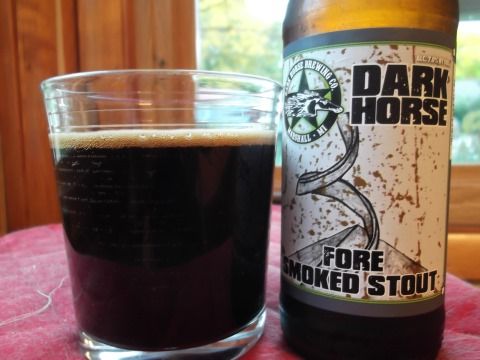
I Looked and Behold, a Dark Horse Beer: Fore Smoked Stout by Dark Horse Brewing Company


Oooh! My first rauchbier of the autumn. I believe that it is also my first Dark Horse review. I've had a collaboration brew with which they were involved and have sampled their wares at the Great Taste but I can't find any evidence that I've blessed them with a solo inspection of one of their beers.

Dark Horse hails from Marshall, Michigan – a town about the size of Portage that lies in the south central part of the lower bit of the state. I don't really know why but I always think that the brewery is in California or Colorado when I see their six packs in the cooler. And they're almost always seated next to Short's, Bell's, Founders, and whole lot of other establishments that lie east of the Mississippi so you'd think I'd get the hint. But no.

Honestly, I don't know much about Dark Horse. I presume they brew lots of IPAs because that's what breweries do to placate all those tongues wagging in Citra-fueled paroxysm. Fore Smoked Stout is the fourth entry in their Stout Series so apparently they also have a thing for stouts in addition to hoppier beers.

Fore can rightly be described as Stygian in appearance. Pouring it, the beer looked to have the color and viscosity of motor oil. Sure, it's deep brown but looking at the glass like any normal person does, it is black. It may have been clear but I couldn't say for sure. I can tell you, however, that I didn't see any flakes or chunks. As per normal, I managed only a small head here. The foam was moved beyond the realm of tan into brown, albeit one of a lighter hue. Sadly it went away rather quickly. The effervescence you ask? Stygian, I say, Stygian!

As a lover of smoke beers, I find trying a new one to be exciting because I get to find out how far a brewer is willing to go/keen on going. Are they going to throw in a just a little smoked malt simply to add to the gustatory milieu and appease a wide audience or will they use a more generous helping to emphasize the smoky taste to appeal to the hearty few?

I can usually tell by waving my beer around to look at the color and whatnot because a fairly smoky beer is discernible even when it is a foot or more away from your nose. If there's a Schlekerla even 30 cm away, you'll know it. Fore is not one of those beers. Bitter chocolate was most pronounced to my proboscis with the smoke having a definite supporting role. And no, it didn't smell like bacon. Nor of apple wood. Perhaps it was oak smoked. There was also a firm sweetness which reminded me of the Chinese haw flakes I ate as a kid.

While I am sure the history of the stout is quite lengthy and convoluted, I simply think of them as, well strong porters. Fore certainly fits that description with a lot of dark/bitter chocolate taste that was bedecked with a hint of coffee and, of course, some (non-porcine tasting) smoke. Some spicy hops added a touch of bitterness but it was really the black malts that gave that acerbic taste.

A bitter chocolate aftertaste lingered long after the last drop had descended into my gullet and was joined by the hops which became a little grassy here. This was by no means a very hoppy beer but they let your tongue know they were there. And, when the carbonation joined, it was more than a little dry. I also noticed a slight alcohol burn. Fore is only 7% but you can taste it. There wasn't much lacing here – just some small spots here and there.

Dark Horse definitely took the smoke-as-an-accent route. It doesn't jump out at you and instead has a good ol' time blending with the coffee and bitter chocolate maltiness. Fore has a definite ashen black malt taste and it is bitter. But in a good way. While I wish there was more smoke flavor – I always wish there was more smoke flavor – Fore is a really tasty combination of dark and smoked malts. It's also on the big side with a heavy-medium body and some alcohol burn. Still, I found that it went down quite smoothly.

Junk food pairing: Pair Fore Smoked Stout with some Smoked Gouda Triscuits smothered in American Flavor Easy Cheese.

13 October, 2016

The Trouble With the Maples: Maple Dunkel by Leinenkugel Brewing Company


I am taking a break from the Oktoberfest madness before I polish off the remaining ones in my cellar. It's like a 7th inning stretch. Besides, there is a cornucopia of non-Märzen beers out there to enjoy.

One that tried recently was Leinenkukgel's Maple Dunkel. The bier is available only as part of their Autumn Explorer Pack. Well, unless the liquor store you frequent busts the packs open to sell as singles. I was ambivalent about it going in. On the one hand, another of their newish seasonals, Snowdrift Vanilla Porter was simply disgusting to my palate and exemplifies how flavorings bring out the worst in the brewery. On the other, this year's Spring Explorer Pack brought Heart of Oak, an oak aged Vienna lager which was excellent.

But I like dunkels, I like maple syrup. Either this bier would be a cloying train wreck or another justification for my sentimental love of the brewery despite it being a subsidiary of the Omni Corp of brewing.

Having lived up by Eau Claire for a stretch, Leine's has a special place in my heart. It was something of a hometown brewery during the interregnum between the closing of Hibernia and the opening of the Northwoods Brewpub, circa 1997, which was the next brewery to set up shop in Eau Claire, during which many old duffs bemoaned the loss of Walters at taverns across the area. During my college days when money was tight, Leinekugel's (Original) was a welcome respite from countless half-barrels of Old Milwaukee. After college, when money was tight, I couldn't afford to drink Sprecher all day at Summerfest and so I quaffed many a Leine's Honey Weiss.

And so despite having sold out to Miller in 1988 and having run the shandy into the ground, I still indulge in a Leine's every once in a while. Besides, they have a nice tour.

Maple Dunkel pours a lovely deep copper color and is quite clear. I think I need to start pouring every beer like you're supposed to pour bottled nitro brews – turn the bottle upside down into the glass and shake like a maraca. For whatever reason, I was only able to produce a small head. The light tan foam didn't stick around very long. There were some bubbles inside. Aside from my poor pouring, it was a very beautiful bier.

As I was inspecting the appearance, I could smell maple. It was somewhere between maple syrup and maple-flavored syrup although it leaned towards the latter. The aroma was sweet and overpowered the basic bier with just a tiny hit of dark malt roast coming though. At this point I was basically resigned to my fate which was going to be drinking a flavored mess. Another Snowdrift – cloying and awful.

It was no surprise to taste maple. Lots and lots of maple – flavoring. It was cloyingly sweet with an overabundance of vanilla-caramel taste but lacking the woody-earthy flavors and the slight tartness that real maple syrup has. A rather muted dose of roasted grain could not penetrate the treacle while some spicy hops struggled to be tasted.

That maple flavoring lingered a bit at the end until spicy/grassy hops come and add some welcome bitterness and dryness. There was no Schaumhaftvermoegen in sight.

Maple Dunkel is a dreadful bier to my taste. I've had beers brewed with maple syrup and maple sap and some were good and some weren't. I can imagine a tasty dunkel that has been laced with maple flavoring – if the flavoring has been used judiciously. That's not the case here because there's no dunkel here. It's just maple flavoring. Although I will say that I liked the hops quite a bit as they were the only thing that I could taste besides maple.

Junk food pairing: I kept my snacking simple with Maple Dunkel and indulged in plain old Cheez Its.

11 October, 2016

Brewing and Nothingness: Festbier by Victory Brewing Company


I am taking a break from native Oktoberfests because it was getting to be dolorous and drinking beer shouldn't be that way. Quaffing a Märzen should be a mirthful experience, one that highlights the brief periods of joy that punctuate our time on this earth before we return to the soil. And so I look to suburban Philadelphia wherein lies Victory Brewing to address my existential ennui.

My previous encounters with Victory beers were all positive and mostly very fine indeed. But I've been afflicted with a case of microbrew angst this past month or so as various other breweries with good reputations offered Oktoberfests of a less than tasteful nature. Perhaps now that our state Department of Natural Resources is run like a business, there truly is something in the air or in the water which afflicts our brewmasters, rendering them maladroit and consigning them to produce Oktoberfests which would have made Gabriel Sedlmayr cry.

It is my hope that by looking to the east, to the city where John Wagner brewed the first lager on these shores (well, a suburb of that city) that I may find some hope that all is not lost.

Victory Festbier pours a lovely amber and was suitably clear. While I only managed to produce only a meager head of light tan foam which went away quite quickly, the bier was rather effervescent with a fair number of bubbles inside.

The aroma smelled strongly of bread, which as a good sign. But there was also a little caramel and some roasted malt scent too. It was surprised at how restrained the sweetness was here considering the bier's color. So far, so good.

Things got even better upon tasting the brew. A shiver went down my spine as luscious Maillard reacted malt taste swirled and eddied on my tongue. It was a wonderful toasty flavor that had a deep vein of nuttiness as well. The malt also tasted of fresh bread along with just a hint of toffee sweetness. Peppery hops hovered in the background and paired with a healthy dose of carbonation to add crispness.

For the final act, the malt faded allowing the hops to step into the limelight. They became spicier – almost minty – and gave a nice cleansing bitterness. Dry but not overly so. Schaumhaftvermoegen was limited to a few shorts streaks and the odd speck of foam.

Eureka! Victory proved, well, victorious. While it may not provide a definitive answer, Festbier certainly comes down on the affirmative side when it comes to decoction mashing. Those toasty Maillard flavors run deep and full here and I just love the nutty taste to it. They are given pride of place but complemented by other malty flavors while some really tasty hops offer contrast and balance. The malt is rich instead of being watery. Sweetness bows before savory. Everything in its place. There is yet hope for Oktoberfests.

Junk food pairing: Pair your Victory Festbier with some Mature Cheddar and Chive crisps, er, potato chips. They have a rich heartiness that other cheddar chips don't and thusly go very well with savory malt taste of the bier.

10 October, 2016

I Saw the Best Märzens of My Generation Destroyed by Maltiness

I am getting to the point where I cannot drink anymore Oktoberfests. It has nothing to do with them being seasonal biers because they are tasty in a variety of situations throughout the year. They're not particularly big biers nor are they optimized for warmer weather with light bodies. Nor are they brewed with nutmeg, allspice, clove, and cinnamon and thusly given a narrow window of quaffing potential. The style is not tied to a harvest or a holiday and there's nothing really seasonal about them any longer since virtually no one brews them in March and pulls them from the lagering caves in September.

No, I have made the mistake of investing in the Oktoberfests of my fair state and being disappointed most of the time. I have no explanation and the reason why they've been so untasty is probably reasons – they are plural. Poor shipping and storage practices may certainly be an issue. I won't deny that but nor can I prove it. But my cynic soon return and feels that most Wisconsin breweries have abandoned the state's German brewing heritage to varying degrees and so the Oktoberfest is simply a perfunctory exercise in obeisance. When you brew IPAs, sours, and potent barrel-aged potables all year, you're not getting practice at brewing lagers.

Contrariwise, some Wisconsin breweries with a fine lagery track record have produced some most unremarkable, if not awful, Oktoberfest biers this year. So there goes my lagerphobic hypothesis.

Whatever the case may be, I still have lots of Oktoberfest reviews piling up which calls for another omnibus.


From the wilds of La Crosse comes Pearl Street's Lederhosen Lager. Pearl Street brews various and sundry German styles and has an annual pils. This is definitely not a lagerphobic brewery that genuflects to tradition once a year.

So why is Lederhosen Lager so thoroughly mediocre? It was just a little over-carbonated – not a hanging offense - and under malted – a cardinal sin. It leaned to the caramel side but wasn't cloyingly sweet and let some more bready flavors come through. But all the malt tastes were subdued. I liked the spicy hops, though, and it left some of the best Schaumhaftvermoegen of the season.


Lakefront knows lagers. Hell, even their pumpkin beer is a lager and it is actually brewed with pumpkins. They have a great brewery tour to boot.

Sadly their Oktoberfest is par for the course as far as Wisconsin iterations go. Caramel sweetness was the dominant flavor – which I can handle - with very little bready taste – which doesn't cut the senf. I somehow managed to catch a dash of root beer in there too. And it was overly carbonated. I did like the herbal hops, though.

If I may quote T.S. Eliot's typist, well now that's done and I'm glad it's over.


Capital and I go way back. Their maibock was not only my first taste of a helles bock but I also lost my seasonal beer virginity with it. It was the spring of 1991 and I was blissfully unaware that beers were seasonal like Shamrock Shakes and McRibs. Later that year their Oktoberfest became the first Märzen to cross my lips. Capital is also likely responsible for introducing me to the concept of drinking local and was a cornerstone of my microbrew education.

Having said all of this, I was not impressed by their Oktoberfest this year. It has always been a caramel-forward bier and that hasn't changed this year. But, like most of the Wisconsin Oktos I've had this year, this one lacks a bready base upon which to build a house of sweetness. It wasn't over-carbonated and I really liked the hops which were grassy and herbal but those biscuit and bread tastes were just too faint, lost like distant stars in the city streetlights.


I will close with the completion of the trifecta of Oktoberfests from Green Bay featuring Stillmank. Neither Titletown nor Hinterland was able to pull through this year.

Stillmank, however, did.

And I believe it was the first time I'd had one of their beers so I was quite impressed. While there was some malty sweetness to be had, it was kept in check by a nice bready flavor. Stillmank got the proportion of malt tastes just right to my taste with bread/biscuit at the fore with sweeter malt given a supporting role. A good Oktoberfest is about getting the various malt flavors in the right spots for a grainy gestalt. Now I grant you that Stillmank didn't endow their Oktoberfest with much of that toasty/Maillard reacted goodness that I crave, but it was still a fine maltiness. And the hops. They were simply wonderful with a sprightly, fresh grassy flavor that is hard to beat.

Going into this little venture last month I wouldn't have dreamt that Stillmank would not only make a great Oktoberfest but that it would probably be the best domestic (i.e. - from Wisconsin) one of the season. Truth be told, I have a couple more from Wisconsin in my cellar and I'll likely have others on tap so the title is provisional, but this will certainly go down near, if not at, the top.

06 October, 2016

What Have the Germans Ever Done For Us?: Oktoberfest by Potosi Brewery


Good ol' Potosi. Whenever I hear the name, I think of how a friend of mine still holds it against me that I unwittingly drank his last Potosi Czech Style Pilsner one day in the dim and distant past. He still speaks of the incident in tones of thinly veiled anger. He's like liberals who still piss and moan about Ralph Nader forgetting all the while that it was the Supreme Court who crowned Dubya president. In addition to a very tasty Czech pils – there was a reason I chose it amongst the others on offer - they have a fine brewery and museum out there on the Mighty Mississip.

With the vast majority of Wisconsin Oktoberfests that I've had this season ranging from almost medicore to awful, I had a goodly amount of confidence that Potosi could be different. Their Oktoberfest could be like the Battle of Guadalcanal or the Battle of Stalingrad. Just as those campaigns proved to be turning points in World War II, so too could Potosi's bier be the critical juncture in the search for a good Oktoberfest brewed in the Land of Cheese.

I mean today's Wisconsin microbrewers are ostensibly the successors to generations of German immigrants who settled in our fair state - and their descendants too. The earliest waves of Forty-Eighters brought socialist ideas which most famously shaped Milwaukee along with other things like kindergarten. And immigrants regardless of political orientation gave us their love of sausages, strudel, and of course bier. Germans had a very large impact not only on culture here in Wisconsin but also the United States at large.

Ergo it's been frustrating as a Wisconsonian of some German extraction to witness breweries of my state flounder attempting to brew on Oktoberfest that tastes as good as one that has made the trip all the way from Munich. Hell, we've even let California eat our lunch.

Potosi's Oktoberfest poured a gorgeous clear copper hue. My initial pour managed only a small head that was off-white and left me wishing is Auf wiedersehen all too soon. This was my inability to pour correctly, however, as my second and more vigorous pour gave a much larger and much prettier crown of foam. There wasn't much effervescence on display.

Moderately sweet caramel was first to hit my nose followed by a smidgen of roasted grain while some faint grassy hops lingered in the background. I wasn't surprised by the bouquet since the bier's color lacked the pale complexion of Oktoberfests: The Next Generation.

Considering the lack of bubbles, Oktoberfest was well-carbonated by which I mean it had just the right amount of carbonation. Not particularly acidic, but just enough push back against the malt. And that malt was mostly caramel tasting with attendant sweetness. Not cloying though. It was joined by a little roasted grain and some hops which had taken on a spicy tint. Overall it had a nice medium body and a clean lager taste that was fairly crisp.

The malt faded on the finish allowing the spicy hop taste to really come through. While rather bitter and a fair bit dryer than I'm used to for the style, it was still rather pleasant. My first pour of the small head produced no Schaumhaftvermoegen but my second let loose some really nice, thick streaks of foam.

This was not a bad Oktoberfest but nor was it great. I liked the level of caramel sweetness here but felt it needed more roasted grain flavor to bolster the larger malt taste. This has been a common refrain here this Oktoberfest season. Most of the one's that I've had have had a very one dimensional malt taste – caramel and little else. Potosi, to its credit, adds more non-caramel malt flavor than your average bear but this bier just didn't find that Golden Malty Mean.

Junk food pairing: I paired my Potosi Oktoberfest with Snyder's Zesty Ranch Pretzel Pieces to good effect.